你的公司没有自己的模型:从 Slack、演示文稿和会议中引导构建世界模型
Your Company Has No Model of Itself: Bootstrapping a World Model from Slack, Decks and Meetings
原文由官网提供,中文由 GPT-6 Luna 翻译。相邻片段合并排版,正文与时间点保持对应。
已插入 39 张经核对的幻灯片或演示截图;点击图片可放大。图注链接为当前视频时间,左侧正文时间保留原转录版本,二者可能不同。
共 44 个阅读段落
好。很高兴来到这里。再为 AI Engineering 的所有工作人员鼓掌。到目前为止,这场大会确实非常非常精彩。谢谢。好。我想先请大家想想公司里那个似乎什么都知道的人。他们经历过 17 次重组,了解所有八卦和办公室政治,而且不知为何,他们总能预测这些重大策略举措会带来什么结果。这个人基本上就是公司的世界模型。问题是,这样的人无法规模化,也没人会把他们说的话真正记录下来。我是 Citadel Securities 的 João Wenzel,今天我会谈谈我们如何尝试用智能体系统来近似实现这一点。
Okay. Pleasure to be here. Another round of applause for everyone at AI Engineering. This has been a really, really exceptional conference so far. Thank you. All right. So I want to begin by asking you to think about that person in your company who just seems to know everything. They've been through 17 reorgs. They know all the gossip, all the politics. and somehow they always seem to predict what's going to come out of these big strategic moves. That person is a company's world model, essentially. And the problem is that they don't scale and nobody really writes down what they say. I'm João Wenzel with Citadel Securities and I'm going to talk a little bit about how we try to approximate that with an agentic system.
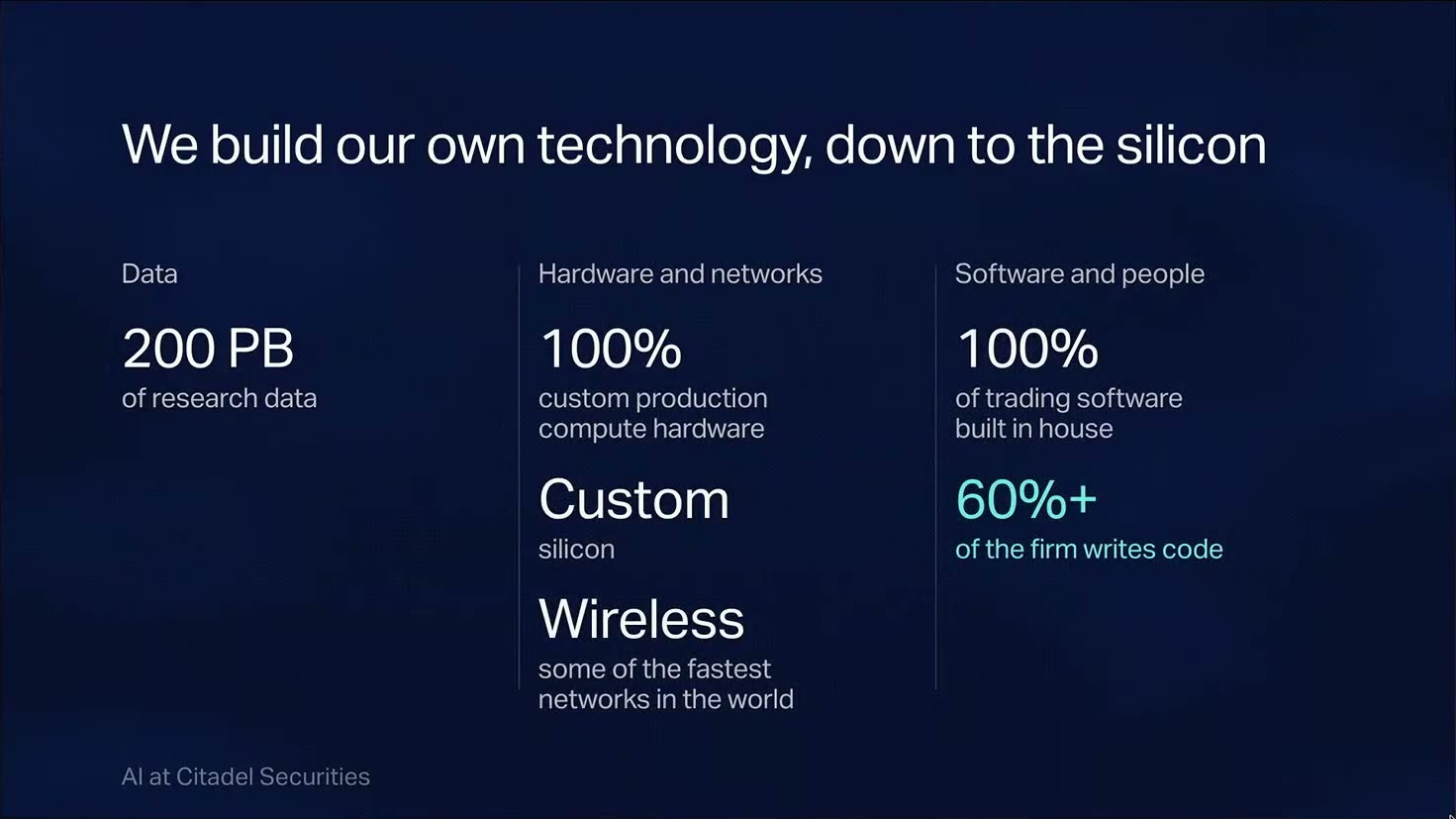
先简单介绍 Citadel Securities。我们自己构建技术,一直做到硅片层面。目前,我们超过三分之二的员工会编写代码。所以很自然地,我们对 AI 极其投入,智能体也已经在组织里帮我们做很多事情。
So a little bit about Citadel Securities. we build our own technology down to the silicon. At this point, over two-thirds of our employees write code. So naturally, we are completely AI-pilled, and agents already help us with a lot of things at the organization.
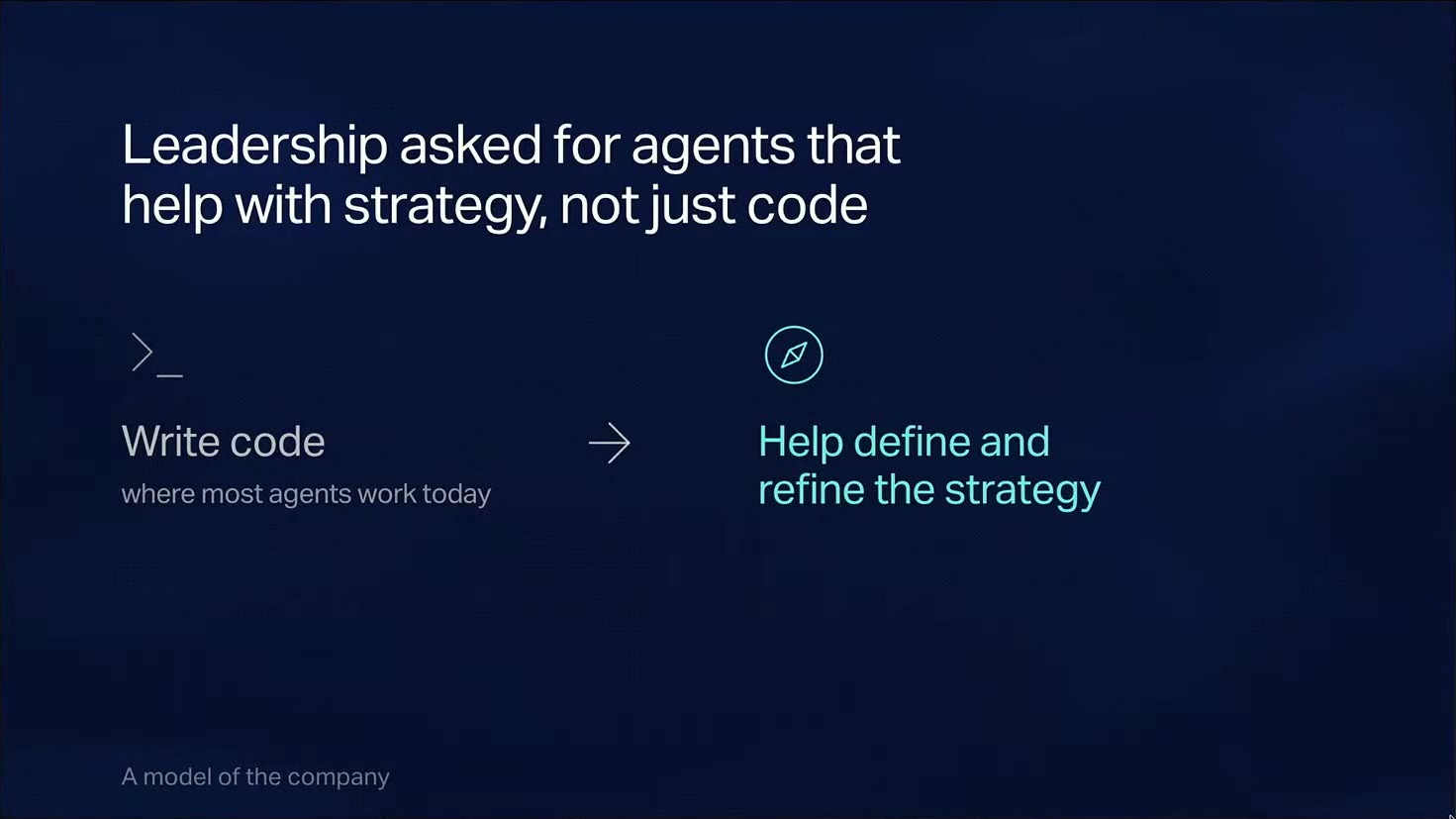
所以领导层自然开始询问战略方面的问题。这些智能体运行框架很擅长生成高质量代码,但它们真的能帮我们制定和完善公司的战略吗?
So naturally, leadership started asking questions about strategy. These harnesses are really good at producing high-quality code, but can they actually help define and refine the strategy of our company?
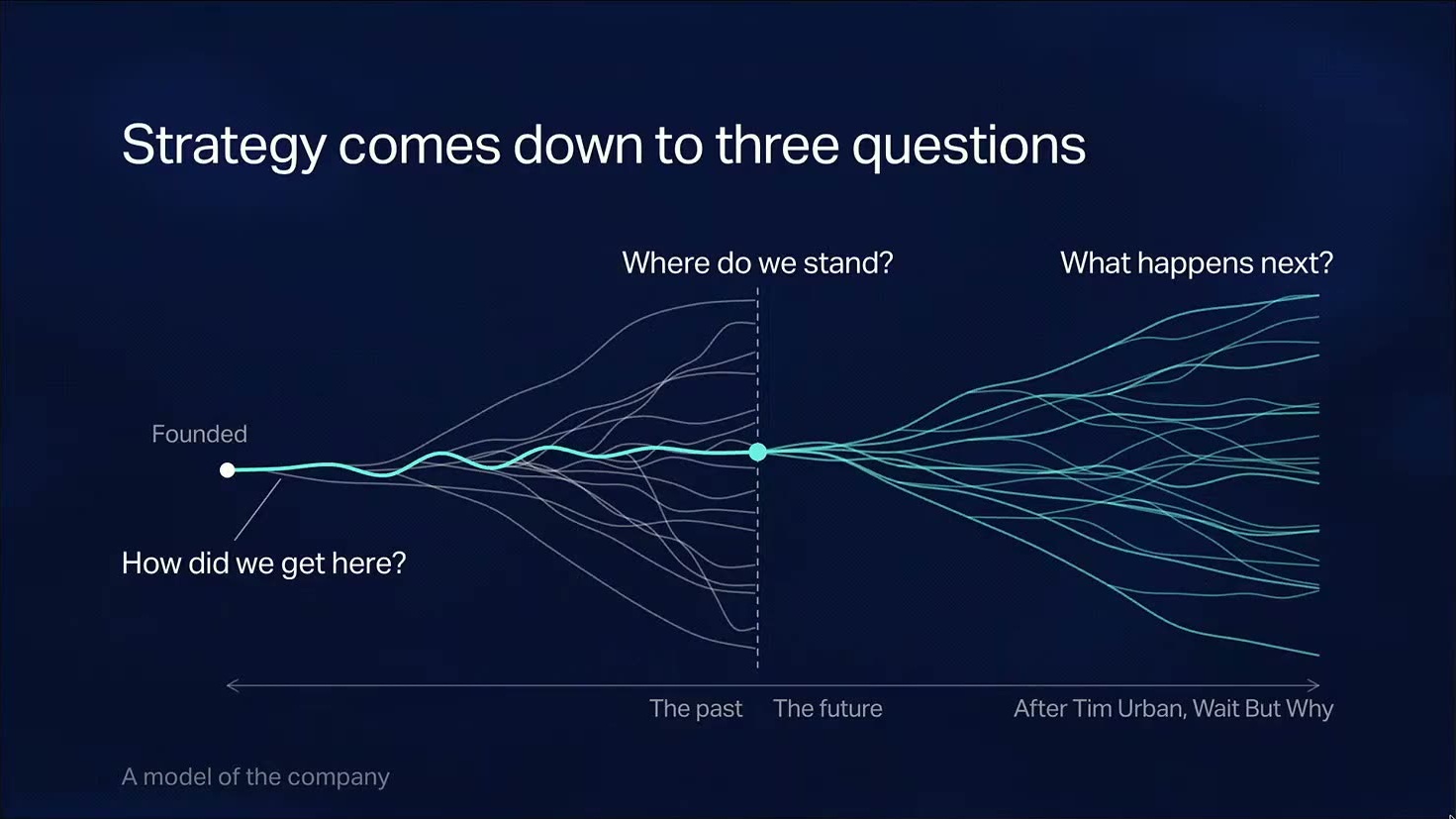
这是我最喜欢的图示之一,借自 Tim Urban。战略归根结底涉及 3 个问题,对吧?我们现在处于什么位置,接下来会发生什么?我们是如何走到这一步的?要回答任何一个问题,智能体都必须深入了解自己所在的公司。所以这场演讲大致是在讲如何构建一个机构记忆层。我们就这么称呼它吧。
So this is one of my favorite visuals I've borrowed from Tim Urban. Strategy really comes down to three questions, right? Where do we stand right now? What's going to happen next? And how did we get here? And to answer any of those questions, an agent has to have a really rich profile of the company that it's operating in. So this is broadly a talk about engineering an institutional memory layer. Let's call it that.
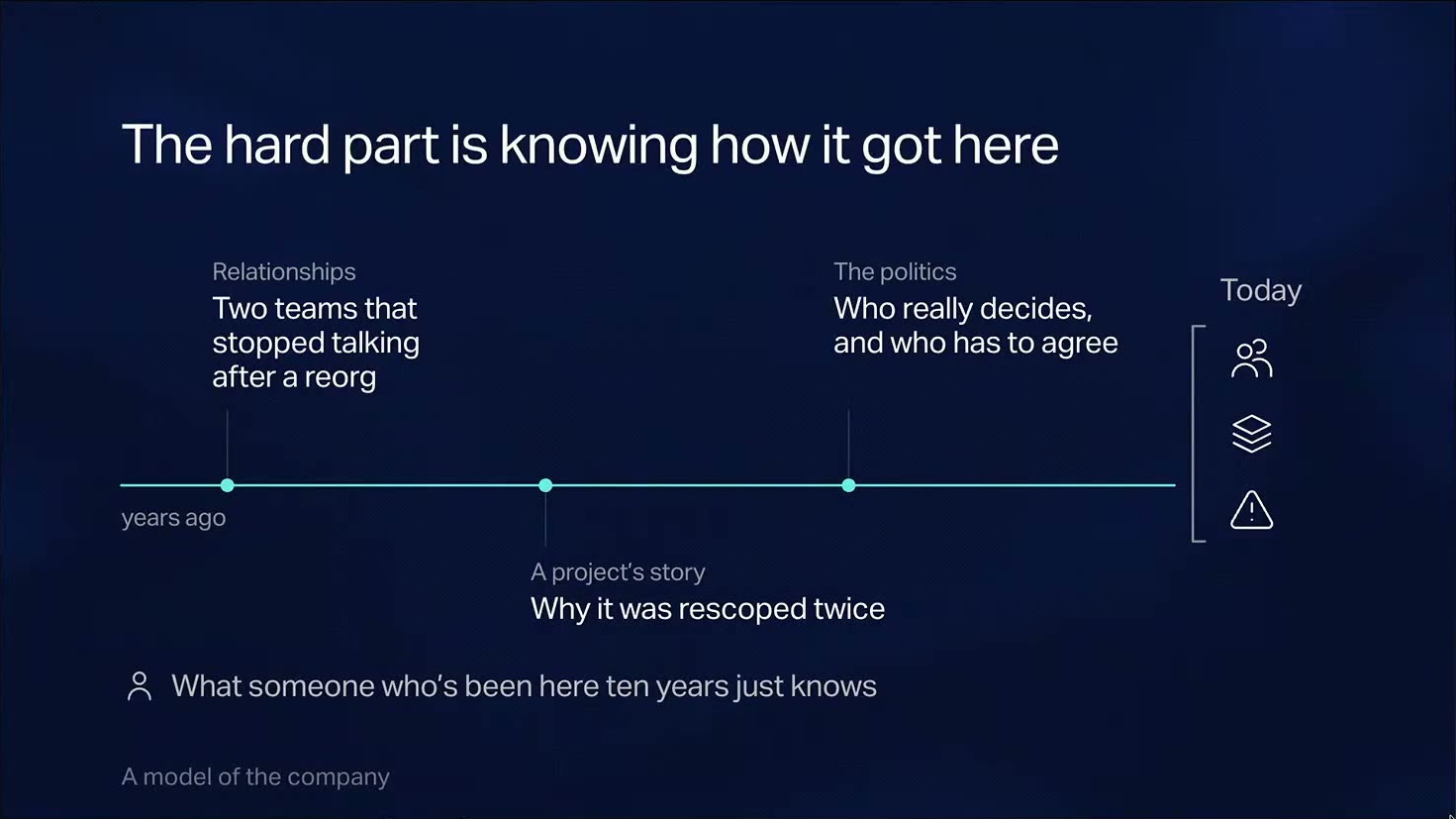
智能体需要了解各种关系,对吧?两个团队曾经一起工作,但重组后就不再交流了。或者一个项目的来龙去脉,以及它为什么多次重新界定范围。还有办公室政治,对吧?比如,谁在会议室里?他们在说什么?又有哪些话没说出口?
The agents need to have information about relationships, right? Two teams that used to work together but no longer talk because there was a reorg. Or a project story and why it was re-scoped several times. Or the politics, right? Like, who's in the room? What are they saying? And what are they not saying?
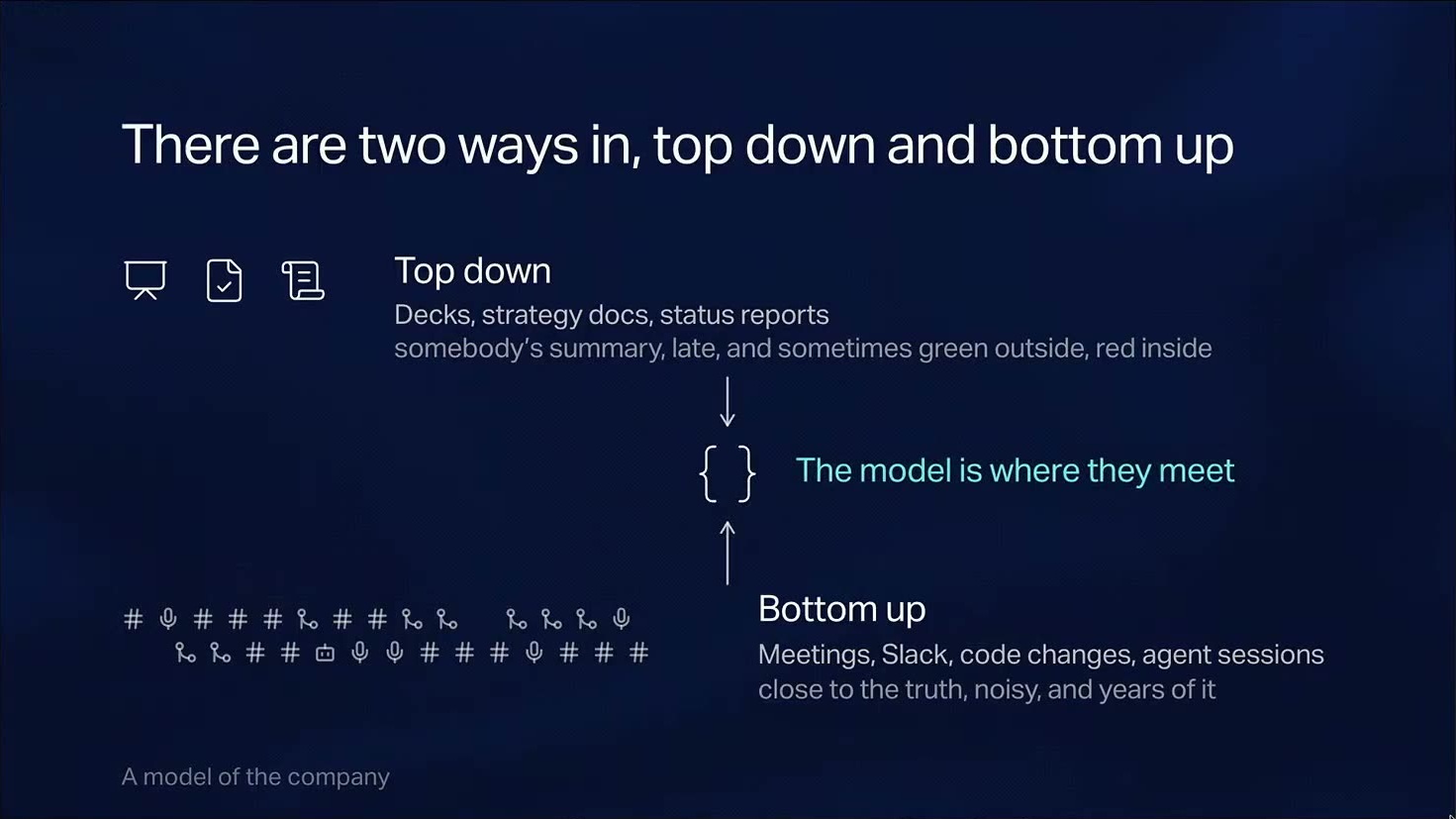
大致有两种切入方式,对吧?一种自上而下,一种自下而上。自上而下,你有演示文稿、战略文件,会议记录和状态报告,它们整洁、清楚,但也带有独特的人为因素。人们通常喜欢把自己的想法和意见注入这些材料,有时还是故意的,结果就会出现我称作“西瓜项目”的东西。外表是绿色,内部却是红色。自下而上则是那些非常嘈杂的内容,里面包含的有效信号超乎意料,但很难发现。比如会议记录、Slack、代码变更,甚至你和常用智能体运行框架互动留下的会话轨迹。
There's two ways in, right? There's top-down and there's bottom-up. Top down, you have the decks, you have your strategy docs, your meeting and status reports, and they're tidy and they're pretty clean, but there's a unique human twist. People generally like to infuse their thoughts and opinions into these things, sometimes by design, so you end up with things I call watermelon projects. They're green on the outside and red on the inside. Then you have, on the bottom, you have the really noisy stuff, which has a surprising amount of signal, but it's hard to uncover. You have meeting notes, and you have slack and coat changes, and even your session traces with your favorite harness.
模型把这些信息汇集到一起。证据在这一层被综合。
And the model is where they meet. The evidence is synthesized at that level.
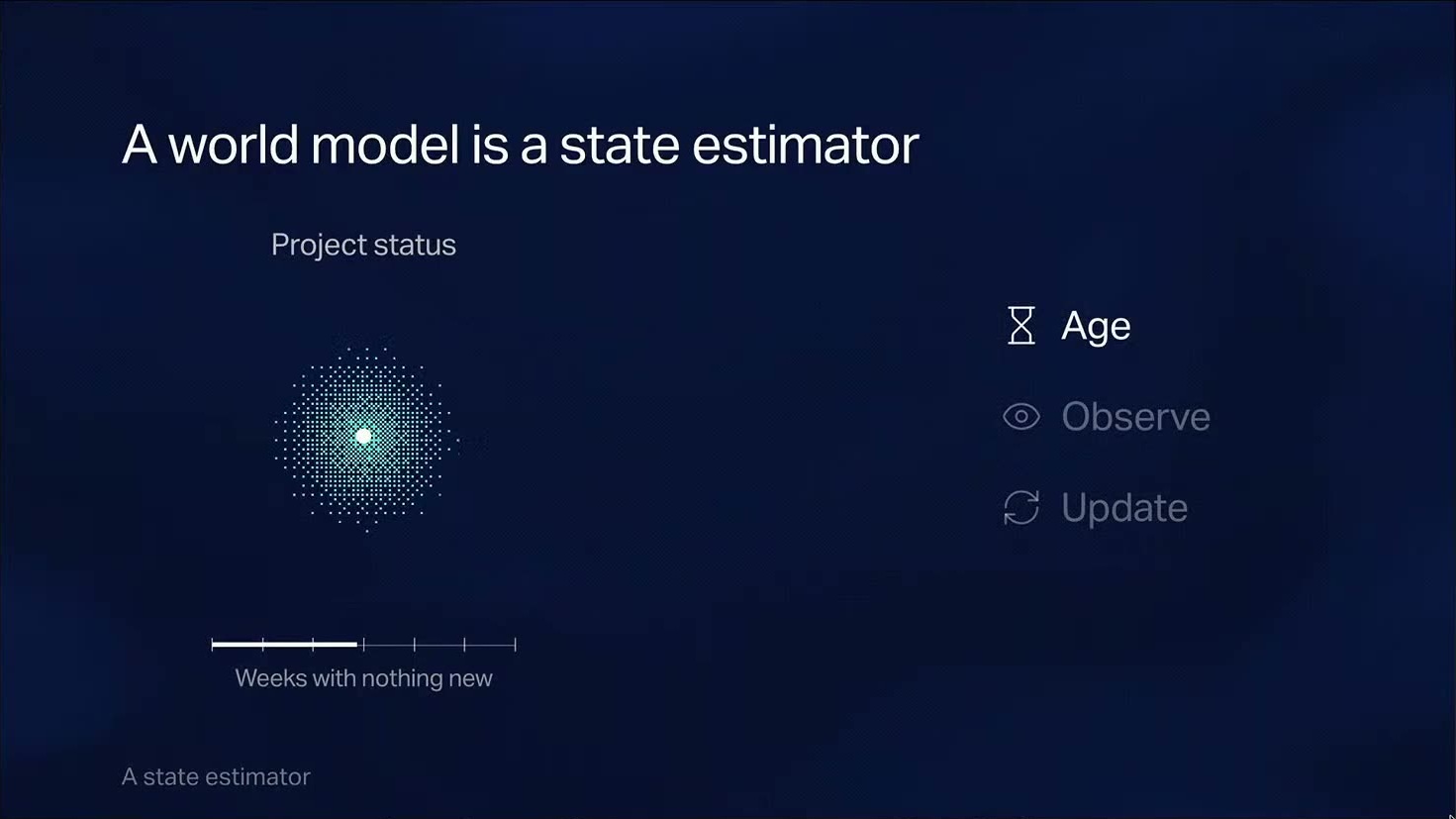
证据有时会带来问题,因为信息可能不完整,也可能错误;不过事实证明,在机器人领域,其实已经有解决办法,叫作状态估计器。做法是先对某个你关心的事情形成一定的信念,自从你上次看到或观察到支持它的证据后,时间越久,你就越不信任它,对吧?它会变得越发模糊。
Now, the evidence piece sometimes is problematic because it's either partial or wrong, but it turns out that in robotics, you actually have the solution for this, and it's called a state estimator. What you do is you have some sort of belief about something you care about, and the longer it's been since you've seen or observed evidence that supports it, the less you trust it, right? The fuzzier it gets.
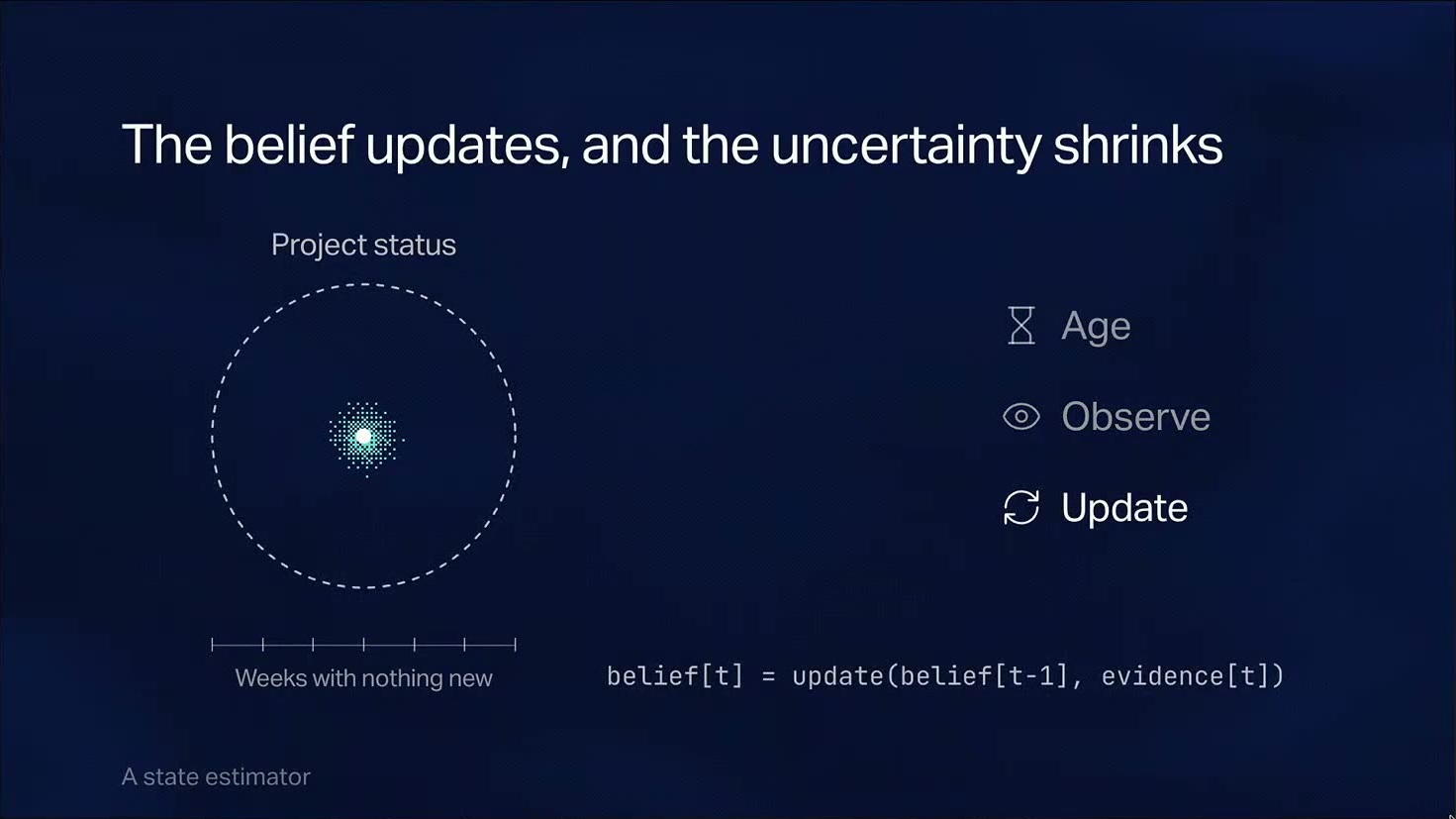
直到你看到一份演示文稿、一段对话线程或一份会议记录,这些内容让原来的不确定性收敛,你现在有了新证据,对吧?于是你对它更有把握了。然后你就会更新判断。更新判断时我关心的事情,或者智能体应该关心的事情,有 3 个。首先,多久之前收到过某个信号?其次,信号来自哪里,它现在还可信吗?最后,它和其他传感器的信号大体一致吗?这和自动驾驶有很多相似之处,我稍后会再谈到。我们先从自上而下开始。
Until you have a deck or some thread or some meeting note, that sort of collapses that and you now have new evidence, right? And now you're more certain of it. And therefore you produce the update. And the things that I care about when producing an update or that the agent should care about, there's three things. There's how long has it been since some signal has been received. There's where did that signal come from, and is it still trustworthy? And then does it broadly agree with other sensors? There's a lot of parallels here with self-driving, for example, that I'll come back to. So let's start at the top.
一个很简单的例子是 BizOps 的某个人已经制作好的幻灯片,
A very simple example is something like a slide that is produced already by someone in BizOps,
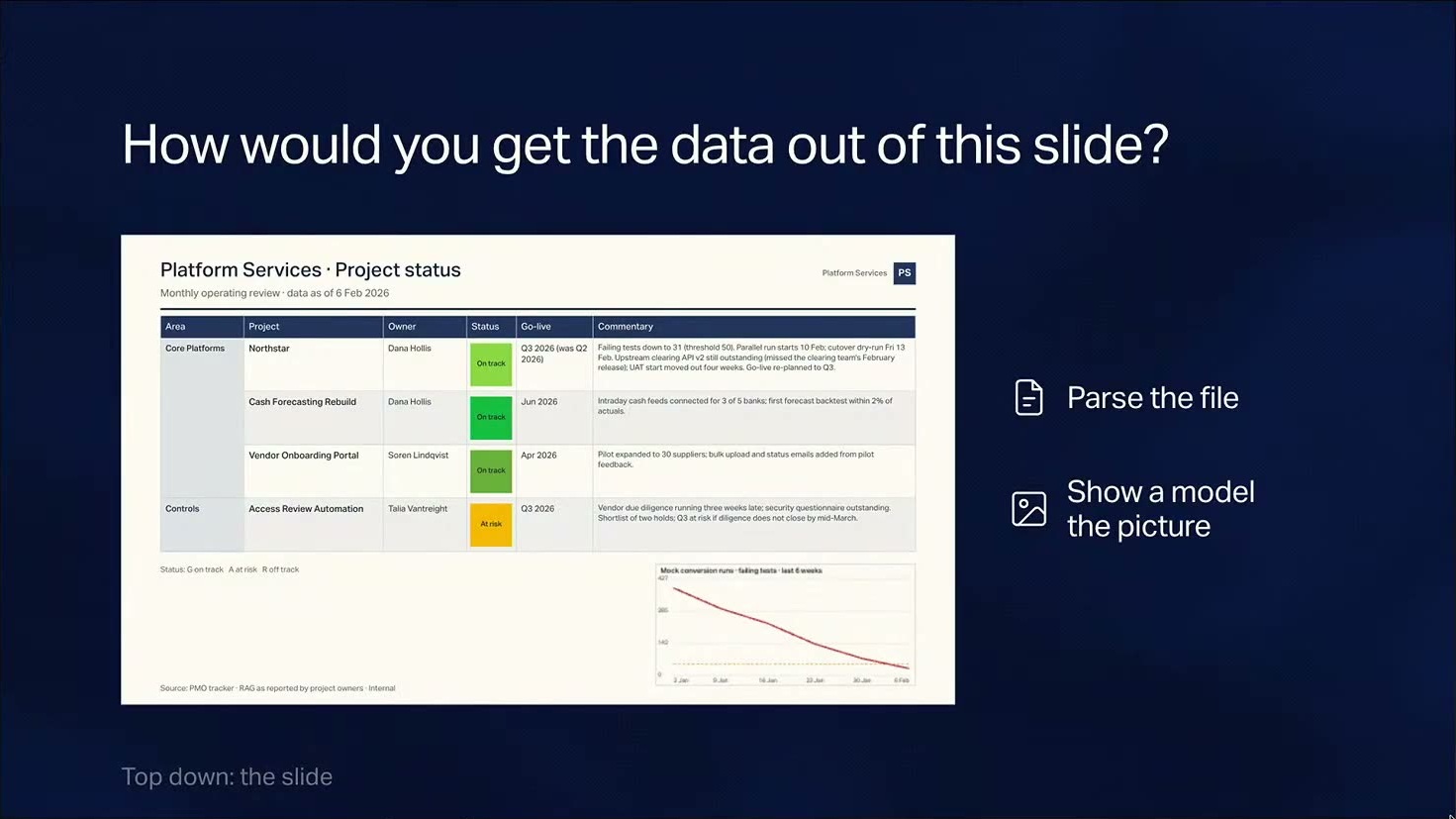
他们每月都会制作一份状态汇报。问题是,怎样从这页幻灯片中提取数据?我相信大家中有很多人都试过。
and they produce a monthly status deck. and the question is, how do you get data out of this slide? Many of you, I'm sure, have tried that.
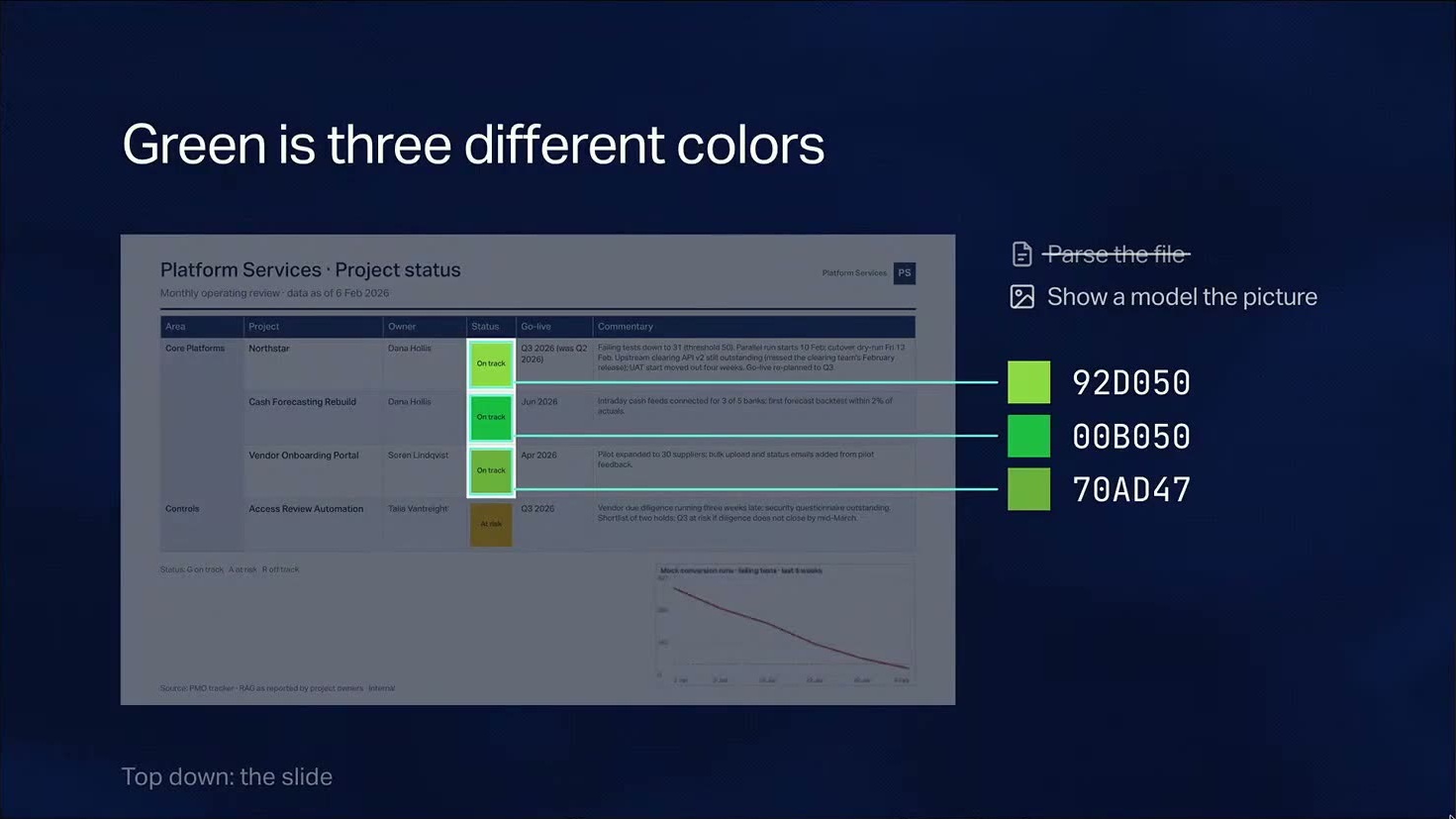
这其实很容易让人误判。假设你尝试解析文件,你解压 PowerPoint 文件,得到一份 XML,然后突然会碰到一个很有意思的概念问题:什么叫绿色?绿色对应的十六进制代码是什么?处理这类脚本时就会出问题。接着你会想,解决办法是截一张图,然后把图片交给视觉模型。但即使分辨率很高,你处理的也可能是有人把截图复制粘贴回演示文稿里,然后让 Claude 眯着眼睛判断数字到底是 31 还是 81。
It's deceptive, actually, because let's say you try to parse the file. You unpack the PowerPoint file and you get an XML and all of a sudden you get into this really interesting conceptual question. What is green? What is the hex code for green? And things break down when it comes to this type of script. Then the solution is to say, well, I'm just going to take a screenshot of it and throw it at a vision model. But at that point, even if it's pretty high res, you're dealing with someone who copy-pasted a screenshot back into a presentation, and essentially you have Claude trying to squint and trying to figure out if it's a 31 or an 81.
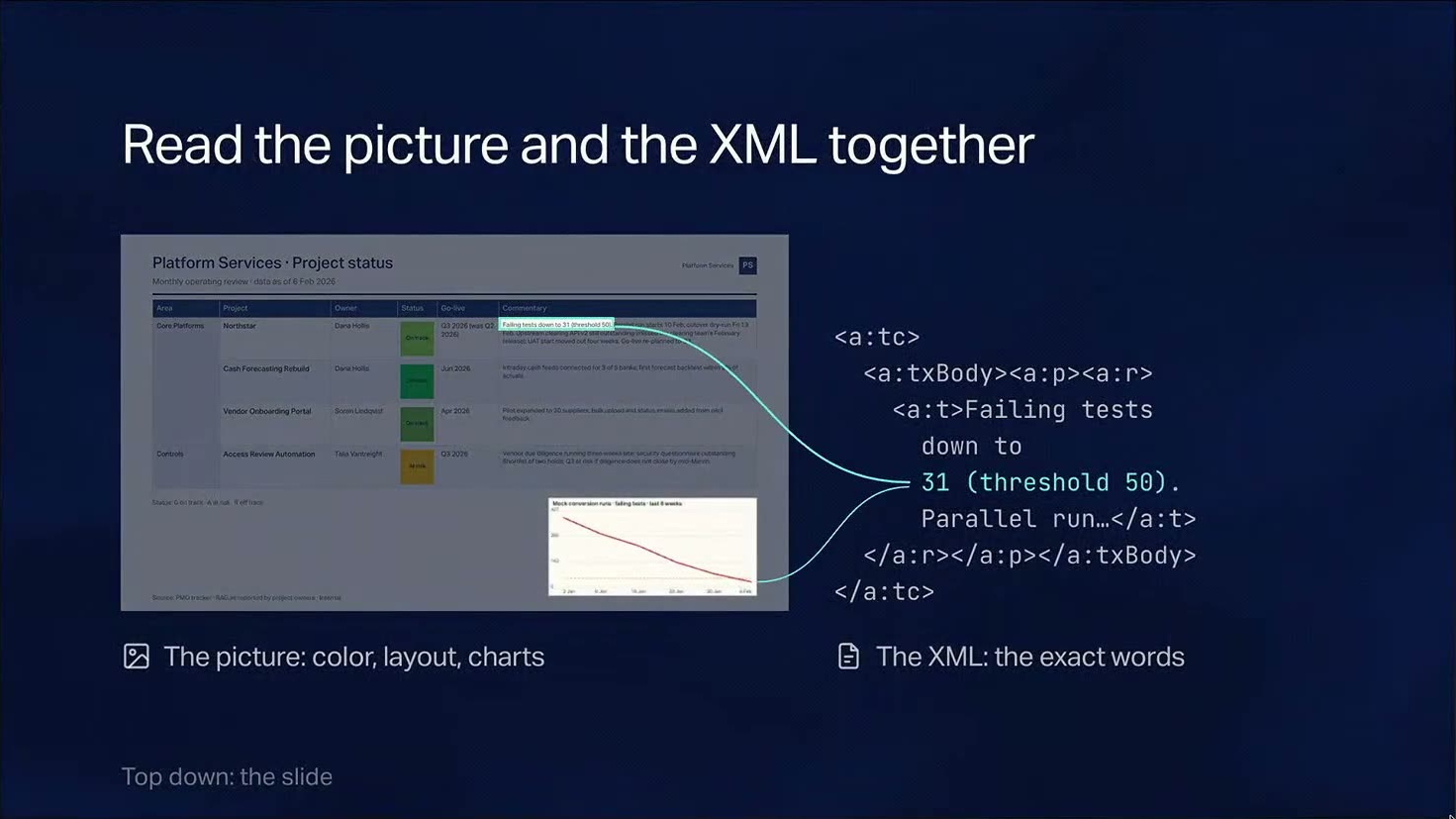
所以这场演讲的主题其实是:优雅来自综合各种信息,并加入更多信息。这个例子很基础,但如果同时使用XML 和视觉模型的输出。这还挺基础的,对吧?
And so the theme of the talk really is about elegance comes from just synthesizing things and adding more information. And in this example, it's very basic, but you get the true picture by taking both the XML and the output of a vision model. Now, that's pretty basic, right?
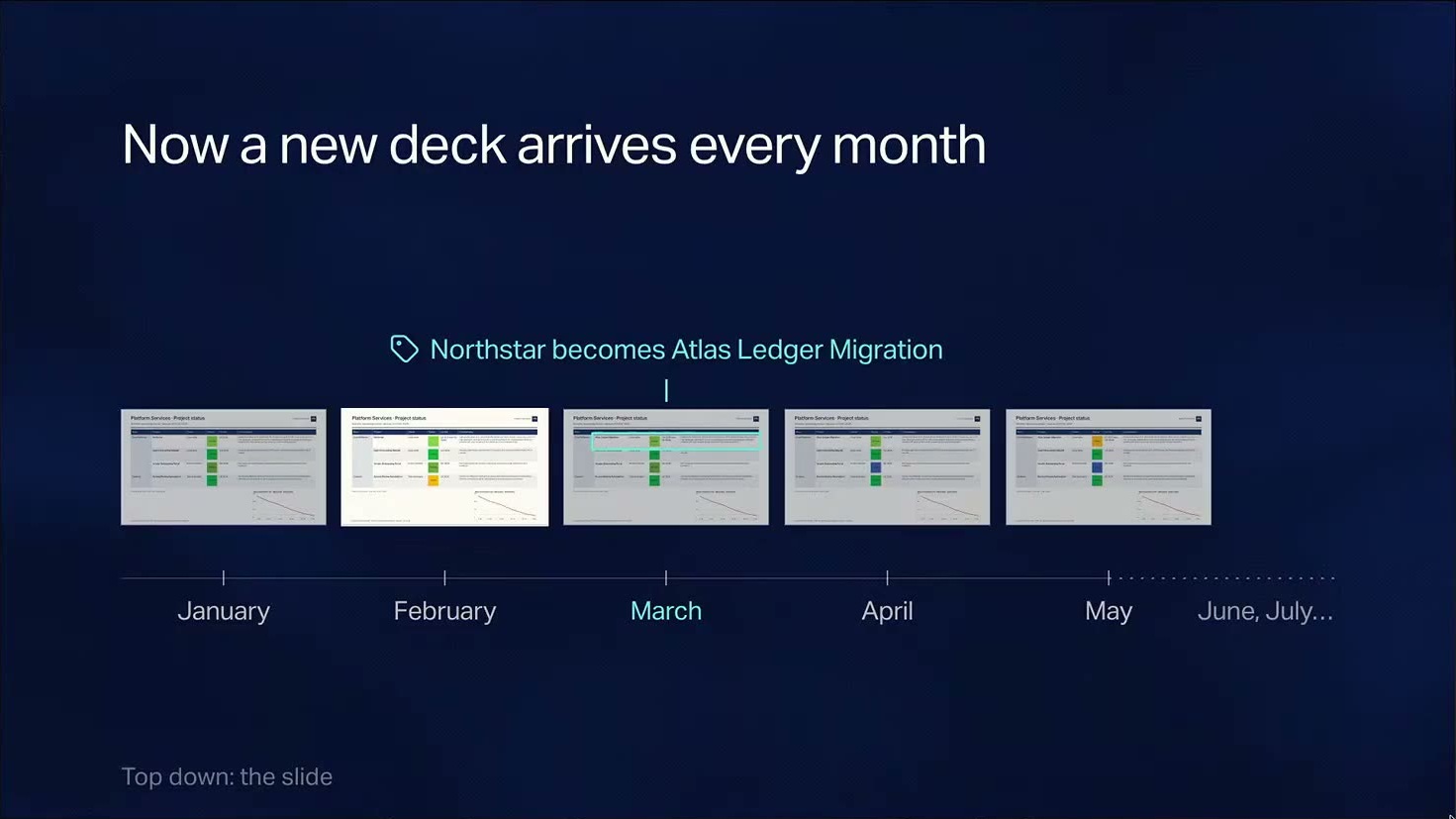
但问题是,你希望随着时间推移建立连续性,对吧?比如公司积累的这些材料其实一直在不断增加。在这个例子里,有个项目在 3 月突然改了名字。所以,你需要建立一个纵向、可追踪的审计层,作为公司机构记忆共享上下文层的一部分。这里有两个矛盾之处。矛盾之一是,即使你把这件事做得非常好,
But the issue is that you want to establish some continuity over time, right? Like this collateral that your company accrues is very much sort of always building up. And so in this particular example, you have a project that just spontaneously changed names back in March. And so, you know, you have to establish that sort of longitudinal traceable audit layer as you create this shared context layer about the sort of institutional memory of your company. And the irony, there's two things. The irony here is that even if you do this really well,
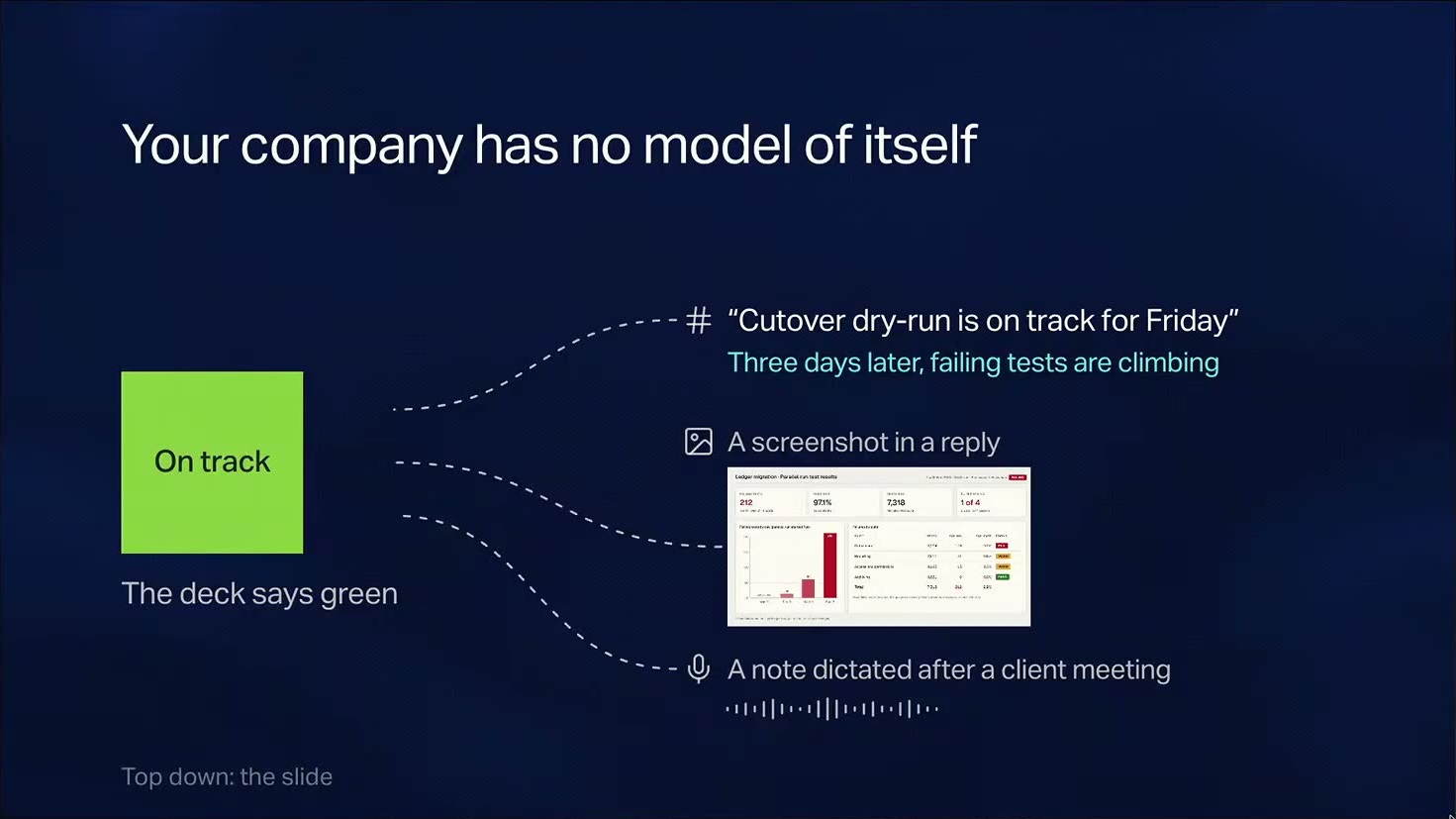
仍然会缺少一半信息,对吧?你看着一份演示文稿,但 Slack 上的说法却不一样,因为那份文稿是 5 天前的。而现在 Slack 上有人说:“顺便说一句,我觉得我们按计划进行。”然后另一个人回复了一张仪表板截图,事实却已经不是这样了。于是事情就开始变得一团糟。因此我们需要做得更好,把所有这些信息整合起来,对吧?你的公司没有自己的模型。
you're still missing half the picture, right? You're looking at a deck and your Slack says otherwise because that was five days ago. And now you have someone on Slack saying, hey, by the way, I think we're on track for this. But then someone replies with a picture of a dashboard and it's no longer the case. So things just start breaking down. And so we need to do a better job of integrating all these things, right? Your company has no model of itself.
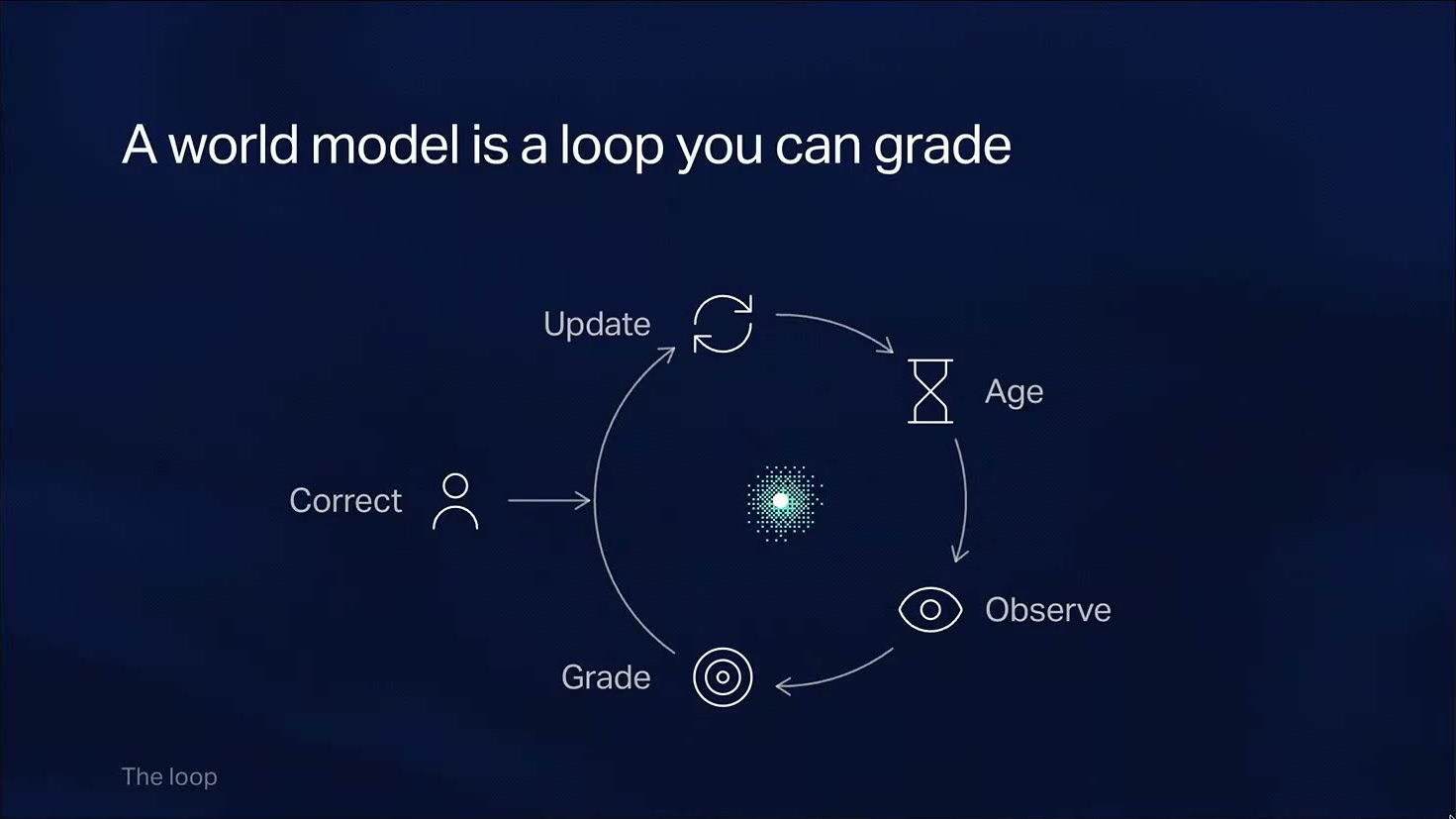
所以我在这里简单提出一个方案。想法是利用我之前描述的关于状态估计器的 3 个要素。有更新、时效和观测阶段,还有评分阶段。评分阶段基本上是比较你观测到的内容和原先预期的内容。然后是纠正阶段,人们可以通过它向系统提供新的反馈,并引导系统的行为。在 Citadel Securities,我们构建的系统在这个循环的每个环节都有智能体。但关键在于模型只会提出这些更改,接下来由代码和人员决定如何更新记录。
So I'm proposing just a brief plan here. The idea is you take the three things that I described earlier about the state estimator. You have the update, age, and observe stages, and then you have grade. The grade stage is basically comparing what you observed versus what you expected. And then the correct stage is basically a way for people to allow the system to get new feedback and steer the behavior of the system. At Citadel Securities, the system that we've built has agents at every part of this particular loop. But the key thing is that the model is proposing these changes, and then you have code and people deciding how the records are updated.
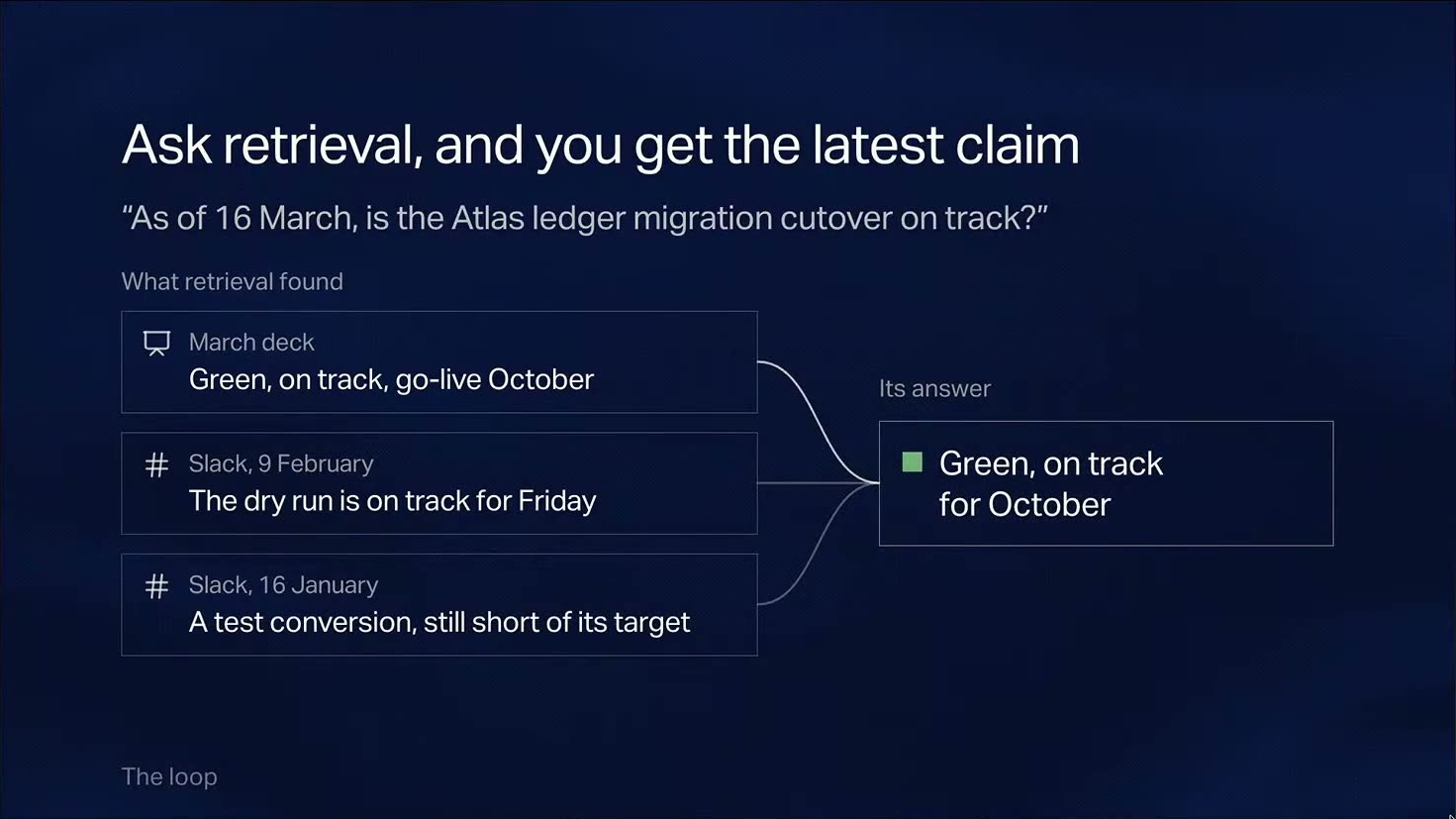
当然,你可能会问,为什么不直接用 RAG?RAG 可能就能解决问题。但实际上并不能。在这个例子里,我问:这个项目现在是什么状态?进展顺利吗?截至 3 月 16 日,某个模型会轻松找到几条 Slack 消息和一些幻灯片,然后说:“对,状态是绿色。”但它缺少很多上下文,对吧?这还不够。
And of course you're probably asking yourself, why not just RAG? Probably RAG would do the trick. And in fact, it really doesn't. In this example, I asked, hey, what's the status of this project? Is it on track? And as of March 16th, some model would happily pick up a couple of Slack messages and some slides and say, yep, it's green. But it's missing a lot of the context, right? It's not enough.
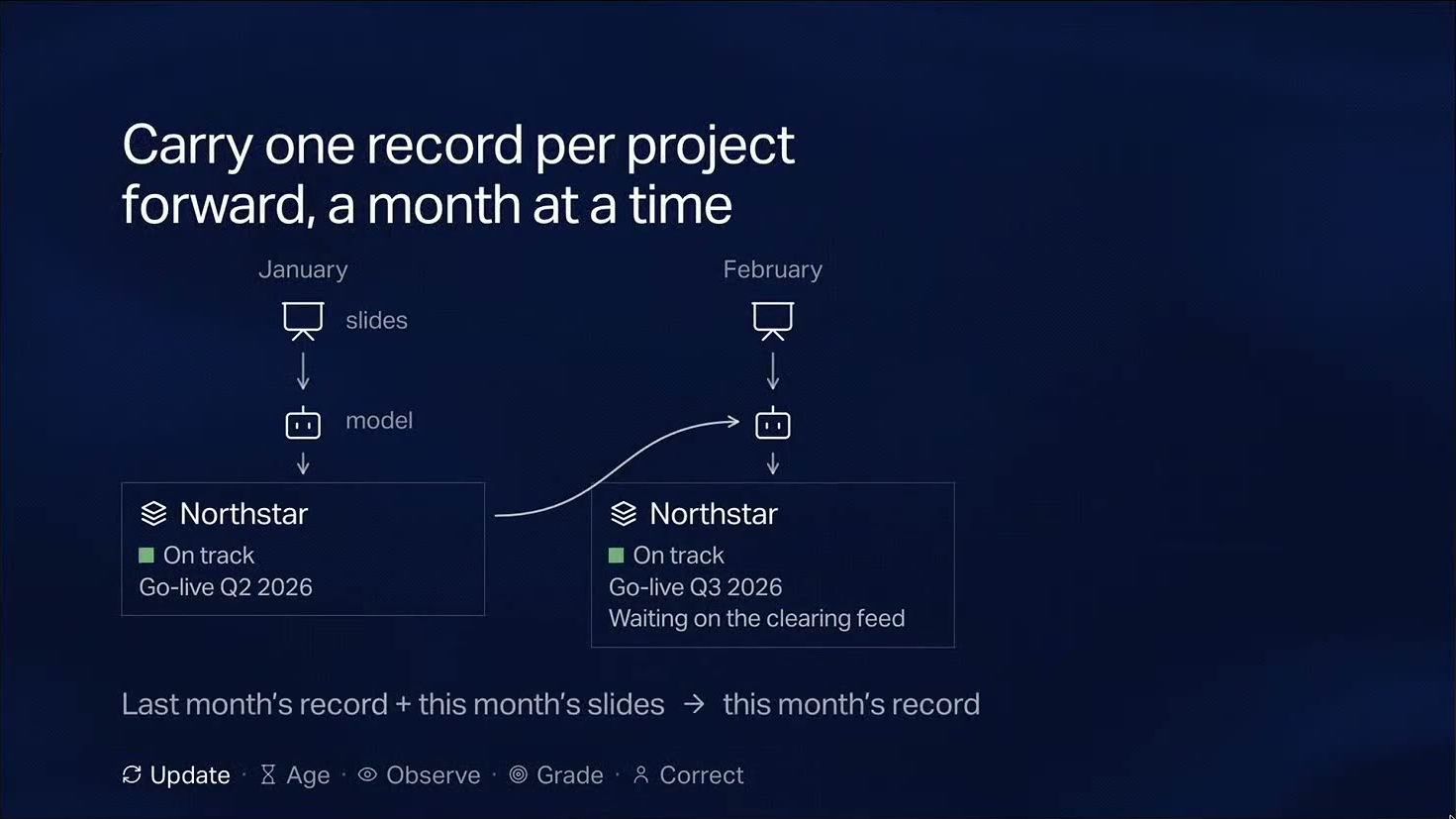
下面讲我们如何开始构建这个世界模型。第一阶段是持续、稳健地更新信息。在这个简单例子里,我取了一些幻灯片和演示文稿,基本上就是每个月都查看一次。到了新月份,我们取上个月的记录和这个月的幻灯片,并尝试构建一份纵向记录。我们已经这样做了 3 年。现在我们拥有一个相当庞大的历史记录数据库,能据此构建稳健的机构级或企业级世界模型。
So here's how we start building this world model. The first stage is about updating information consistently and robustly. In this simple example, where I'm taking some slides and some decks, we are basically just looking at every month. A new month comes around, we take last month's record and this month's slide, and you try to construct a sort of longitudinal record. And we've been doing this now for three years. We have a pretty large historical database of these records that now allow us to construct this robust so-called institutional or enterprise world model.
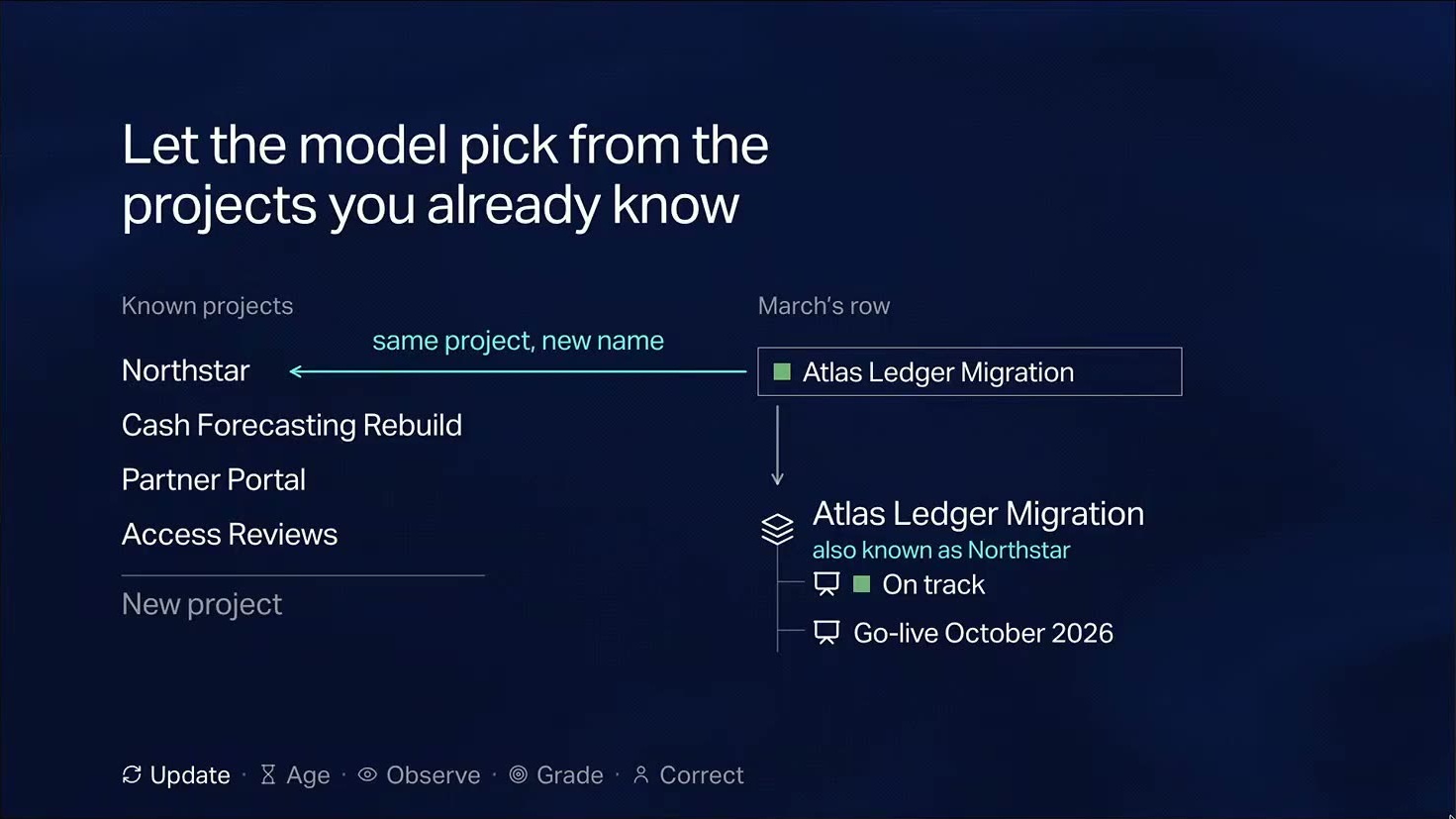
先从最基本的事情开始。有时这些模型连最基本的事情都会搞错,但这是正常的。某个项目的实际名称突然发生了变化,但通过查看历史记录,模型可以看到并推断出它其实指的是 Project North Star,因为参与人员相同,目标类型也有一定连续性,诸如此类。
You start with the basics. Sometimes these models struggle with the most basic things, but they're normal. The actual name of a particular project changed spontaneously, but by actually looking at that historical set of records, it can see and infer that it actually refers to Project North Star by virtue of who was involved, by virtue of some continuity in the types of goals, those kinds of things.
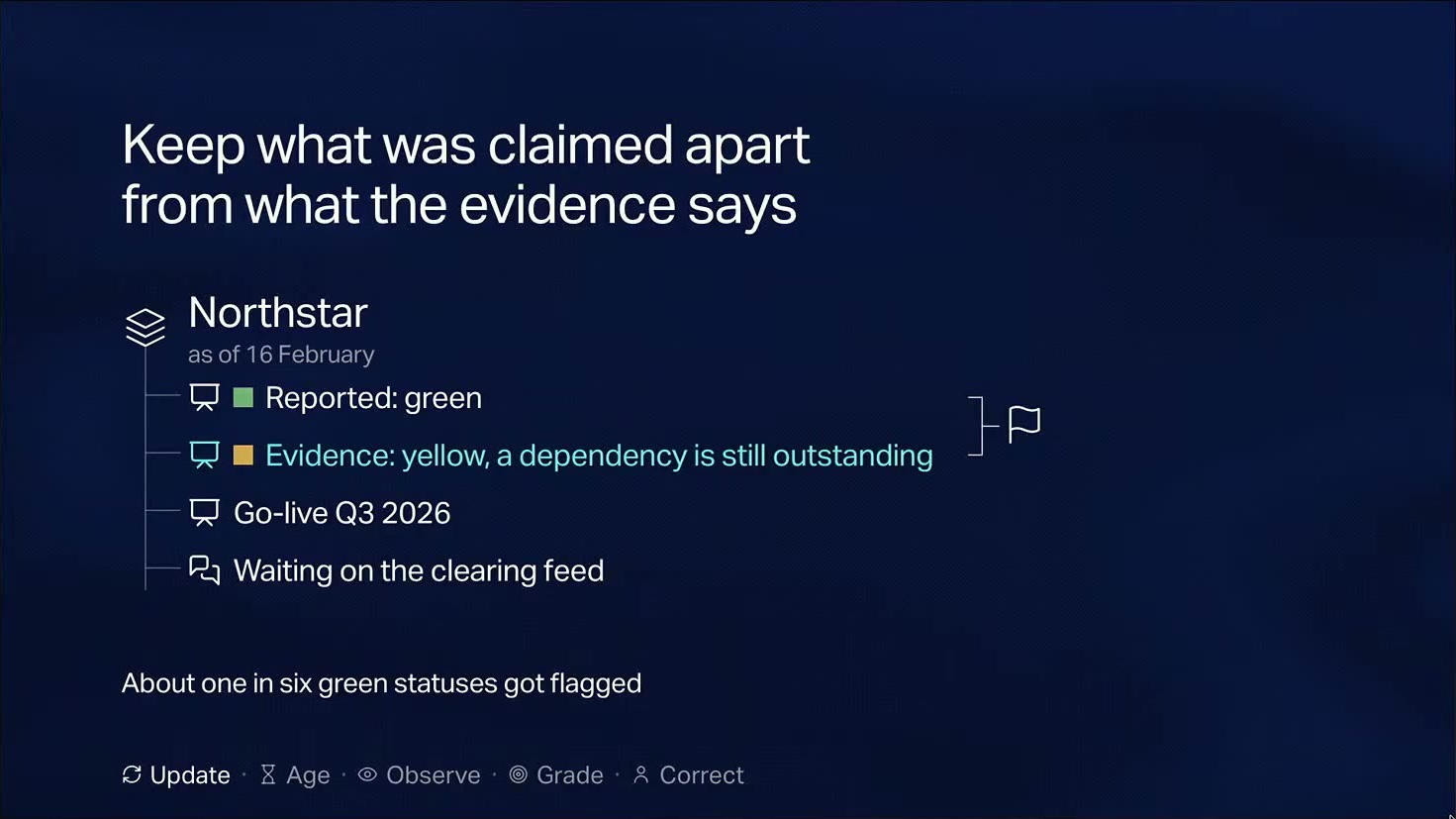
但更有意思的是,你会让智能体系统区分报告中所说的内容,以及支持这些说法的实际证据。例如,看一份状态演示文稿时,系统会发现:虽然文稿里标成绿色,实际上应该标成黄色并特别标注,因为有人留下评论,提到仍有一项依赖尚未解决。
But more interestingly, what you want to do is you have the agentic system try to discriminate between what's being reported and actual evidence for what it's saying. So you look at some status deck, for example, and here it's identifying that while it is green on the deck, in fact it should be highlighted as a yellow and should be flagged as such because there's a comment someone left talking about how there's a dependency still outstanding.
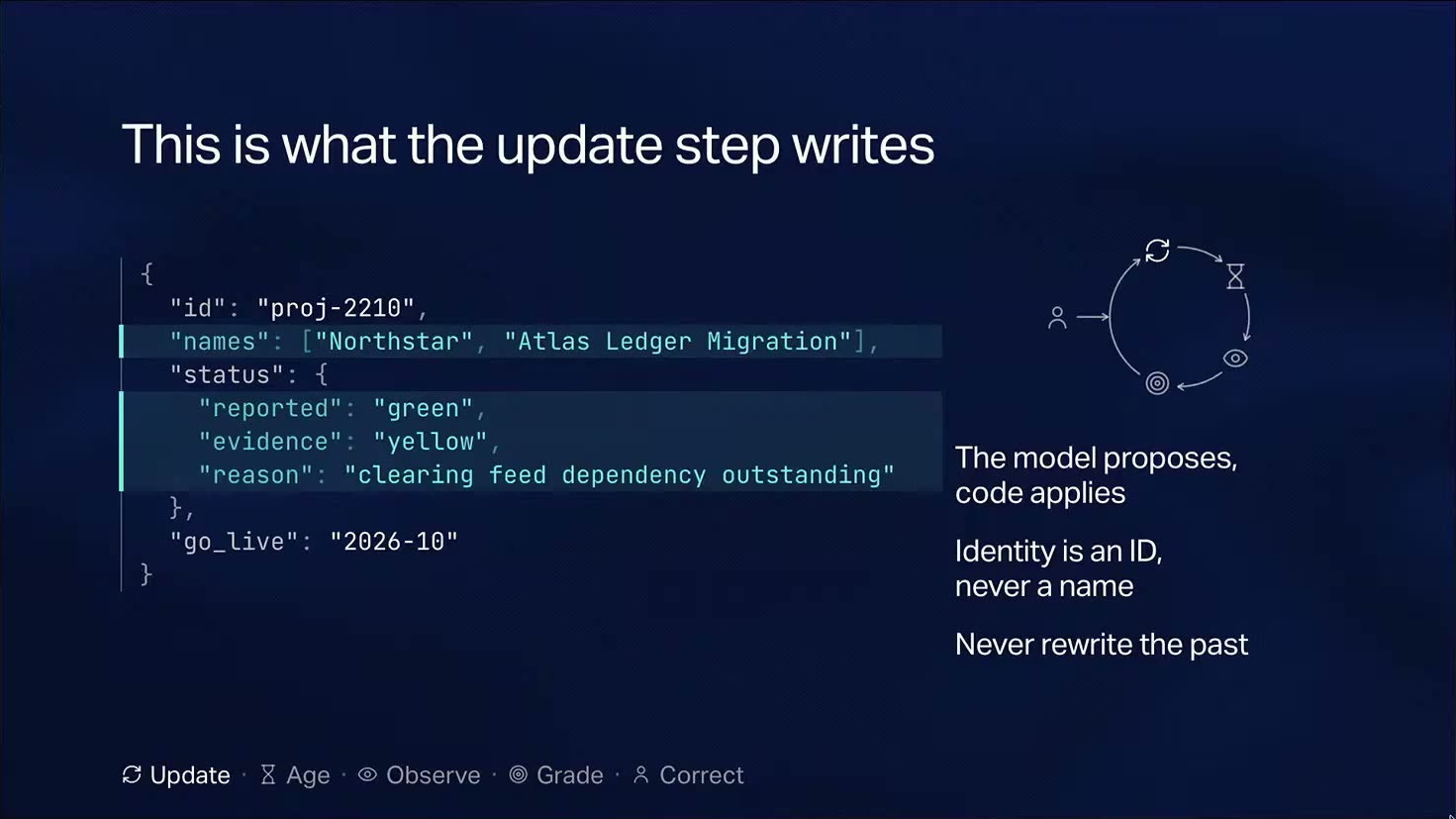
关键是不要改动之前的月份,对吧?你只是在前馈机制中逐渐修正信息。这样一来,之后就能进行稳健的评测。这是实际更新步骤写入的内容。非常简单:这是报告中所说的内容,这是证据所指向的内容,以及原因。
The main thing here is that you don't touch previous months, right? You just sort of heal in the sort of feed-forward mechanism. And what that allows you to do is to actually do some robust evals down the line, right? So here's what the actual update step writes. Very simple. This is what it was reported. This is where the evidence points, and this is why.
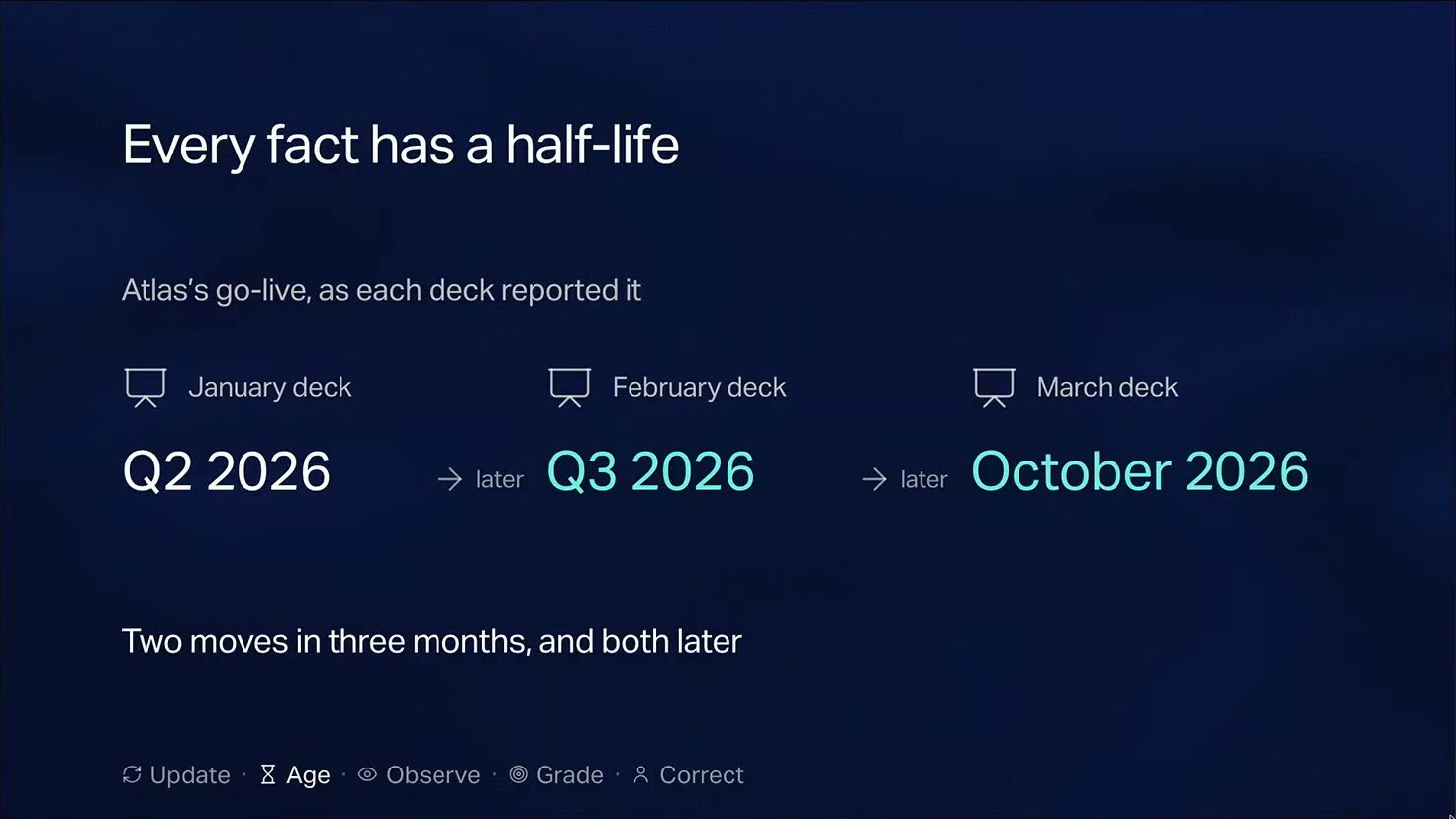
然后加入第二个组成部分:时效。事实上,每个事实都有半衰期。我们都见过这种情况:回头翻看一些演示文稿,会发现某个项目的上线日期一再推迟。1 月时说是第二季度,后来改成第三季度,现在已经是 10 月。你确实能观察到这一点。
And then you fold in the second component, age. The reality is every fact has a half-life. We've all seen, you know, you go back at some slides, and you see that the go-live date for a particular project keeps slipping. It was Q2 in January, then it was Q3, now it's October. And you actually observe this.
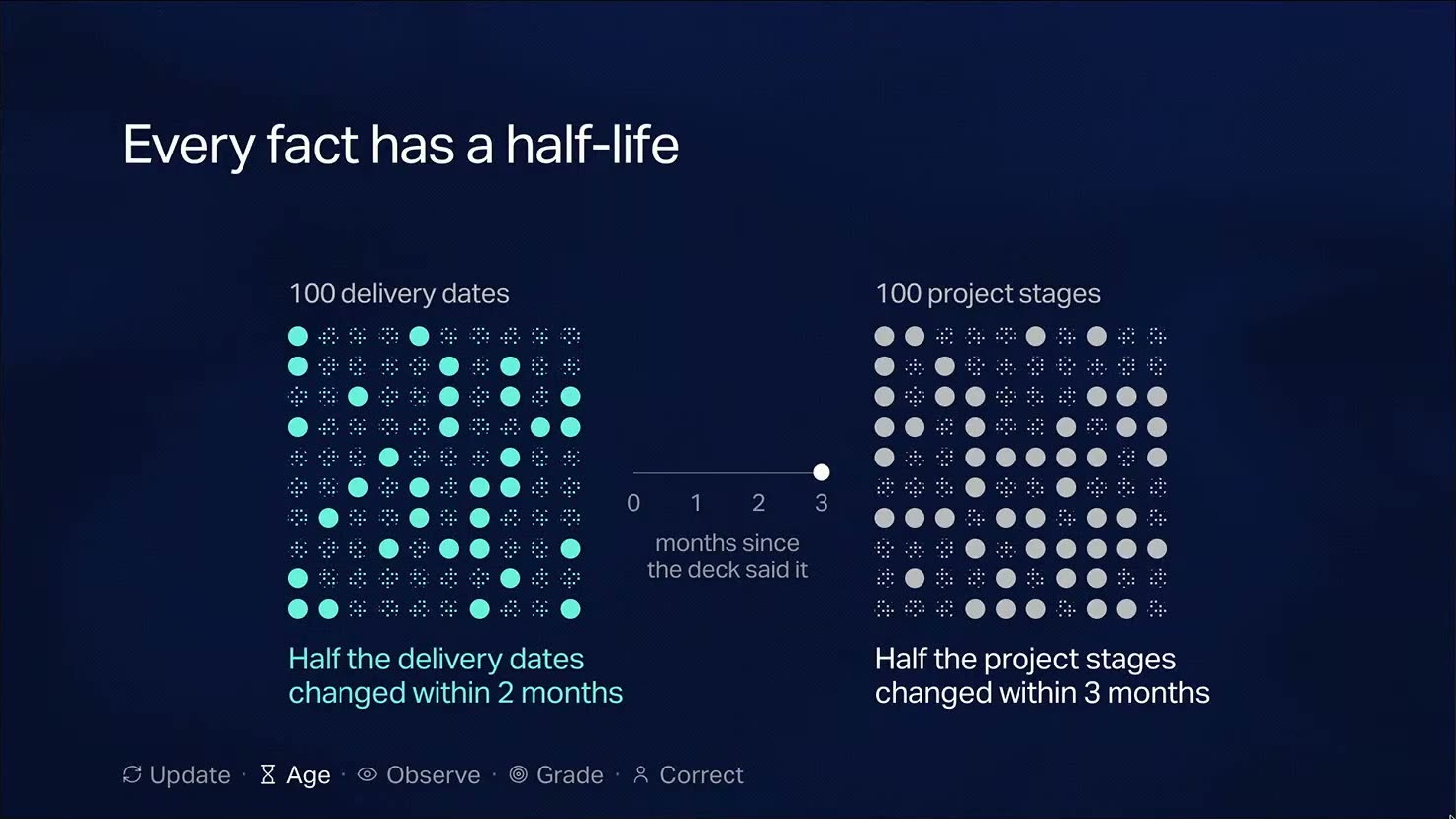
通过收集所有这些数据,你就能得到一些很有意思的初步分析洞见。例如,看看过去 3 年的交付日期,平均而言,一半交付日期会在 2 个月内改变,其中 90% 会改到晚于最初提出的日期。目前为止都还不错,挺基础的。
By actually collecting all this data, you can have some pretty interesting beginnings of analytical insights. For example, in the last three years, you look at these delivery dates, and on average, half the delivery dates change within two months, and 90% of those change into a date that is after what was originally proposed. So far, so good. Pretty basic.
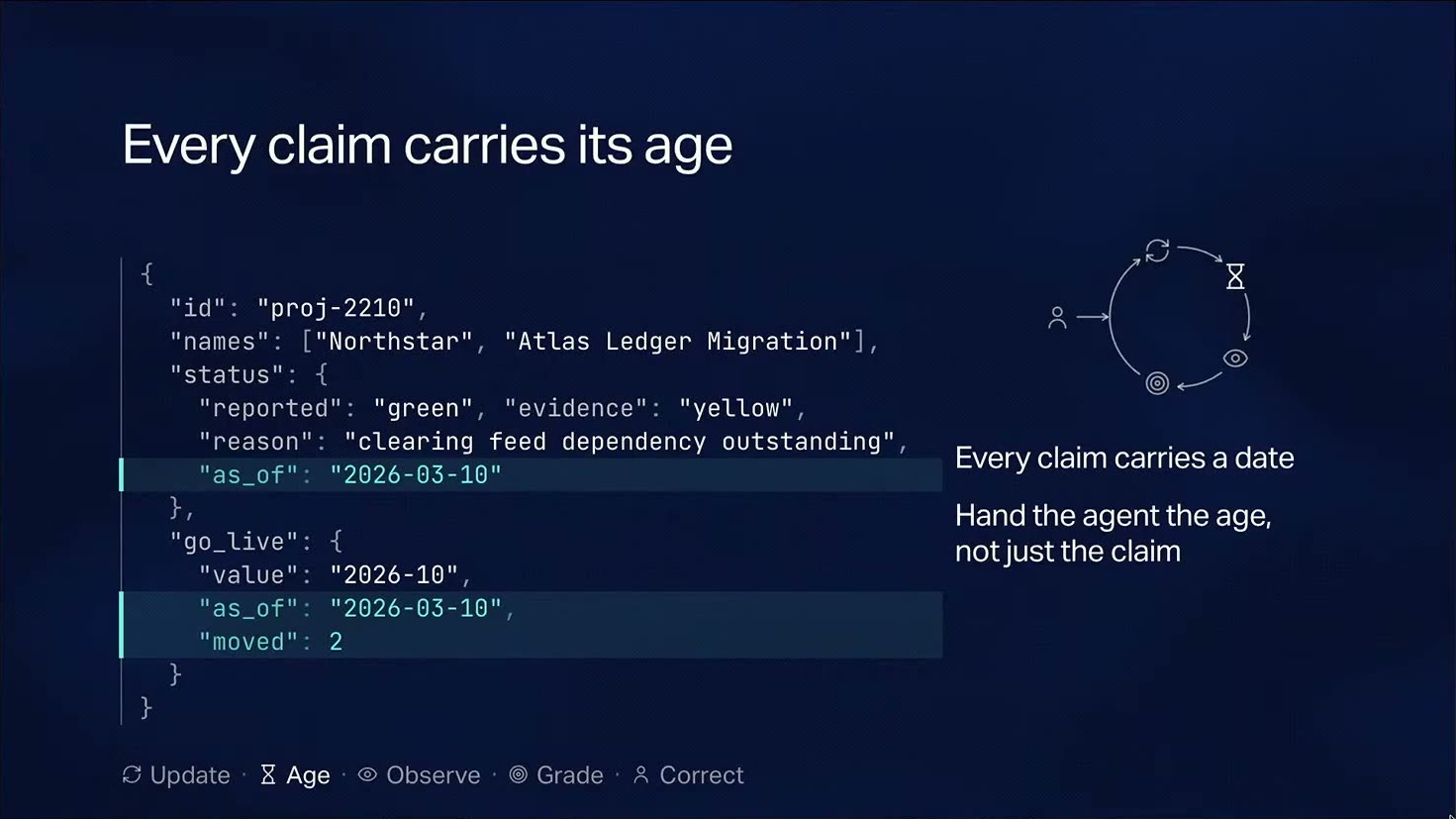
但这会迫使你为某个具体说法关联一个日期,这样当你询问某个项目、某个人或公司意图的状态时,智能体就能适当偏重较新的信息。
But what this forces you to do is then introduce this notion of a date that is associated to a particular claim so that the agent can introduce some sort of recency bias when you ask about the status of a particular project, person, or the corporate intent, let's say.
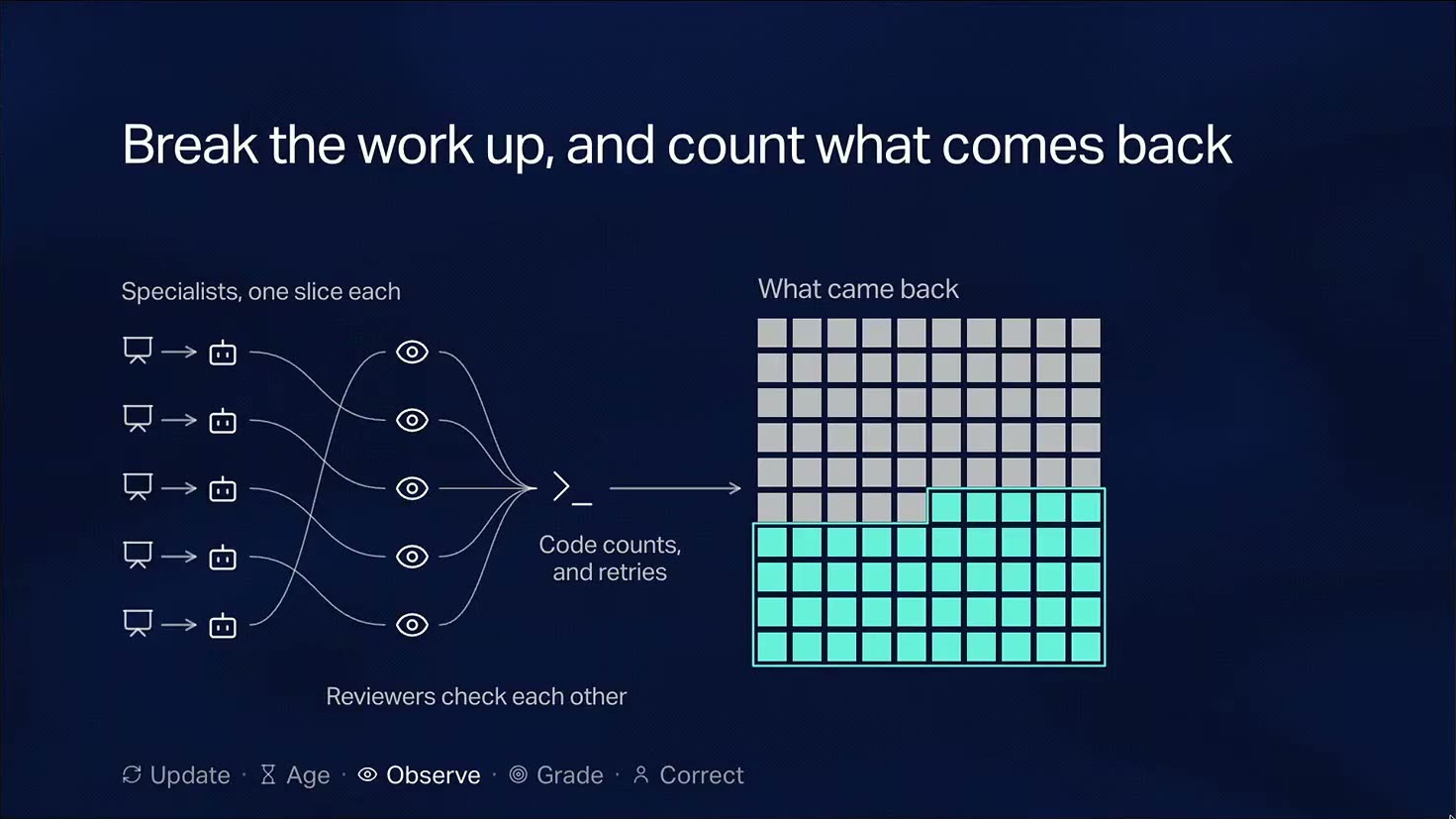
接下来是观测部分。关于观测这一节,我会很快带过,只讲一些非常实用的内容。一开始,我很容易被一个想法吸引:干脆 YOLO 一把。让 Claude 或其他模型看看整个语料库,然后观察它会做什么。结果很明显,会丢失很多信息。有些细节也会被忽略。所以最后我们不得不设计一个简单的智能体工作流,让一系列专业智能体拆解这些资产的相关材料,查找特定内容,再让其他智能体复核,等等。
Then the observe section. The observe section here, I'm going to pretty quickly gloss over it, but just kind of give you something very tactical. In the beginning, I was pretty seductive to just basically say, well, let's just YOLO this. Let's have Claude or some other model take a look at the entire corpus of things, and let's see what it does. And as it turns out, it's pretty clear that a lot of information is lost. It loses some attention to detail. And so what ultimately we had to do was engineer a simple agentic workflow where you have a series of specialists break down the collateral of these assets look for specific things, be reviewed by other agents, and so on.
你在右侧看到的,是对某个项目有洞见的更新数量在这样做之后增加了一倍多。所以我想这里的经验是:要有意识地设计这些工作流,别想当然地认为 YOLO 方法一定有效。不过现在,我觉得终于来到真正有意思的内容了。
And what you see here on the right-hand side is that actually the amount of insightful updates to a particular project more than doubled after doing this. So I guess the takeaway here is be intentional about how you build these workflows and don't just assume that a YOLO method is going to work out. But now you get, I think, to the really interesting stuff.
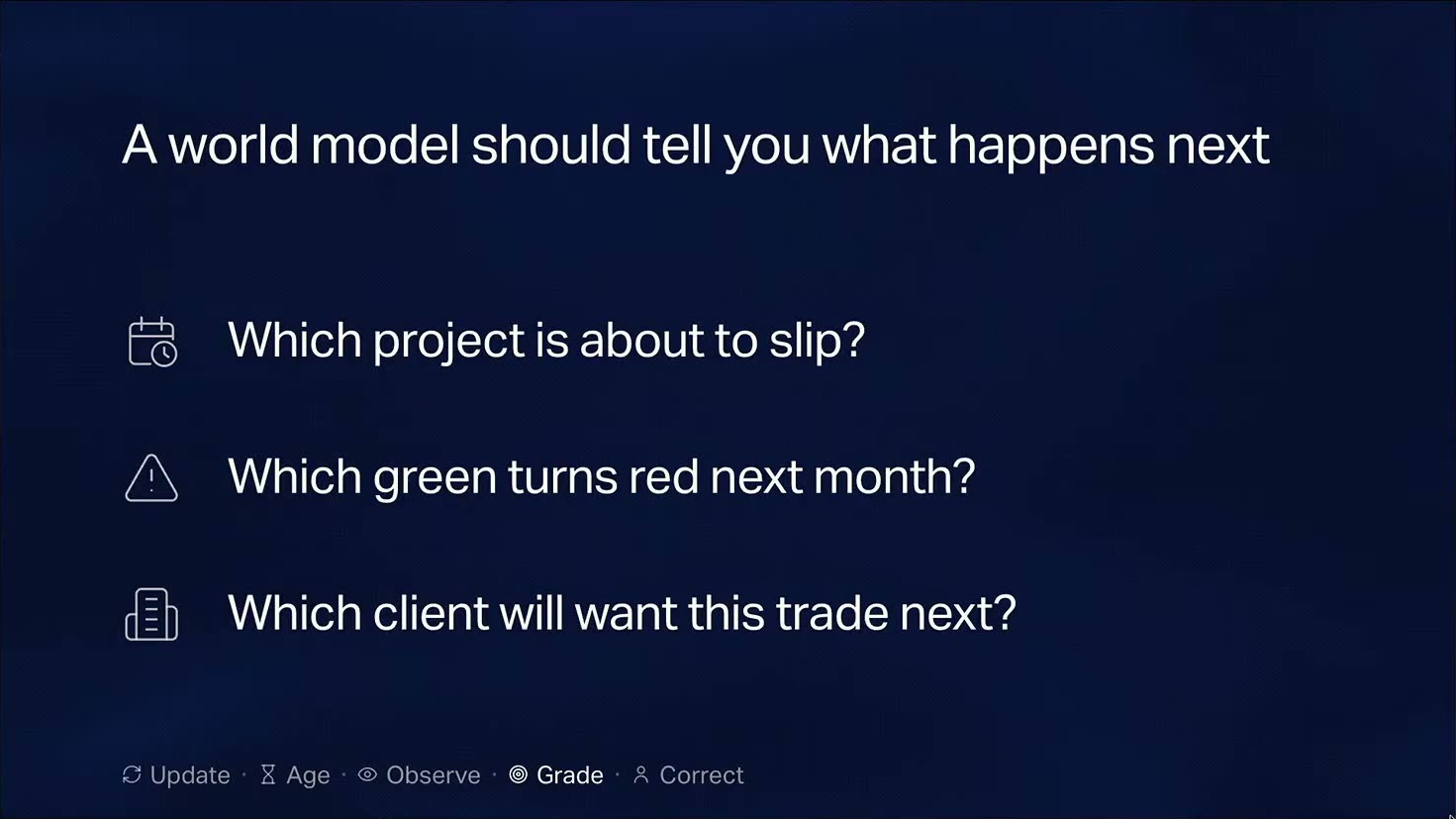
世界模型应该告诉你接下来会发生什么。哪个项目即将延期,或者哪个绿色状态下个月会变成红色。事实证明,你确实能做到这一点,对吧?
A world model should tell you what happens next. What project is about to slip, or which green turns red the next month. And it turns out that you can actually do this, right?
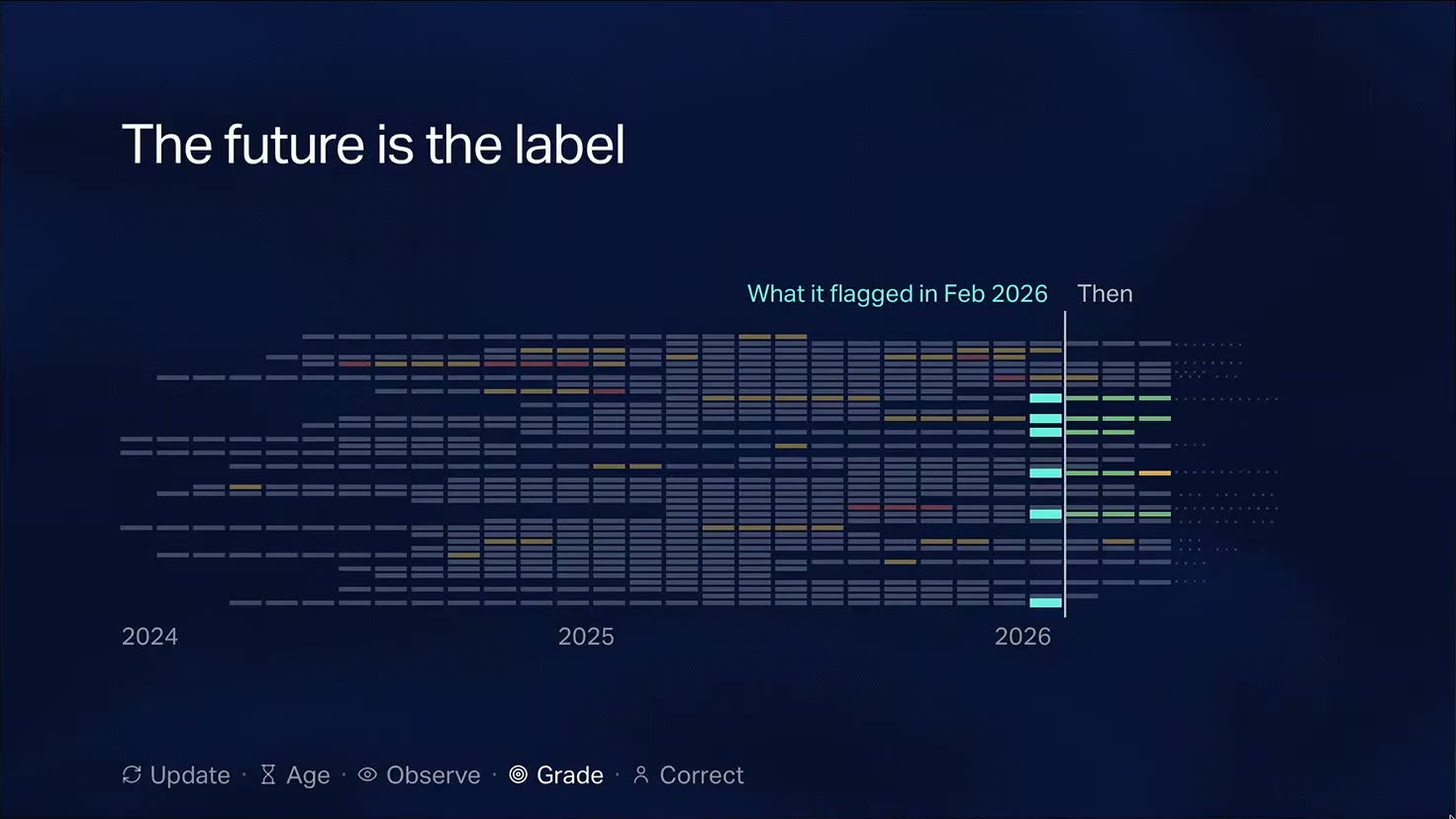
因为你可以回顾过去,建立一份快照,以某个过去的日期为准,然后进行回测。例如,如果我们截取一份截至 2 月的快照,就可以查看后来出现的标签,再看看,比较智能体预测会延期或作出标记的情况,与实际发生的情况。
Because you can look back and establish a snapshot as of some sort of past date and essentially run a backtest. So for example, if we take a snapshot as of February, we can look at the future labels that came after that and see and compare what the agent said was going to slip or flagged versus what actually happened.
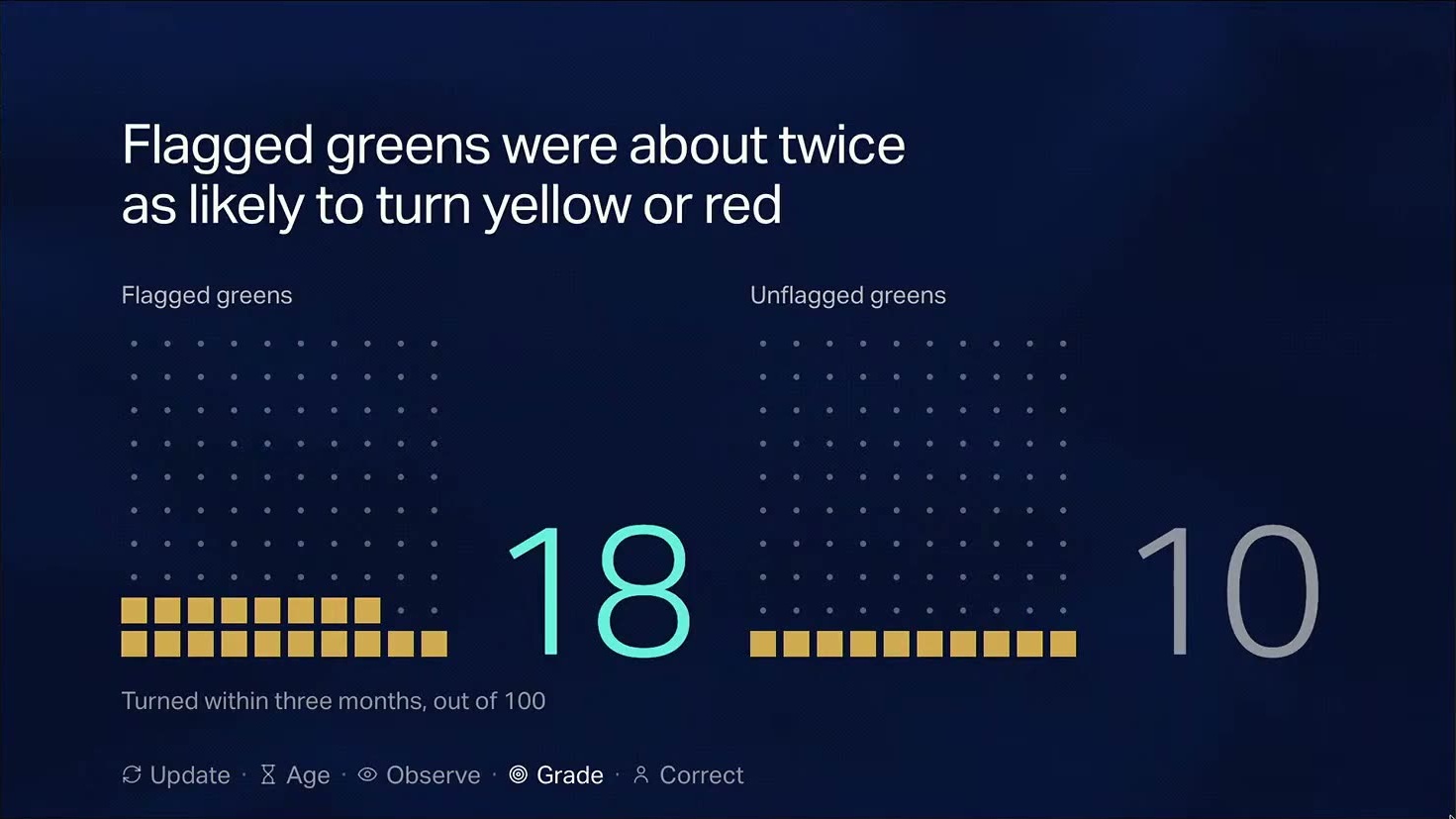
你会发现,智能体分析这些信息后,被标记的绿色状态项目变成黄色或红色的可能性是其他项目的 2 倍。所以,这令人鼓舞,因为我们开始看到一些初步迹象,表明它还不能准确预测究竟会出什么问题,但至少能告诉你应该关注什么。比如,你有 18 个案例,智能体给出了一个被标记的判断,但那些没有被标记的情况又该怎么办?
And you can see that as the agent analyzes all this information, that for statuses that were green but flagged, they were twice as likely to actually turn yellow or red. And so, again, this is encouraging because we're starting to see some beginning of the inability to say, well, it's not predictive of exactly what's going to go wrong, but at least it should tell you what to look at. So, you know, you have 18 different cases where you have a verdict from an agent that's flagged, but what about those where you don't?
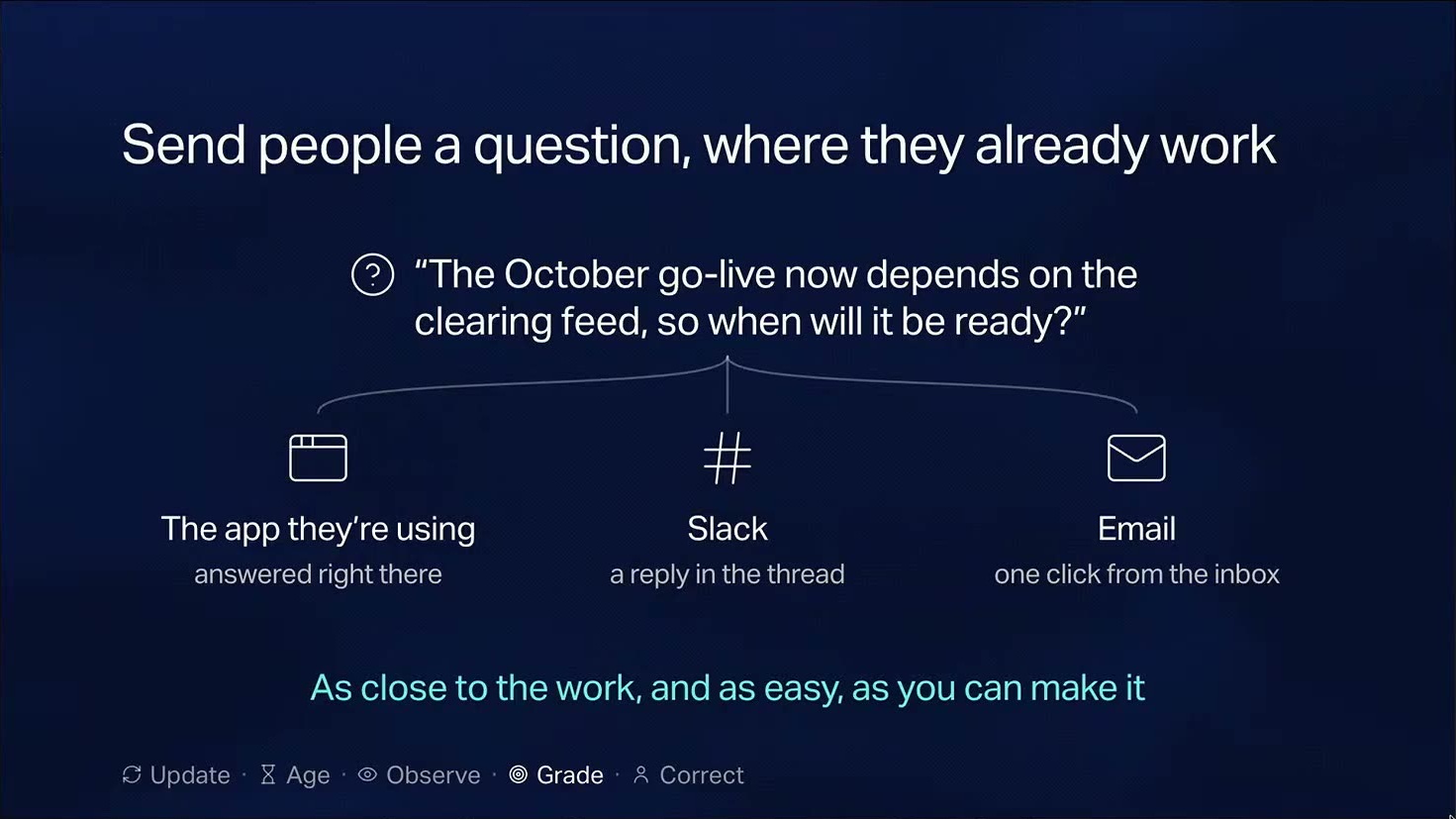
这就需要一些产品直觉。首先,如何设计一个优雅的反馈循环,让实际用户、利益相关者,也就是人类参与进来?你该问他们什么,又该在哪里和他们互动?为了弄清楚如何最好地收集这些信息,我投入了不少工作。关键是去用户所在的地方,不管是他们使用的应用、Slack、电子邮件,还是其他渠道。你越贴近用户,越能简化反馈收集机制,整个流程就越容易规模化,也越稳健。
And this is where some product intuition comes in. First of all, how would you incorporate a very elegant sort of loop where you include an actual user, a stakeholder, a human? What do you ask them and where do you meet them? I put a nontrivial amount of work into finding out how best to actually capture this information. It's meeting the users where they are, whether it's the app they're using, Slack, email, whatever. The closer you can get to them and the simpler you can make that feedback collection mechanism, the more scalable and robust the process is going to be.
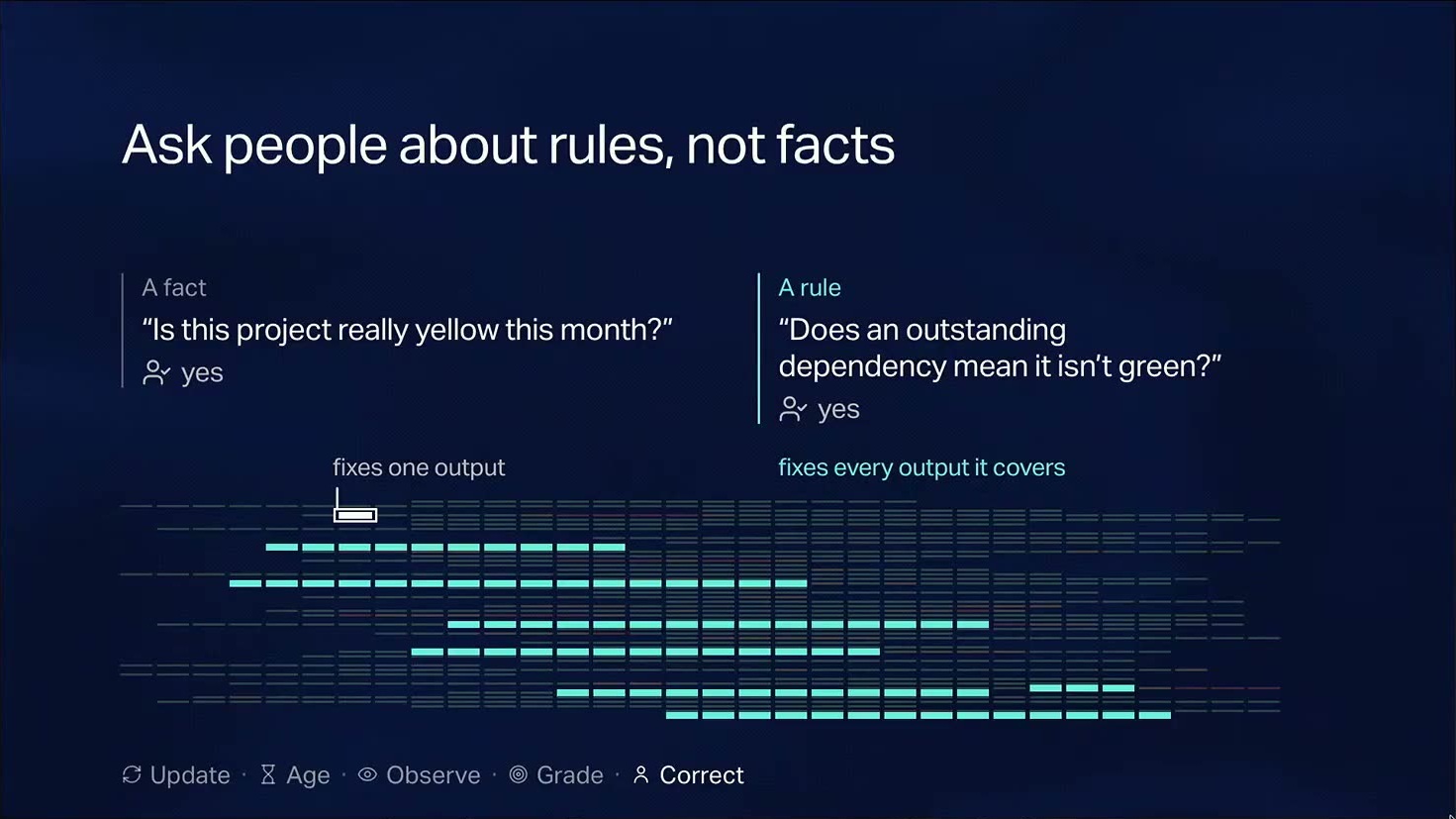
问什么也很重要。你需要判断,自己问的是一个只会修正单项输出的事实,还是在问一条规则。一旦智能体理解了这个模式,就能更好地修正它涉及的所有输出,现在如此,未来也如此。所以现在,我们的记录中不只包含一个元素,也就是智能体推断出的内容,更重要的是,还会记录有人实际提供反馈后确认的内容。
It also matters what you ask. You want to understand whether you're asking a fact which only fixes one output, or if you're asking about a rule. And once an agent understands that pattern, it does a much better job of fixing every output it covers, both now and into the future. So we have this notion now of our record containing not just an element of what was inferred by the agent, but more importantly confirmed after someone actually provided that signal.
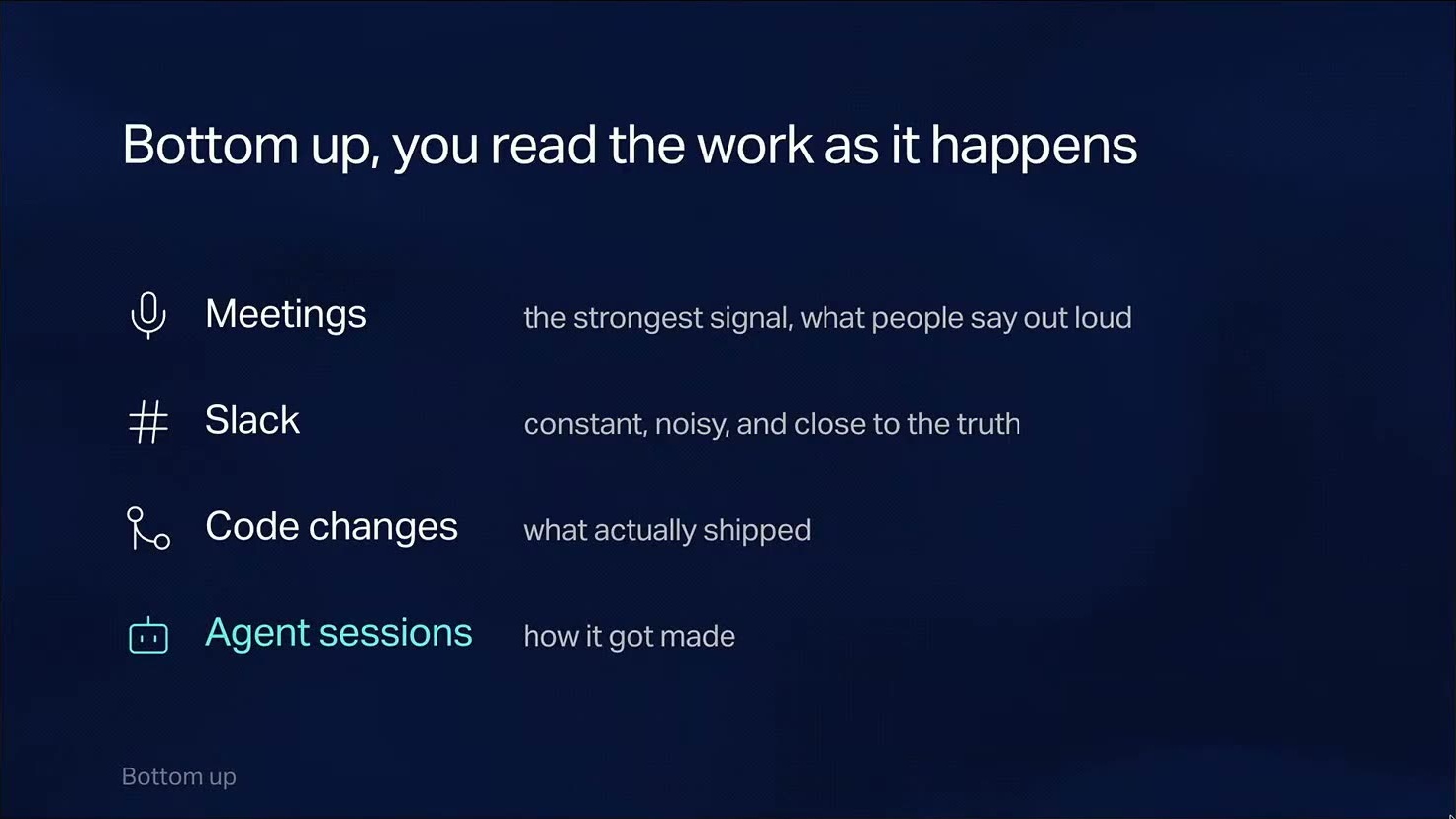
好,现在说自下而上的部分。会议能提供很强的信号,也就是人们直接说出来的话。还有 Slack。内容持续不断,也很嘈杂,但非常接近事实。代码变更能说明实际交付了什么。还有智能体会话记录,它们能展现事情是如何一步步做出来的。我鼓励大家探索所有这些不同的数据源,逐渐构建出这样的模型。
Okay, so now bottom up, right? You have meetings with really strong signal, what people say out loud. You have your Slack. Obviously, it's constant. It's noisy. It's very close to the truth. Code changes describe what shipped. And then, of course, the Asian sessions, which is how the sausage was made. And I think I encourage you all to explore all of these disparate data sources to kind of build such a model up.
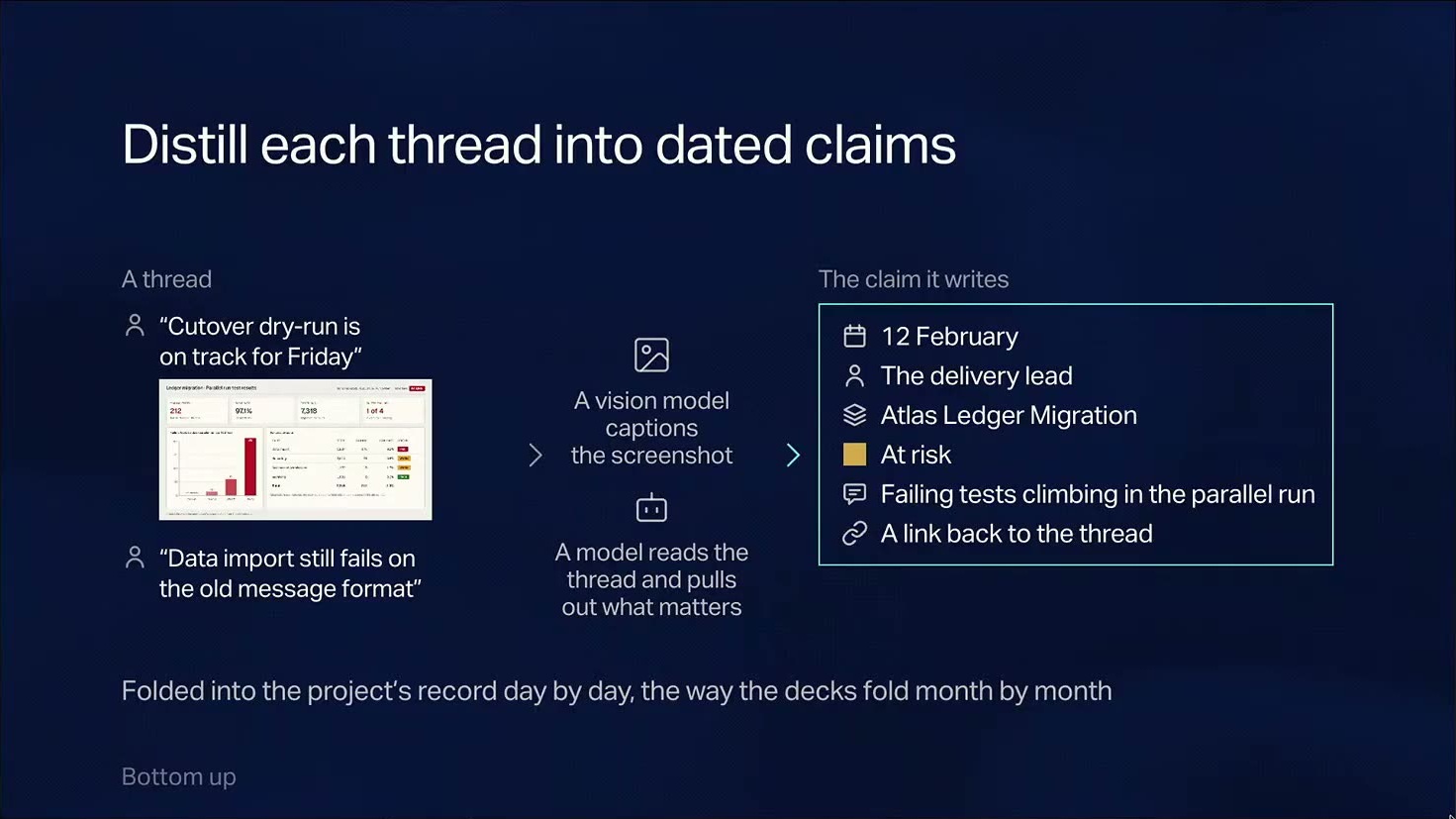
Slack 相对简单,对吧?你只需查看每个对话线程并尝试理解,根据附件、参与者和内容,确定你希望智能体记录或更新哪些说法。事情发生在什么时候?由谁负责?或者说这和谁、哪个项目有关?证据链接在哪里?等等。至于 PR,它会展示发生了哪些变化。这是了解项目如何演变的好方法。
With Slack, it's relatively simple, right? like you're just looking at every thread and trying to understand, based on attachments and participants and content, the claims that you want the agent to record or update. When was this? Who was responsible? Or who does this relate to? What project? What is the sort of link to the evidence? And so on. With PRs, of course, it shows you what changed. And it's a really nice way to see how a project is evolving.
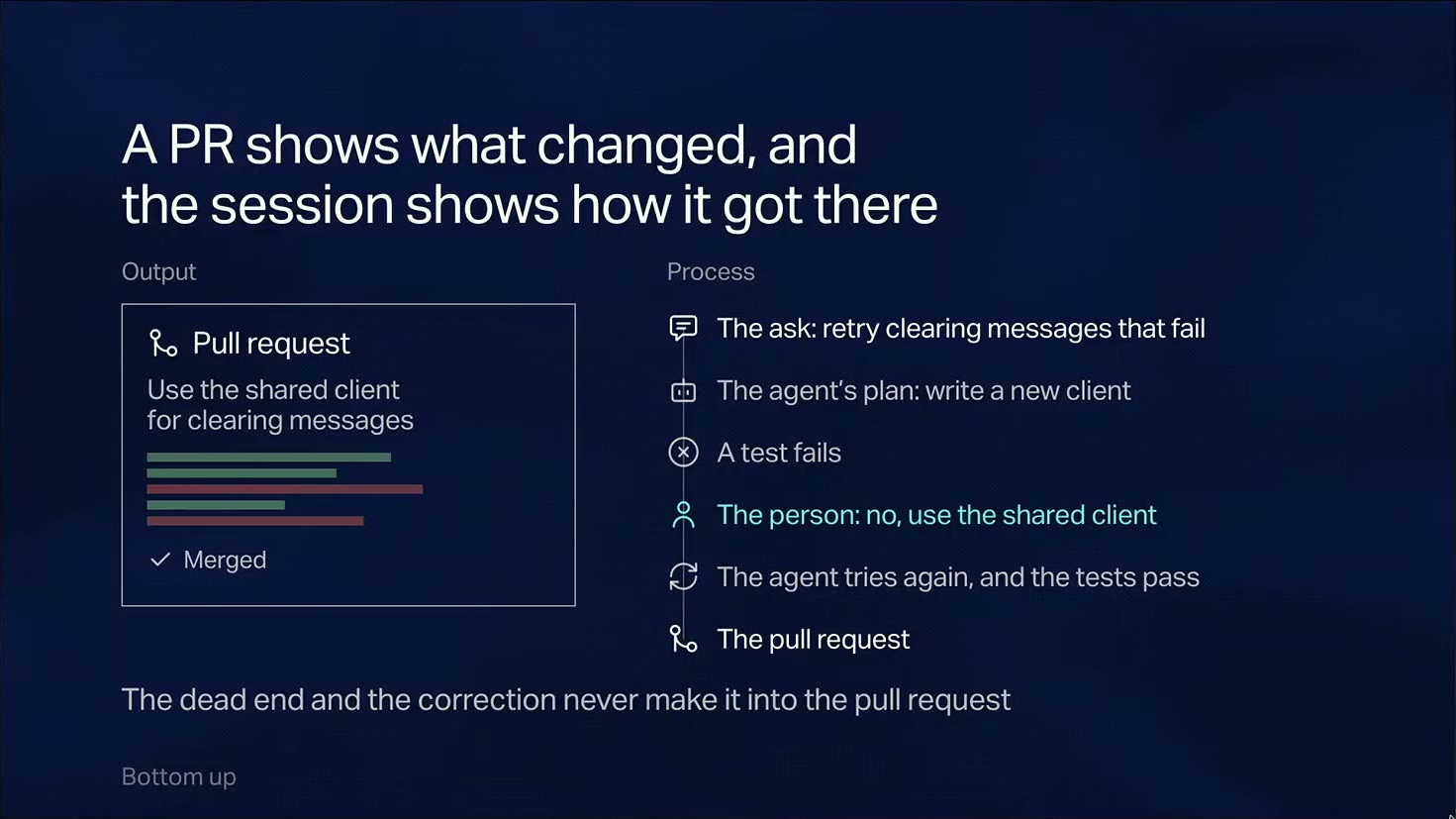
但要理解项目如何实际运行和部署的细节,看看选择共享会话记录的用户和工程师的实际操作轨迹,会很有意思。你可以了解需求如何随时间演变、测试在哪里失败,或者开发者作出了哪些特定决策,以及诸如此类的事情。最后,这些都会汇总到一个拉取请求中,但把这些信息综合起来,我觉得会产生很大差别。
But when it comes to the actual subtleties of how projects are run and deployed, it's really interesting to look at the actual traces for users and engineers who opt into that. You understand how the ask evolved over time, test failures, or particular decisions from the developer, those kinds of things. Ultimately, these culminate in a pull request, but the synthesis of these things, I think, makes a big difference.
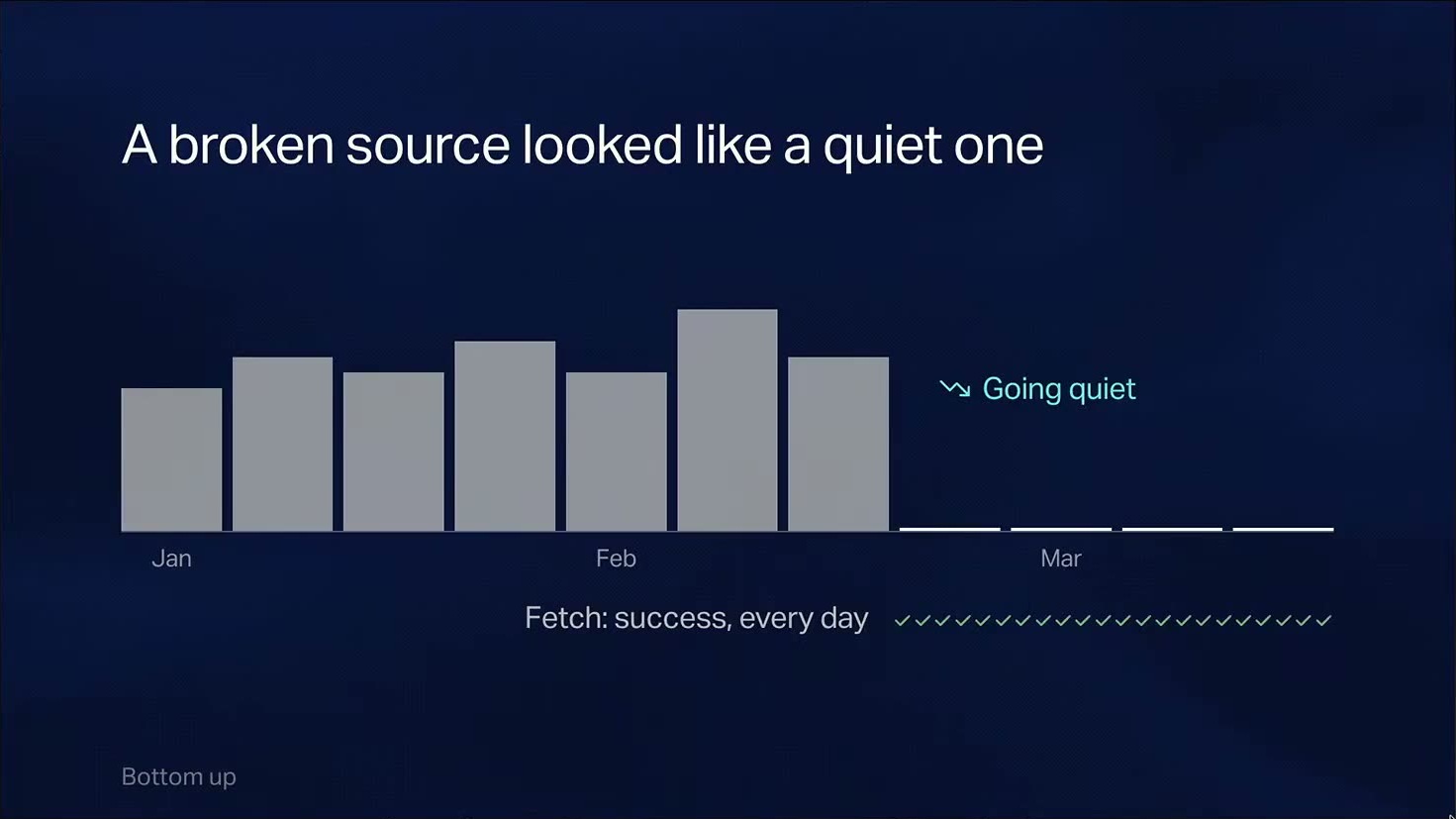
我还想提醒大家注意另一件事:要仔细考虑来自各种所谓传感器的信号是否有效。例如,如果你正开车驶上高速,车速表突然不显示了,这不代表你的车速变成了每小时 0 英里。这只是一个故障信号。例如,我们有时会在自下而上的方法中遇到一些问题,你会看到某种说法,“嘿,这个频道突然安静下来了,这是怎么回事?”但实际上,我们把它当成了零,其实不应该这么处理。
The other gotcha I just want to share is to just be mindful of how you think about the validity of signal coming from different so-called sensors. If you're driving down a highway, for example, and your speedometer just disappears, it doesn't mean you're now going at zero miles an hour. It's just like a faulty signal. So for example, here we ran into a couple of issues sometimes when the bottoms-up approach, you had some semblance of a claim saying, hey, this particular channel, this thing is going quiet, what's going on? But in reality, we were treating it as a zero, and really it shouldn't have been.
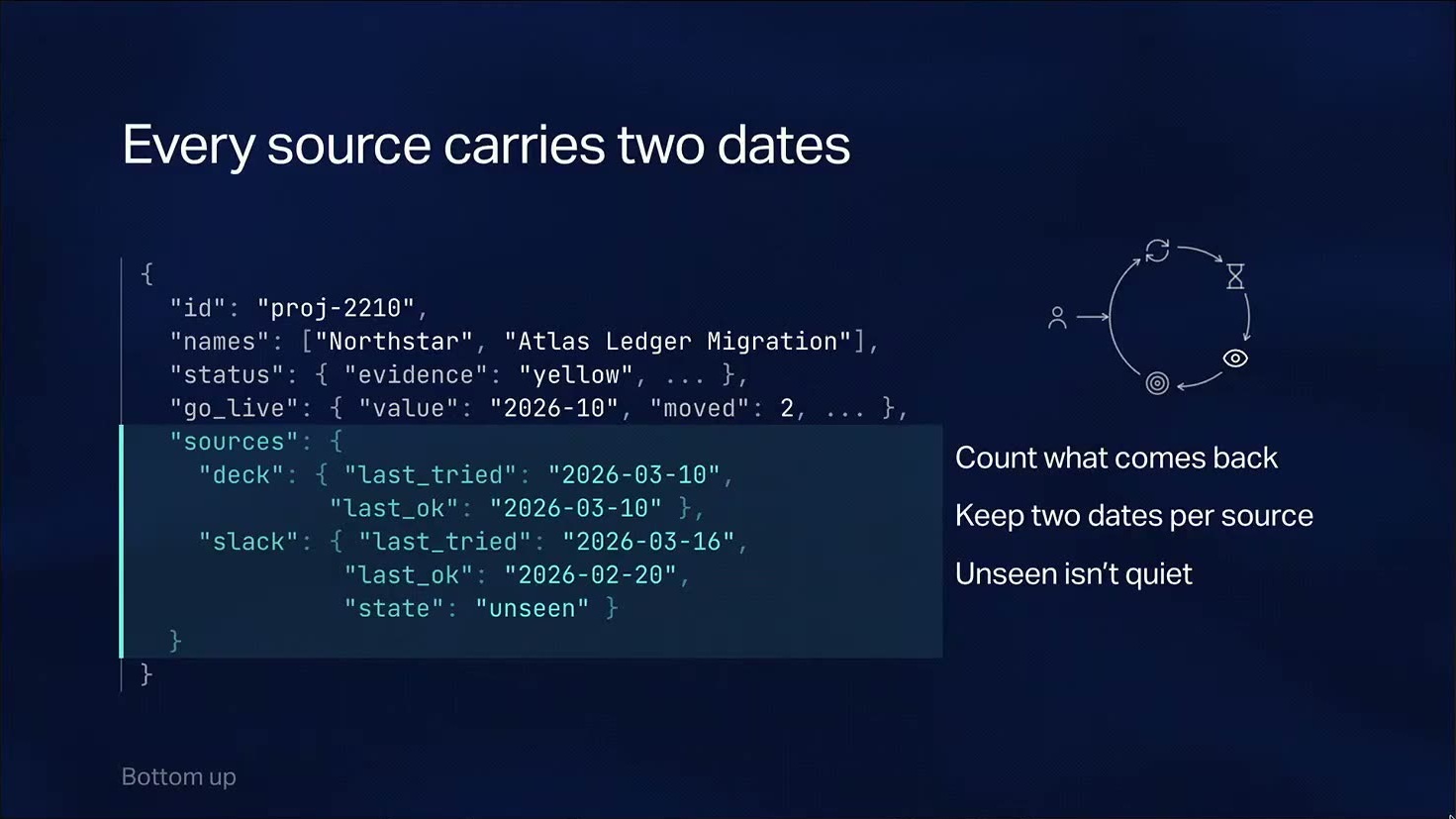
所以我们不断迭代,逐渐弄清楚如何纳入上次尝试从该传感器获取信息的时间,它上次正常是什么时候,以及当这些信号出现分歧时该怎么办。
And so we sort of iterated over time to understand how to incorporate when we last tried to get information from that sensor, when it was last okay, and what do you do when these diverge?
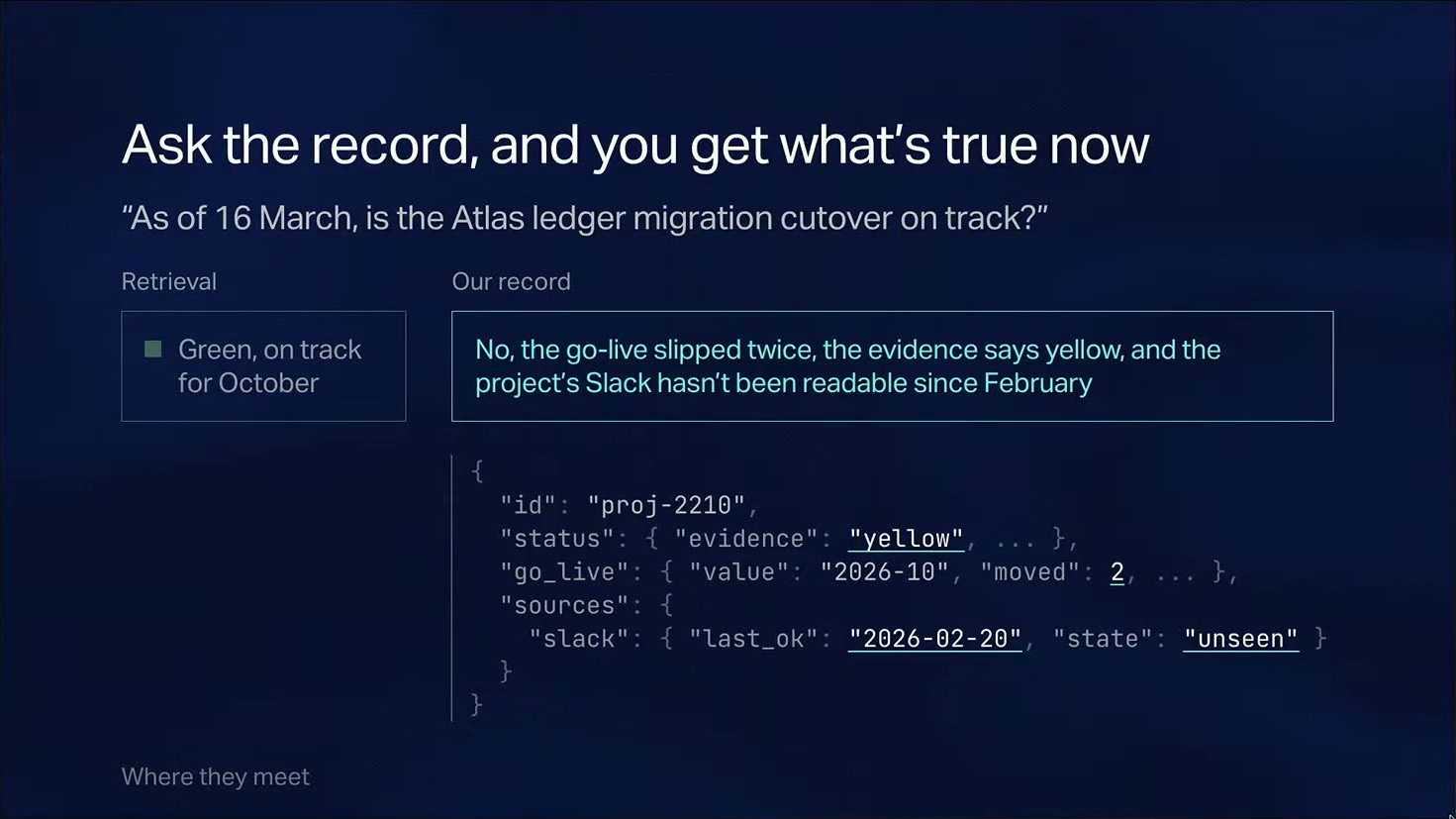
现在,如果你查看我们构建的实际记录,智能体在理解真实世界状态方面会有效得多。状态不是绿色。上线日期已经两次推迟,证据显示应该标黄,而且有人在讨论测试失败。事情会比较棘手。
So now, if you look at the actual record that we constructed, the agents are going to be much more effective in understanding the true state of the world. It's not green. It's the go-live, slip-twice, the evidence says yellow, people are talking about failing tests. It's going to be tricky.
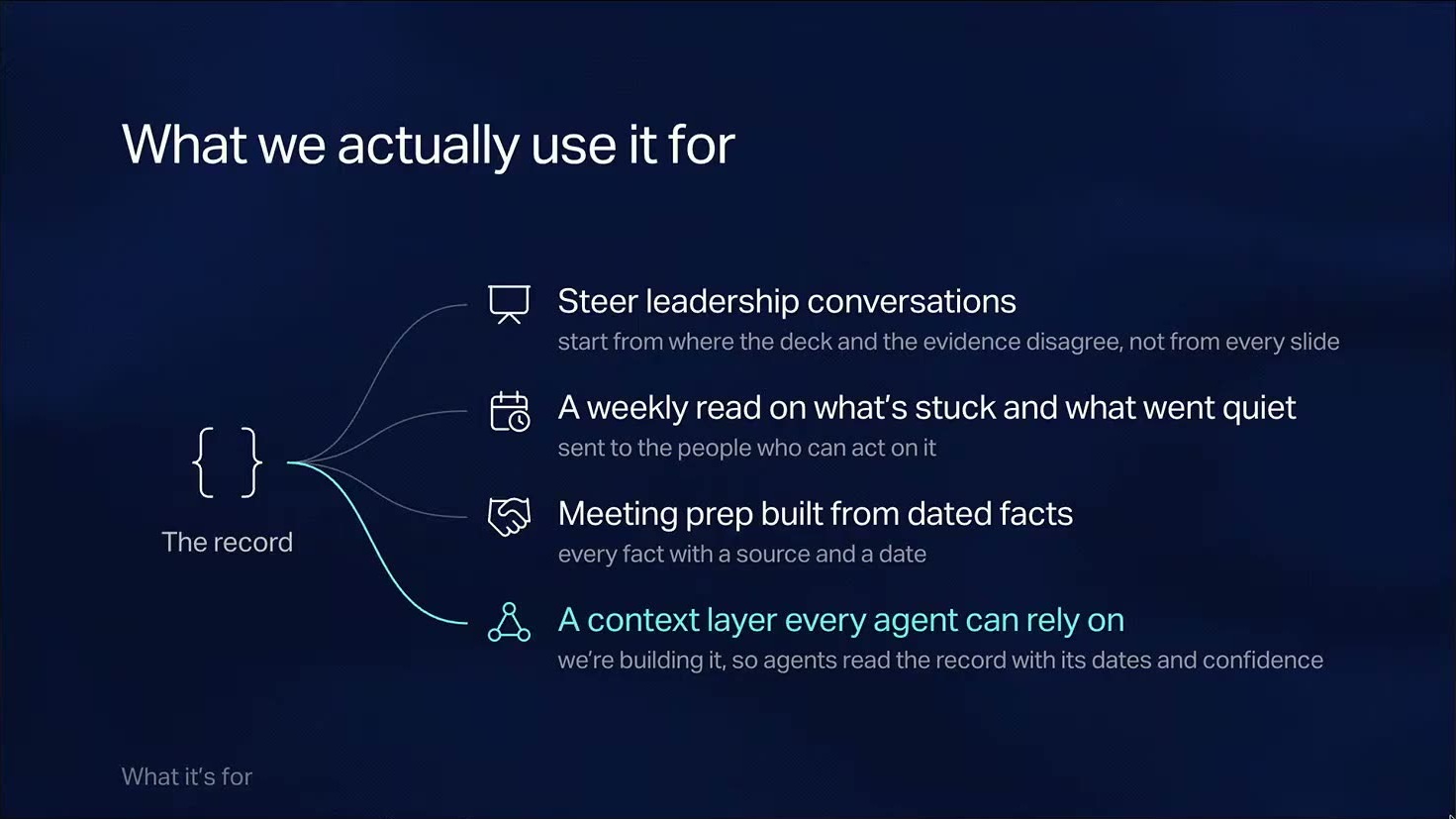
那我们用它做什么呢?用来引导领导层对话。我们不再把一份演示文稿发给所有人,逼着大家翻完一堆幻灯片,而大家其实都会一眼带过,现在可以从真正重要的事情开始。先看演示文稿与证据不一致的地方。你还可以每周为经理和领导提供一份简报,说明哪些事情卡住了,哪些频道变安静了。但我认为更重要的是,你开始有了一个上下文层,每个智能体都可以依赖它。我们正在运用这种模式并构建它,让它可以扩展到其他不同用例。
So what do we use this for? We use it to steer leadership conversations. Instead of circulating a deck to everyone and forcing everyone to just go through some slides everyone glosses over, you start with the stuff that actually matters. You start where the deck and the evidence disagree. You also produce a weekly read for managers and leaders on what stuck and what went quiet. But I think also, most importantly, you have the sort of beginning of a context layer that every agent can rely on. And we're using this pattern and constructing it so that it's extendable to other different use cases.
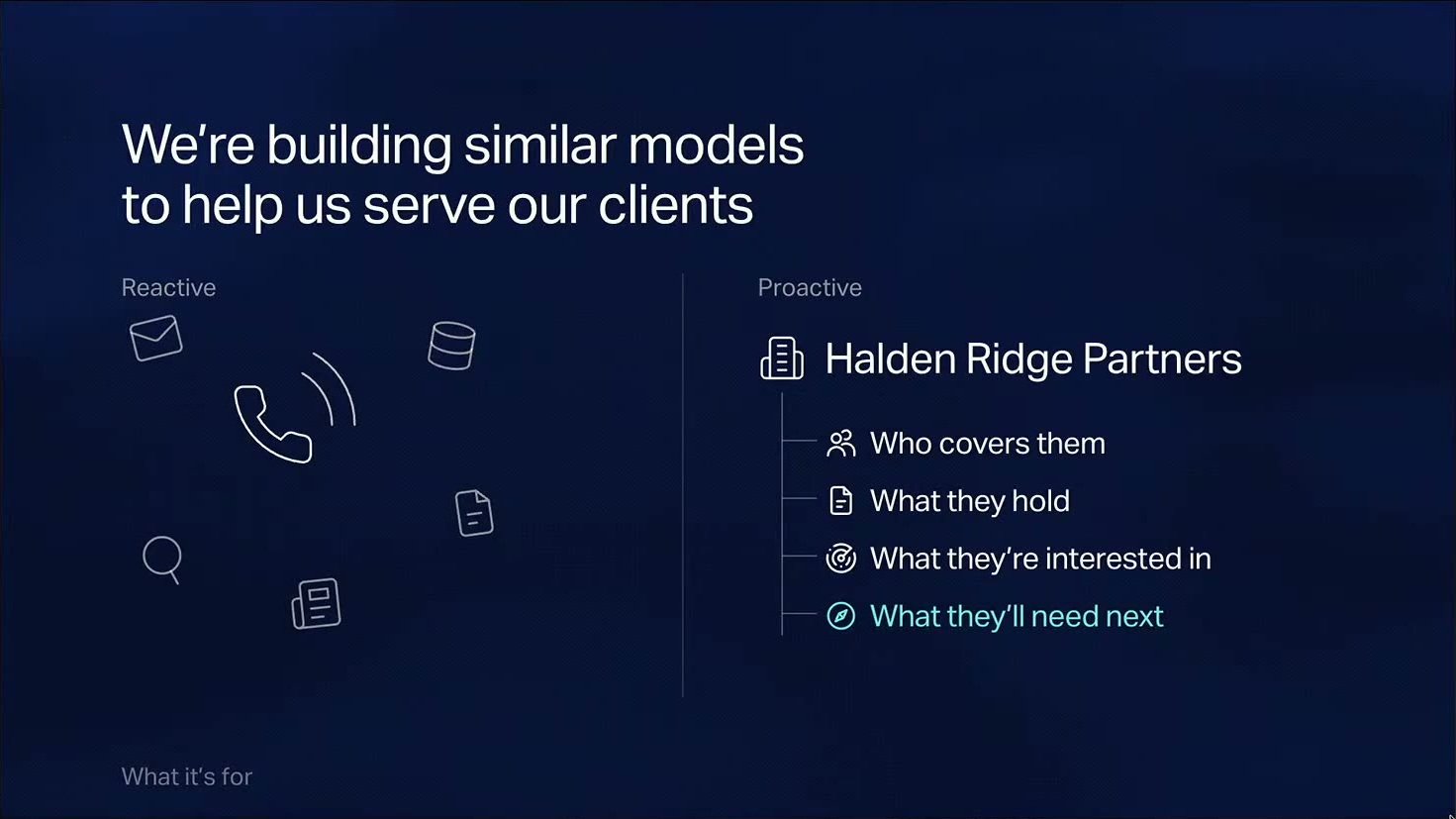
例如,在我们的客户业务中,我们想知道如何构建类似的模型,帮助我们更好地服务客户。我们知道自己有一些客户,想了解他们分别持有哪些资产,他们对什么感兴趣,以及如何尽可能提前预判他们的需求,把各种信息整合进来,这些信息来自各类不同的内部和外部来源。
Right in our client franchise, for example, we're curious about how we can build similar models to help serve our clients. We know we have some client, and we want to understand who holds what, what are they interested in, how can we anticipate their needs as best as possible by folding in information from all sorts of disparate internal and external sources.
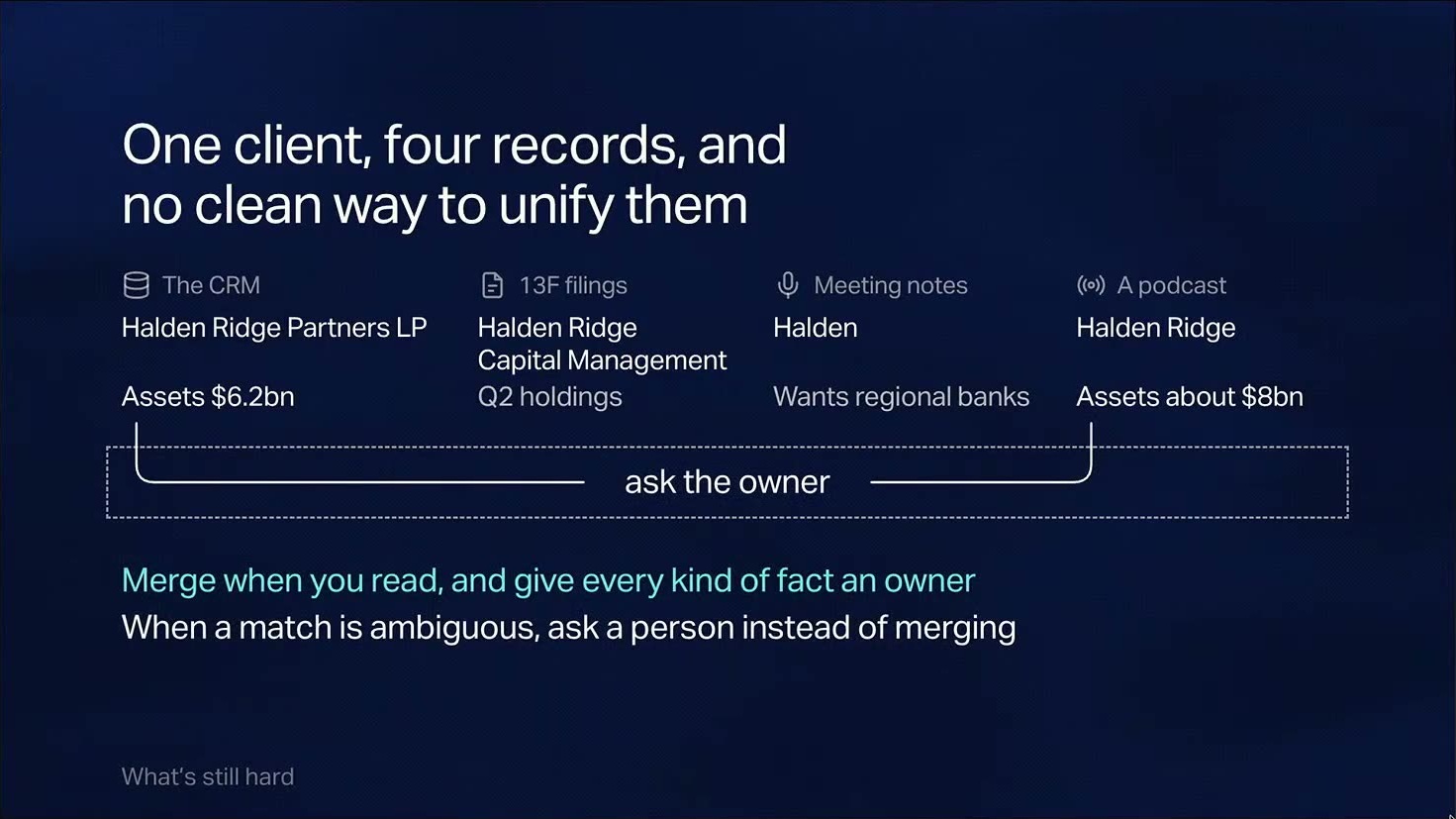
有几件事比较难做,也许我们可以在会后聊聊你的解决方案,我很想听听,例如,当你有很多信息时,同一个客户在 4 个不同系统里各有一条记录,却没有统一的标识符,该怎样优雅地把这些记录关联起来?这是一个我觉得我们还没有明确答案的问题。
So a couple of things that are difficult to do, just to kind of, maybe we can chat outside about your solutions, I'd be very curious to hear, are when you have a lot of, you know, for example, one client with four records and four different systems with no canonical identifier, how do you go about mapping those in a very elegant way? That's one thing that I don't think we have a clear answer to.
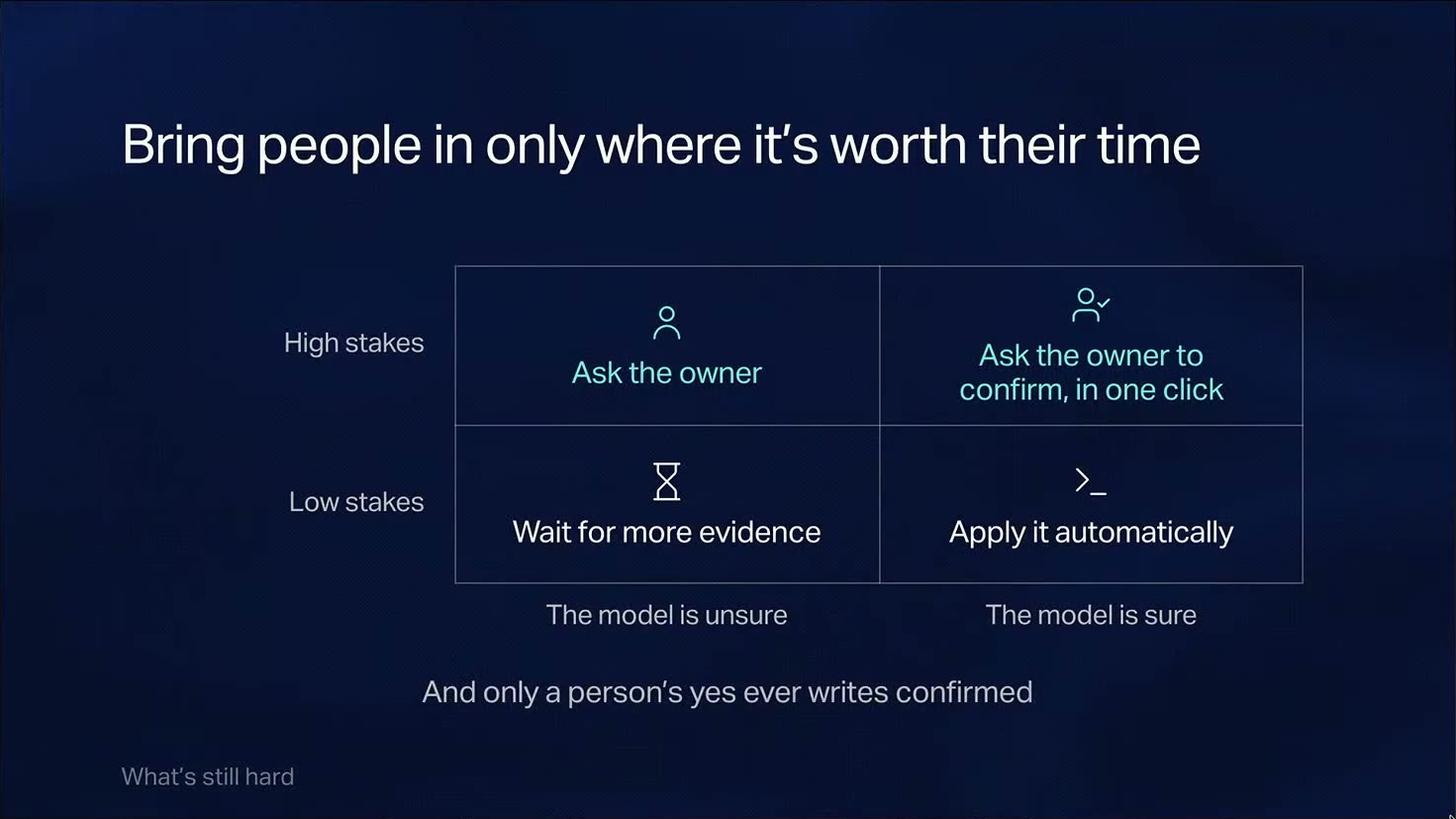
第二,如何最有效地从利益相关者和用户那里捕捉信号?模型有把握、风险也很低时,就直接自动处理。风险低但模型没把握时,就等更多证据。但风险很高时,问谁、什么时候问,以及整个反馈机制,就都非常重要。再看一遍这个循环。更新、时效、观测、评分和纠正。最后给大家 3 点建议。你的公司所拥有的模型,应该把它看作一个状态估计器,对吧?
The second thing is, how can we be most effective at capturing signal from stakeholders and users? Where the model is sure, and the stakes are pretty low, you should just apply it automatically. When those stakes are low, but the model isn't sure, just wait for more evidence. But if the stakes are high, it really matters who you ask, when you ask it, and kind of the whole mechanism there. So here's the loop again. Update, age, observe, grade, and correct. And three things I want you to take home. The model that your company has, you should think about it as a state estimator, right?
不要以为只要把一切都索引起来,再把一切编目,就足够了,因为这些事情本质上极其微妙,
Don't assume that just like indexing everything and cataloging everything is enough because by definition, these things are extremely nuanced
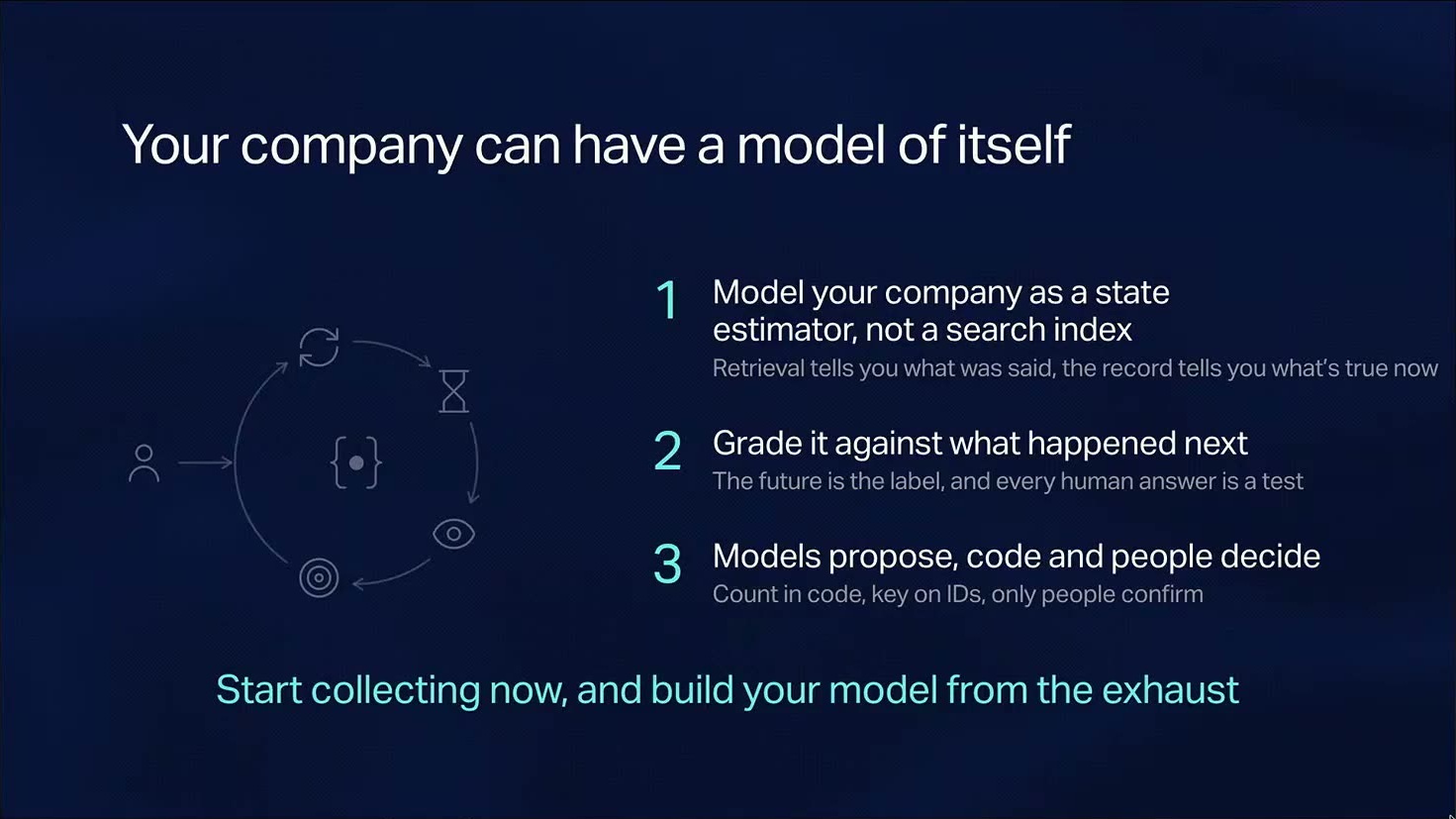
而且其中固有的信息往往藏在字里行间,即使最先进的模型也很难捕捉。要根据后续发生的事情对它评分,对吧?所以要认真考虑如何整合,并从一开始就实施评测。还要想一个优雅的方案,让你的模型、智能体和利益相关者能够和谐协作。你的公司可以拥有自己的模型。我建议现在就开始收集信息,如果你还没有开始的话。尤其是如果你在一家大公司,而且像我一样,有幸或者不幸地处理过数千份演示文稿,那你肯定应该开始考虑这件事,因为我确实看到明显的改进,智能体现在能够重建那种公司记忆,并把它运用到各种日常任务中,而且不会对所有事情都一头雾水。
and this intrinsic information that lives almost between the lines is hard for even the best state-of-the-art models to capture. Grade it against what happens next, right? So be intentional and think through how you can integrate and implement evals from the get-go. And think about an elegant solution that allows your models and your agents and your stakeholders to kind of play nice together. Your company can have a model of itself. I encourage you to start collecting now if you're not collecting already. And certainly if you have, if you're at a bigger company and like me you had the fortune or misfortune of dealing with thousands of decks, definitely something you should start thinking about because I've definitely seen material improvements in how these agents are able to reconstruct that sort of corporate memory and apply it in all sorts of daily tasks without sort of being all confused about things.
好,非常感谢。我是 João。如果你们有问题,我会在外面等大家。谢谢。谢谢大家。
Okay, thank you very much. I'm João and I'll be outside for any questions if you want. Cheers. Thank you.