自我改进型组织
Self-Improving Organizations
原文由官网提供,中文由 GPT-6 Luna 翻译。相邻片段合并排版,正文与时间点保持对应。
已插入 16 张经核对的幻灯片或演示截图;点击图片可放大。图注链接为当前视频时间,左侧正文时间保留原转录版本,二者可能不同。
共 35 个阅读段落
大家好,最近怎么样?我是 Will Brown。我负责 Prime Intellect 的应用研究,希望大家都在 AI Engineer 大会上玩得开心。这一直是我最喜欢的大会之一。看到大家在做什么、构建什么,总是很棒,我觉得这里让人们有机会讨论未来会是什么样,并开始观察行业趋势,了解哪些进展有效、哪些无效。今天这场演讲的主题大概就是思考:从我们目前正在做的事情出发,接下来会发生什么,我们一直在做哪些工作,以及从正在开展的研究中看到了什么,这些都指向我们对未来 AI 可能形态的看法,尤其是在组织层面。
Hey, how's it going? I'm Will Brown. I lead applied research at Prime Intellect, and I hope you are all having a great AI engineer conference. This is always one of my favorites. It's always just so cool to see what everyone's working on and building, and I feel like it is a place where people get to talk about what the future looks like, and start seeing the trends in the industry and seeing the progress and what works and what doesn't. And that's kind of the theme I want to think about for this talk today is what comes next from what we're doing right now and what are some of the things that we've been working on and also just been seeing in research that's unfolding that kind of points at what we think the future of AI might look like at the organization level.
过去几个月、几年里,我们看到智能体、界面、机器人等方面取得了很多很棒的进展,诸如此类。但未来还会有更多进展。一切发展得太快了。我觉得现在是个非常令人兴奋的时期,我们可以想象、推测并规划接下来会发生什么,以及未来的走向。
We have seen a lot of very cool progress in agents and interfaces and bots and things like that over the past several months, years. But there's always more coming. Things are moving so fast. I think it's a very exciting time to just imagine and speculate and plan for what comes next.
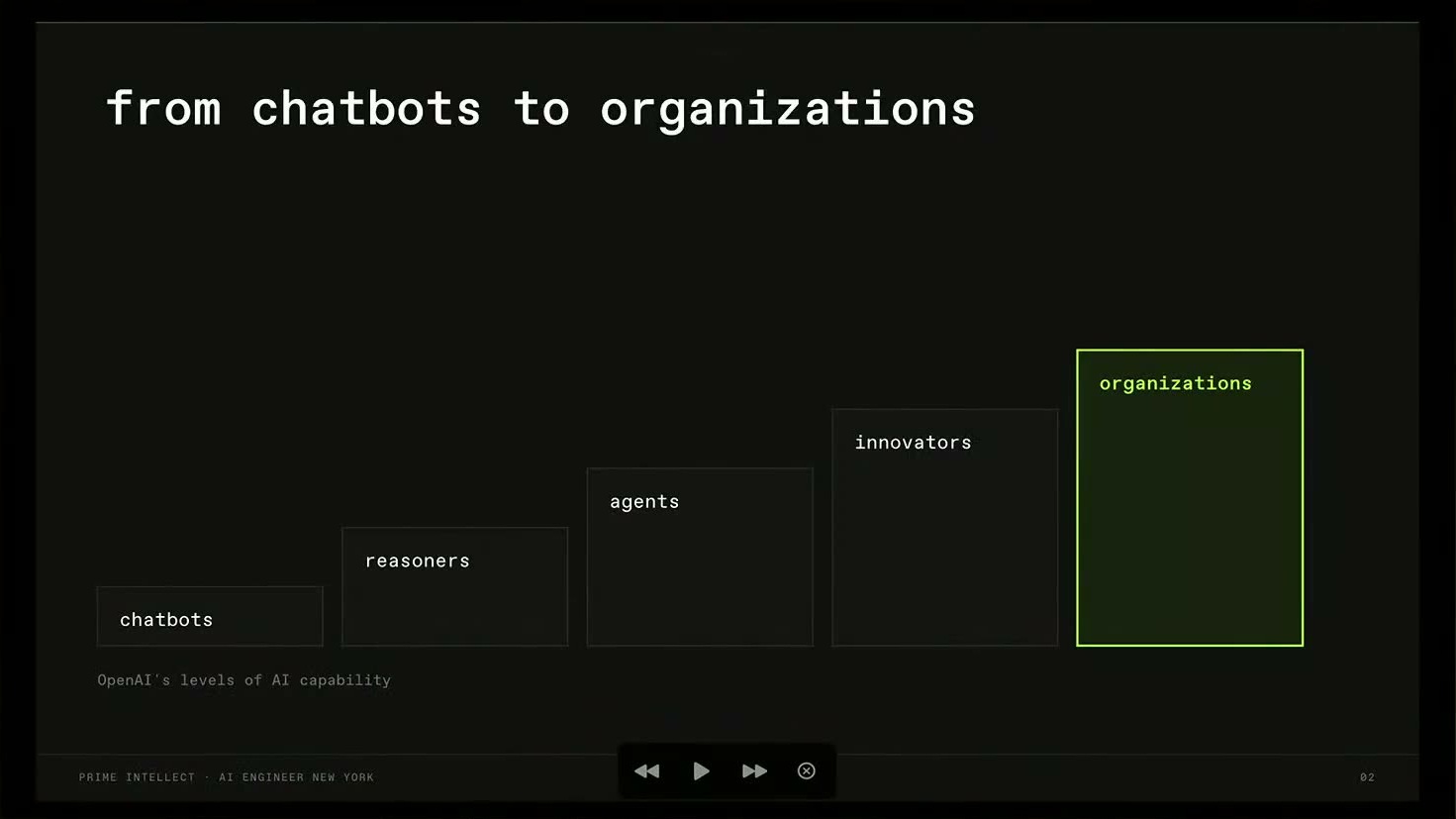
不知道大家是否还记得早期 ChatGPT 的日子,OpenAI 当时大致阐述过他们对通往 AGI 的道路上 AI 进展不同阶段的划分。通往 AGI 的不同阶段。我觉得我们的进展比预期快得多。我记得 18 个月前,我在纽约参加 AI Engineer 大会并发表演讲,当时我们已经有了推理模型,聊天机器人也出现一阵子了,而推理模型是新事物,但那时我们还没有真正的智能体。现在我们很快经历了智能体和创新者阶段,接下来的问题似乎是:好,那么组织会发生什么变化?
I don't know if any of you remember back in the early chat GPT days, open AI had kind of spelled out their framing of what are the different stages of AI progress on the road to AGI. And I think we moved along this faster than we thought we would. We like, I remember 18 months ago I was here in New York at AI engineer giving a talk where where we had gotten reasoners and chatbots had been around for a while and reasoners were the new thing, but we didn't really have agents yet. And now we've climbed pretty quickly through agents and innovators, and the question next seems to be, okay, what happens for organizations?
组织真正成为 AI 原生意味着什么?这不只是说初创公司使用很多智能体、用 Claude Code 构建所有东西,而是要达到大型企业的规模。未来的公司是否会深入整合智能体,贯穿整个组织的生命周期?我们又需要构建什么,才能走到那一步?
does it mean for an organization to truly be AI native, not just as a startup that uses a lot of agents and builds everything with Claude Code, but at the large enterprise scale, do companies of the future look like that involve deep integration of agents throughout the life cycle of the organisation? And what do we need to build on the path there?
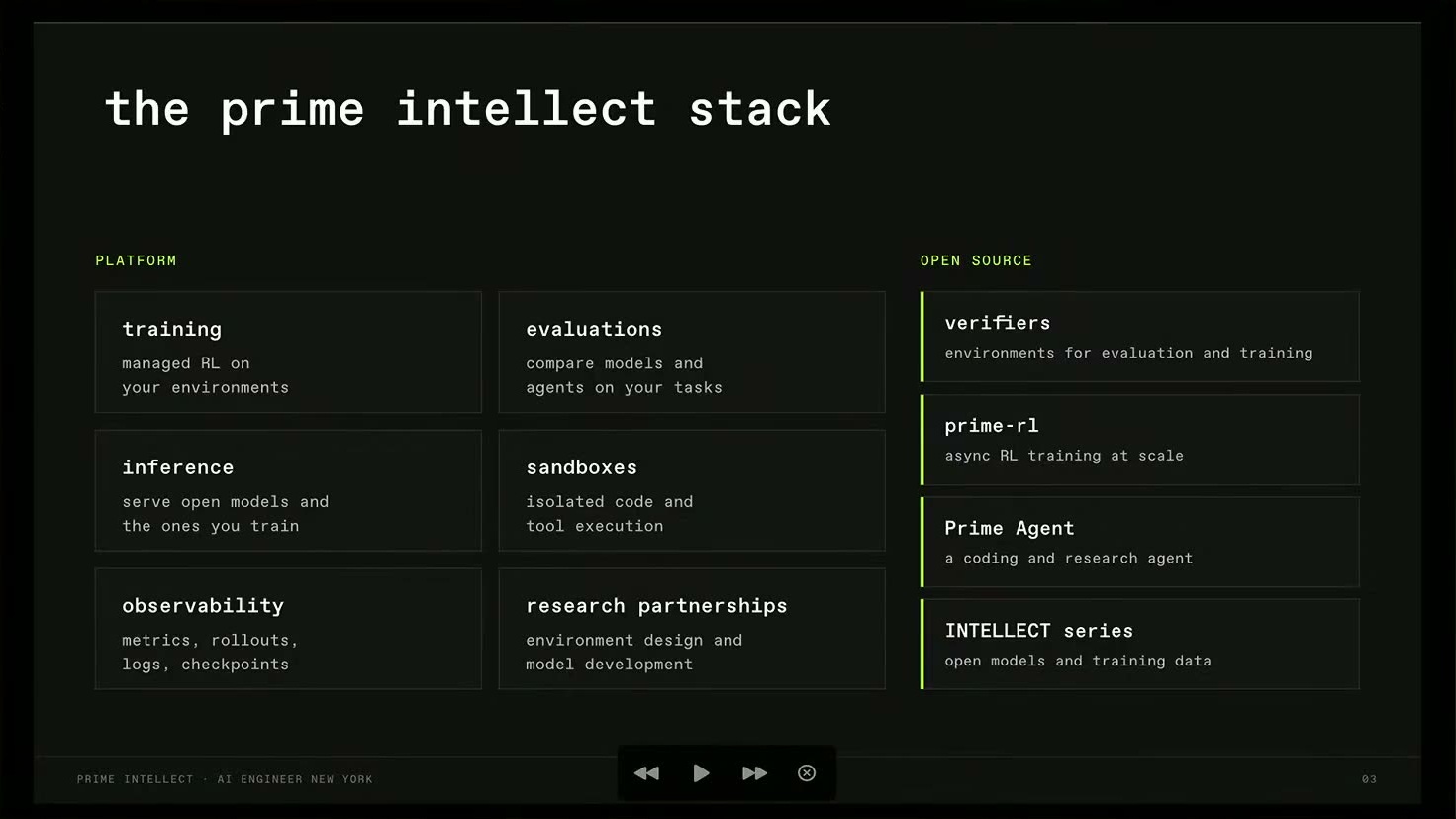
先简单介绍一下 Prime Intellect,作为背景。我们围绕 AI 基础设施构建很多东西,用于训练、部署,以及持续改进模型,尤其是开源模型和开源工具。我们做很多工作,大致涵盖大型实验室内部会做的那些事情,这些就是我们的产品。我们这样做,是因为我们想象一个似乎很快就会到来的未来:开源模型可以轻松获取,你可以在自己的工作流、数据和运行框架上训练和部署它们;组织可以让这些模型随着自身发展共同成长,从而累积机构知识,并从工作流、数据、员工和流程中形成机构优势,同时也能使用前沿实验室的模型。
So a bit about Prime Intellect, just for some backdrop. We build a lot of different things around AI infrastructure for training, deploying, and continuously improving models, and especially open source models and open source tooling. And so we do a lot of things, and we roughly do the sorts of things that you would do inside of a big lab, and these are our products. And the reason we do this is because we are imagining a future that is coming pretty quickly, it seems, where open source models are readily available to train and deploy on your own workflows, on your own data, in your own harnesses, and can be the sorts of things that organizations organizations can have grow with them over time that allow compounding their institutional knowledge, their institutional advantage from their workflows, from their data, from their people and their processes in addition to using the models from the frontier labs.
这场演讲会谈谈我们如何看待这一切演变和展开:AI 原生企业中的训练扮演什么角色,如何与前沿模型共存,以及我们认为哪种形态最能为人们释放价值,它又会是什么样子?组织拥有大量知识,
This talk will be a bit about how we see that evolving and unfolding, where what is the role of training in an AI native enterprise, how does this coexist with the frontier models, and what do we think is going to be the version of this that really unlocks the most value for people and what does it look like? And so organizations have lots of knowledge
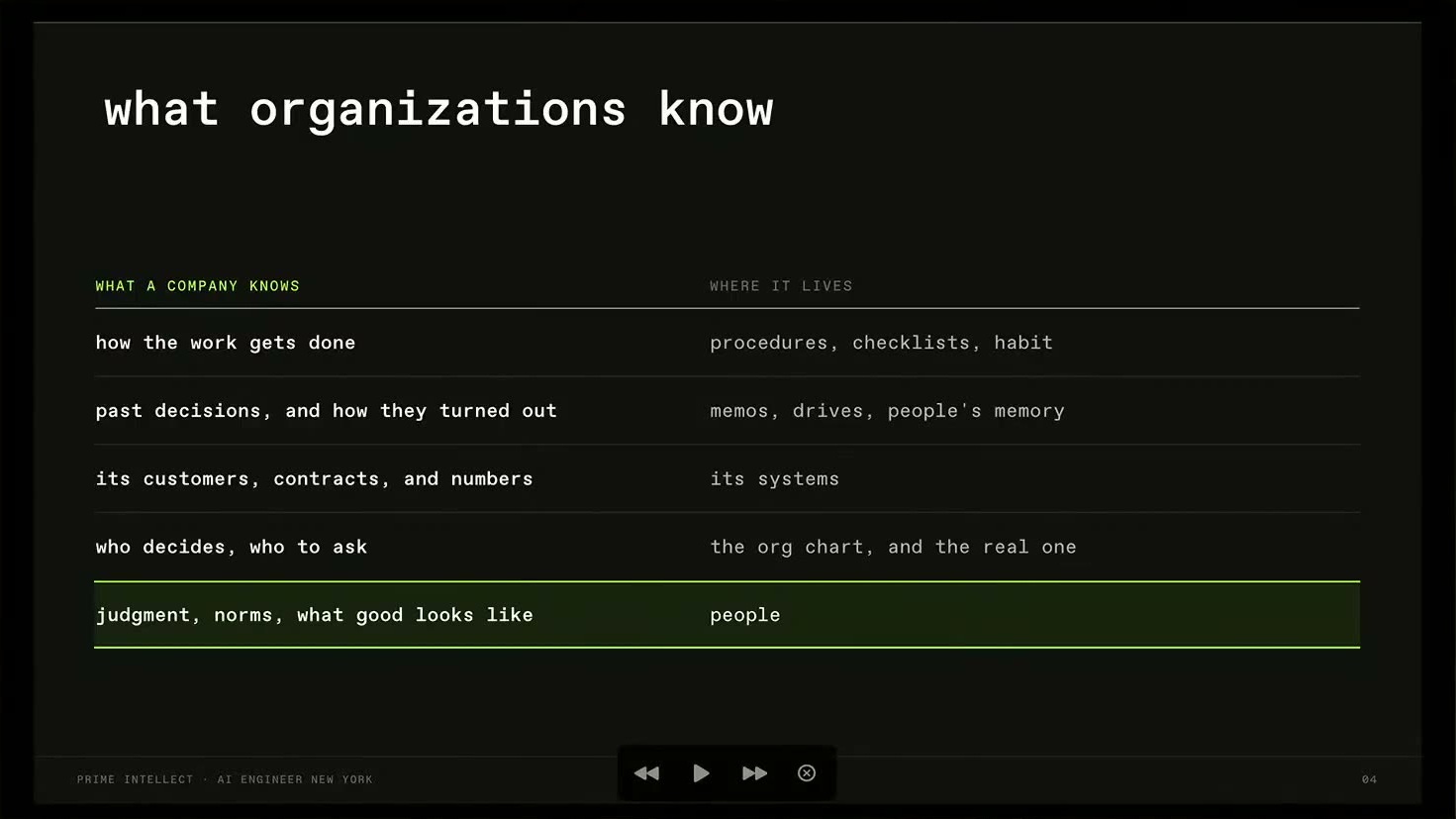
组织存在的时间越长,越成熟稳定,其中未明说的隐性知识就越多,这些知识往往从来不会被写下来。有些东西会被写下来,比如代码库、电子邮件和流程。其中有些内容写得非常明确,会规定你必须做某件事,或者某件事就是这样运作的。但很多事情存在于人们脑海里,也隐藏在电子邮件的字里行间,会议记录里,以及谁和谁交谈之类的关系里。很多公司纸面上有一张组织结构图,实际上还有一张真实组织图,显示究竟是谁在作出决策、变革如何在公司内推行,以及哪些指令可能真正生效。
and the longer organizations have been around and the more established it is, the more implicit knowledge there is that kind of doesn't ever get written down. There are things that do get written down. There's code bases, there's emails, there's processes. Some of these are very explicit. There are rules of you must do this, this thing works like that. But a lot of things live in people's heads and they live in between the lines of emails, of the meeting notes, of the kind of who talks to who. A lot of companies have an on paper org chart and then a real org chart of who actually makes decisions and how does change get adopted throughout the company, what sorts of mandates are likely to take effect.
人们在公司待久了,会积累起这些知识:哦,事情大致就是这么运作的。这些地方容易产生摩擦。我认为,在很多情况下,这正是 AI 在组织层面的重大机遇之一:很多员工个人其实无法改变组织中出问题的环节,因为没人把问题明确说出来。没人从全局角度审视组织里发生的一切并指出:这地方效率低,可以改进;这个问题不断出现在不同团队里,但没人发现解决方案其实已经由另一个团队找到。这正是智能体擅长处理的事情。
People have built up this knowledge from being at companies for a long time of, oh, this is kind of how things work. This is where the friction points are. And I think in many cases, and I think this is really one of the big opportunities for AI at the organizational level is, is that many individual people are kind of not in a position where they can change the things that are broken in an organization, because no one is actually spelling it out. No one is, like, taking a bird's-eye view of looking at everything that happens in an organization and saying, hey, this over here is inefficient, this could be better, this thing keeps happening across all these different teams, but nobody's figured out that the solution has actually been discovered by that team. And these are the sorts of things that agents are great for.
智能体很擅长梳理大量非结构化文本数据,从中发现这类模式,把它们转化为有用的东西并呈现出来,比如指出:这个工作流有问题,因为它浪费时间、效率低,其实可以换一种做法。不过,我们不想只做一次。我们希望这成为组织广泛采用 AI 的方式,让智能体能够获取所需上下文,同时也能改进智能体本身,并改进组织。我们希望智能体更像同事,但人类同事会在工作中学习。
Agents are very capable at combing through large amounts of textual data that's unstructured and finding these kinds of patterns and turning them into something useful and surfacing them as, okay, this workflow has a problem because it is wasting time and it's inefficient and it could be different instead. And we don't want to just do this once, though. We want this to become the way that organizations adopt AI broadly, where agents are able to get the context they need, but also they're able to improve both the agents themselves as well as the organizations. We want agents to be more like our coworkers, but human coworkers learn on the job.
目前智能体在工作中学习的方式相当原始,它们依靠上下文内学习。哎呀,抱歉。我倒回几秒钟,这样我们就可以在录像里剪掉这段。智能体学习的方式相当原始,比如通过上下文内学习,通常看起来就像它们
Agents currently learn on the job in relatively primitive ways, and they do this via in-context learning. and, oops, sorry. I'm going to go back a few seconds so we can edit this on the recording. Agents learn in relatively primitive ways through, like, in-context learning, and this typically looks like them
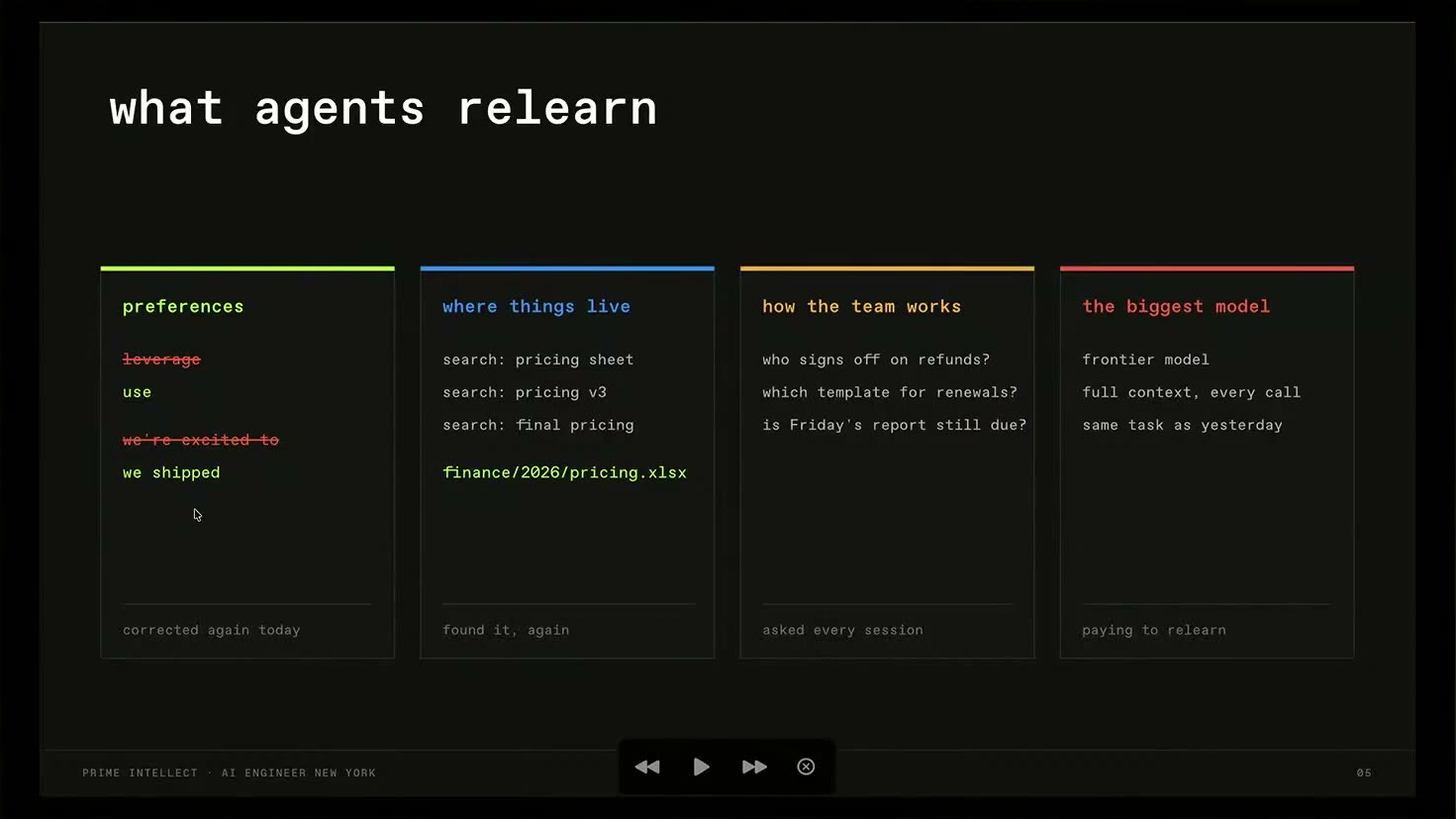
有别人写好的技能文件,或者浏览一下代码库,但它们并没有人类员工真正拥有的机构层面的隐性知识。它们会反复学习、重新发现事情,而且会消耗大量输入 token。如今人们意识到,缓存输入是许多智能体成本中的瓶颈。即使缓存率很高、缓存成本下降,你每次重新运行工作流时,仍然得重新处理大量输入。要解决这个问题,你会希望把更多东西融入模型,尤其是那些难以写成规则的东西。
kind of having a skill file written by somebody or, like, looking around a code base, but they don't get the institutional-level latent knowledge that human employees really do. They relearn a lot, they have to rediscover things, they spend a lot of input tokens. I think nowadays people realize that cached input is the bottleneck in many agent costs. And even if you do get great cache rates and cache costs go down, you still have to reprocess a lot of input to redo a workflow every single time. And so to get around this, you kind of want to bake in more into the model, especially for things that are harder to write down as rules.
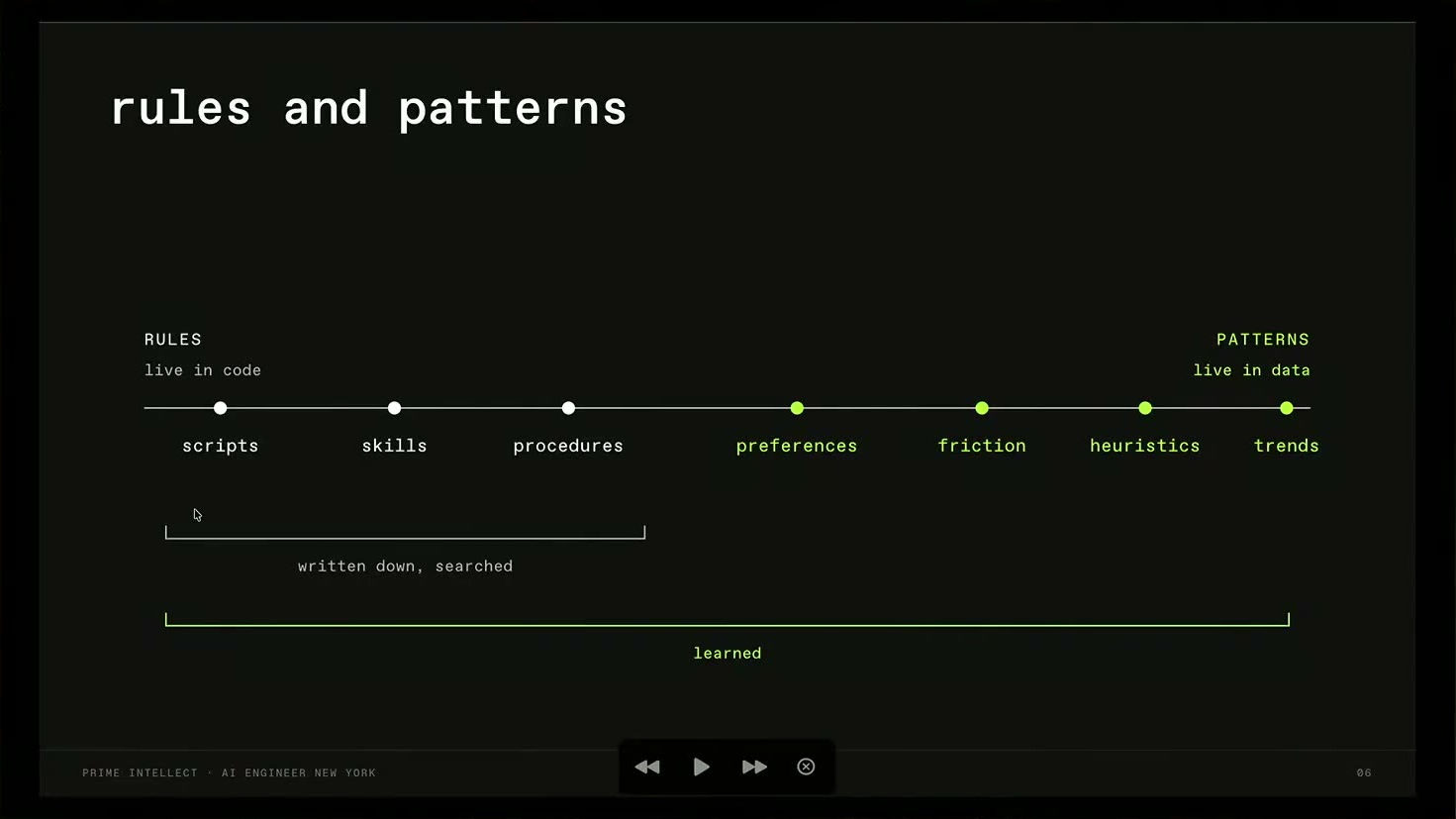
我喜欢把规则到模式看作一条连续谱,也喜欢从概念上思考代码与数据的区别。很多东西以代码形式存在,技能也有点像代码,规则也有点像代码,但偏好、摩擦、启发式方法和趋势之类的东西,都属于数据。机构依赖大量数据运行,而组织员工会隐性地学会这些东西,模型却从来没有机会真正学会。我们认为,这正是阻碍智能体成为真正同事的因素。
I like thinking about the spectrum from rules to patterns, as well as conceptually code versus data. And so lots of things live as code, and skills are kind of like this, rules are kind of like this, but things like preferences and friction, heuristics and trends, these are all data. And institutions have so much data that they are running on, and the employees of the organization implicitly learn that models never really get a chance to learn. And this is the sort of thing that we see as blocking them from becoming true coworkers.
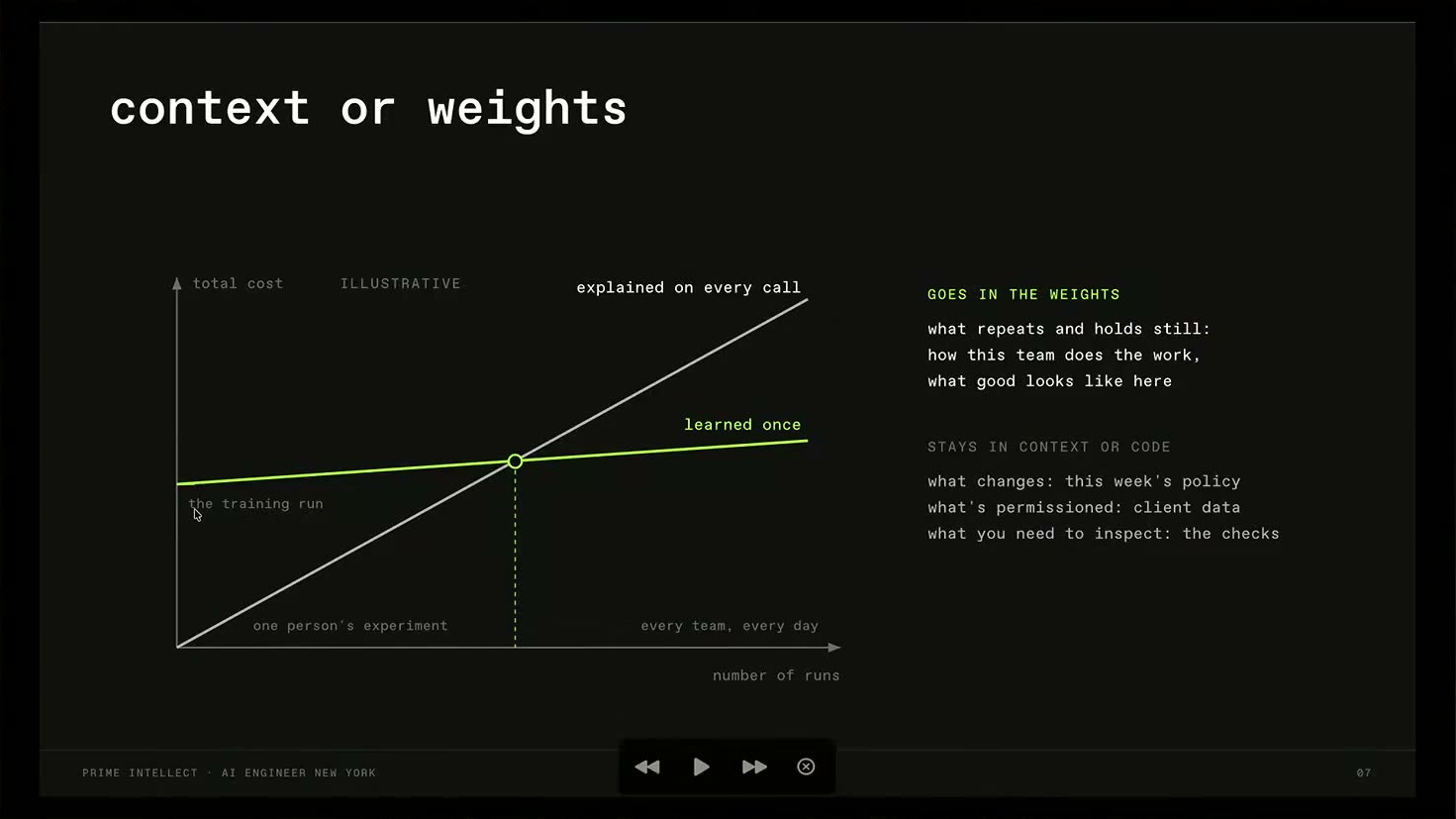
所以问题在于,哪些内容放进上下文,哪些内容进入权重。其中一部分需要靠表现来赢得。这些东西不会立刻进入模型权重。但看看每一代新模型,模型之所以更好,不是因为提示更好,而是因为训练得更多。训练有用。训练确实有效。我们看到的进步正是训练带来的。模型大致是在大量数据上训练的,这些数据旨在近似那些实验室认为有高价值的内容,也就是组织中的可重复工作流。我很喜欢这一点。
And so there is a question of what goes in context, what goes in the weights. And part of it is you kind of need to earn it. Things don't just go in the weights right away. But if you see every new generation of models, the models get better not because the prompt is better, but because they train them more. Training is useful. Training works. Training is why we see the progress we do. and the model is roughly trained on lots of data that is aiming to approximate things that the labs expect will be high-value, repeatable workflows at organizations. And I like this.
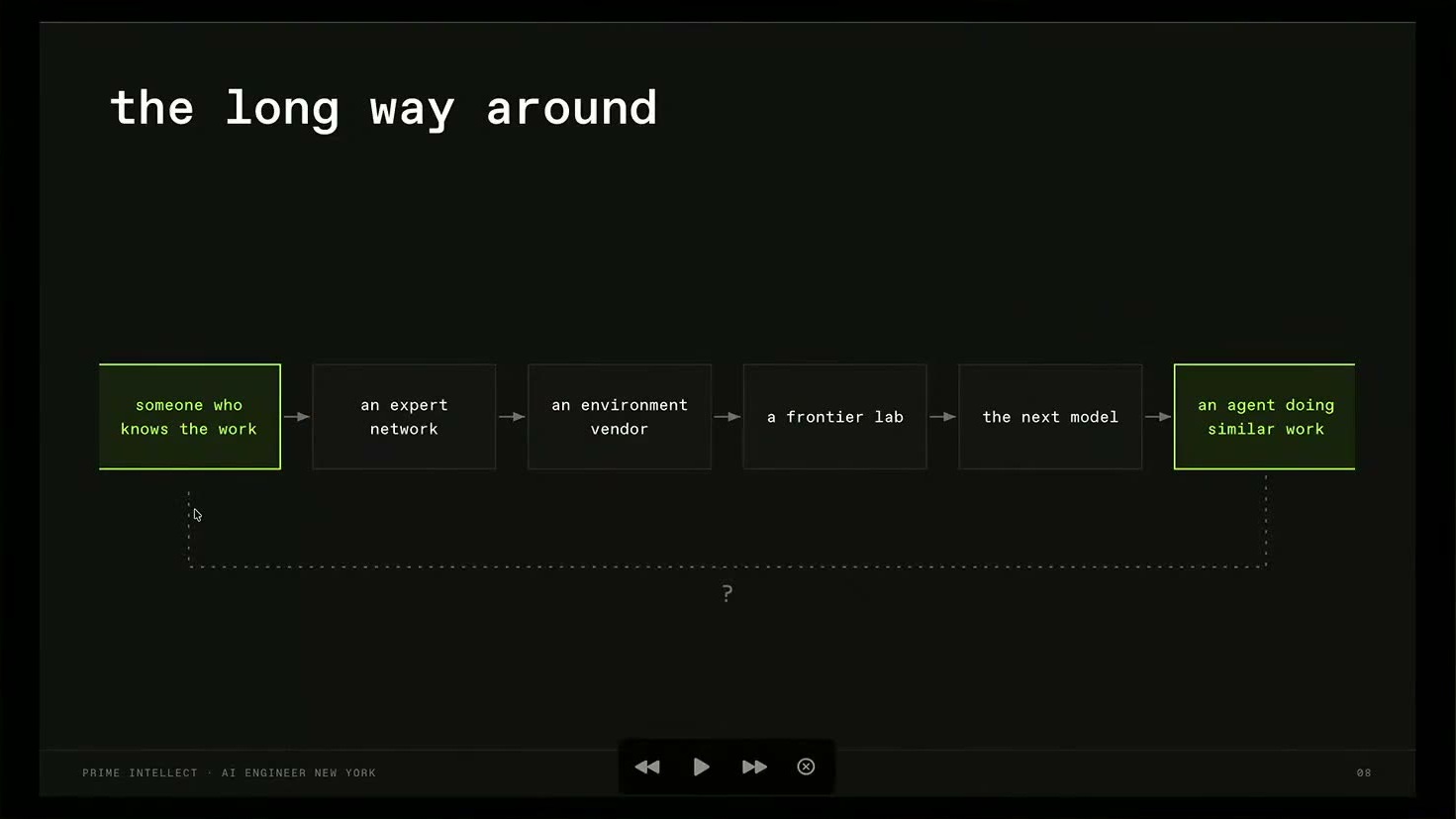
我觉得当前确实存在一套有效的流程。模型就是通过它变得更好。但把流程说清楚后会发现,它的效率相对较低。举例来说,要让模型非常擅长使用 Salesforce 工具组合,首先得有一个熟悉这些工具用法的人在找工作。这个人也许以前在使用这些工具的地方工作过,现在则利用空闲时间浏览专家网络网站赚钱。他把自己的知识分享给一家专家网络公司的员工。这家网络公司的员工随后会把这份人类提供的数据转交给另一个负责创建强化学习环境的人。
I think there's a process that currently it works. It's how the models get better. But if you spell it out, it's relatively inefficient. So the way that a model would learn how to get really good at using some combination of Salesforce tools, for example, Let's say someone who knows how those tools get used has to be looking for work. And maybe they previously worked at a place that were using these tools and now they are browsing expert network sites to make money in their free time. And they are sharing their knowledge to someone who works at an expert network company. This person at this network company will then take this data from the human and pass it to someone else whose job is to create RL environments.
这个强化学习环境接着可能会被一个不具备相关专业知识的人卖给实验室里的研究人员;他们也不是该领域的专家,然后会由他们进一步完善,并放入训练流水线,进入下一轮前沿模型训练,这样模型就能通过这场传话游戏,获得一些最初那位人类专家的知识。但这条流水线要经过很多步骤,而且整个过程相当保密。参与其中两个阶段的人彼此会交流,但真正懂这件事的人并不负责监督训练过程,也不会直接参与模型训练,就像如果人类每天都在为自己使用的编码智能体提供训练,就可以直接参与模型训练。
This RL environment might get sold then by someone who doesn't have this expert knowledge to a researcher at a lab who also really isn't the expert in the domain, who then will be refining it to put it into a training pipeline to go into the next frontier model run to make a model that has kind of through this game of telephone gotten some knowledge of that human originally. But there's so many steps in this pipeline and it's a relatively secret pipeline. People talk across two stages of it, but the human who knows this thing is not supervising the training run, is not directly inputting how the model gets trained in the way that a human could if they were doing it for their coding agent that they're working with day to day.
因此我们看到了一个机遇,也希望朝这个方向发展:缩小这个差距,让那些真正懂的人能够——就像我们使用编码智能体时每次都会重复提示相同的内容,告诉它们不要再犯相同的错误一样——直接训练模型。你可以告诉模型一些事情,让它们长期学会这些内容,而不只是把它们写成智能体的 MD 文件中的一行,然后文件不断累积、需要你不停重构。你可以把其中一些东西写进上下文,比如上下文偏好。在这种情况下,你刚才那样做并不完全符合我的意愿,我会更希望你换成这种做法。
And so what we see as an opportunity, and also where we would hope to go, is to close this gap and to allow the person who, the same way that when we work with our coding agents, we're prompting them the same things every time, telling them to not repeat the same mistakes. This is how you could train models. You can tell the models things and they will learn these things durably, not just as a line in your agent's MD which accumulates and you have to refactor it all the time. You can do some of that, but a lot of times what you really want is you're giving contextual preference. In this setting, this thing that you did was not exactly what I wanted and I would have preferred this instead.
我们希望系统能把这些反馈累积起来,形成持久学习。训练是实现这一点的非常有效的方法,因为你提供的数据形式与真正训练流水线所需的数据非常接近。
And we want systems that can compound this into durable learning. And training is a very effective way of doing this, because the shape of data you're giving there is quite close to what you would want from an actual training pipeline.
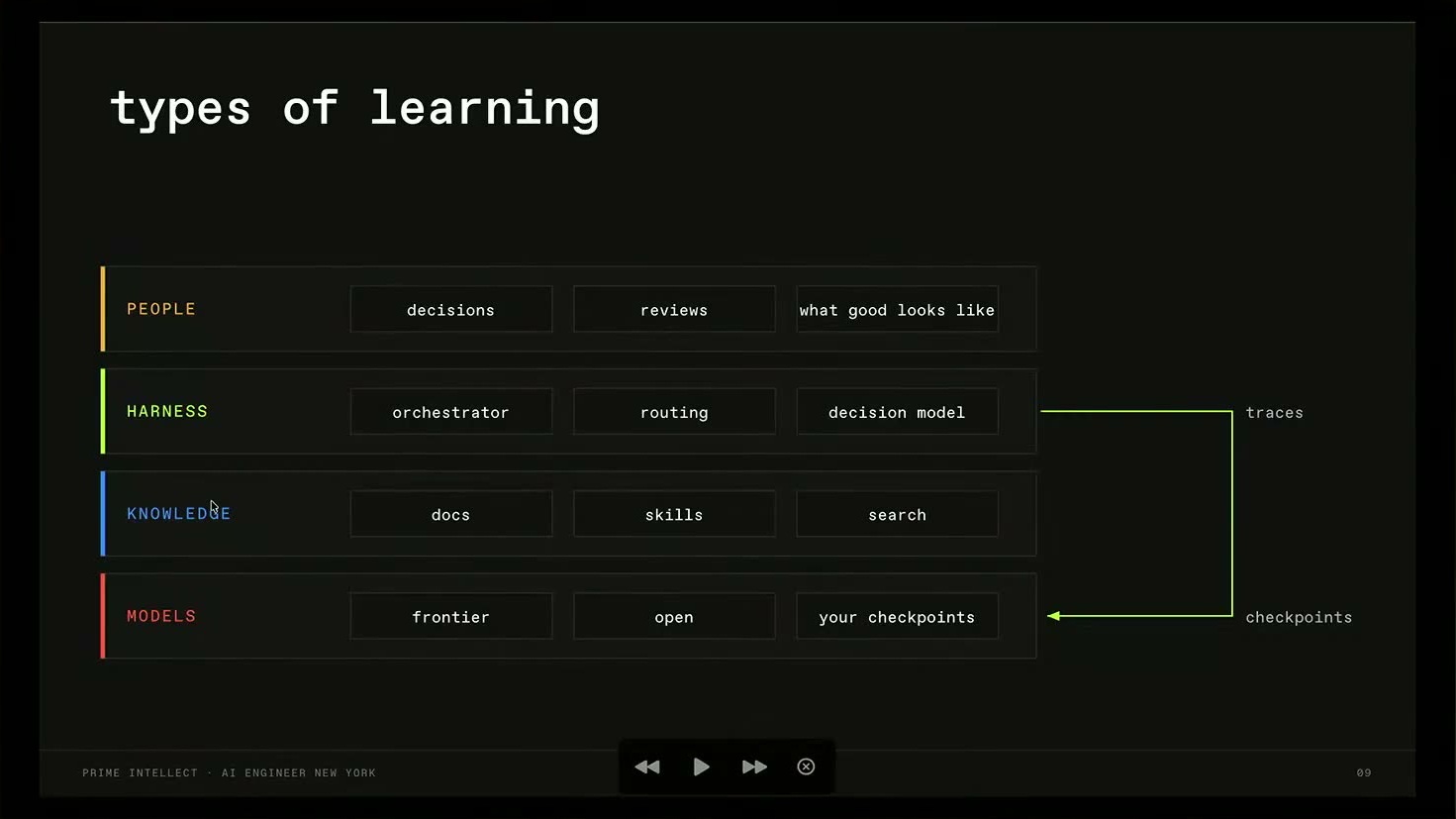
所以学习方式有好几种。人们会做一些事;你也可以在智能体运行框架层面通过技能和记忆来实现学习。组织里的文件系统和数据库中还存在大量知识,你可以用工具和代码检索这些知识。然后是模型本身,它们拥有非常广泛的世界知识。不过我相信大家都体验过这种挫折:使用知识截止日期已经过去很久的模型。如今,你基本没法和模型谈论过去 6 个月的新闻。每次都得让它们在上下文中重新学习一个世界模型。这使它们无法像讨论更早发生的事情那样流畅地讨论近期事件。
And so there's several different types of learning. There's things that people do, there's things that you can do at the harness layer with skills and memory. There's knowledge that just lives throughout an organization in file systems and databases that you retrieve with tools and with code. Then there's the models themselves which have this really broad world knowledge. But we all have, I'm sure, experienced frustration when using a model whose cut off of knowledge is a while back. You can't really talk to the models about the news of the past six months nowadays. They have to go relearn a world model in context every single time. This does not allow them to really operate as fluently as they can discuss things that happened longer ago.
因此我们设想,组织若想最大程度发挥模型的价值,会越来越希望拥有一些模型,让它们直觉层面真正理解组织内部正在发生的事情,也就是对组织有直觉层面的理解。这正是值得训练模型去掌握的东西。那么该如何实现?组织如何从抽象地提出一个想法——我们要用自己的数据训练模型——走到真正做到这一步?
So, organizations, to get the most value out of models, we imagine they will want to increasingly have models that really understand what is going on in the organization at an intuitive level. This is the sort of thing that you want to train for. So how do you get there? What is the road for an organization to go from having this idea in the abstract of we're going to train models on our data to actually getting there?
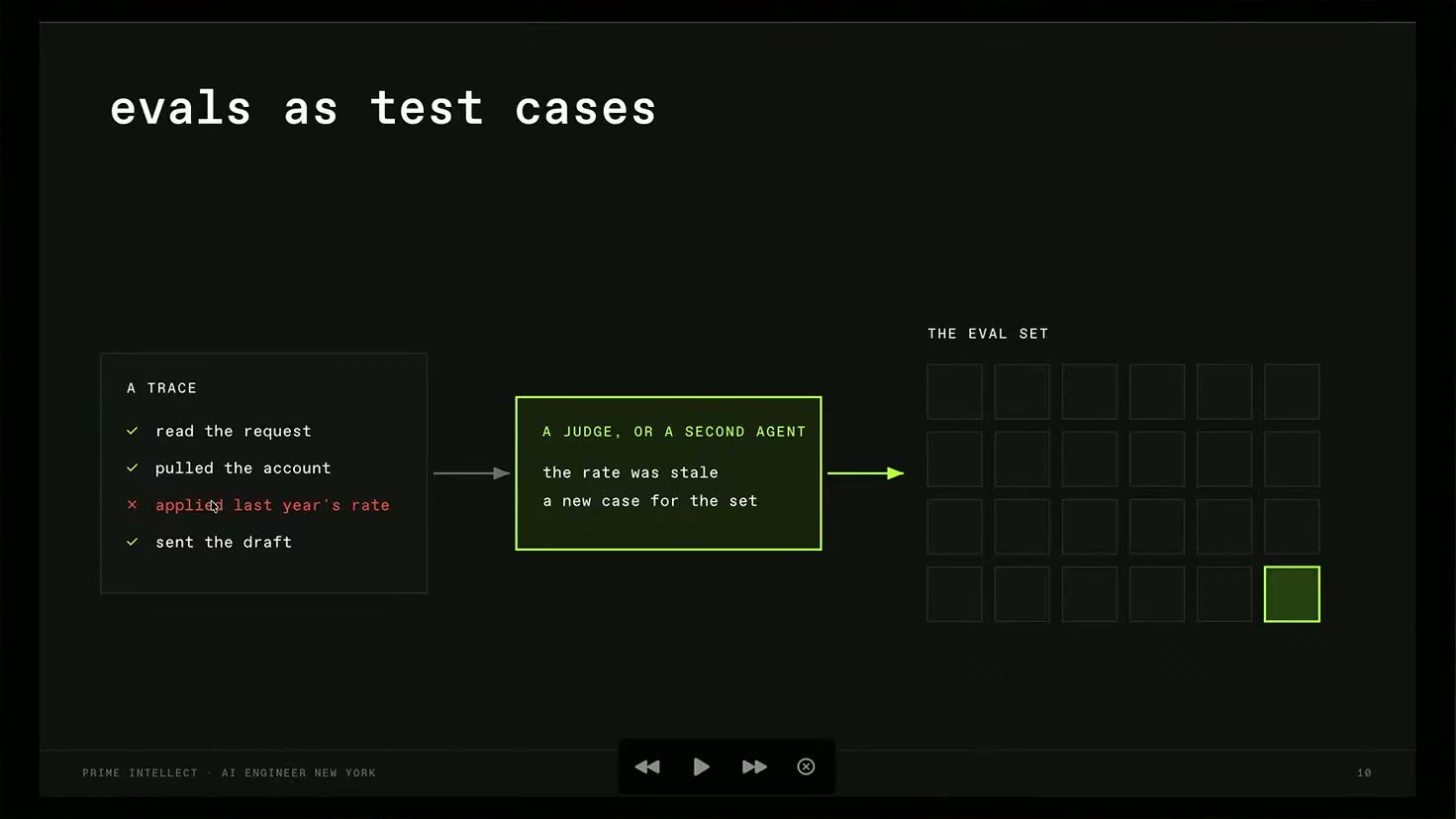
我认为一个非常有用的起点是把评测当作测试用例。我觉得代码领域已经成熟到一定程度,具备测试和生命周期管理,通常可以确保代码库随着时间健康发展。而智能体正在替我们做这类工作的很大一部分。我认为对大多数组织来说,最实际的持续学习方式就是把模型有点像代码库那样对待,为它建立一套生命周期。可以给它添加测试用例,添加功能,添加资产。使用智能体的过程也能帮助实现这一点:最初先收集轨迹。
And I think one really useful starting point is evals as essentially test cases. I think, like, with code, we've gotten to a point of maturity around, like, testing and life cycles and software development life cycles for ensuring that code bases grow healthily over time, usually. And agents are doing so much of this work for us. And the version of continual learning that I think is, like, most practical for most organizations is just treating a model kind of like a code base, where it is the sort of thing that you can have a life cycle around. You can add test cases to. You can add features to. You can add assets to. And this is the sort of thing that the process of using agents, like initially you collect traces.
这些轨迹包含你的提示,也包含你对模型表现的反馈。仅仅通过使用这些模型,你就会逐渐积累构建评测所需的资产。只是过去构建评测有点麻烦,很多组织不太愿意手动去做,不过智能体很快就能做到这一点,好在我们有机器人可以替我们完成很多评测整理工作,尤其是在我们用评测最佳实践对它们进行更多训练后,它们就能构建稳健且适合学习的评测。
These traces have your prompts and they have your feedback to things that models did. And this, just from the process of using these models, you are accumulating the assets you need to create evals. It's just that making evals historically has been a little bit painful and a lot of organizations have not necessarily wanted to do it manually, but the agents are quite quickly getting to the point where, thankfully, we have robots that can do a lot of the eval curation for us, especially as we train them more on the best practices of making evals in ways that are robust and amenable to learning.
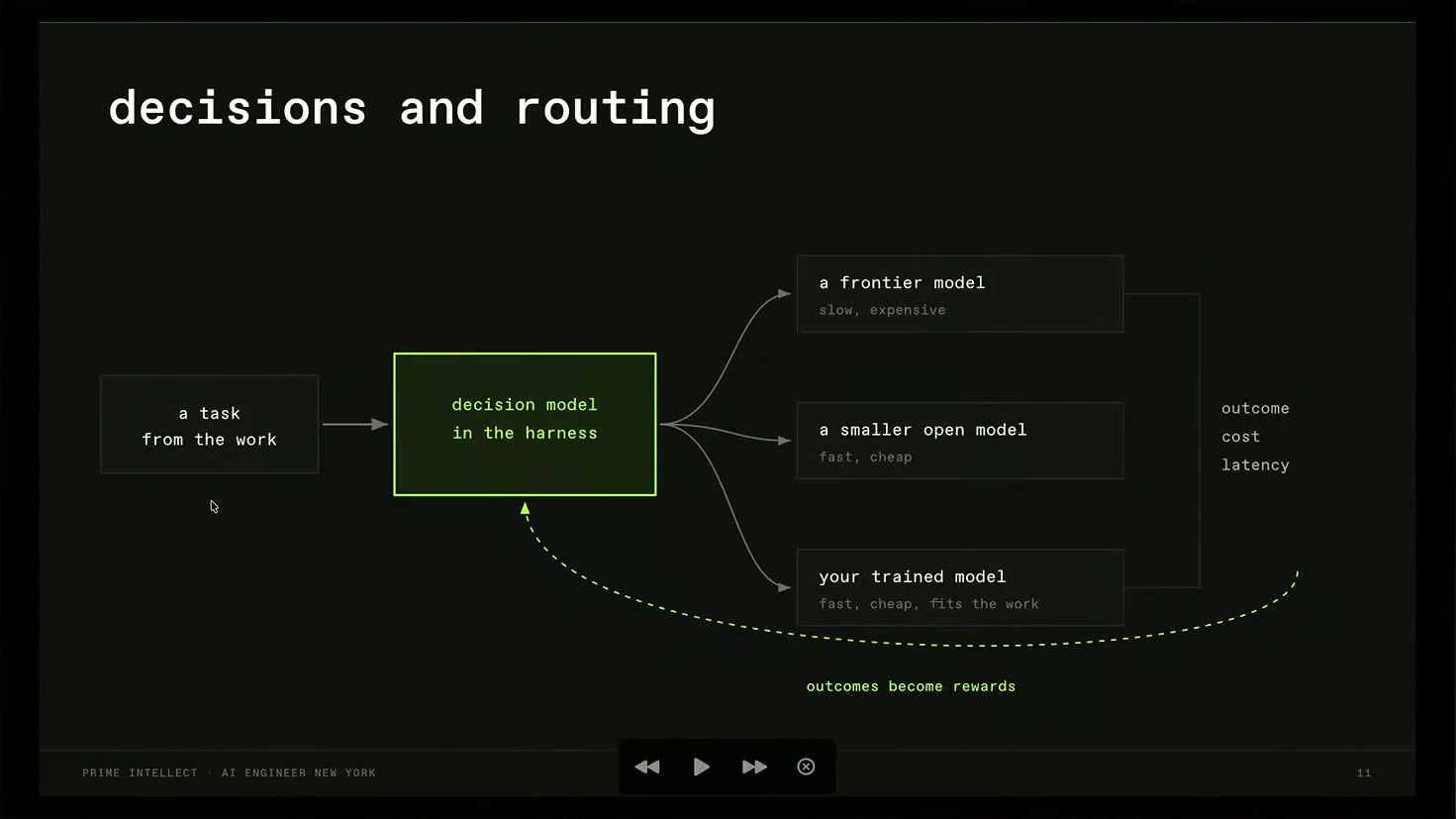
另一个很有用的例子是最近的决策模型热潮,过去几周以来,Jev 让这股热潮席卷了全球,此外还有路由方面的相似趋势,大家对成本优化也非常感兴趣,因为我们发现,每个月在 Claude 上花很多钱是完全可能的,于是我们会考虑何时应该使用更便宜的模型。我觉得人们逐渐认识到,这类逻辑需要放在智能体运行框架中。但它也具有一种属性,和决策模型非常相似。我把这两件事放在一起说,是因为有些任务标签非常明确,存在一个正确答案,而且人类或另一个智能体可以提供反馈。
And so I think another useful example here is the decision model craze that has kind of been taking the world by storm in the past couple weeks with Jev, and also the parallels around routing and people being very excited about cost optimization because we see that it's possible to spend very large amounts of money on Claude every month and we figure out when should we use a cheaper model. And this is the sort of thing that I think people are recognizing needs to kind of live in the harness. But it also is an attribute that looks relatively similar to decision models. And the reason I bring both these up together is because there's things with very clear labels where there's a right answer and there's an opportunity for a human or another agent to give feedback.
你可以让大模型和小模型执行相同任务,再判断小模型是否和大模型一样好。如果是,那么这就构成一种数据:对于这类任务,我们可以更多地路由给小模型。决策模型也类似,它会学习模仿人在特定情境下作出判断的方式。这是一个很适合标注的动作,人类可能会负责审批,就像我们有时会批准 Claude Code 的工具调用一样,不过我觉得大多数人已经启用了自动接受工具调用;每个组织对于更定制化、并非单纯涉及工具安全的事项,都会有自己的规则和偏好,而这些东西可以不断累积,形成决策模型。
You can have the big model and the small model do the same task, judge whether the small model was as good as the big model. If so, then this is now data of, like, for this kind of thing, we can start routing to the small model more. Same for a decision model that's learning to kind of mimic the way that a human in a certain situation would make a judgment. This is a great labelable action, where the human might be doing the approval the same way that, like, we approve our tool calls and Claude Code sometimes, times, but I think most people have turned on auto tool acceptance, but every organization for more bespoke things that aren't just about tool security are going to have their own rules and preferences, and these are the sorts of things that you could then compound into a decision model.
我认为这是一种非常可信的持续学习方式,很多人明天就能接入,并立即看到价值。
And so this is a very believable form of continual learning that a lot of people could just plug in tomorrow and see immediate value from.
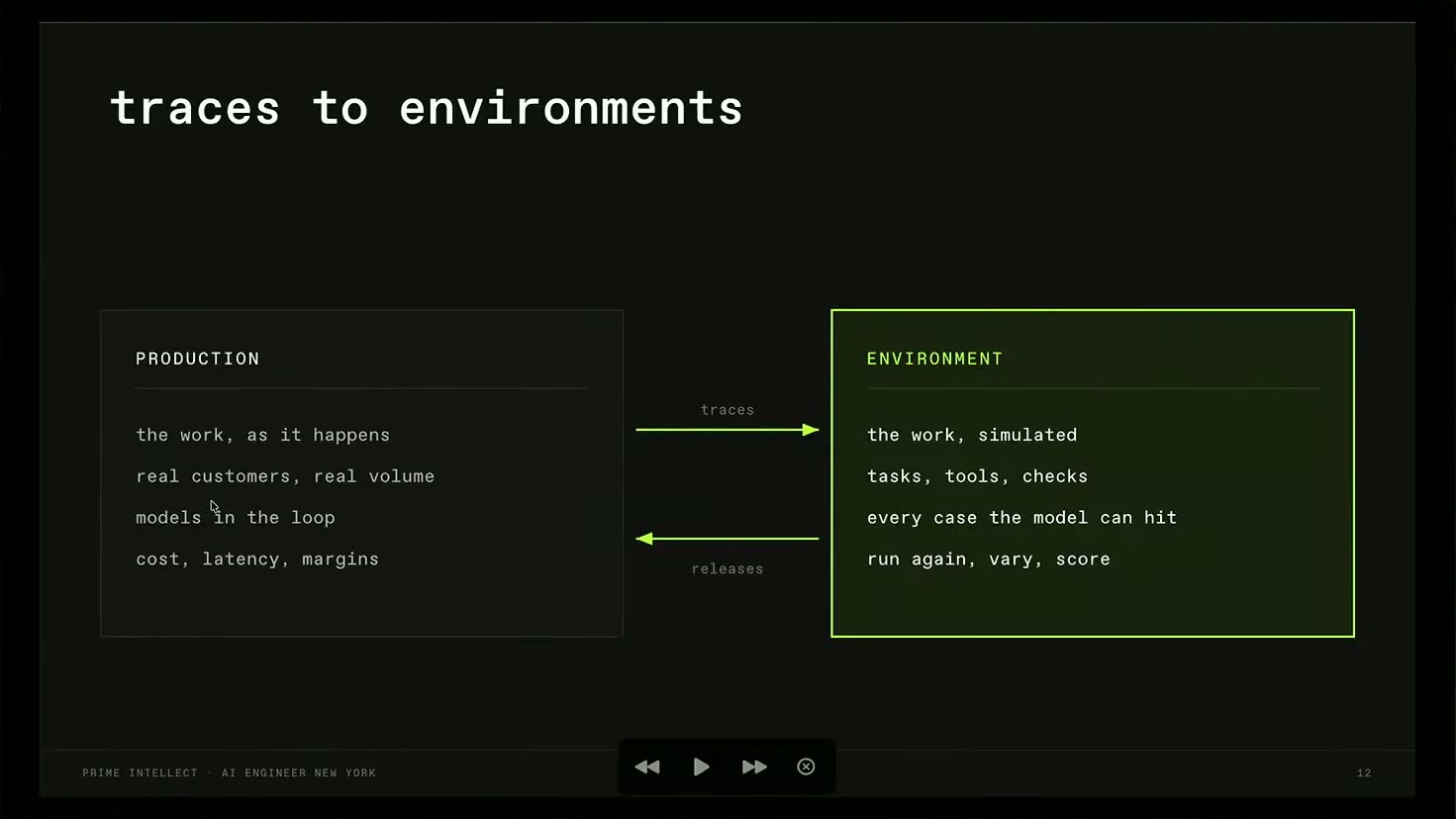
更广泛地说,我们看到人们想做的事情——这也是 Prime Intellect 很多工作的内容——是与想开展相当有雄心的训练项目的组织合作,把模型在高流量用例生产部署中产生的轨迹,转化为丰富、稳健、融合真实与合成数据的环境,这些环境能捕捉他们希望用长时间运行的智能体处理的真实任务的复杂性,也就是这类智能体要处理的任务。只要有充分的编排、工具支持,并让人类参与审核,智能体就很有用,能够把这些数据转化为足够丰富、可以用于训练的环境。我们看到,每一代开源和闭源模型都会让这个过程变得更加自动化。
But more broadly, what we see people wanting to do, and this is a lot of the work that we do at Prime Intellect is working with organizations that are looking to do relatively ambitious training projects around turning their traces from deploying a model in production for a high-volume use case into rich, robust environments that are blended, real, and synthetic that kind of capture the complexity of the real tasks they want to be using long-running agents for. And agents are very useful with sufficient orchestration around them, sufficient tooling and humans in the loop at turning these into environments that are rich enough to train in. And we see that this is getting more and more automated with every new generation of open and closed models.
这意味着我们有机会让整个流程自然形成:把我们已经在做的事情变成自我改进循环,只要用智能体整理数据并创建界面,让人类提供自己想要什么的信号。我自己一直在尝试这个想法,
And this means that we have an opportunity to start having this whole thing of taking the stuff that we're already doing and turning it into a self-improvement loop just kind of fall out magically from applying agents to curation of the data and creating interfaces for humans to give signal about what they want. This is an idea that I've been, for my own setup,
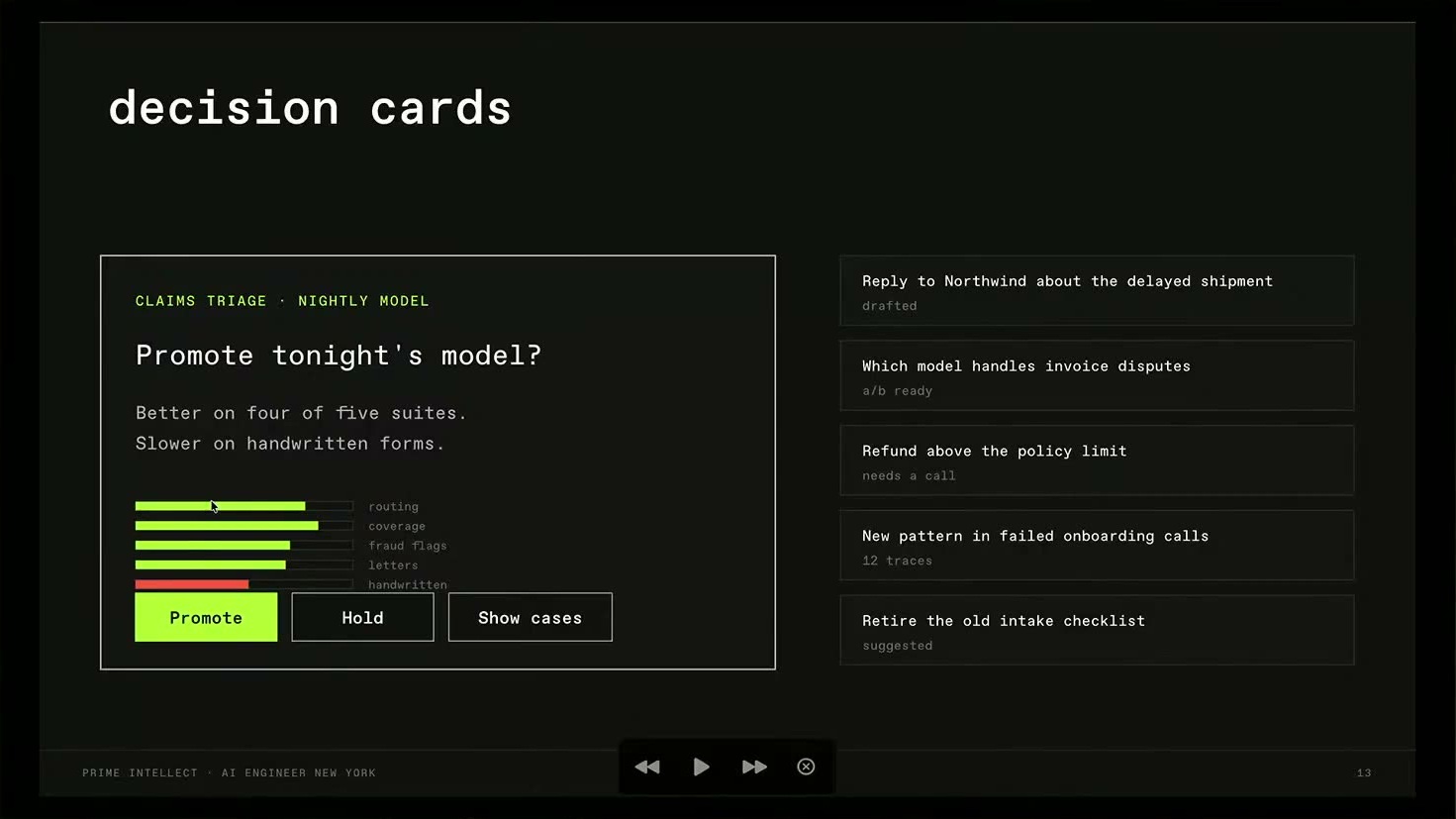
已经试了很多,我认为它会成为一种流行界面,让人们今后能更多地与模型互动。你们已经在一些机器人里看到一点这种形式,不过我觉得,尤其现在模型能即时编写代码,这类小组件卡片功能是一种非常实用的动态界面形式,也非常有助于引出人类的决策。它们有点像工具调用审批,但更加个性化、更加具体,也能绕过一个问题:你有 20 个不同的机器人在运行,得记住它们分别在哪里,还有谁在替你整理所有这些,然后人们会问:你想要一个机器人吗?
been playing around with a lot that I think will become a popular interface for interacting with models more in the future. You're seeing it a little bit in some of the bots, but I think, especially now that models are good at writing code on the fly, these kind of widget card features that are, I think, a very practical form of dynamic UI that are also really useful for eliciting human decisions. So they're kind of like the tool call approval thing, but much more personalized, much more specific, and also kind of get around the problem of, like, okay, you have 20 different bots that are going, and you have to remember which ones are where, and who is curating all this for you, and then people are like, do you want one bot?
你就说:一个挺好,不过我其实想要两个。于是你有两个,接着就有 20 个。我觉得我们一直在单一对话流和多流智能体线程之间来回摆动。但我们真正想做的是作出决策。我们想给智能体一些想法,让它们去执行,然后在需要我们作决定时再回来找我们。希望智能体能够妥善判断什么时候该把决策交给我们。如果智能体能即时为我们创建界面,让我们直接提供它们需要的信息,首先,这对我们人类来说比起阅读一长串对话、费力找出问题在哪里,要方便得多。这也有点像 Jev 式决策模型在人类一侧的对应形式,而且还能形成完美的数据。
And then you're like, oh, one's great, but I actually want two. Then you have two. Then you have 20. And I think we kind of are oscillating back and forth between this single stream and the multi-stream agent threads. But what we really want to do are make decisions. We want to give ideas to the agents, let them run with the ideas, and then come back to us when we need to make decisions. And the agents hopefully should make good choices about when to bring us decisions. And if agents can create interfaces on the fly for us that allow us to very directly give them the information they need, one, this is much more ergonomic for us as humans than reading, trying to parse through a long thread message to see where was the question. It's also kind of like the human dual side of the decision model, Jev style, but it also is perfect data.
我们一直在尝试用这种方式训练模型,通过这类自然界面接收人类输入,从而启动反馈循环;这些输入可以直接充当标签,成为模型能够直接改进的内容,因为目标非常明确。而且还能绕过很多问题,例如我们常听到的奖励操纵等等。这些问题也值得解决,但我们认为这是一种非常有用的起点,可以用于很多这类问题。这种做法可以应用,不一定要用在技术栈中的每一个模型上,可以用在编排层模型上,也可以用在决策模型上,但它是一个入口,能让模型开始不断累积偏好和隐性知识,并把这些内容融入模型。
And so it's a setting where we've been experimenting with this as a way of training models to kind of get this feedback loop going from having human input with these kinds of natural interfaces be the sort of thing that directly acts as a label and is the sort of thing that a model can directly improve on because there is a very explicit target. and it gets around a lot of the problems that we kind of hear about in reward hacking and whatnot. Those things are worth addressing too, but this is where we see a very useful starting point being for a lot of these problems. And this can be done, it doesn't have to be with every model in your stack, it can be the orchestration layer models, it can be the decision models, but it is an entry point for kind of starting to have this compounding of preferences and latent knowledge happen in the models.
最近还有一个例子,今天刚好有
And so I think there's a recent example today
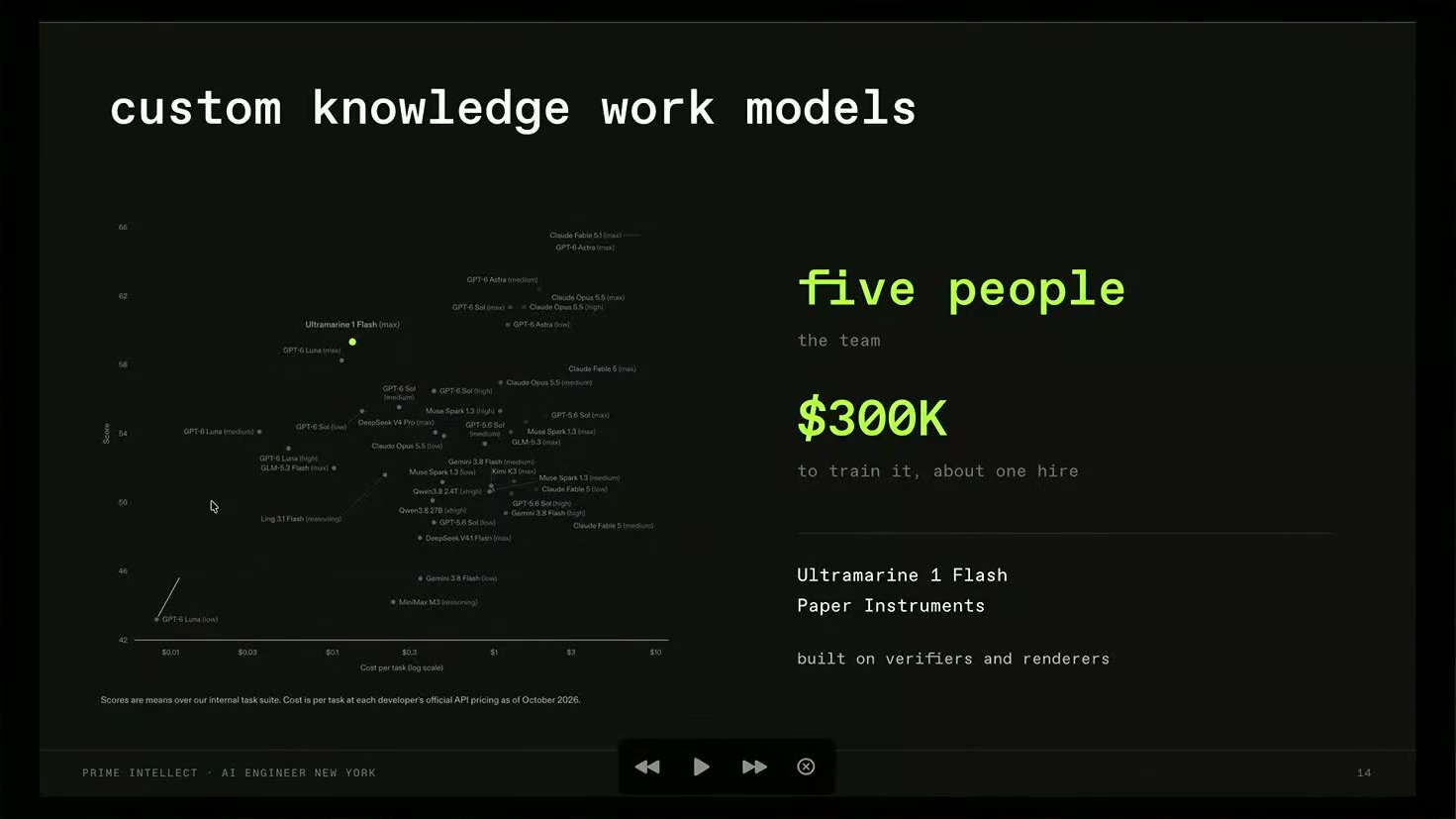
我之前加进来的内容,来自一家叫 Paper Instruments 的公司。他们用我们的一些工具做这件事,他们是我们的朋友。他们训练了一个模型,花费 300,000 美元,这个模型大致处于帕累托前沿的最优位置,适用于电子表格、幻灯片等知识工作。对组织来说,这相当于一笔员工级别的投入,也就是组织要作出的投入,可以用来聘一名软件工程师,也可以用来训练一个模型。你还可以把这项投入分散到更长的一段时间里,逐步累积知识。这类事情正变得越来越实用,而且它也是我们看到很多组织如今都想做的事情。
I just added this earlier From a company called Paper Instruments They use some of our tooling to do this They're friends of ours But they trained a model for 300k That is kind of Pareto Frontier optimal For knowledge work for things like spreadsheets and slides And it's like an employee scale investment For an org to do where you could go hire a software engineer or you could train a model. And you can also spread this out over a longer period of time if you're kind of compounding the knowledge over time. But it's the sort of thing that is increasingly becoming quite practical and it's the sort of thing that a lot of organizations we see wanting to do now
我们也看到了一个趋势,人们对这类工作的需求正逐月增长,因为大家开始认识到:第一,这件事的价值,以及开源模型已经足够好,可以进一步改进,并变得更加个性化;只要把你的领域知识、智能体运行框架和环境转化成训练环境,供模型训练。而且这种做法天然适合形成学习循环。
and we kind of see the trend of how much more the demand for this is growing month after month as people start recognizing, one, the value of this and how kind of the open models are good enough that you can get them to be much better and also much more personalized by turning your knowledge for your domain, your harness, your environment into a training setting for them. But also it's the sort of thing that naturally lends itself to a learning loop.
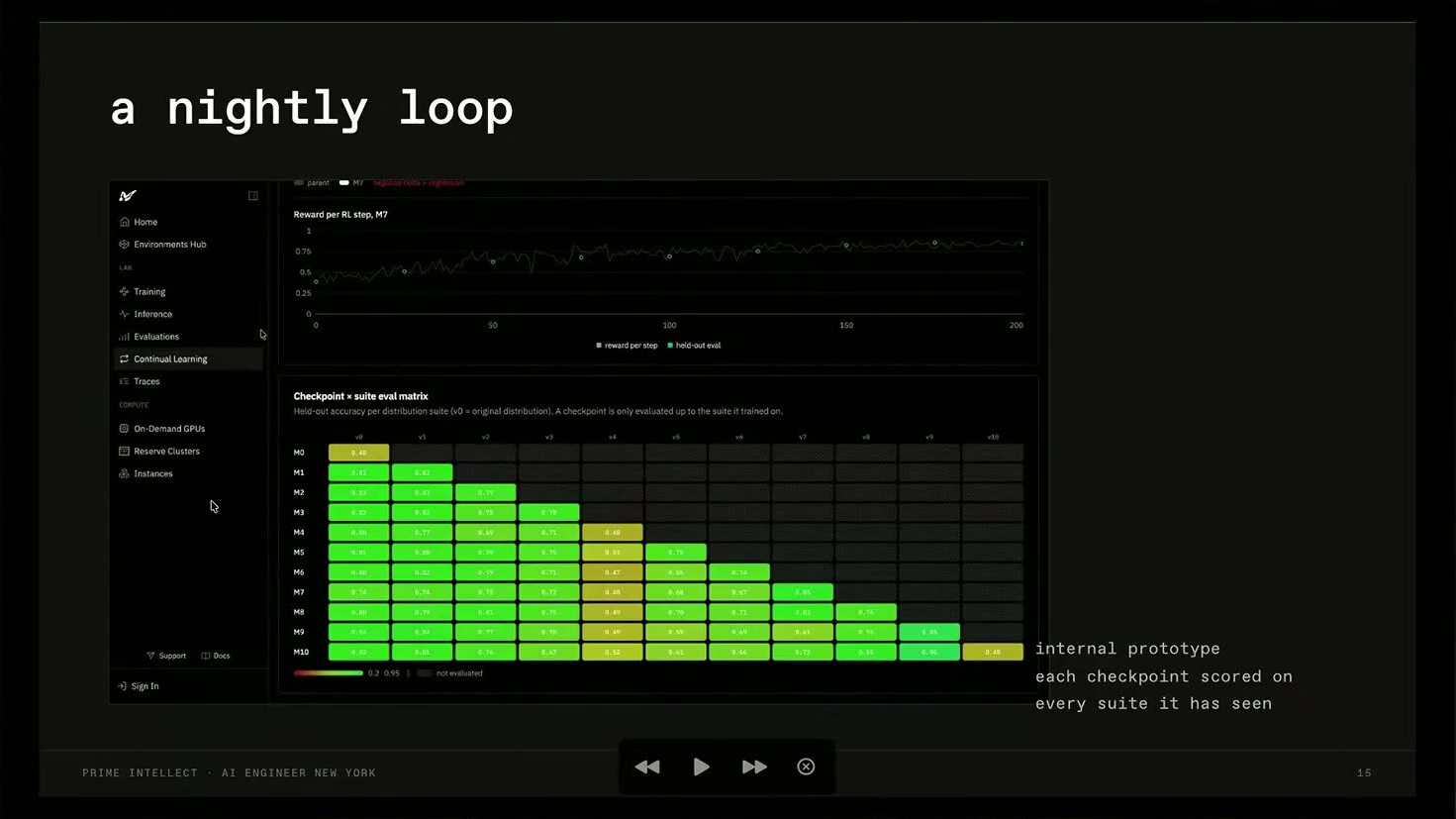
这是我们内部正在做的一个原型,关于我们如何设想人们如何真正在现实中部署持续学习:你可以拥有运行轨迹、开始收集这些数据,然后每天晚上查看拟议的实验,检查被标记为问题的事项,并启动当晚的训练任务。白天,你的推理算力可能用于为智能体提供服务。夜间员工使用得没那么多时,你可以把算力转而用于训练,而不是推理。我们认为这是一种很自然的方式,让组织很快就能真正基于模型权重进行持续学习,并开始不断累积知识,让智能体具备越来越强的能力。
And so this is a prototype of something we're doing internally around kind of how we're imagining people can really deploy continual learning in the world, which is that you can have traces, you can start collecting these, and you can then, like, every night, see the proposed experiment, look at the things that have been flagged as issues, and kick off a training run for the night. Maybe your inference capacity in the day is serving your agents. At night, employees are not using them as much, and you can use that capacity for training instead. And so this is a very natural way that we see organizations able to, like, quite soon, actually do for real continual learning in the weights of the models and start compounding their knowledge into better and better capabilities for their agents.
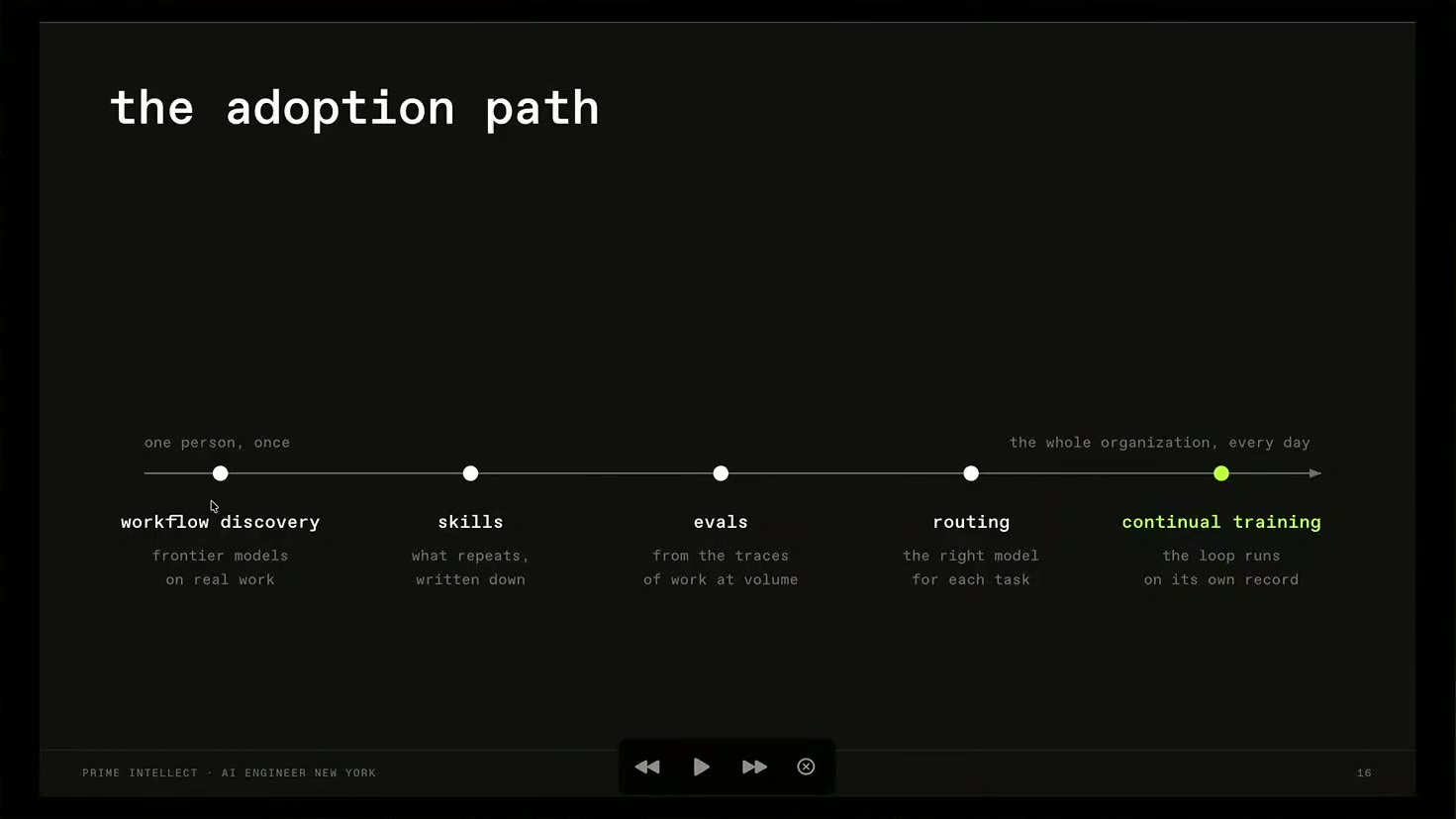
我们认为很多工作最终会朝这个方向发展。首先要做的事情很多:你要先发现自己的工作流,创建技能、构建评测、做路由,之后才会逐渐想要获得规模经济,获得不断累积的收益,这些收益来自公司和组织内部的数据,并让组织变得越来越能够自我改进,随着时间推移不断变好。我讲完了。如果时间允许,我可以回答问题。我也不确定。没有问题。是的,我们来自 Prime Intellect。
And so this is kind of where we see a lot of this culminating towards, there's so many things you do first. You discover your workflow, you create skills, you make evals, you do routing, and then eventually you start to want to get the economies of scale, get the compounding benefits that come from the data inside of your companies, your organizations, and have the organizations become increasingly self-improving in ways that get better and better over time. That's what I got. I can maybe take questions if there's any time. I don't know. No questions. And, yeah, we're at Prime Intellect.
我们正在做很多这方面的工作。其中很多是开源和公开的,我们会写博客、发推文;另外我们也与公司合作,正在招聘并扩大团队。如果你想联系,欢迎联系我们。谢谢。谢谢大家。
We are working on a lot of this stuff. A lot of it is open source and public, and we blog about it and tweet about it, but also we work with companies and we're hiring and growing, and so get in touch if you want to get in touch. Thanks. Thank you.