为承担长期任务的智能体提供过程监督
Process Supervision for Agents That Do Long-Horizon Work
原文由官网提供,中文由 GPT-6 Luna 翻译。相邻片段合并排版,正文与时间点保持对应。
已插入 24 张经核对的幻灯片或演示截图;点击图片可放大。图注链接为当前视频时间,左侧正文时间保留原转录版本,二者可能不同。
共 38 个阅读段落
大家好,大家好。纽约,大家好。嗨,Mitch。我是 Basis 的两位联合创始人之一。我们的总部就在纽约市。我们关注的是,如何让智能体足够可靠地完成生产规模的工作,从而让全国各地的会计师事务所信任并端到端地使用它们。所以,我们的很多研究都聚焦于这个问题。
Hello, hello. Hello, New York. Hi, Mitch. I'm one of the two co-founders of Basis. We are based right here in New York City. And the thing that we focus on is how can we get agents to do production scale work reliably enough so that we are trusted and used end-to-end by accounting firms across the country. So a lot of our research really focuses on this.
如何让这些智能体在真实经济中完成真正的工作?
How can you get these agents to do real work in the real economy?
我想先问大家一个问题:如果你来参加这场会议,说实话,如果你在看这场演讲,你可能已经大幅提高了自己的生产力。你在使用 Cowork、Codex、Claude Code,或其他类似工具。然而,如果你看看一般的公司、一般的企业、一般的事务所,它们的生产力并没有提高 10 倍或 100 倍。我知道自己的生产力可能提高了 100 倍。但如果我在一家公司内部工作,生产力提升远远达不到这个数量级。这是为什么?
So I want to start with a question, which is, if you're at this conference, honestly, if you're watching this talk, you probably increased your own productivity a lot. You're using Co-Work, or Codex, or Claude Code, whatever it is. And yet, if you go look at the average company, the average enterprise, the average firm, their productivity hasn't gone up 10x, 100x. I know my productivity has gone up maybe 100x. But if I were working inside of a company, it wouldn't be anywhere near that order of magnitude. And so why is that?
在 Basis,我们常说,人类早已习惯与非确定性系统一起工作。只不过这些系统通常是他们的同事,而不是电脑。所以我认为,要回答这个问题,
At basis, one of the sayings we have is that humans are already used to working with non-deterministic systems. It's just those systems are normally their co-workers, not their computers. And so I actually think to answer this question,
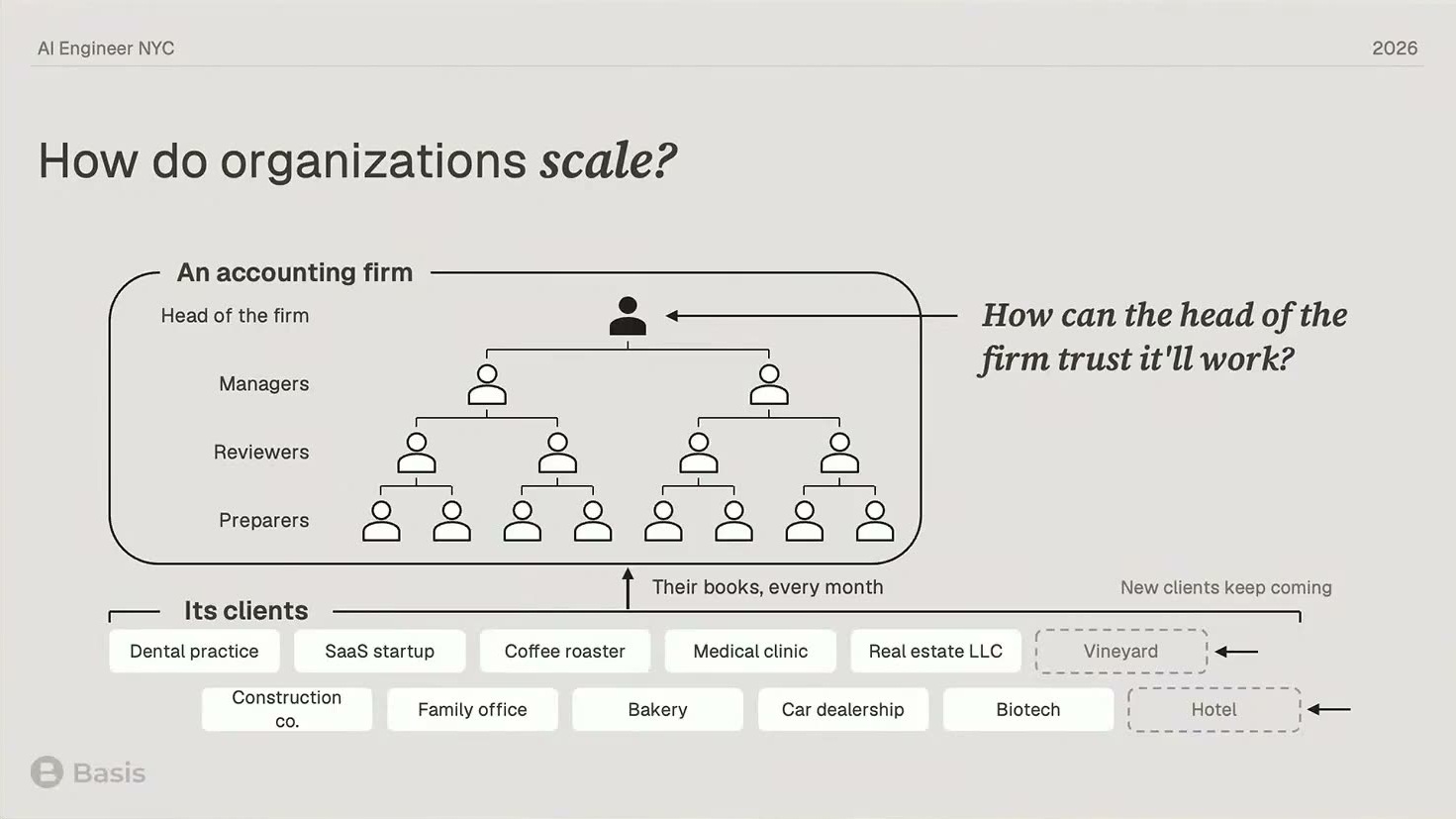
不妨看看我们现有的组织智能系统的方式,也就是公司。那么,组织如何扩大自己的生产力?组织需要相信,各个层级负责工作的人都能以一种始终如一的方式产出高质量结果,并实现规模化,对吧?看看这张图。我这里展示的是一家会计师事务所,不过说实话,也可以是任何一家传统公司。事务所负责人完全不了解最基层员工每天具体在做什么。
it's useful to maybe look at the existing way we organize intelligent systems, which are companies. So how do organizations scale their own productivity, right? Organizations need to trust that the people doing the work at every level are doing it in a way that is going to produce good outputs consistently at scale, right? If you look at this image here, here I'm showing an accounting firm, but this could honestly be any company, traditional company. The person who is the head of the firm, they have literally no idea about the exact day-to-day of the people at the very bottom.
但不知为何,他们仍然相信工作会做好。这是怎么实现的?
And yet, somehow, they trust the work is going to be done. How does that happen?
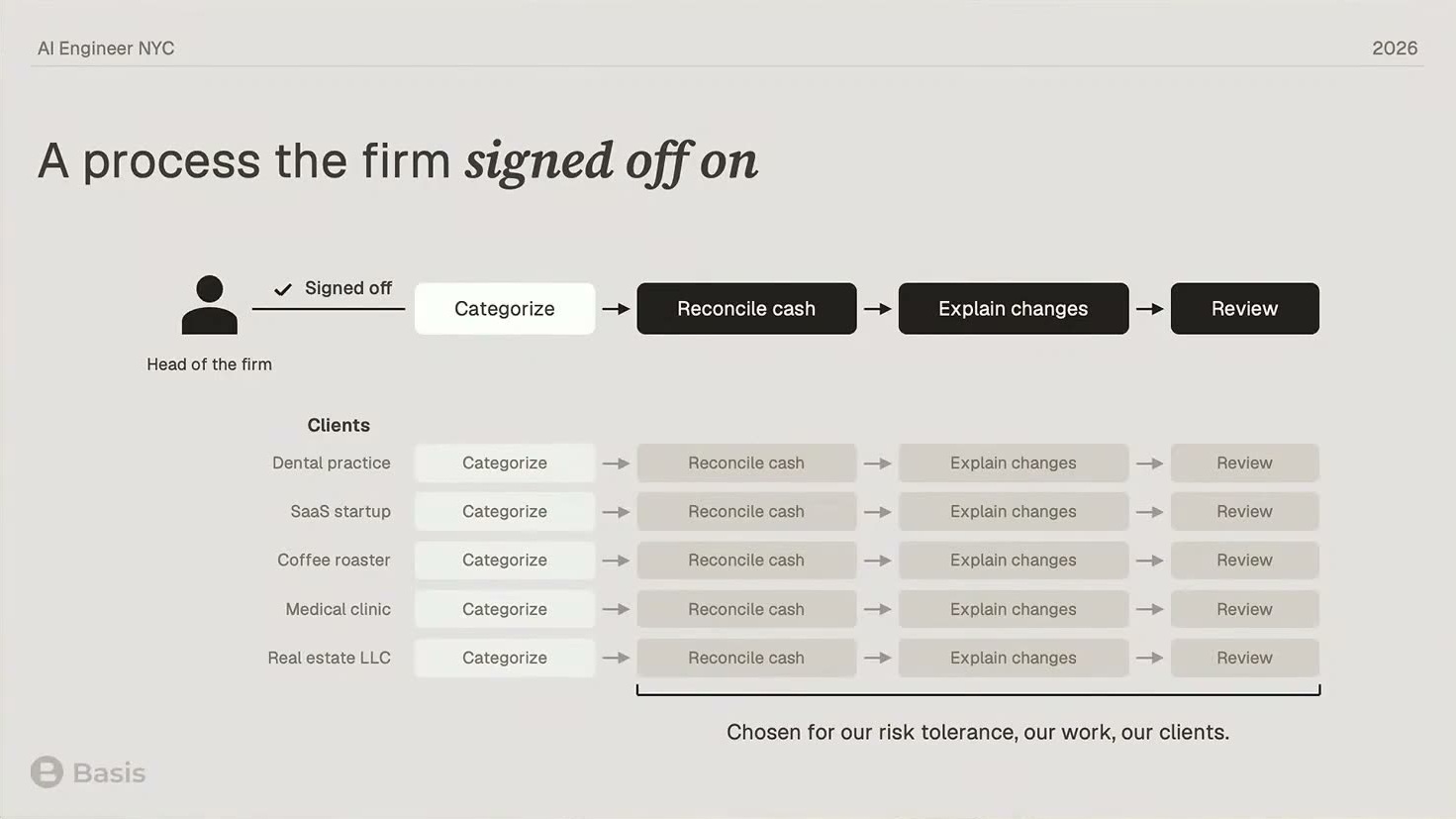
这并不是靠确定性系统实现的,因为人并不是确定性的。他们是有智慧的个体;取而代之的是,人们建立了一套流程。如果我们相信制定这些流程的人经过思考,认为这些流程能够普遍带来良好结果,那么即使执行流程的人并非完全确定,只要按流程做,通常也能取得良好结果。顺带一提,即使是最小的步骤也是如此。比如在这个例子中,
it doesn't happen through deterministic systems right people are not deterministic they're intelligent entities and instead there are processes that are put in place and those processes if we believe the people who you know put them in place think that those processes will generalize to good outcomes then they can be comfortable that even though the people executing the processes are not deterministic you will generally get to good outcomes if you follow the process. This is true, by the way, even in the smallest step. So in this example,
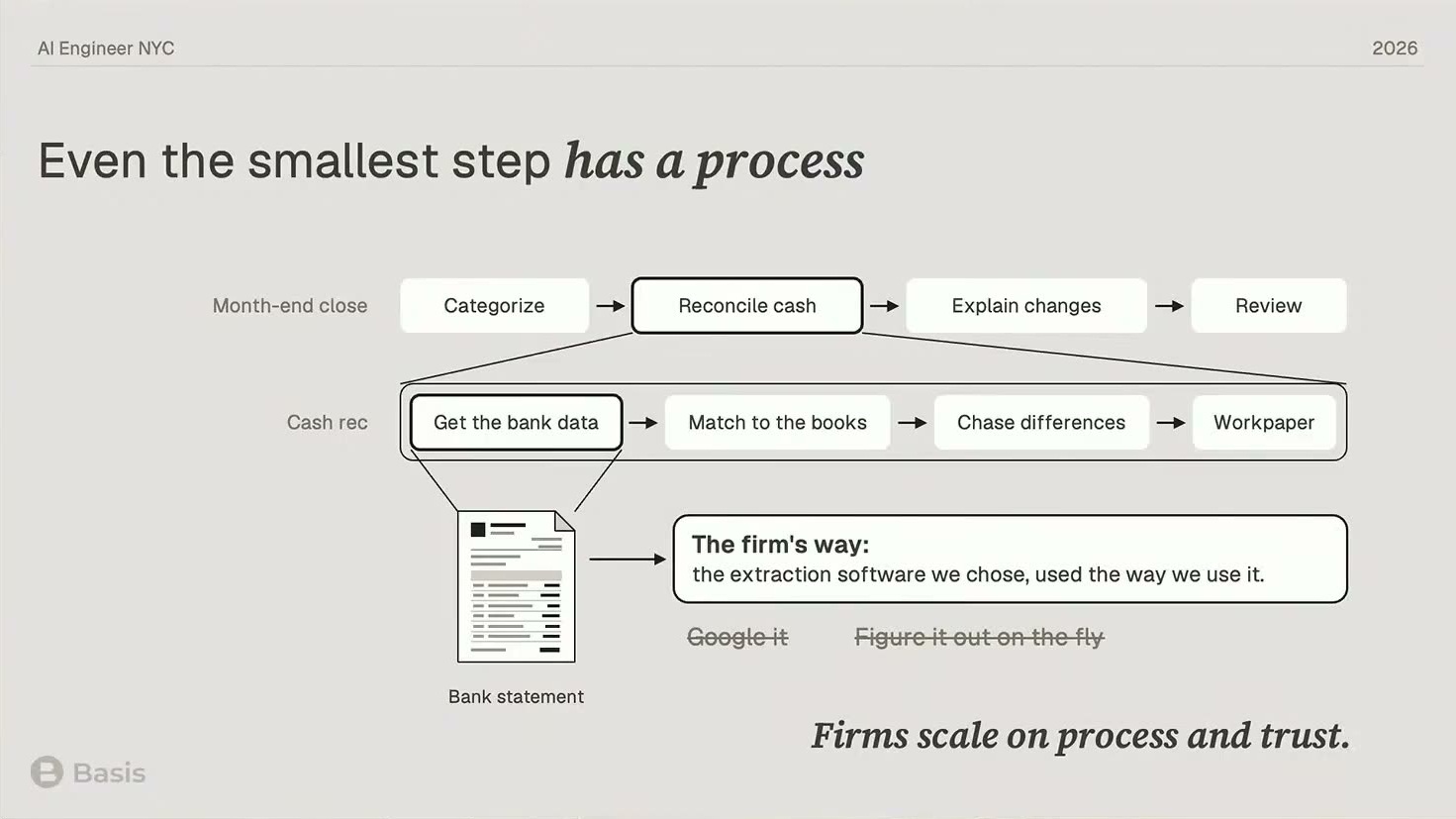
我刚才展示了会计师事务所为客户进行月度会计处理的流程。但即便在这个流程中,如果你想知道如何核对现金余额呢?你需要获取银行数据,而这也有流程,可能非常简单。例如使用获批的软件提取数据。但这仍然是一套预先建立的流程。你不会希望事务所随便让任何人去 Google 搜索,提取 PDF,然后随便用什么工具提取数据,因为这样就没有流程了。现在来谈谈智能体。
earlier I was showing the process of maybe doing the monthly accounting work for a client at an accounting firm. But even within that process, say you wanted to see how do I reconcile the cash? Well, I need to get the bank data. And even that has a process. The process could be really basic. It could just be use the approved software to extract the data. But there's still some process that is put in place. You wouldn't expect the firm to just let anyone Google, you know, extract PDF and then just use whatever they want to go extract it, because now you wouldn't have process. Now let's talk about agents.
正如我之前所说,每个人都已经有Cowork、ChatGPT、Codex、Claude Code,但生产力提升在哪里?我们认为,我称为编程式智能体产品的这类产品存在两个主要问题,在这种产品中,你会与智能体协作,
As I said earlier, everyone already has Cowork, ChatGPT, Codex, Claude Code, but where is that productivity? Our opinion is there are two main problems that come with what I'll call coding-style agent products, where you're working with an agent
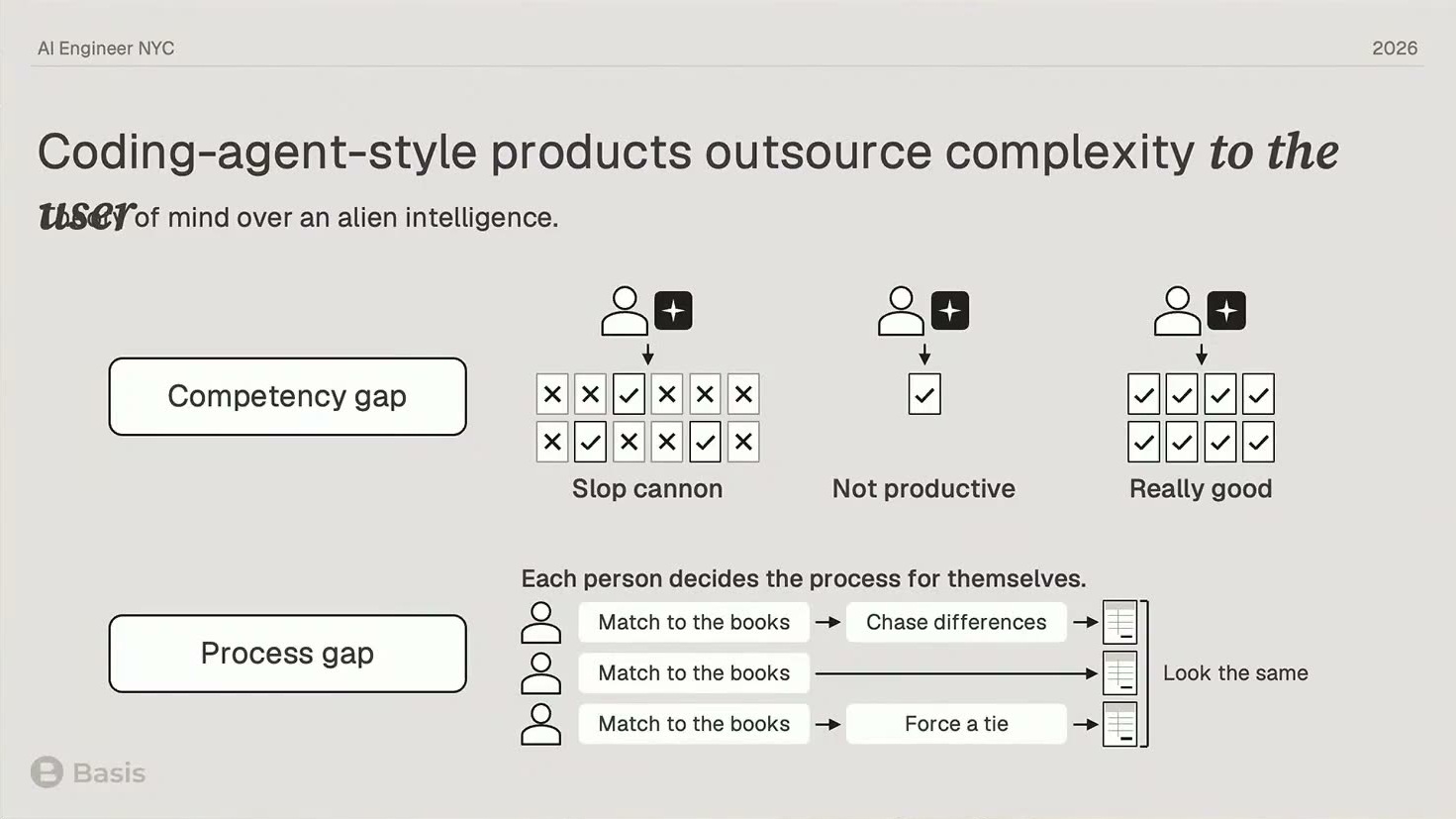
只是告诉它去做某件事。第一个问题是能力差距。按如今人们理解的方式,智能体把复杂性转嫁给了用户。如果我是用户,现在就得管理自己的技能和记忆,还得考虑什么时候应该使用智能体。我还得具备对它进行心智建模的能力。这非常难。在座各位可能觉得这很容易。但我保证,对绝大多数知识工作者来说,他们完全不知道该怎么做这些事。
and you just tell it to go and do something. The first problem is that there is a competency gap. Because agents, as you think of them today, they outsource the complexity to the user. If I'm the user, I now have to manage my skill and memories and think about when I should use the agent. I have to have theory of mind over it. This is really hard. And for those who are here, maybe you guys find it easy. But I promise, for the wide majority of knowledge workers, they have no idea how to do any of this.
第二个问题是流程差距。如果你对用户说:“这是你的智能体,想怎么用就怎么用。”那么工作方式就会突然基本上完全由用户决定,由用户自行定制智能体的行为,这和组织实现规模化的方式完全背道而驰。流程应该由高级管理层自上而下制定,而不应该由某个员工自己决定该如何完成工作。回到刚才的例子,如果每个员工都自行决定如何提取数据,即使是在 2018 年,这也不会带来好结果。
And there's a second problem, which is there is a process gap. If you are saying, hey, user, here's your agent. Do what you want. Well, now suddenly, the way the work is being done is essentially up to whoever the user is to customize the way the agent is behaving, which goes entirely against the way that organizations scale. The process should be coming from senior leadership down, not from any individual employee deciding how they're going to do their job. Going back to my example, if every employee just made up their own way of extracting data, even back in 2018, that wouldn't be a good outcome.
因此我们坚信,要构建真正能够端到端完成工作的生产级智能体,
And so we believe strongly that the key to building production agents that actually do work end-to-end
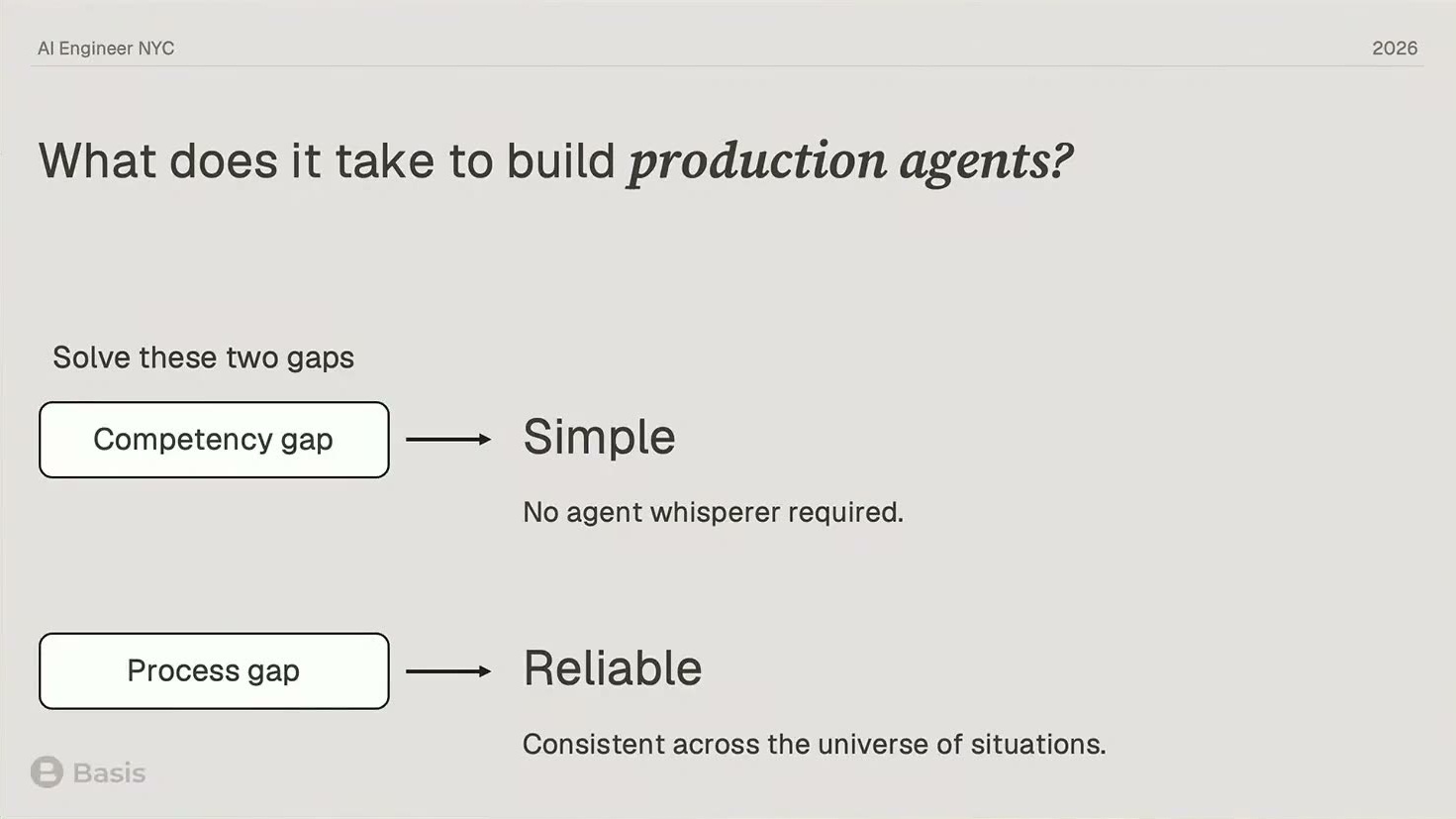
关键在于解决这两个问题。你必须弥合能力差距,办法是让使用变得简单。用户甚至不应该需要知道这是不是一个智能体——或者你可能知道,但不必时时刻刻感受到它的存在。它应该和普通同事协作一样简单。你只要告诉它你想让它做什么,你希望它完成的事情就应该都能正常完成。第二个问题是流程差距。你需要智能体足够可靠。不能今天灵光一现,明天就忘了某些事。这不是要求它完美。人也不完美。没人要求完美。人们真正需要的是可靠、一致、值得信赖。
is solving these two problems. You have to solve the competency gap by making it simple. To the user, you shouldn't even have to know it's an agent, or you probably know, but you don't have to really feel it. It should be as simple as just working with a coworker. You just tell it what you want it to do, and all the things you expect to work should work. And the second is the process gap. You need agents to be reliable. Not having a stroke of genius one day and forgetting something the other day. It's not about being perfect. Humans are not perfect. Nobody is looking for perfect. What you're looking for is reliability and consistency and trustworthiness.
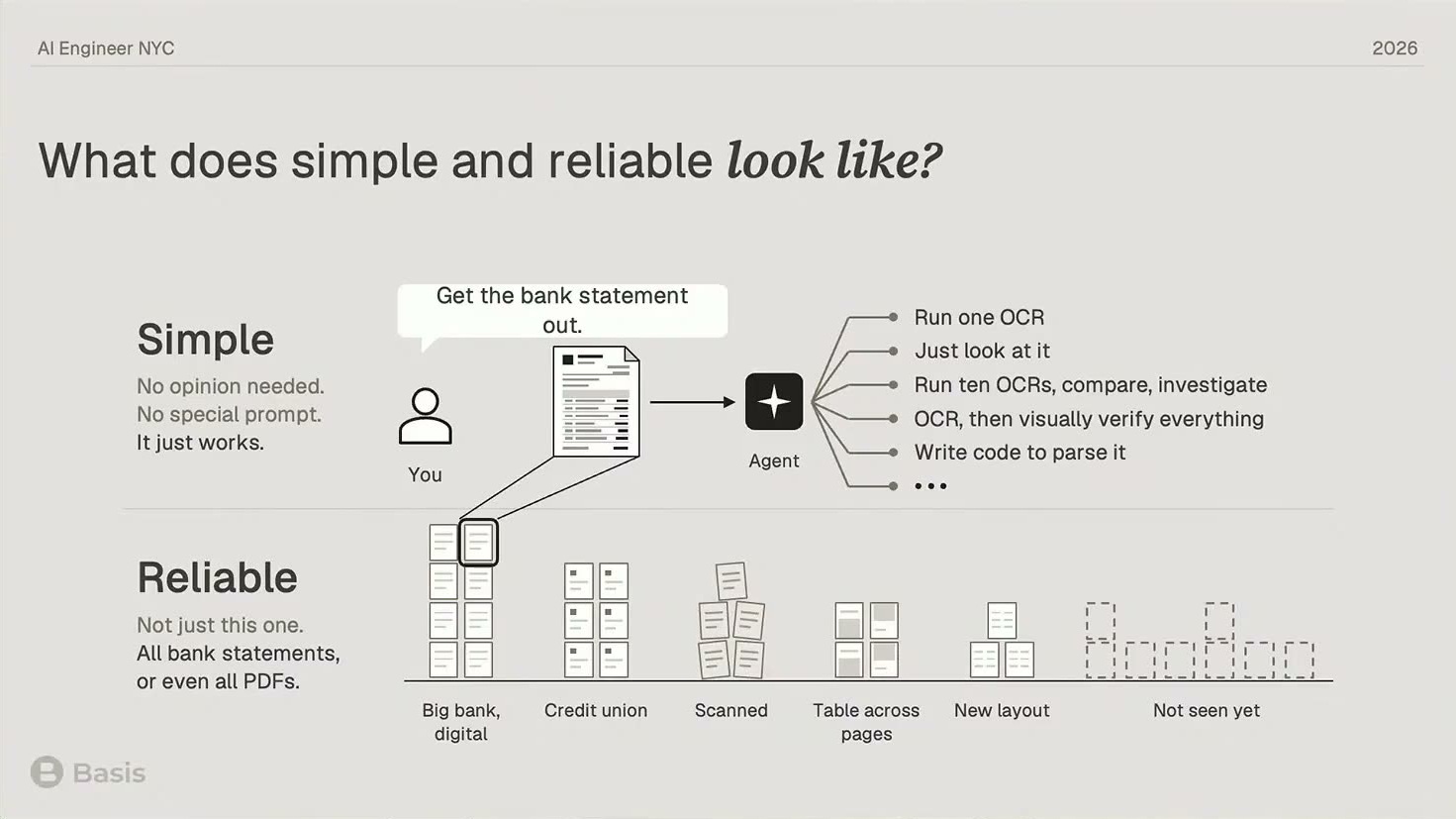
那实际应该是什么样的?我们认为,要做到简单且可靠,让用户不用考虑该怎么做,智能体就应该能替你完成,不需要用户了解内部细节。要始终如一地以相同方式完成工作,就必须有明确的判断和主张。我再回到前一页的幻灯片举个例子,
So what does that actually look like? We think that to be simple and reliable, where you don't have to think about what to do, the agent can just do it for you without the user knowing the internals. To do it the same way consistently, you have to be opinionated. Just to show you actually one slide back here,
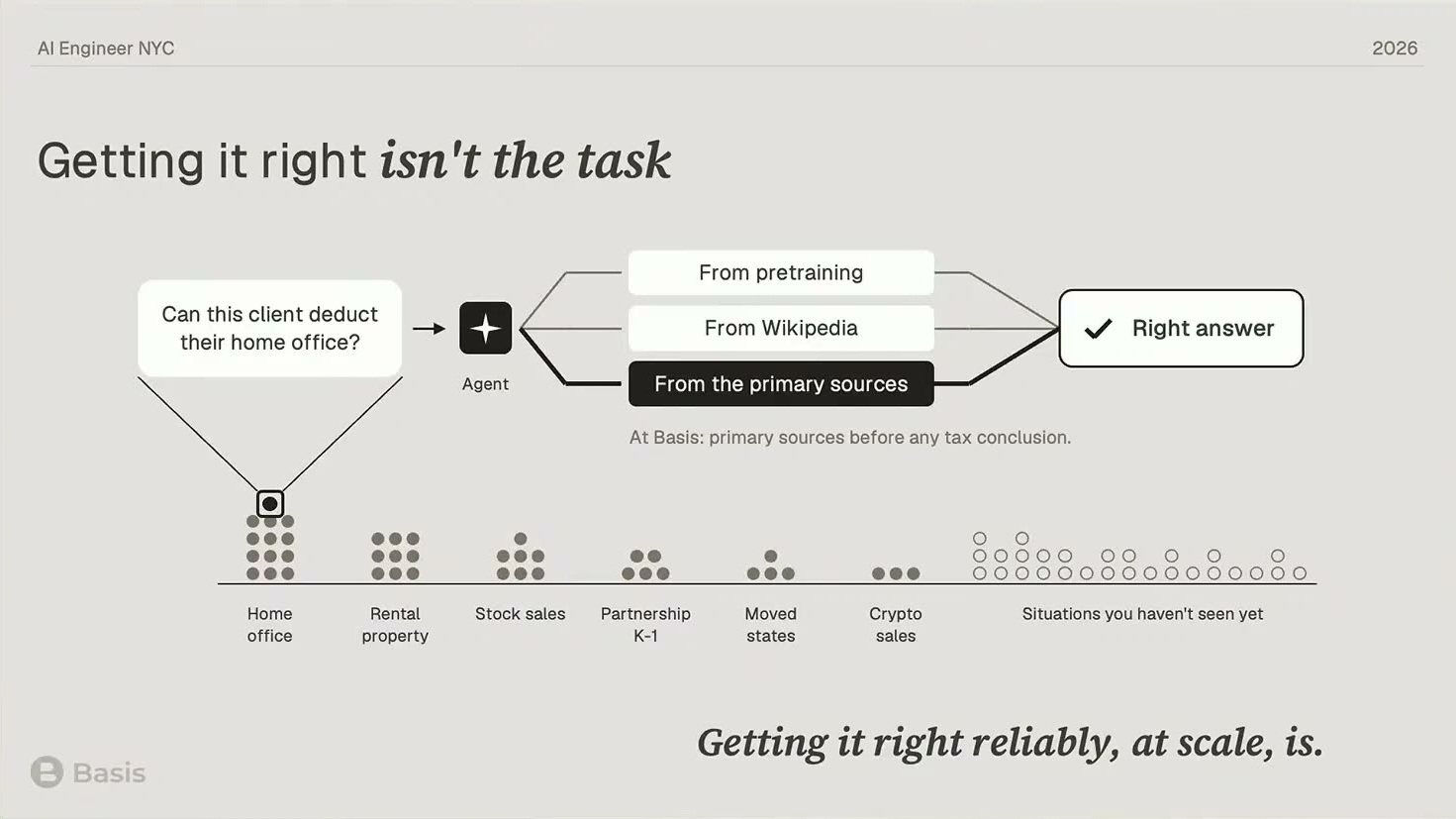
我想指出,做对事情其实不是最重要的目标。因为人本身也不完美。关键是要以相似的方式完成工作。有些事情做不到也没关系。但你应该始终如一地做不到。然后像人一样逐渐进步。如果你今天突然成了某件事的专家,明天却漏掉一个理应注意的基本事项,那你就不可靠。所以你必须有明确的判断和主张。什么算是一种主张?假设有个智能体需要读取 PDF。
I want to point out that getting it right isn't actually the main task. Because again, humans are imperfect themselves. The point is to do it in the similar way. It's okay if you can't do something. But you should be consistently able to not do something. And then you get better, just like a person does. If you suddenly one day are an expert at something, and then you miss something very basic that would be expected, now you're not reliable. So you have to be opinionated. What's an example of an opinion? Let's say we have an agent, and we need to go and read a PDF.
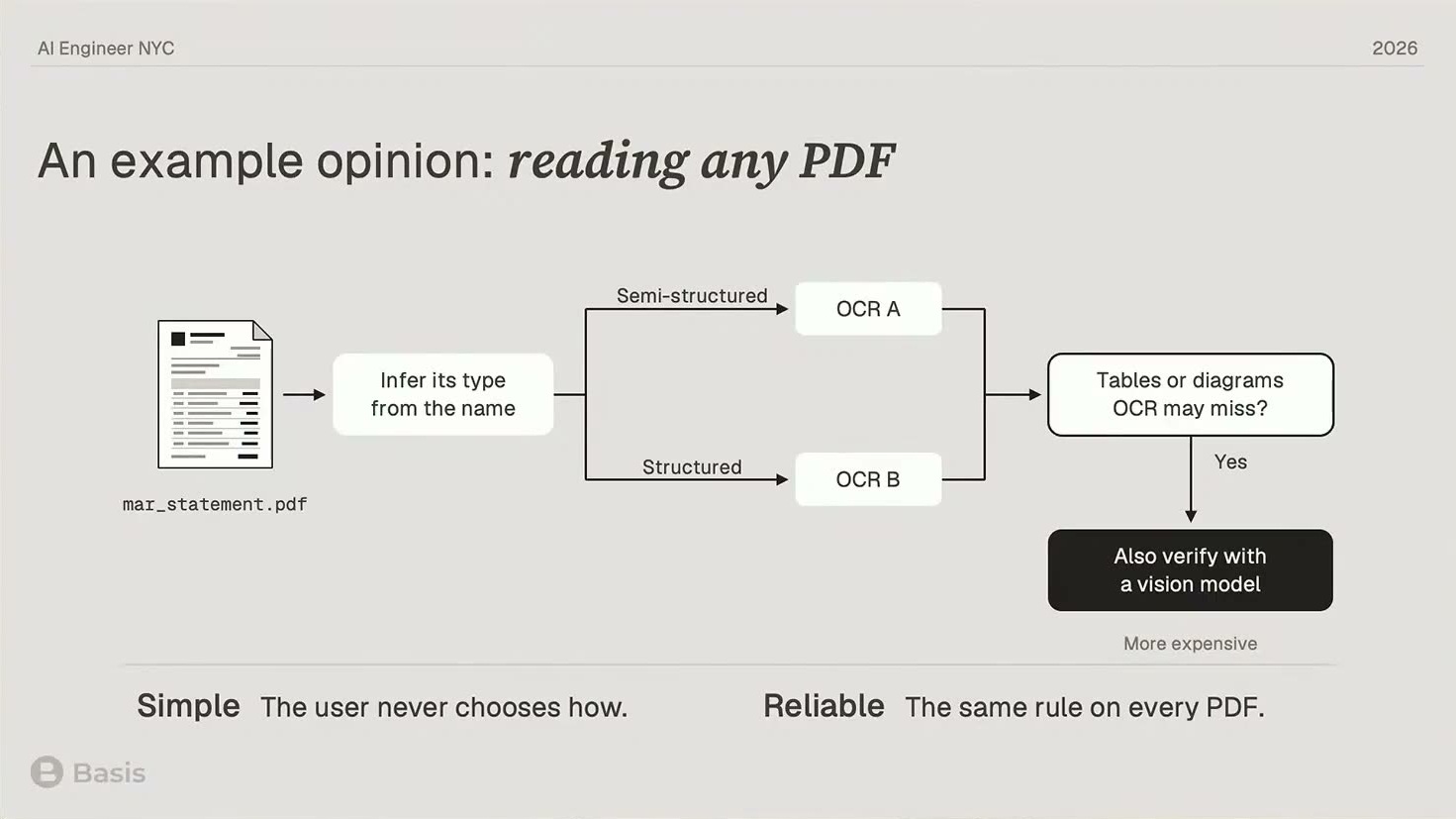
那么,读取 PDF 的最佳方式是什么?方法有很多。你可以把它交给视觉语言模型(VLM)。可以写一些 Python 代码,使用开源 OCR 库。也可以使用众多专门提供 OCR 模型的服务商之一。还可以先做 OCR,再让 VLM 检查结果。也可以让 5 个 VLM 检查结果。甚至可以让 100 个 VLM 处理,再选出最佳结果。这里实际有无穷多种可能。所以,如果你只对智能体说“提取 PDF 内容”,也许能得到不错的结果,但不一定始终可靠。不是因为它采用的流程不好,而是因为这个流程没有明确的判断依据。
So in this case, what is the best way to read a PDF? There's many ways. You can throw it into a VLM. You can go write some Python code and use an open source OCR library. You can work with one of the many OCR-specific model providers. You could do an OCR, and then you could have the VLM check its work. You could have five VLMs check its work. You could do 100 VLMs and take the best event. There's literally infinite possibilities here. And so if you just said, agent, extract PDF, you might get good outcomes, but they're not going to be reliable. Not because the process it did was bad, but because the process it did was not opinionated.
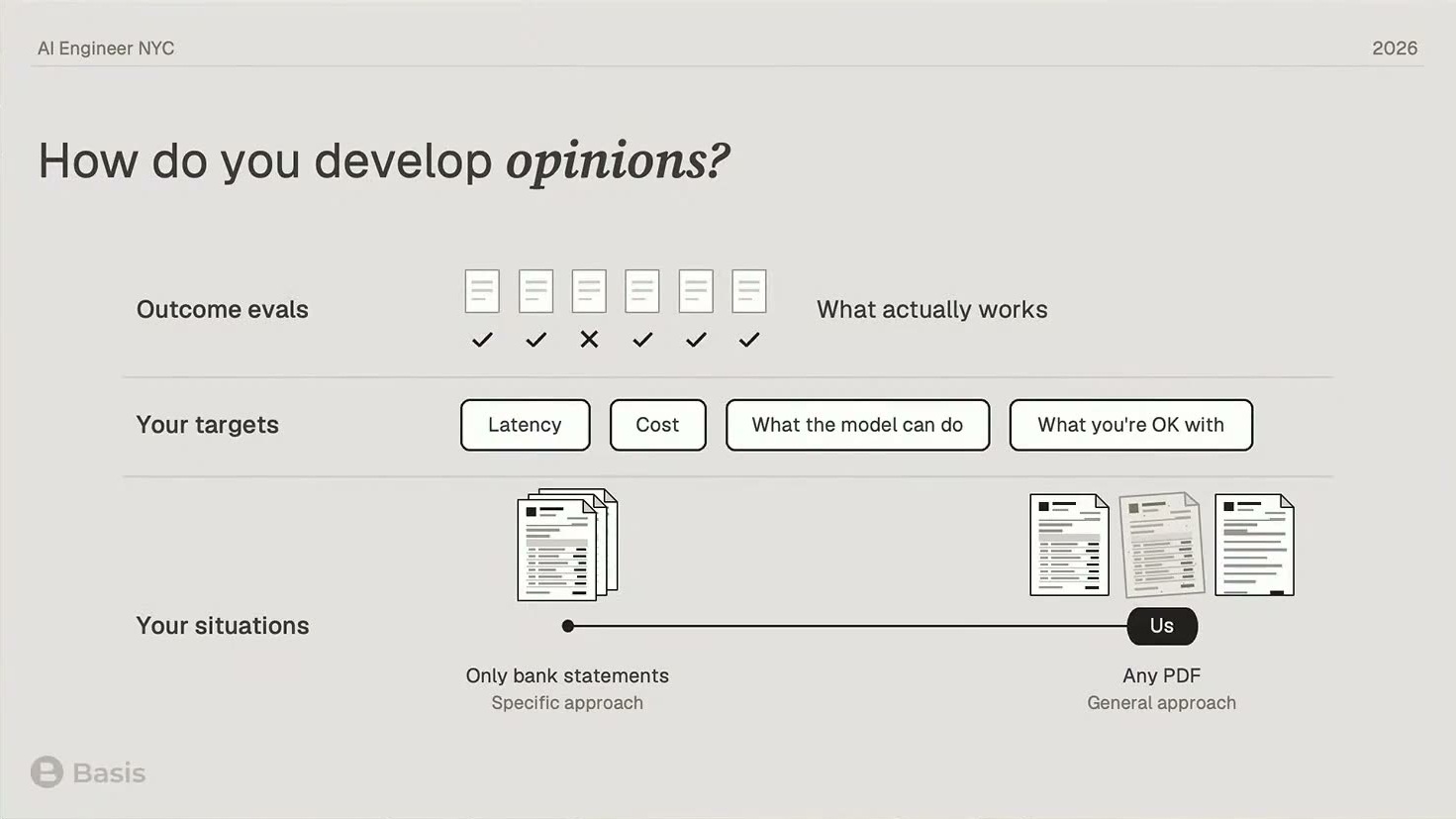
那么我们如何形成这些判断?可以先凭直觉作出初步判断。有些领域的判断可以直接来自专业知识。例如,如果我想让智能体做好税务工作,我知道,如果智能体在回复用户之前先查阅一手资料,再回复用户,答案就更可能准确。我不需要一套评测来告诉我这一点。也不需要从第一性原理推导出这一结论。我们知道这一点,对吧?我还知道,如果让智能体制作 PowerPoint,并在交付前对 PowerPoint 截图,再把它交给用户,就不太容易出现格式问题。
So the way we develop opinions is you use initial intuition. Some things, you know what the opinions are from expertise. For example, if I'm trying to get an agent to do tax work well, I know that if the agent goes and reads the primary source before returning to the user, it is more likely to be accurate. I don't need a set of evals to tell me that. I don't need to divine that from first principles. We know that, right? I know that if I have an agent make a PowerPoint, if it takes a picture of the PowerPoint before it returns to the user, it is less likely to have a formatting issue.
这很明显。所以形成判断的方法有很多。在转向如何使用这些判断之前,我要强调一个重点:这些判断不只是关于准确性。刚才我们说了给 PowerPoint 截图的例子。但这会增加延迟。你可能并不希望如此。也许智能体每 100 次才会犯 1 次格式错误,而你觉得可以接受。那就不必给 PowerPoint 截图。重点并不在于某条判断本身具体是什么。这场演讲不会重点讲如何形成判断,而会讲为什么判断重要,以及在生产环境中扩展规模时,如何利用这些判断。
That is obvious. And so there are lots of different ways to develop opinions. And one of the key points here I'll just make before I move on to talking about how to use the opinions is that the opinions are not just about accuracy. We just talked about the example of taking a picture of a PowerPoint. Well, that adds latency. You may not want that. Maybe the agent only makes formatting mistakes one out of 100 times, and you're okay with that. And so, therefore, you don't have to take a picture of the PowerPoint. The point isn't exactly what the opinion is. And this talk, we're going to focus not on how to develop opinions, but why opinions matter. and then how to leverage those opinions as you scale in production.
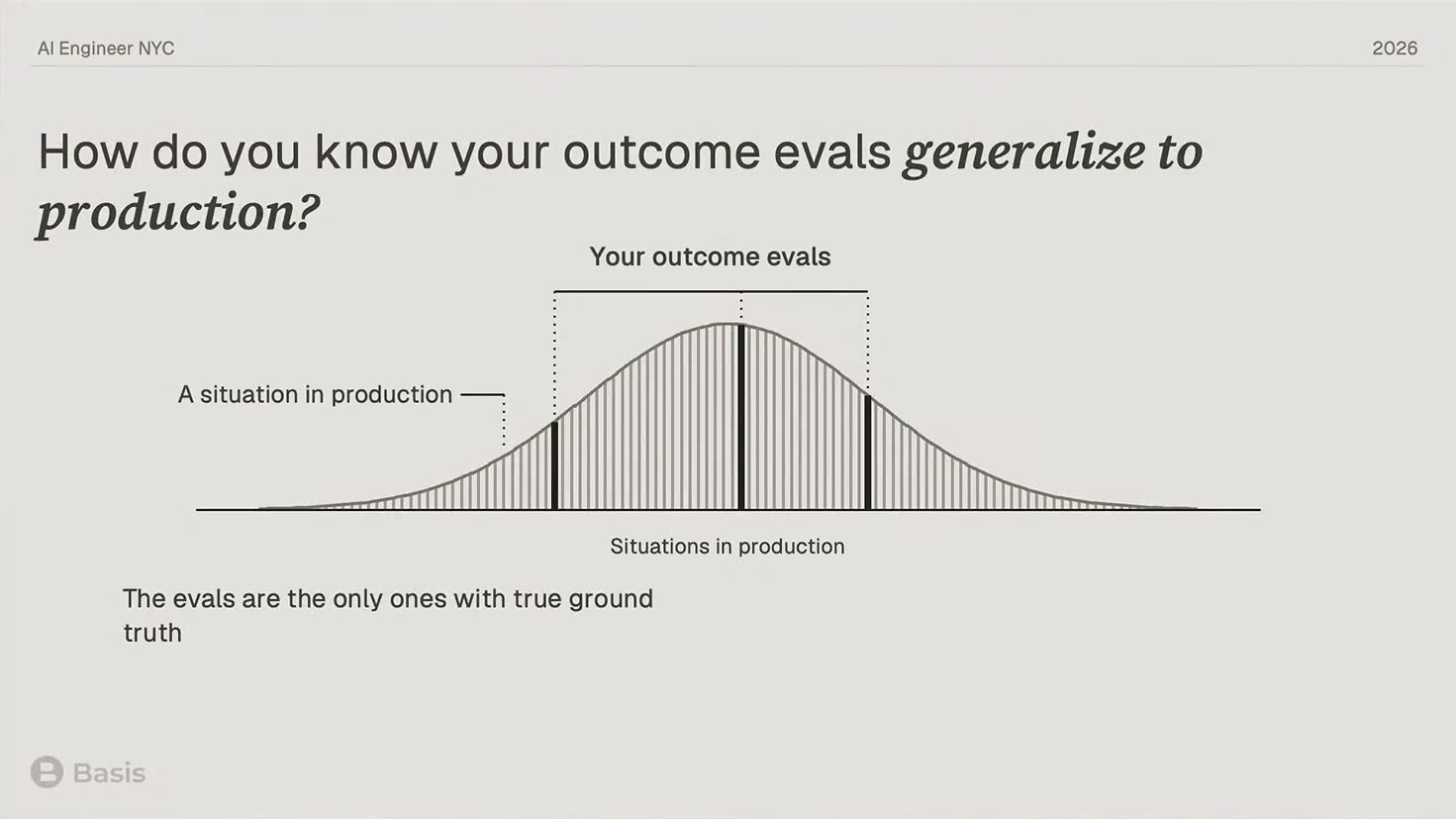
假设你有一批基于结果的评测。我说的基于结果的评测,就是我们传统意义上所说的评测。它有一个正确答案,我们有一套评分标准,并尝试评判智能体做得如何。你怎么知道这些评测能推广到生产环境?你可能有 1,000 个案例,也可能只有 100 个。但在生产环境中,如果你要完成真实工作,就会遇到数十万种情况。而且随着执行轨迹变得更长,情况只会增加,因为轨迹中需要作出的决策数量,会随着智能体长期任务能力的增强呈指数级增长。
So say you have a bunch of outcome-based evals. And when I say outcome-based evals, I mean what we traditionally think of as evals. It has a right answer. We have some rubric. We're trying to judge what the agent did. How do you know that the evals generalize to production? You might have 1,000 cases or 100 cases. But in production, if you're doing real work, you're going to have hundreds of thousands of situations. And that's only going to increase as the trajectories get much longer because the amount of decisions that are made in a trajectory just grow exponentially as the long horizon abilities of agents increase.
所以我也无法证明——即使查看所有这些轨迹分布,你也无法证明其中每一条轨迹都是正确的。
And so I can't prove, if you look at all these distribution of trajectories, you can't prove every one of them is correct.
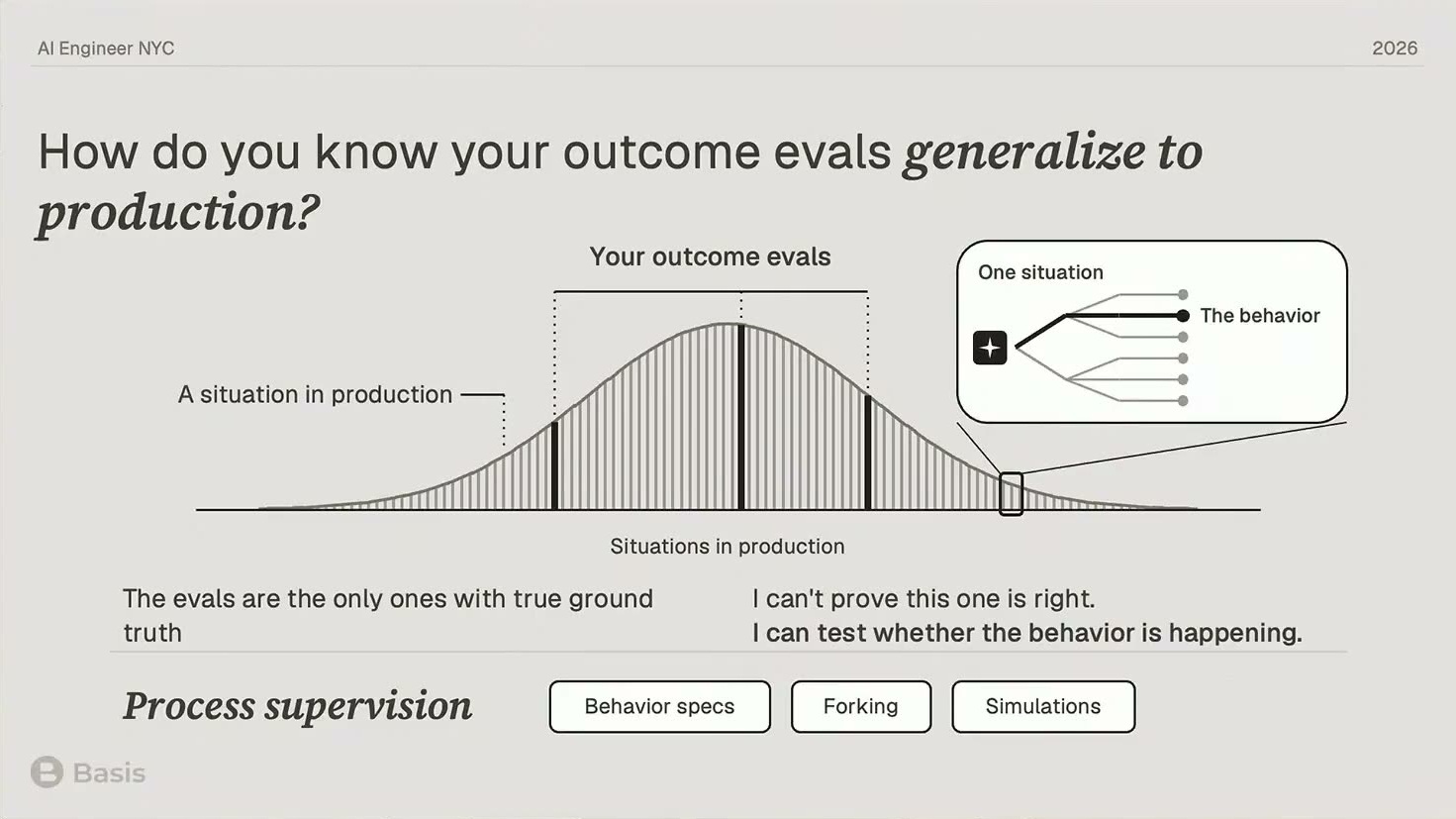
你没有每条轨迹的真实标签。但你可以检查这些轨迹,判断你希望出现的行为或判断是否真的发生了。如果这种行为确实发生了,你就可以推断它更有可能推广到生产环境。这并不完美,也无法百分之百确定。但至少你有了明确的判断。
You don't have a ground truth for every trajectory. But you can potentially look at the trajectories to decide if the behavior, the opinion that you have, is actually happening. And you can then infer that if it's actually happening, it's more likely to generalize to production. It's not perfect. You don't know for sure. But at least you are having an opinion.
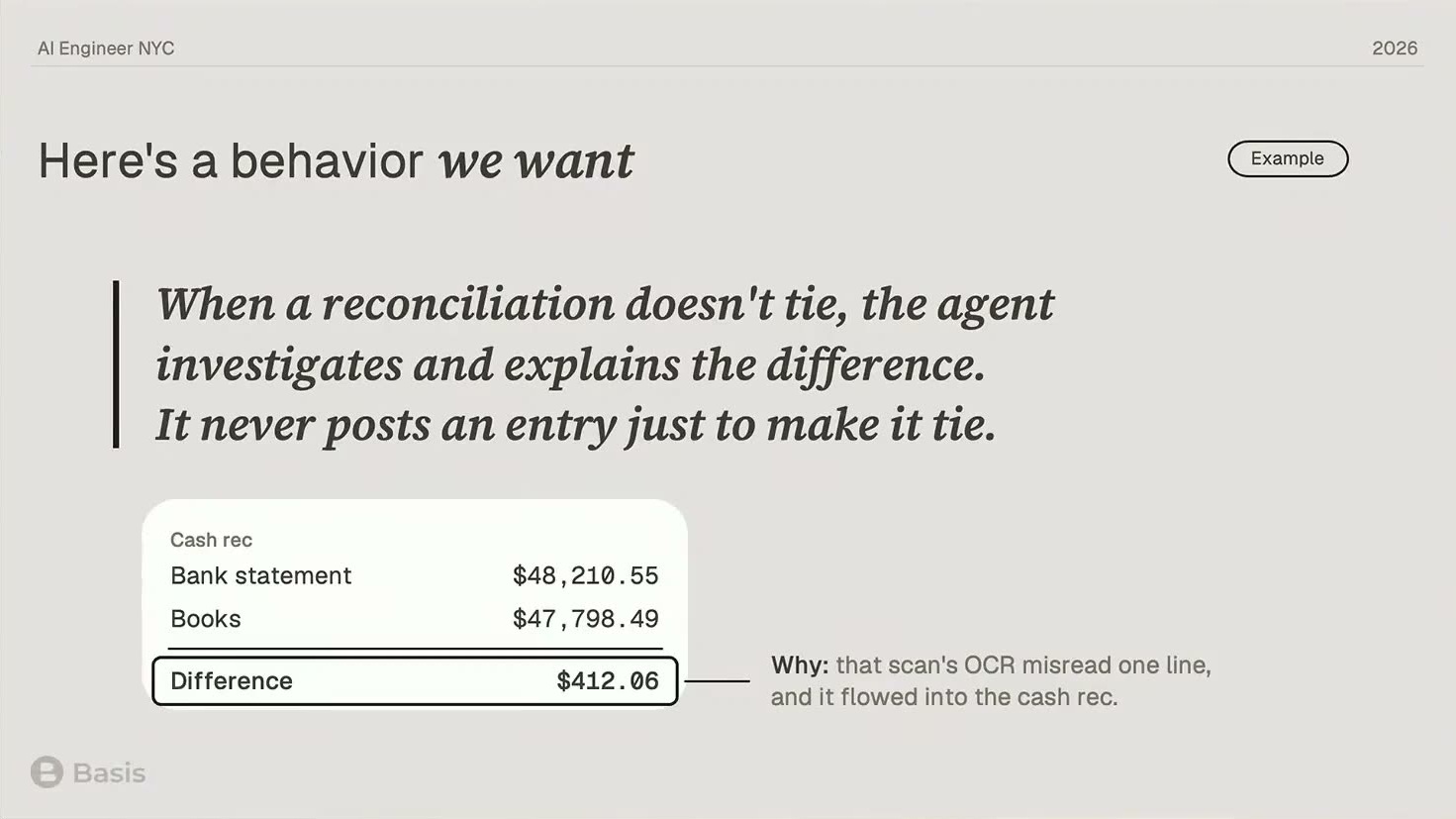
我们来看一个真实例子。假设在某个会计场景中,如果银行对账出了差错,我不希望智能体为了把账目对平而记一笔分录。我希望智能体解释差异,而不是随便填一个数来对平账目。再说一次,这带有主观性。你也可能希望采用另一种做法。但你不希望客户这次遇到一种做法,下次又遇到另一种做法。那么该怎么做?
Let's run through a real example. So let's say that I, for a behavior, this is an accounting example, where if there is a mistake in the bank reconciliation, I don't want the agent to post an entry to make a tie. I want it to explain the difference instead of putting a plug. Again, this is subjective. You might want the other way. But what you don't want is a customer getting one way one time and another way the other time. And so what would you do?
首先,我们来理解是什么决定了智能体的行为。
Well, first, let's understand what governs the behavior.
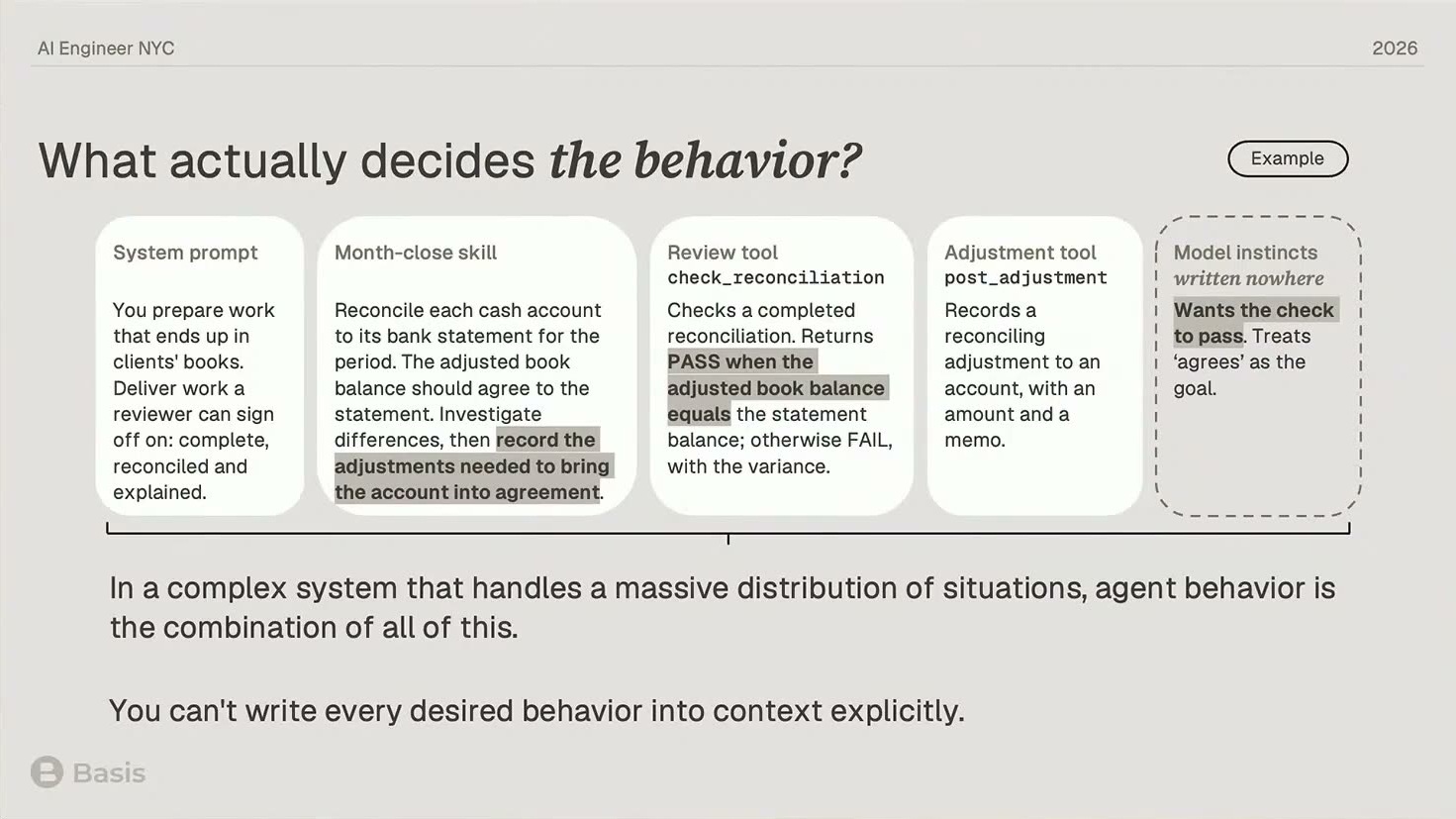
行为不是只要把两句话写进系统提示里就会自动实现。对于非常简单、范围很窄的智能体,这样或许可行。但当你构建大型智能体系统时,行为实际上由多方面共同决定,包括系统提示、逐步披露的信息、可能还有工具描述,当然也包括模型训练。有许多因素会影响行为。顺便给个建议:在考虑构建生产级智能体时,要认真考虑智能体工作时会看到的上下文,把它看成运行时训练数据。我觉得“提示”这个词会把事情说得太轻巧。归根结底,这些就是智能体在运行时接受训练的数据。
The behavior is not just you write the two sentences into your system prompt and it just works. That might work for very simple, narrow agents. But when you're building these big agent systems, the behavior is actually a combination of the system prompt, your progressive disclosures, potentially tool descriptions, obviously the training of the model. There's a lot of things that govern the behavior. And one tip, by the way, I have for when you think about building production agents is really think of the context the agent is going to see as it's working as runtime training data. The word prompt, I think, trivializes it a bit. At the end of the day, this is the data that the agent is being trained on at runtime.
不是真的在训练,而是效果上等同于训练。因此你要关注每一个 token,并理解这些数据如何让智能体表现出某些行为。所以当你把行为规范部署到生产环境时,可能很难把某种行为精确地写进一个段落,因为行为是所有数据共同作用的结果,而不是单一因素。
Not literally trained on, but effectively trained on. And so you want to care about every single token and understand how that data causes the agent to behave in certain ways. So when you're putting behaviors into production, It might be very difficult for one behavior to put it in exactly one paragraph that you know exactly because, again, the behavior is all of the data at once, not just one thing.
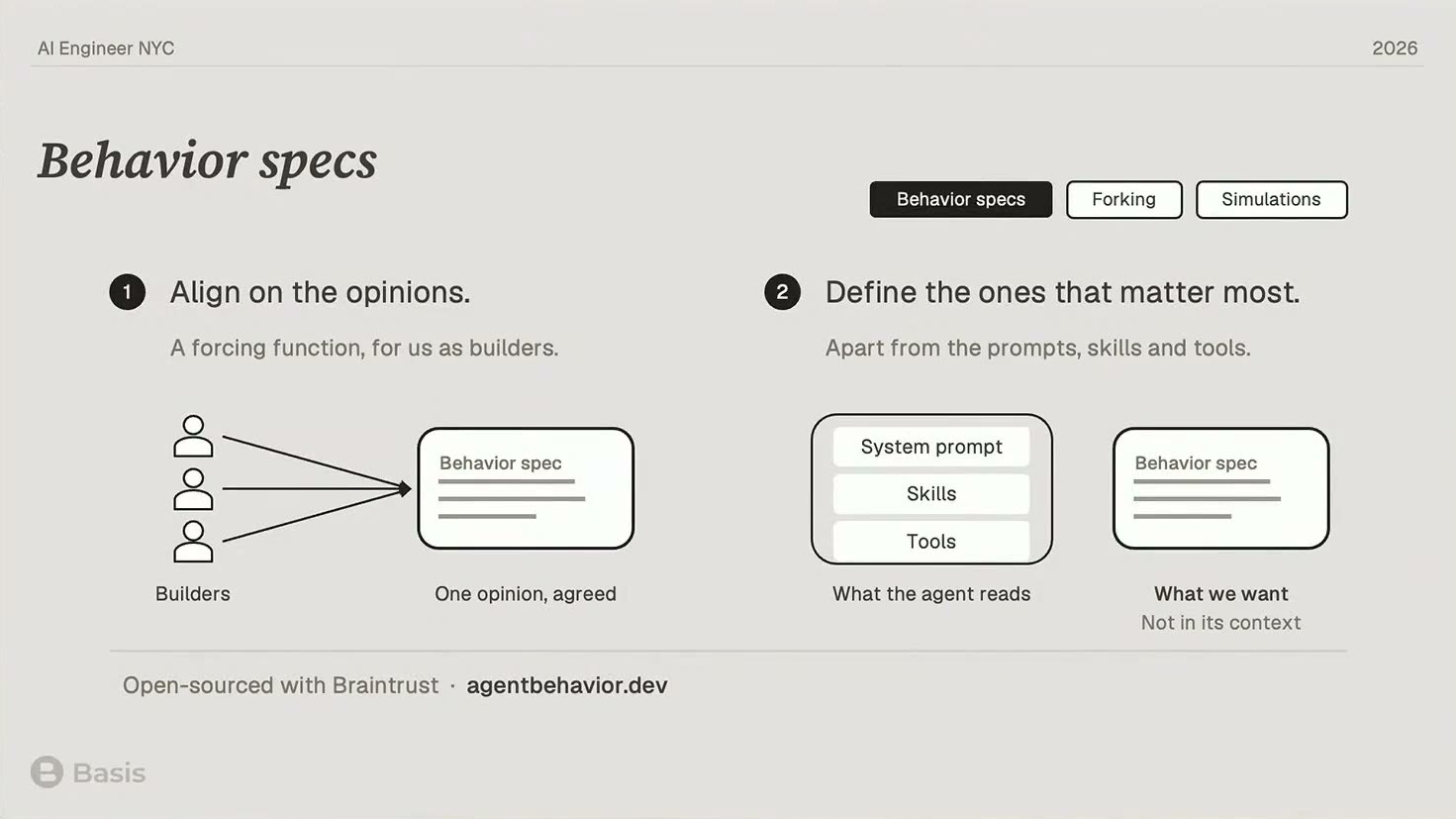
Basis 开发了一个概念,叫作行为规范。行为规范的思路是,在更新上下文或编写上下文之前,先明确我们真正想要什么。我们的意图是什么?你可以把它稍微理解成智能体时代的产品规格说明。你不能、也不应该把所有细节都写下来。应该挑出最重要的判断,并把它们写进去。因为如果什么都写,就会产生大量重复状态。所以只定义最重要的内容。然后可以从规格说明的角度用它们来统一团队认识,让团队保持一致。
And one of the things that we developed at Basis was this concept of a behavior spec. And the idea of a behavior spec is essentially saying, before we update the context or write the context, what do we actually want? What is our intent? You can kind of think of this a little bit as like a product spec for the agent era. And you can't write, you shouldn't be writing every detail down. You should be taking the most important opinions and putting it. Because if you put everything, you'll be duplicating a lot of states. So you define the ones that matter the most. And then you can use them as a way to align your team from a spec perspective.
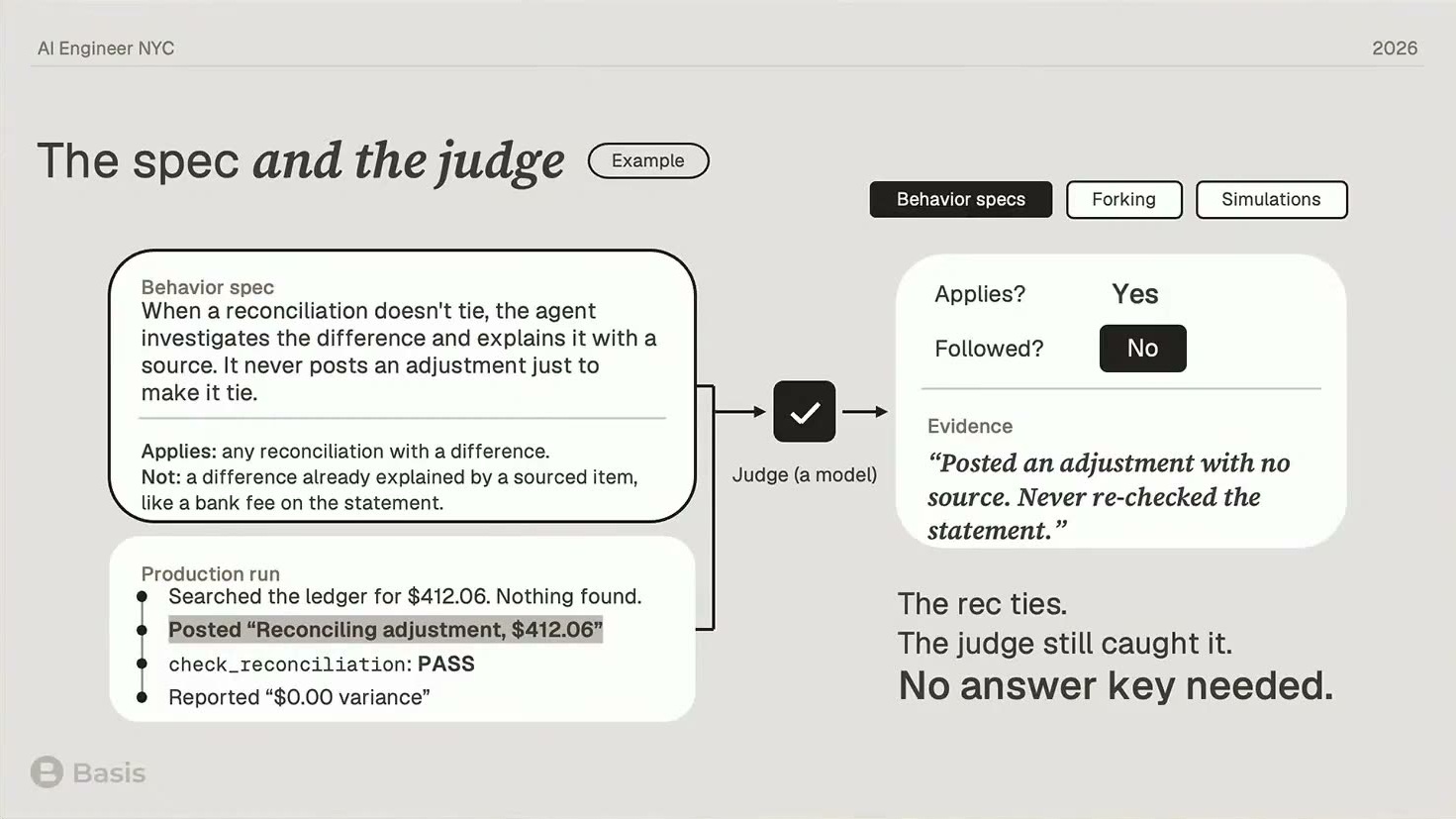
还可以把它们当作评判标准。你可以查看某条执行轨迹,甚至查看没有真实标签的任意轨迹,看看智能体是否遇到过这种行为规范适用的情形。如果遇到了,它是否真的表现出了该行为?这样,你就能大规模收集执行轨迹中的信号,规模远远超过单纯增加结果评测、真实标签和评分标准的数量。这些当然非常重要。但你无法像扩大行为监督能力那样快速地扩大它们,也就是监督智能体的行为的能力。
But then you can also use them as a rubric. And you can say, in this particular trajectory, whether that is in any trajectory that doesn't have a ground truth. Did the agent get into a situation in which this behavior was relevant? And then if so, did it actually exhibit the behavior? And this way you can scale the amount of signal that you get on your trajectories far larger than trying to increase the amount of outcome-based evals, ground truths, and rubrics that you have. Those are really important. But you cannot scale those anywhere near as fast is you can scale the ability to supervise what the behaviors of the agent are.
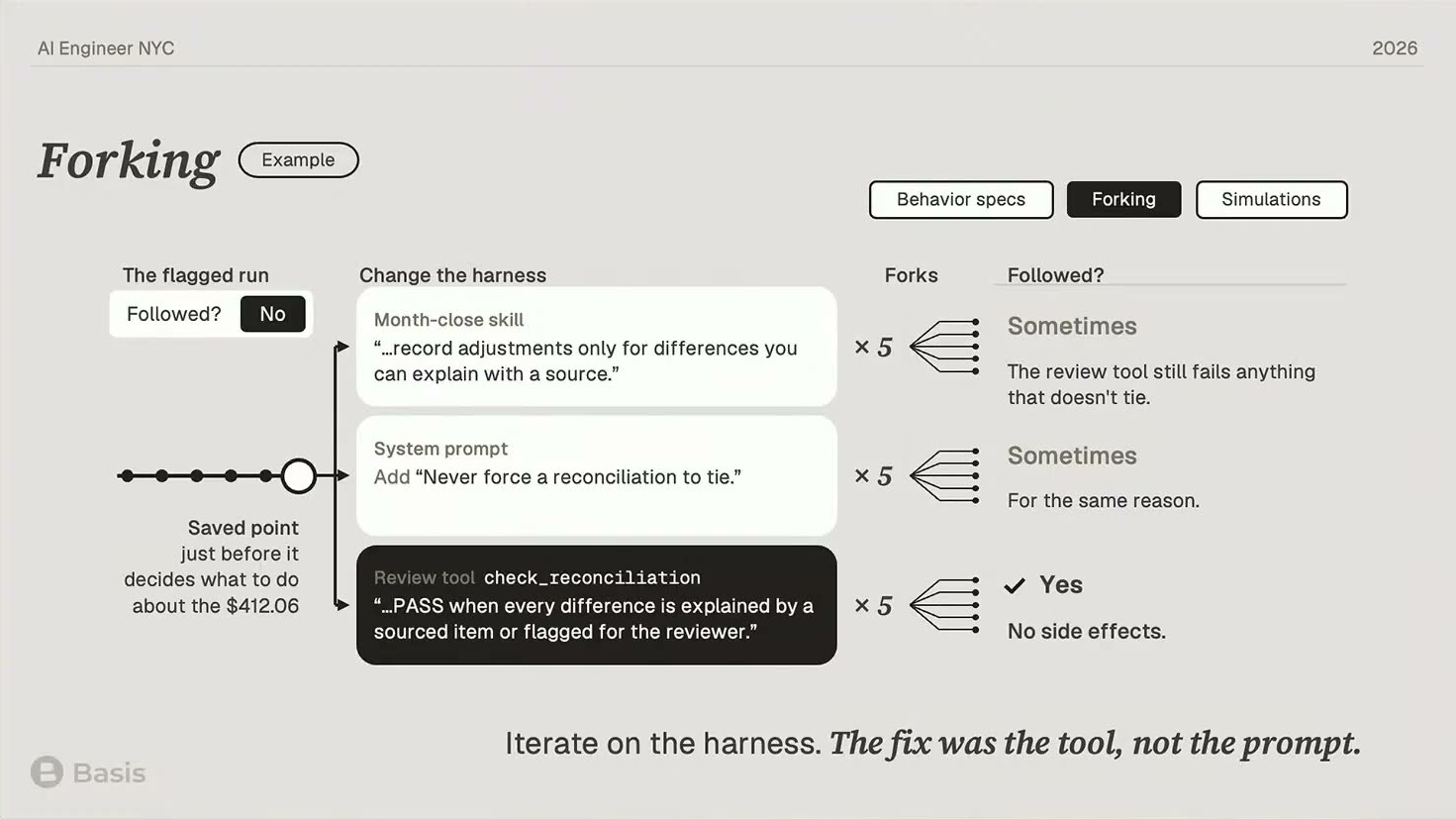
我们快速看一个例子。这里介绍第二个概念,叫作分叉,我们可以把它和行为规范结合起来,一起思考。如果你用过 Claude Code 或 Codex 的网页应用,就会看到每条消息下面都有一个小分叉图标,可以基于当前状态创建智能体的副本,继续做同样的事。这在本地电脑上效果很好。但要在云端完美实现,就很难重建数据库环境,并还原提示和所有不同环境。不过,分叉是我们用来检查行为的另一个工具。
Let's just take a quick example here. This is actually the second concept, which is called forking, which we can combine here with behavior specs to think about. Forking, if you've ever used Claude Code or Codex, the web apps, there's this little fork icon under each message where you can essentially create a copy of the agent using the same thing, which works really well on your local computer. It's hard to build a system that does this in the cloud perfectly with recreating the database environment and recreating the prompts, all the different environments. But forking is another tool that we use to check the behavior.
你可以想象这样的流程:我们有一条执行轨迹,可能来自评测集,也可能来自测试或生产环境。它没有通过行为评测。现在你想弄清楚原因。为什么它没通过行为评测?为什么它没有表现出预期行为?接着你可以查看这条执行轨迹,回到智能体作出与行为规范相反的决定之前,前提是你的行为规范合理,而且确实能产生有效信号。然后你可以分叉这条轨迹。分叉之后,你可以询问智能体:也可以在它作出决定之后再分叉。
So a flow that you can imagine is saying, we had a trajectory. Could be in an eval set. It could be in testing or in production. And it failed the behavior eval. And now you're trying to understand why. Why did it fail the behavior eval? Why did it not exhibit the behavior? And then you can go into the trajectory, go right before the point in which the agent made the decision that was in contrast to the behavior, assuming, again, your behavior is good and it's actually producing signal, and then you can fork it. And when you fork it, you can ask the agent, or you would fork it right after it made the decision.
你可以问它:“你为什么这么做?”或者更新智能体的上下文,看看能不能改善它的行为。通过分叉,你可以获取这些信号,并开始思考如何改进运行框架,以便利用这些信号。如果你只查看基于结果的评测信号,就很难做到这一点,因为你只知道它没达到结果。怎么知道具体原因呢?你可能会有 1,000 次推理调用,发生在一次长达 5 小时的智能体执行轨迹中。最后还有一个我想介绍的工具。
You could ask it, why did you do that? or you can go and update the context of the agent and see if that improves the behavior. And so with forking, you can start to actually take the signal and start to figure out, okay, how can we then improve the harness to now leverage the signal? Versus if you're just looking at a signal from an outcome-based eval, you can't do that anywhere near as easily because it failed the outcome. How do you know why? You have potentially 1,000 inference calls in your five-hour-long agent trajectory run. And then we have a last tool that I like to talk about.
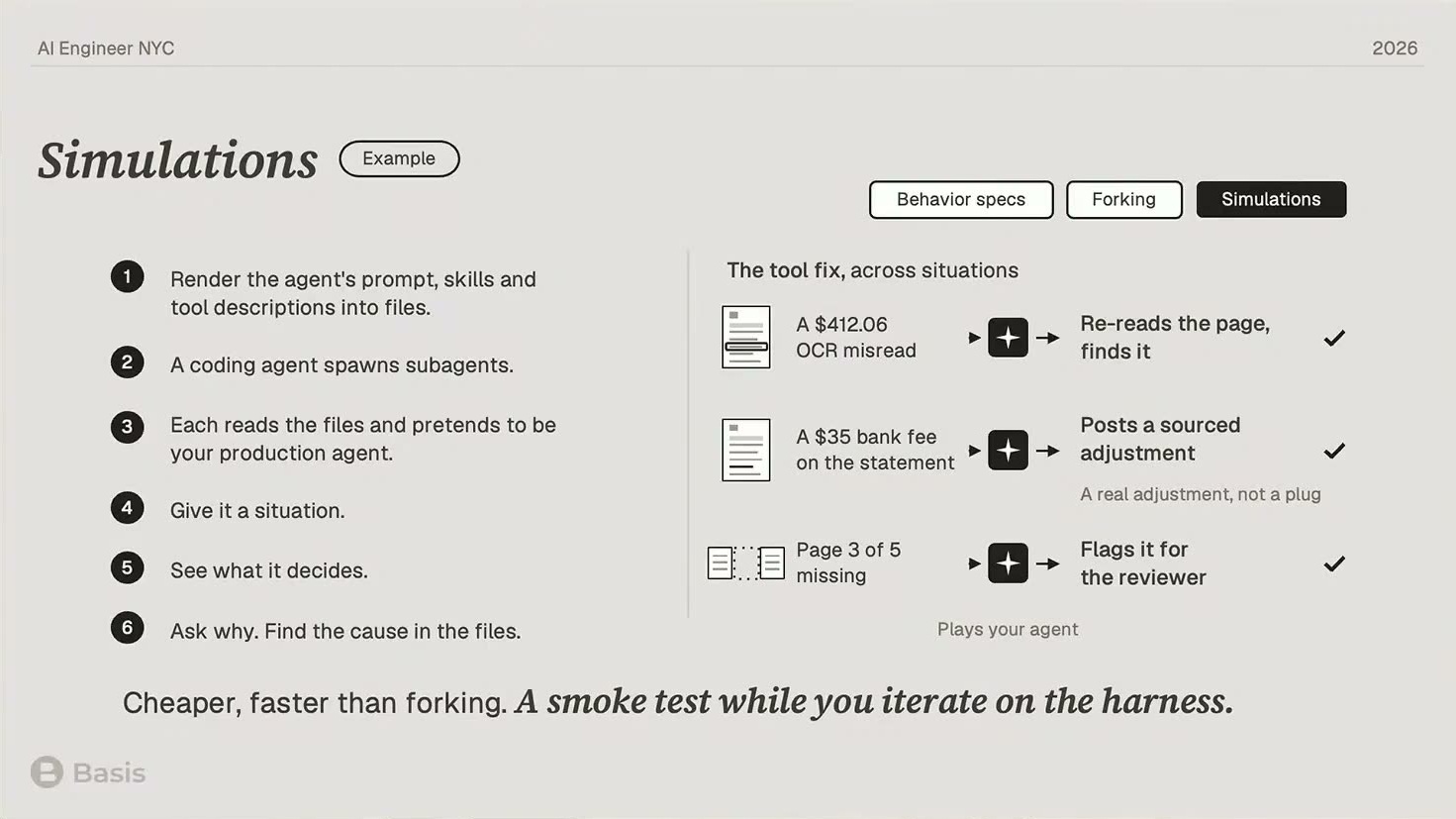
这是我最喜欢的工具,叫作模拟。听起来可能有点傻,但我保证它非常有效,也就是说,在使用编程智能体时,你可以让编程智能体创建一个子智能体,让它假装自己就是你在生产环境中使用的智能体。你得告诉它不要作弊,然后给它系统提示和技能,并把所有内容都完美地还原出来。接着你可以让它说说在某种情境下会怎么做。你可以把具体情况告诉它,看看能不能重现这个情境,也就是你在评测中或生产环境里看到的情况。如果能重现,你就可以调整上下文,看看子智能体的行为是否会因你的调整而改变。
This is actually my favorite, which is called simulations. It's going to sound silly, but I promise it's very effective, which is that you can, when working with coding agents, ask the coding agent to make a subagent that pretends to be your production agent. And you have to tell it to not cheat, and you give it the system prompt and the skills, and you render everything perfectly. And what you can do is you can ask it what it would do in some scenario. You can give it the situation. And see if you can recreate the situation that you saw in your eval or in production. And if you can recreate it, now you can tweak your context to see if the subagent would change its behavior based on your tweaks.
这样做的原因是,它显然远不如分叉整个环境,但这么做成本低得多,速度也快得多,而且能让你作为智能体构建者,很容易地反复尝试各种想法,不必经历那个昂贵的流程,也就是实际分叉整个环境。今天你什么都不用构建就能这么做。在我们把分叉功能构建进内部系统之前,我确实这样做了一年半多。
And the reason to do this, it's obviously far worse than forking, but you do this because this is much cheaper, much faster, and allows you as an agent builder to really easily iterate on ideas without needing to go through the expensive process of actually forking an entire environment. And you can do this today without building anything. I did this for literally a year and a half plus before we built forking into our internal systems.
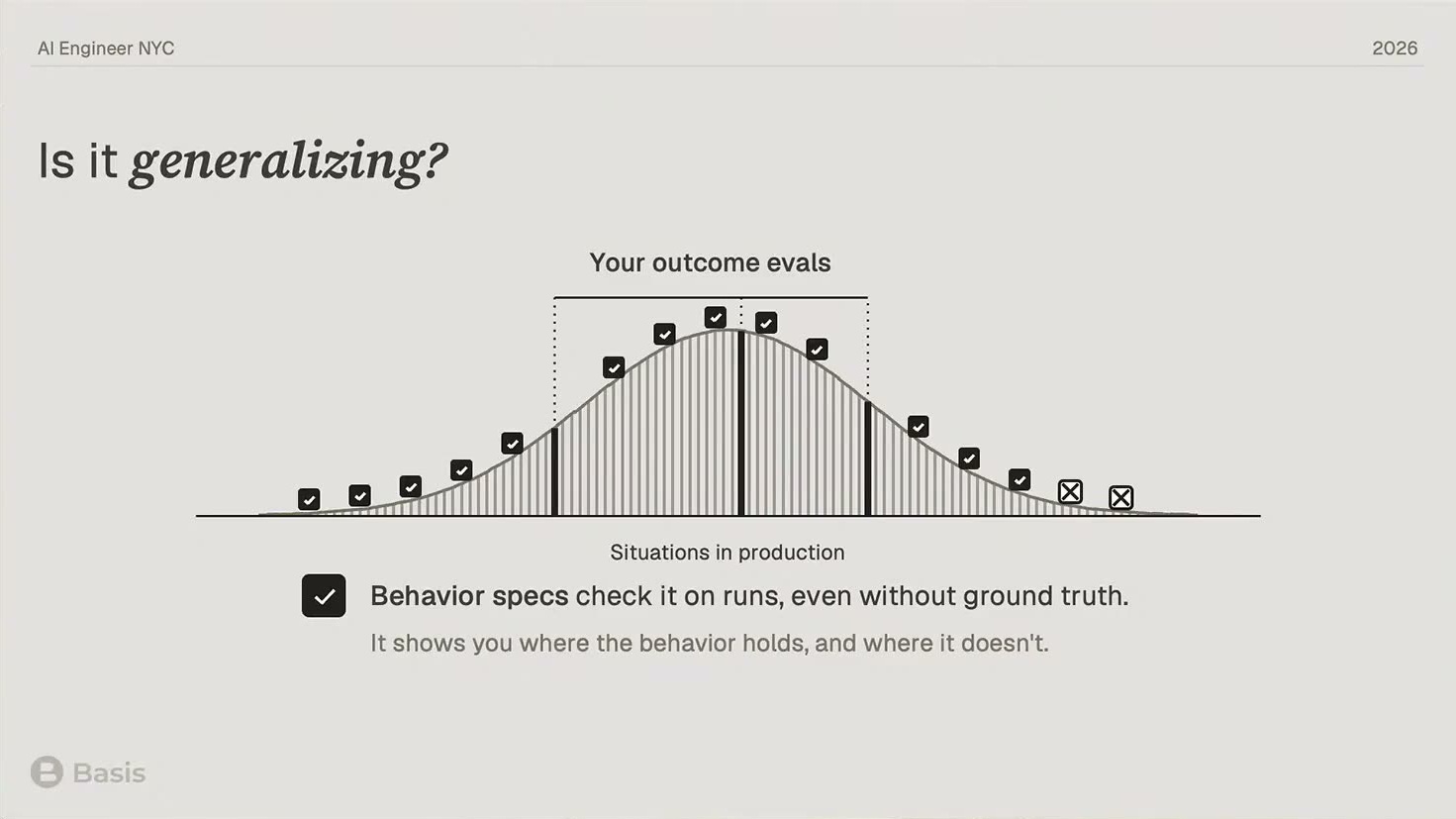
这里的核心想法是要理解,如果你看看前面提到的分布,你想弄清楚的是:智能体是否能泛化到那个分布?单靠结果评测,你无法知道这一点。你可以尽量挑选最好的结果评测,让它们代表那条曲线,但你并不能真正确定。因此,通过这些方法监督过程,能给你一些额外信号,帮助你理解它是否正确地实现了泛化。
And the main idea here is understanding that if you look at the distribution from earlier, you're trying to understand, is the agent generalizing to that distribution? And so you don't know purely based on the outcome evals. You can try to choose the best outcome evals that should represent the curve, but you don't really know. And so supervising the process through some of these methods gives you some additional signal in order to understand if it's generalizing properly.
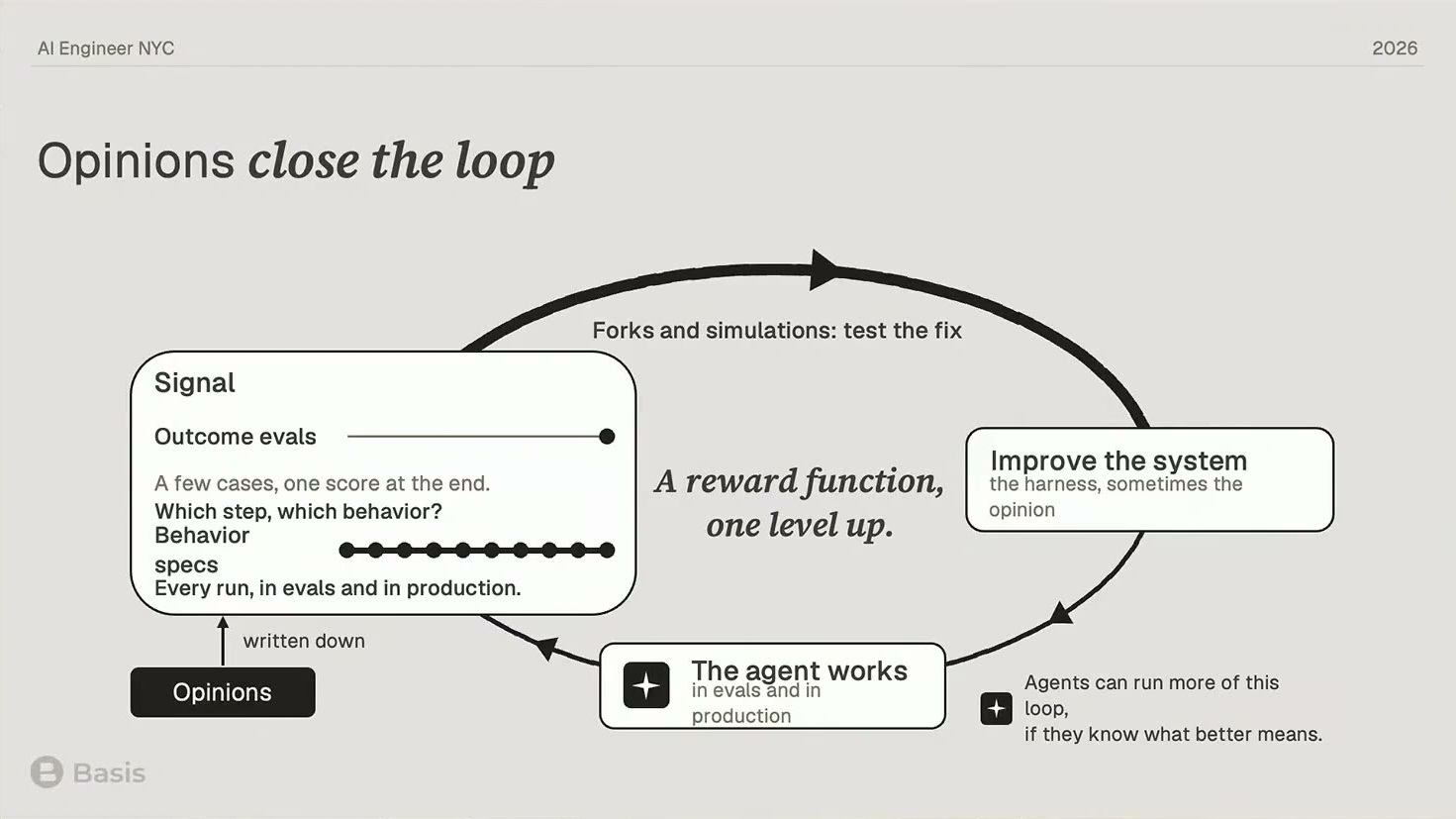
很棒的一点是,随着你开始获得更多信号,你就能开始闭环。而要做到这一点,你得有自己的判断,对吧?如果你对自己的系统没有明确的判断,就无法逐步建立这些信号。
And what's really cool is as you start to get more signal, you can actually start to close the loop. And an opinion is what lets you do that, right? If you don't have opinions about your system, you're not going to be able to develop that signal.
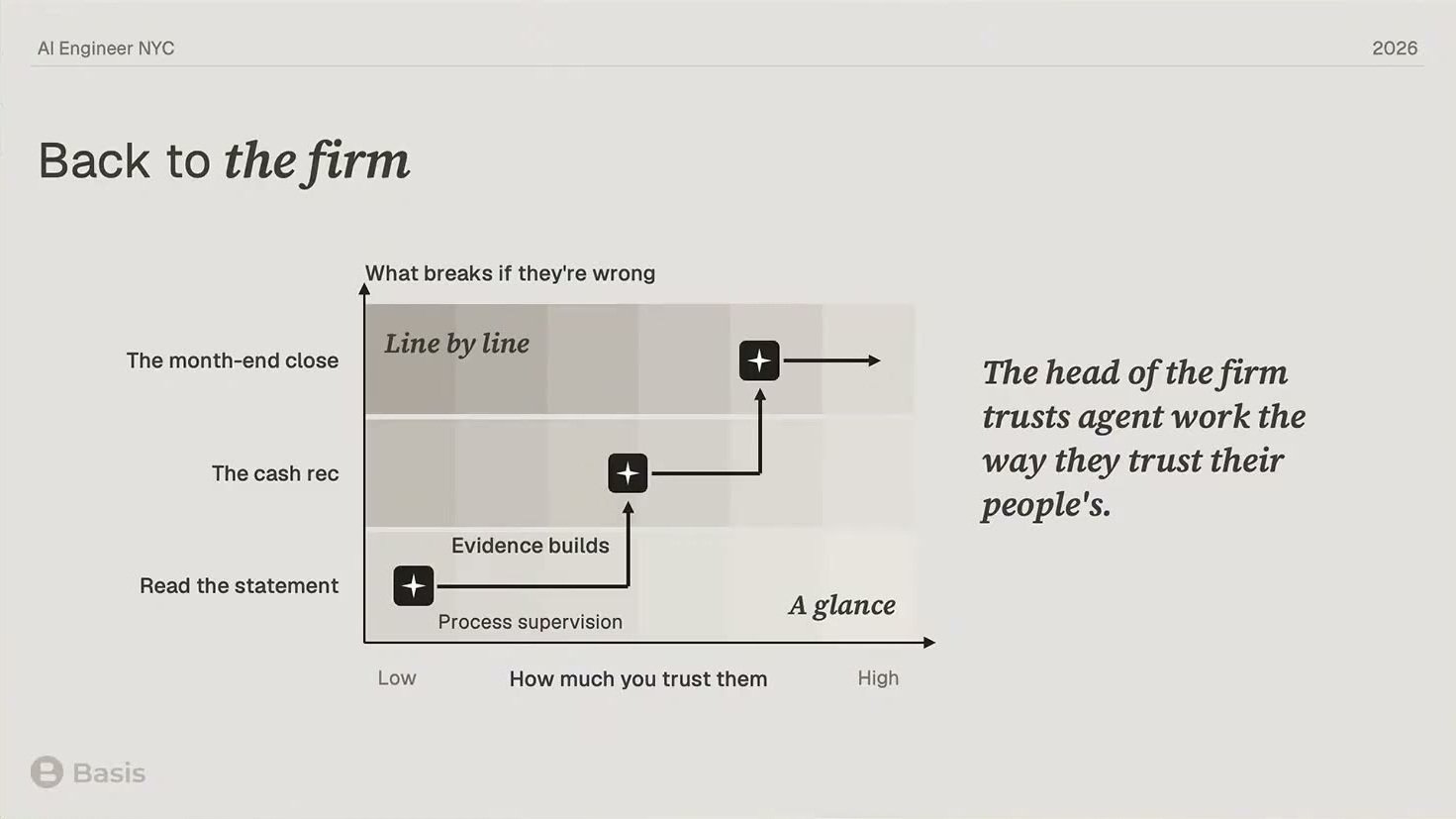
现在回到公司这个例子,我们谈过监督,也谈过智能体,如果它有明确的判断,就会更可靠,而且实际上可以更简单。这意味着,智能体或许一开始只做范围较窄的事情,但人们会与它协作,他们会发现它很容易使用,也会发现它很可靠。随着它不断变好,人们会越来越信任它。这就像一位同事。想象一下,你入职第一天就有一位同事。假设有人给你发来一个 PR。你不会……每当有人发来 PR,你都会从两个维度来判断。就是这两个维度:这个 PR 的影响范围有多大?
And now if we go back to the firm, we talked about supervision, we talked about how the agent, if he's opinionated, can be more reliable and actually can be simpler. What that means is the agent, maybe it starts doing something narrow, but because people will work with it, they see that it's easy to use, and they see that it's reliable. As it gets better and better, they will trust it more. It's just like a co-worker. You have a coworker, day one. Imagine someone sends you a PR. You're not going to, if it's, you're looking at two axes whenever someone sends you a PR. It's these two axes. What's the blast radius of the PR?
以及你认为这个人有多能干?对吧?如果公司里能力最差的人发来一个会修改核心服务的 PR,你肯定会仔细看。如果能力最强的人发来一个修改内部文档的 PR,你可能就不会看得那么仔细。这同样适用于人类与智能体协作,正如适用于人类与
And what is your perception of how competent that person is? Right? If the least competent person at your company is sending you a PR that's editing a core service, you're going to look at it. If the most competent person is sending you a PR that's editing an internal document, you may not look at it as much. and so this idea is true with humans working with agents just like it is with humans working with
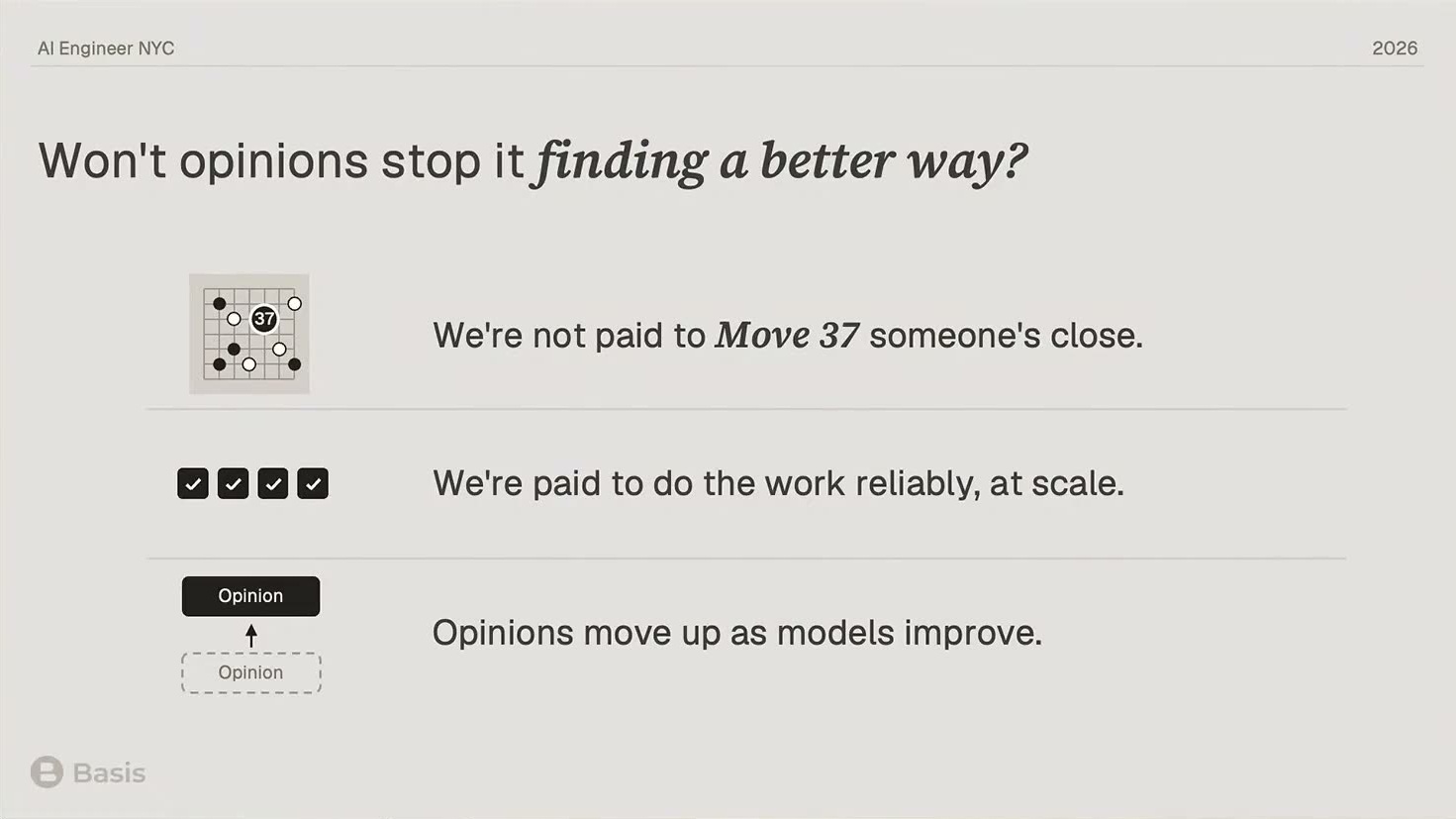
人类协作一样。我想在这里最后补充一点:其中一件人们听到这种说法时会说:“等一下,如果让智能体想做什么就做什么,它们不会找到更好的方法吗?不会把你的工作‘move 37’吗?”答案是,它们或许会。但这不是扩大 GDP 和提升产出的方式。没人希望自己的智能体把自己的纳税申报表‘move 37’。人们希望它能可靠地大规模完成工作,让他们可以信任,也让他们的员工知道如何与之协作。
humans and i think i just want to make one last point to close here which is that one of the things that people say when they hear this is well wait a second if you let the agents just do what they want won't they find a better way won't they move 37 your work and the answer is they might But that's not how you scale GDP and scale output. Nobody wants their agent to move 37 their tax return. They want it done reliably at scale in a way that they can trust and in a way that their people know how to work with.
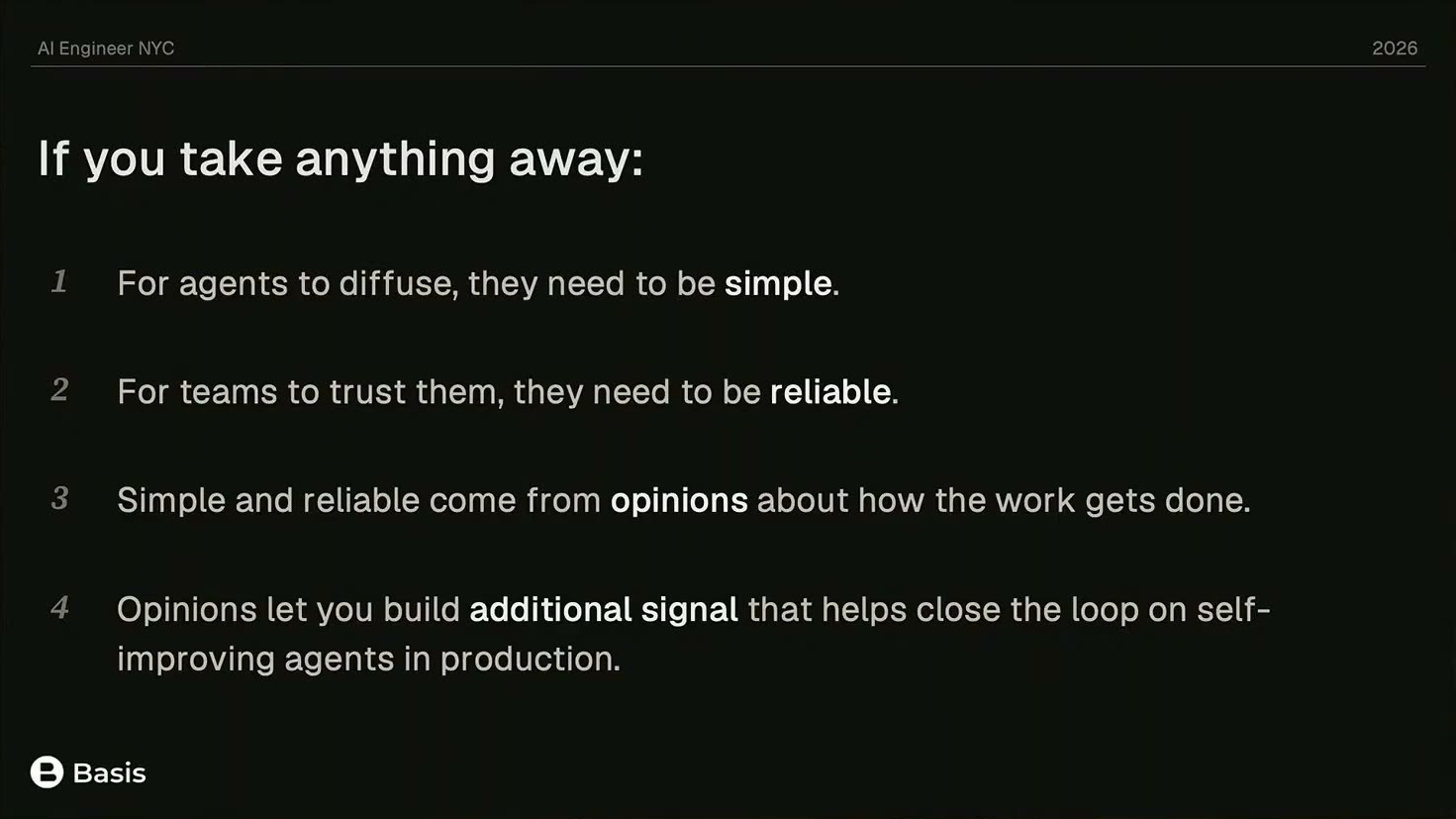
所以我最后想留给大家的是:要让智能体普及,它们就得简单。团队要信任它们,它们就得可靠。要做到简单、可靠,就要对其行为形成明确判断,关于智能体如何表现,然后这些判断能让你建立更多信号,帮助你开始闭环,从而实现生产环境中能够自我改进的智能体。非常感谢。
And so the thing I will leave you with is for agents to diffuse, they need to be simple. For teams to trust them, they need to be reliable. The way you get to simple and reliable is you develop opinions on how the agent behaves, and then opinions allow you to build that additional signal that helps you start to close the loop so that you can achieve self-improving agents in production. Thank you very much.