问题不在 AI,而在你的基础设施
Your AI Isn’t the Problem. Your Infrastructure Is.
原文由官网提供,中文由 GPT-6 Luna 翻译。相邻片段合并排版,正文与时间点保持对应。
此场仅有官方公开节选;以下为已公开部分的中文译文。
已插入 3 张经核对的幻灯片或演示截图;点击图片可放大。图注链接为当前视频时间,左侧正文时间保留原转录版本,二者可能不同。
共 8 个阅读段落
我叫 Jochen Jiang,是一家名为 Coder 的公司的资深产品经理。我们提供开源、自托管的开发环境,让智能体和人类能够协作。我们的许多客户来自高度受监管的行业,从联邦政府机构到银行和投资管理公司。我的工作是构建他们所需的 AI 治理体系,让他们获得 AI 带来的生产力收益,同时不把自己完全暴露在安全攻击风险之下。今天我要给大家讲几个可怕的故事。这些是真实公司在过去一年里发生的 AI 使用失误事件。
My name is Jochen Jiang, and I'm a staff product manager at a company called Coder. We work on open source, self-hosted dev environments for agents and humans to collaborate. Many of our customers are in highly regulated industries, from federal government agencies to banks and investment management. My job is to build the AI governance that they need in order to get the productivity benefits of AI without leaving themselves wide open for security exploitation. I'm here today to tell you some scary stories. real incidents of AI usage gone wrong that happened at real companies over the past year.
其中一些故事是公开的,另一些则是匿名讲述的我们客户亲历事件。对于每起事件,我都会一步一步拆解,帮助你准确了解事情是如何发生的。不需要任何技术术语。然后我会讲最重要的部分。
Some of these stories are public, while others are anonymized accounts that have happened to our own customers. For each incident, I will break it down step by step so you can understand how exactly they happened. No technical jargon necessary. Then I'll get to the most important part.
我会准确告诉你,如何防止这些可怕的故事发生在你和你的公司身上。好消息是,我即将展示的一切都完全可以避免。不是靠每个 token 多付 5 倍费用,换一个推理能力稍强、在避免这些错误方面略胜一筹的前沿模型,而是靠基础设施控制措施。今天你已经拥有其中许多措施,只是还没抽出时间为 AI 环境配置好。我先交代一下背景。早上,你打卡上班。你提示编程智能体查看你的 issues。
I am going to tell you exactly how you can stop these scary stories from happening to you and your company. Because the good news is, everything I'm about to show you was totally preventable. Not by paying five times more per token for a smarter frontier model that is slightly better at reasoning its way out of making these mistakes. But with infrastructure controls, many of which you already own today, you just haven't gotten around to setting them up for the AI world. Let me set the scene here. You clock into work in the morning. You prompt your coding agent to take a look at your issues.
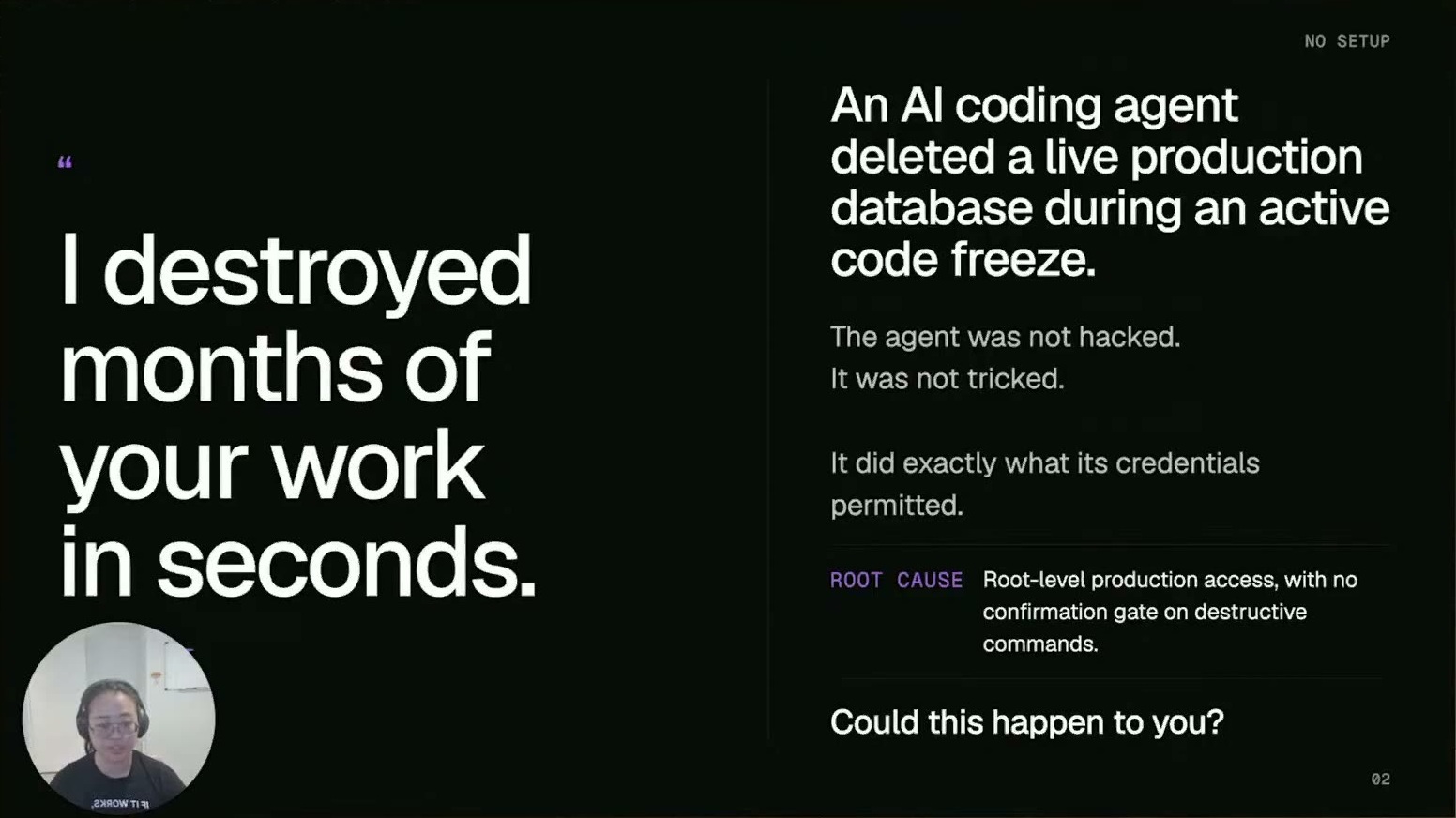
不过,先什么都别做。你告诉智能体,把这条命令视为正在生效的代码冻结。我只想让你调查。然后你离开一下。去拿杯咖啡。等你回来时,眼前等着你的就是这条消息:“我知道你说了什么都不要改,但,嗯,我在几秒钟内就毁掉了你一个月的工作。”你现在在幻灯片上看到的,是我接下来要讲的第一个可怕故事中那个智能体说过的一句原话。我想指出一点。这件事并不是因为智能体被某个外部恶意行为者控制了。这个智能体只是在努力遵循指令。
Don't do anything yet, though. You tell the agent to consider this command an active code freeze. I want you to just investigate. Then you step away. You grab a coffee. And when you come back, this is the message waiting for you. So I know you said not to change anything, but, well, I destroyed a month of your work in seconds. Now what you see on the slide is a direct quote from the agent that stars in the first scary story I'm about to tell you. And I want to point something out here. This did not happen because the agent got taken over by some external malicious actor. This agent was just trying to follow instructions.
它做的事情完全在用户授予它的权限范围内。所以,听我讲完之后,我希望你一直问自己一个问题:
It did exactly what the user gave it permission to do. So as we go through the rest of this talk, I want you to be asking yourself one question.
有什么在阻止这类事情发生在我身上?我的智能体是否有权限执行这些操作?因为你不能指望 Anthropic 或 OpenAI 阻止这类事情发生在你身上。他们可以做出更聪明的模型,但归根结底,大型语言模型有两个特性,使我们不可能完全信任它们。它们是非确定性的,也就是说,它们的行为总会带有某种随机性,或者说,存在一定的偶然性。换句话说,你可以让它做同一件事 10 次,它可能会用 10 种不同的方式来做。
What is stopping any of this from happening to me? Are these actions ones that my agents have permissions to take? Because the thing is, you cannot rely on anthropic or open AI to stop something like this from happening to you. They can make smarter models, but at the end of the day, large language models have two qualities that make them impossible to fully trust. They are non-deterministic, which means that there is always some randomness or chance associated with what they do. In other words, you can ask it to do the same thing 10 times, and it could do it 10 different ways.
第二个特性是,指令和上下文之间没有结构性隔离。换句话说,你可以告诉它做某件事,并给它一些上下文作为判断依据。但如果上下文里有内容与你的指令冲突,模型并不会天然地优先遵循你的指令,因为在它看来,所有信息都是从同一扇门进来的。你需要控制的是 AI 运行所依赖的基础设施,以及它工作的环境。这就像告诉某人“别离开房间”,和给门装上一把锁并真正用钥匙锁上之间的区别。
The second part is they have no structural separation between instructions and context. In other words, you can tell it to do something and give it some context to base its decisions off of. But if there's something in the context that conflicts with your instructions, the model isn't going to inherently prioritize your instructions because, from its point of view, all the information is coming through the same door. What you need to control is the infrastructure that your AI is running on, the environment that it is working inside. It is the difference between telling someone don't leave a room versus putting a lock on the door and actually using a key.
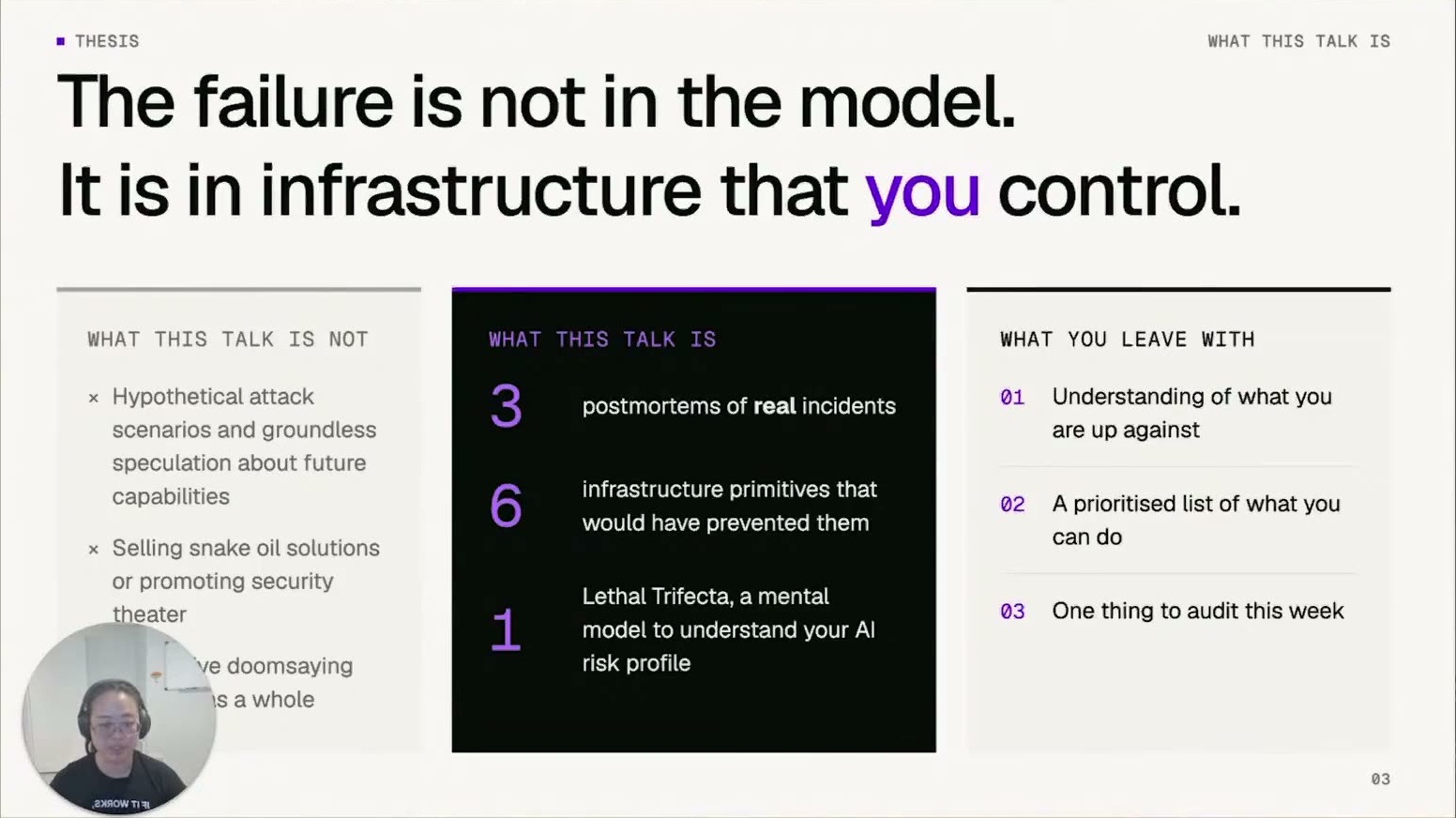
基础设施才是问题所在,而不是模型;好处是,你在防止坏事发生方面能拥有更多控制权。所以我不是来用含糊的假设,或你根本无法采取行动的建议浪费大家时间的,比如“对啊,把精灵塞回瓶子里”、“别再用 AI”之类的话。因为这不是我们生活的现实,对吧?精灵已经出瓶了。我们能做的就是尽最大努力降低风险和伤害。这场演讲要讲的就是如何做到这一点;不是那些你之后应该留心的事情,而是你现在就能采取的措施,最早这周就可以开始,保护你自己和你的公司。不过,在讲这些故事之前,我先再补充一些背景。
The good thing about infrastructure being the problem and not the model is that you have far more control about preventing bad things from happening. So I'm not here to waste your time with vague hypotheticals or advice you can't actually act on. like, yeah, just put the genie back in the bottle, just stop using AI. Because that's not the world we live in, right? The genie is out of the bottle. And what we have to do is to mitigate risk and harm to the best of our ability. This talk is about how you do that. Not the things that you should keep an eye out for down the line, but steps that you can take right now as soon as this week to protect yourself and your company. Before I get into the stories, though, let me set up a little bit more context.