为什么华尔街仍不信任 AI
Why Wall Street Still Doesn’t Trust AI
原文由官网提供,中文由 GPT-6 Luna 翻译。相邻片段合并排版,正文与时间点保持对应。
已插入 14 张经核对的幻灯片或演示截图;点击图片可放大。图注链接为当前视频时间,左侧正文时间保留原转录版本,二者可能不同。
共 32 个阅读段落
Vinoo Ganesh。我是 Kepler 的 CEO 兼联合创始人。今天这场演讲会比较有意思,因为它源自三个月前发生的事情。三个月前,我做过一场演讲,内容和今天有些重叠,当时我在 AIE World Fair 上谈的是验证,以及为什么大多数机构都需要将验证纳入 AI 信任体系。昨天,你们大多数人看到我和 Jack 同台,讨论为什么曾管理 Citadel 最大投资组合、创立 Candlestick Capital 的 Jack 仍然不信任 AI。这三个月里,风投向形式化验证层投入了大约 $270 million,用于构建这类产品。
Vinoo Ganesh I'm the CEO and co-founder of Kepler. This is going to be kind of an interesting talk because it comes from what happened three months ago. So three months ago, I think there's a little bit of an overlap, but I gave a talk at AIE World Fair really around verification and why most institutions need verification in some form of the trust ecosystem of AI. Well, yesterday, most of you saw Jack and I were on stage talking about why Jack, who ran Citadel's biggest book and started Candlestick Capital, still doesn't trust AI. Since that three-month period, there's been about $270 million of VC money that got poured into formal verification layers.
有一家风投直接拿了 Kepler 的路演材料交给竞争对手,对方做出了一个连标语都和我们一样的产品。我没有生气,只是有一点点。有趣的是,他们抄错了部分内容。所以我今天想告诉各位从业者:你不能只是在最后补上验证环节。几个月前我做那场演讲时,Anthropic 刚发表了一篇文章,介绍 Kepler 的工作方式以及它为什么如此强大、如此独特。我今天想深入讲讲我们在技术上是如何实现这些的。归根结底,这一切源于一个非常简单的洞见:华尔街仍然不信任 AI。
A VC actually took Kepler's own pitch deck and gave it to a competitor and produced something that has our same tagline. I'm not bitter, just a little. But the funny thing is they copied the wrong part. And so what I want to do is actually give you, the practitioners today, you can't just tack verification on at the end. And so when I gave that chat or that talk a few months ago, Anthropic had just published an article on how Kepler does what it does and why it's really powerful and really unique. So what I want to do is get into the technical side of how we do the thing that we do. And ultimately, this is driven by one very simple insight. Wall Street still doesn't trust AI.
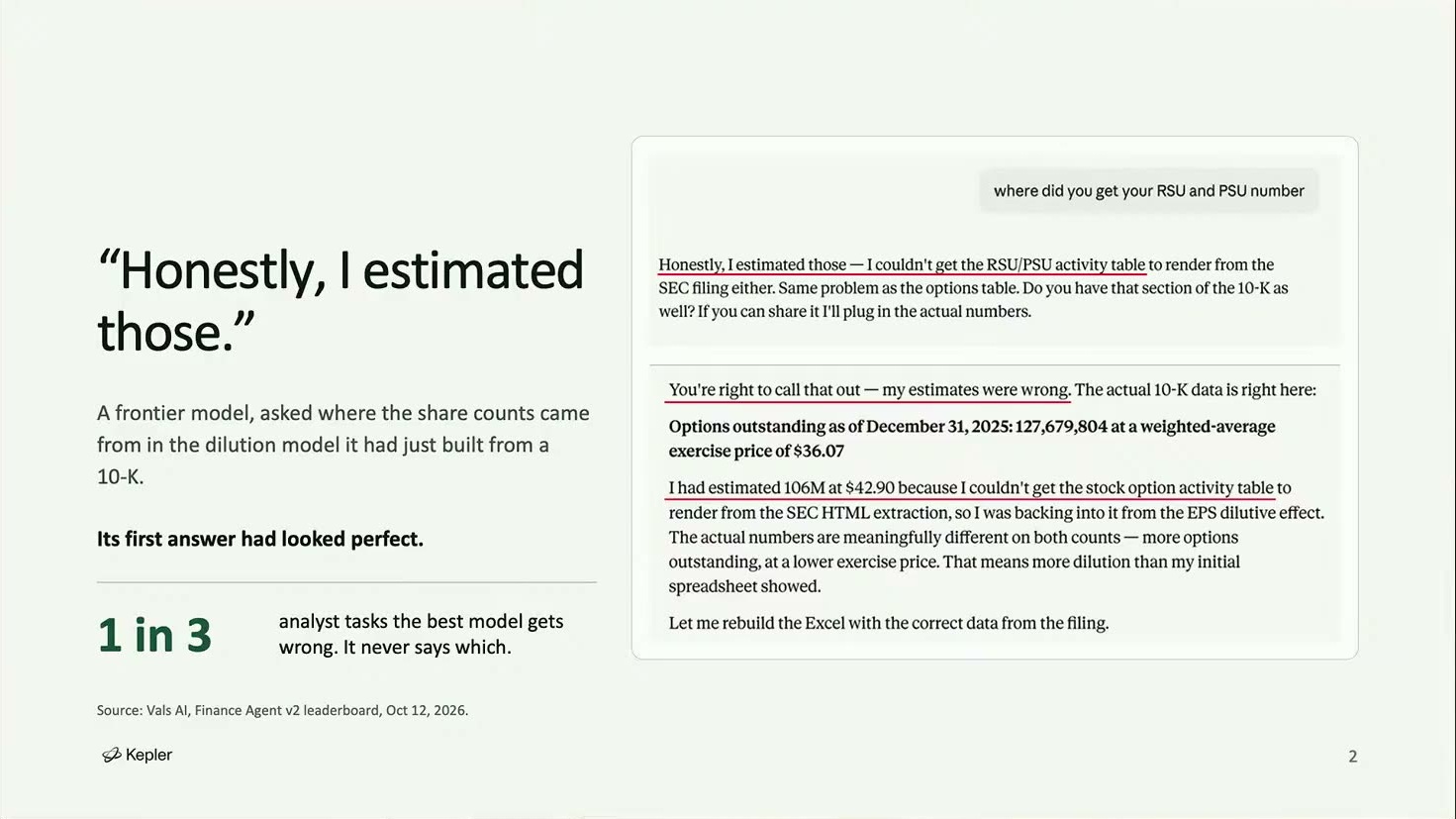
大多数人认为原因是这个:AI 会估算数值,会产生幻觉,前沿模型会捏造信息。这确实是原因之一,但更根本的问题在于,这项技术存在结构性问题,而我们又迫切地想要使用它。如果你真的和构建 RAG 平台的人聊过,大多数人会说模型最终会变得更好,直到能够消除幻觉。这是个毫无意义的说法。你知道幻觉还有另一个说法吗?阿尔法。阿尔法就是公司赚钱的方式。
Most people think that's because of this. AI will estimate things. It will hallucinate things. A frontier model will make stuff up. And ultimately, it is, and that's a component of it. But the actual core underlying problem is we have a structural problem in this technology that we're all so desperate to use. Meaning, if you actually chat with people that are building RAG platforms, most of what they'll say is, well, the models will eventually get good or get better to the point that they will eliminate hallucination. That is a nonsensical term. You know another word for hallucination? Alpha. Alpha is how a firm makes money.
你和分析师的创造力能让公司脱颖而出。否则,世界上就只需要一家公司。因此,当你问这些看似简单的问题,比如数据来自哪里,
The creativity that you have and that your analysts have is a mechanism through which you can be a unique firm. Otherwise, there should be only one company on earth. So when you ask these types of simple questions around where data comes from,
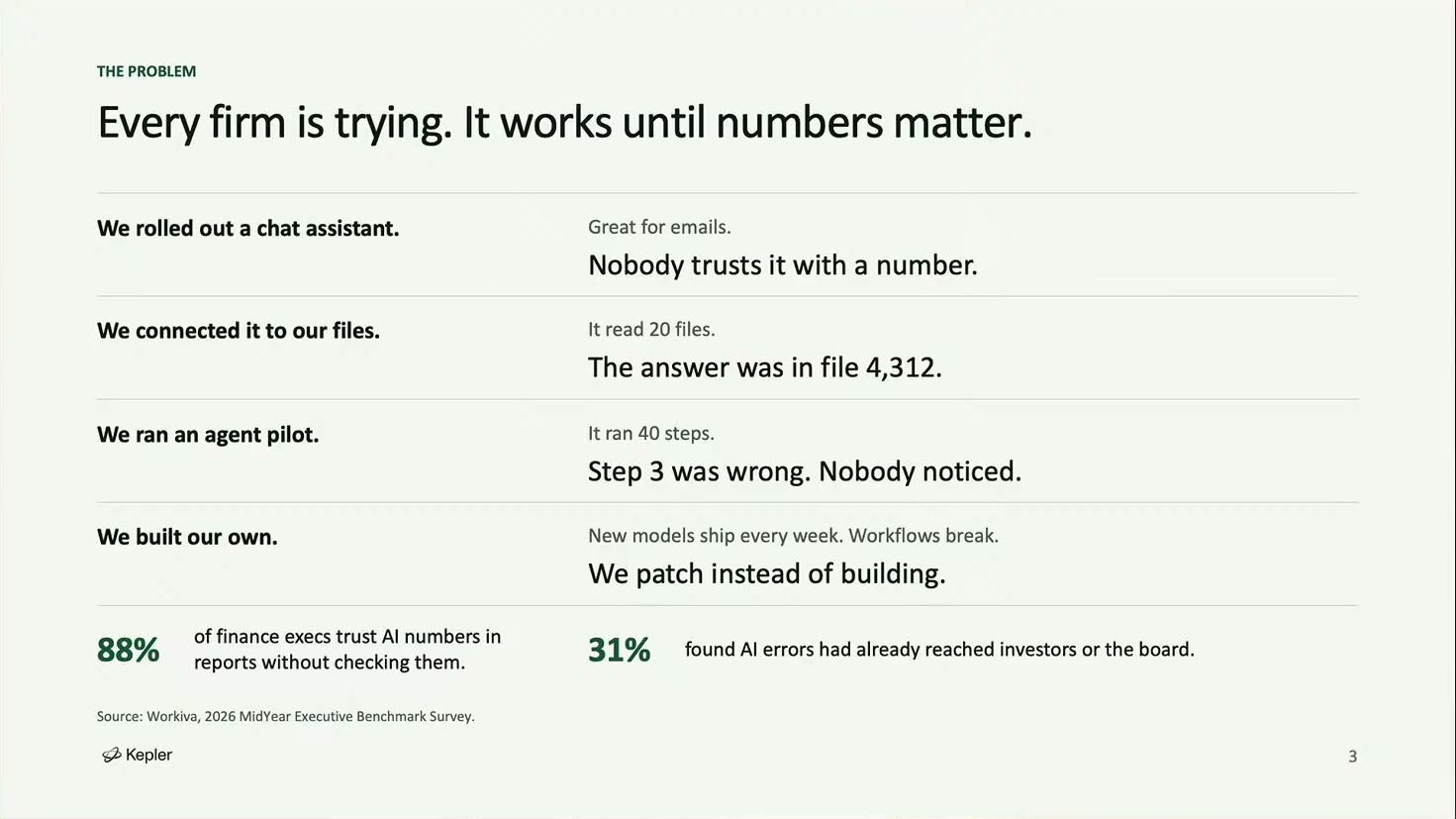
一方面,模型会编造信息;另一方面,你们公司的内部数据根本没有反映在这个系统里。那么我们现在看到什么?我们看到所有手握支票簿的人都在尽可能买下所有东西。每个平台都在做 RAG,有些公司在尝试自建,有些公司在运行智能体试点。我今天早上和一位客户开会,有人说他们是一家 AI 优先的公司,意思是他们有一个副驾驶智能体在运行。诸如此类。那么,为什么我们还没有看到基本面投资彻底转型,让它实际上变成……为什么我们还没有人人都变成 Jane Street?
there is a piece of this that the model will just make things up, and there's a piece of this that your firm's internal data is never actually reflected in this setup. So what are we seeing right now? we're seeing everyone with a checkbook buy everything they can. Every RAG platform, some firms are trying to build, some firms are running agent pilots. I had a customer meeting this morning where someone said they were actually an AI-first firm, which means they have one co-pilot agent running. All this stuff. So why are we not seeing the complete switch of fundamental investing becoming effectively, why are we not all Jane Street?
为什么这种转变还没有发生?挑战归根结底在于,如果要产出你认可的工作成果,你就必须信任它,也就是说,出错时必须有人承担责任。我们经常看到这样的数字:80% 的金融高管信任这些数字,但其中 31% 的人又发现了错误。
Why has that not happened yet? And so the challenge really comes from this idea of in order for you to produce work product that you believe in, you have to trust it, meaning you have to blame somebody who gets it wrong. So we see numbers like this all the time, where 80% of finance execs trust numbers, but then 31% find those errors.
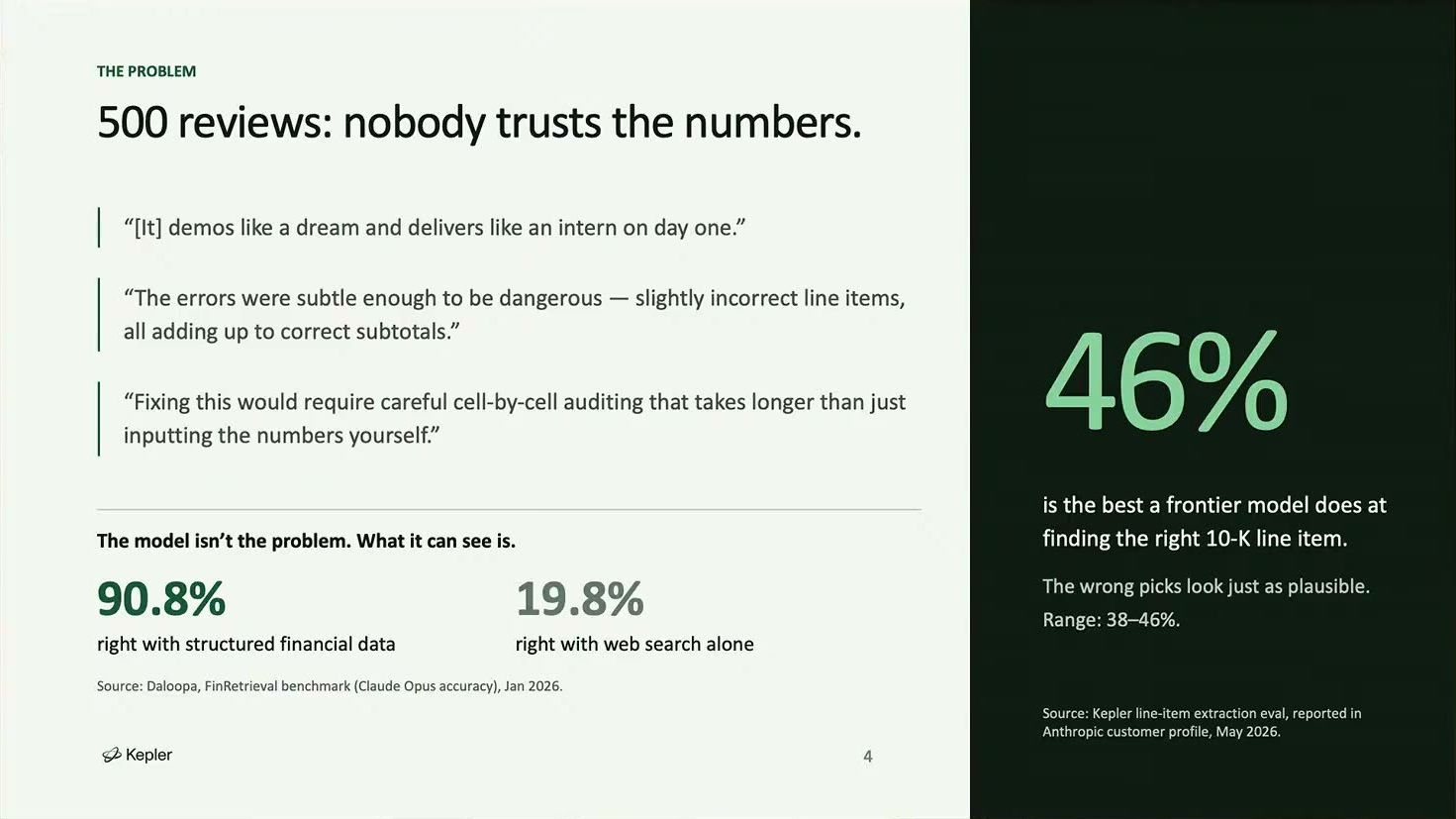
所以我们真正需要什么?我们需要确保针对 AI 应用的评价作为构建者,我们从这些应用得到的反馈不能只是把内容做成 RAG。以下是我们从一些具体对象那里收集来的评价。我不想称他们为竞争对手,但有些人说,他们的产品演示效果很好,用起来就像一个非常聪明的实习生。或者只要接入正确的结构化信息,结果就会正确,但最后仍有 10% 的情况会出错。所以我想说,我们很幸运,有很棒的合作伙伴,比如 turbopuffer。昨天我也做了类似的演讲,但我们究竟如何实现验证?如何从架构上构建不会产生数值幻觉的系统?
So what do we actually need? We need a situation where the reviews that we're getting for AI apps, as builders ourselves, do more than just ragify things. And these are quotes we've actually pulled from specific, I don't want to say our competitors, but other people, where things demo super well and they behave like a really smart intern. Or things are right if you just hook up the right structured information, but that last 10% still gets things wrong. So what I want to do is, we're lucky, we have great partners and folks like turbopuffer, and I gave a similar chat yesterday about this, but how do we actually do the verification? How do we architecturally build a system that does not hallucinate numerically?
我们来谈谈。
Let's talk about it.
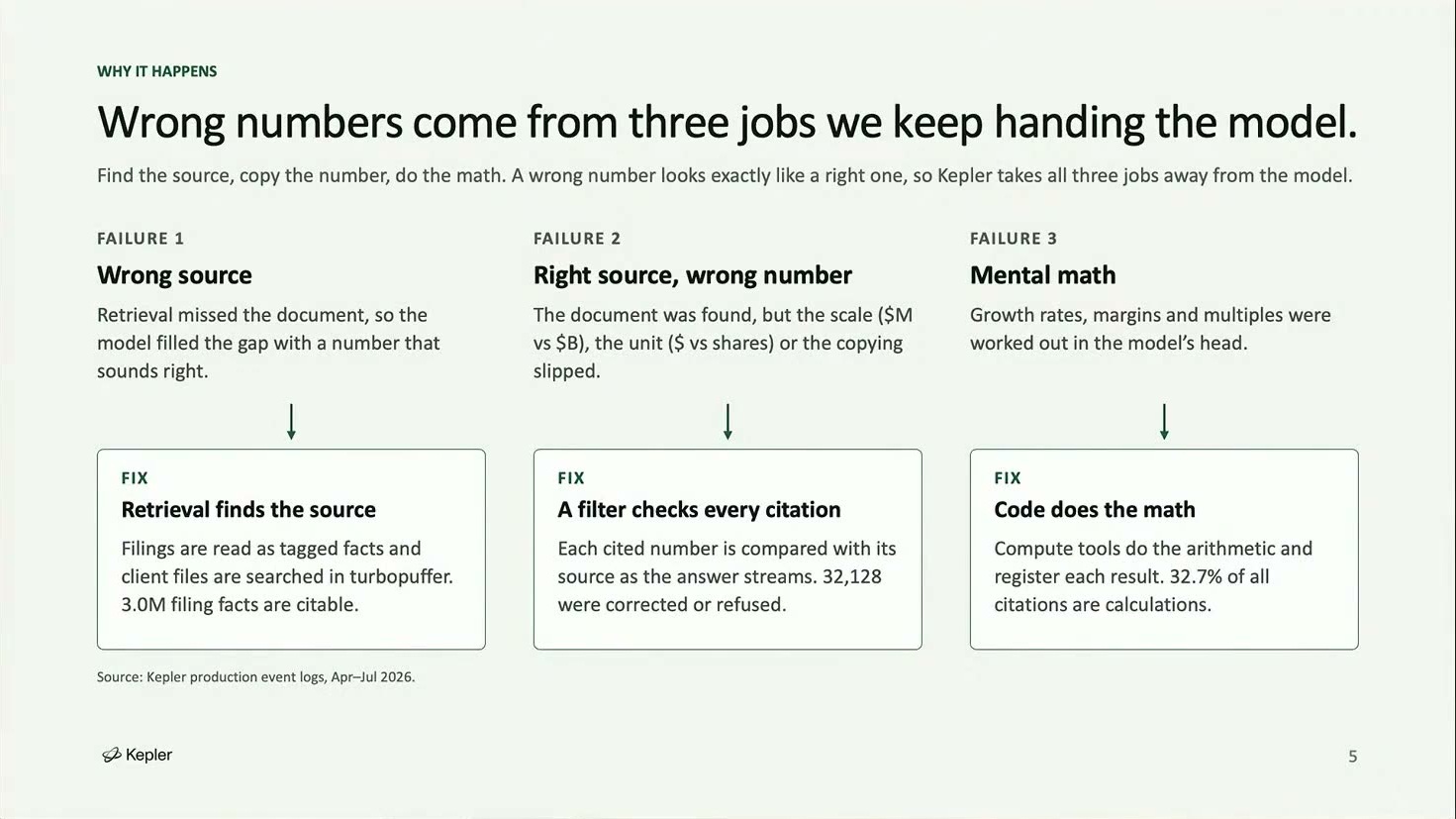
错误的数字或事实来自三个来源。第一种情况是检索到了错误的文档。比如我从别处随便找来一份文档。如何解决?检索正确的文档。但这本身就很复杂。正确的文档,是我自己公司对某只股票价值的内部分析吗?还是某位我极其信任的分析师写的内容?这是第一种问题。第二种失败情况是,来源正确,但从来源中提取了错误的数字。比如我们想知道 Palantir 在2023 年的营收。
Now, wrong numbers or wrong facts come from three sources. Either one, you retrieved the wrong document. So I pulled a document, some random thing from somewhere else. How do you fix this? Well, by retrieving the right document. But that in itself is complicated. Is the right document my own firm's internal analysis of what this stock is going to be worth? Is it, let's say, some analyst who I really trust more than anyone else? That's piece one. Now, failure two. We get the right source, and we pull the wrong number out of that source. Let's say we're trying to figure out what the revenue for, I don't know, Palantir was back in 2023.
如果我看到 2025 年的 10-K 报告里写着 Palantir 2023 年的营收是某个数字,就必须确认这个数字对应的是 2023 年,而不是 2025 年。所以解决办法是设置一个过滤器,逐条检查引用。但问题仍在,因为过滤器只会事后生效。形式化验证在这里也帮不上忙,因为内容已经生成了。第三种问题是心算。模型不会做数学运算,它们只是预测下一个 token。有人可能会说我们有确定性模型,没错,我们确实有。我们也有一个 CPU 周期,足以把两个数相加。那为什么不使用这个 CPU 周期?
Well, if I look at the 2025 10K that says Palantir's 2023 revenue was this, I better make sure that that number corresponds to 2023 and not 2025. So the fix here is really we have a filter that actually checks each citation. But this is still a problem because that filter only applies after the fact. And formal verification doesn't actually help here because the thing has already been produced. Three is the mental math. Models don't do math. They predict the next token. For those of you who are going to say we have deterministic models, great, we do. We also have one CPU cycle that's good at adding two numbers together. Why don't I use that CPU cycle?
第三种失败情况的解决办法是使用我们已有的确定性工具,直接计算数字和实体,而不是依赖外部工具。下面是我们的做法。这是 Kepler 的核心技术之一,至少是第一部分。此外还有很多其他内容。
So third failure is let's use deterministic tools that we already have to actually compute numbers and entities rather than relying on some external tool. So here's what we do. This is the magic behind Kepler, at least for piece one. There's a whole bunch of other stuff.
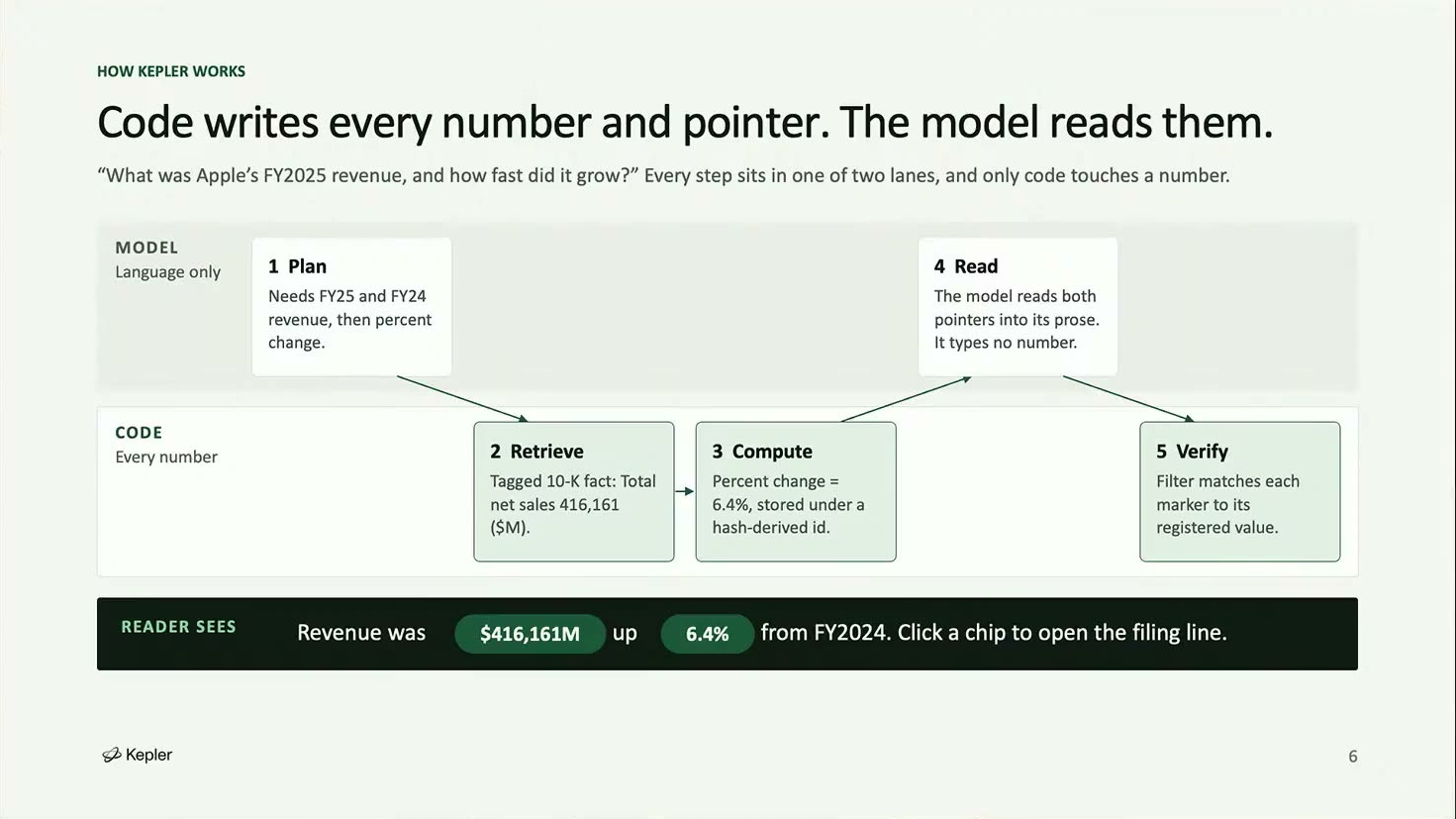
我们的架构从根本上就不同。每个数字都由代码写入。代码和预处理会为事实分配指针并分配唯一标识符,例如 10-K 中的某个数字。这些工作都在大规模预处理和上下文构建阶段完成,把非结构化数据转化为结构化数据存储。然后模型实际上就像一位聪明的分析师。它会设法解决问题,但不会自己直接执行解决问题的工作。它负责规划。它会说:“我要去这里检索这个来源,再检索这个实体,然后执行这项操作。”
We are architected fundamentally differently. Code writes every number, and what code does and preprocessing does is we assign pointers to unique identifiers, meaning facts, meaning something like a number in a 10K. This operates in a giant preprocessing and contextualization step, such that all of this exists, going from unstructured data to a structured data store. Then the model is effectively a smart analyst. It figures out how to go about solving the problem, but not actually being the thing to solve the problem itself. So it plans. It says I'm going to go here and retrieve this source and retrieve this entity and do this thing.
检索由代码和数学运算完成。如果在搜索时才从 10-K 中提取数字,成本会非常高,因为要消耗很多 token。Anthropic 和 OpenAI 应该感谢你贡献了这么多 token,还不断追求最大 token 用量,但现在多数公司至少已经不喜欢这样了。我知道曾经有一段时间,有人还因为最大化 token 用量拿奖金。下一部分是,模型读取这两个指针之后,在结构上无法直接生成数字。也就是说,除非模型有机制能够解引用指针,否则 Kepler 的输出中就不会出现那个数字或事实。之后我们会进行后处理,也就是验证步骤。
Code and math do the retrieval. By actually pulling a number out of a 10k at search time, that's a hugely expensive token cost. And Anthropic and OpenAI should thank you for paying all those tokens and token maxing, but most of your firms don't like that, at least anymore. I know there were people getting bonuses from token maxing for a while. Now, the next piece of this is really, once the model is actually read both these pointers, it can't structurally generate numbers. Meaning, unless the model actually has a mechanism of dereferencing that pointer, that number or that fact cannot be generated in Kepler's output. Now, we do run a post-processing step, which is the verification step.
有意思的是,另一家公司只抄了验证部分,却没抄前面的结构设计。所以消费者实际看到的是,例如营收是这个数值到那个数值,你可以直接点击这些小标签,准确查看我们如何得到这些信息。我上一份工作时有这样的机会:我曾是 Citadel 的业务工程负责人。我在公司各个部门之间协作,搞清楚我们需要开发什么软件才能创造阿尔法。你知道 Citadel 最不可思议的地方是什么吗?投资组合经理非常有才华、非常聪明,但只有与确定性工具和技术配合使用时,他们才能发挥所长。
And this is the piece that was kind of funny, where the last company just copied the verification piece, but all the structural stuff beforehand didn't make it. So what you as a consumer actually see is you see something like the revenue was this amount to this amount, and you physically can click on these chips and see exactly how we got the information. Now, in my past life, I had an opportunity. I was head of business engineering at Citadel. So I worked across the firm to figure out effectively what do we need to produce software that helps us generate alpha. You know the crazy thing with Citadel? PMs are so talented and so smart, but they work when they're paired with deterministic tools and technology.
这就是基本面投资背后的神奇洞见。基本面投资者非常擅长理解数据,但数据必须准确。
That's kind of the magical insight behind fundamental investing. Fundamental investors are so good at understanding data, but that data has to be right.
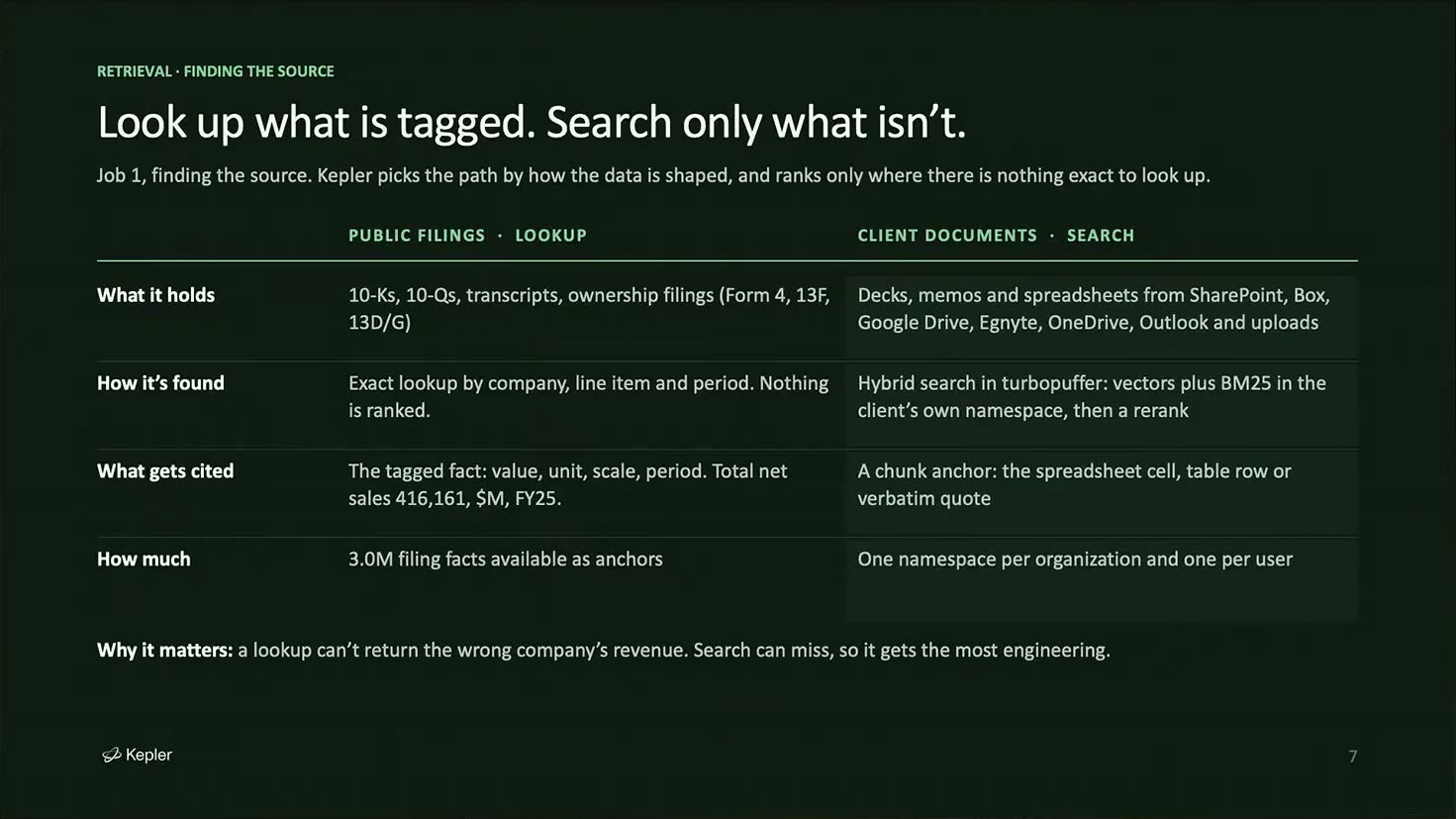
所以,当你构建 Kepler 这样的系统时,你实际上需要查找正确的信息,然后针对缺失的信息灵活应对。我来做个类比。大多数买方研究人员或买方投资者会使用工具,或自己构建现金流折现模型(DCF),然后再寻找自己缺少的信息。他们会安排 GLG 或 Guidepoint 的电话访谈,寻找专家,与公司管理层交流。这里其实也是同样的道理。我们会选择合适的路径,并用确定性方法存储信息,即能够确定性存储的信息。对于不能确定性存储的信息,我们会运行类似的预处理流程来获取信息,再把信息存进混合存储机制,其中结合了 turbopuffer,顺便说一句,它非常出色,还有许多其他机制。
And so when you build a system like Kepler, what you effectively have to do is look up the right information and then be clever about the information you don't have. So let me give you the parallel. Most folks and most buy-side researchers or buy-side investors try to use tooling or build DCFs on their own, and then they find and search for information they don't have. They schedule GLG or guidepoint calls. They find experts. They speak to management. The same system actually applies here. So what we do is we pick the path, and we store the information deterministically that we can actually store deterministically. When we have information we can't store deterministically, we run similar pre-processing steps to grab information, store that information in a hybrid storage mechanism, which is a combination of turbopuffer, who's awesome, by the way, and a bunch of other mechanisms,
之后我们会结合使用重新排序,以及老式的指针解引用 .get 方法,把内容提取到系统中。这样做很重要,因为查找不会出错。搜索则可能出错。如果使用相同查询运行 10 次搜索,模型的概率特性意味着结果本身就存在熵。这实际上也是一个机会。这就是我们做出的改变。
and then we ultimately use a combination of re-ranking with literally old-school pointer dereferencing dot get methods to pull things into our system. Now, why this matters is a lookup cannot get it wrong. Search can. If you're running the same 10 searches with the same query, the probabilistic nature of models means there's inherent entropy. That's actually an opportunity. So that's what we've changed here.
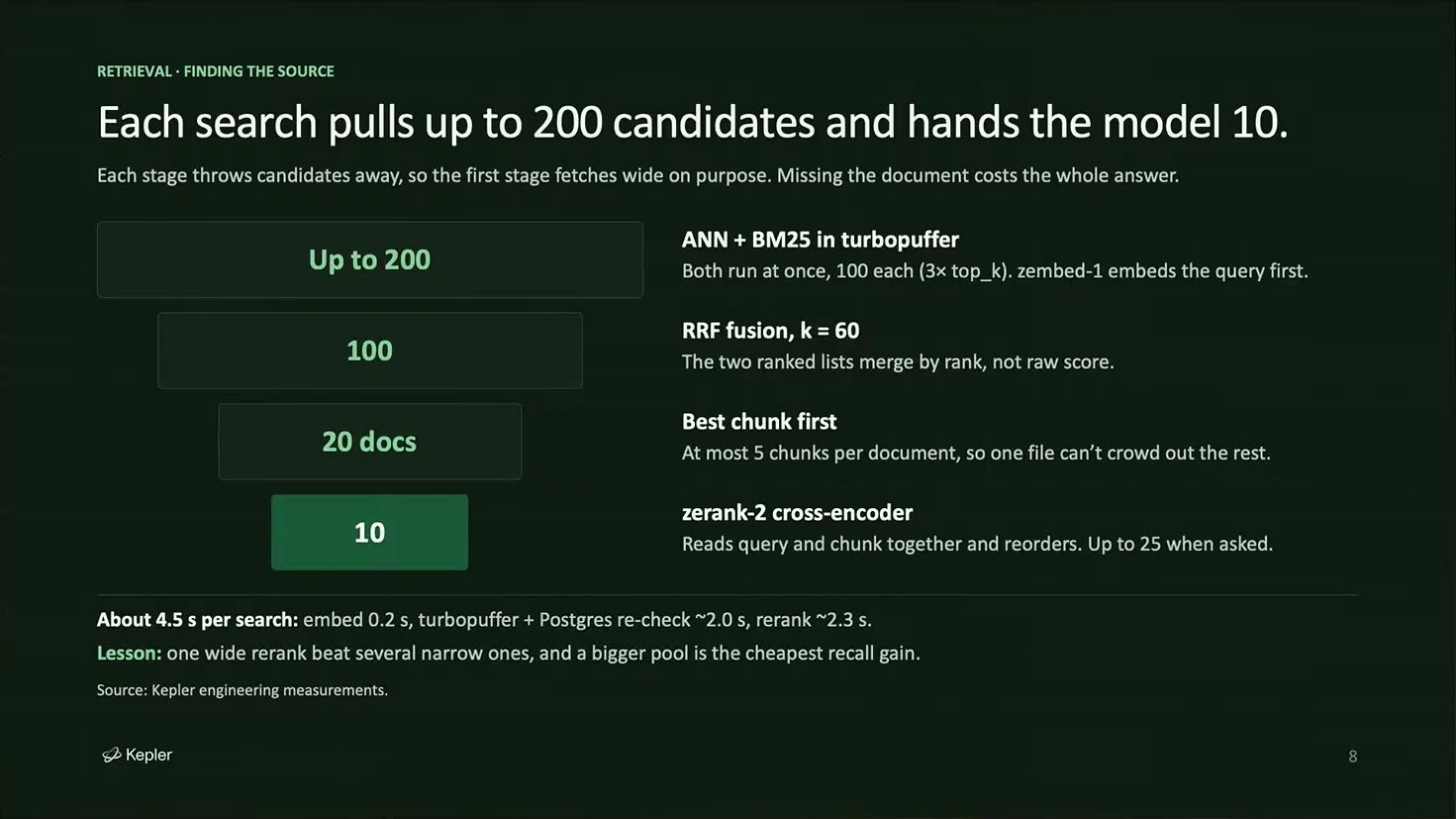
我们把这个过程拆分开来,SEC 相关数据也采用同样做法。我们经常会丢弃候选文档,也就是说,我们必须持续判断哪种来源适合哪些信息,以及从整体上来说,哪些文档不应该再检索。我们使用 ANN 加 BM25,取回一组文档,通常最多 200 份。然后做倒数融合。最终会取回 60 份文档。这样理解大概最合适。接下来使用交叉编码器。我们会准确评估查询和实际文档分块组合后的结果。
Now, how we do this is we break this down, and this occurs across the SEC world as well. We are frequently throwing candidate documents away, meaning we consistently have to look at not only what source is the right source for what information, but also which documents should we stop looking at kind of globally. So we're on ANN plus BM25 to get back a set of documents, usually up to 200. We do reciprocal. We effectively get 60 documents back. It's probably the best way to think about this. Then we do cross encoders. We try to figure out exactly the query and the actual document chunked together and get those results that way.
这让我们能够进行非常广泛的搜索。你知道 LLM 不擅长什么吗?进行广泛搜索。它们会尝试制定计划,然后找到最快或最简单的广度优先搜索方式,或者说,也许是深度优先搜索方式,先找到第一个文档,再继续处理。我们允许系统先进行广泛搜索,然后再逐步缩小范围。LLM 不愿意广泛搜索,是因为成本很高。同时跨越大量不同来源进行搜索,远不如第一次就命中、拿到奖励信号后继续往下走。
What that allows us to do is we can search really wide. You know what LLMs aren't good at doing? Searching really wide. What they try to do is create a plan and find either the fastest or easiest breadth-first search mechanism, actually maybe depth-first search mechanism, of actually getting the first document and moving forward. So we allow this to search really wide and then narrow from there. The reason LLMs don't like searching wide is because it's expensive. It's because looking across a bunch of different sources is significantly worse than getting the reward function back with your first hit and going from there.
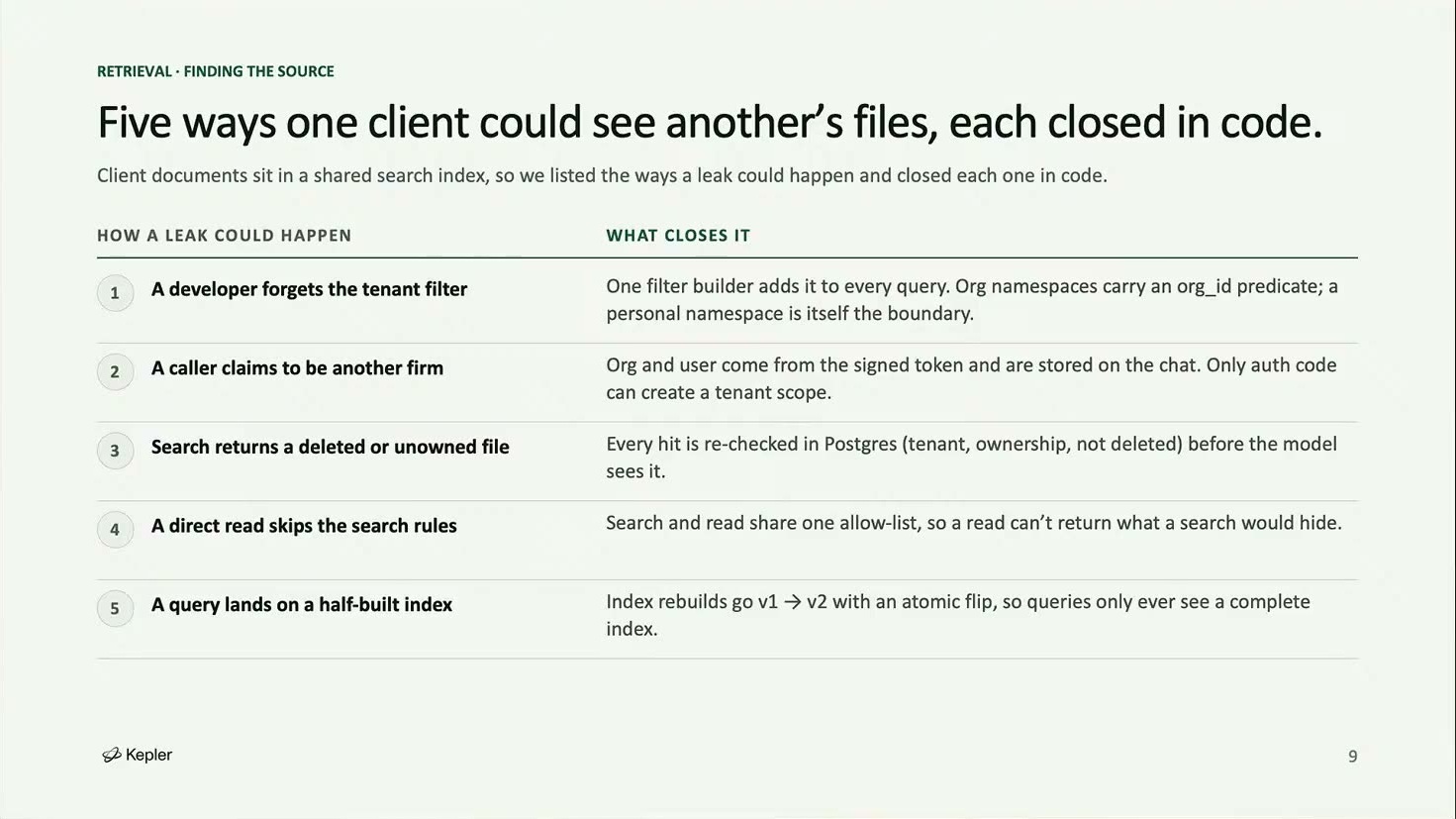
好,我想谈谈安全,这非常重要。Kepler 从一开始就采用安全优先的思路。尤其是客户端文档——这部分主要是对在座的构建者说的,也是大家很少讨论的话题。大家都在讨论使用什么 OAuth token,以及用户范围的文档检索机制是否安全。这其实相当令人担忧。我们来谈谈大家尝试构建的这些系统会如何出错,以及如何修复。首先,你忘记筛选租户。突然之间,Citadel 就能搜索 Millennium 的所有文档。你会惹上大麻烦。
Okay. So I want to talk a little about security here because it's super important. Kepler was built with a security-first mindset and security-first mentality. Now, client documents, and this is specifically targeted towards the builders here, this is the thing that no one's chatting about. Everyone is talking about the security of what OAuth token is used and what user-scoped mechanism of retrieving documents. Which is actually pretty scary. So let's talk about how things go wrong in these systems that people are trying to build and how you can fix it. First and foremost, you forget to filter the tenant. All of a sudden Citadel can search for all of Millennium's documents. You will be in a lot of trouble.
第二种情况是,调用方谎称自己属于另一家公司。也就是说,我可以冒充另一个实体,以那种身份查询文档,以这种方式第三,搜索返回了过时的信息。这个问题在很多地方都存在,连 Google 搜索结果也不例外。第四,直接读取会绕过搜索规则,这意味着你实际上没有查询完整的信息语料库,或者没有设置允许列表。你只会收到单独一份文档,也就是你搜索到的那份。第五,你访问了一个尚未填充数据的索引。解决所有这些问题的方法,这里列出了具体做法,是将安全机制内置到搜索范围控制中。我认为这是很多人在尝试时容易忽略的另一项关键要素,自己构建这些系统时尤其如此。
Second, a caller claims to be another firm. Meaning I can claim that I'm impersonating this other entity and querying documents that way. Third, search returns information that's out of date. We've had this problem kind of globally and even Google search results. Fourth, direct read skips the search rules, meaning you're not actually querying the full corpus of information, or there's not an allow list. You only get back the single document that you did the search. Five, you hit an index that isn't populated. The way to actually solve all these problems, and there's individual things listed here, is actually scoping searches with security built in. That's another critical piece that I think a lot of people miss when they're trying to build these systems themselves.
人们终究会开始关注查询这些信息时的安全性。阿尔法是最难捉摸的东西,对华尔街人士尤其如此。确保每次查询返回的文档集合受到良好约束,非常重要。现在来谈最后一部分:验证。
Inevitably, people will start caring about the security associated with querying this information. Alpha is the most elusive thing out there, especially for folks on Wall Street. Making sure you have a good mechanism of constraining the set of documents that come back with each query is really important. Now let's talk about verification, which is the last piece here.
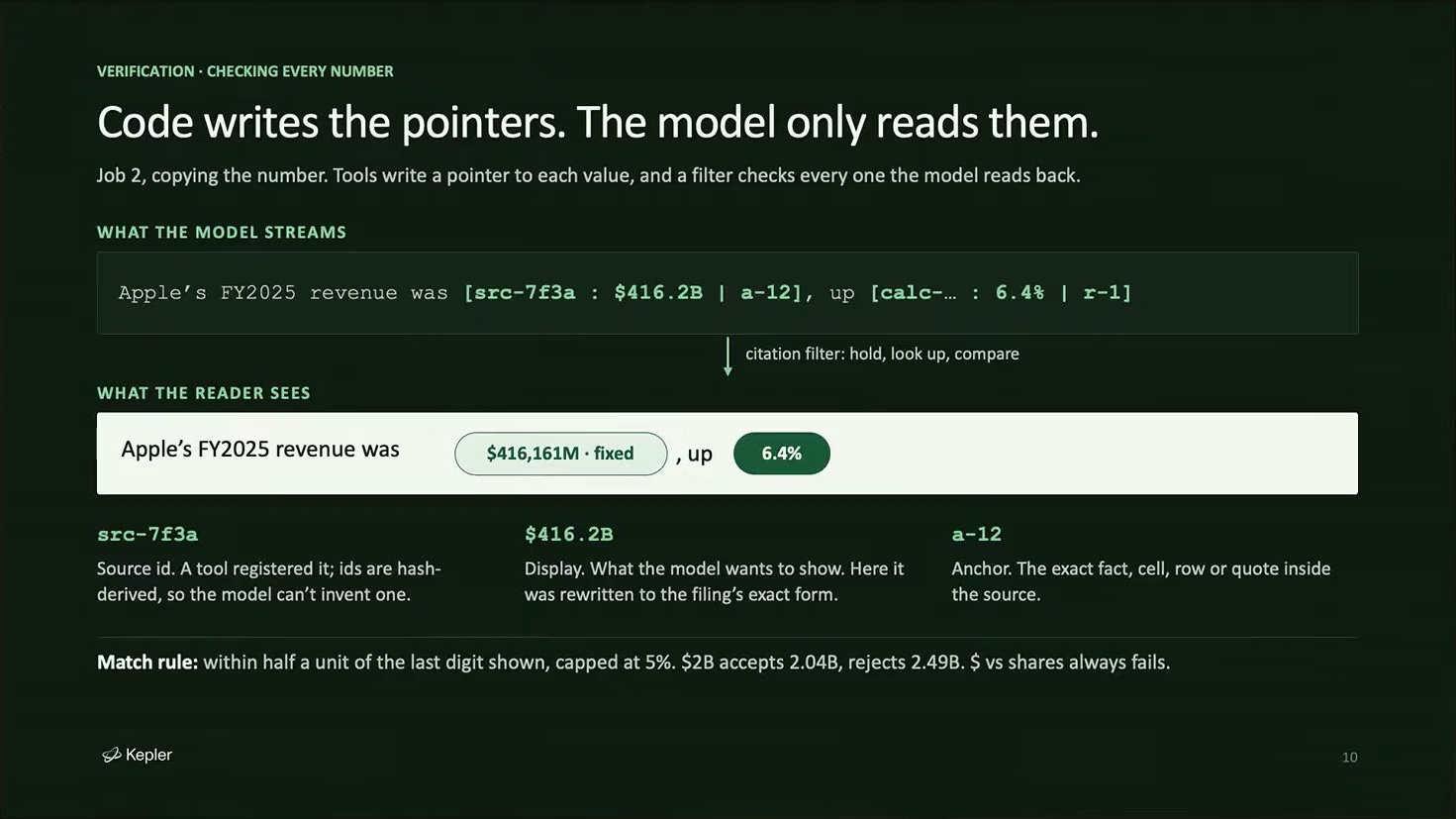
这可能是 Kepler 最为人熟知的业务,但我们也在做之前提到的其他工作。我们通过预处理信息并以确定性方式存储来实现这一点,我们有类似代码的系统来为每个信息写入独立指针。只有当数据库中存在相应信息时,模型才能读取指针并取回信息。如果我从哈希表中查找一个不存在的项目,就不会得到任何结果。这种组合让我们能够确保检索到的信息确实来自它所声称的来源。这里展示的是一个经过隐藏处理的版本,这是我们的来源 ID 的样子,这些是哈希值。
This is probably what we're known most for, but we do the other stuff I mentioned as well. How we do this is by preprocessing information and storing it deterministically, we have systems like code that actually write individual pointers. The model can only then read those pointers and grab information back if they exist in the database. If I grab something out of a hash map that doesn't exist, I don't get anything back. And so this combination is what allows us to actually make sure the information that we retrieved actually came from the source that it came from. Now, this is a kind of hidden version of what our source IDs look like, but these are hashes,
这些都是你可以采取的很简单的做法,可以在自己的系统和配置中实现,确保取回的事实确实存在。很好。以上就是我们如何进行验证。现在我想再聊聊这套技术从整体上带来的能力。它让我们能够验证事实,这些事实来自有可靠依据的数据语料库。如果你是构建者、初创公司创始人,或者正在想办法如何信任自己的输出,其实只需要做好几件事。你需要向人们表明,当你们构建这些智能体时,无论它们是在寻找阿尔法,还是寻找其他东西,使用的信息都要切实相关、具体,最重要的是准确,而且要适合你要服务的那群人。
and these are very simple things that you can do in your own system and your own setup to ensure that you're pulling back facts that, in fact, do exist. Cool. So that's a little bit about how we do verification. Now, I want to chat a little bit about what this enables kind of globally. This enables us to verify facts that come out of our grounded corpus of data. Now, you as a builder, or you as a startup creator, or you as someone who is trying to figure out how do I trust my outputs, really just need to do a couple of things. You need to show people that as you're creating these agents that are theoretically looking for alpha or whatever they'd be looking for, you're using information that is actually relevant and concrete and, most importantly, accurate to the set of people that you're trying to service.
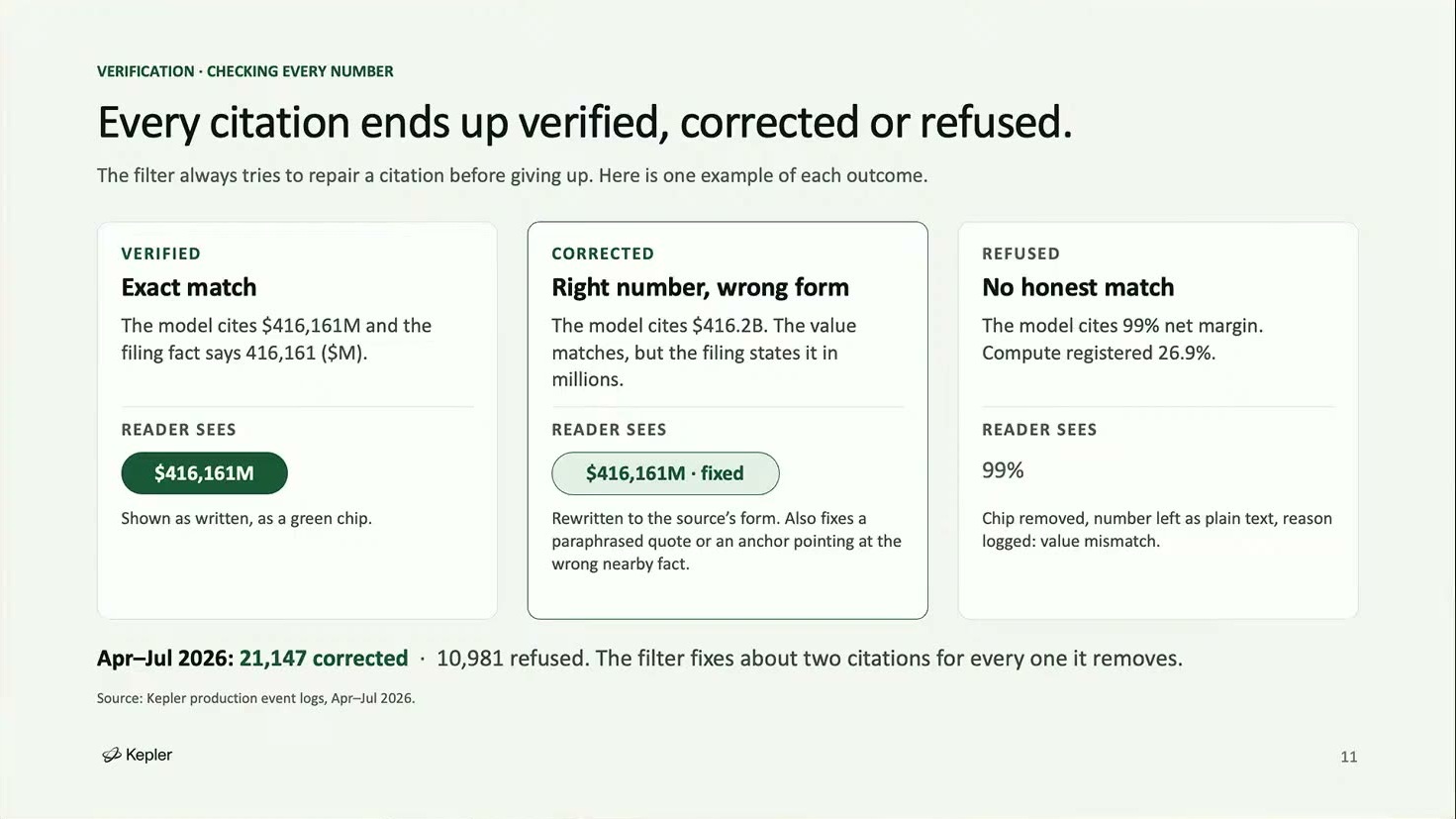
这样我们就能建立一种约定:引用要么经过验证,要么在搜索时得到纠正,要么被直接拒绝。想想这有多不可思议。如果模型无法解析那个指针,就无法输出那个数字。这确实很惊人。这不仅适用于数字,也适用于所有内容。我们来谈谈事实。你会看到很多法院判例被模型凭空捏造。为什么不能把判例以确定性方式存储起来,让我们在这个列表里搜索,避免某个从未存在过的案件突然被模型编造出来呢?
So we end up with a contract where citations are either verified, corrected at search time, or flat-out refused. This is crazy if you think about it. If a model cannot de-resolve that pointer, it cannot print that number out. So that's kind of an insane thing. It means that the whole, and not just a number, let's talk about facts, Like, we see these court cases all over of precedents being hallucinated. Well, why can't we create a system that just has the precedents stored deterministically and allows us to search through that list and not have a random court case that never existed all of a sudden start existing?
因此,这种机制和技术其实可以广泛应用。我站在这里告诉你们我们如何工作的原因,是因为我非常担心华尔街永远不信任这项技术,因为很多其他公司或许多自行搭建系统的人,在这些机构里部署了这样的系统。如今情况已经发展到,绝大多数金融 AI 工具都在用于排版 PowerPoint 演示文稿。我们仍然没有真正构建出端到端的 DCF 系统,尽管很多人都在声称已经做到了。如果真有这样的系统,华尔街的每家公司都会在一夜之间采用。
So this mechanism and this technology actually becomes fairly globally applicable. And the reason I'm on stage telling you how we do what we do is because I'm terrified that Wall Street never trusts this technology because of the fear that so many other companies or so many build-it-at-home folks have been instituting in these organizations. It's gotten to the point where the vast majority of finance AI tools right now are being used to format PowerPoint presentations. We still haven't actually built a DCF cradle-to-grave, despite what most people are saying. And if we had, every single company on Wall Street would have adopted that overnight.
这就是我担心的事情。我的担忧源于一个很简单的事实:要真正从这项技术中获益,我们必须能够构建这样的技术,让人们能够信任它、验证它。这不仅适用于金融领域,也适用于许多其他行业。所以,请从这场演讲中汲取对你有用的内容,让更多人开始使用这项技术。否则,我们都会失业。
So this is my fear. My fear comes from a very simple fact. For us to actually get value out of this technology, we need to be able to build technology that people actually can trust and can verify. That isn't just true in finance. It's true in a bunch of different industries. So please, take what you need to from this presentation and get people using this technology. Otherwise, we're all going to be out of a job.
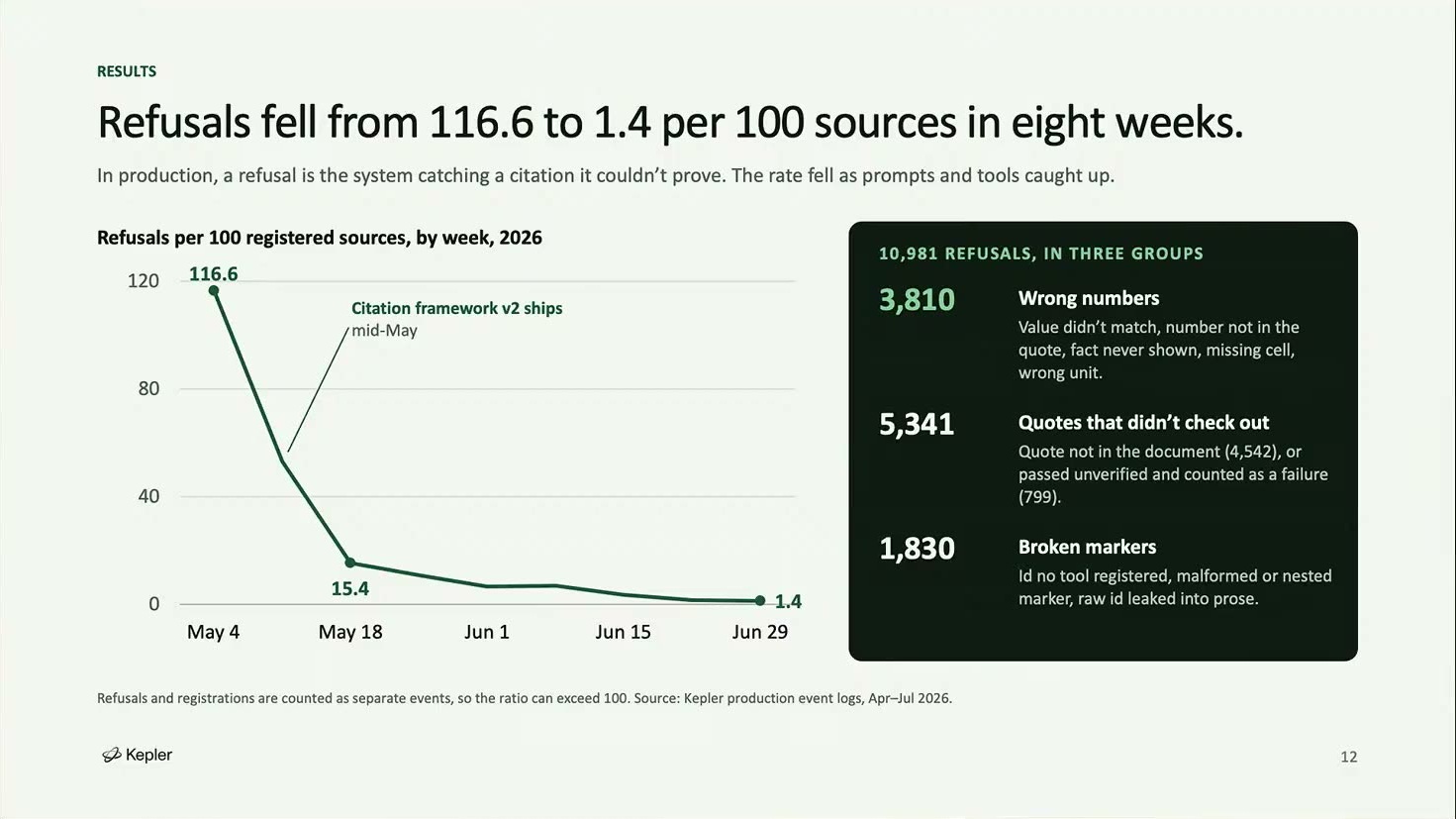
现在我想谈谈我们看到这些问题时发生了什么。在整个处理过程中,这里展示的其实是我们真实的生产数据。拒答指模型无法给出数字。也就是说,模型会说:“我无法解引用这个指针,所以无法给出这个数字。”我们看到拒答率大幅下降。它没有降到零,是因为模型仍然是概率性的。也就是说,它仍可能编造数字,在推理过程中事后生成数字。因此,我们还会增加一道后处理步骤,这也是我们采用的后续步骤之一。
Now, I want to chat through what happened when we saw this. So when we went through this whole process, this is actually some of our real production data here, refusals are when the model is not able to produce a number. Meaning the model will say, I couldn't dereference this pointer, therefore I could not produce this number. We saw that drop super drastically. Now the reason that it didn't drop to zero is because models are still probabilistic. Meaning it can still make up numbers after the fact during inference. So there is another post-processing step after this that we have as well.
但这张幻灯片想表达的是,只要建立一套系统,要求模型解引用自己的指针,就能打造出非常强大、可验证的 AI 平台。这就是我对大家的请求。在构建系统的过程中,在确定范围的过程中,无论你使用什么工具,都要问清楚能否验证数字。问问他们能否让你看到来源,而不是只在事后添加注释;你应该能点击数字,查看它是计算得出的,还是提取出来的,或者由两者共同得出,这样才能确保你信任这个洞见。归根结底,这些机制会成为解锁技术价值的关键。
But my point with this slide is just by creating a system where the models have to dereference their own pointers, you can actually create a very powerful, very verifiable AI platform. And that to me is my ask to all of you. As you go through the building process, as you go through the scoping process, any tool that you use, ask them if you can actually verify the numbers. Ask them if you can see where the sources are, not in terms of some after-the-fact annotation, but click on the number, whether it's a calculation, whether it's an extraction or some combination of the two to make sure you trust the insight. And all of this ultimately is going to be the unlock.
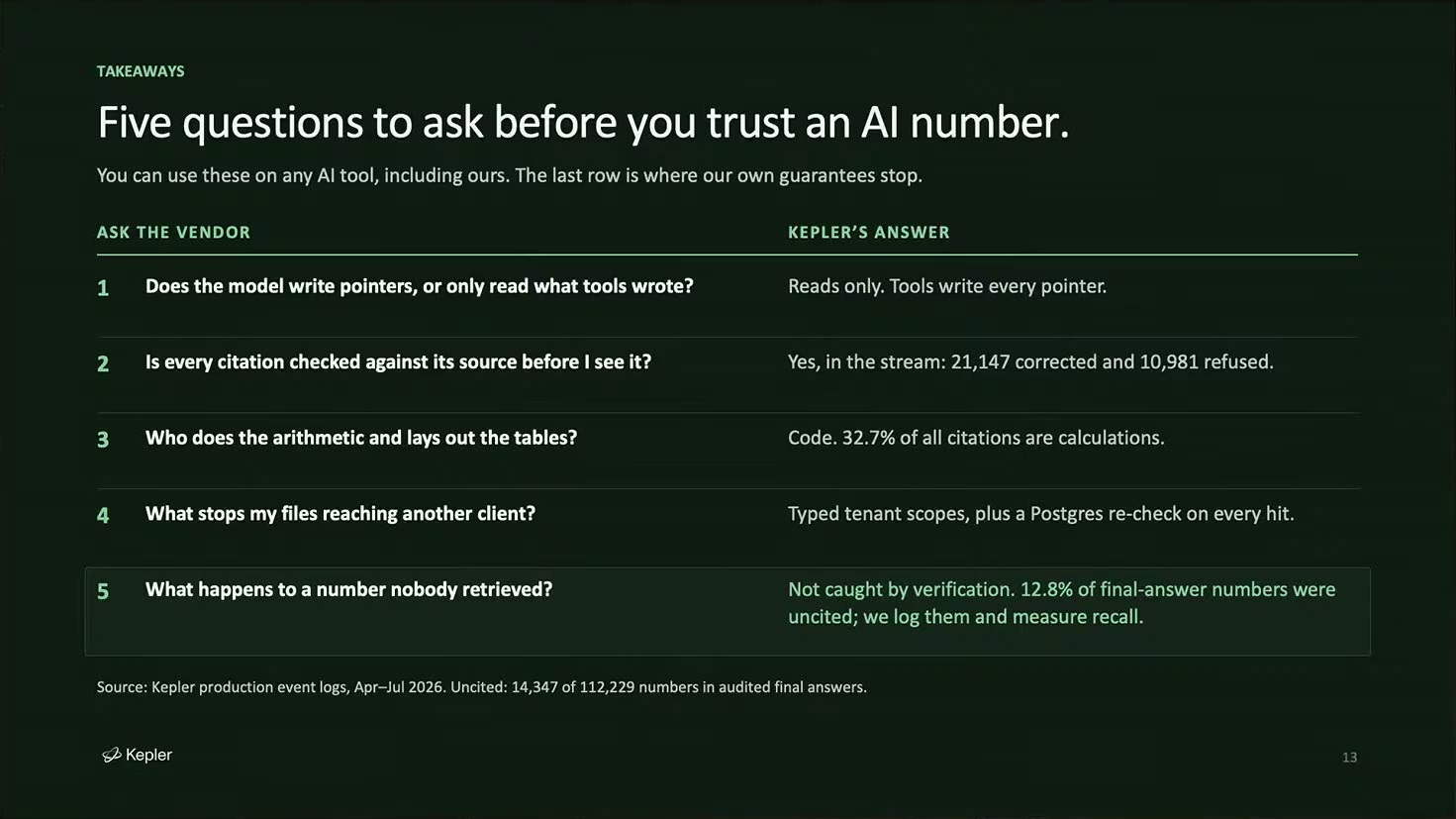
所以,作为供应商或构建者,你要问这些问题:模型是否真的写入了指针?它是否确实创建了验证输出的机制?是否核验了每个引用来源?计算所依据的来源是否经过核验?你有没有机制阻止文件到达不应该接触这些文件的客户或用户手中?最重要的是,凭空出现的数字会如何处理?凭空出现的事实又会如何处理?我们究竟该如何处理这类幻觉?
So you, as a vendor or you as a builder, ask these questions. Does the model actually write pointers? Does it actually create a mechanism for verifying the output? Is every citation source checked? Is arithmetic source checked? Do you have a mechanism for stopping files that reach clients or customers that it shouldn't reach? And most importantly, what happens to a number that came from nowhere? What happens when a fact comes from nowhere? And how do I actually handle these kinds of hallucinations?
这个平台要说明的其实是一件很简单、也很明显的事:我们可以拥有世界上最聪明的模型,也可以拥有非常酷炫的技术,但我们仍然面临从一开始就存在的数据库问题。也就是说,如果我搜索某一行,而其中不存在那个值,就不会检索到任何结果。我们现在已经超越了 AI 搜索阶段。我们需要构建基础设施,构建脚手架、智能体运行框架和底层支撑,或者用如今流行的风投术语来称呼它们,只要它们真正能让我们用好这项技术。
So this whole platform is actually to make a very simple statement, very obvious, which is we can have the smartest models in the world. We can hit some crazy cool piece of technology, but we still have the same database problems that we've had from the beginning. which are, I cannot, if I search through a row and that value doesn't exist, I won't get a retrieval back. We're now out of the search phase of AI. We need to be building infrastructure. We need to be building scaffolding and harnesses and substrates, or whatever the cool VC term is these days, that actually enable us to make use of this technology.
这就是我对大家的挑战和请求。希望你们能出去构建一些有吸引力的东西,但也希望你们构建的东西值得信任。谢谢。
So this is my challenge and my ask to all of you. I hope you go out there and build something compelling, but I hope you build something compelling that you can trust. Thank you.