Token 才是便宜的部分
Tokens Are the Cheap Part
原文由官网提供,中文由 GPT-6 Luna 翻译。相邻片段合并排版,正文与时间点保持对应。
已插入 17 张经核对的幻灯片或演示截图;点击图片可放大。图注链接为当前视频时间,左侧正文时间保留原转录版本,二者可能不同。
共 30 个阅读段落
大家好,我是 Steve Jamison,Jellyfish 的 AI 研究与工程负责人。今天我想向大家说明,为什么 token 才是便宜的那一部分。我今天介绍的研究来自 Jellyfish 平台,这是业内规模最大的工程工作流程数据与 AI 遥测数据相结合的数据集。
Hi, I'm Steve Jamison, AI Research and Engineering Leader at Jellyfish. I'm here to show you why tokens are the cheap part. The research that I'll present is drawn from the Jellyfish platform, the industry's largest set of engineering workflow data joined to AI telemetry data.
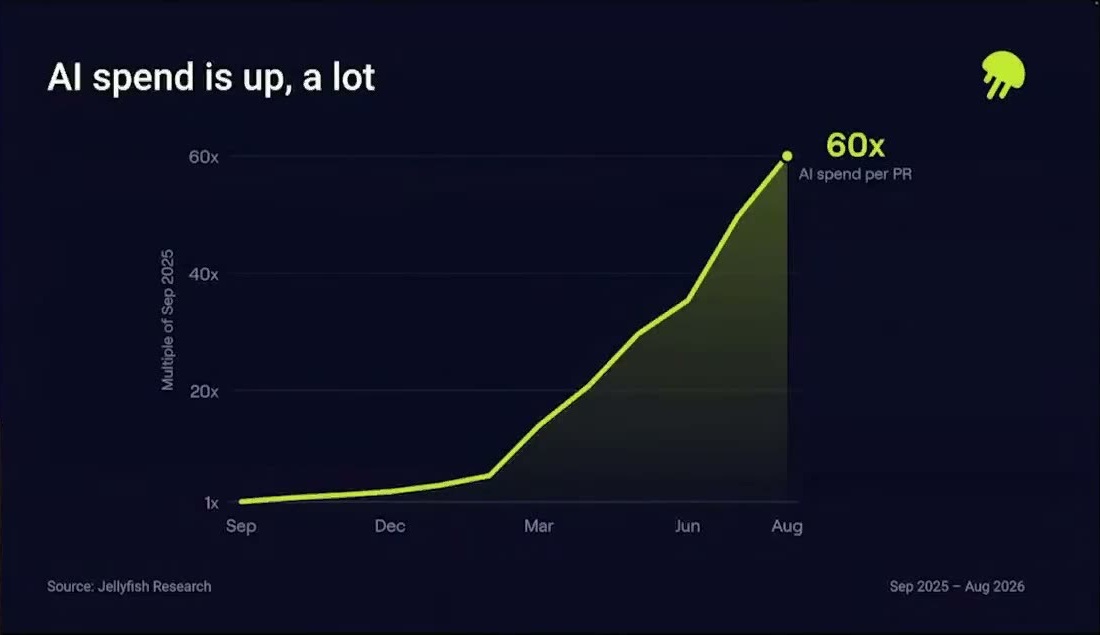
AI 成本不断攀升,这已经不是什么秘密。与去年同期相比,成本增长了 60 倍。用例范围很广、种类繁多。模型和智能体运行框架都在进步。这带来的影响令人兴奋。但预算和支出的讨论就没那么有趣了。这些讨论涉及你的同事、高层管理者以及董事会,这些对象并不总是容易沟通,尤其是在你缺少合适数据时。
It's no secret that AI costs are climbing. They're up 60x from this time last year. The use cases are wide and varied. The models and harnesses are getting much better. The implications are exciting. But discussions around budget and spend are not as much fun. These conversations involve your peers and senior leadership and the board. not always the easiest audiences, especially when you don't have the right data.
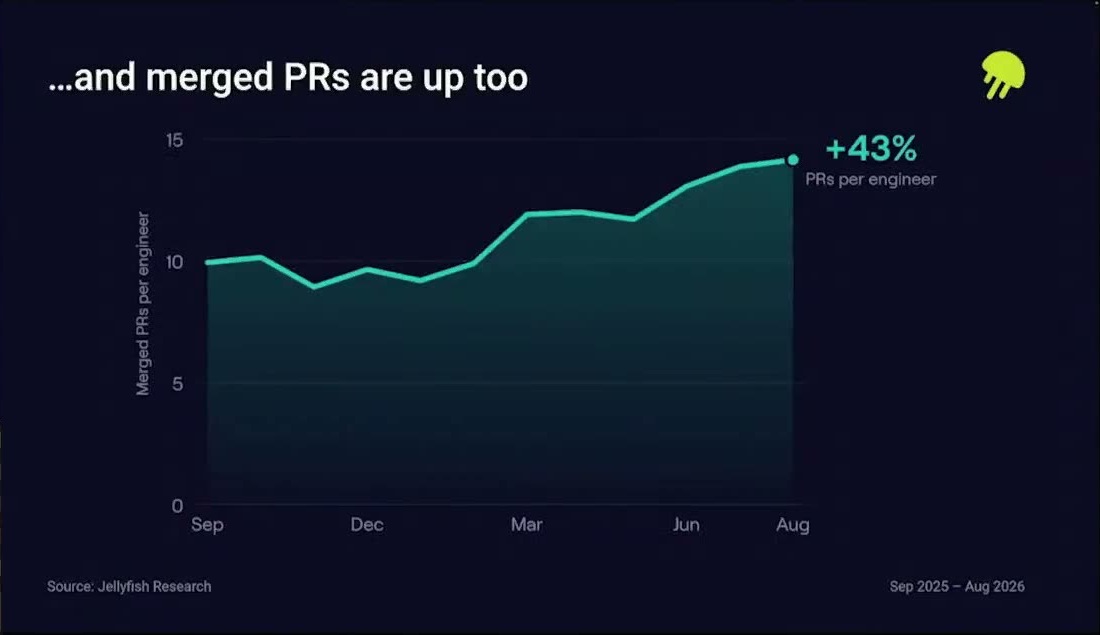
如今这涉及真金白银,产出也在增长。每位工程师合并的 PR 数量增长了 43%,在同一一年期间。这非常惊人。我们从未见过这样的生产力投入,尤其是在如此短的时间内。大量研究和经验数据都表明,AI 和智能体编程正在推动这些吞吐量增长。
And it's real money these days. Output is up too. Merged PRs per engineer are up 43% over the same one-year horizon. This is phenomenal. We've not seen productivity inputs like this, especially on this timescale. There's plenty of research and anecdotal data to know that AI and agentic coding are driving these throughput gains.
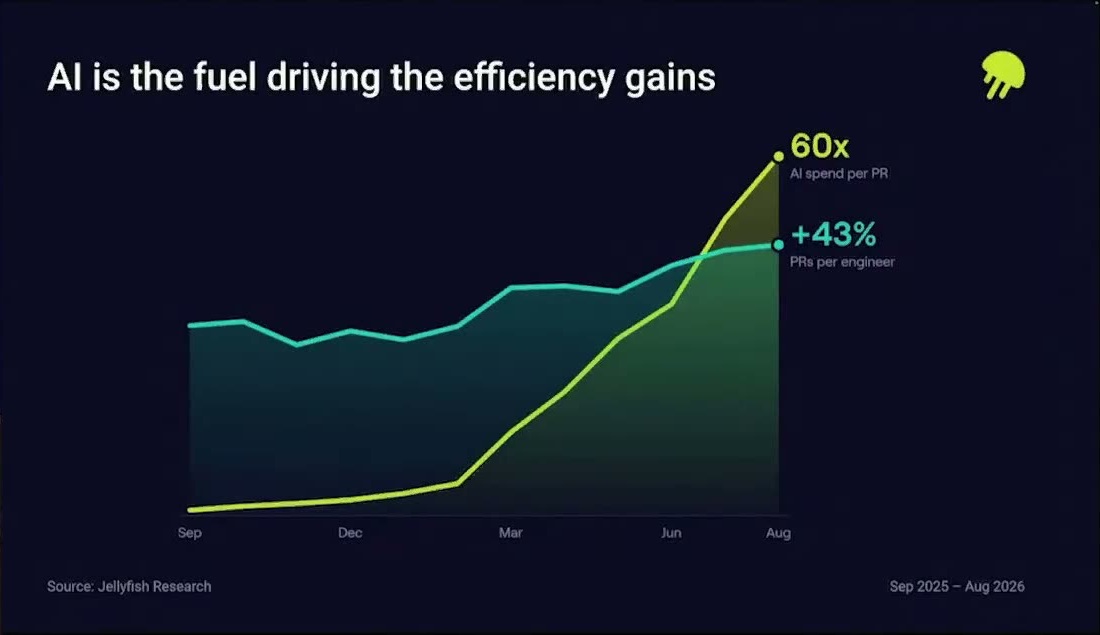
甚至我们的图表也显示了这种相关性。请留意拐点出现的位置。AI 支出在 2026 年初上升,与此同时,吞吐量也开始稳定增长。不过,这两个数字之间存在一种张力。
Heck, even our charts show the correlation. Notice where the inflection points are. AI spend increased in early 2026 when throughput gains start a steady increase of their own. There's a tension with these two numbers, though.
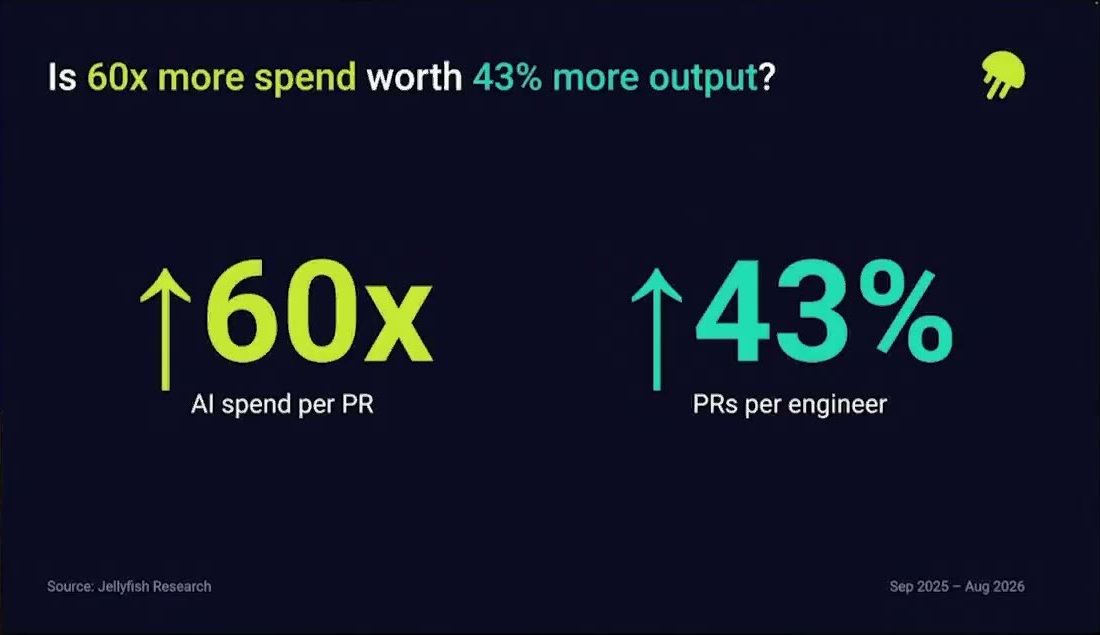
该如何调和它们?支出增长了 60 倍。吞吐量也增长了 43%。这算好还是坏?43% 是个很大的数字。但 60 倍也不小。你怎么知道自己花得够不够?是不是还有更多生产力提升,只要肯花钱就能释放出来?我们应该把支出提高 50%,还是提高到 2 倍?又该如何判断花得太多了?我相信你们很多人都感受过这种张力。CFO 或董事会会要求你拿出支出的凭据。你能给他们看吗?
How do you reconcile them? Spend is up 60x. Throughput is also up 43%. Is that good? Bad? 43% is a big number. But so is 60x. How do you know if you're spending enough? Is there more productivity gain locked behind a checkbook? Should we increase spend 50% 2x more? Or how do you know if you spent too much? I'm sure many of you have felt the tension here. The CFO or board are asking for the receipts of the spend. Can you show them?
合并 PR 增长 43% 能让他们满意吗?如果你限制使用量和支出,又会怎么样?你是在避免 token 白白烧掉,还是阻碍了进一步的效率提升?你可以问其他公司的同行他们花了多少。不过,对很多公司来说,这个数字仍在不断变化。但你该如何把它换算到自己的组织上?显然,只比较他们的账单和你的账单并不足够。我们听说有些公司在 AI 上花了 10 万美元、50 万美元,甚至数百万美元,现实逐渐明朗后,又不断设定和重设 AI 预算。
Will merged PRs are up 43% satisfy them? Also, what happens if you cap use and spend? Are you stopping from setting tokens on fire? Or are you stumping further efficiency gains? You can ask peers at other companies what they're paying. For many, it's still a moving target, though. But how do you equate that to your org? Surely, just comparing their bill to yours isn't adequate. We've heard the reports of companies spending $100K, $500K, even millions on AI, setting, then resetting their AI budgets as reality sets in.
归根结底,这两个数字无法完整讲述情况。即使把它们放在一起,也漏掉了成本端最大的一项。
Ultimately, these two numbers can't tell the story. And even together, they missed the biggest line on the cost side.
这两个数字没有包括最大的成本:开发者薪资。AI 正以前所未见的规模提高开发者的生产力。它不只是一种工具,而是一种智能。这种智能彻底改变了每位开发者能产出的工作量。所以我们需要用不同方式看待它的成本。不要把它仅仅视为间接费用;它也是产出每个 PR 所需成本的一部分。
These two numbers leave out the biggest cost of all, developer salary. AI is making developers more productive on a scale we haven't seen before. It isn't just another tool, it's intelligence. This intelligence dramatically changes how much each dev can produce. That's why we need to think about its cost differently. Not often the side is overhead, but it's part of what it takes to produce each PR.
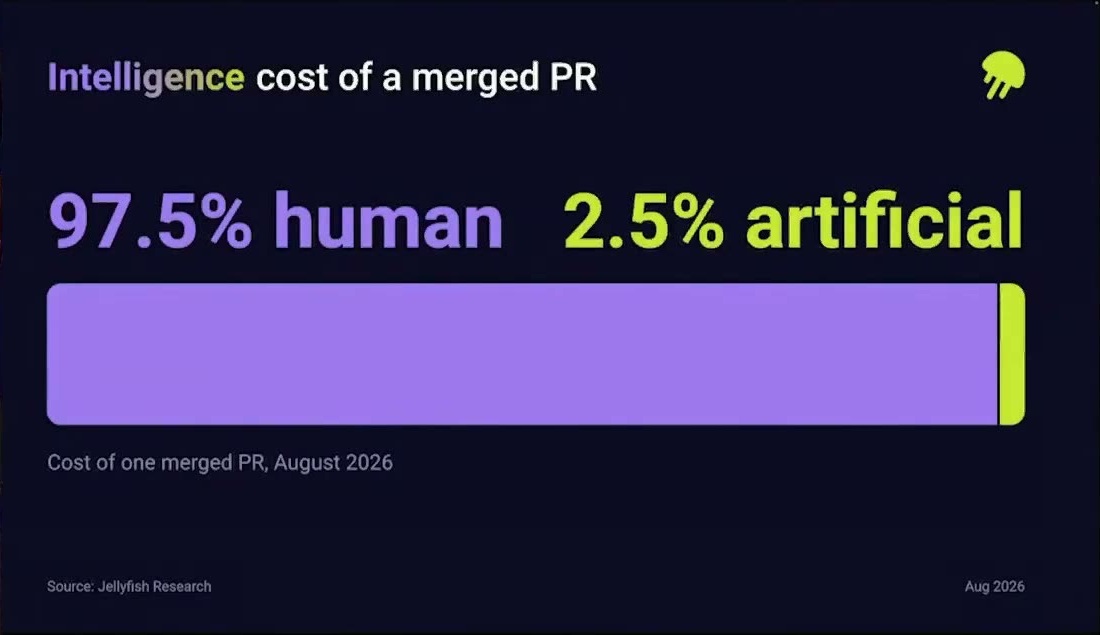
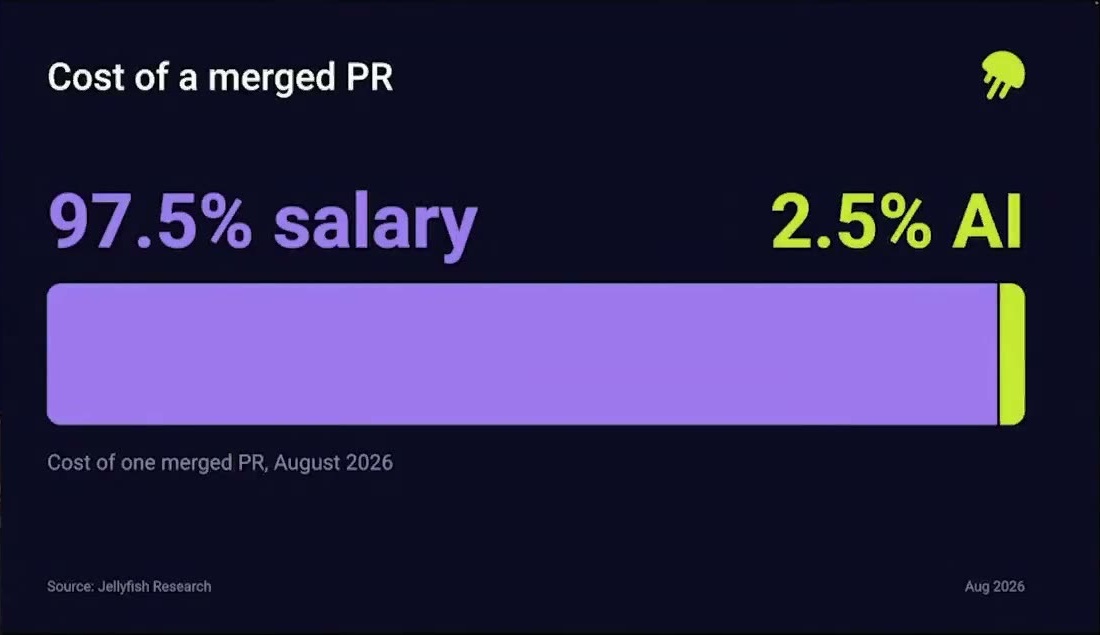
我们把这称为每个 PR 的智能成本。把你支付给工程师的薪酬和 AI 支出放在一起,归入同一个成本类别。在产出一个合并代码单元的成本中,AI 约占 2.5%。另有 97.5% 是薪资。这与其他报告的数据一致;这里的数据截至 2026 年 8 月。在这里,token 才是便宜的部分。但这是当前的相对成本,不是美元金额。接下来看看过去一年合并 PR 的成本发生了什么变化。
We're going to call this intelligence costs of a PR. What you pay your engineers plus what you pay for AI, put them together in one cost bucket. AI is about 2.5% of the cost to produce another unit of merged code. Salary is the other 97.5%. This is in line with other reported figures, and this data is from August 2026. Here, tokens are the cheap part. But that's current relative costs, not dollars. Let's look at what happened to the cost of merged PR over the last year.
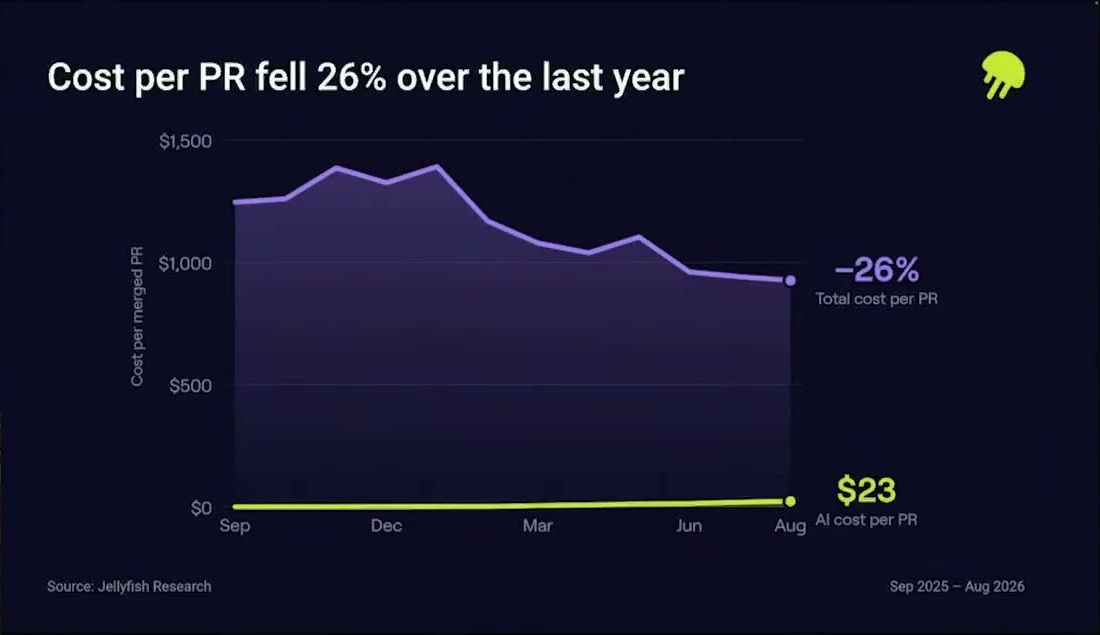
过去一年,合并一个 PR 的美元成本下降了 26%。这里说的不是创建的 PR,而是合并的 PR。这个计算考虑了审查时间,而且已经通过一定程度的质量门槛。每个合并 PR 成本的下降,包含了同期 AI 成本增长 60 倍的影响。而且这一变化几乎普遍存在。我们研究的公司中,83% 的每 PR 成本有所下降。这说明了什么?吞吐量提升意味着薪资被分摊到更多 PR 上,而且这一效果发生得比 AI 成本上涨更快。
The dollar cost of a merged PR fell 26% over the last year. Not PRs created, but PRs merged. Review time has factored in, and some level of quality gates has been cleared. That decline in cost per merged PR includes a 60x increase in AI costs over the same time frame. The change is nearly universal, too. 83% of the companies we studied showed a drop in cost per PR. What does this tell us? The additional throughput gains are spreading salary thinner across PRs, and this is happening faster than the AI costs are increasing.
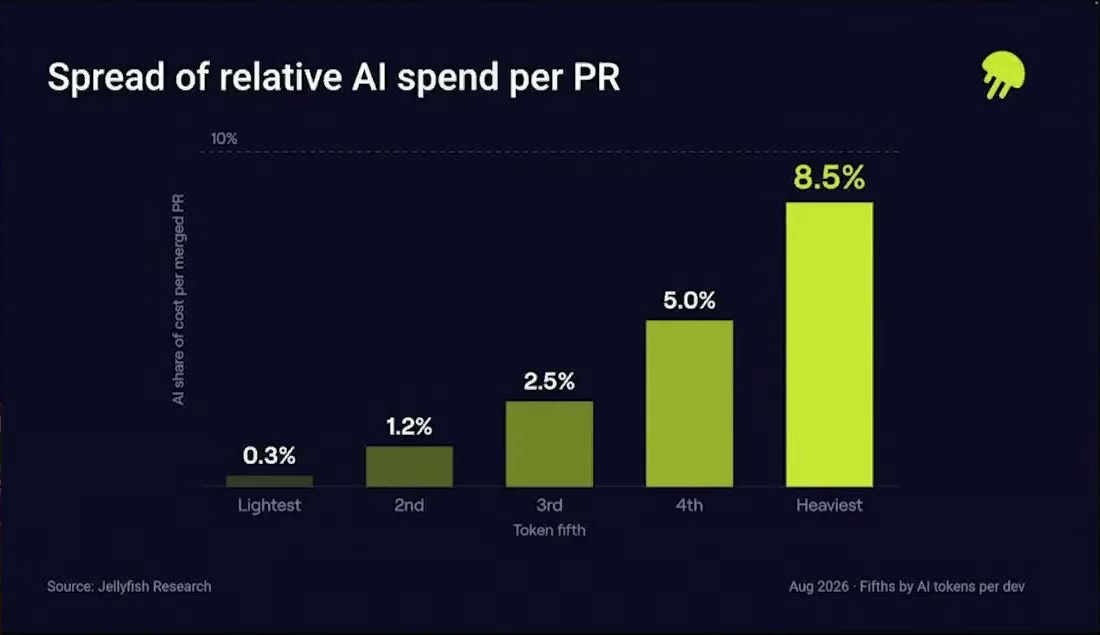
token 支出的范围有多大?我们按 token 使用量给公司排名,再将它们分成五分位组。这里的差距很大。支出最低的组中,AI 约占 PR 成本的 0.3%。这相当于每位开发者每月约 6,000 万个 token。按每位开发者的 AI 支出计算,最高的 20% 我们称为支出最高组。在这一组中,AI 占 PR 成本的 8.5%。这相当于每位开发者每月约 25 亿个 token,比支出最低的组高出约两个数量级。
What's the range in token spend? We ranked companies by token usage, then grouped them into quintiles or fifths. The range here is quite large. The lightest group, about 0.3% of the cost of a PR is AI. This represents about 60 million tokens per dev per month. The top 20% of AI spend per dev, we're going to call the heaviest spend group. There, 8.5% of the PR cost is AI. This represents about 2.5 billion tokens per dev per month, about two orders of magnitude more than the lightest group.
接下来几张幻灯片会用这些分组来观察 token 支出如何影响其他指标。
We'll use these groups on the next slides to see how token spend influences other metrics.
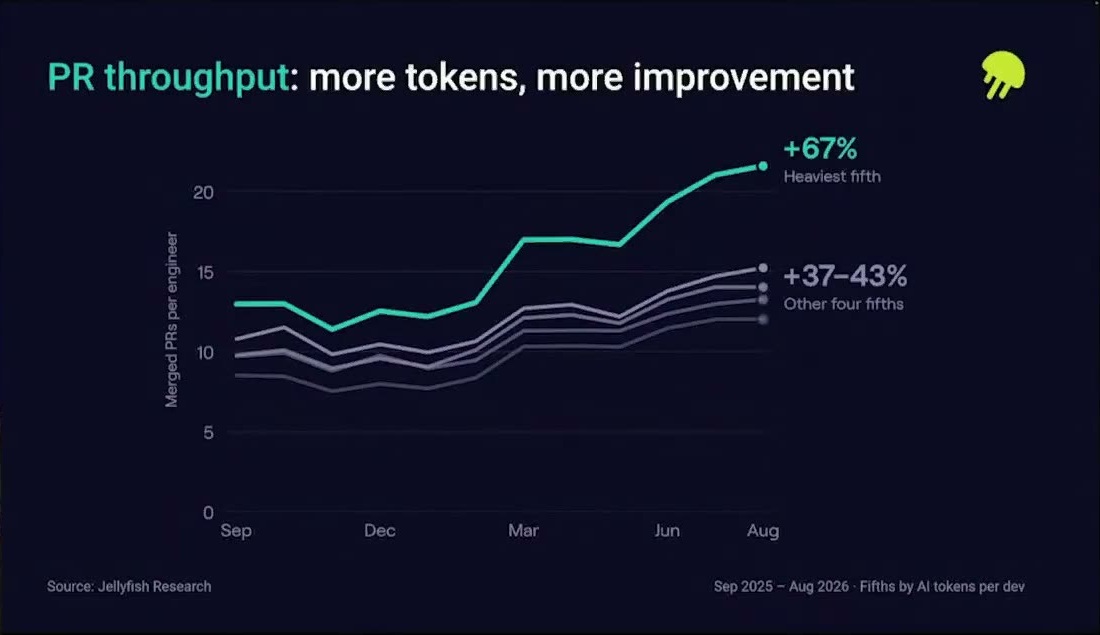
首先看 PR 吞吐量,即每位开发者合并的 PR 数量,并按上一张幻灯片中的相同 AI 支出五分位组划分。支出最低的五分之四群体,PR 吞吐量提升约 40%,上下略有浮动。而支出最高的那组提升更多,增长了 67%。AI 支出越高,吞吐量提升就越多。
First, PR throughput measured as merged PRs per dev, split by the same AI spend quintiles on the previous slide. The bottom four-fifths of spenders sell PR throughput gains of around 40%, give or take. But the heavy spend group improved more at a 67% increase. More AI spend led to more throughput gains.
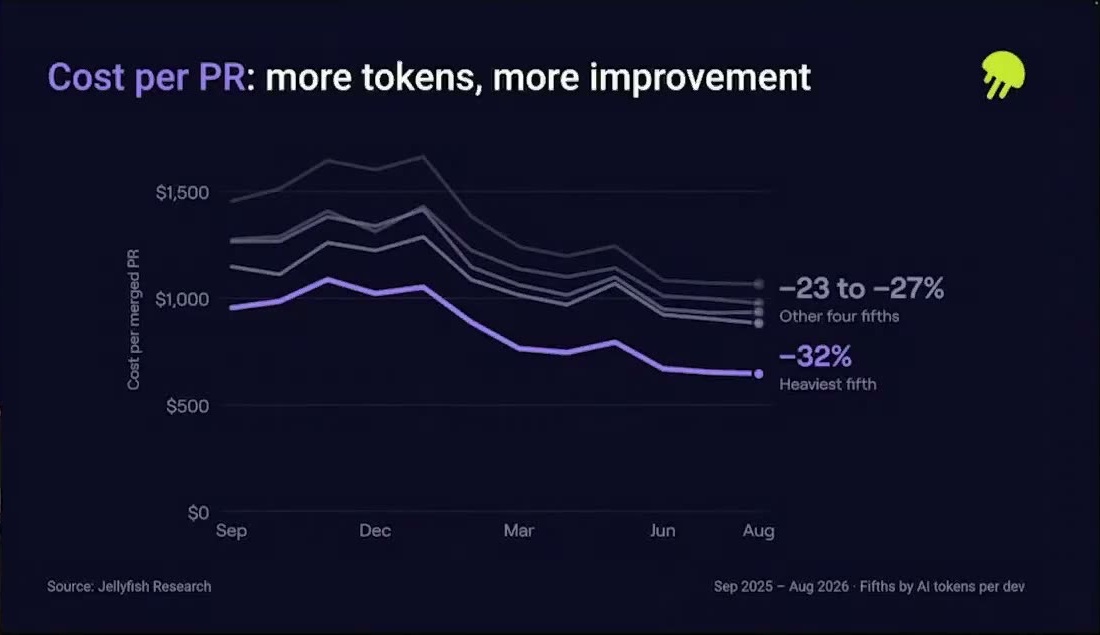
接下来看看每个 PR 的成本。各组再次都取得了积极结果。所有 AI 使用组的每 PR 成本都在下降。不过,支出最高的五分之一,也就是花钱最多的公司,改善幅度仍然最大。他们看到每 PR 成本在过去一年下降了 32%。另外四组的每 PR 成本下降了约 25%。在 AI 上投入和支出更多,带来了更大幅度的每 PR 成本改善,相比之下,投入较少的同行改善幅度更小。
let's look at the cost per PR. Positive results are seen again across the board. Cost per PR is dropping for all AI usage groups. However, again, the heaviest fifth, so the companies that spent the most, improved the most. They saw a cost per PR decrease of 32% over the last year. The other four groups saw about a 25% decrease in cost per PR. Investing and spending more on AI fueled more of an improvement in cost per PR. compared to peers who leaned in less.
因此,正如整体平均数据所显示的,每 PR 成本变化主要由 PR 吞吐量驱动,而非 AI 支出。支出最高的公司,PR 吞吐量增长了 67%,而同行大约增长 40%。一个月内把相同的薪资分摊到更多 PR 上,带来的影响超过 AI 成本上涨的影响,因为 token 才是便宜的部分。这并不是说组织应该让 token 白白烧掉,毫无节制地支出。
So we saw that the same as we saw in the population average, cost per PR changes are driven largely by PR throughput, not by AI spend. The heavy spenders experience PR throughput gains of 67% compared to about 40-ish percent for their peers. Spreading the same salary across more PRs in the month has more of an effect than the rising AI costs, because tokens are the cheap part. This is not to say that orgs should light tokens on fire and spend with a banding.
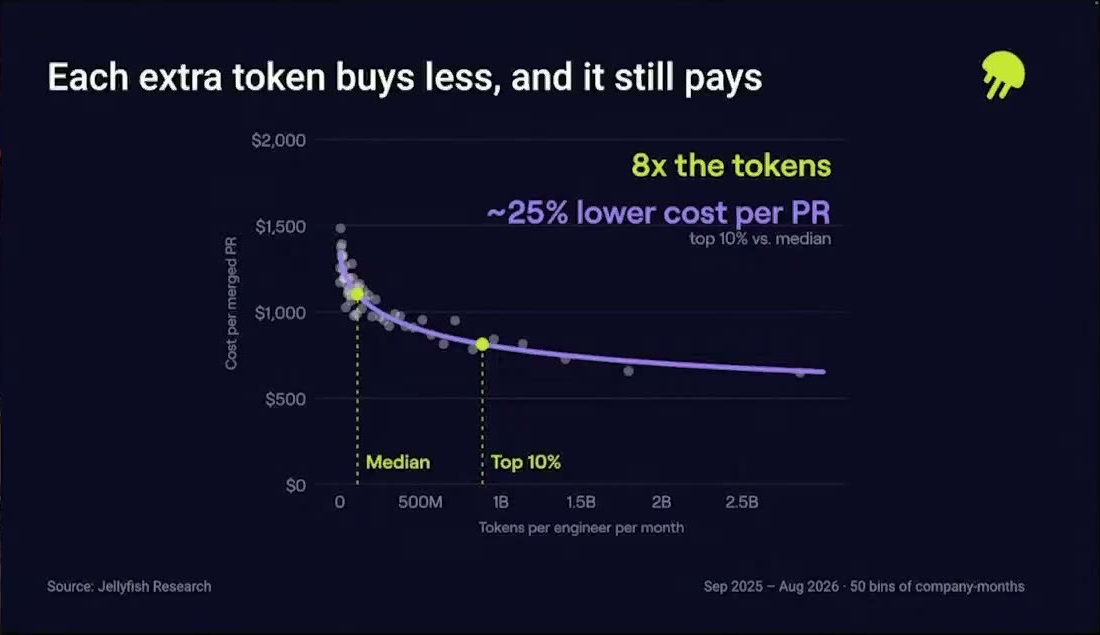
这里横轴表示使用的 token 数量,纵轴表示每 PR 成本。开始时曲线下降得很陡,相对少量的 AI 支出一开始就能带来很大收益。随着 token 使用量增加,每 PR 成本的改善幅度会变小。这就是边际收益递减。不过我要强调,边际收益递减不等于没有收益。我们看到,支出最高的 10% 使用的 token 是中位数的 8 倍,每 PR 成本则低了 25%。
Here, we're looking at tokens used on the horizontal axis and cost per PR on the vertical axis. There's a steep drop at the beginning where relative small AI spend results in large gains initially. As token usage increases, the cost per PR improvement decreases. This is diminishing returns. I want to stress, though, diminishing returns is not the same as no returns. We're seeing that the top 10% are spending 8x the tokens compared to the median and achieving a 25% lower cost per PR.
总有一天 token 不再是便宜的部分,但总体而言,对于现实中大多数公司来说,我们还远未达到那个临界点。更多 token 带来更多 PR,进而降低交付成本。到目前为止,我们一直在谈公司层面的情况。接下来我想稍微岔开一下,谈谈我们对开发者所做的一项研究。
There will be a time when tokens aren't the cheap part, but by and large, for most companies out in the wild, we're not close to that threshold. More tokens leads to more PRs, which leads to a lower cost of delivery. So far, we've talked about companies. Next, I'd like to take a tangent and talk about a study we did with developers.
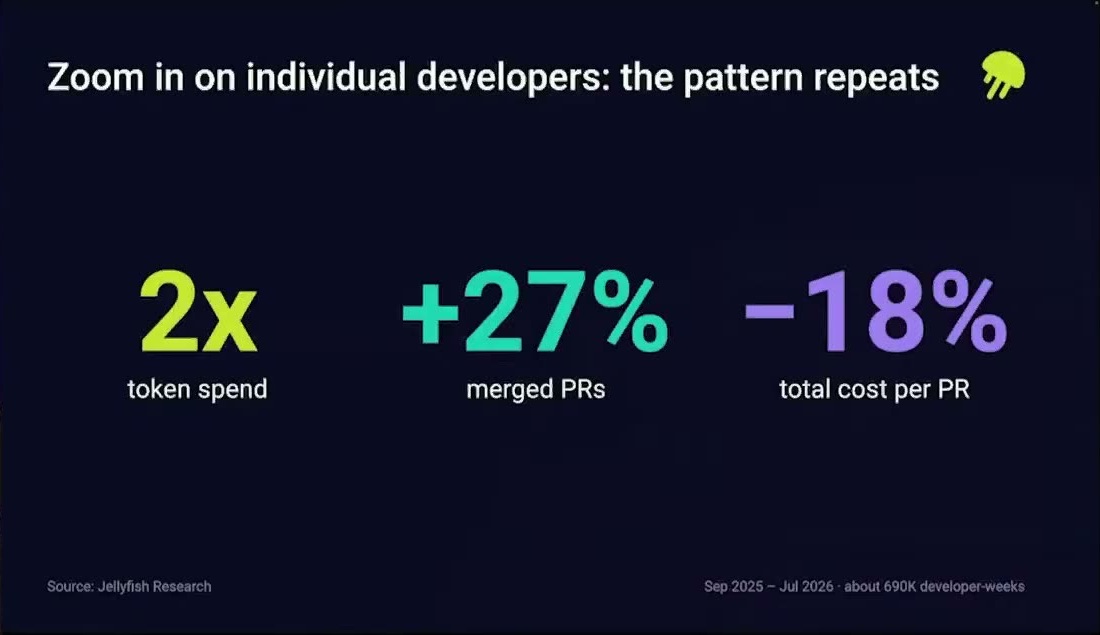
我们比较了开发者大量使用 token 的工作周,以及同一开发者较少使用 token 的工作周。我们在个人层面看到了同样的现象。比较每位开发者大量使用智能体技能的工作周和他们未使用技能的工作周。他们的 token 支出约为 2 倍,合并的 PR 多了 27%;把薪资和 token 成本合在一起计算后,每 PR 成本降低约 18%。我谈到这项研究时,人们通常会提出两个合理的疑问。第一,工作速度变快,会不会导致质量变差?第二,PR 数量增加也就是我们看到的吞吐量提升,是否是因为工作被拆成了更小的部分?
Here we looked at developer weeks with heavy token use compared to the same developer weeks with lower token use. Here we saw the same phenomenon just at the individual level. Compare each developer's heavy agent skill weeks with their own weeks without skills. They spend about twice as much on tokens, merge 27% more PRs, and reach PR costs about 18% less once salary and tokens are counted together. there are two fair curiosities i get when i talk about this work first does faster work result in worse work and second are the more prs the throughput gains that we're seeing are they being driven by smaller chunks of work
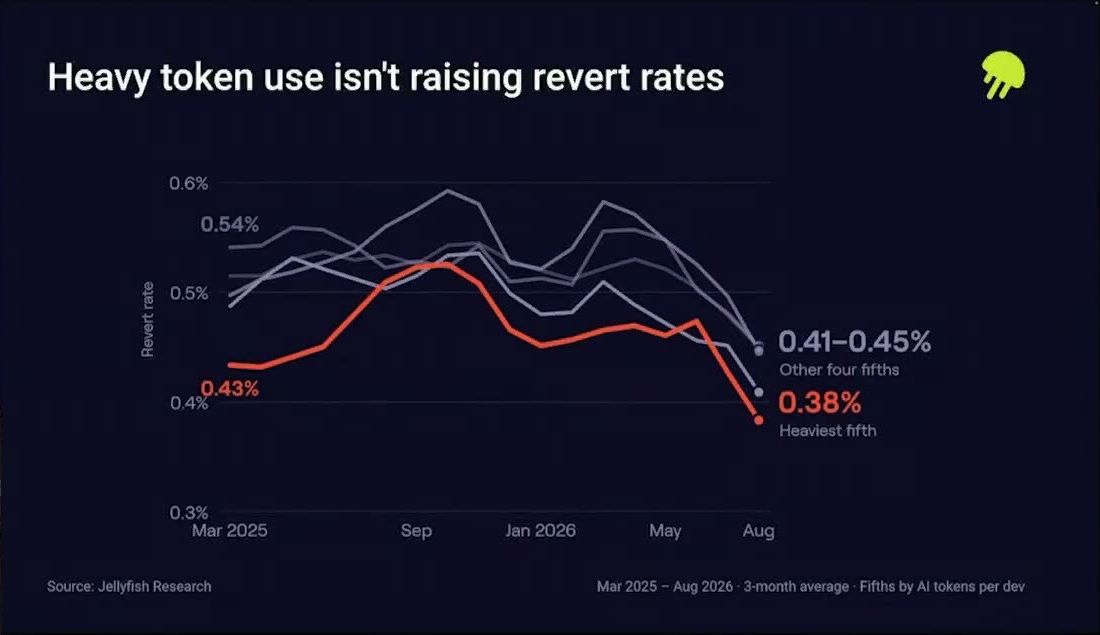
第一个问题是:工作更便宜、更快了,质量会不会更差?如果 AI 让 PR 更快、更便宜,我们是不是只是在发布更多错误?一个可用的替代指标是回滚,也就是合并一个撤销先前 PR 的 PR。在 token 使用量增长之前,支出最高的五分之一组回滚率最低。而且所有组的回滚率都略微下降。不过这些变化幅度略低于数据中的噪声水平。因此,这并不能证明质量有所改善。但更重要的是,我们没有看到任何令人担忧的迹象,表明随着 token 支出增加、PR 吞吐量加快,出现了普遍或严重的质量问题。
First curiosity is cheaper, faster work, worse work. If AI makes PRs faster and cheaper, are we just shipping more mistakes? One proxy for this is reverts. Merge PRs that undo an earlier PR. The heaviest fifth started lowest before most of the token growth. And revert rates dropped slightly for every group. though these deltas are just slightly below the noise in the data. It's not evidence of improvement here. However, more importantly, we're not seeing any worrying signs of rampant or severe quality issues with higher token spends and faster PR throughput.
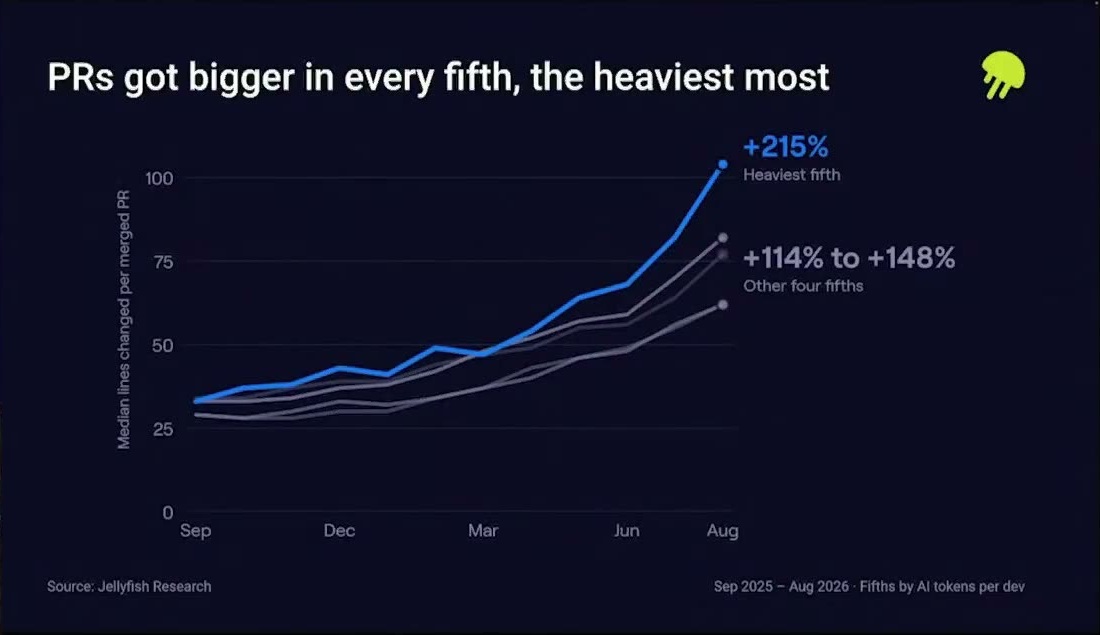
第二个疑问是:吞吐量提升是不是因为 PR 变小了?显然不是,PR 并没有变小。事实上,AI 让每个 PR 生成的代码行数增加了。在场的开发者对此应该不意外。若你曾经翻白眼嫌弃过,举个手:那些不必要的 AI 行内注释,或者满是大多无关测试的文件。生成式 AI 喜欢生成代码。而且开发者创建代码的门槛很低,于是每个 PR 都有可能做得更多,而不是再多开一张工单。
it. The second curiosity, is throughput driven by smaller PRs? And this is demonstrably no, not smaller PRs. In fact, AI is driving an increase in lines of code generated per PR. This is no surprise to the devs in the room. Raise your hand if you've rolled your eyes at for both unnecessary inline AI comments, or a file full of mostly irrelevant tests. Gen AI likes to generate code. Also, the bar to create is low for devs, and there's a pool to do more per PR instead of spending up another ticket.
可能只需要一个,也许两个提示,“再处理一下这个边界情况”,或者“把这个和那个元素合并起来”。这样就能少处理几个 PR。不过,这和如今大家感受到的 PR 审查压力并不太相符。而且 AI 正变得越来越有能力,所以我们也开始尝试更宏大的任务。这场演讲无法深入探讨究竟是什么推动了代码行数的这类变化。不过,PR 吞吐量的提升并不是来自更小的 PR。大多数人对此直觉上都能理解,但验证一下仍然有用。
It's just one, maybe two prompts, and I'll handle this edge case, or I can combine this and that element. Fewer PRs to wrangle. This doesn't mesh well with the PR review stress folks are feeling these days though. Also, AI is just becoming more capable, so we're getting more ambitious. It is beyond this talk to dig into what's actually driving those level of lines of code changes. However, the increase in PR throughput is not coming from smaller PRs. This is intuitive for most, but it's still good to verify.
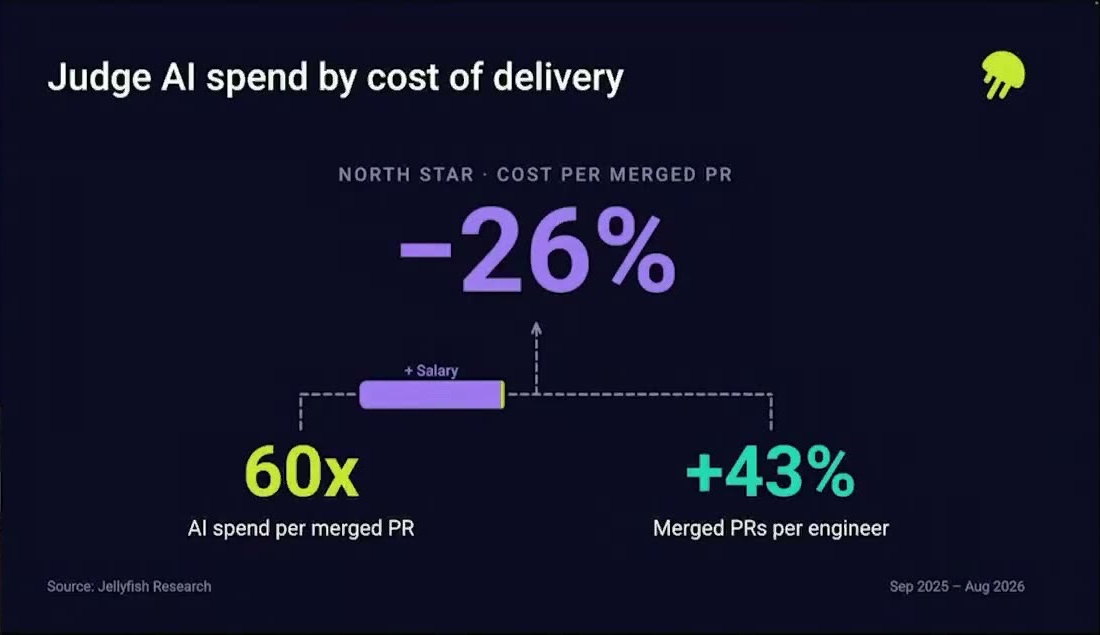
回到开场时的问题。多花 60 倍,换来多 43% 的产出,值不值得?单独看这两个数字无法判断。两者都应该跟踪。它们都是重要数字,但只是辅助指标。每个 PR 的 AI 支出代表你购买的智能资源,用来帮助开发者加快工作。每位工程师完成的 PR 数量则代表这些支出带来的产出。但只看这两个数字,会忽略其中的权衡。把薪资也纳入计算,再看成本与吞吐量的比率。
Back to the opening question. Is 60x more spend worth 43% more output? You can't tell in isolation. You should track both. They are important numbers, but they're supporting metrics. AI spend per PR is the intelligence that you're buying as a resource to help make your devs go faster. PRs per engineer is what you're getting with that spend. However, looking at those hides the trade-off. But put salary into the equation and take the ratio of cost to throughput.
这样就能得到答案。
And there you get your answer.
在同一时期,每 PR 成本下降了 26%。很明显,尽管账单不断上涨,AI 仍然带来了成本效率。而且相对而言,实现这些效率所需的 AI 支出很少。AI 仍只占 PR 成本的一小部分,平均为 2.5%,支出最高的组也不到 10%。Token 才是便宜的部分。在我们观察到的范围内,支出越多,收益仍在持续。
Cost per PR is down 26% over that same time period. It's clear AI is driving cost efficiencies despite the increasing bills. and the AI spend needed to get those efficiencies is small, relatively speaking. AI is still a sliver of what a PR costs, 2.5% on average, under 10% for the heavy spender group. Tokens are the cheap part. In the range that we see, more spend kept paying.
token 使用量较高的用户 PR 吞吐量提升了 67%,而支出较低的同行提升了 40%。这使每 PR 成本下降了 32%,而支出较低的同行大约下降 25%。看每 PR 成本与 token 的比率曲线,按 token 使用量计算,公司月度使用量最高的 10% 带来了 8 倍的 token 使用量,但每 PR 成本比中位数低 25%。AI 正以前所未见的规模提高开发者的生产力。
heavier token users saw 67% PR throughput gain compared to 40% for their lower spend peers. This drove cost per PR down 32% compared to about 25% for the lower spend peers. Looking at the PR cost to token ratio curve, The top 10% of company months by token usage resulted in 8x the tokens, but 25% lower cost per PR compared to the median. AI is making developers more productive on a scale we haven't seen before.
它不只是一种工具,而是一种智能,改变了每位开发者能产出的工作量。所以我们需要用不同方式看待它的成本。不要把它放在一边当作间接费用,而要视为产出每个 PR 所需成本的一部分。你需要把 AI 支出和人工支出,也就是薪资支出,加在一起,计算每个 PR 的真实成本。这并不是说可以随意挥霍。当然,你应该留意失控运行的任务。你应该跟踪 AI 支出。
It isn't just another tool, it is intelligence, which changes how much each dev can produce. That's why we need to think about its costs differently. Not off to the side as overhead, but as part of what it takes to produce each PR. You need to add the AI spend and the human spend, the human salary spend, together to calculate your real costs per PR. This isn't to say spend frivolously. Sure, you should watch for runaway jobs. You should track your AI spend.
我不是说不用关注每个 PR 花了多少 AI 费用。我的意思是,不要让它成为你的首要衡量指标。换一种框架,可能会改变你思考其他投资的方式和时机,例如接入模型路由器、对自己的模型进行后训练,实施 token 限额,等等。你能否通过控制 AI 成本获得更高效率?还是继续投资于能提高吞吐量的事项,例如让更多人使用 AI?无论如何,每个月都要跟踪每个 PR 的总智能成本,也就是人工与 AI 成本之和,并与 AI 账单和 PR 吞吐量一起对照。
I'm not saying don't look at how much AI spend is going in each PR. I'm saying don't let that be your driving metric. A new framing might steer how and when you think about other investments, like integrating model routers, post-training your own model, implementing token limits, et cetera. Will you get more efficiencies out of trying to control AI costs or by continuing to invest in things that increase throughput, like more AI enablement? Either way, track the total intelligence costs, human plus artificial, per PR every month next to that AI bill and next to the PR throughput.
趋势如何?吞吐量是否还在提升?成本效率如何?交付成本又如何?同时观察回滚和质量指标,作为平衡参照。我们不希望AI 搅乱整个工作流程。因此,进入预算季时,要把每 PR 成本摆上台面。不要只看 token 账单,也不要只看吞吐量提升。账单告诉你花了多少;每 PR 成本告诉你这些钱有没有发挥作用。目前,对大多数公司来说,这个数字说明应该继续投资。要获得效率提升,token 才是便宜的部分。
How are you trending? Is throughput continuing to improve? What about those cost efficiencies, the cost to deliver? Watch reverts and quality metrics beside all of this as a counterweight. We don't AI slot mucking up the gears. So heading into budget season, bring cost per PR to the table. Not just your token bill, not just the throughput bump. The bill tells you what you spent. Cost per PR tells you whether it worked. And right now, for most companies, it says keep investing. Tokens are the cheap part to get efficiency gains.
讲得很好。你已经听到了最后。以下是关注我们最新研究的方式。这些研究同样来自业内规模最大的工程工作流程与 AI 遥测数据集。你可以在 LinkedIn 上关注我和我的同事,也可以关注 Jellyfish。订阅我们的 Substack,或者访问我们网站上的 Jellyfish 博客。如果你想跟踪所在组织的工程工作流程和 AI 成效,包括每个合并 PR 的成本,可以访问我们的网站预约演示,或者联系我,我会帮你联系合适的同事。
Well done. You made it to the end. Here's how you can stay up to date with our latest research, which again draws from the largest engineering workflow and AI telemetry data set in the industry. You can follow me on LinkedIn, my colleagues, or Jellyfish. subscribe to our sub stack, or you can check out our Jellyfish blog on the website. If you want help tracking your org's engineering workflow and AI effectiveness, including cost per merged PR, go to our website and book a demo or reach out to me and I'll get you connected to the right folks.
再说一次,我是 Steve Jamison,Jellyfish 的 AI 研究与工程负责人。感谢收看。再见。
Again, I'm Steve Jamison, AI research and engineering leader at Jellyfish. Thanks for watching. Cheers.