智能体能工作,有人信任它吗?
The Agent Works. Does Anyone Trust It?
原文由官网提供,中文由 GPT-6 Luna 翻译。相邻片段合并排版,正文与时间点保持对应。
已插入 6 张经核对的幻灯片或演示截图;点击图片可放大。图注链接为当前视频时间,左侧正文时间保留原转录版本,二者可能不同。
共 21 个阅读段落
系统上线(GoLive)能证明系统确实存在,却不能证明参与工作的人会真正使用它,也不能证明它会按交易模型创造哪怕 1 美元的价值。我是 Michele Grant,《规模化领导力》的创作者,现在每家企业都在面对这样的问题:智能体能工作,但有人信任它吗?我在企业转型领域工作了 20 多年,其中十多年负责媒体、科技和消费品行业的并购整合。在那些交易中,我们不会在上线之后双手合十、祈祷大家能够信任它。
GoLive proves that a system exists, but it doesn't prove the people behind the work will actually use it. or that it will ever deliver a single dollar from the deal model. I am Michele Grant, creator of Leading at Scale, and the question every enterprise is confronting right now is the agent works. Does anyone trust it? I have spent over 20 years in enterprise transformation and more than a decade leading M&A integrations across media, tech, and consumer goods. On those deals, trust was not something we crossed our fingers and hoped for after launch.
我们会在第一天之前,通过早期变革管理和风险管理来建立信任。这样平台上线时,实际执行工作的团队就会真正依赖它。AI 智能体也需要完全相同的能力。当智能体交付企业预算中规划的价值,同时始终处于公司批准的风险承受范围、政策和监管防护规则之内时,它才会赢得信任。
We engineered it before day one through early change management and risk management. So when the platform went live, the teams on the ground actually relied on it. AI agents demand the exact same muscle. An agent earns trust when it delivers the value the business budgeted for while staying safely within the company's approved risk appetite, policies, and regulatory guardrails.
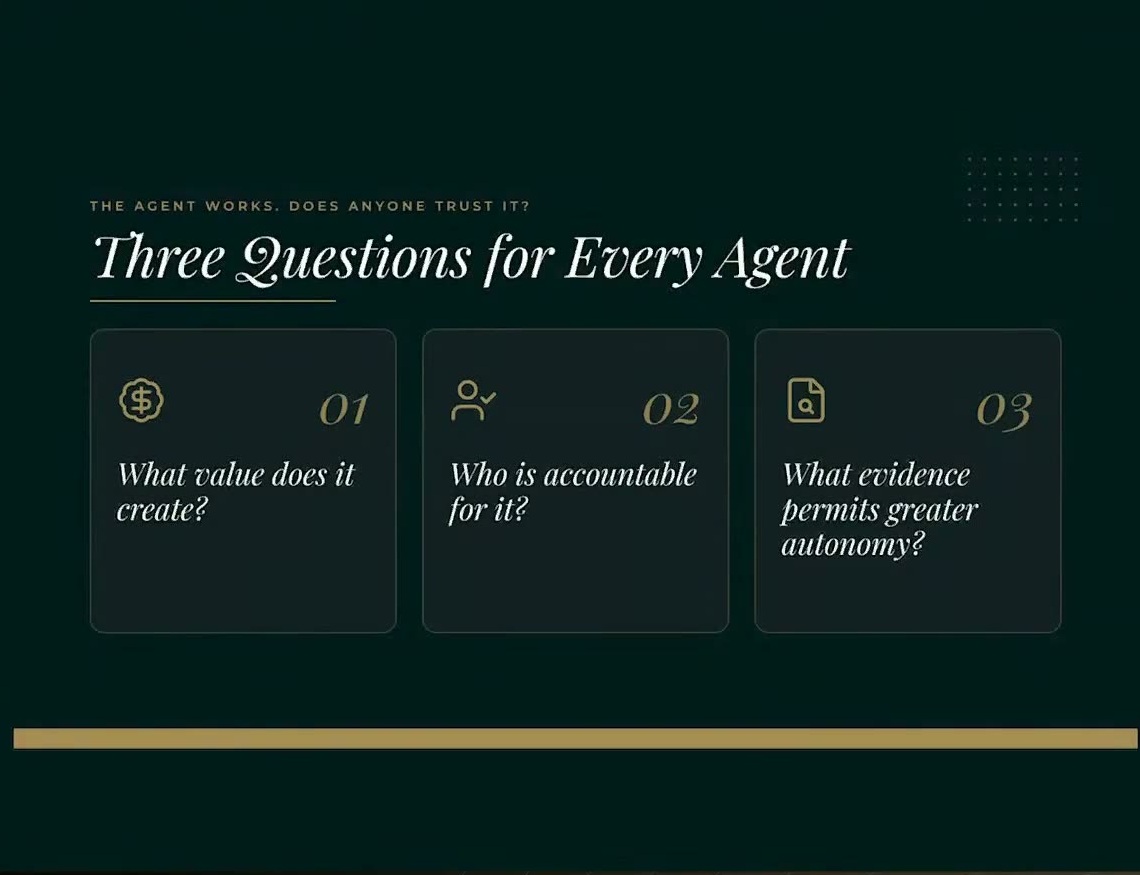
根据我的经验,领导层需要回答 3 个简单直接的问题。它创造什么价值?谁对此负责?以及……什么证据能让它获准以更高的自主性运行?智能体一旦走出沙盒、进入核心业务工作流程,整个检验标准就变了。试点测试软件能否运行,但日常运营检验的是它能否在领导层设定的控制范围内创造价值。成熟的 AI 风险框架能提供有力的原则。
In my experience, leadership gets there by answering three straightforward questions. What value does it create? Who is on the hook for it? And And what evidence gives it permission to run with greater autonomy? The moment an agent steps out of a sandbox and into a core business workflow, the entire test changes. A pilot tests whether the software functions, but daily operations is where we test whether it creates value within the controls set by leadership. Established AI risk frameworks give you strong principles.
但它们没有告诉你如何把这些原则应用到每个智能体上。对于每个智能体,领导层都必须决定 4 件事。它获准做什么?谁是负责人?它会记录什么证据?什么情况会触发升级处理?这不是一项工程任务。根据我们的经验,这是一项高管层的运营职责。今天我会向大家展示如何履行这项职责。我们以一个真实场景为例。请设想一笔 150 亿美元的收购,目标是实现 4 亿美元的净协同效应。交易已经完成,整合工作正在推进。整合管理办公室,我们今天也会简称为 IMO,正在推动涵盖 40 条工作流的协同效应路线图,内容从精简供应商合同到整合 ERP 系统,无所不包。
What they do not give you is how to apply these principles to each agent. For every agent, leadership has to decide four things. What is it permitted to do? Who owns it? What evidence it records? And what triggers an escalation? That work is not an engineering task. We find it is an executive operating mandate. And today, I'll show you how to meet it. Let us ground this in a real-world scenario. own. Picture a $15 billion acquisition targeting 400 million in net synergies. The deal has already closed and the integration efforts are now underway. The integration management office, which we'll also refer to as the IMO today, is driving the synergy roadmap across 40 work streams, covering everything from rationalizing vendor contracts to consolidating ERP systems.
每项计划都有一位业务负责人,对其最终节省额负责。每周,IMO 的分析师都会把数字与总账核对,并向全部 40 位负责人追踪进度。他们还会把实际结果与计划进行比较,最后为指导委员会整理高管简报,委员会成员包括 CFO、首席风险官、业务部门负责人和整合负责人。
And every single initiative has a business owner accountable for its bottom line savings. Every week, analysts in the IMO are going to reconcile the numbers against the general ledger as they track down status from all 40 leads. They're also comparing actuals against the plan, then finally assembling the executive deck for the steering committee, which is going to include the CFO, the chief risk officer, business unit heads, and the integration lead.
工程团队构建了一个智能体来自动生成初稿。智能体接收每周更新,与总账核对,按照计划计算差异,并标记进度落后的项目。一切看起来都不错,于是他们决定开展为期 4 周的试点。智能体生成的草稿与分析师的报告逐行一致。所以我们可以说,技术确实可行。现在的问题是,指导委员会需要看到什么价值,才会信任它来运行这项业务?
The engineering team builds an agent to automate that first draft. The agent then ingests the weekly updates, reconciles the ledger, runs variance math against the plan, and flags the initiatives that are falling behind. Everything looks good, and they decide to run a four-week pilot. The agent's drafts match the analyst's reports, line for line. So we can say that the tech works. Now, the question is, what value does that steering committee need before they can trust it to run the business?
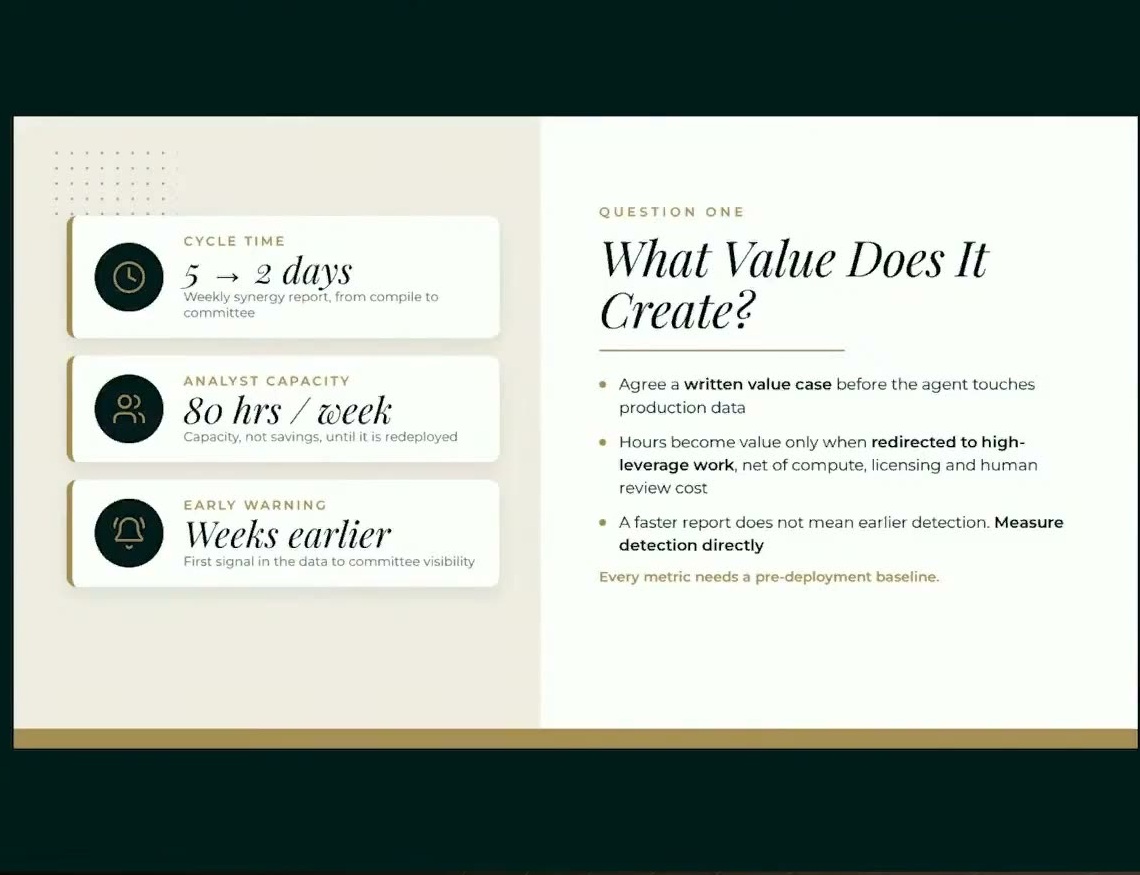
首先,指导委员会需要一份书面的价值论证,而且必须在智能体接触生产数据前达成一致。在我们的例子中,这涉及 3 项具体指标。先看周期时间。如果现在编制周报需要 5 个工作日,你就应该设定一个明确目标,比如缩短到 2 天。第二项指标是分析师产能。如果 4 名分析师每周花一半时间制作整套材料,这就是智能体每周能为他们省下的 80 小时。只有当整合负责人把这些时间分配给协同目标落后的工作流、帮助它们重回正轨时,这段时间才算作价值。
First, the steering committee needs a written value case, agreed upon before the agent ever touches production data. In our example, that comes down to three specific metrics. First, let's look at cycle time. If that weekly report eats five business days to compile right now, you're going to want to set a hard target such as two days. Your second metric will be analyst capacity. If four analysts spend half of their week building the stack, that is 80 hours a week the agent gives back. That time counts as value only when the integration lead assigns it to the work streams that are behind on their synergy targets and need help getting back on track.
而且,要扣除运行智能体所需的计算、许可和人工审核成本之后,才能计算这项价值。第三项指标最重要:发现时间。也就是从数据首次显示项目落后,到指导委员会看到这一情况,所需的时间。把报告从 5 天缩短到 2 天,并不保证委员会会更早发现项目进展落后。智能体必须及时发现,而价值论证要直接衡量这一点。每项指标都需要部署前基线。
Then you only count that value after netting out the compute, licensing, and human review costs of running the agent. Your third metric is the most important one, detection time. That is how long it takes from the first sign of a slip in the data to the moment the steering committee sees it. Cutting the report from five days to two days does not guarantee that the committee sees that slip any sooner. The agent has to catch it, and the value case measures that directly. Every single metric requires a pre-deployment baseline.
如果 IMO 今天说不出基线,就不要部署。如果你无法衡量起点,就永远无法证明智能体带来了改变。接下来,指导委员会需要知道谁负责智能体带来的风险。我们会把三道防线模型应用到智能体上。
If the IMO cannot state the baseline today, do not deploy. If you can't measure where you started, you can never prove the agent moved the needle. Next, the steering committee needs to know who owns the risk the agent creates. We are going to apply the three-line model to the agent.
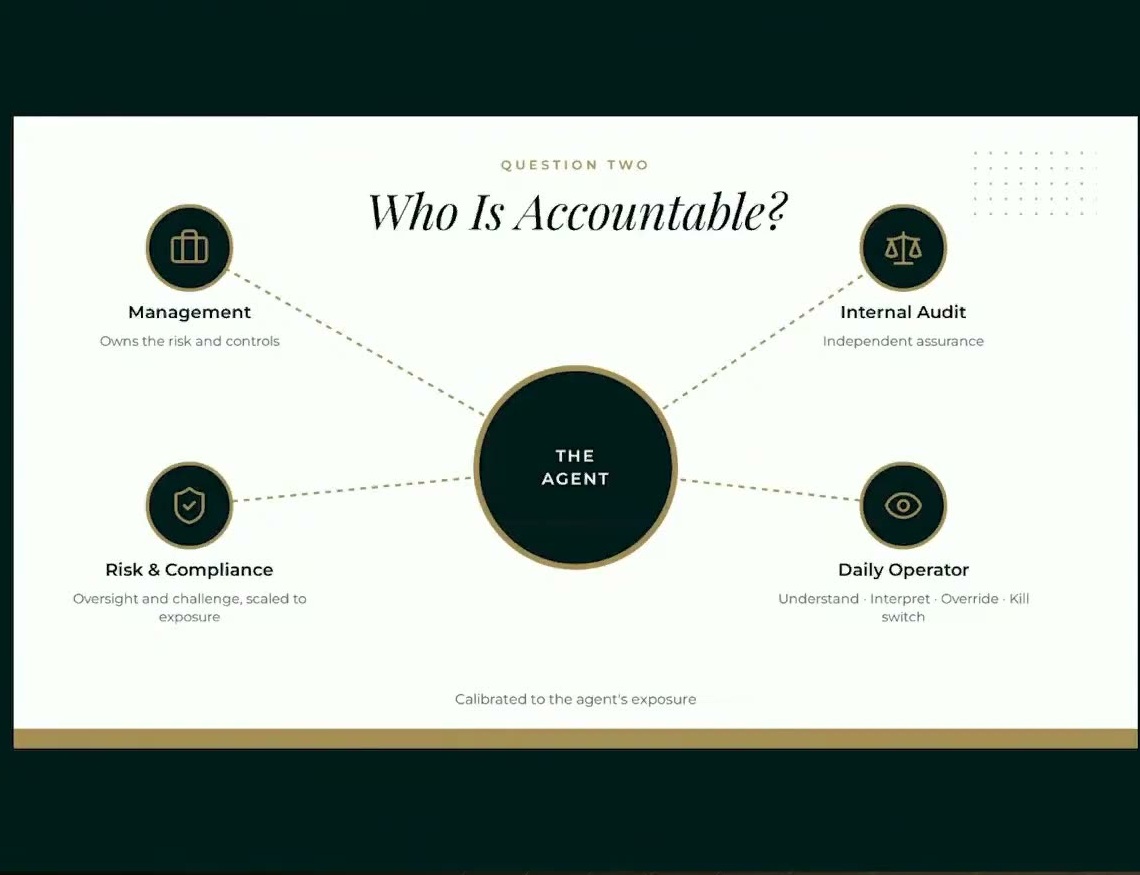
第一道防线由管理层负责控制措施。整合负责人是负有责任的高管。她对智能体输出负责,就像她过去对手动制作的简报负责一样。第二道防线由风险与合规团队监督智能体,并质疑其运行方式。他们审查的深入程度,取决于智能体的风险敞口。由资深分析师审阅、仅供内部使用的草稿,和自主发布数据到董事会的智能体,所需的审查标准完全不同。第三道防线由内部审计提供保证,并根据重大风险决定智能体何时、以何种方式纳入年度审计计划。
In the first line, management owns the controls. The integration lead is the accountable executive. She owns the agent's output exactly the way she owned the manual deck. In the second line, risk and compliance oversee the agent and challenge how to run it. How deep they go depends on the agent's exposure. An internal draft scrubbed by a senior analyst warrants a very different review standard than an autonomous agent publishing figures straight to the board. In the third line, internal audit provides assurance deciding based on material risk when and how the agent enters the annual audit plan.
还需要指定一名员工每天监督智能体。在我们的例子中,这个人就是资深分析师。她要在草稿送交指导委员会之前进行审阅。她的职责需要具备 4 项特定能力。她首先要了解运营边界。她必须结合上下文解读输出。她必须有权覆盖或撤销智能体的操作,还需要一个明确的紧急停止开关,以便它一旦出现异常行为就能安全关闭。
The agent also needs one employee assigned to oversee it every day. In our example, that is the senior analyst. reviews the draft before it reaches the community. Her role requires four specific capabilities. She has to first understand the operational boundaries. She has to interpret its output with context. She must have the authority to override or reverse it, and she needs a clear kill switch to shut it down safely the second it behaves unexpectedly.
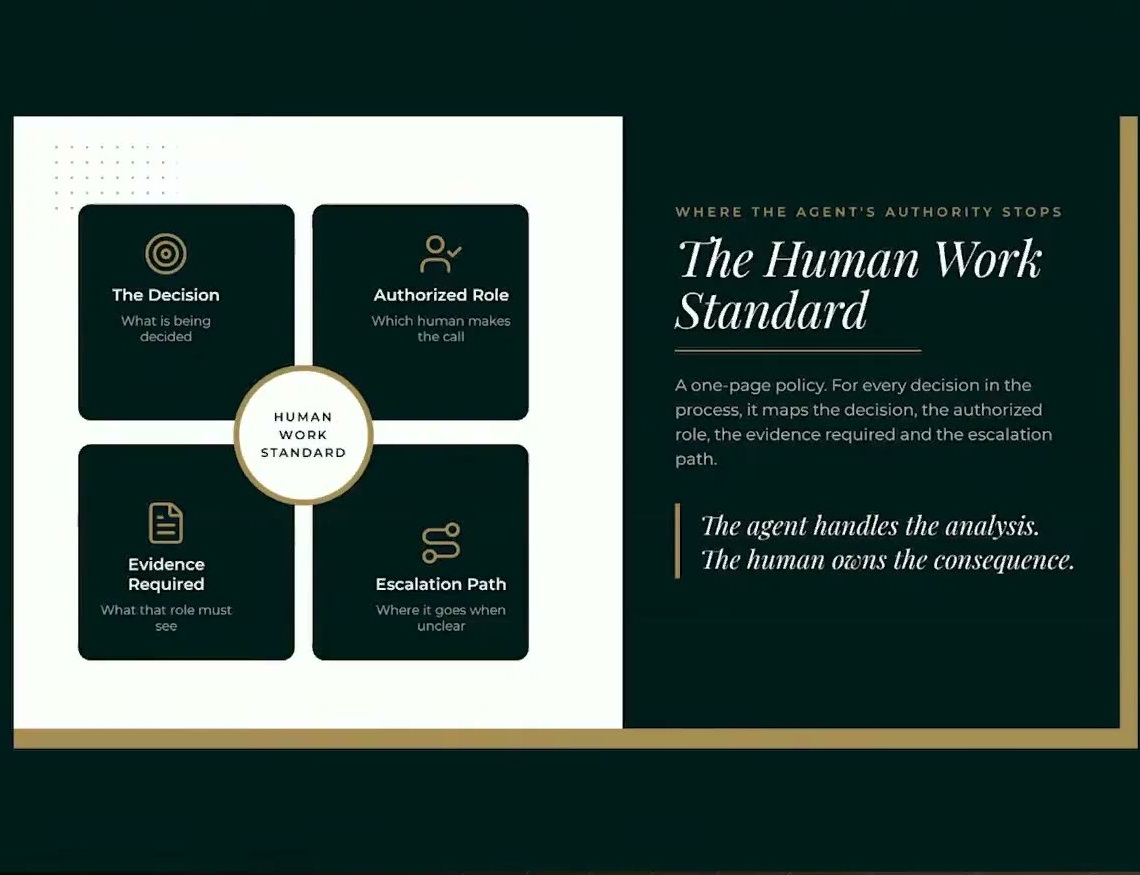
承担责任也意味着要明确智能体的权限止于何处。我会把这些内容写进一页政策,称为《Human Works Standard》(人类工作标准)。对于流程中的每个决策节点,它都会列出获授权作出决定的人类角色、所需证据和升级处理路径。这些决策存在于各个层级。资深分析师要判断差异是会计时点差异,还是真实的现金短缺。工作流负责人决定如何弥补这一短缺。
Accountability also means defining where the agent's authority stops. I document this in a one-page policy called the Human Works Standard. For every fork in the process, it maps the decision the human role authorized to make it, the required evidence, and the escalation path. These decisions exist at every tier. senior analyst decides whether a variance is an accounting timing difference or a real cash shortfall. The work stream lead decides how to remediate that shortfall.
整合负责人则决定是否向指导委员会正式报告某项计划存在风险。智能体会为上述每一项决策准备分析,到此为止。作出决定的人要对后果负责。因此,把这些决策留给团队,并不会拖慢智能体。智能体可以投入使用,同时每个角色保留自己的权限。推迟部署的一个原因,是有些决策没有指定负责人。这意味着,如果领导层没有商定由谁宣布某项计划偏离进度,智能体发出的标记就不会带来任何行动。接下来第三个问题就与在场的工程师有关。
And the integration lead is going to decide whether to formally flag an initiative as at risk to the steering committee. The agent prepares the analysis behind every one of those decisions, and it stops there. The person who makes the decision owns the consequence. So keeping these decisions with your team does not slow the agent down. It can go into use while each role keeps its authority. one reason to delay deployments is a decision with no assigned owner. This means if leadership has not agreed who declares an initiative off track, the agent's flags lead to no action. The third question is where the engineers in this room
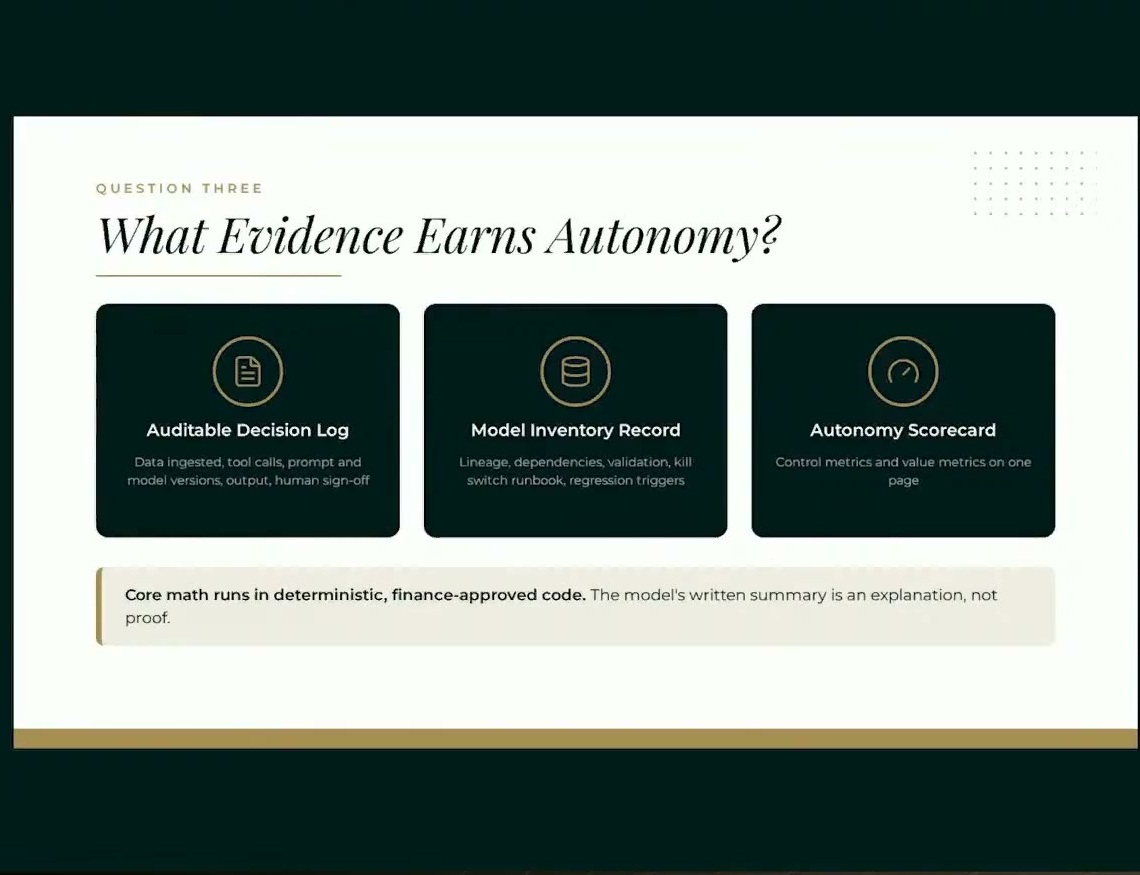
更高自主性的依据,来自智能体的构建方式。我会查看 3 项材料。第一项是可审计的决策日志。对于智能体评估的每条工作流,日志都会记录摄取的原始数据、执行的工具调用、提示和模型版本,以及生成的输出和人工签核。两项工程设计选择能让日志经得起审查。第一,核心计算和对账规则必须运行于经过财务批准的确定性代码中,而不是由 LLM 生成对话式文本来完成。
come in. The evidence for greater autonomy comes from how the agent is built. I look for three artifacts. The first is an auditable decision log. For every work stream the agent evaluates, it records the raw data ingested, the tool calls executed, the prompt and the model versions, output generated along with the human sign-off. Two engineering choices make that log airtight. First, your core math and reconciliation rules must run in deterministic finance-approved code, not generated as conversational prose from an LLM.
第二,要把模型写出的摘要视为有帮助的解释,而不是证据。真正的证据来自遥测数据。系统调取了哪些记录?运行了哪些确定性工具?谁签字审核了?如果报告的节省金额与总账不符,智能体不会触碰这个数字。它会标记差异并向上报告。第二项材料是模型清单记录,其中记录负有责任的高管、数据血缘、不同源系统之间的依赖关系、验证结果、升级处理路径,以及紧急停止开关的操作手册。
Second, treat the model's written summary as a helpful explanation, not proof. Your real proof lives in the telemetry. What records were pulled? What deterministic tools ran? And who signed the review? If reported savings do not match the general ledger, Agent does not touch the number. flats discrepancy and roots it up. second artifact is the model inventory record. captures the accountable executive. lineage. Dependencies across source systems. Validation results. Escalation path. And the kill switch runbook.
最……最重要的是,它会记录回归触发条件:任何提示、基础模型或源 API 的更新,都必须在重新投入生产环境之前进行完整的重新验证。
Most Most importantly, it documents your regression triggers, which are any updates to our prompt, base model, or source API that require full revalidation before running in production again.
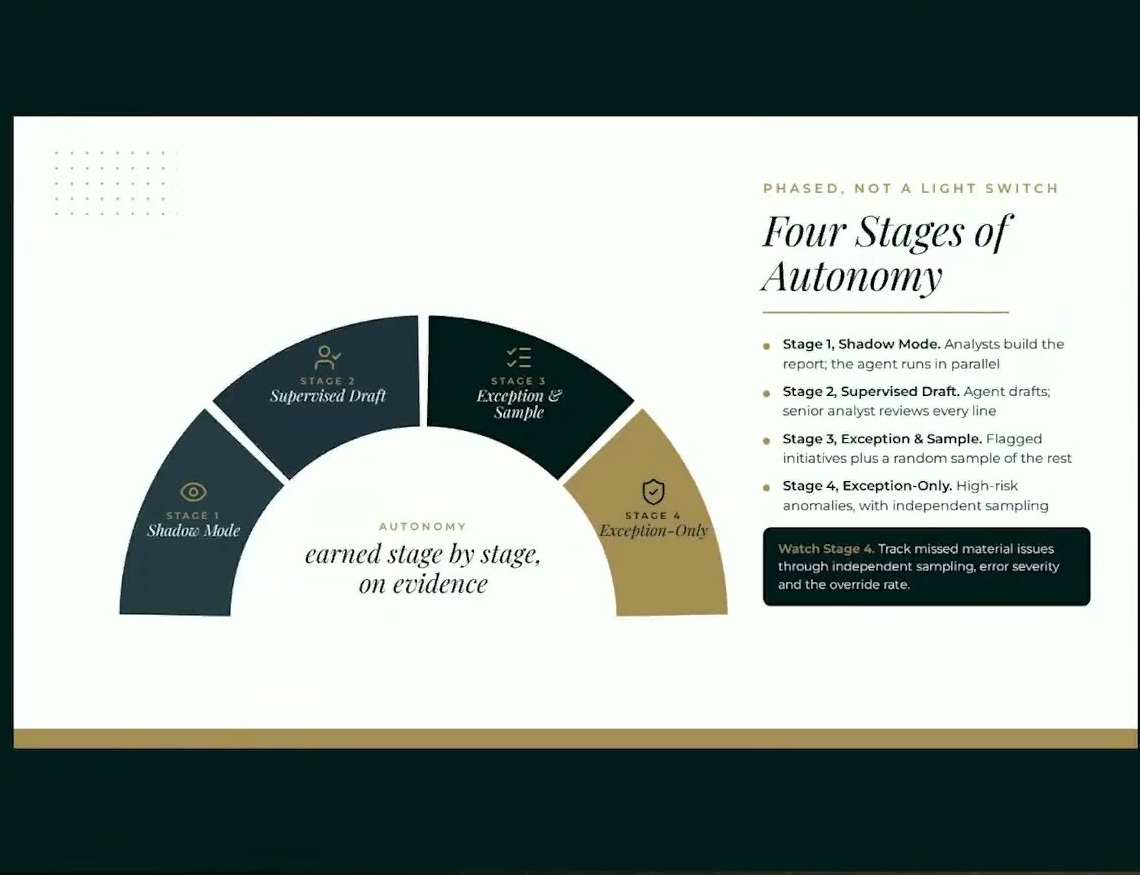
第三项材料是自主性评分卡。指导委员会通过它分 4 个阶段授予自主权限。第一阶段是影子模式。分析师仍按目前的方式编制报告。智能体在旁同步运行,团队比较两者的结果。第二阶段是受监督的草稿模式。智能体编制初稿,资深分析师逐项审核每一条内容。第 3 阶段是审核例外情况并进行抽样:分析师审核进度落后的计划,并随机抽查部分申报的节省额。接下来是第 4 阶段,只审核例外情况。
third artifact, this is going to be the Autonomy Scorecard. The steering committee uses it to grant autonomy in four stages. Stage one is shadow mode. The analysts build the report as they do today. agent runs right alongside them and the team compares the two. Stage two is the supervised draft. The agent compiles the first draft and the senior analyst reviews every single line item. Stage 3 is the exception and sample, where the analyst reviews land initiatives plus a random sample of the claimants. Then we have stage 4, where it's exceptions only.
分析师只审查高风险异常,并辅以定期独立抽样。不过要特别关注第 4 阶段,因为人类只看例外时,最大的弱点就是智能体没有标记出来的事项。因此我建议通过独立抽样追踪遗漏的重大问题,监测错误严重程度,并仔细观察人工覆盖率。人工覆盖率下降,并不自动意味着智能体变得更聪明。也可能意味着审查深度有所下降。
The analyst reviews only high-risk anomalies, supported by periodic independent sampling. Pay close attention to stage 4, however, because once humans only look at exceptions, your biggest vulnerability is what the agent failed to flag. So I advise tracking missed material issues through independent sampling, monitoring error severity, and watching your override rate carefully. A falling override rate does not automatically mean the agent is getting smarter. It can also mean the depth of review has split.
独立抽样能告诉你实际属于哪种情况。评分卡把这些控制指标与价值指标并列呈现,包括周期时间、投入的分析师工时和发现时间。通过这一页视图,指导委员会可以高效地基于数据作出明确决定,是提升智能体权限、维持现状、降低权限,还是退回受监督审核阶段。现在回到那 3 个问题。
So independent sampling tells you which one of these you are seeing. The scorecard puts those control metrics side by side with your value metrics, cycle time, analyst hours deployed, and your detection time. And with that single page view, the steering committee can make clean, efficient data-backed decisions to either promote the agent, hold it where it is, step it back, or down to supervised review stage. So let's come back to the three questions.
对你构建、资助或治理的每个智能体,都问一遍这些问题。它创造什么价值?谁对此负责?什么证据允许它自主运行?在今天的并购案例中,智能体不会凭空创造 4 亿美元的协同效应。采购、供应链和运营负责人通过艰苦的整合工作实现这些价值。智能体带来的价值很明确:提前数周提供经过核实的证据,让领导层有时间介入,趁交易协同效应仍可实现时采取行动。
Ask them of every agent you build, fund or govern. What value does it create? Who is accountable for it? and what evidence permits it to operate with autonomy. In our M&A example today, the agent does not magically create a 400 million in synergies. Procurement, supply chain, and operating leaders capture that value through the gritty work of integration. what the agent delivers is clear. Verified evidence weeks ahead of schedule, giving leadership the runway to intervene while the deal's synergies can still be captured.
构建一个能工作的智能体只是第一步。回答这 3 个问题,才能赢得信任,让智能体大规模运行。谢谢。
Building an agent that works is just the first step. Answering those three questions is what earns it the trust to run at scale. Thank you.