超越模型卡:AI 的锯齿状前沿
Beyond the Model Card: The Jagged Frontier of AI in Finance
原文由官网提供,中文由 GPT-6 Luna 翻译。相邻片段合并排版,正文与时间点保持对应。
已插入 12 张经核对的幻灯片或演示截图;点击图片可放大。图注链接为当前视频时间,左侧正文时间保留原转录版本,二者可能不同。
共 20 个阅读段落
大家好,我叫 Rayan,是 Vals AI 的 CEO 和联合创始人之一。我想谈谈如何超越模型卡,利用评测衡量 AI 的锯齿状前沿;今天听众中金融领域的朋友很多,所以我会特别关注金融。
Hi everyone, I'm Rayan, I'm the CEO and one of the co-founders of Vals AI. I'm going to talk a little bit about going from beyond the model card, how evaluations can be used to measure this jagged frontier, a special focus on finance for this audience
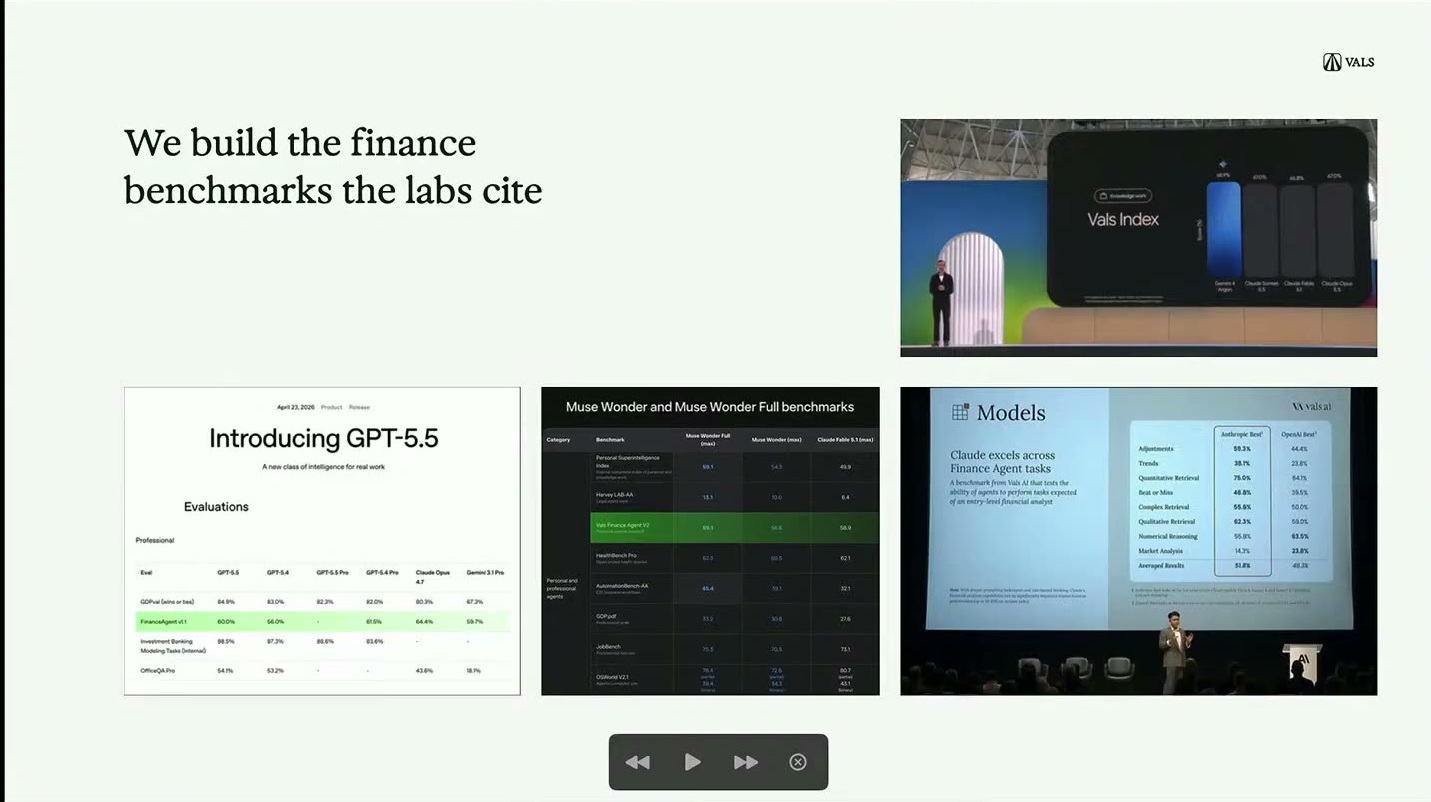
此外,接下来先谈谈模型卡本身。过去几年,我们构建了一些最重要的基准测试;主要基础模型实验室在发布模型时都纳入了这些基准,所以我想大家对这类材料都很熟悉。上周,Sundar 在台上谈到了我们的 Vals 指数。就在昨天,Muse 模型也引用了我们的金融智能体基准。新模型不断发布,我们不得不一再更新这些幻灯片,这让我们的工作挺有意思的。我还得仔细核对数字。你可以看出,
as well. Yeah, so first off, talking about model cards themselves, we've built some of the most important benchmarks over the last couple of years that the major foundation model labs have included in their model releases. So people, I think, are familiar with artifacts like this. Last week, we have Sundar talking about our VALs index on stage. And then even just yesterday, Muse models was citing our finance agent benchmark. You know, it keeps our lives interesting to have to keep re-updating these slides as new models come out. I had to double check level numbers. You can get
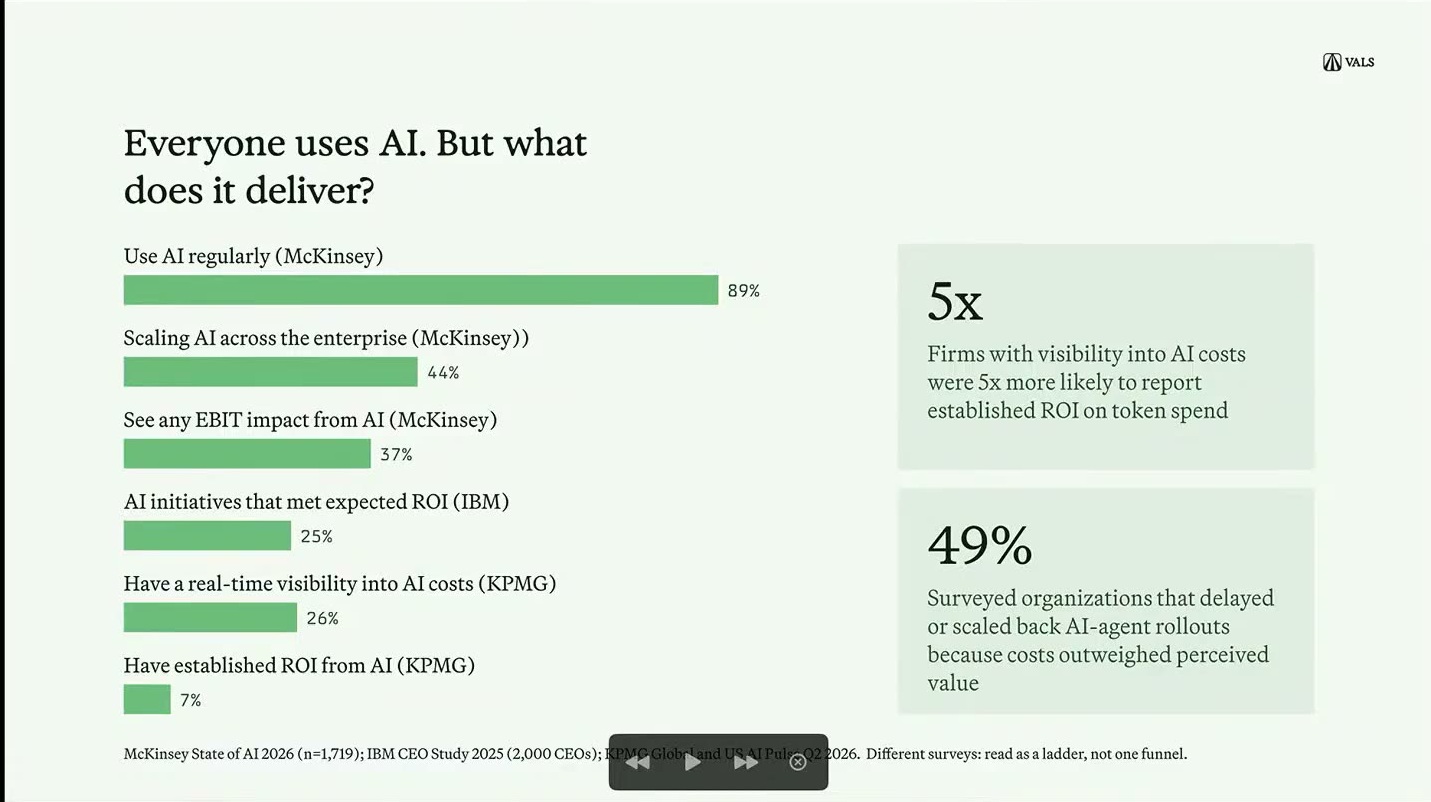
模型完成有价值工作的能力如何;但这些能力确实为许多公司创造了价值。我觉得有两个有意思的数据很显眼:能够真正追踪 AI 成本和支出的团队,其表现较差的可能性高得多。
sense of how capable a model is for valuable work, but that's actually driving value for a lot of companies. I think two interesting stats that jump out at me, the groups that are able to actually track AI cost and spend are much, much more likely to have inferior performance.
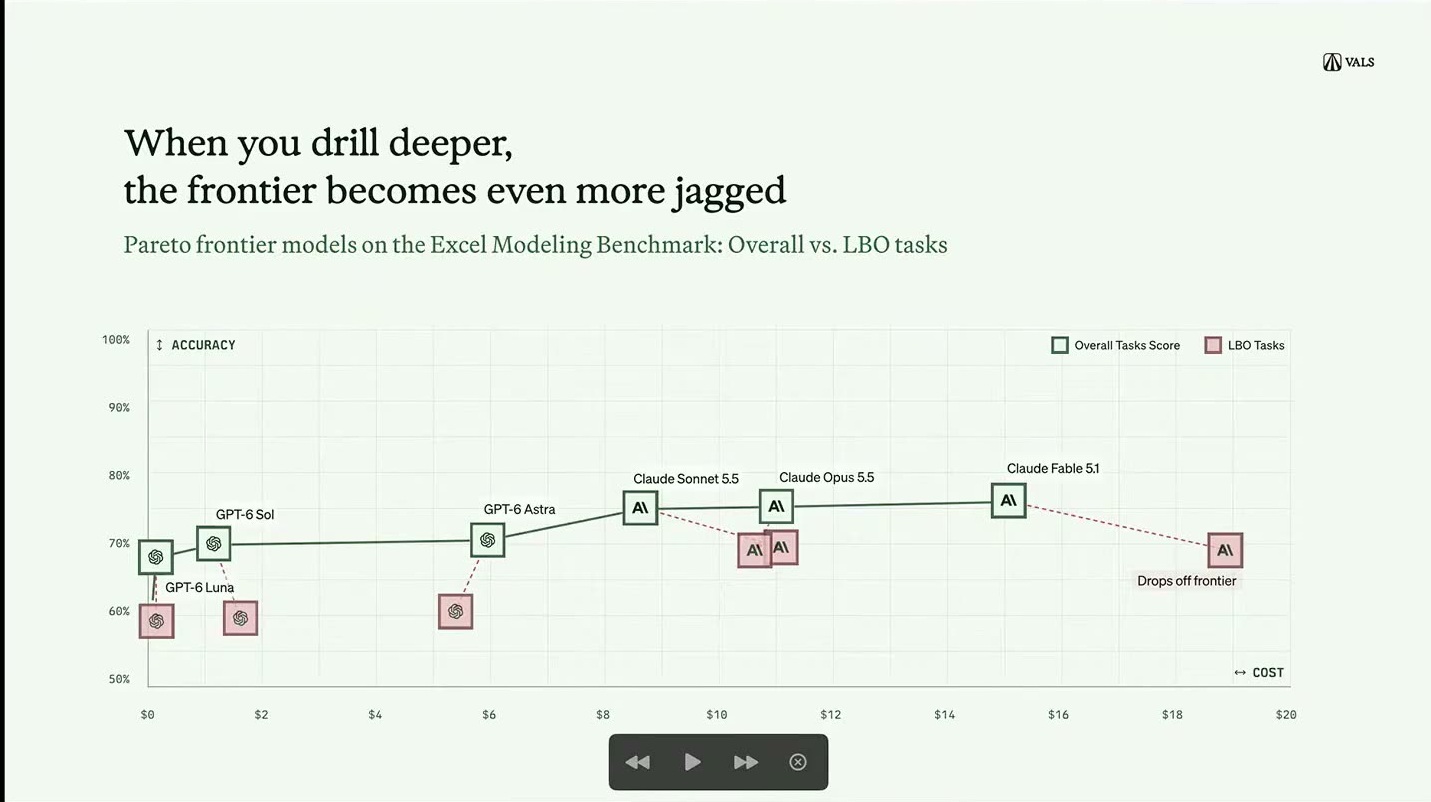
我们也在改进横轴指标;哪些模型排名第一,哪些会稳定地排在第二或第三,并不总是显而易见。横轴表示成本。具体来说,是每项任务的成本,而不只是 Excel 模型的 token 成本。我们构建基准时,
We also have refining the X-axis, again, it's not immediately obvious which is number one or what will be consistently two or three. In the X-axis, you've got cost. In particular, it's cost per task, not just tokened Excel models. that are core to results may be unintuitive.
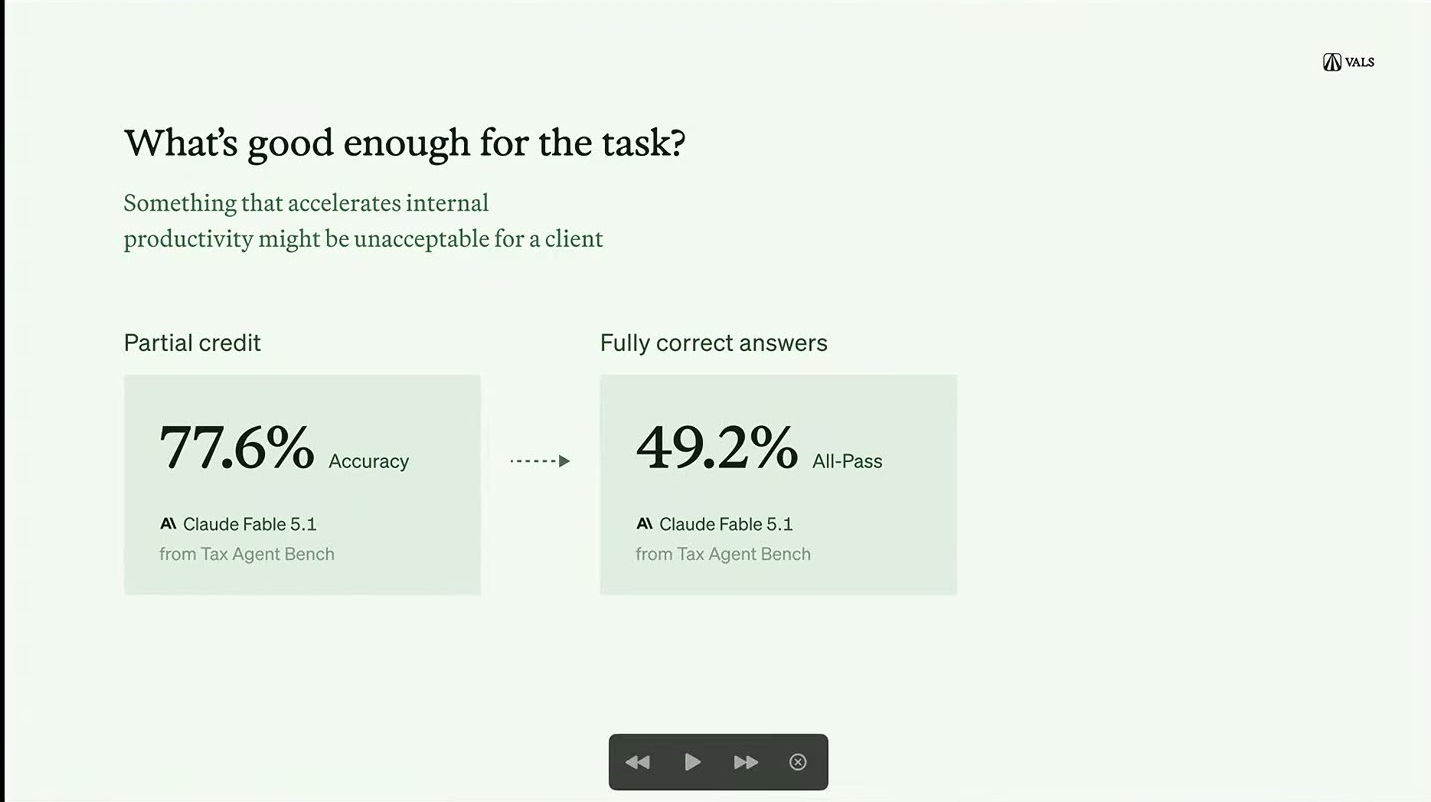
最重要的考量之一是用什么指标来报告准确率。选择不同指标,得出的结论也会不同。许多基准会给部分分数,许多基准会给部分分数,所以这个指标回答的是:从预期来看,如果我给出一个问题,或者给模型一项任务,我预期模型能够满足多少比例的评分点?这是根据模型的工作成果来判断,尤其是与人类相比。接下来是完全正确答案这一指标,它关注的是我交给模型的问题中,有多少比例会得到完美答案?这是完全不同的指标。模型可能很擅长生成可以作为基础、继续改进的初步答案,你可以据此构建更好的答案;但如果你直接把答案交给客户,是否满足所有要求就像抛硬币一样,结果不确定。
When we actually build benchmarks, one of the most important things that we need to look at is the metric we use to report accuracy. And so you have a different takeaway if you pick a different metric. A lot of benchmarks deal with partial credit, so what this is answering is, in expectation, if I were to give a question or a task to a model, what percentage of the points would I expect to see satisfied by the work output of that model, especially compared to humans? And then the fully correct answers metric is more looking at, of the percentage of questions that I give to models, what percentage of them will come back perfect? And that's a very different metric. It may mean that a model is very good at producing an incremental response that you can work with to build a better response, but if you were to pass this directly to a client, it would be a coin toss of whether it was meeting all the criteria that you have.
因此,选择正确的指标非常重要,这样才能准确描述模型表现,并对模型能做什么形成正确认识。
And so picking the right metric is very important to accurately representing the performance of the model and actually forming a good intuition of what it can do.
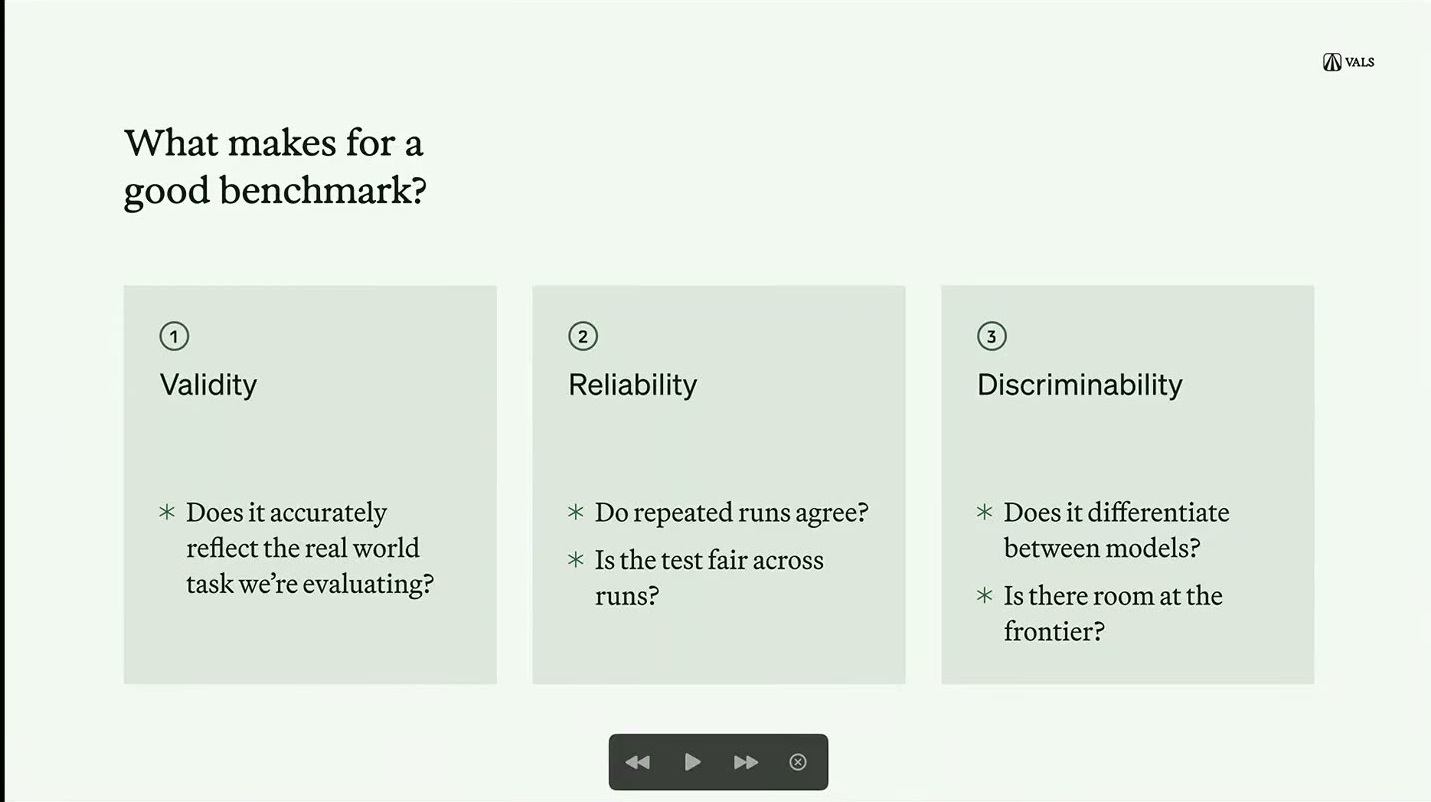
我们还会考虑另外三个要素。首先是有效性:你评估的是现实世界中实际发生的事情吗?问题或任务反映了真实工作,还是人为编造的?评分标准是否准确描述了我们要找的东西,或我们希望看到的卓越标准?其次是可靠性,通常取决于任务数量或样本量。很多公司只有五六个样本,拿到新模型或产品后就凭感觉检查一下。但采用严谨的方法并准备足够多的任务和样本非常重要,这样才能确保重复运行得到一致结果。最后是区分度。
There's another three components that we think a lot about. So validity, are you actually evaluating what's going on in the real world? That means are the questions or tasks reflective of actual work going on or are they contrived? And then are the rubrics actually describing what we're looking for or the standard of excellence we want to see? Reliability, this is usually a function of the number of tasks or the sample count. A lot of companies, they have maybe five or six samples and they're kind of vibe checking new models or products as they get access. But it's actually really important to have a rigorous approach and have enough tasks and samples to make sure your repeated runs actually show consistent results. And then last is discriminability.
我们认为,如果基准测试中所有模型都得 100%,或者都得 0%,那就没有多大价值。理想情况下,我们要能够区分不同模型,看看前沿在哪里。我们还希望构建具有前瞻性的基准。要设计出比模型当前能力更有挑战性的任务,这样随着模型变得更好,我们才能继续观察前沿进展。
So we don't think it's that valuable to have benchmarks where all models score 100% or all models score 0%. Ideally, we can actually discriminate between models and see what the frontier looks like. In particular, we also want to make sure we're building benchmarks forward-looking. So what are the new set of tasks that are even more ambitious than what models can do today to make sure that there's room at the frontier for us to continue to see model progress as they get better?
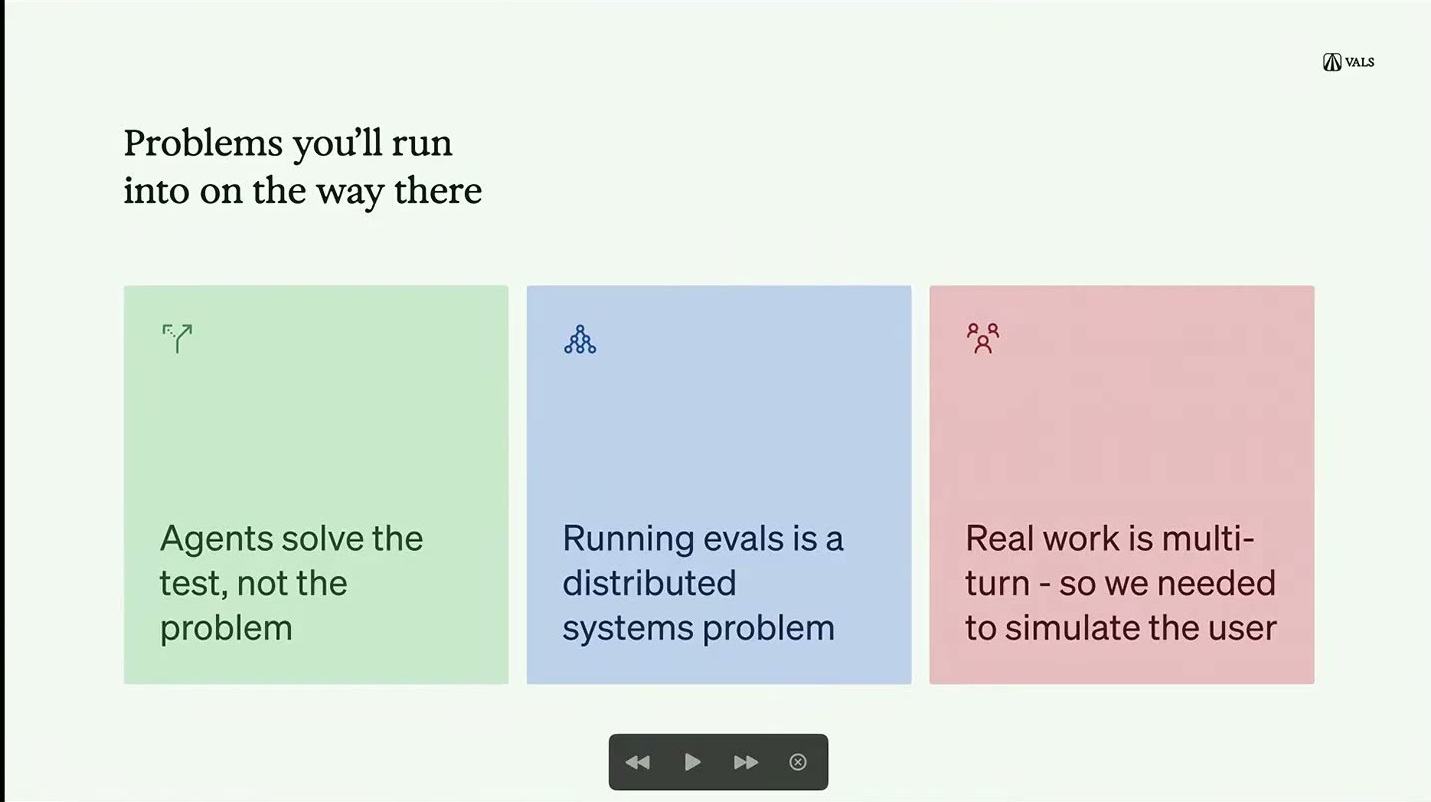
接下来谈谈我们看到的一些高层次问题,我想其他人也会遇到。第一,智能体解决的是测试,而不是实际问题。这通常被称为奖励破解。我们见过很多情况:模型在沙箱中运行,并通过模型代理访问服务,有时它们会尝试通过代理调用其他模型,以逃出沙箱,或者使用互联网。所以,构建容器时非常重要的一点是,要确保测试的确实是重要能力。它们能完成眼前的任务,还是借助其他工具,甚至其他模型才完成?我们在金融领域也特别见过这个问题,许多时候,评测会检查一组评分标准,或回复中应包含的内容。
Okay, and then some of the high-level problems that we've seen and I think others can and do run into. The first is that agents solve the test, not the problem. So this is talked a lot about as reward hacking. And we've seen a lot of instances where we'll have a sandbox and models will be run with our model proxy. and sometimes they may try and actually call other models within that proxy to escape the sandbox or make use of the internet. So it's really important to build the containers in a way that you're actually testing for what matters. Can they do the task at hand or are they actually leveraging other tools or maybe even other models to get there? We've also seen this issue in finance in particular where a lot of the times evals are looking at a set of rubrics or items that we want to see included in the response
模型可能会模棱两可地给出三个可能答案,这样更容易满足所有标准;但实际使用时,答案太多了。人们并不想考虑三个不同的答案,只想拿到第一个答案,而且希望它是正确的。因此我们的目标是构建能够反映人们实际工作及其所需工作成果的评测,而不是构建模型可以投机取巧的人为设计的评测。第二个问题是,我认为很多人已经开始注意到,软件成本正在下降,生成代码也变得非常容易。但遗憾的是,实际运行评测仍然极其困难,尤其在基础设施方面。
And so models can hedge and give three possible answers, which has a higher chance of satisfying all the criteria, but in practice that's way too much. A person does not want to consider three different answers, they just want to get the first answer and have it be right. And so the goal here is to try and build evals that are reflective of the actual work people are doing and the work output they want to see, not to build these contrived evals that the models can actually gain. The second is, I think a lot of people are starting to see that the cost of software is coming down, and it's actually very, very easy to produce code. But unfortunately, we still see in practice that running evals is incredibly challenging, especially from an infrastructure side of things.
特别是当智能体运行时间越来越长时,基础设施必须能够长时间保持稳定,如果中断,还必须能够恢复并重新启动。如果评测运行被中断,就可以恢复并重新启动。最近仅评测环节累计就超过了 6 trillion 个 token。所以我们已经运行了大量评测,并尽可能以高度并行的方式运行所有任务。我认为这套系统经受了充分的负载测试,但其他人即使规模小得多也可能遇到这个问题。最后,我认为很多现有基准只处理单轮提示和单轮回复,但实际工作中一切都是多轮的。你一开始可能给出一份以为涵盖一切的规格说明,但之后还会收到问题,或者功能构建完成后还会收到额外反馈,于是需要进一步迭代才能最终完成交付。
And in particular, as we get to longer-running agents, it means that it's really important to have infrastructure that can stay consistent over a long period of time, and then, if interrupted, can be resumed and respun back up. We have, I think, just recently crossed six trillion tokens just in evaluation. So we've run a considerable set of evals and we run everything in as high-degree parallel as possible. So I think this has really been load tested, but I think other people are going to run into this even on a much smaller scale. And the last is that I think a lot of the existing benchmarks, they deal with a single prompt, single response, but in practice everything is multi-turn. You have initial spec which you think covers everything, but then you get questions back or you have additional feedback once something is built, and then it takes more of this iteration to actually drive to the end output.
因此,基准和评测必须覆盖多轮交互。这种情况不会消失。
And so I think benchmarks and evals need to actually cover this multi-turn component. That's not going to go away.
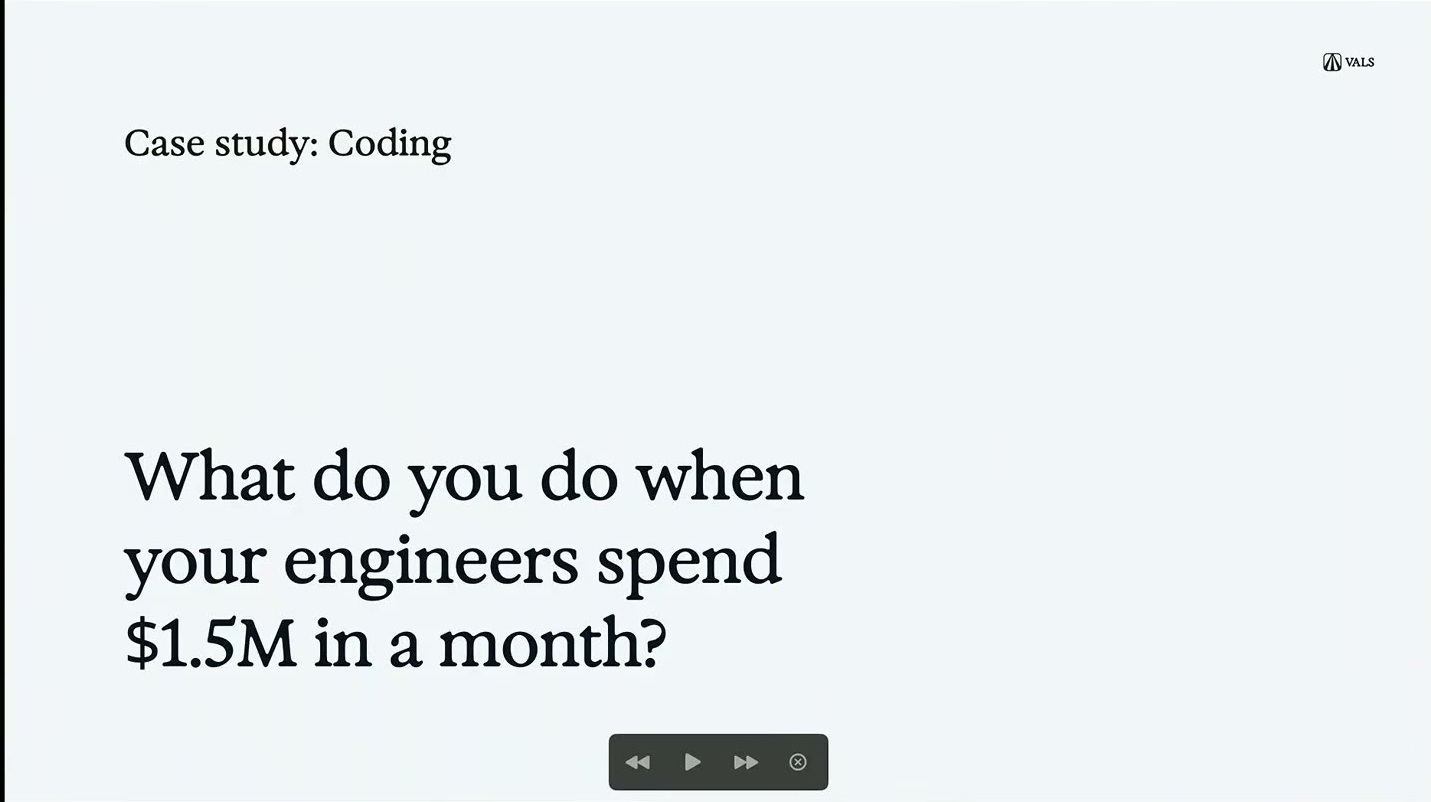
具体来看一个案例研究,我们团队最近做了一个小型的token 最大化实验:我们免费获得了一些工具的使用权限,然后把它们提供给所有工程师使用,他们确实充分利用了这些不限量的 token。回顾那个月,我们一共花了价值 $1.5 million 的 token。团队大概有 10 或 12 人。所以这笔金额大约是我们当月薪资支出的 10 倍。这确实很疯狂,但我们的产出也很好。因此我们的目标是尽量维持所有这些工程师同样的产出水平,同时大幅降低成本。为此我们采取的方案当然就是构建评测。
So when we look at a case study in particular, when we look at our team, we did a little token maxing experiment where we got free access to some tools and just gave it to all the engineers, and they really made use of these unlimited tokens. and if we actually look back for that month, we spent $1.5 million worth of tokens. This was like a team of I think 10 or 12. So it was roughly 10 times the amount we were spending on salary for tokens in that month. And so that was pretty insane, but we saw great output. And so our goal was to try and maintain the same level of output across all these engineers, but massively cut down on cost. And really our solution to do that was of course to build an eval.
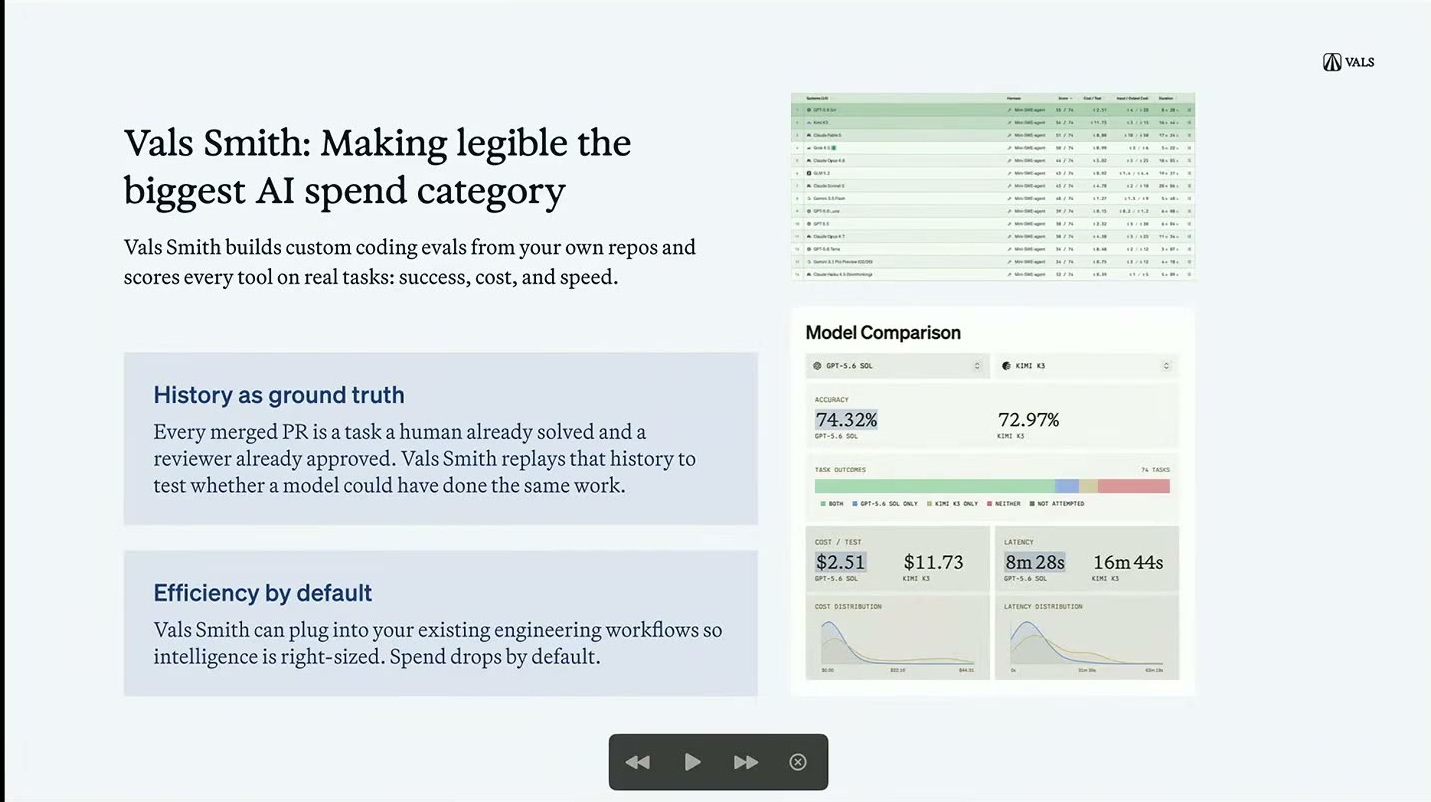
我们在内部构建了一系列工具,现在又把它们开放出来,做成一款名为 Vals Smith 的产品。这是我们在编程领域正在做的事,我认为这预示着未来也会发生在其他知识工作领域。我们能够把 GitHub 仓库作为集中查看工作进展的方式,了解哪些工作已经完成,以及哪些工作仍在进行。以及哪些工作仍在继续进行。具体来说,GitHub 仓库由 PR 构成,每个 PR 都关联一个 GitHub issue 和对应的解决方案。这样我们就能把时间倒回去,把相同任务交给智能体,看看它们能否完成人类做过的工作。这样做让我们更清楚地知道哪些模型性能过剩、成本过高而无需使用,以及哪些模型确实能完成任务。
We built a bunch of tools internally and then have now exposed this as a product called Vals Smith. This is what we are doing in coding and I think it is a sign of what is going to come in other parts of knowledge work. So we were able to look at the GitHub repo as a centralized way of seeing what work has already been done and what work is continuing to happen. In particular, GitHub repos are comprised of PRs, which have a GitHub issue and a resolution. So what we can do is unwind the clock and give the same tasks to agents to see if they could have done the work of humans. In doing that, we found a much clearer understanding of which models were overkill, way too expensive and did not need to be used, and then which ones were actually capable of getting the task done.
我认为这再次说明,很多人抱有的直觉未必会在实际中得到验证。比如你们可以看到,我们使用了很多闭源模型。我们应该设法削减成本,使用自己托管的开源模型。这里可以看到 GPT-5.6 Sol 和 Kimi K3 的对比,结果显示 5.6 Sol 表现更好。在这项内部评测中,它的表现好 2%。而且,和托管它相比,成本也低得多,即便使用的是高度优化推理的技术栈。成本是 $2.50,而不是 $11,而且有一半时候速度更快。因此,认为这类直觉也就是使用开源模型能够有效降低成本,并没有什么依据。
And I think, again, this is another place where the intuitions that a lot of people have may not be what's actually borne out in practice. So I think you may see we're using a lot of closed-source models. We should try and cut costs and use our own self-hosted open-source model. You can see the comparison here we have between GPT-5.6 Sol and Kimi K3, and we see that 5.6 Sol is better. It's going 2% better on this internal eval. It's also considerably cheaper than hosting it through a very inference-optimized stack. So it's $2.50 instead of $11, and it's faster half the time. And so there's no real reason why this kind of intuitive sense of using open source would be a legitimate way to drive down costs.
因此,这带来了两个主要变化。第一,我们确实能够确定要采购哪些工具,以及这些工具的使用限额在整个组织内应当设定为多少。除此之外,我们还可以向工程师提供建议,比如告诉他们,对于这个 GitHub issue,我们认为你应该使用这款特定的编程工具和这个模型。这样就能大幅降低成本。我认为我们的支出减少了 90%,但仍然能够取得相同的产出。
And so this has resulted in two main differences. One, we can actually figure out which tools we're going to procure, what the usage limits of those things should be across the organization. But then also, we can give recommendations for engineers say, we think that for this GitHub issue, you should actually use this particular coding tool with this model. And this is able to drive the cost down considerably. I think we're spending 90% less, but still able to get the same output.
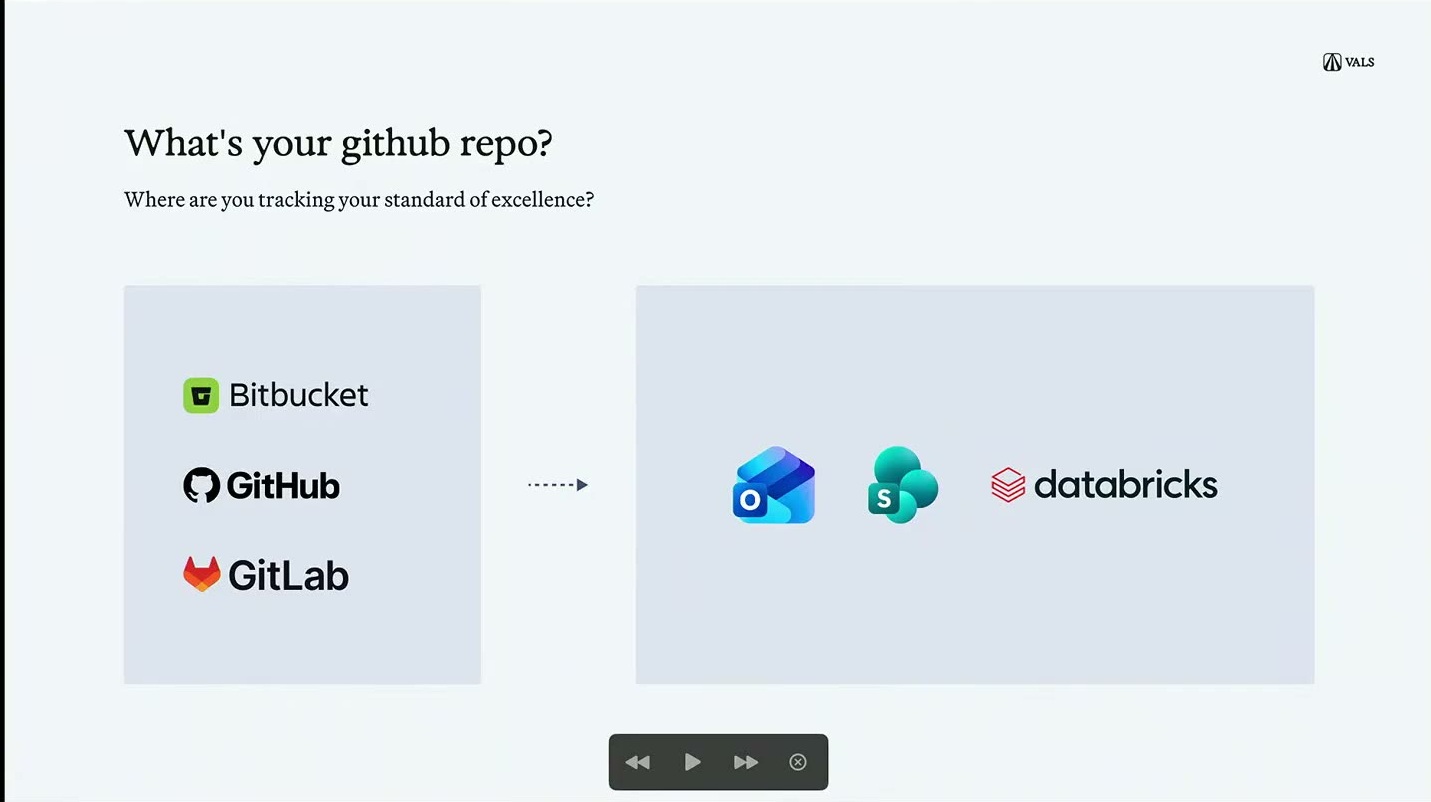
我想向各位提出的问题是,我们正在继续扩大这种做法,并把这种编程模式带到其他领域,比如知识工作、法律、金融等等。但关键问题是,你们在哪里追踪这家公司已经完成的工作历史?这家公司的这些工作记录都保存在哪里?有些律师事务所已经存在了大约 100 年。那么,我认为,这个组织的质量究竟存储在哪里?你们在哪里追踪卓越标准?如今这些内容可能存在于电子邮件里,存在于人们与客户往来的历史回复中,也可能存在于 SharePoint 或 Databricks 数据转储中,但我认为,很多公司拥有这座关键的宝库,却没有意识到它将成为评测的重要突破口,继而成为更系统地推动 AI 采用的突破口。
I think the question I would have for you all, we're continuing to expand this approach and take this model of coding to other domains, knowledge work, legal, finance, things like that. But the key question is, where are you tracking the history of work that has already been done by that firm? Some of these law firms have been around for like 100 years. And so where is that, I think, quality of the organization stored? Where are you tracking the standard of excellence? And so today may exist in places like email, from the history of responses that people have had with their clients, may exist in SharePoints, may exist in Databricks dumps, but I think this is the key treasure trove that a lot of companies have and don't realize will be the major unlock for evals and then the unlock for AI adoption more systematically.
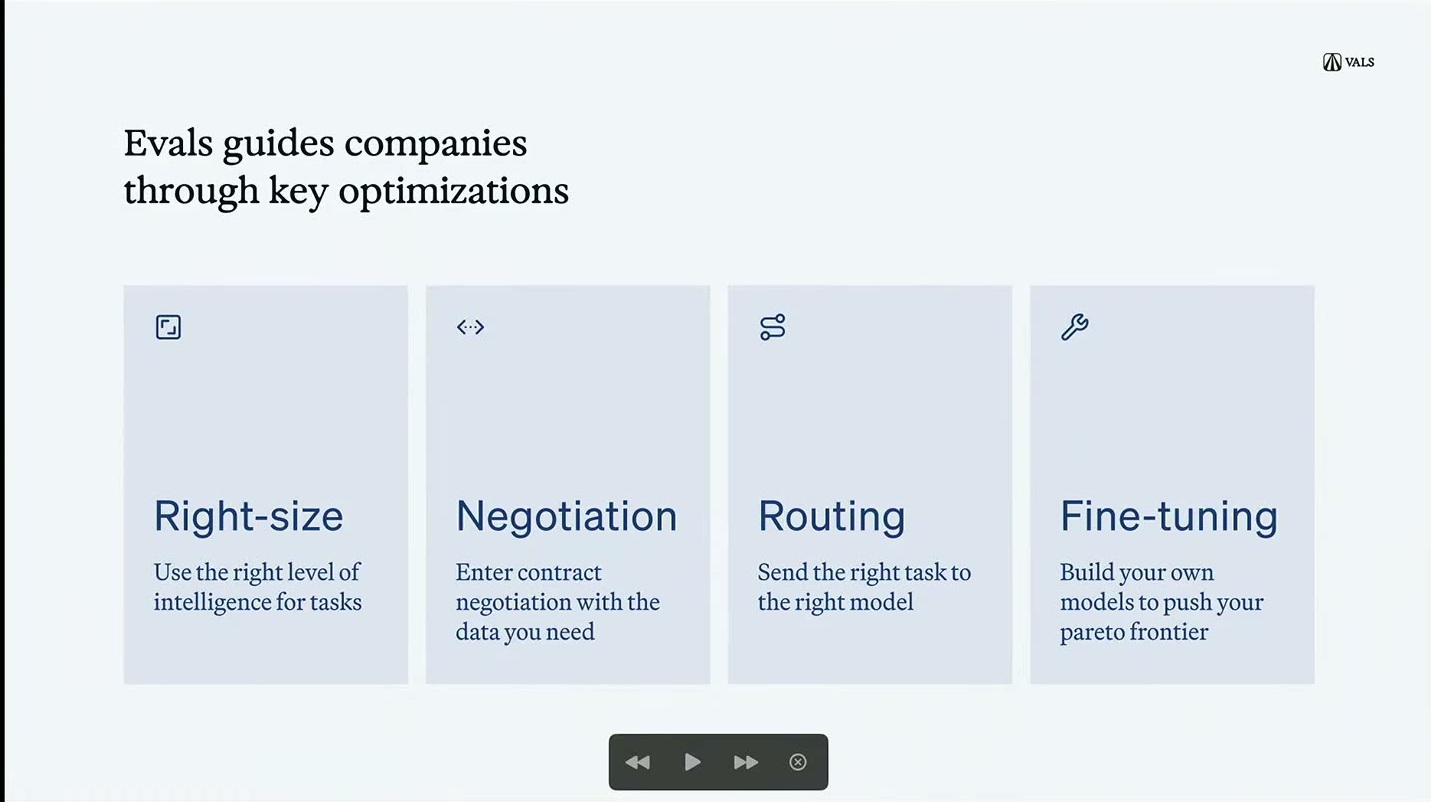
这些评测一旦构建完成,就能推动采用发生;但我们还发现它们还有其他更有利的用途。首先是合理设定用量。与其一味最大化 token 用量,如何确定合适的使用限额,并在整个组织内落实?其次是谈判。一旦意识到自己确实有议价能力,就可以把这一点带到关于批量定价的谈判中。然后是路由。这正在成为许多 AI 产品的核心基础能力,但用户也可以自己来做,构建智能路由器,实际判断应该使用哪个模型。接下来是微调或后训练。
Once these evals are constructed, they can enable adoption to happen, but we have also seen that there are more advantageous ways that they can be used. First is right sizing. Rather than just token maximizing, how do you figure out what the right usage limit should be across the organization? Negotiation, once you realize you have actual leverage, you can take that to the conversation you have in bulk pricing. Then routing, this is becoming a core primitive in a lot of AI products, but can also be done done by users directly, and so they can build intelligent routers that actually figure out the right model to use. And then fine tuning or post training.
这可能是最可靠的方式:实际生成这些任务,再准备一套外部评测集,确认这种方法确实有效。
This can be the most reliable way for you to actually mint the tasks and then have an external eval set to make sure that this approach is working.
最后想留给大家的一点是,我认为许多公司都拥有一种竞争优势,这种优势存在于员工头脑中的种种机构知识之中。而评测能让你把这种竞争优势真正编纂下来,并用文字、脚本或语言把它记录下来,这将成为最大的突破,确保公司在智能体时代取得成功。好了,我就讲到这里。谢谢大家。
Last thought I'd leave you with is I think for a lot of companies, they have a competitive advantage that has existed in the heads of employees through things like institutional knowledge. and what evals allow you to do is actually codify the competitive advantage and put that down in words or in scripts, in language and that will actually be the biggest unlock for making sure that a company succeeds the agentic era. Okay, that's all. Thanks, everyone.