优秀的智能体始于优秀的基础设施
Great Agents Start with Great Infrastructure
原文由官网提供,中文由 GPT-6 Luna 翻译。相邻片段合并排版,正文与时间点保持对应。
已插入 19 张经核对的幻灯片或演示截图;点击图片可放大。图注链接为当前视频时间,左侧正文时间保留原转录版本,二者可能不同。
共 28 个阅读段落
很好!抱歉,我没事。大家好,我是 Modal 的 CTO Akshat,今天要谈谈他们对基础设施的真正需求。我听说在座听众很多都与金融领域关系密切,所以我想谈谈
Great! Sorry, I'm good. Hey everyone, I'm Akshat, CTO of Modal, and I'm going to talk about really need from their infrastructure. I'm told this audience is very finance adjacent, so I thought I'd talk about what
如果电子表格中的每个单元格背后都有一个智能体,会怎么样?想象一下,你是一家基金的金融分析师。你想对投资组合中的每家公司都进行复杂分析。过去通常要花好几天。你得接入每一家被投企业,查看它们的数据源,并分别为它们运行一些 Python 代码。现在显然有了智能体,这应该容易多了。
if every cell in a spreadsheet could be backed by an agent? And imagine you're a financial analyst at a fund. you want to run a complex analysis on every company in your portfolio. Normally in the past, this would take days. You'd have to connect every portfolio company, look at their data sources, run some Python for each of them. now obviously with agents, this should be much easier.
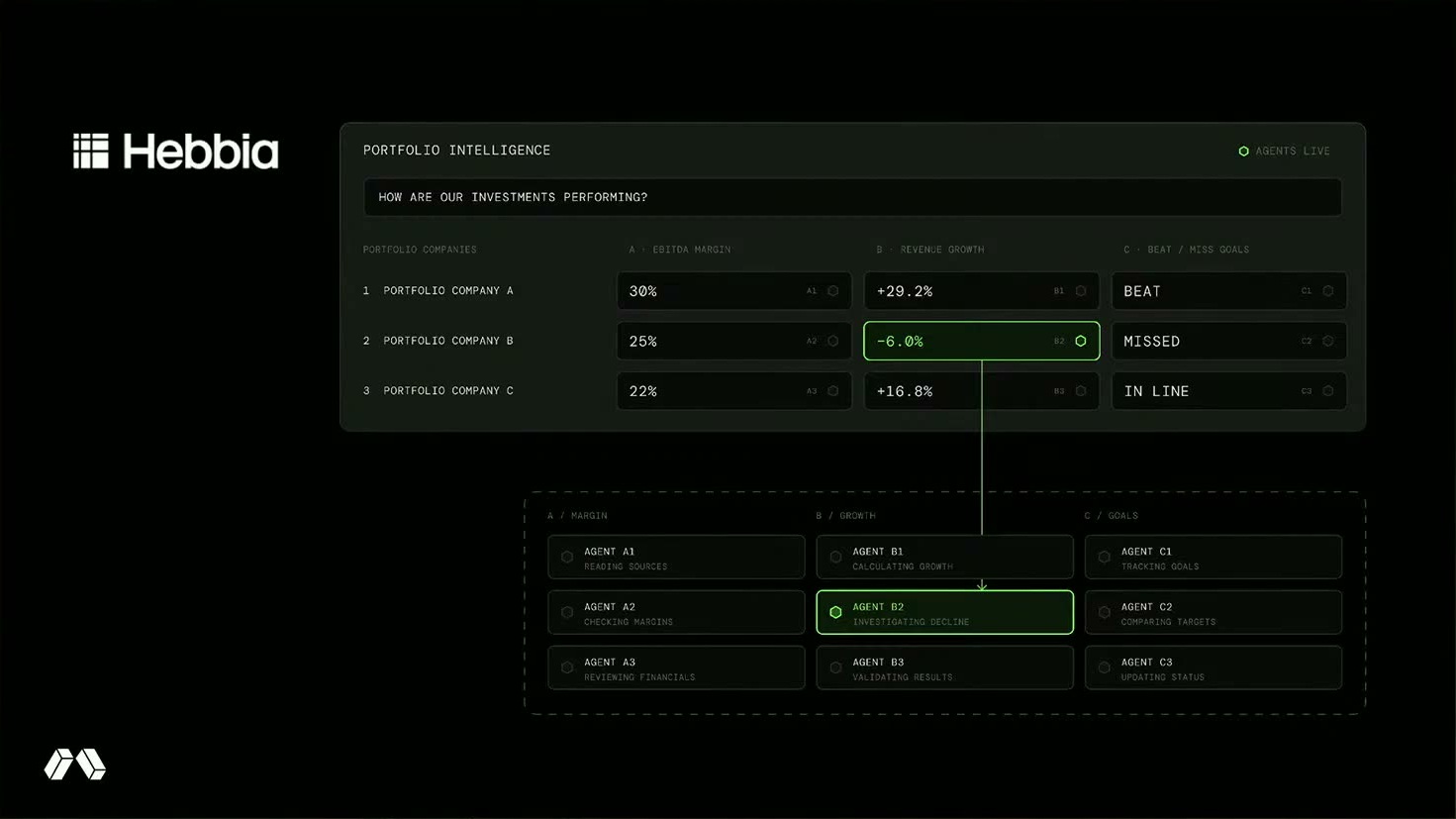
实际上,我们的一位客户 Hebbia构建了一个恰好能实现这一点的产品。现在你可以直接进入他们的产品,打开一张电子表格,然后运行一个查询,其中每个单元格实际上都由一个不同的智能体提供支持。我想谈谈构建这样的系统到底是什么样子。首先,每个智能体都由一个 Modal 沙箱提供支持。
Well, actually, one of our customers, Hebbia, built something that's exactly this. you can go in right now in their product, you have a spreadsheet, and you can run a query where literally every cell is backed by a different agent. And I wanted to talk about what does building this really look like. Well, first, every agent is backed by a modal sandbox.
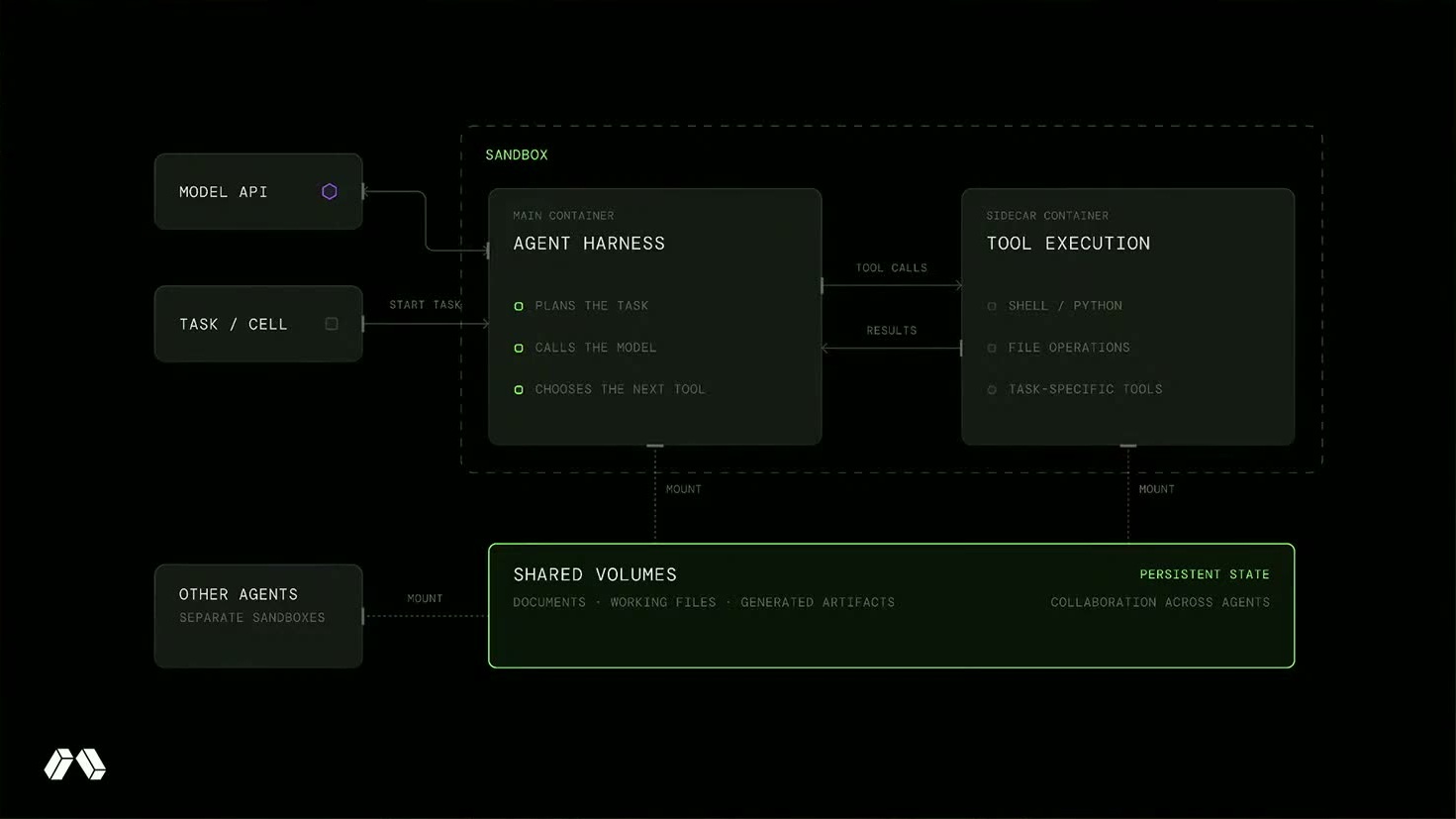
沙箱是运行不可信代码的安全环境。过去,每个沙箱都与一个容器或微型虚拟机一一对应。但现在已经不是这样了。如今,Modal 有一项功能,可以在一个沙箱里运行多个容器或微型虚拟机,就在一个沙箱内部。要实现这样的系统,你确实需要这么做。在这种架构中,你会运行智能体运行框架。智能体运行框架就是智能体循环,用于执行诸如运行程序、调用模型 API 进行推理、运行工具调用,然后反复循环等操作。
Sandbox is a secure environment for running untrusted code. It used to be that every sandbox was one-to-one with a container or micro VM. That's actually no longer the case. Today actually, modal has this feature where you can run multiple containers or micro VMs inside a sandbox. You actually need to do that for doing something like this, where in this architecture you run the harness. The harness is the agent loop that does things like running the, calling the model API for inference, running the tool calls, and then looping over it.
出于安全、隔离以及其他许多原因,你会希望把它与工具调用实际运行的地方分开。因此,你的沙箱里会运行多个容器,其中包括一个 sidecar。你还需要共享存储,因为你希望智能体能够彼此交流。至于如何划分存储,则由你决定。比如,你可以让每一行使用同一个卷,这样电子表格中该行的智能体就能协作。有些情况下,你还希望在主容器和 sidecar 之间共享存储。这些情况。
want to separate that from the place where the tool calls actually run for security and isolation and a bunch of other things. So you have the sandbox that's running multiple containers, including a sidecar. You also want shared storage, because you want your agents to be able to talk to each other. And it's up to you how you stripe it. Like maybe you have every row gets the same volume, and agents in that row in the spreadsheet can collaborate. And you also want to share storage between your main container and the sidecar for some cases.
最后,你需要让所有这些环境都能极快地启动,因为你的电子表格可能有很多单元格。如果有人要查询,你就想启动数千个智能体,然后在任务结束后再把它们关闭。
And finally, you need all of this to spin up really, really fast, because your spreadsheet can have lots of cells. If someone wants to query, you want to launch thousands of agents, and then you want to spin them back down when it's over.
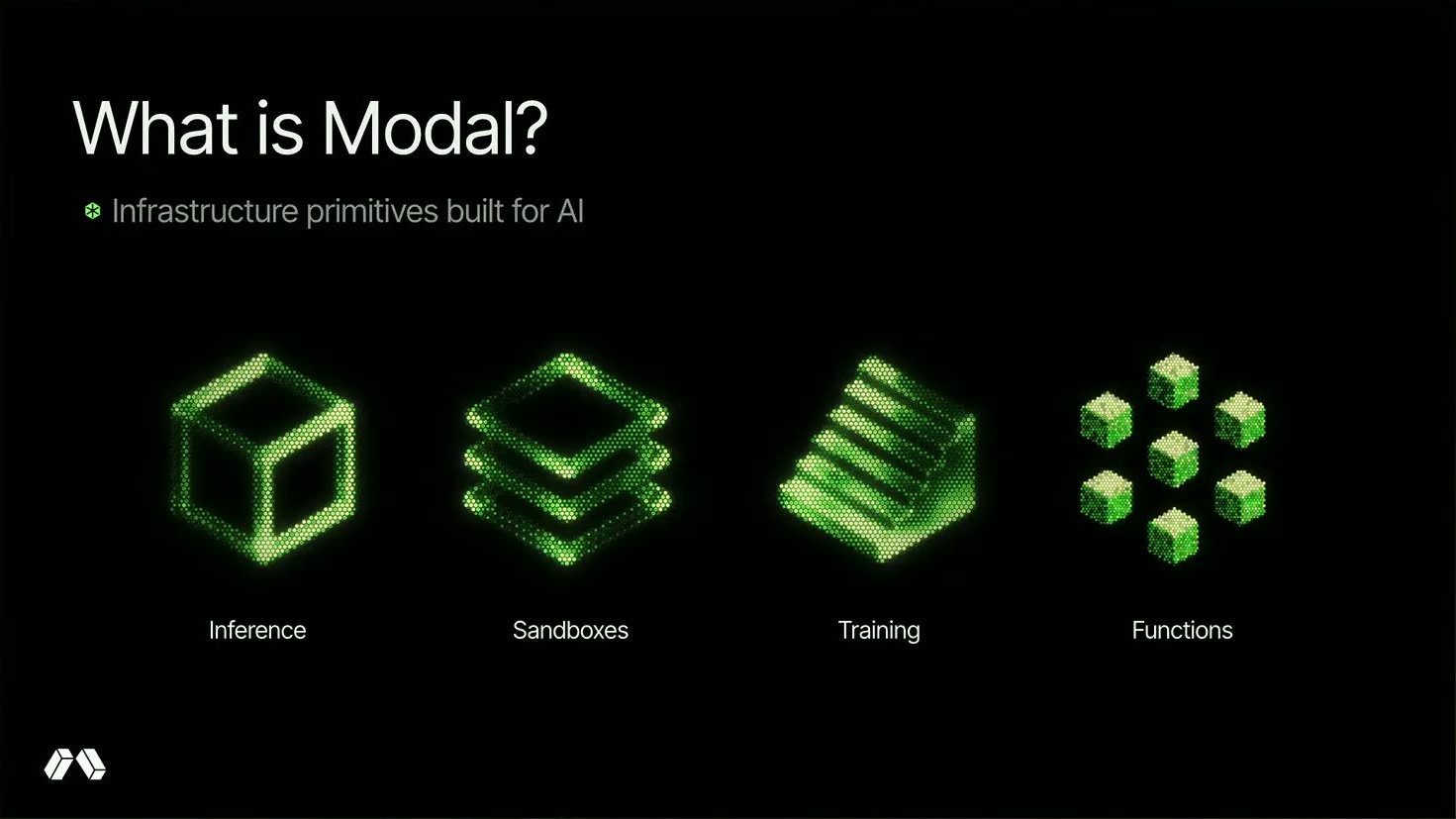
在继续讲这个之前,我想先稍微岔开一下,谈谈 Modal 是什么。Modal 是一个为 AI 应用打造的原语平台。我们从头构建了这个平台,打造了自己的文件系统、调度系统,以及运行时,为推理等应用场景提供出色的性能和开发者体验,包括 LLM 推理、沙箱、训练、函数,以及运行大量批处理,等等。今天我特别要谈的是沙箱:这一原语是什么,以及
So before I talk more about that, I just wanted to take a quick aside to talk about what is modal. Modal is a platform of primitives that is built for AI applications. We have built this platform from scratch, built our own file systems, scheduling and the runtime to give you great performance and devx for use cases like inference, including LLM inference, sandboxes, training and functions, running a lot of batch processing and what not. Today in particular I'm going to talk about sandboxes, what this primitive is and how
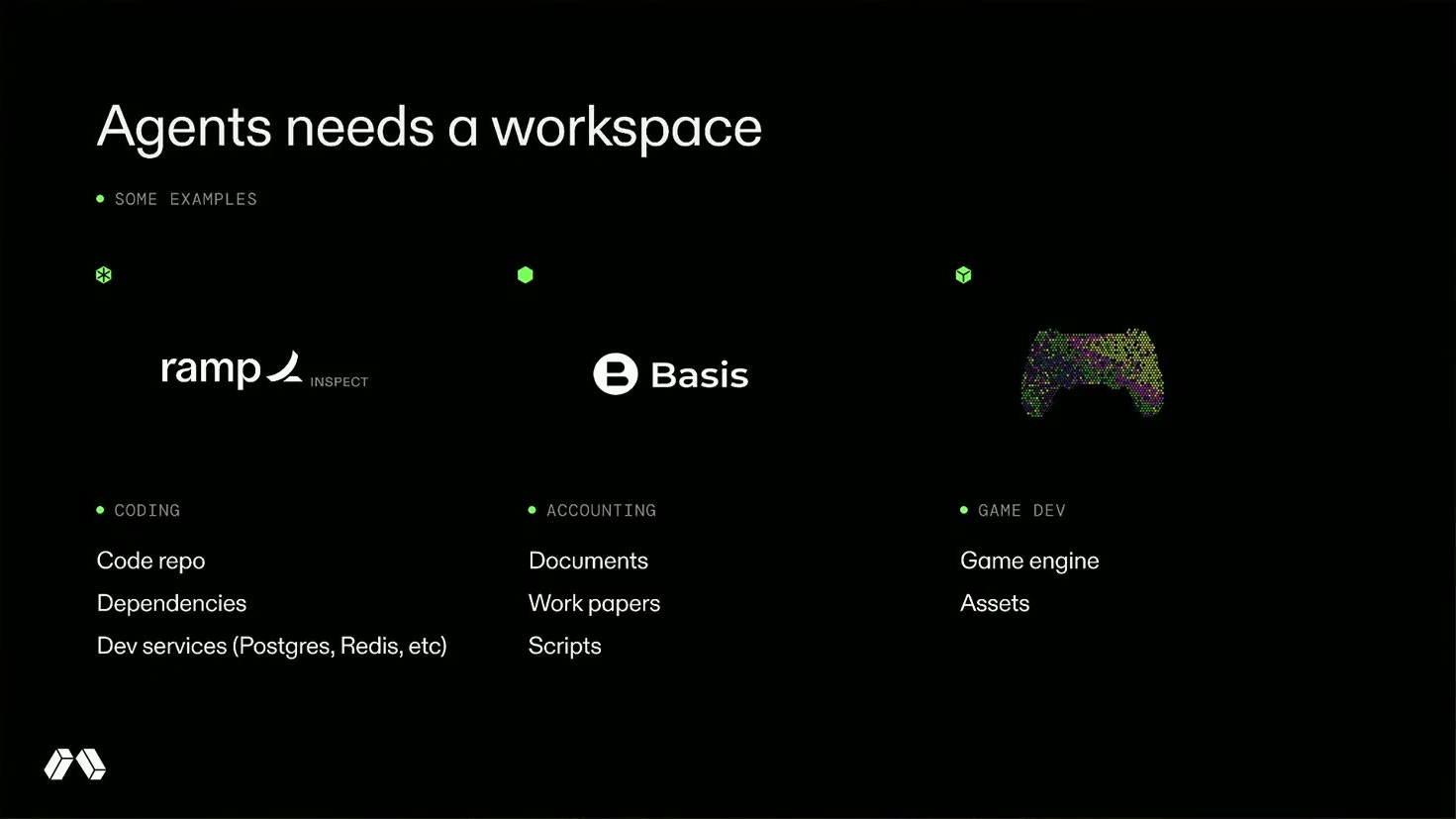
它如何演进。如果你想构建这样的系统,甚至更进一步——我们之后还会详细讨论这意味着什么——你需要哪些基础原语?首先,如果你要构建智能体,就需要一个工作区。我这里有几个来自我们现有客户的例子。你们可能听说过 Ramp Inspect。Ramp Inspect 是 Ramp 内部使用的编程智能体,我认为到现在它几乎负责提交 Ramp 的每一个PR。如果你在构建编程智能体,就需要让代码仓库、GitHub 仓库、依赖项,以及开发服务都位于每个智能体自己的同一个工作区里。
it's evolving. So if you want to build something like this, or even further, and we'll talk more about what that means, what are the primitives you need for that? The first thing is, if you're building an agent, you need a workspace. And I have some examples from some of our current customers. You might have heard of Ramp Inspect. Ramp Inspect is Ramp's internal coding agent that I think at this point pushes almost every single PR at Ramp. If you're building a coding agent, you need your repo, your GitHub repo, your dependencies, you need your dev services, all in the same workspace for each agent.
另一个例子是 Basis。它的工作方式是:你的文档可能会送达,然后智能体就会被触发去处理这些文档,但接着它要等待会计人员的回复。你不知道这可能要等多久。可能要等好几天。
Another example is basis. it looks like is your documents might arrive, your agent is then triggered to work on them, but then it's waiting for a response from the accountant. You don't know how long this could take. It could take many days.
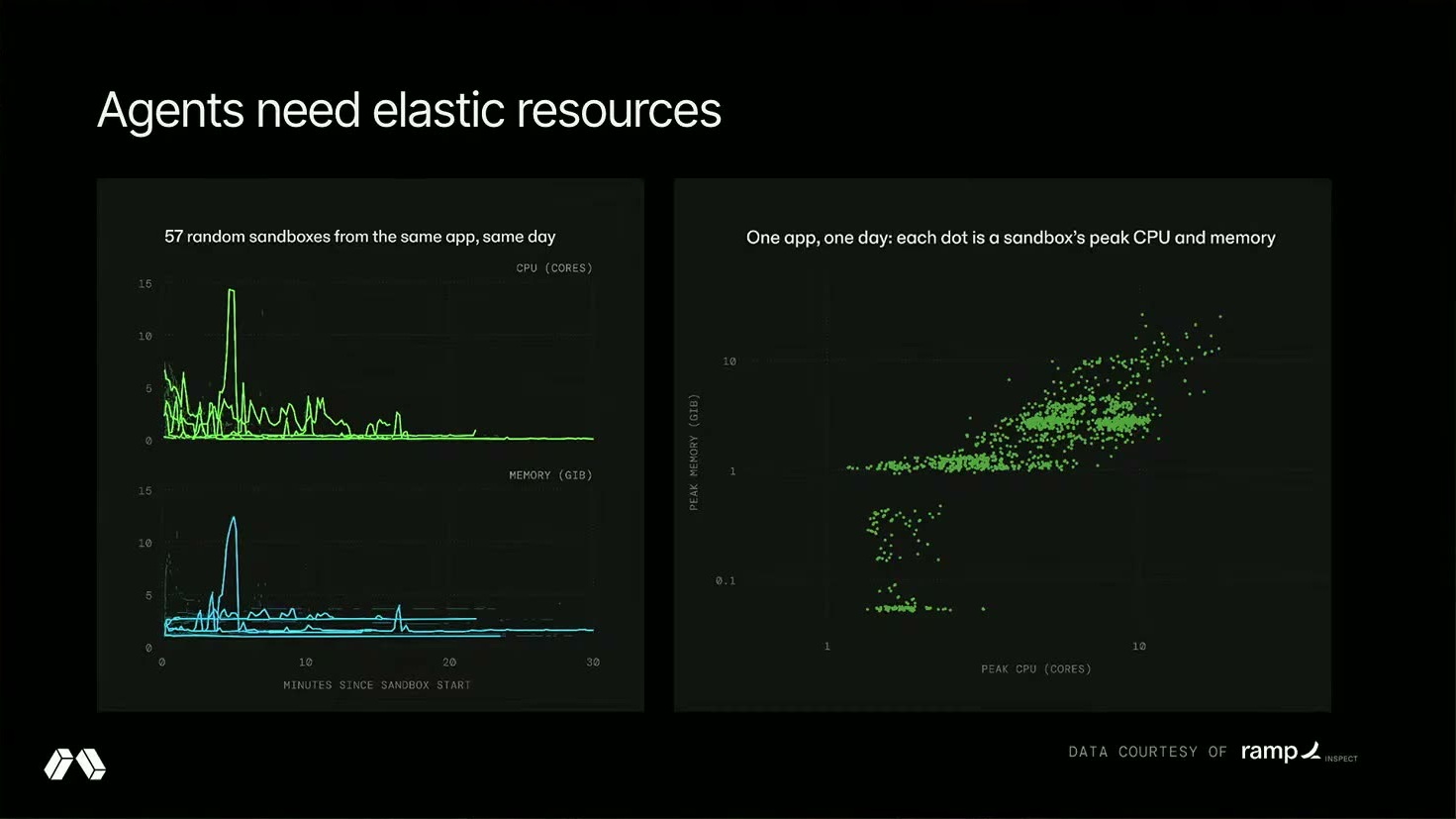
当你想让状态长期持久化时,资源使用情况也会发生变化。在第二张图里,你可以看到每个沙箱的使用情况。确实存在一些稳定趋势,但整体波动很大。如果要预先配置这些资源,就不太合理。而是在沙箱需要时可靠地为它提供这些资源,并且只为实际使用的那段时间付费。
When you want to persist the state over time, your usage is going to change. In the second chart, you can see usage for each sandbox. There's definitely some consistent trends, but it's all over the place. If you were provisioning this, it doesn't make sense. and then reliably get them when the sandbox needs them and only pay for them for that duration.
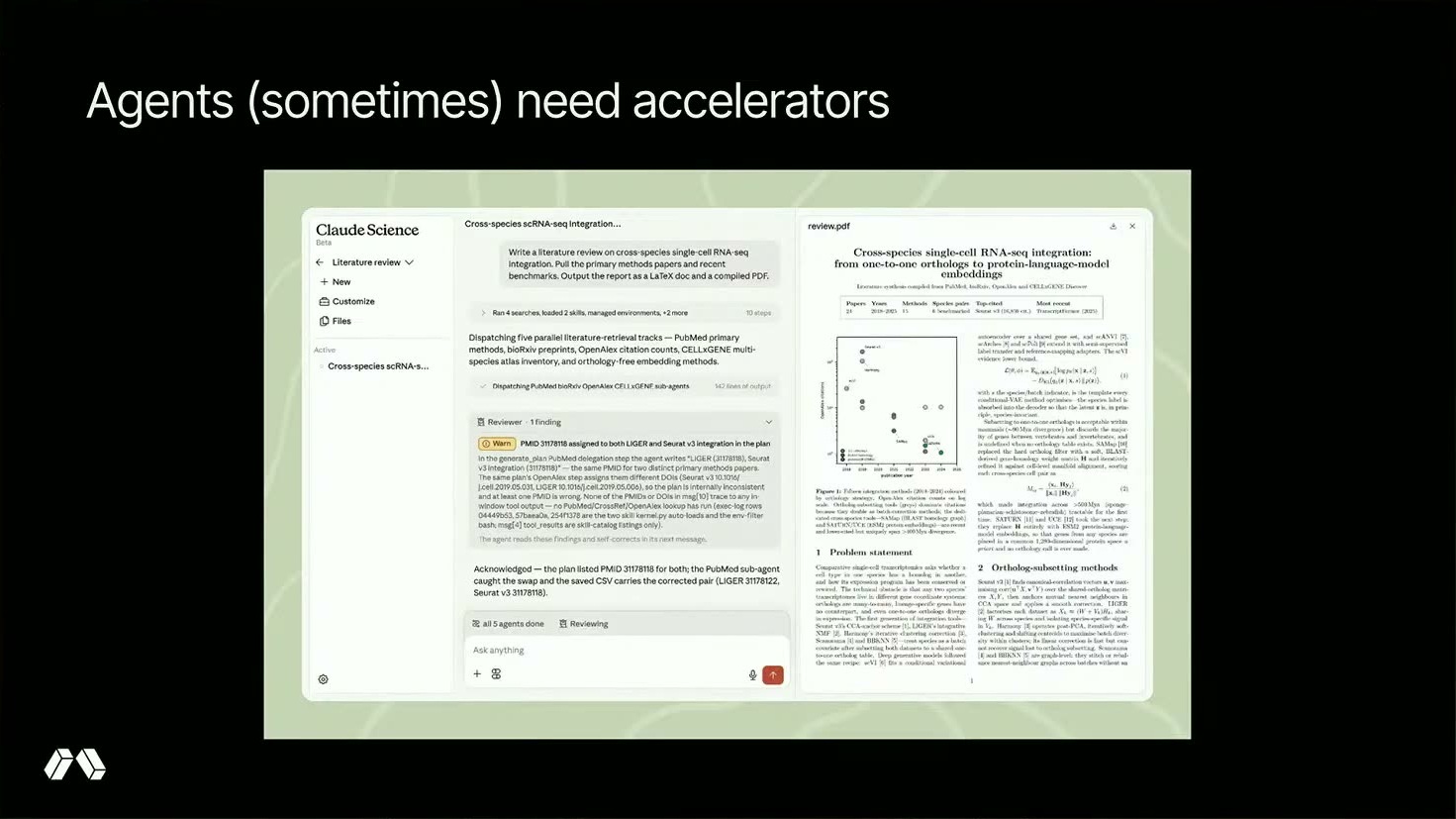
另一个有意思的新趋势是,智能体需要更多云计算资源,例如先在 CPU 上对一些数据进行预处理,或者启动 GPU,在 CPU 上运行一些预处理过的数据,或者启动 GPU 来运行科学模型,然后把这项工作卸载到 Modal 沙箱中。比如,一个科学模型,也可以把它卸载到 Modal 沙箱中。我们还看到,这种情况出现在 RSI关于给智能体提供沙箱时会发生什么的讨论中,例如 Hillclient。另一个新趋势是,智能体之间的协作越来越多,这意味着你要共享文件系统,与子智能体共享,你们共享同一个文件系统。
The other interesting emerging thing is agents need a lot more cloud science where pre-processed some data on CPUs or spin-up GPUs for running pre-processed some data on CPUs or spin-up GPUs for running a scientific model, it will offload that to a modal sandbox. is a scientific model, it will offload that to a modal sandbox. And we're seeing this show up in RSI about what happens when you give an agent sandboxes to Hillclient. The next emerging thing is agents are collaborating a lot more, and that means that you share a file system with your sub-agent, you share file system.
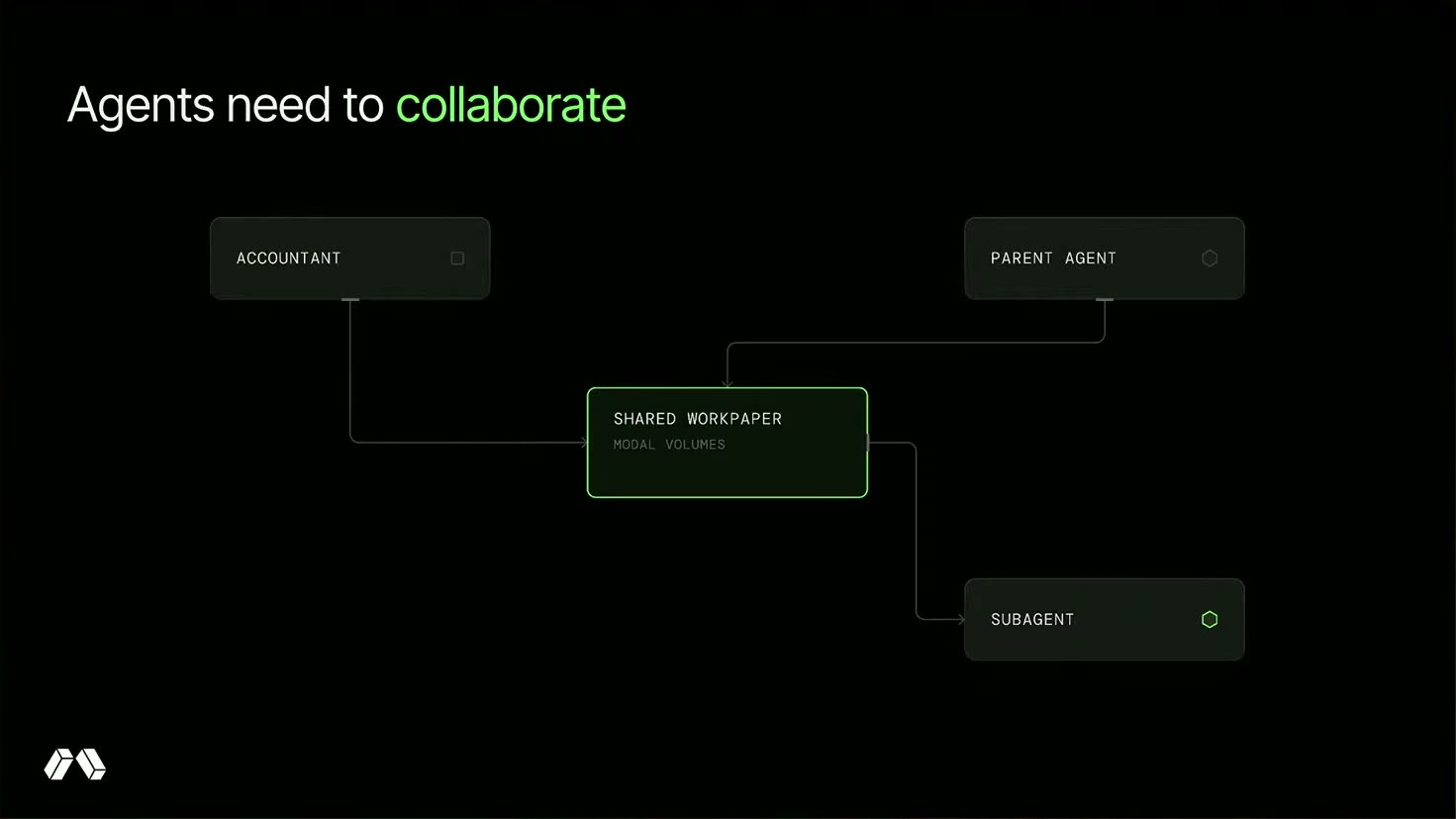
另一个新趋势是,智能体之间的协作越来越多,这意味着你们共享文件和文件夹,并与人类一起在同一内容上协作。这意味着文件系统必须速度快、一致性好,而且开发者体验易于理解。这是我们正在通过 Modal Volumes 开展的工作。
The next emerging thing is agents are collaborating a lot more, and that means that you share a file and files with your human where you're all collaborating with the same thing. This means file systems that are fast, have consistency, and devx you can reason about. Something we're working on with modal volumes.
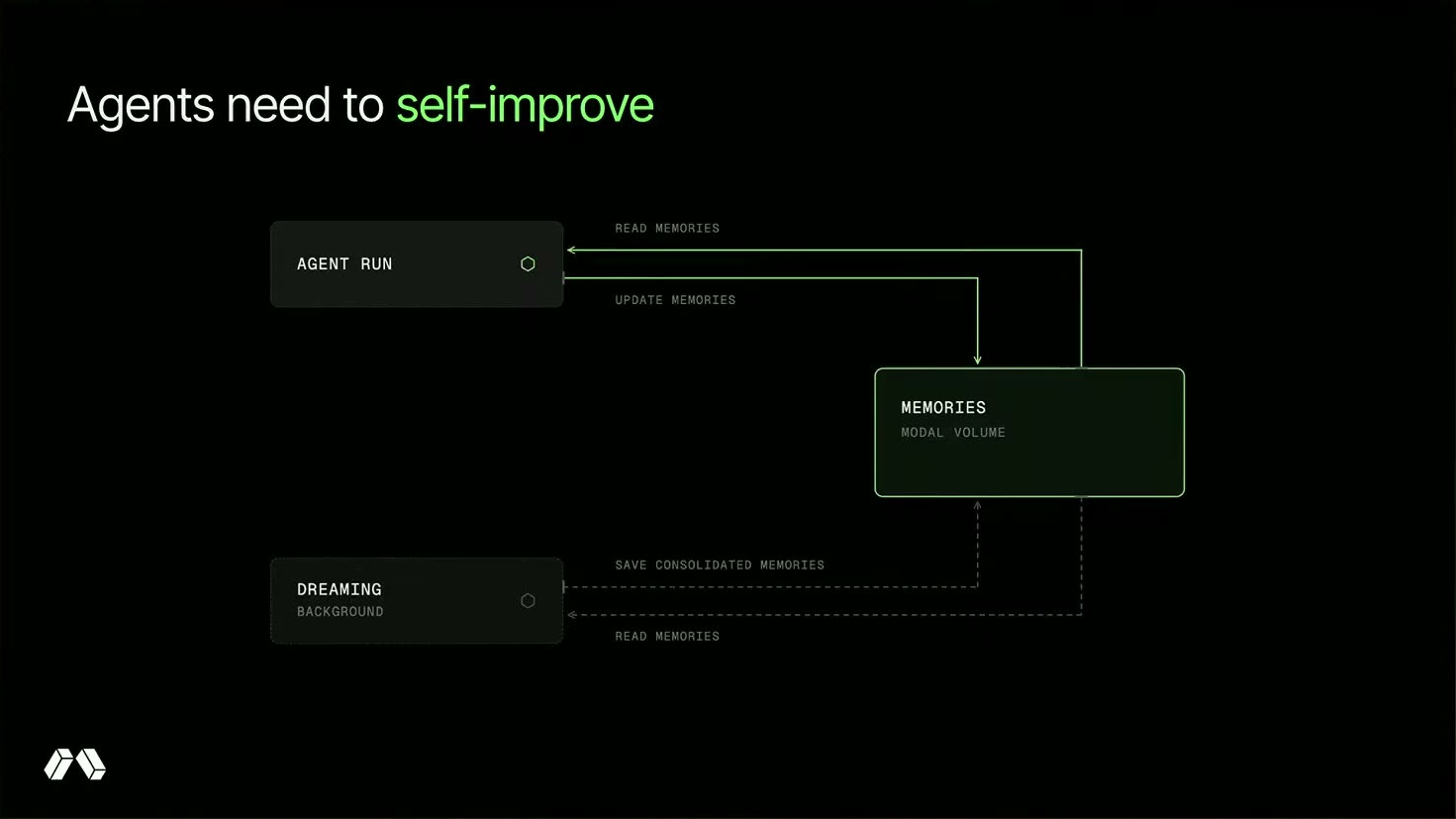
与之相关的是,我们看到越来越多的自我改进。智能体会保存并更新记忆,还会运行后台任务;这现在称为“做梦”,以便随着时间不断更新记忆。实际上,这也就是文件系统中的文件。不过,你仍然希望这个文件系统有出色的性能。
The related thing is we're seeing a lot more self-improvement. will save and update memory, they'll run background tasks, which is now called dreaming, to update this memory over time. Actually this also just looks like files in a file system. But again, you want really great performance from this file system.
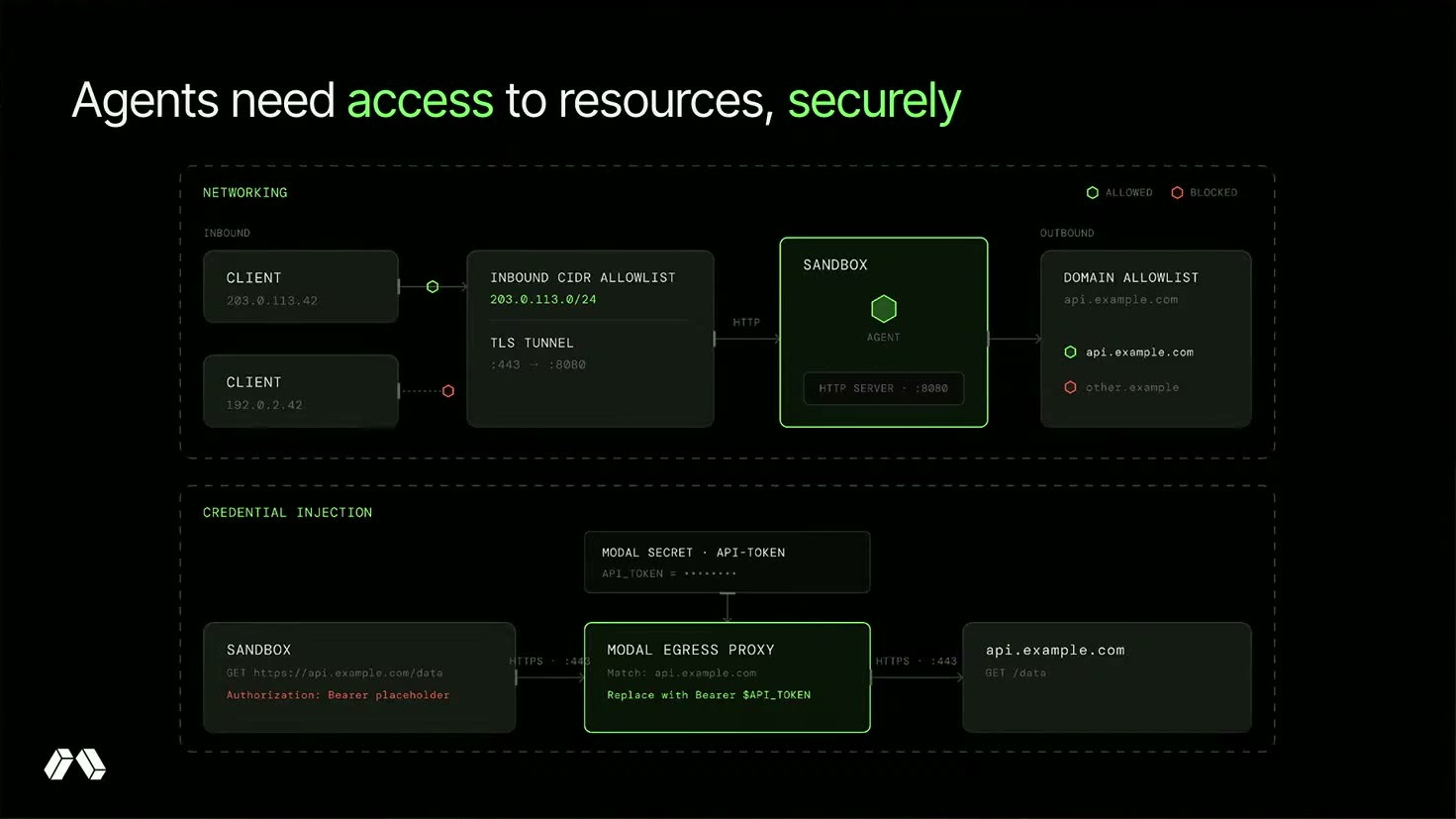
智能体令人担忧的一点是,它们可能会出错,而且不知道什么时候会把你的敏感数据泄露到德国论坛之类的地方,因此你需要对它们能做和不能做的事进行大量控制,还需要控制哪些 IP 地址可以与智能体通信,它如何通过身份验证、可以访问哪些域名;此外,如果你使用凭证与服务通信,你需要以某种方式注入凭证,让智能体看不到凭证,也就无法之后将其外传。
and the scary thing about agents is they can mess up and they don't really know when they might leak your sensitive data to a german forum or something so you need to have a lot of control over what they can and cannot do and you need things like controlling what ips can even talk to the agent, how do you authenticate it, what domains can it talk to, and also if you're using credentials for talking to services, basically you want to inject them in a way that the agent cannot actually see them and then exfiltrate them somewhere later.
这方面一个有意思的发展是,我们意识到,按域名设置的允许列表实际上还不够。
And the interesting evolution of this is we've realized that domain-related allow lists are actually not enough.
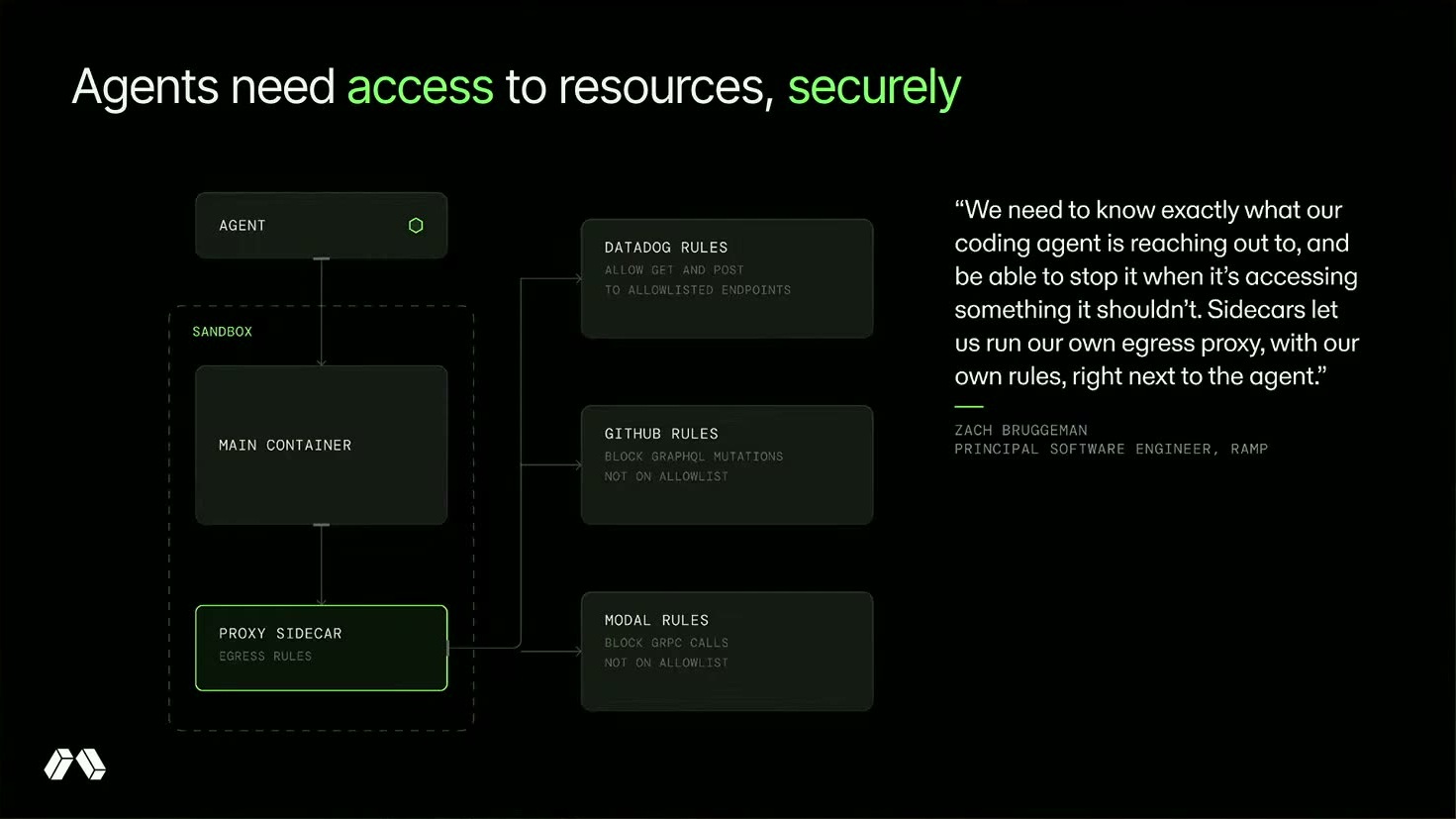
很多用户希望有更精细的控制,甚至要控制可以访问哪些路径,比如在 Datadog 或 GitHub 上。例如,我可能希望具体了解智能体正在执行哪些操作。再回到 sidecar,我们看到一种新兴模式,用户会自己编写轻量级代理,并为允许执行的具体操作制定自定义规则。Ramp 是另一家成功采用了这种方式的公司。
a lot of our users actually want very specific control over even like what paths can I talk to on let's say Datadog or GitHub. Like maybe I want to reason about specific operations that the agent is doing. And going back to sidecars, we've seen this emerging as a pattern where users actually write their own lightweight proxy that has custom rules about what exactly you can do. And Ramp's another example of a company that's been using this successfully.
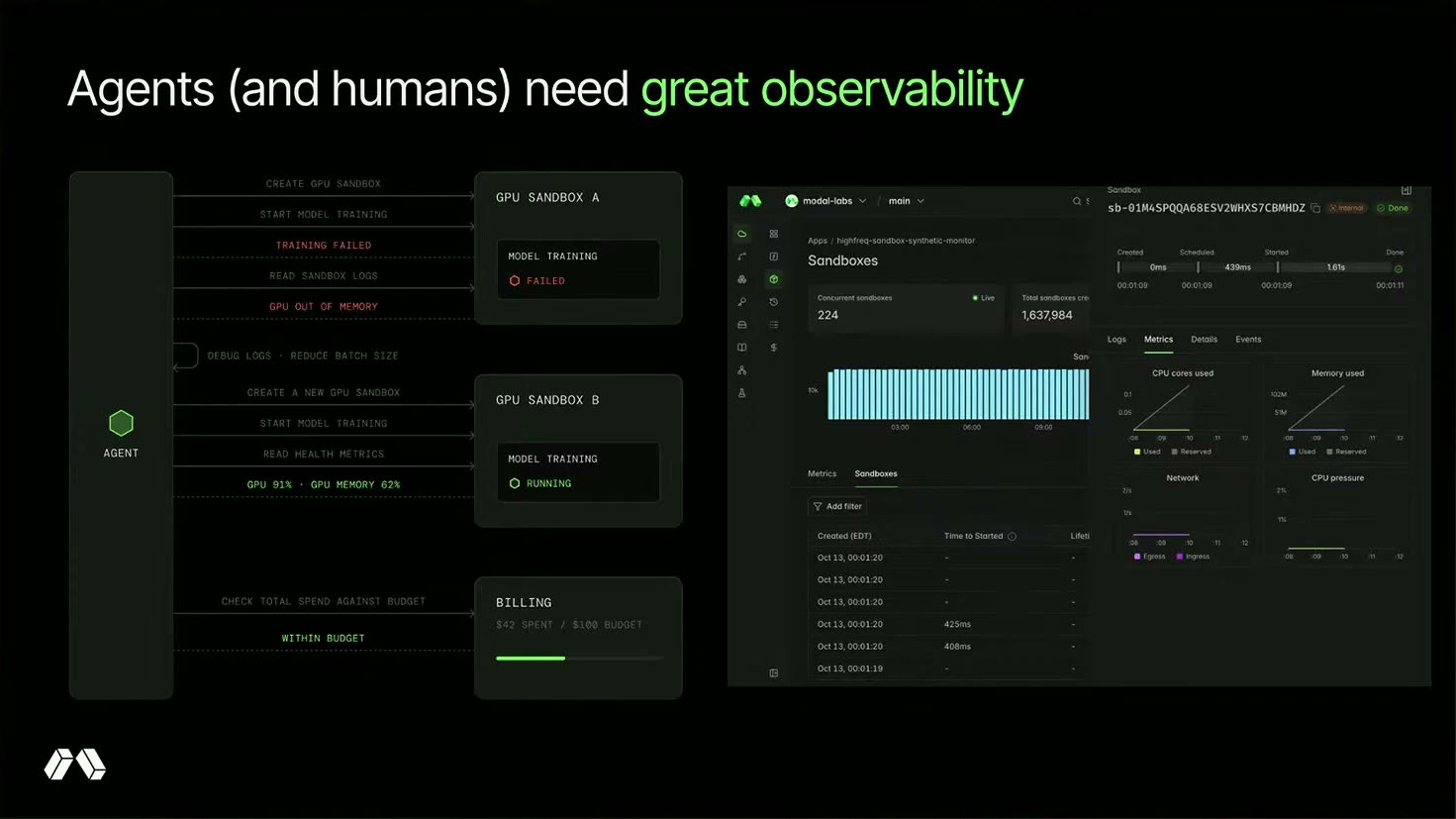
最后一个常被低估的方面是,出色的可观测性非常重要。回到自动化研究以及智能体进行大量训练的例子,如果训练任务失败了,会发生什么?你希望智能体能够轻松查看失败日志,并思考发生了什么,然后用另一组参数再迭代一次。训练运行期间,你希望查看指标和 GPU 利用率,并确保任务没有卡住。也许你还想查看预算,确保没有在你的沙箱上花费过多。
And the final underrated thing is it's really important to have really great observability. Going back to the example of auto research and an agent doing a lot of training, what happens when the training run fails? You want your agent to be able to easily look at the logs of the failure, reason about what happened and do another iteration with a different set of parameters. While training is running, you want to look at the metrics, GPU utilization and make sure it's not stalled. Maybe you want to look at the budget and make sure you're not spending too much on your sandbox.
显然,这一切对人类都很重要;但随着智能体驱动更多计算任务,我们也花了很多时间把这些信息提供给智能体本身,让它们能够据此进行推理。好。我想我们已经知道需要什么了。不如让 Astra 帮我们构建一个智能体平台?我觉得这不是个好主意。我认为你不应该靠 vibe coding 来构建沙箱平台。主要有三个原因。第一是可靠性。我想大家都深切体会到,把可靠性做好有多难。
And obviously all of this is really important for humans, but as agents are driving a lot more compute, we're spending a lot of time exposing all of this to the agents themselves so they can reason about all of this. All right. I think we know what we need. Why don't we have Astra build us an agent platform? Well, I don't think it's a good idea. I don't think you should vibe code a sandbox platform. And there's three main reasons for that. Number one is reliability. I think we're all painfully aware how hard it is to get right.
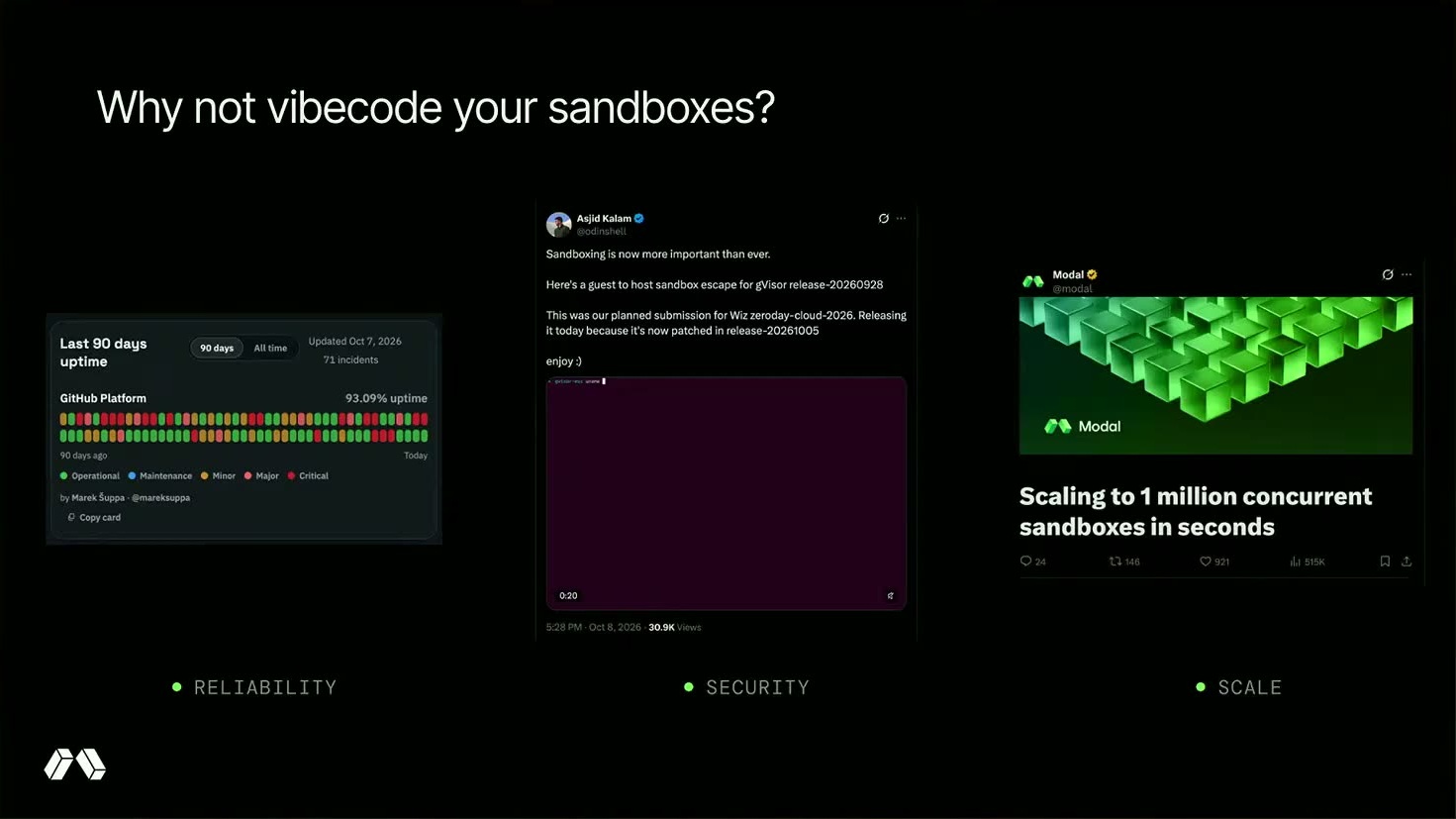
我们每天都会用的一些网站仍然会不断宕机。原因在于,即使有了 AI,要推理这种反馈循环也非常困难,尤其是发生尾部事件、系统出现故障时,这就是为什么构建系统时必须格外谨慎。另一个原因是安全。你可以靠 vibe coding 构建沙箱平台,但谁来承担全部工作,持续审视安全边界,并确保它经得起审查,尤其是在一切都快速演进的时代?最后一个原因是规模。
Certain websites we use every day keep going down. and the reason for that is even with AI, it's actually really hard to reason about the feedback loop of what happens in the case of this tail event when the system breaks and this is why you need to be very careful in building systems. Security is another one. You could vibe code a sandbox platform but who is going to do all the work to continually reason about the security boundaries and make sure it's defensible in an age when everything is evolving very fast. And finally, scale.
我们有一篇博客文章介绍如何把沙箱扩展到 100 万个,其中涉及大量有意思的工程设计,以及系统层面的推理。同样,这类事情不太适合交给一个 vibe coding 出来的平台,因为达到规模后,你希望它依然能够正常工作。
We have a blog post about how we scale to a million sandboxes, which involves a lot of very interesting engineering design and reasoning about systems. And this is, again, something that you kind of don't want to leave up to a Vibe-coded platform, because when you get to scale, you want it to work.
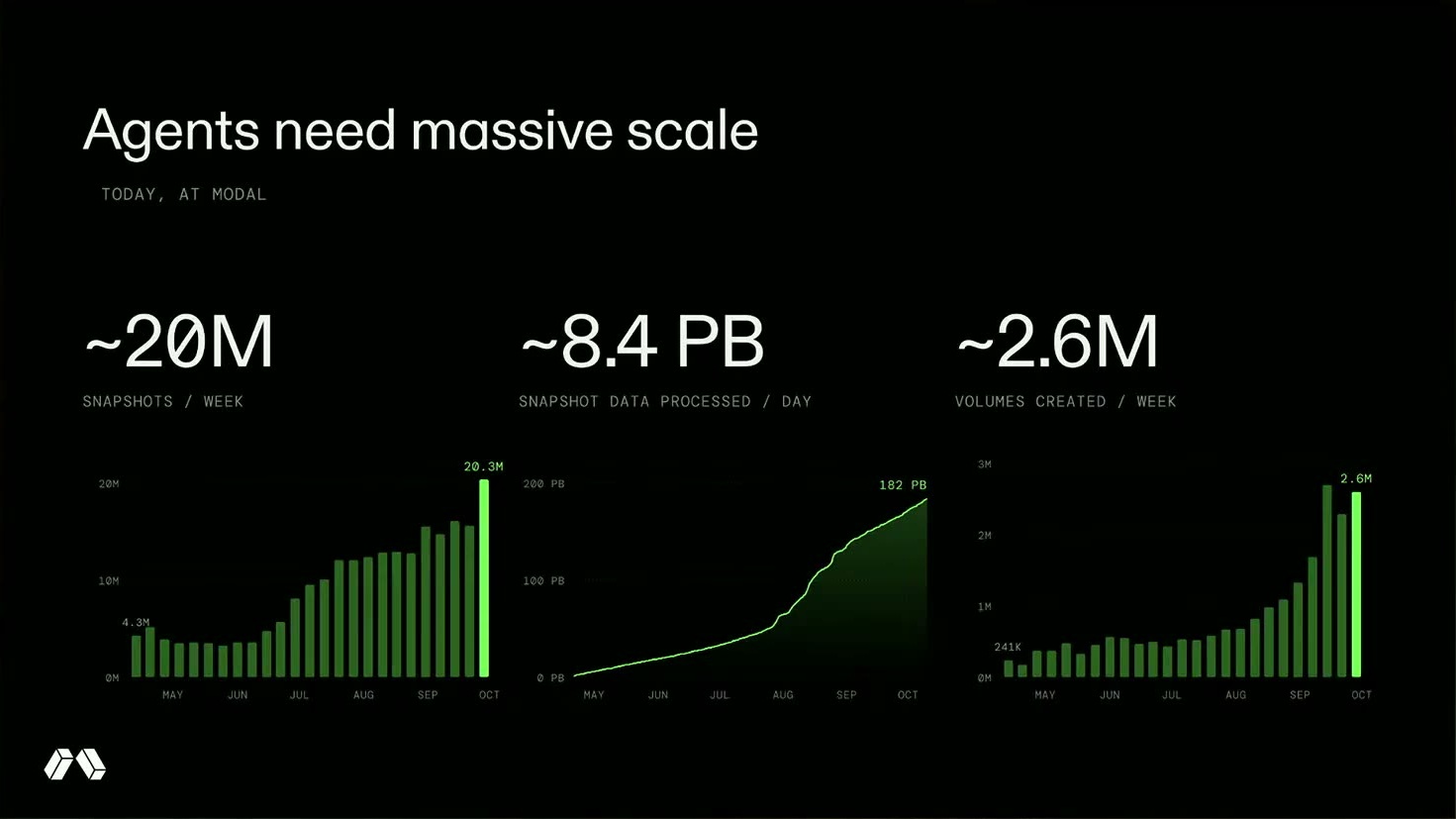
说到这一点,我们提到的很多东西实际上都已达到巨大规模。例如我刚才提到的快照,增长得相当快。我们每周处理 2000 万个快照。每天处理大约 8 PB 的数据,这些数据对应每个快照。我们的用户每周还会创建将近 260 万个卷,而这一切都在飞速增长。
And on that point, we're actually seeing massive scale for a lot of things I mentioned. So, for example, for the snapshots I mentioned, it's growing quite fast. We're seeing 20 million snapshots a week. We're processing about eight petabytes of data a day for each of these snapshots. And our users are creating almost 2.6 million volumes a week, and all of this is growing super fast.
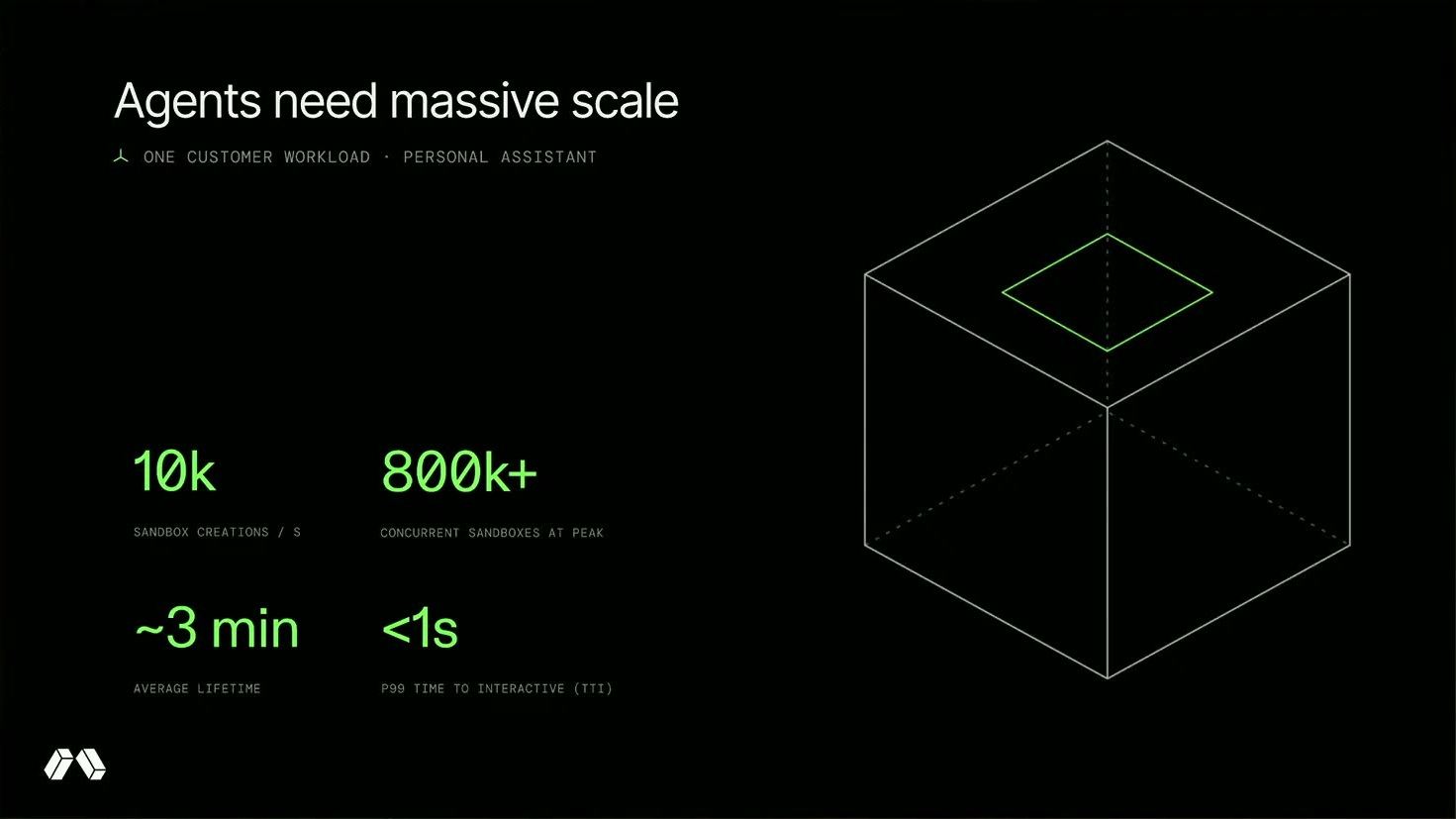
以一个个人助理客户的工作负载为例,你每秒需要创建 10,000 个沙箱。你需要运行将近 100 万个沙箱。它们不会运行太久,可能只有两三分钟。但它们启动后,你希望它们能在不到 1 秒内变得可交互;这正是该工作负载的实际要求。
And just to take a customer workload for personal assistant, You need to create 10,000 sandboxes a second. You need to run almost a million sandboxes. And they're not going to last very long, they'll just last for like two or three minutes. But when they come up, you want them to be interactive in less than a second. That's what this workload really demands.
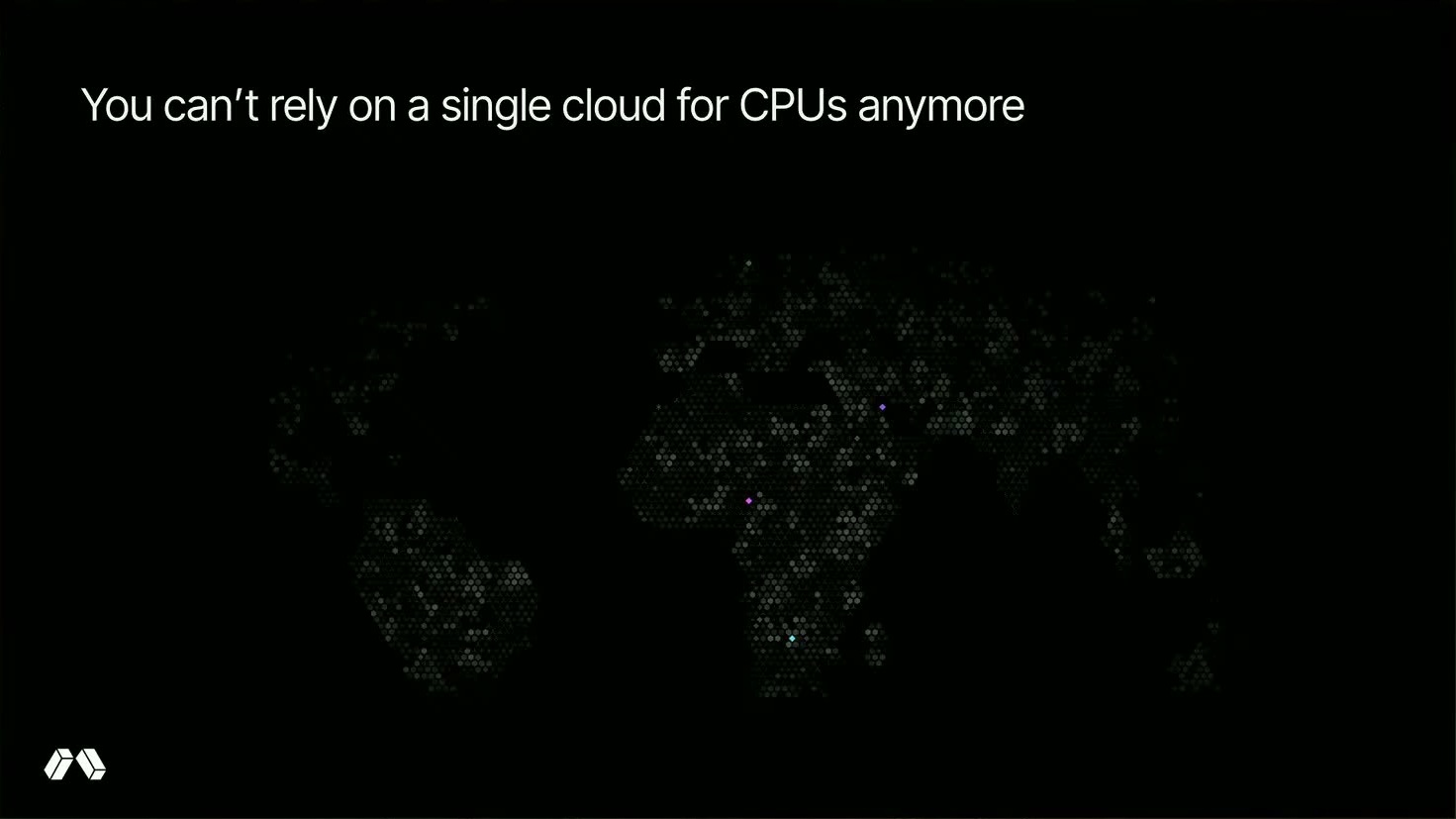
规模方面另一个有意思的地方是,你无法仅靠单一云平台获得所需的全部容量。全球的 CPU 资源也变得紧张,不只是 GPU。因此,我们投入大量时间做的一件事,就是汇集云容量,来源包括许多超大规模云服务商和新兴云服务商。这样,用户在需要时就能使用全球各地的 CPU 容量,但我们不能依赖单一云服务商来做到这一点。
And the other interesting thing on scale is you actually cannot get all of the scale from a single cloud platform. The world is actually getting crunched on CPUs as well, not just GPUs. So one thing we spend a lot of time doing is actually aggregating cloud capacity from a bunch of hyperscalers and neoclouds. So our users have access to CPU capacity across the world when they need it, but we cannot rely on one cloud provider to do that.
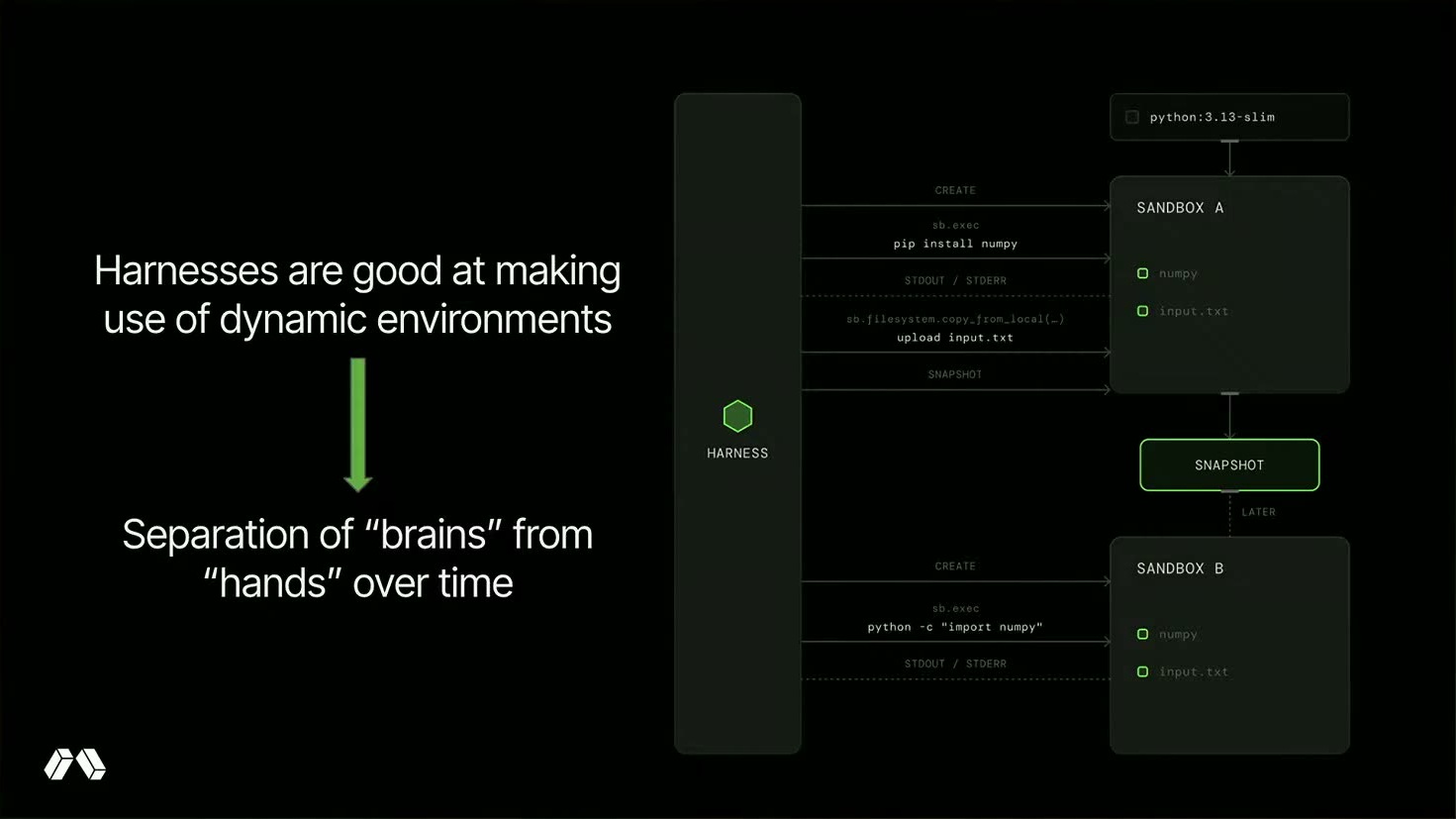
好,那么这一切最终会走向哪里?我之前提到过,智能体运行框架很擅长利用动态环境。这会带来“大脑”的分离,也就是智能体运行框架,与“手”的分离,也就是沙箱,或者说运行实际任务的运行时环境。这意味着什么?我这里举个例子:智能体运行框架将能够启动不同环境,并根据当下需要来决定启动什么环境。它们擅长创建环境快照,并将其保留下来,作为之后需要使用的制品。
Okay, so where is all this going? I hinted at this earlier, but the harnesses are really good at making use of dynamic environments. and what this is leading to is a lot of separation of the brains, which is the harness, from the hands, which is the sandbox or the runtime where stuff is running. And what this means, I have an example here, is the harnesses are going to be able to spin up environments based on what they need right now. They're good at snapshotting them and keeping them around as artifacts that they need later.
还可以根据需要调整所有这些内容。所以我认为,这指向一种有意思的演进,
And again, adjusting all of this as necessary. So I think this points at an interesting evolution
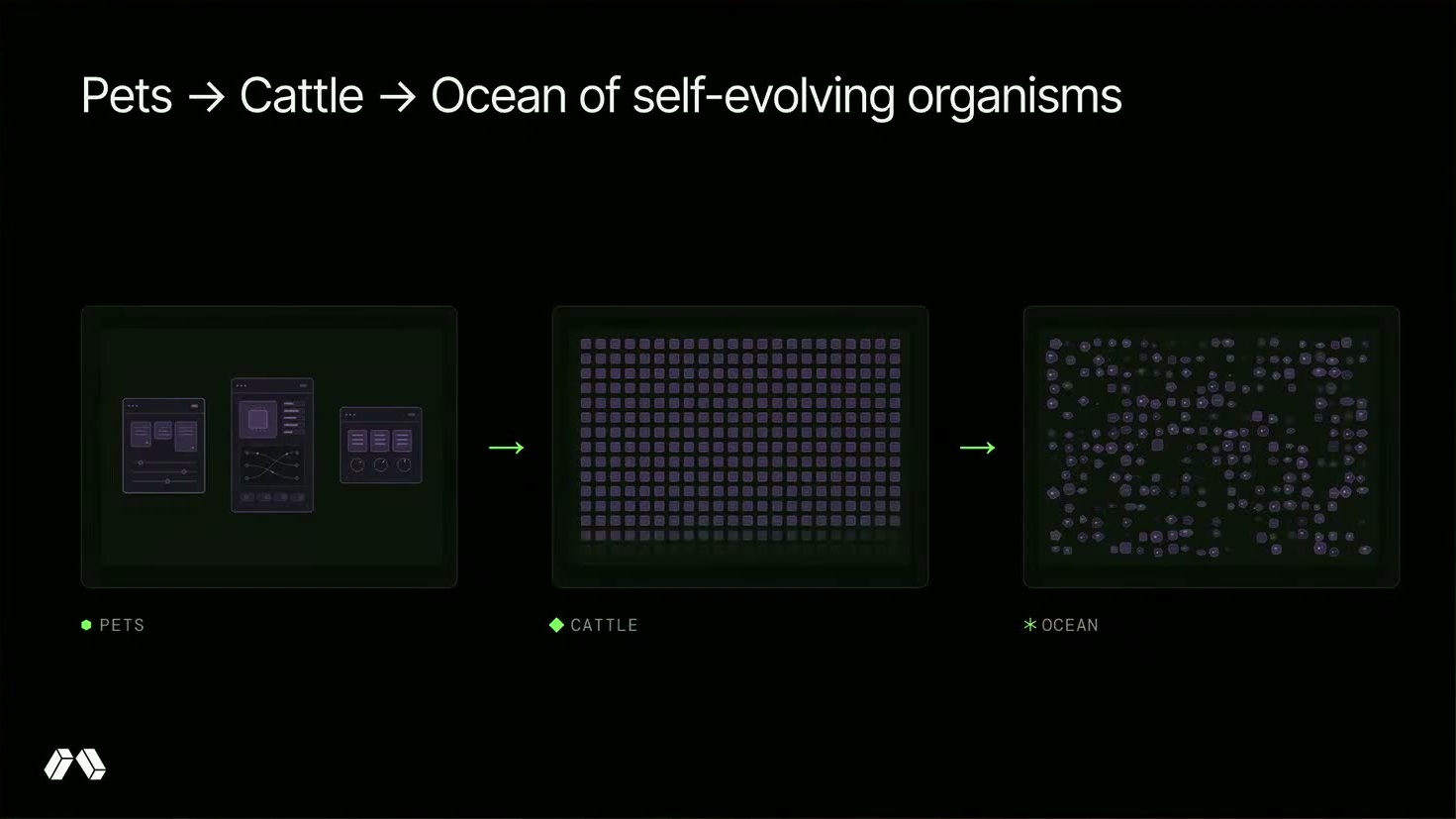
也就是我们熟悉的“宠物到牲畜”类比。回顾一下,过去,人们会把服务想成宠物。每个服务都是定制的。你必须管理它。你必须针对这一份特定部署进行推理。后来随着容器化和 Kubernetes 的发展,人们开始把它们视为同质化的模板。所有服务器都一样,可以横向扩缩。其中一台服务器出故障也没关系,因为系统可以自行恢复。我认为,如今许多部署智能体的人正处于这个阶段。
of the pets to cattle analogy we're all familiar with. To recap, in the olden days, people thought of services like pets. Each one was bespoke. You had to manage it. You had to reason about this individual deployment specifically. And then over time, with containerization and Kubernetes, people started to think about it as homogenous templates. These servers are all the same, you can scale them up and down. If one of them fails, it's not an issue because our system can heal from that. And I think this is where a lot of people deploying agents are today.
他们使用这些同质化环境来扩展智能体。但我认为这确实有限制,因为模型非常擅长对动态环境进行推理,擅长创建快照、按需创建大量环境,并在这些环境之间协同工作。那么新的世界会是什么样子?这里的类比有点像一片微生物的海洋,里面充满了各种生物,它们能够自我进化并彼此协作。这个类比还“修复”了 credit(致谢)这一点。不过有一点让我非常兴奋:如果你为智能体提供这些非常稳固可靠的基础原语,涵盖计算、存储和网络,它们就能够完成更多事情,比如我刚才谈到的那些事,例如启动大量环境,彼此协作,并保持高度动态。
They're kind of using these homogenous environments and scaling up these agents. But I think that's really limiting because the models are so good at reasoning about dynamic environments, snapshotting, creating lots of environments when needed and working across them. So what does the new world look like? analogy here is it kind of looks like an ocean of microbes, of all these organisms that are self-evolving and working with each other. credits this fix for the analogy here. but one thing I'm really excited about is as you give agents these really rock-solid primitives for compute and storage and networking, they will be able to actually do a lot more by doing the stuff I talked about, like spinning up lots of environments, working with each other, and being very dynamic.
所以,是的,我和 Modal 团队都真心认为,优秀的基础原语能让智能体做得更多。如果你有兴趣进一步交流,欢迎联系我们。谢谢。
So yeah, I and us at Modal really think that great primitives let your agents do more, and yeah if you're interested in talking about this more reach out to us thank you