即时本体
Just-in-Time Ontologies
原文由官网提供,中文由 GPT-6 Luna 翻译。相邻片段合并排版,正文与时间点保持对应。
已插入 27 张经核对的幻灯片或演示截图;点击图片可放大。图注链接为当前视频时间,左侧正文时间保留原转录版本,二者可能不同。
共 41 个阅读段落
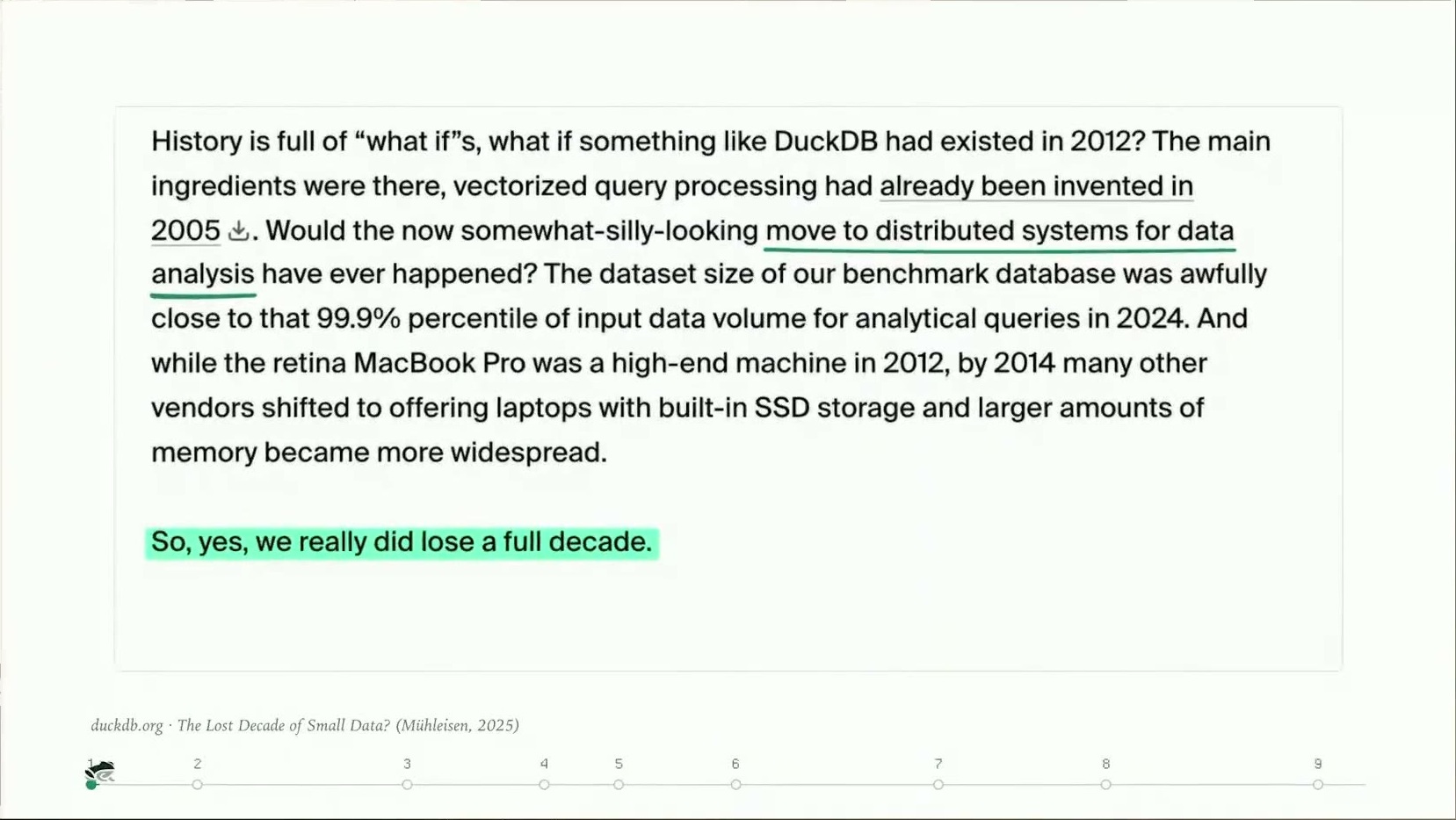
我非常喜欢 DuckDB 的 Hannes 写的这篇文章,他在文中问道:我们是否花了十年追逐分布式架构,而这些架构预设计算和存储都缓慢且昂贵?不过,每个时代的能力都会定义架构和工具,而工具总是持续落后。我们先让计算比存储便宜,然后让所有人都能使用计算,接着又让它变得更快。每一次,架构都会经历巨大变化。今天我们所有的数据基础设施,都建立在数据转换成本高昂这个观念之上。如果这个观念已经不再成立呢?我相信,我们已经解决了数据转换的最后一个瓶颈:通用智能,也就是判断能力;而且我们可以随取随用,在帕累托前沿的各个位置都能获得这种能力,这让我们正处于范式转变的前夕。
So I really love this article from Hannes at DuckDB, where he asks if we lost a decade chasing distributed architectures that presumed compute and storage were slow and expensive. Capability in every era, though, defines architecture and tooling, and the tooling lags behind consistently. We first made compute cheaper than storage, and then we gave it to everybody, and then we made it faster. And every single time, architectures undergo this massive change. All of our data infrastructure today is built on the idea that transformation is expensive. What if that wasn't true anymore? I believe we've solved the final bottleneck in transformation, general intelligence or judgment, and we've made it accessible on tap all along the Pareto frontier, which puts us right on the verge of a paradigm shift.
所以,这场演讲会谈谈为什么单一本体总会失败,以及模型在流水线中扮演的三个角色、交汇不同模型的先验以获得更好结果,以及帕累托探索:今天的模型如何同时针对成本、速度和准确度调整工作负载。
So in this talk, we're going to cover why single ontologies always fail, the three roles models play in pipelines, intersecting model priors for better results, and Pareto surfing, how today's models can tune a workload for cost, speed, and accuracy all at the same time.
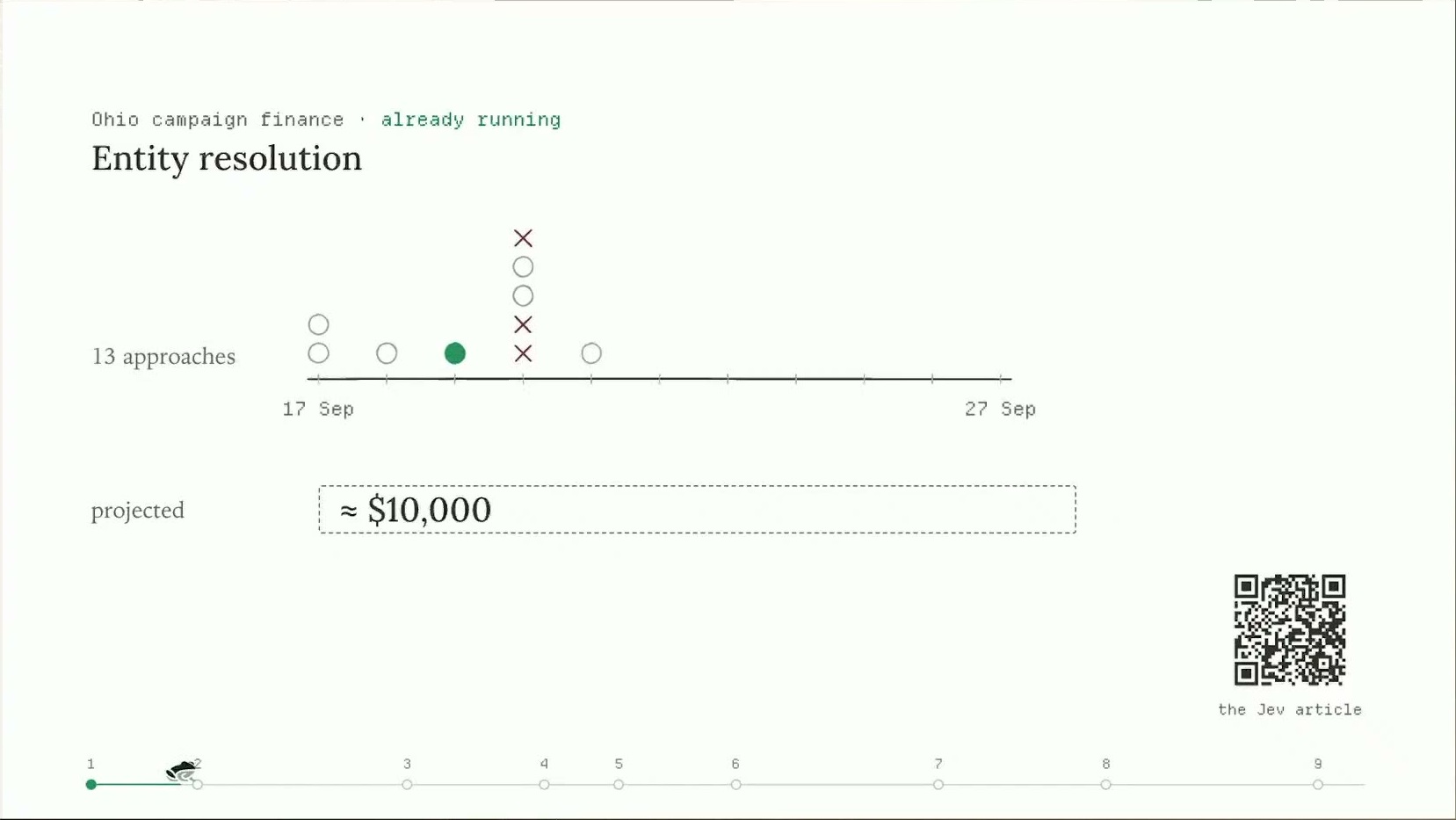
这里有个简单例子。Jeff 发布时,我们已经有一个实体解析流水线在运行,用来处理俄亥俄州的竞选财务记录,判断它们是否属于同一个人、公司或委员会。预计这项工作要花大约 10,000 美元。我们的系统采用了那个新模型,找出它适用的位置,测试了十多种方法,然后将它整合进来。第一次通话后的 10 天内,我们就为俄亥俄州每一笔低于 800 美元的捐款案例得到了最终的真实标签。这就是帕累托探索和即时转换的力量。好,我们开始吧。
Here's a quick example. When Jeff launched, we already had an entity resolution pipeline running, working out Ohio's campaign finance records and whether they belong to the same person, company, or committee. It was projected to cost about $10,000. Our systems took that new model, worked out where it fit, tested over a dozen approaches, and integrated it. Ten days after that first call, we had final ground truth for every donor case in Ohio under $800. That is the power of Pareto surfing and just-in-time transformations. So, let's get into it.
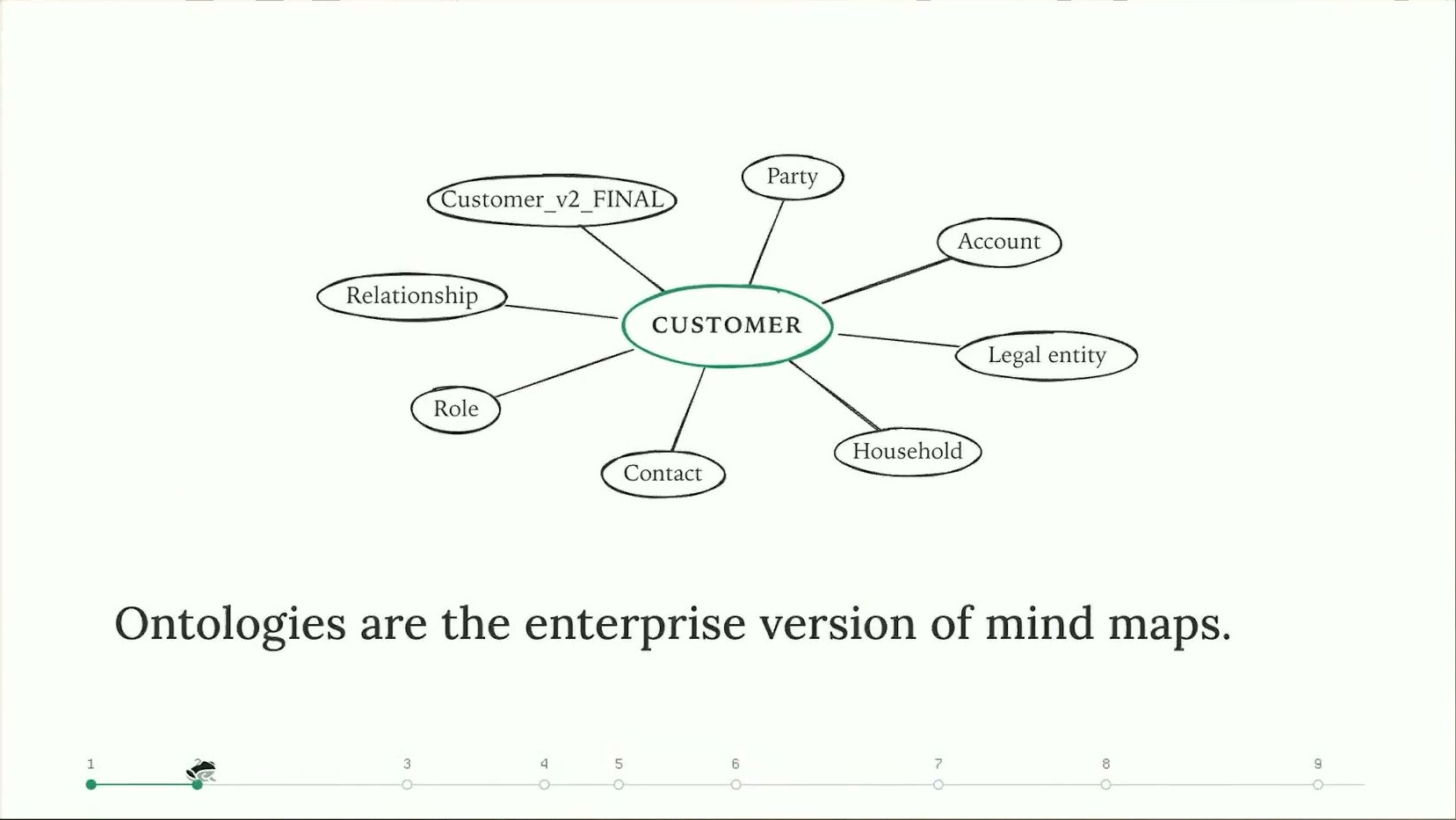
本体就是企业版的思维导图。它就像一个会把我们所有人都吸进去的泥潭,我也不例外。两年前创办 Southbridge 时,我谈过一种单一的通用模式。
Ontologies are the enterprise version of mind maps. It's this tar pit that sucks us all in, including me. I talked about a single universal schema when I founded Southbridge two years ago.
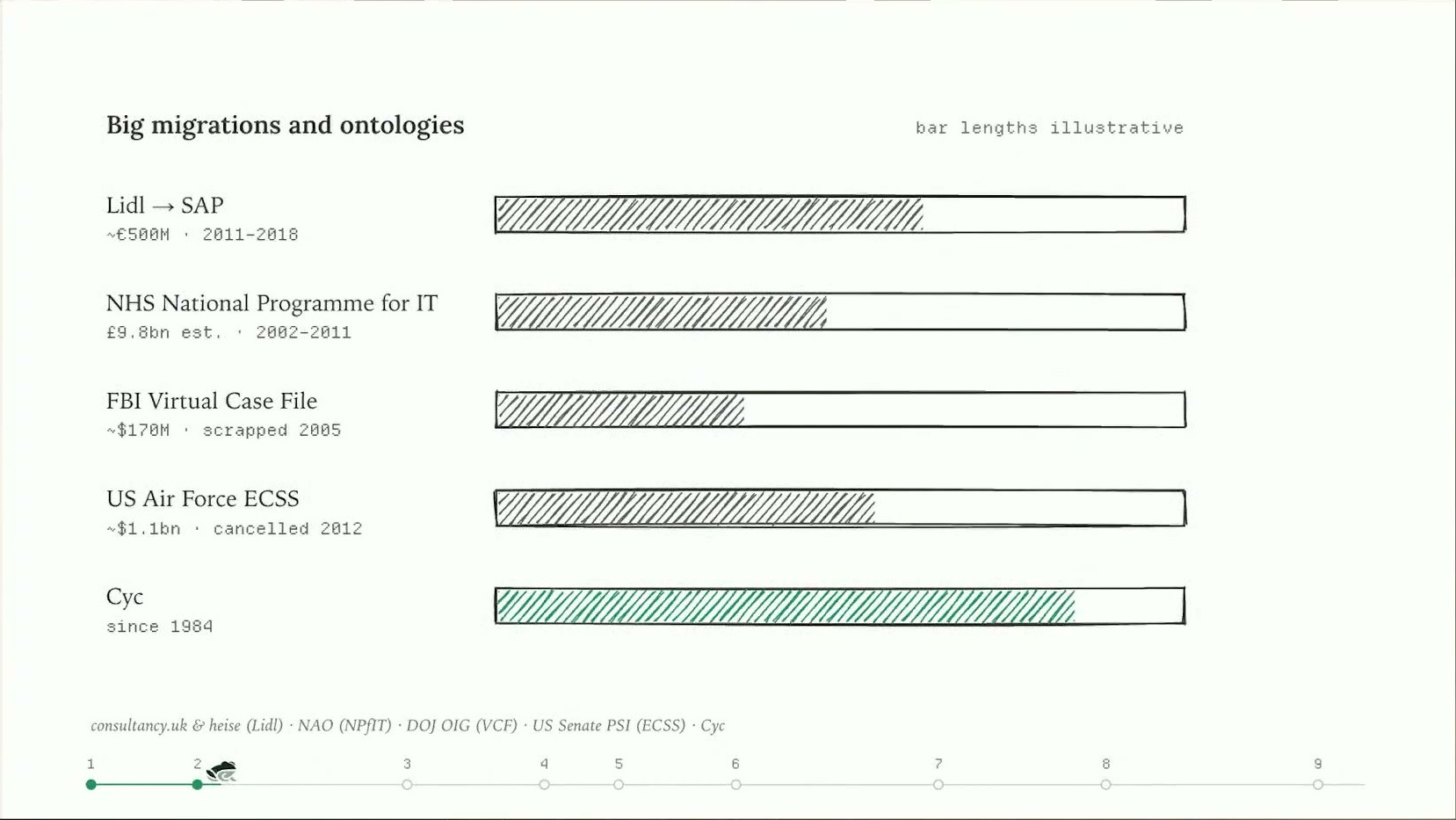
一种流行看法是,数据迁移和本体会失败,是因为缺乏认同;这种说法并没有错,只是没有涵盖全貌。它们会半途而废,组织和人员始终不会切换过去。这些都是真的,100% 正确。
The popular conception, and it's not wrong, it's just a small part of the picture, is that migrations and ontologies fail because of a lack of buy-in. And they're abandoned halfway through, that organizations and people never switch over. All of that is true, 100%.
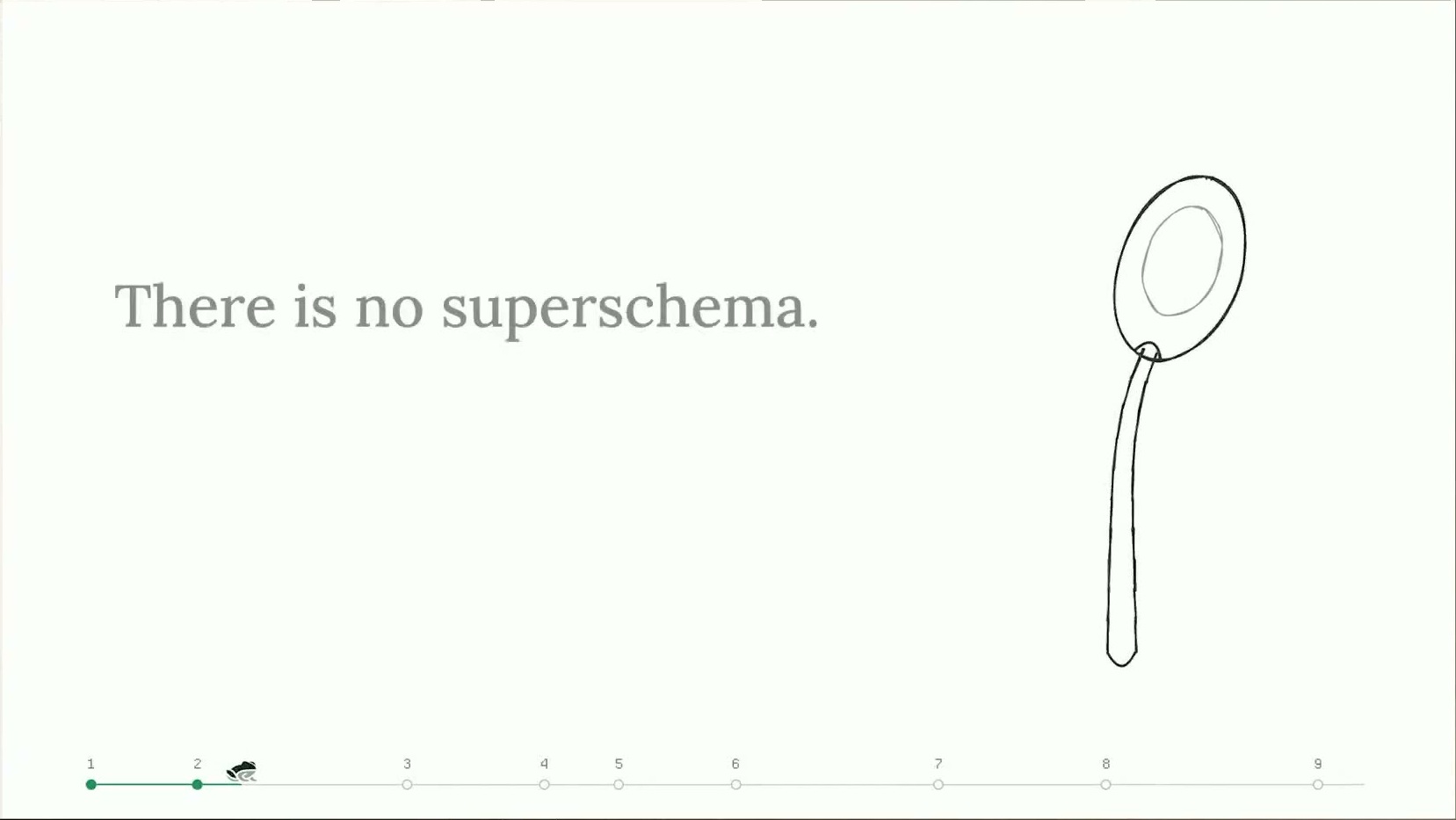
但缺乏认同并不是主要原因。即使你能眨眼之间把所有信息整合、迁移到一个超级模式中,仍然得面对一个事实:根本不存在超级模式。实际上有四种模式。
But buy-in isn't the primary reason. if you could integrate and migrate all of your information into a single super schema in the blink of an eye, you still have to contend with the truth that there is no super schema. There actually are four schemas.
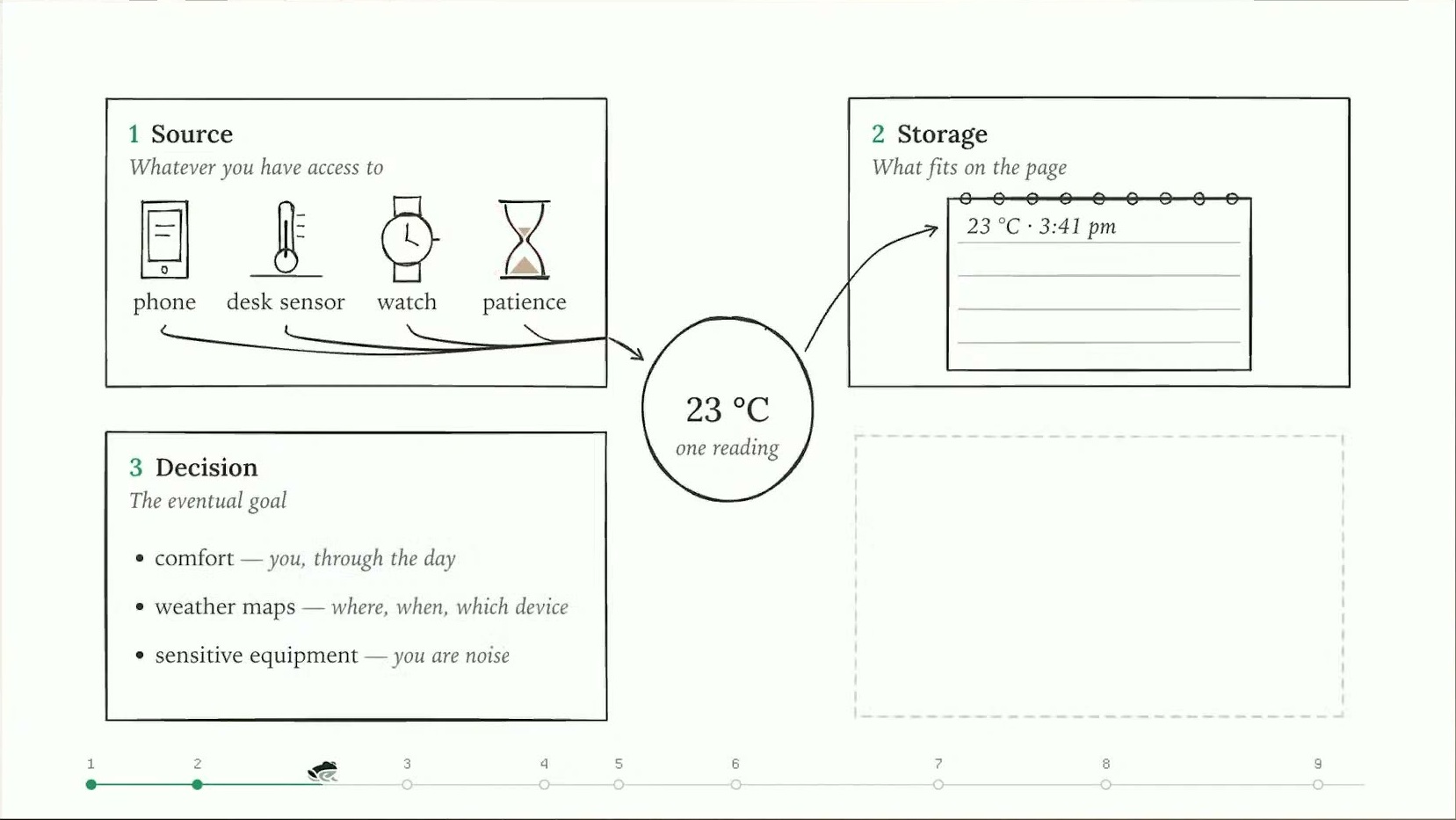
第一种属于数据来源,也就是信息来自哪里。我们以温度为例。假设我请你把温度记下来。来源模式就是你能够获取的信息。你的手机能告诉你所在地区的温度;你桌上的传感器准确度较低,但更贴近你的位置;也可以用手表。而你是否愿意耐心完成我的请求,也属于来源模式的一部分。第二种是存储模式。你能记下来的东西有限。你没法记下自己正在使用的设备固件。你甚至没法把时间精确记到秒,因为你不可能在一秒钟内写完所有内容。这就是存储对你施加的模式限制。
The first one belongs to the source, wherever the information comes from. Let's take temperature as an example. Say I ask you to write down the temperature. The source schema is whatever you have access to. Your phone gives you your region's temperature, sensor on your desk, which is less accurate, but it's more local, or your watch. But even your patience in following through on my request is part of that source schema. The second one is the storage schema. There's only so much you can write down. You can't write down the firmware of the device you're using. You can't even write the time down to the second because you couldn't finish writing all of that inside of a second. This is the schema imposed on you by storage.
第三种属于决策。我为什么要你记下温度?也许我想了解什么能让你感到舒适,那么我就需要你在一天中的不同时段提供温度,还要确保是你本人在测量。也许我正在制作天气迁移图,那我不在乎是谁测量的,但我很在乎你的准确位置,测量时间、使用的设备,以及这些信息后来是否发生变化。又或者,我要决定是否安装敏感设备,以及安装在哪里,这时你自己就成了一个需要从计算中剔除的变量。还有第四种,等我们谈到先验时再说。这是最近才加进来的。
The third one belongs to the decision. Why do I need you to write the temperature down? Maybe I'm figuring out what makes you comfortable, in which case I need temperatures from you spread throughout the day, and I need to make sure that it's you that's doing the measuring. Maybe I'm building weather migration maps, in which case I don't care who does the measuring, but I care a lot about your exact location, the time, the device you used, and whether that's changed. Or maybe I'm deciding whether to install sensitive equipment and where, and you yourself become this variable that I need to cancel out. There's a fourth one, though, which we'll get to when we talk about priors. It's a recent addition.
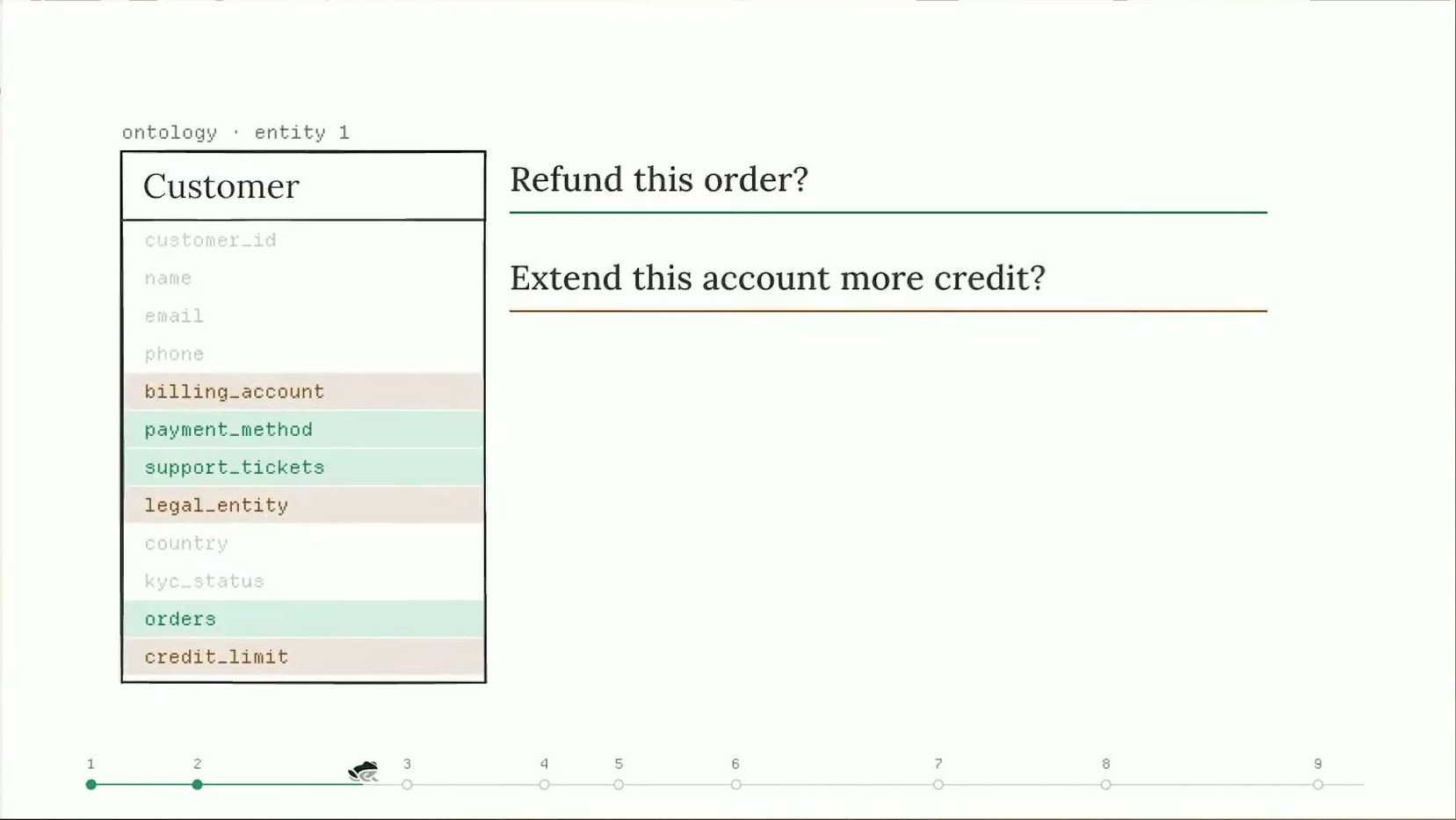
真正的问题在于,你永远不可能同时了解这四种模式,除非就在作出决策的那一刻。几乎每一家企业、每一个家庭里,记录下来的大多数数据,都不太清楚自己将被用于什么目的。以客户为例,这是每种本体中的第一个方框。对账单部门来说,客户是付款的人;对支持部门来说,是打电话的人;对合规部门来说,客户是我们要承担责任的人。只有到作出决策时,界定才会明确。我们该给这笔订单退款吗?能给这个账户提高信用额度吗?突然之间,需要了解什么、如何了解、了解多少,就变得非常清楚。这就是我当初错在哪里:不存在通用模式,也不存在脱离你要回答的问题而独立存在的客户概念。把这些模式整合起来,
The true problem is that you will never know all four schemas at the same time, except at the moment that the decision is being made. In almost every enterprise and every home, most of the data being recorded has little idea what it's going to be used for. Take a customer, the first box in every ontology. to billing a customer is whoever pays, to support it's whoever calls, to compliance it's whoever we're on the hook for. And the only time you know is when the decision is known. Should we refund this order? Can we extend this account more credit? Suddenly, what you need to know, how and to what degree, becomes extremely clear. This is why I was wrong. There is no universal schema. There is no
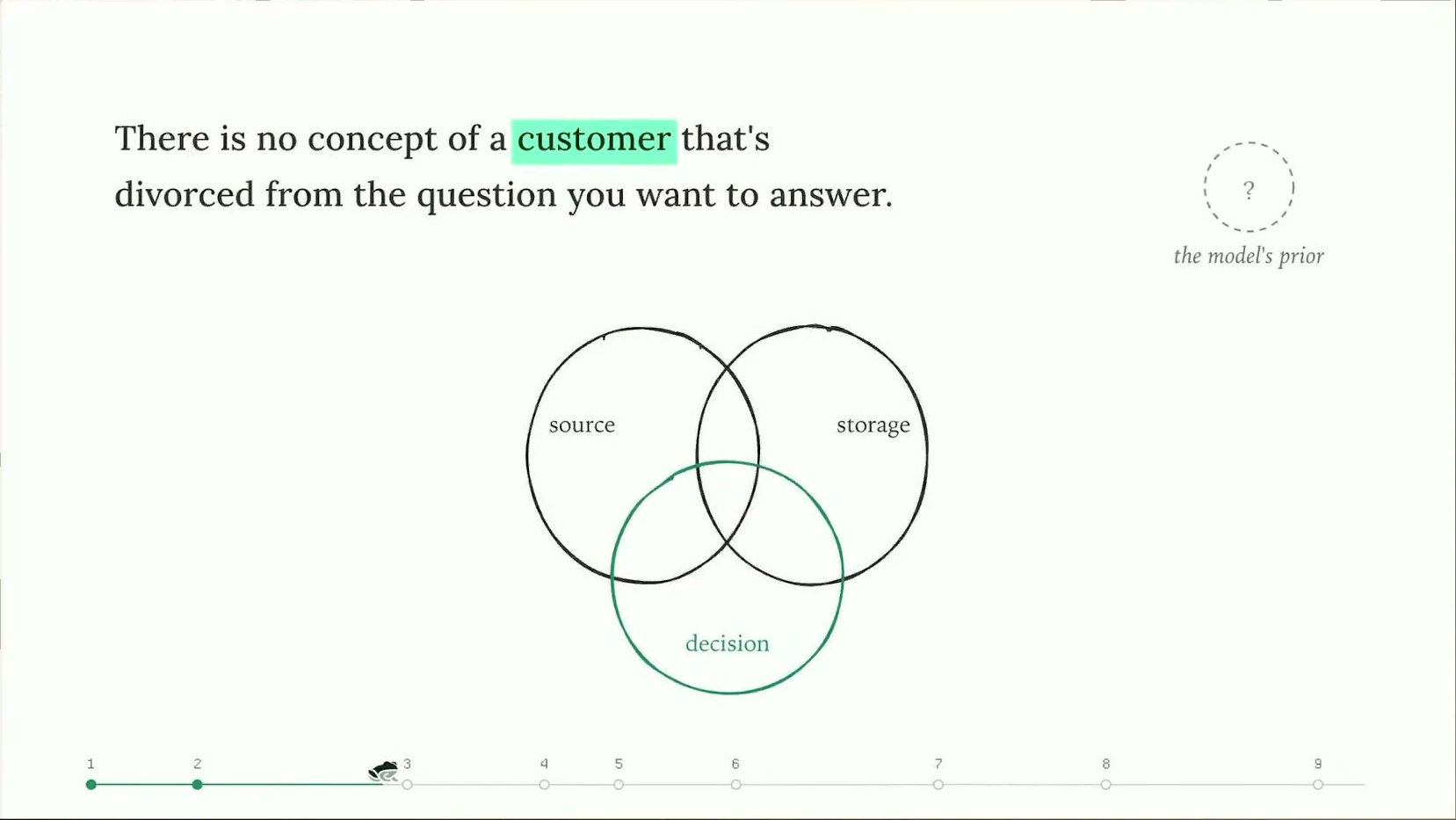
就是转换的过程,让信息真正变得有用,把记录信息时的上下文与决策时的上下文合并起来。这需要判断力。在了解决策空间之后再进行合并,而不是提前合并,这就是我所说的即时本体。稍后我会通过一个故事再谈判断力。这个故事来自我上一份工作,当时我的大部分工作就是确保某些数字永远不会出现。我上一份工作时的故事:我的大部分工作就是确保某些数字永远不会出现。在此之前,先简单介绍我和我们。最能形容我们的是一群痴迷者,痴迷于把智能嵌入流水线。这些流水线能够扩展、反复运行,真正把工作从我们手上接过去,并能自行优化成本、性能和速度。我们所做的数据工作大多分为三类。第一类是写一次、
concept of a customer that's divorced from the question that you want to answer. And pulling these schemas together is the process of transformation, of making information actually useful, taking the context that it was recorded in and merging it with the context of the decision. And that takes discernment. Doing that merge when the decision space is known instead of ahead of time is what I mean by a just-in-time ontology. So we'll come back to discernment with a story from my last job where most of my job was to make sure that certain numbers just did not exist ever. Before that, a little bit about me and us. We are best described as obsessives. Obsessives who embed intelligence into pipelines. Pipelines that can scale, that can run over and over again to take work truly off our hands, and pipelines that can mature in cost, performance, and speed all on
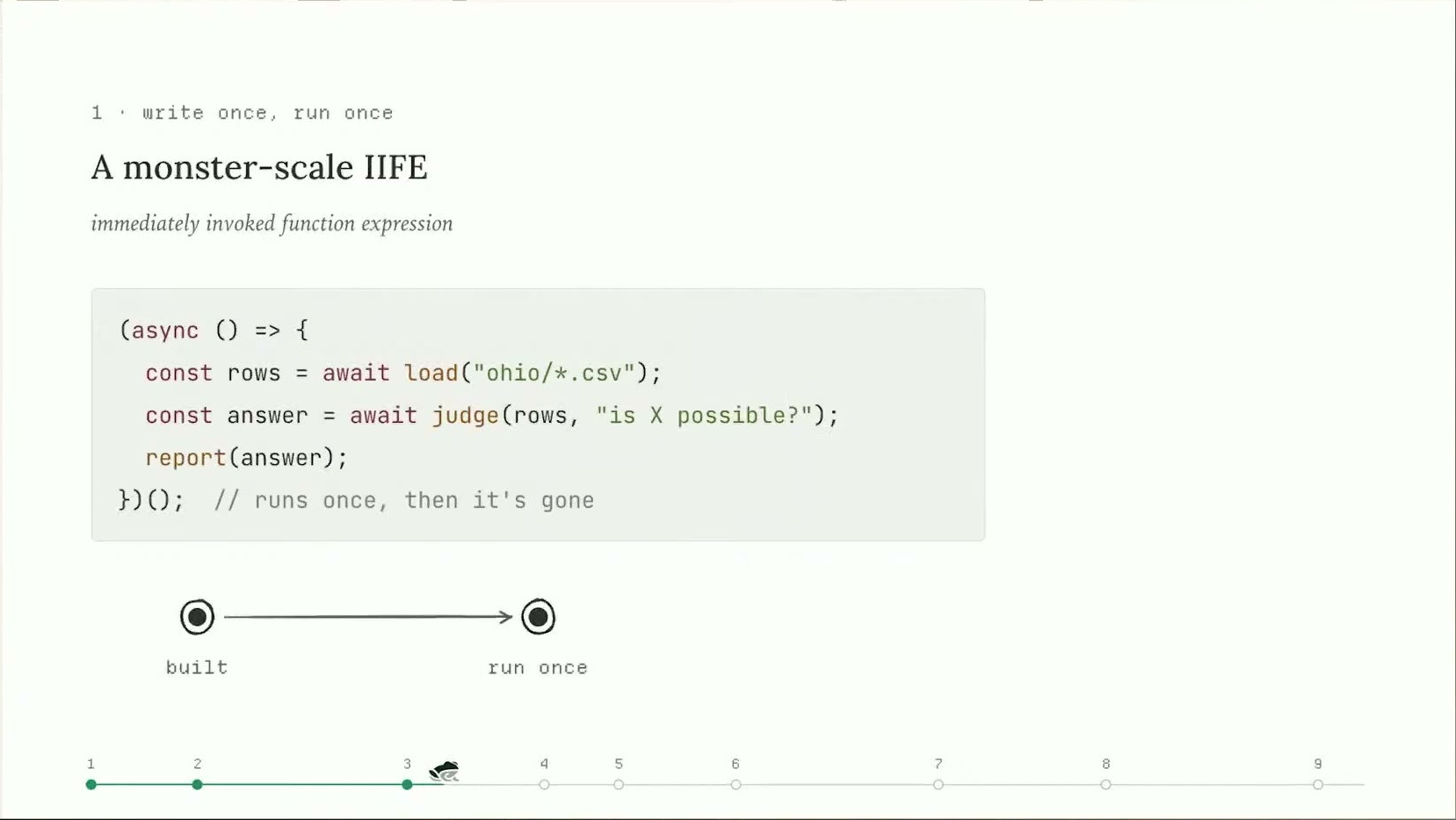
运行一次。如果你做过开发,可以把它们想成规模庞大的即时调用函数。它们专为一次性任务而建,比如合并数据集、挖掘信息,或回答某个具体问题,然后任务就会被拆除。第二类是写很多次、
their own. And most of the work we do in data breaks into three regimes. The first is write-ones, run-ones. If you do any kind of development, think of these as monster-scale immediately invoked functions. They're built for something single-use, like joining a data set, mining
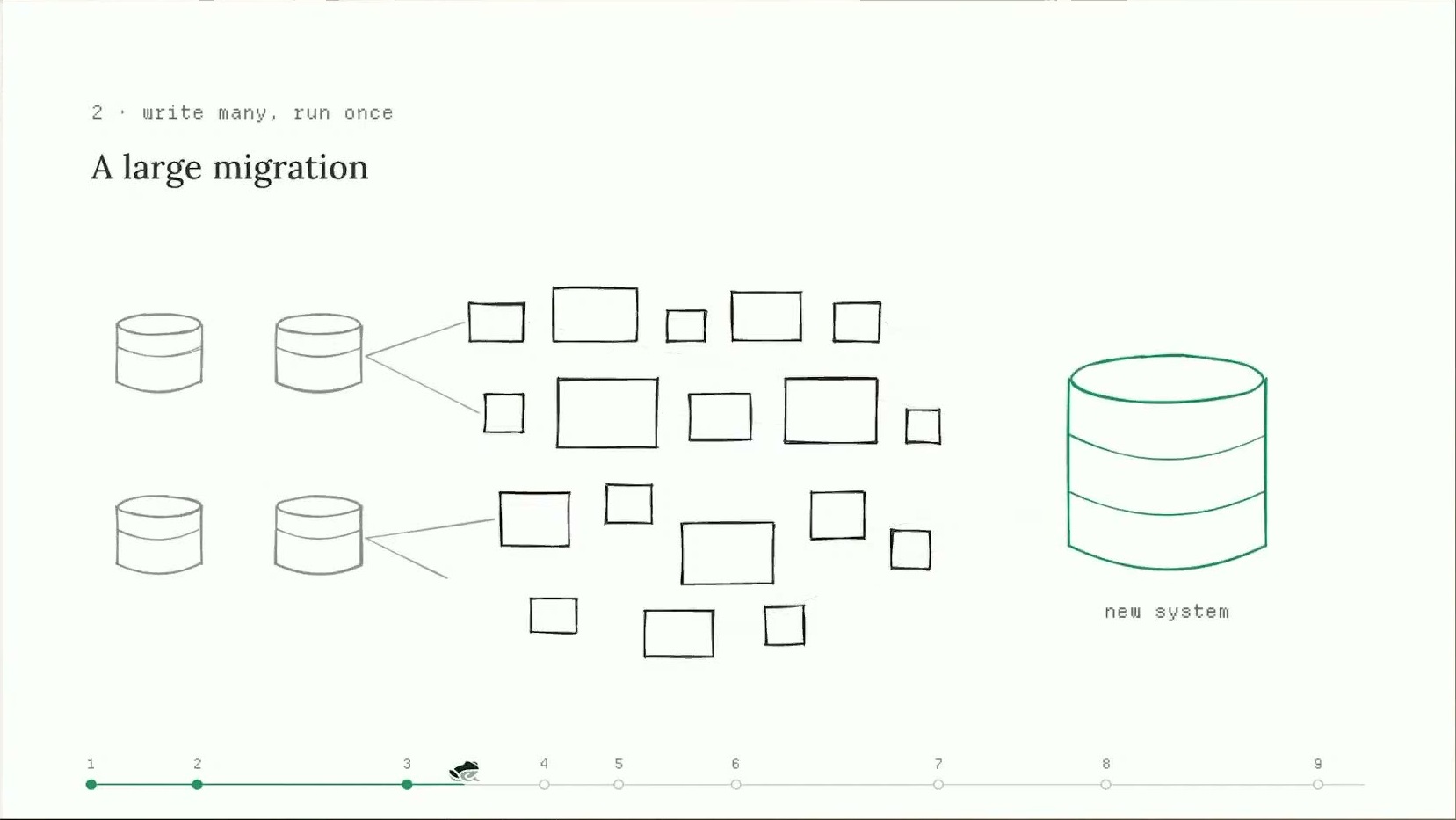
运行一次:为一个共同的大目标构建许多大小不一的工作负载。最接近的例子可能是大型数据迁移:把多年记录从没人完全记得的系统中迁出,为这一次迁移构建许多工作负载,并在源头分别验证,再与其他结果交叉核对,因为整个过程只会发生一次。第三类则是我们最拿手、也最常见的:写很多次、运行很多次。它们是可重复的流水线,会随着时间推移持续构建和维护,并不断加入更多信息。在 Southbridge,我们把大量工作从主线程中移出,放进这些可重复的系统里,涵盖基准测试设计、跟踪、编码,甚至给我们想看的电影制作字幕。
information, or answering one specific question, and then they get torn down. The second is write-many run once, where lots of smaller and larger workloads are built for one large common goal. The closest thing you might know is large migrations. Years of records, moved out of systems nobody fully remembers, lots of workloads built for one move and verified individually at source, checked against the others, because all of it only happens once. The third though, and this is bread and butter, is the most common, is write many, run many. These are repeatable pipelines that are built and maintained over time as we add more information in. And at Southbridge, we've moved so much work off the main thread and into these repeatable systems from benchmark design, tracking, coding, to making subtitles for movies that we want to watch.
现代世界里我们做的几乎所有事情都是数据转换,或者受到数据转换难度的限制。所有这些情况下,我们的工作都很简单:确保人们可以信赖结果。短短两年间,我们从研究如何让早期 GPT-3.5 Turbo 级别的模型在医疗、老龄化、矿业研究等领域可靠运行,发展到构建 Hankweave——我们的开源数据工作智能体运行框架,然后用它让模型协同工作,处理规模达 TB 级的数据。今天,我们拥有能够自我优化的系统。你给它们一个问题、一种安全失败的方式和一个工作场所,它们就能找到解决方案的形态。
Almost everything we do in the modern world is a transformation of data, or it's bottlenecked by how hard it is to transform data. And in all of these cases, our job is simple, make sure people can rely on the results. In just two years, we've gone from figuring out how to make early 3.5 turbo level models reliable on things like healthcare, aging, mining research, to building Hankweave, our open source harness for data work, and then using that to get models to work together at terabyte scale. Today, we have systems that can self-optimize. You give them the problem, a way to fail safely, a place to work, and they find the shape of the solution.
它们会挑选合适的模型,运行试点,扩大规模,并通过帕累托探索找到自己能发现的最佳选项。说个故事。我上一份工作中,大家最常问的问题是:我们能让这项决策以数据为依据吗?当平台上有数千艘船只时,有时这是个正确的问题。问题是,只有 50 个用户时,我们也会问这个问题。如果你了解统计学,就能很好地解释为什么对 50 个用户做 A/B 测试不是好主意。不是因为你得不到结果,而是因为你会得到结果。所以唯一真正的选择就是完全不生成数字,因为数字一旦出现,就会为某个结果辩护。
They pick the right models. They run the pilots. They scale up. And they Pareto-surfed their way to the best option they can find. So, story, at my last job, the question we heard most often was, can we make this decision data-led? And sometimes that was the right question when we had thousands of vessels on the platform. The problem is that we also asked it when we only had 50 users. And if you know statistics, you can explain really well why A-B testing 50 users is a bad idea. Not because you're not going to get a result, but because you will. So the only real option was to not produce a number at all, because the moment a number exists, it argues for a result.
不过今天情况更糟。交互式智能体总会给你一个答案,而且很快就会给你。你让它做某种转换,诸如此类,它就会给你一个“当然可以,先生”的答复。这意味着错误会迅速累积。聊天中一瞬间犯下的错误,可能永远留在生产环境里,成为噩梦,直到某天被发现。出现这种情况的主要原因是,如今数据工作中的智能,实际上承担着三个不同角色,而编码智能体会把它们塞进同一个上下文窗口里。我们把它们拆开来说,因为这有助于理解后面要讲的决策模型,它们恰好分别属于这三类中的一类。第一类是构建和设计流水线,包括拆解问题、编写初步规格说明,
Today, though, it is worse. Interactive agents will always give you an answer. They'll give it to you quickly. You ask for a transformation, whatever, and you get a contrary and yes, sir. What this means is mistakes add up quickly. Moment in chat can be a prod nightmare forever, just waiting to be discovered. The primary reason that this happens is that intelligence, as it relates to data work today, occupies three separate roles that coding agents kind of mash into one context window. Let's pull those apart because it'll help a lot when we get to decision models because they fit into exactly one of these three. The first one is building and designing the pipeline, which is breaking down the problem, writing the early specs.
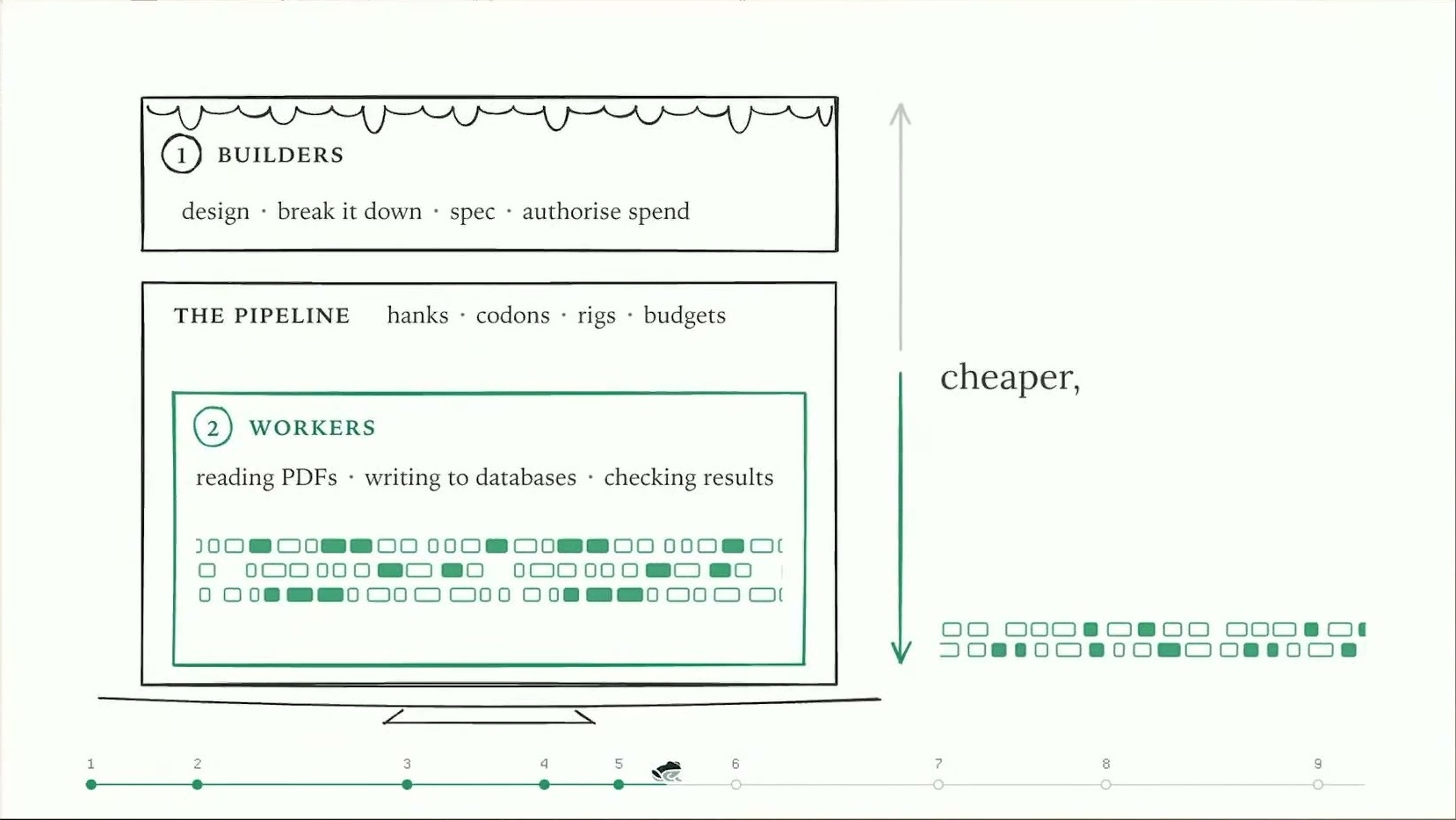
授权支出。第二类通常会和第一类混为一谈,并交给同一批模型:在流水线内部工作,真正执行任务、阅读 PDF、写入数据库、检查结果。在说第三类之前,我想说明这两个角色的需求方向截然不同。第一类需要速度较慢的模型,使用更重、更厚的 token,能思考得更深入、从不同角度审视问题,消化文档,理解这些流水线是如何构建的,并在事情开始之前预测效果,比如 Opus 或更高档的模型。但你希望在流水线内部运行的模型恰恰相反。
authorizing spent. The second one, and this is usually confused with the first and given to the same models, is working inside the pipeline, actually doing the work, reading the PDF, writing to databases, checking results. Before we get to the third one, I want to make it clear that these two roles pull in very different directions. The first one wants slower models with heavier, thicker tokens, models that can think more, walk around a problem and see the angles, digest documentation, understand how these pipelines get built, and predict how something will do before it even starts, like opus or up. The models you want inside pipelines, though, are the opposite.
你需要更便宜、更快、专门化、擅长遵循指令的模型,它们是可重复的工作者,缺陷也可以预先了解。自然界也有同样的情况。例如切叶蚁群里有四种不同体型的工蚁,小、中、大、特大。
You want them cheaper, faster, specialized, good at following instructions, repeatable workers with knowable defects. You see the same thing in nature. A leafcutter ant colony, for example, runs on four different sizes of worker, small, medium, high, X-high.
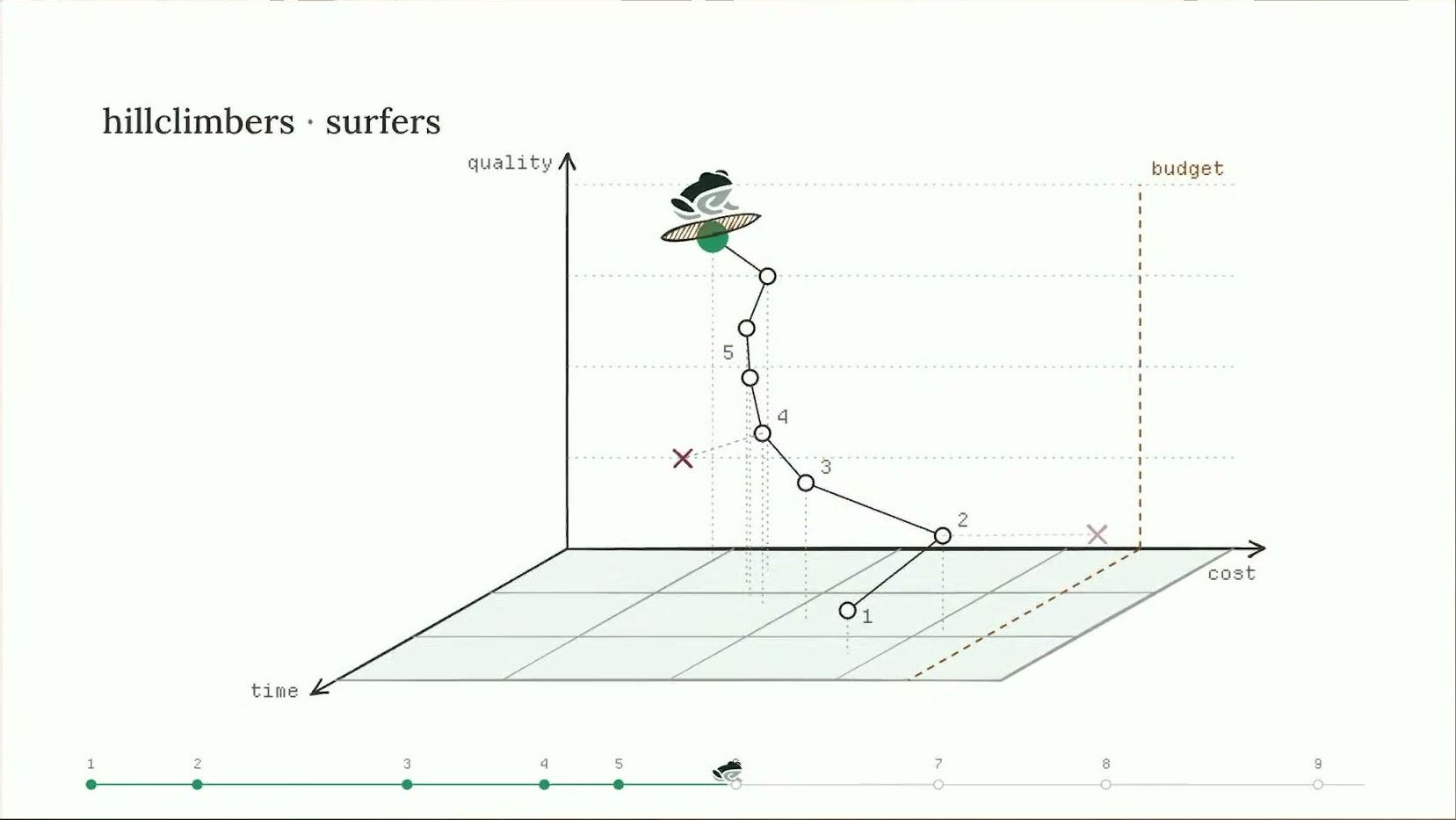
观察你设计、审查或听说的任何系统时,都要留意它在这个层级结构中属于哪一格、处在哪一层。这会带来很大差别。正因为我们区分了这些角色,所以当 JEV 出现在这个迅速兴起的决策模型类别中时,我们很容易就能引入它们,因为它们是工作者。它们专为快速接触信息而构建,并部署在大型工作负载的底层。不过,第三类呢?我们称它们为爬坡者或冲浪者。这类模型可以接手第一个模型,并进行自我优化。只要提供合适的知识、指令和一个极其稳定的立足面,它们就能尝试新方法、调整预算以限制成本风险、快速调试并做笔记,一路探索,不只是找到正确方案,还能找到最优方案。
As you watch any system that you design, review, or hear about, listen for what slots and where in this layer cake. It makes a big difference. Because we had this distinction, bringing in JEV in this newly exploding class of decision models was very easy because they're workers. They're built for quick contact with information, and they're deployed at the bottom end of large workloads. So third category, though. This is something we call the hill climbers or surfers. Models that can take a first one and self-optimize. Given the right knowledge, instructions, and an incredibly stable surface to stand on, they can try new things, vary budgets to limit cost exposure, debug quickly, take notes, surf their way, not just to the right solution, but the optimal one.
我们把这叫作帕累托探索,最后会谈到它。不过先谈谈我们和 Jeff 合作的经历。
We call that Pareto surfing, and we'll cover it at the end. But first, let's talk about our experience with Jeff.
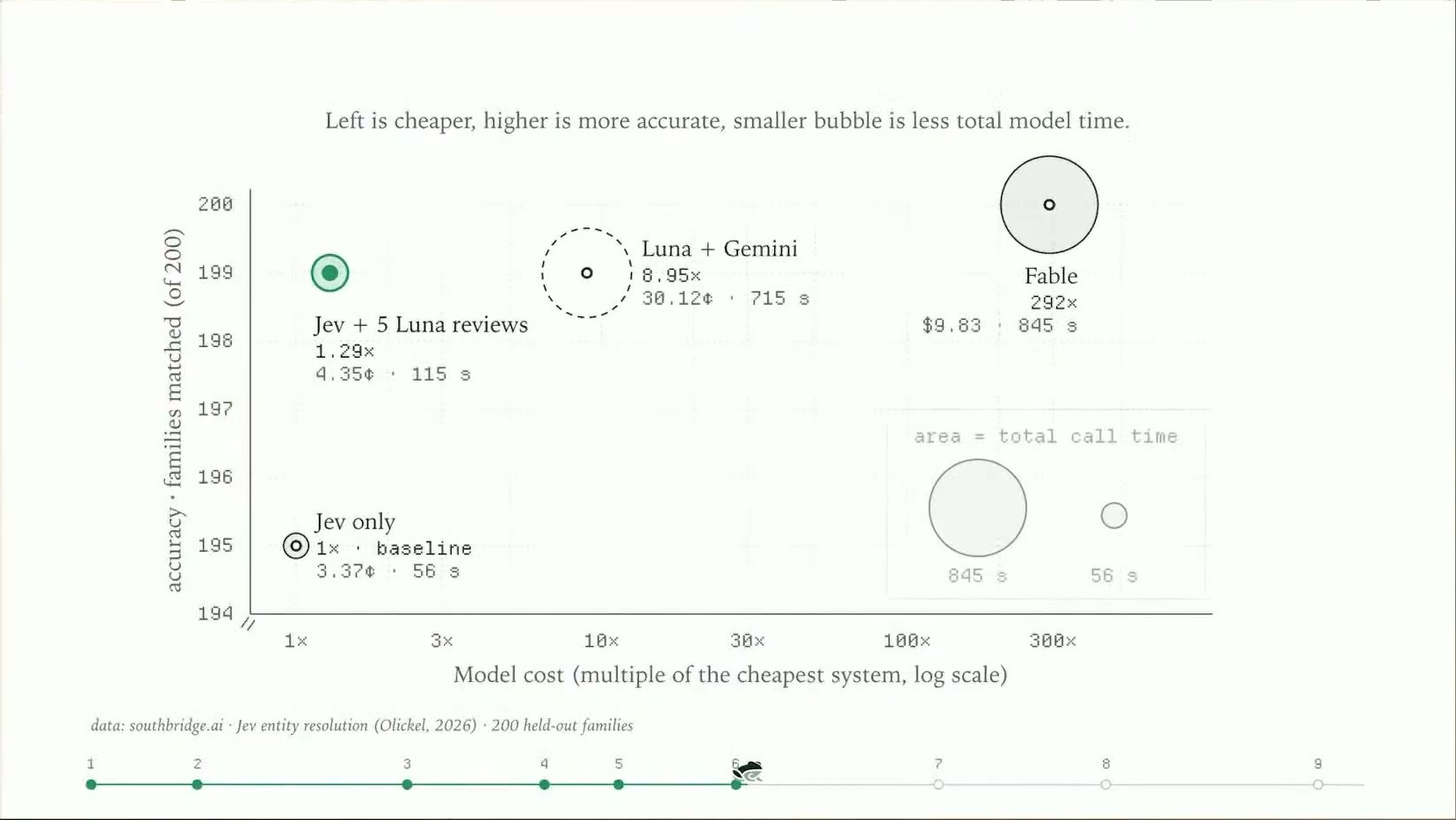
JEV 在一个星期二发布,当时我们正深入开发实体解析流水线。你们正在处理俄亥俄州竞选财务中的捐款人数据。现在很多人都看过这张图。我们之前谈过结果,也根据这个数据集调整了一些正在进行的工作。你可以自行下载,包括提示以及所有内容。
JEV launched on a Tuesday when we were deep into an entity resolution pipeline. You were working on donors in Ohio's campaign finance. And at this point, a lot of people have seen this chart. We talked about the results before and adapted some of the ongoing work to the data set. So you can download it for yourself, prompts and everything.
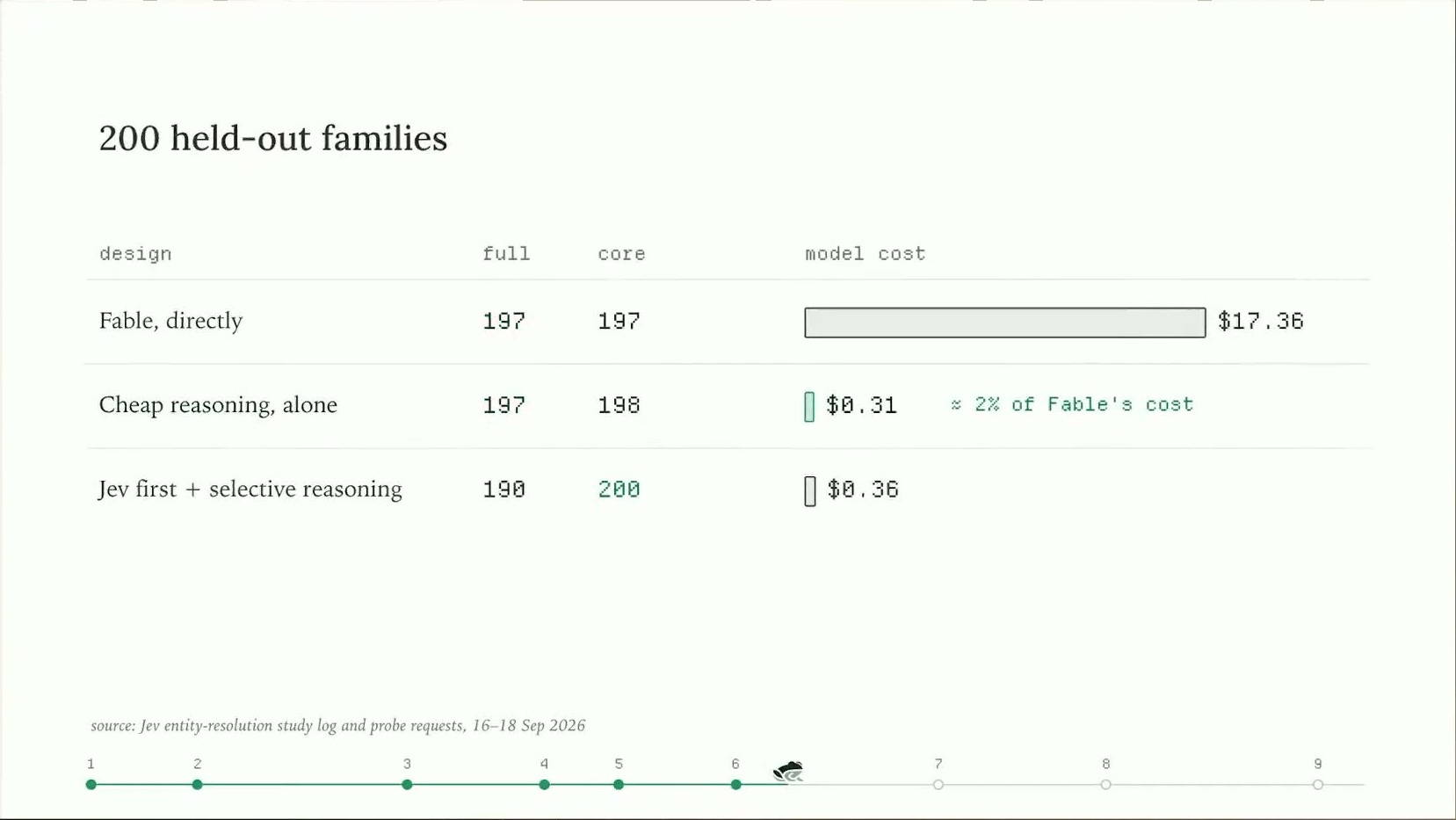
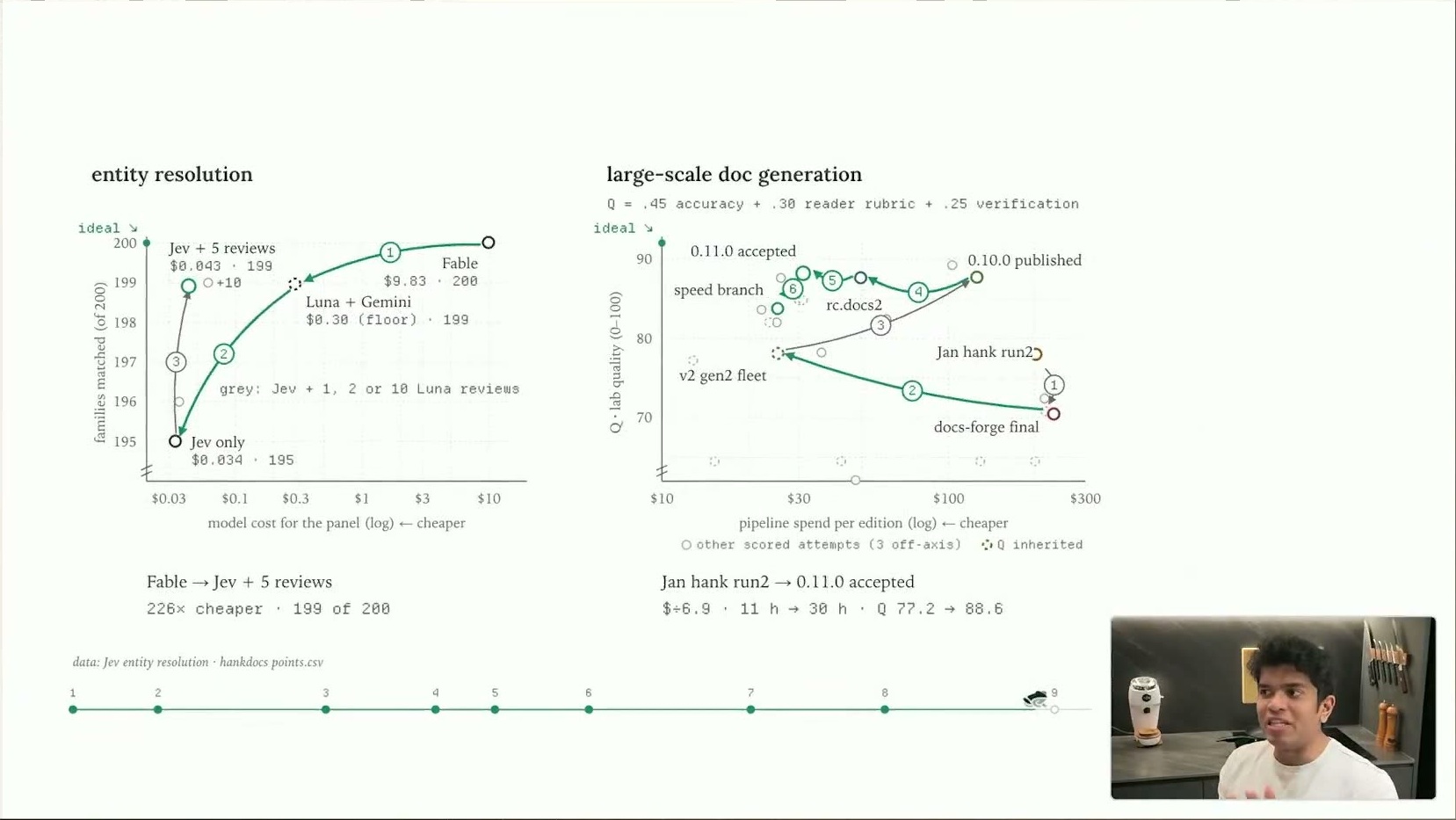
我们没讲的是那支箭头背后的所有工作,以及把同一个想法用于整个州后发生了什么。这里是我们尝试过的所有架构。我们先在一个小型开发集上尝试三种设计:单独使用廉价推理模型;对于不确定的问题,让 Jev 搭配推理模型;以及由推理模型提出答案、Jev 负责核查。在大约 200 个留出家庭样本上,单独使用廉价推理模型的效果和 Fable 一样好,而成本只有约 2%。Jeff 一开始正确给出了核心答案,但漏掉了 9 个家庭关联,因为它很肯定地把每一个都判成了否。于是我们只重写了问题,没有改动模型或阈值。
What we didn't talk about is everything behind that one arrow. And what happened when we ran the same idea on the whole state? Here are all of the architectures we tried. We started with three designs on a small development set, a cheap reasoning model on its own, Jev with a reasoning model for anything it wasn't sure about, and a reasoning model proposing answers with Jev checking them. On about 200 held-out families, the cheap reasoning model on its own did as well as Fable for about 2% of the cost. Jeff first got the core answers right, but it missed nine household legs because it had confidently said no to every one of them. So we rewrote the questions without touching the models or the thresholds.
现在,家庭相关的问题写明了,只要有足够证据就算符合;Jeff 对开发集中的 13 个问题从一律回答否,变成了回答是。
The household question now said what counts is enough evidence, and Jeff went from no on all 13 development questions to yes.
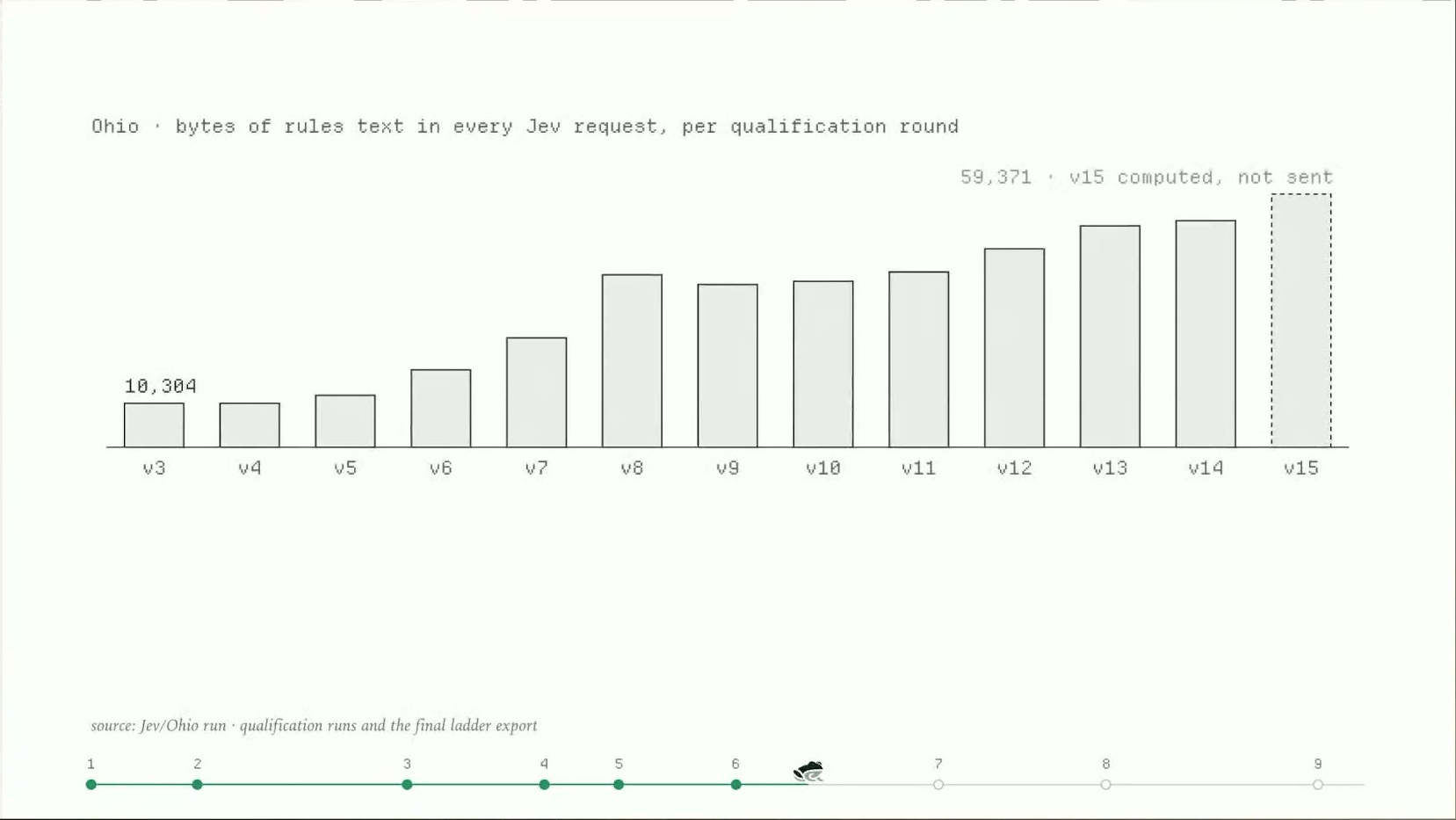
随后我们把它扩展到全州,并进行了十多轮这样的资格判定。每一轮都修正一项定义:委员会是什么,申报人是什么意思,两个人住在同一个地址又意味着什么?
And as we scaled it statewide, we ran over a dozen rounds of such qualification. Each round fixed a definition, what a committee is, what a filer means, when two people live at one address, what does that mean?
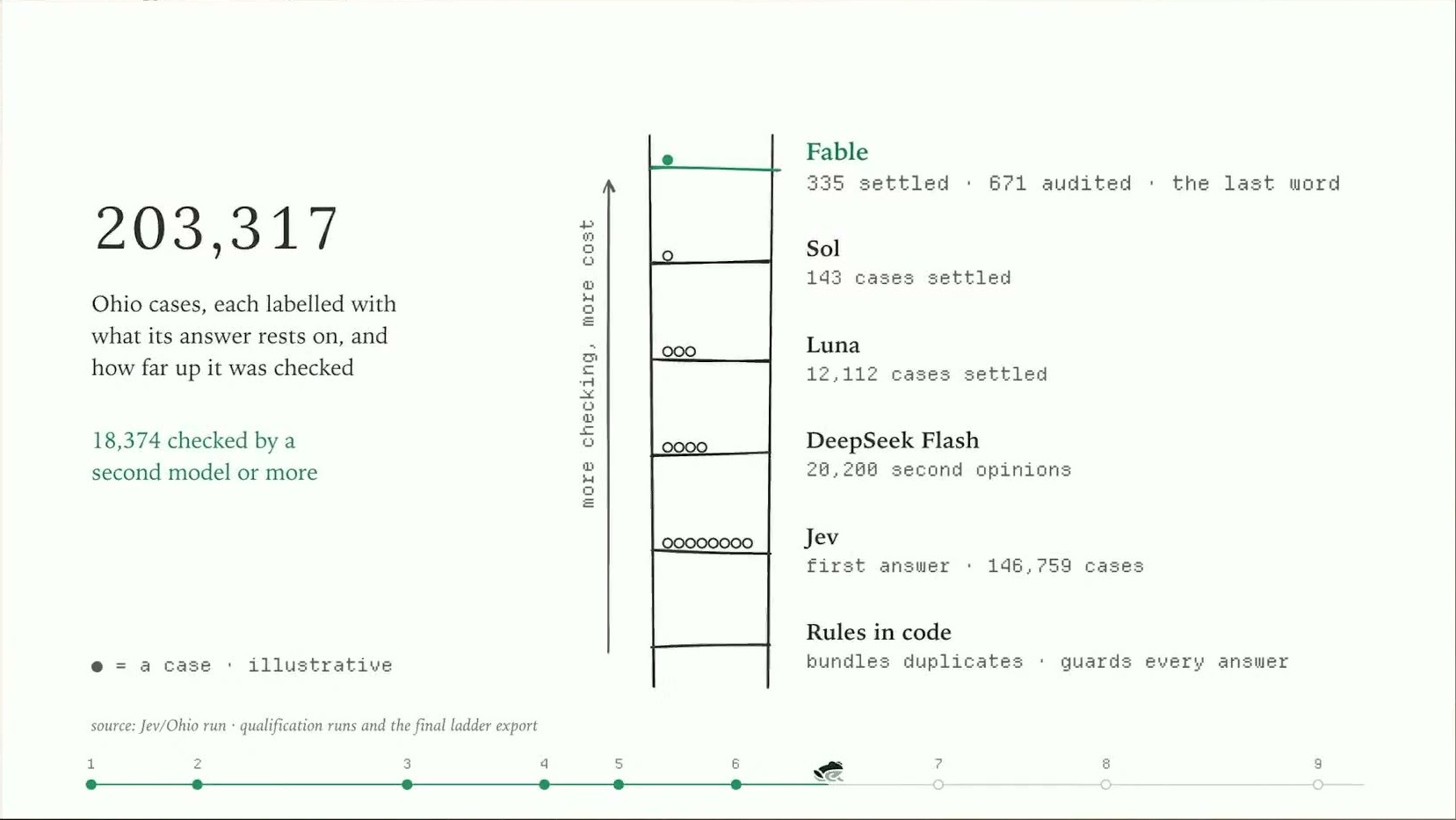
现在,俄亥俄州的 203,317 个案例都带有一个标签,说明答案依据是什么,以及核查到了什么程度。这是我们针对这个具体问题发现的层级结构。以下是我们把决策模型放进流水线后学到的所有经验。
Every one of Ohio's 203,317 cases now has a label that says what the answer rests on and how far it was checked. This is the hierarchy we discovered for this specific problem. And here's everything we learned about putting decision models into pipelines.
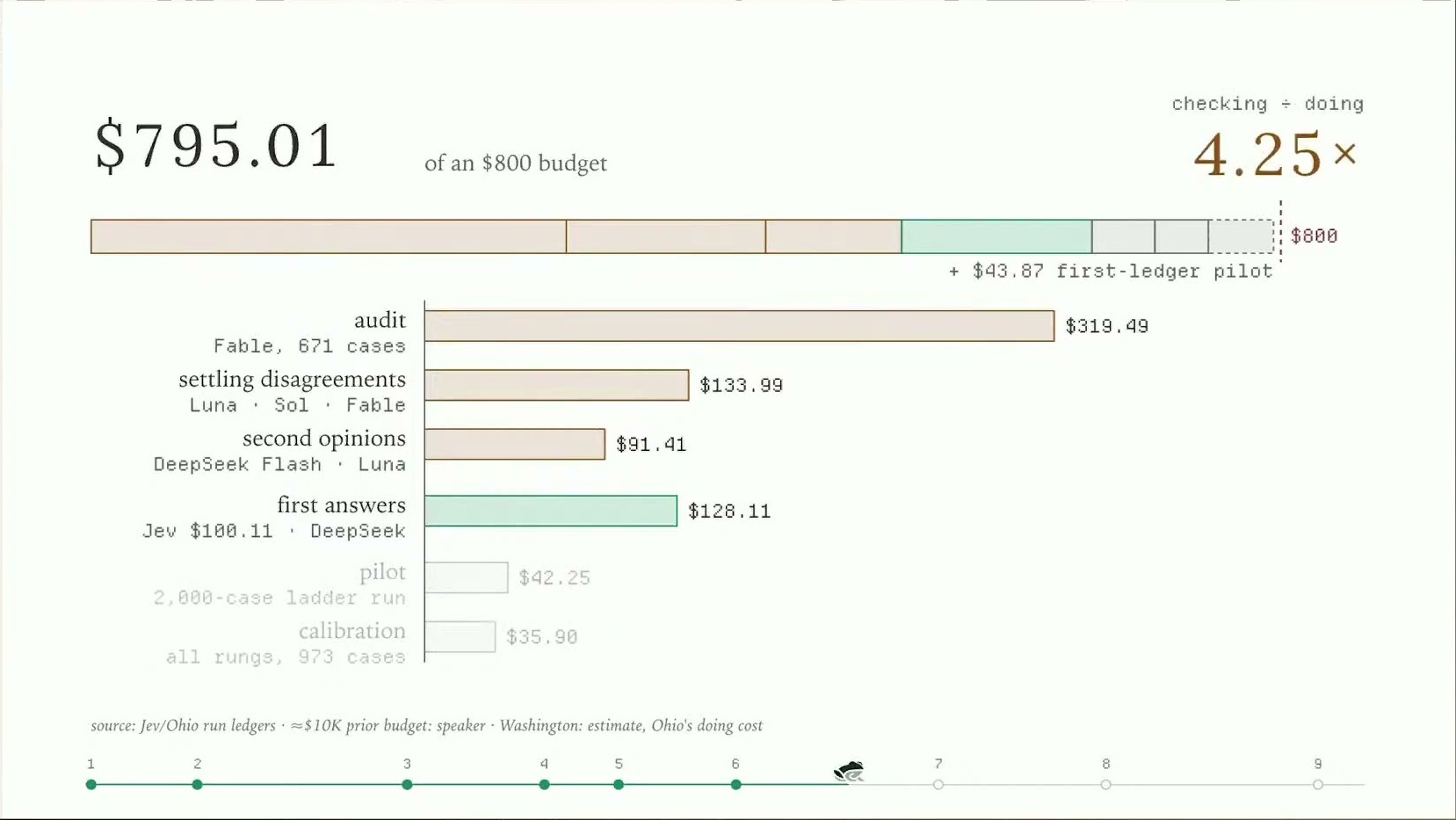
我会把这页留在屏幕上,方便你们截图。接下来看看钱花在哪里。整个州范围的任务总共花了 795 美元,低于预先设定的 800 美元预算。核查成本约为执行成本的 4 倍。545 美元花在第二意见、解决分歧和审计上,首次回答只花了 128 美元。在 Jeff 出现之前,我们预计这项工作要花约 10,000 美元。现在流水线已经构建并通过验证,我们预计下一个州的审计预算会接近零。最令人惊讶的是,我们的智能体 4A 先在 Astra 上运行、后来在 Opus 上运行,它通过构建系统、运行、调试和尝试新方法,逐步自行发现了大多数方案。它运行了 10 天,尝试了十多种架构。
I'll leave this up so you can screenshot it. But here's where the money went. The whole statewide job came to $795 on an $800 budget that was set ahead of time. Checking cost about four times as much as doing. $545 on second opinions, settling disagreements, and the audit against 128 for first answers. And before Jeff, we expected this work to cost about $10,000. And now that the pipeline is built and verified, we expect the audit budget for the next state to be close to zero. The most amazing thing is that our agent, 4A, running on Astra and then later on Opus, found most of these approaches incrementally on its own by building the system, running it, debugging it, and trying new things. It ran for 10 days, tried over a dozen architectures.
它的 hanks 运行了 4,000 多次,同时还调用 Jeff 90,000 次,并实际尝试了帕累托前沿上的几乎所有模型。这些运行中的模型总计处理了大约 60 亿个 token。
Its hanks ran for more than 4,000 times, alongside 90,000 calls to Jeff, tried practically every model on the Pareto frontier. And the models inside those runs went through roughly 6 billion tokens.
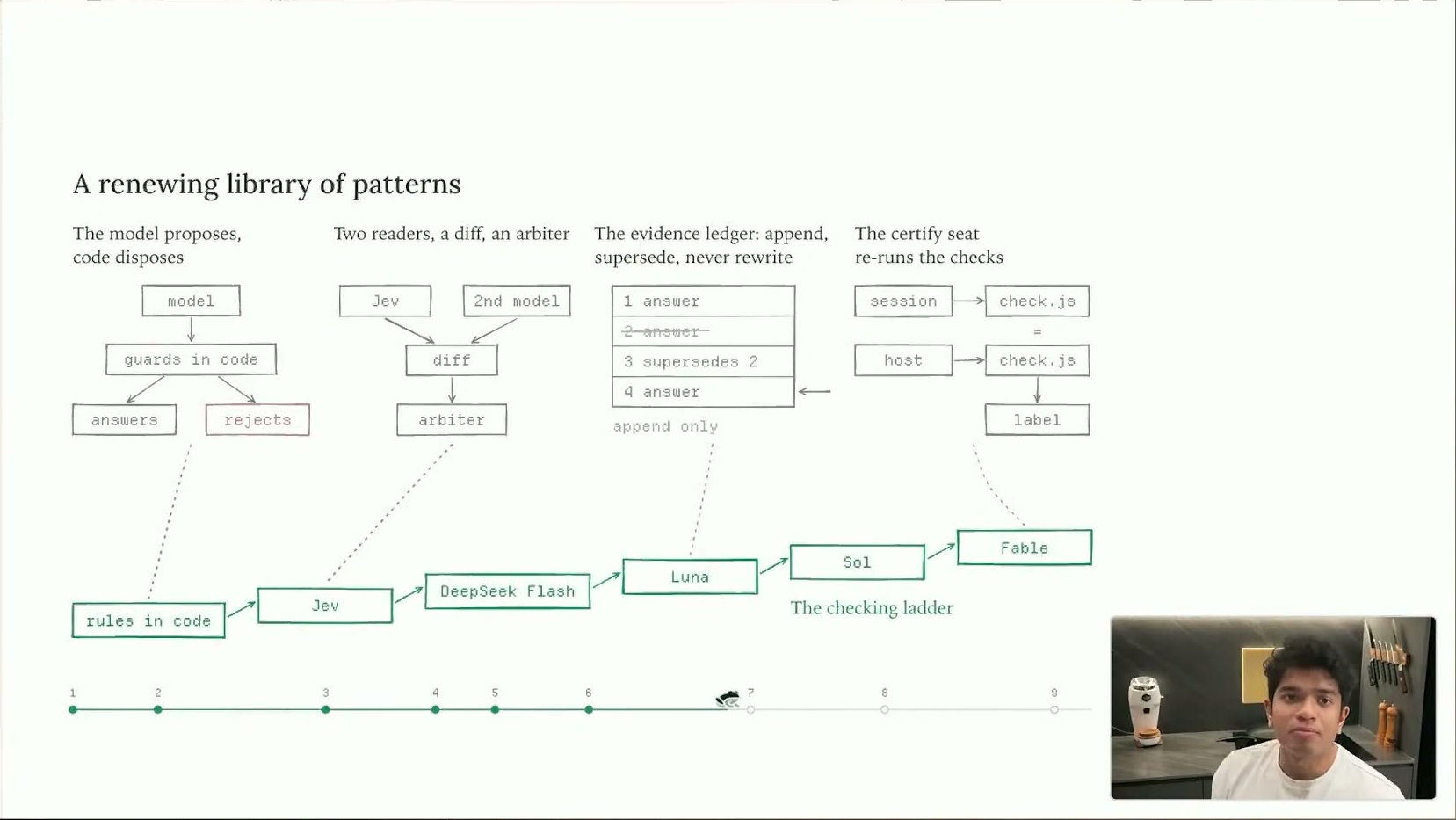
全部完成后,我们把学到的内容写回智能体模式库。这项工作采用了库中已有的模式,我们也在加入新的、经过测试的模式,例如核查信函。在我看来,这就是把工作从人类和智能体的主线程中移走的价值。因为每一次迭代都是一个经过版本控制的 Hank。它们很容易回滚、理解、调试和评议。那么现在模型能原生完成这些工作吗?还不完全行。它们还缺少四样东西,接下来我们会逐一介绍。
And once all of that was done, we wrote what we learned back into our library of agentic patterns. This work leaned on these existing ones, and we're adding new tested ones like the checking letter. This is, to me, the value of taking work off the main thread for humans and for agents. Because every single one of these iterations was a version-controlled Hank. They were easy to revert, understand, debug, and critique. So can models do this natively now? Not quite. They're missing four things, which we'll go over.
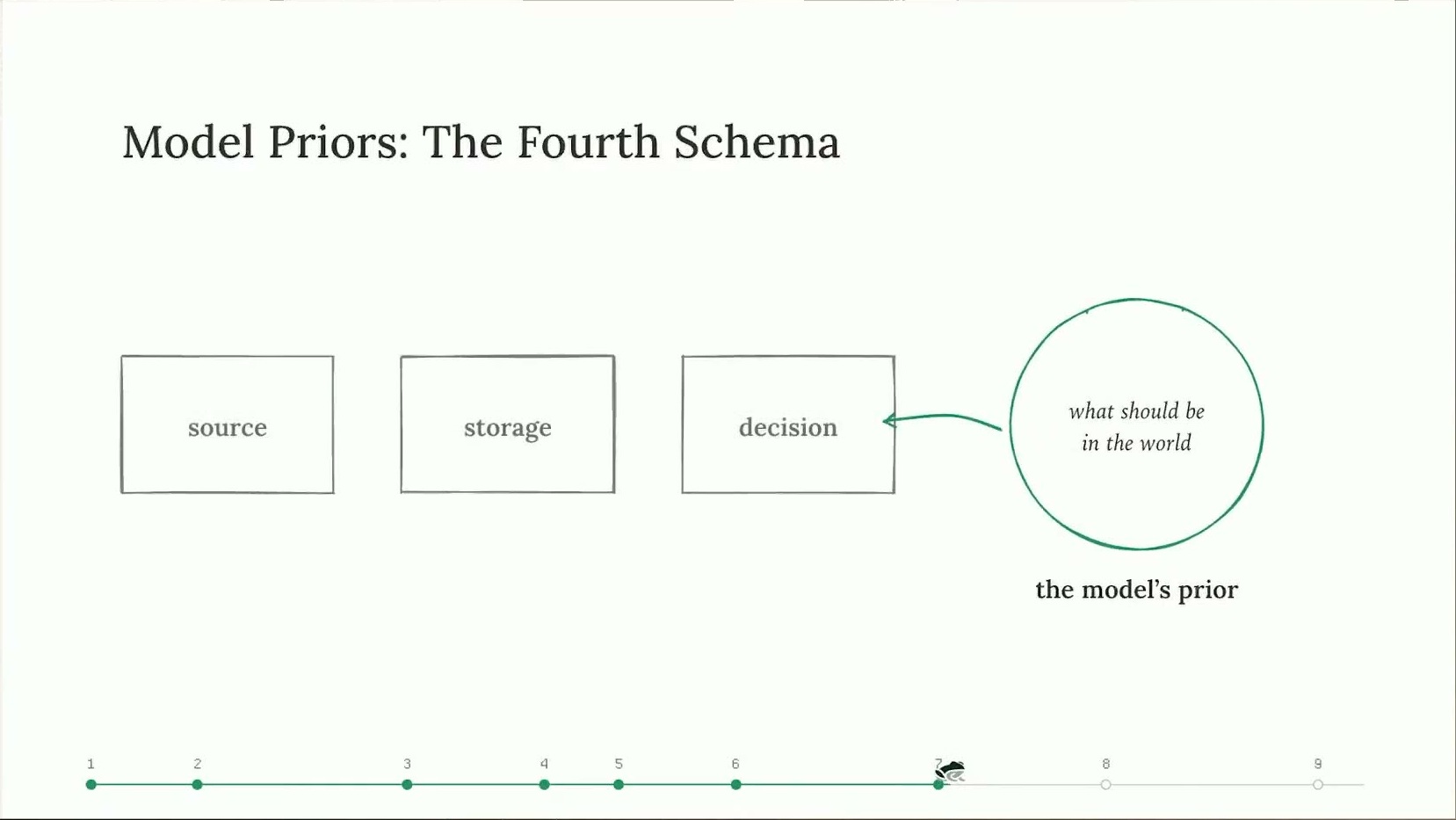
不过随着模型变大、能力增强,有一样东西不会消失:先验。和人类一样,模型会带着自己的先验,也就是关于世界应该是什么样的信念,来执行每项任务。这就是我之前提到的第四种模式,也就是模型自带的模式。奇怪的是,更大的模型有时在这方面反而更差。它们更坚持自己的信念,辩护时也更加激烈。
And there's something that doesn't go away, though, as models get bigger and more capable, the prior. Just like humans, models bring their own priors, their beliefs about what should be in the world, to every task. This is the fourth schema that I mentioned before, the one the model brings with it. Bigger models, in a strange way, are worse at this sometimes. They hold on to their beliefs and argue for them even more vehemently.
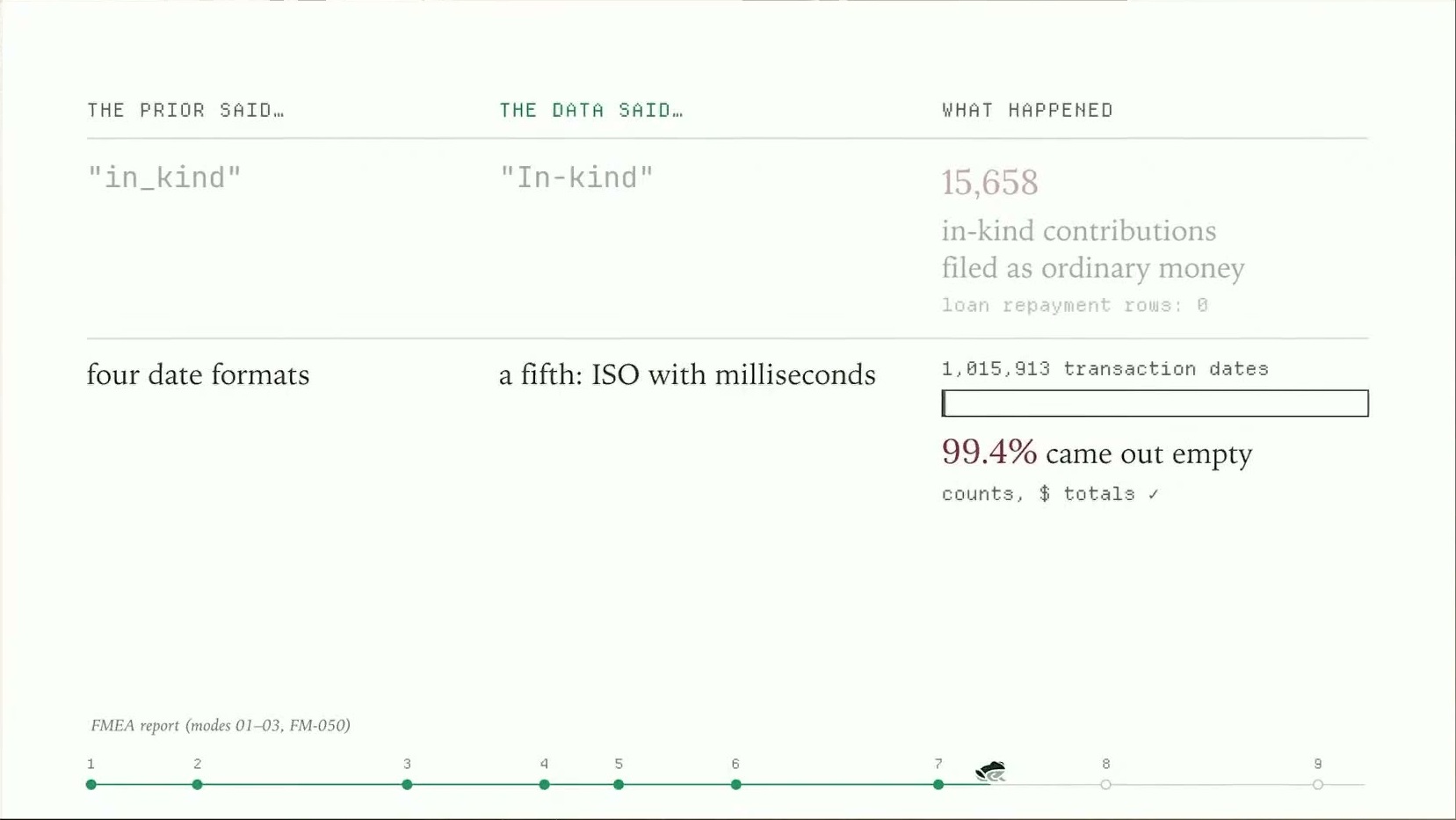
这里举几个我们遇到的例子。一条流水线查找的是带下划线的 in_kind。而文件中写的是首字母大写、带连字符的 In-Kind。因此模型把 15,658 笔实物捐款算成了普通现金。它没有再核对一遍。这些运行中的模型总计处理了大约 60 亿个 token。另一个模型尝试了 4 种日期格式,但文件实际上使用第 5 种格式。于是 99.4% 的交易日期变成了空值。每行的数量和金额又都能对上,所以智能体继续往下走了。几次运行都发现贷款金额是负数,便认定负号多余,把金额存成了绝对值。最后,净额 784,000 美元变成了 530 万美元的债务,而且得到了多个模型的验证。
Here's a few that we ran into. One pipeline looked for in-kind spelled with an underscore. The file spelled it with a capital I and a hyphen. So the model counted 15,658 in-kind contributions as ordinary money. Didn't double check. The loan payment repayments also disappeared the same way. Another one tried four date formats when the file used to fifth. 99.4% of the transaction dates then came out empty. And every row count and dollar matched, so the agent moved on. Several runs noticed that loan amounts were negative, decided that the sign was redundant, and stored the absolute value. A net of $784,000 became $5.3 million of debt in the end, validated by multiple models.
随着模型接管越来越多工作,这很快就成了我在 DataWork 各家公司看到的最大一类错误。
And this is quickly becoming the largest class of error I see across companies at DataWork as models take over.
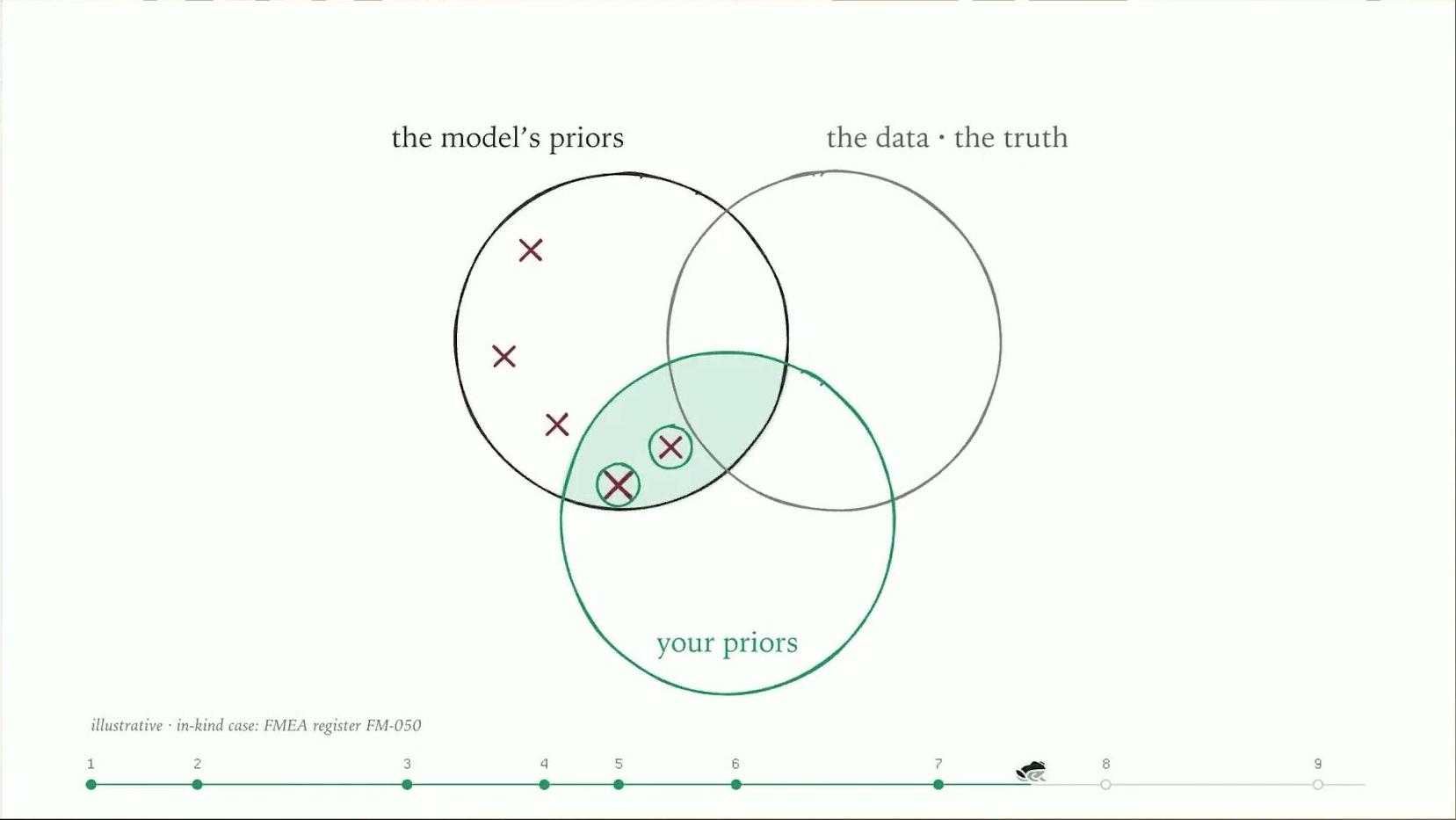
有时只要别凭感觉行事,检查结果并运用人的直觉,就能解决这个问题。有意思的是,你这样做时实际上是在做什么。你正在把自己的先验与模型的先验交叉起来。在第一个例子里,任何人都会发现实物捐款缺失,只要你了解竞选财务,或者想到要检查一下。我们就是这样发现问题的。但就这个具体任务而言,作为一个人来说,我得承认人力很贵。而且速度慢。会拖延时间安排。人的行为甚至比模型更不确定,而且人们讨厌被打断。
Sometimes you can solve this just by not vibing, by checking results and applying human intuition. what you're actually doing there when you do this is interesting. You're intersecting your priors with the models. In that first example, any human would catch missing in-kind contributions, even you campaign finance or think to check. It's how we found it. But humans, speaking as a human on this particular task, are expensive. They are slow. They pause timelines. They're even more non-deterministic than models, and they hate interruptions.
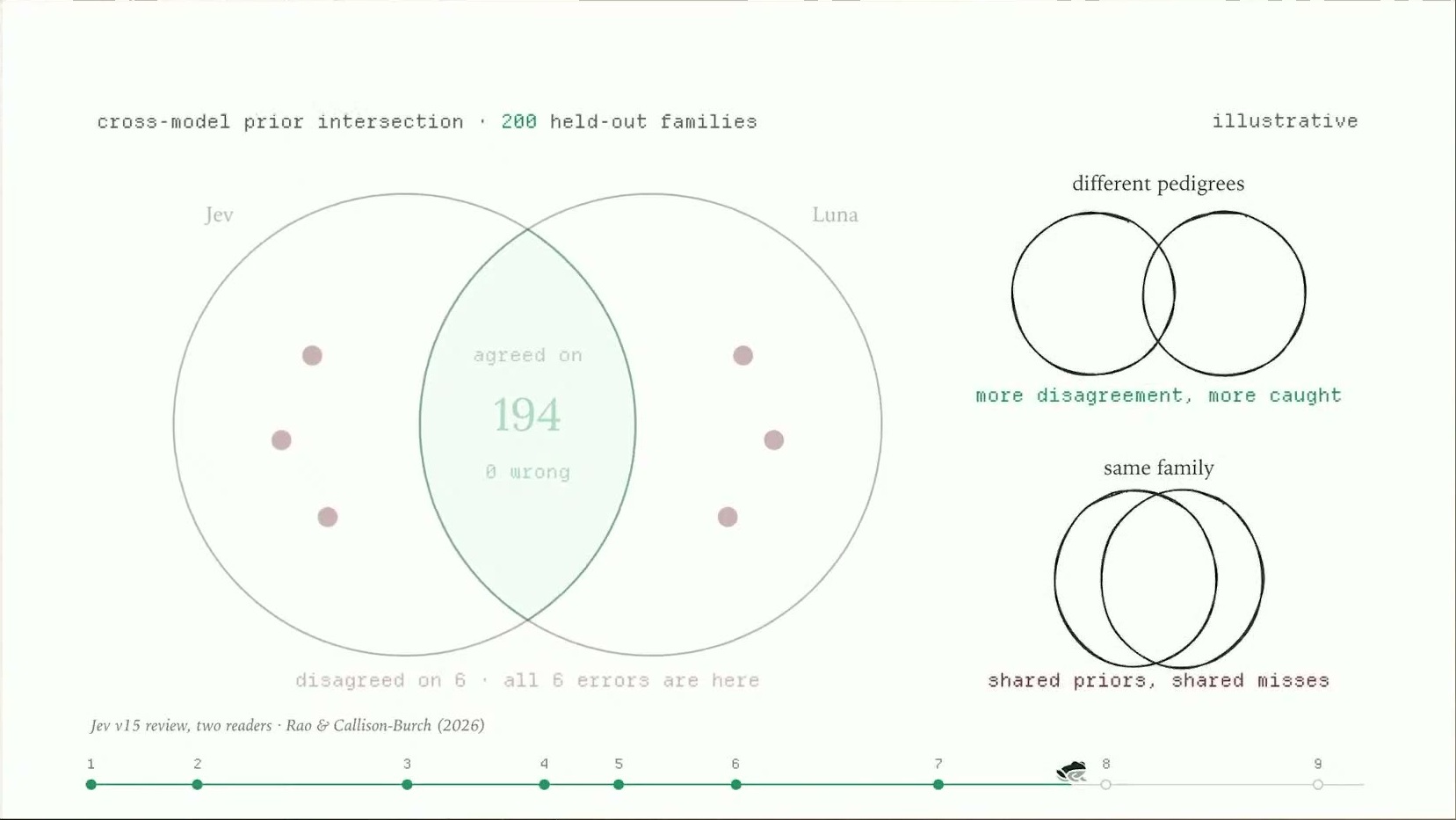
不过事实证明,在 200 个留出家庭样本上,跨模型交叉先验也能发挥很大作用。JEV 和 Luna 对其中 194 个样本意见一致,而且这些共同答案没有一个错;所有错误都出现在双方意见不一致的 6 个家庭中。来自不同模型家族、不同传承路线的模型,往往比同一组模型更容易产生分歧,先验也不同。例如,例外情况是……我就不点名了,有些模型是在同一家公司之外蒸馏出来的。做这类工作可以大幅缩小错误范围,把问题压缩到一小类但持续存在的问题,而这些问题适用于作为一个物种的 LLM。在一次基准测试中,4 个不同模型家族给出的总数完全相同,因为它们共享了同一种符号约定,而答案键没有采用这种约定。
but it turns out you can also get really far with cross model prior intersection on our 200 held out families jev and luna agreed on 194 and none of those shared answers was wrong every error sat in the six families where they disagreed models from different families different pedigrees tend to disagree more and have different priors than models in the same group for example the exception I'm not going to say who are models that are distilled outside the same company. So with that kind of work, you can shrink the surface quite a bit and the errors along with it down to a much smaller but persistent class of problems that apply to LLMs as a species. So in one benchmark, four different model families produce the same total down to this end because they all shared a sign convention that the answer key didn't.
到了这一步,唯一的前进方式就是把这些错误列出来,保持警惕,并采用特定解决方案。
And once you get that far, the only way forward is to list them, look out for them, and apply specific solutions.
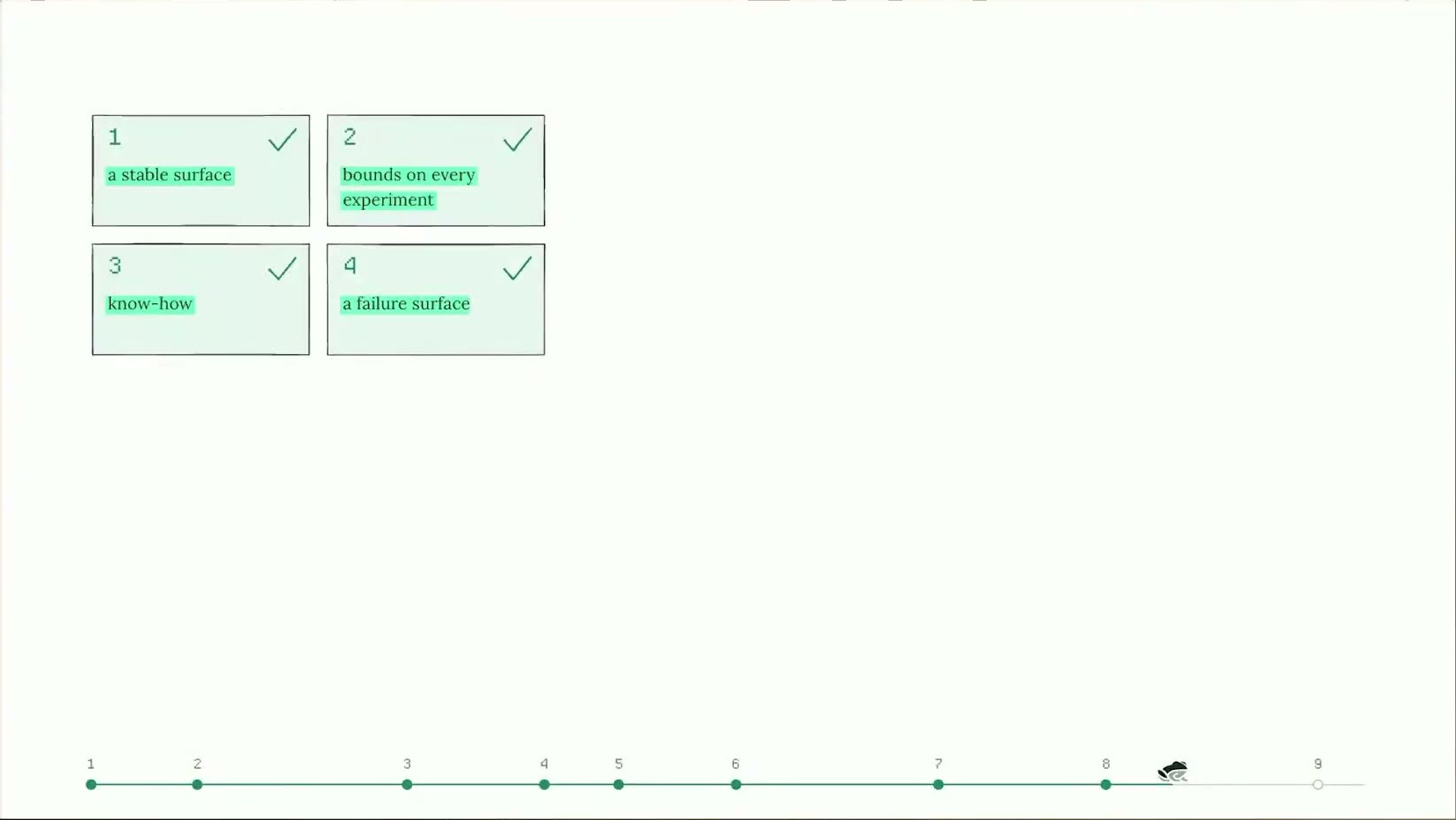
回到刚才的问题:要让系统能够自我优化,我们缺少哪 4 样东西?第一,稳定的部署界面。我们用 Hankweave 来实现这一点。它是一个智能体运行框架,能接住 CloudCode、Py 等快速变化的智能体运行时界面,并提供一致、经过充分测试的日志和 API 接口,还内置检查点,回滚、预算执行等功能。你可以在它上面构建系统。当然也有其他符合这一描述的工具。公平地说,对于无头数据工作,我认为 Hankweave 仍是最早、最稳定、最开放的。如果你们想试试,我会把技能页面留在屏幕上。第二,要有办法限制实验范围。除非能把成本、时间和访问权限当作资源来控制,否则你就无法测试。
So going back, what are the four things we're missing to be able to self-optimize? Number one is a stable deployment surface. We use Hankweave for this, a harness that takes the fast-moving surface of agent runtimes like CloudCode and Py, and that exposes a consistent, well-tested log and API interface with checkpointing, rollback, budget enforcement, everything built in. Something you can build on. But other things fit this description. To be fair, for headless data work, Hankweave, I would say, is still the oldest, most stable, and the most open. I'll leave the skill up if you'd like to try it. Number two is some way to bound your experiments. You can't test unless you can control cost,
第三,知识和方法论。我们发现,这一类新模型能够运用我们从两年部署中学到的一切,包括智能体模式,调试技巧、提示编写等,并把这些经验用于复杂问题。只要有合适的抽象层,就能用很少的 token 表达出来,再由模型实现。第四,也是最重要的一点,是失败边界。阿基米德说过:“给我一个支点,我就能撬动地球。”对我们来说,只要有稳定的技术栈可供构建,并有失败边界可供迭代,我们还没遇到过无法通过反复迭代解决的问题或约束。最后这一点最难用语言、工具和指令表达清楚,从而帮助模型做到。
time, and access as resources. The third one is know-how and methodology. We found that this new class of models can take everything we've learned from two years of deployments, agentic patterns, debugging techniques, prompting, and apply it to complex problems. With the right abstraction layer, you can express it very token efficiently and the models can implement it. The fourth and the most important one is a failure surface. Archimedes said, give me a place to stand and I will move the earth. And in our case, we haven't met a problem or a constraint that we couldn't iterate ourselves to solving, given a stable stack to build on and a failure surface to iterate against. That last one has been the hardest to put into words and into tooling and instructions that helps
目前最好的模型在这方面仍然只是勉强做得到,可以说只是闪现出一丝智能。可以这么说。整个流程有 6 个阶段。首先,我们明确任务规格并拆解工作。
models get there. The current best models are still only barely good at this, sparks of intelligence, so to speak. The whole process, though, involves going through six stages. First, we spec the job
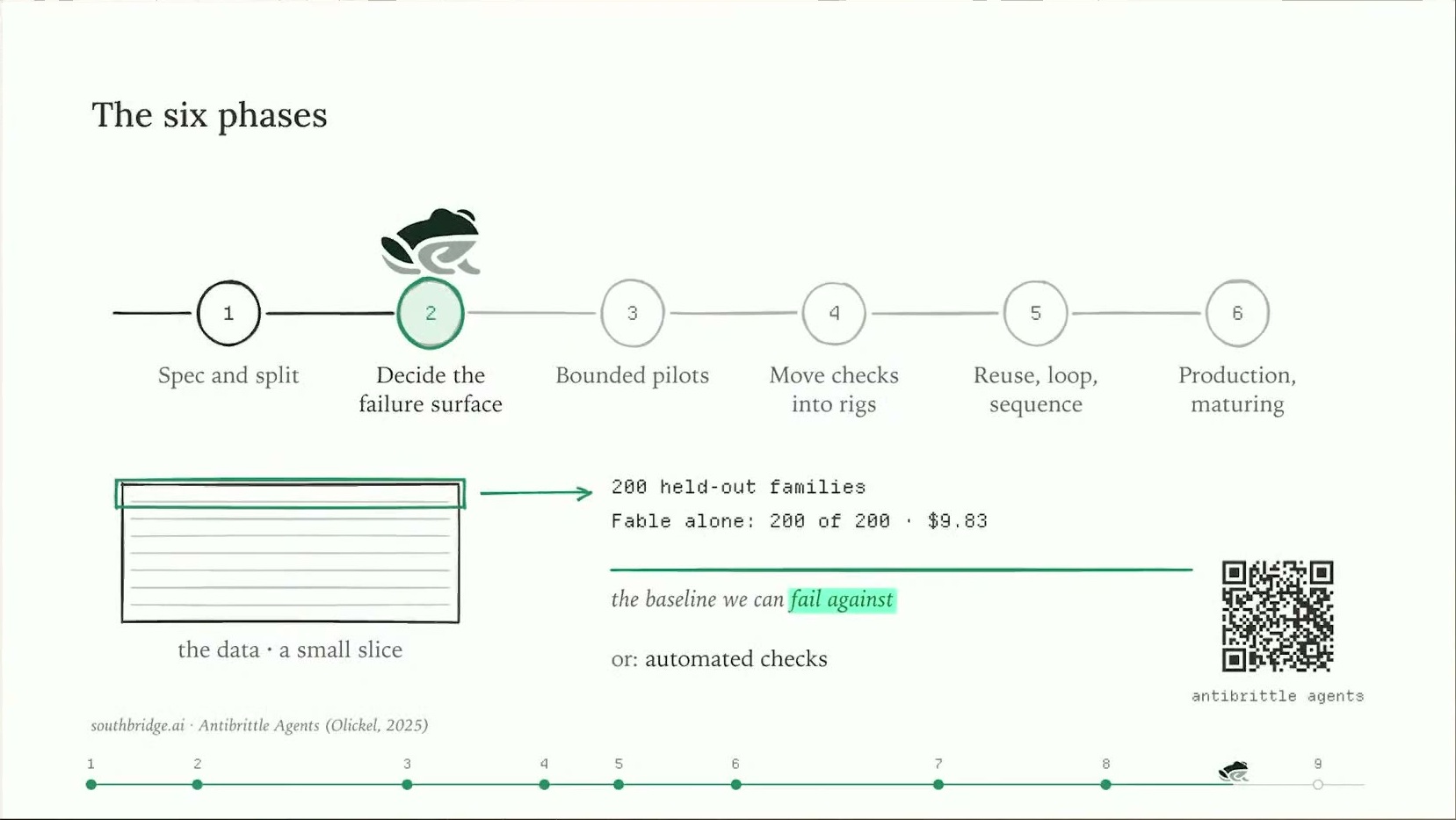
对 Jeff 来说,这意味着把约 800,000 行数据拆成 200,000 个更小、更专门的案例,再把每个案例拆成带类型的问题,比如捐款人类型、是否为同一位捐款人,还有其他不同的问题需要回答。然后我们确定失败边界。在这个案例中,我们在一小部分数据上运行优秀模型,其中有些结果经过人工检查,据此建立一个基线,用来判断何时失败。在其他案例中,我们设置了自动化失败系统、模式检查,也把行为作为一种可以衡量的标准;但一定要在开始之前定义好失败边界,这一点非常重要。接下来就是有趣的部分:我们运行范围最小、边界清晰的试点来测试架构。一旦
and we split it. For Jeff, that means splitting some 800,000 rows into 200,000 smaller specialized cases, and each of those cases into typed questions, what kind of donor, one donor, you know, different, different questions that needed to get answered. Then we decide the failure surface. In this case, we ran good models on a small slice of the data, with some of it being manually checked, to set a baseline that we can fail against. In other cases, we've set automated failure systems, we've set schema checks, we've also covered behavior as a thing that we can measure against, but it's very important to have to define a failure surface before you ever start. But now comes the fun part. We run minimal bounded pilots to test architecture. And once
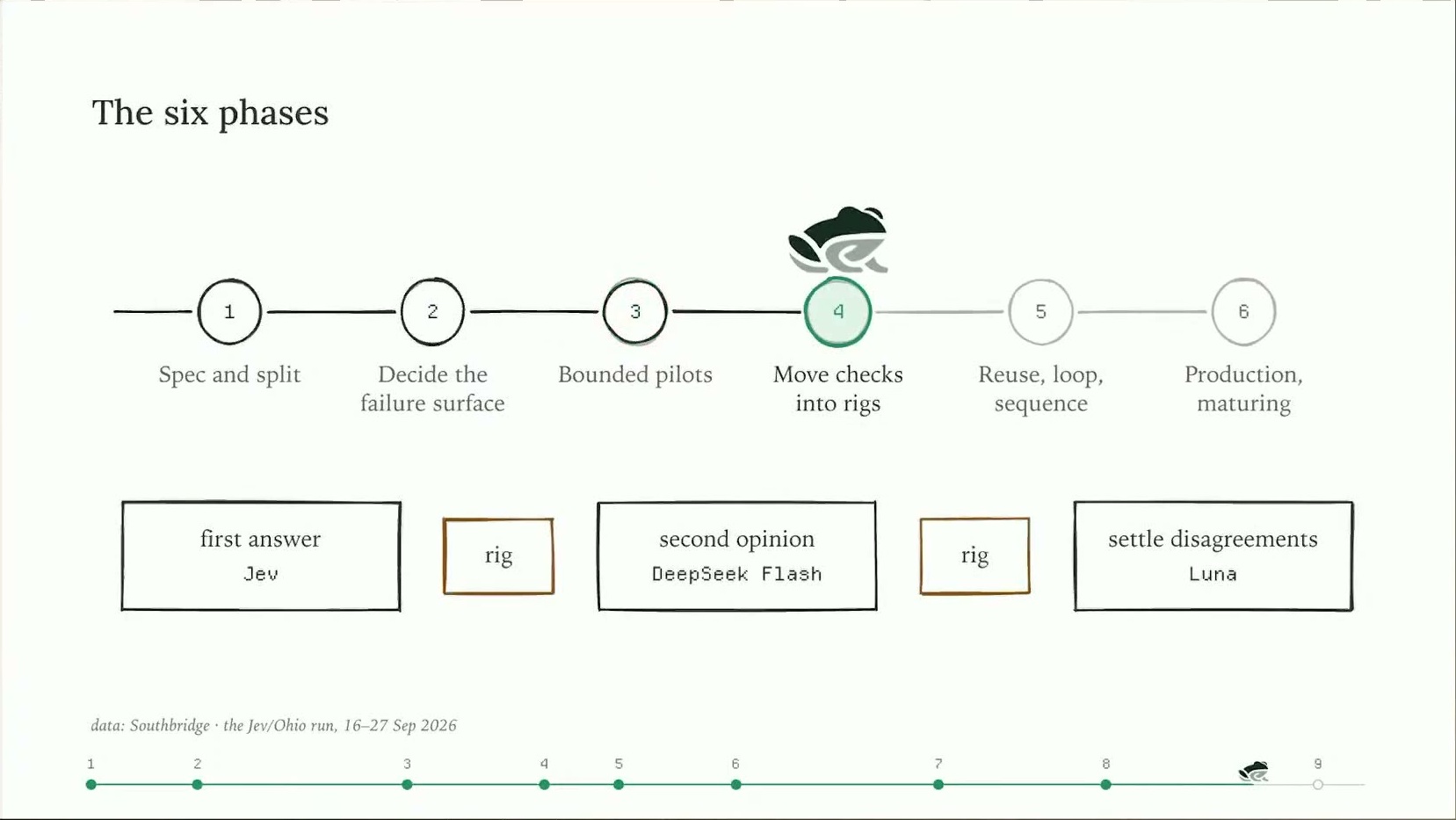
某个方案开始奏效,我们就把这些检查移入 rigs,也就是在边界明确的工作片段之间运行的代码;我们把这些片段称作 codon。之后会重复使用这些 codon,让它们独立循环、验证,再按顺序组合起来。最后,把可运行的流水线部署到生产环境,让它们逐渐成熟。中间这部分就是探索发生的地方。我们先找到一个能给出可靠结果的架构,
something starts working, we move those checks into rigs, code that runs between bounded work segments that we call codons. These codons are then reused, looped independently, validated, and placed in sequence. Finally, working pipelines get deployed to production where they can slowly mature. And that middle part is where the surfing happens. We find an architecture that gives a
把它作为基线,然后替换模型和其他部分,改用更快、更便宜的选项,与已知的中间结果进行比较,并收紧成功要求,每一次都更接近理想方案。你只需观察前沿不断移动。把复杂问题拆成多个部分后,每一部分都能走到自己的最佳位置,正如 Adam Smith 所说。
solid result. We use it as a baseline and we swap models and some other parts for faster, cheaper options, compare against known intermediates, tighten the requirements for success, each time moving closer and closer to the ideal. And you just watch the frontier move. Being able to break a complex problem into pieces means each piece can move to its own best position, as Adam Smith would say.
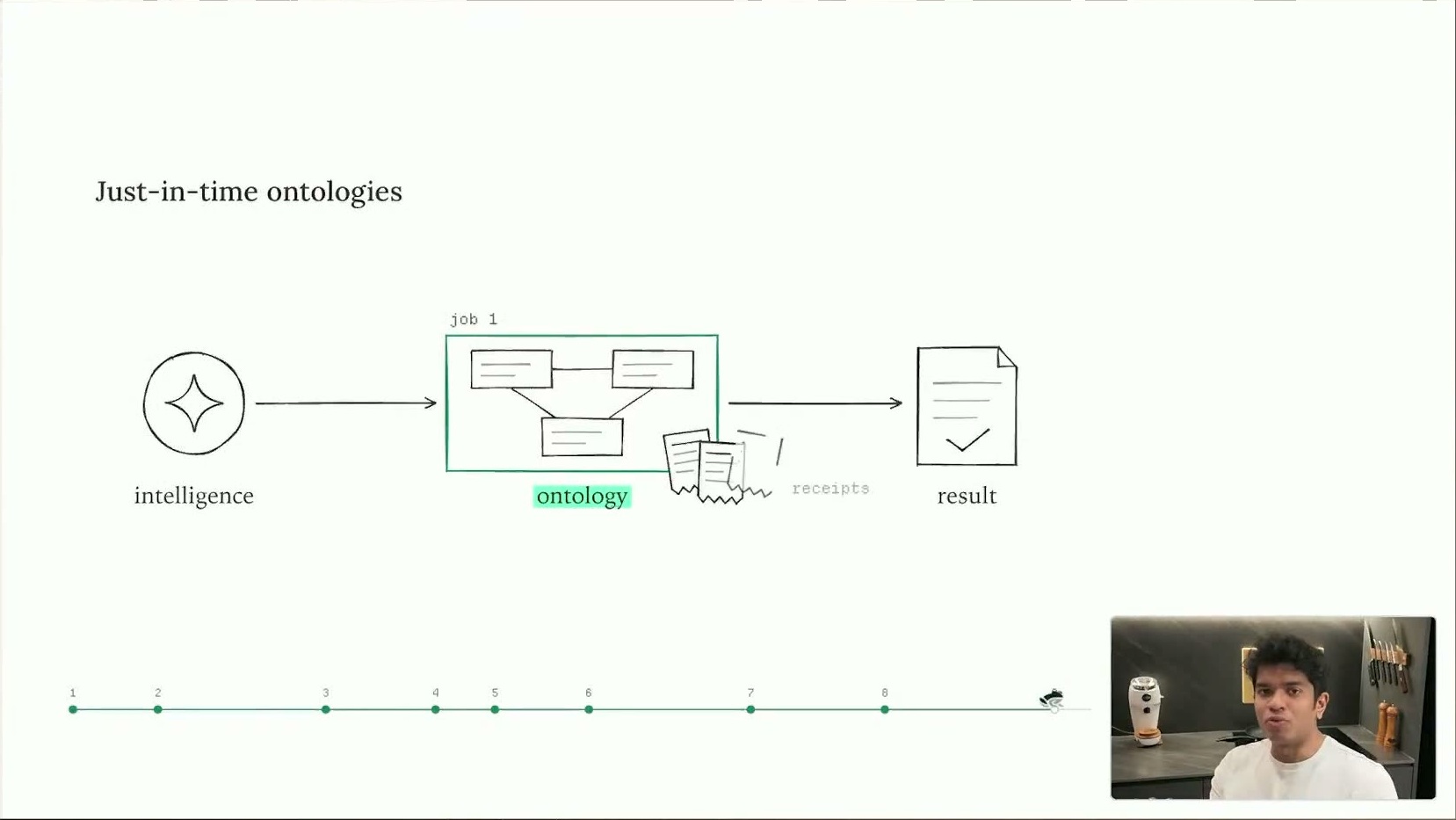
在这样的系统中,本体作为智能与结果之间的中间表示,因此更容易重复使用。这就是我所说的即时本体的另一方面。工作需要时就构建本体,保留其依据和记录,下一个工作需要同样内容时再复用。有了这些之后,就能降低成本。你可以在多个数据集上并行运行它们,以扩大规模。最后我想为此致歉:答案是并不存在本体,至少不存在通用本体。它从来就没有存在过。好消息是,只要能标注并保留周围的上下文,每一种本体和模式都是有效的。如果我们能驾驭这种正开始在周围世界涌现的廉价智能,就会很快迎来这样的未来:任何格式的信息都能发挥尽可能大的作用。
In a system like this, ontologies exist as intermediates between intelligence and result, which makes them easier to reuse. That's the other half of what I mean by just-in-time ontologies. It's built when the job needs it, kept with its receipts, and reused when the next job needs the same thing. And once you have those, you can make these things cheaper. You can run them in parallel across data sets to scale up. I close with an apology, right, that the answer is there is no ontology. Not a universal one, at least. There never was one. The good news is that this makes every ontology and schema valid, as long as you can label and preserve the context around it. And if we can harness this cheap intelligence that's starting to percolate through the world around us, we're rapidly approaching a future where any information in any format is made as useful as it can be.
在 Southbridge,我们正尽最大努力让这个未来成为现实。谢谢。
And at Southbridge, we're working as hard as we can to make that future a reality. Thank you.