基于意图的授权
Intent Based Auth
原文由官网提供,中文由 GPT-6 Luna 翻译。相邻片段合并排版,正文与时间点保持对应。
已插入 1 张经核对的幻灯片或演示截图;点击图片可放大。图注链接为当前视频时间,左侧正文时间保留原转录版本,二者可能不同。
本场抽样画面以现场对谈为主,仅保留标题或嘉宾介绍页;未见可用的内容幻灯片。
共 61 个阅读段落
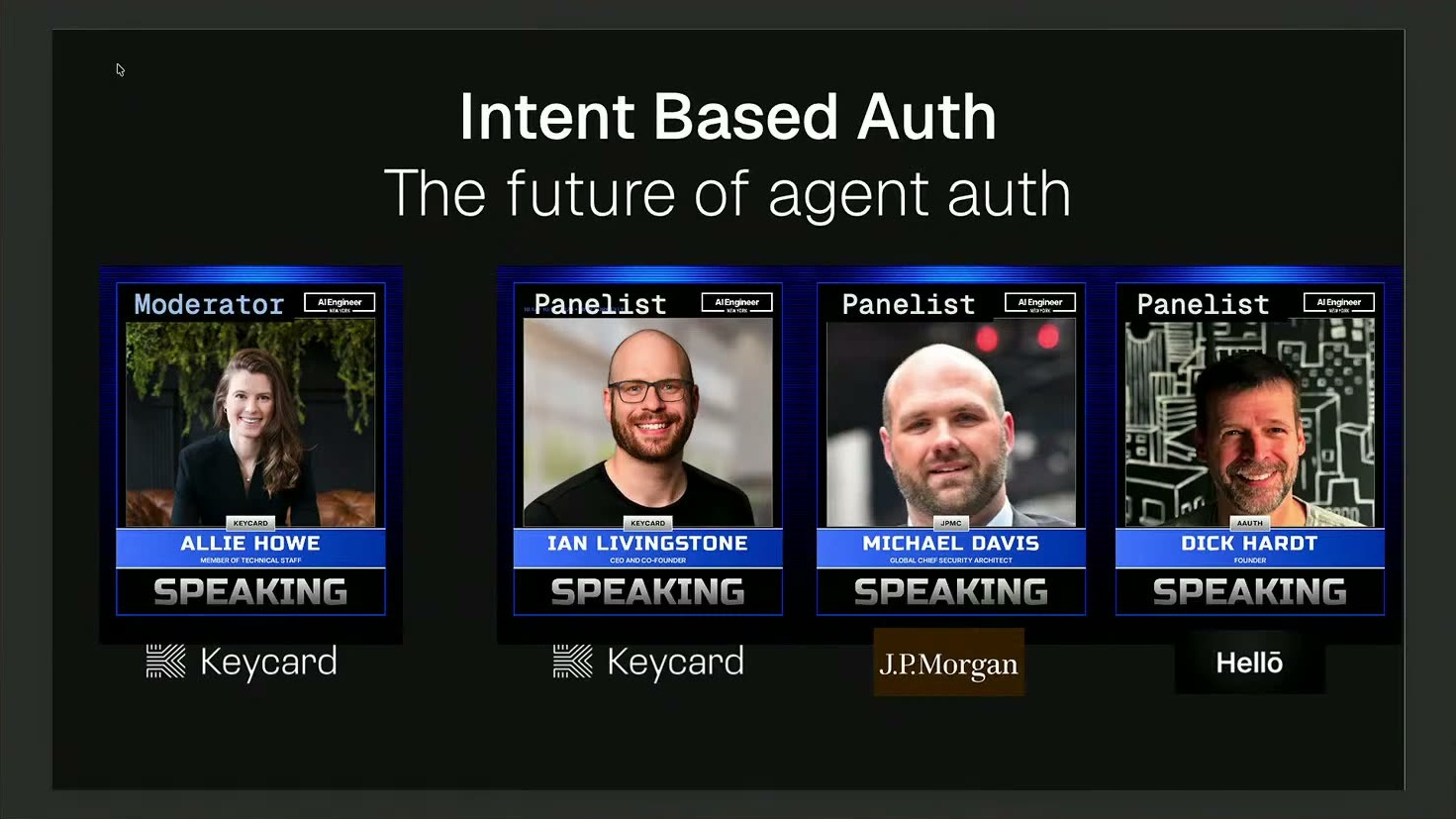
你好。你好。嘿,Dick。嘿,Davis。嘿,Ian。大家好。欢迎来到 AI Engineer New York。我特别高兴今天能来到这里。我叫 Allie Howe。我是 Keycard 的技术团队成员。今天和我同台的是几位很棒的嘉宾。有 Keycard 的 CEO Ian。还有 JPMorgan Chase 全球首席安全架构师 Michael Davis。今天和我们同台的还有 Dick Hardt,他是 AAuth 的创始人,也是 OAuth 的共同创作者。我特别期待和他们聊聊基于意图的授权。
Hi. Hi. Hey, Dick. Hey, Davis. Hey, Ian. Hi, everyone. Welcome to AI Engineer New York. I'm super excited to be here today. My name is Allie Howe. I'm a member of technical staff at Keycard. I'm here with some amazing panelists today. We have Ian, CEO of Keycard. We have Michael Davis, global chief security architect at JPMorgan Chase. And we have Dick Hardt, the founder of AAuth and co-creator of OAuth with us on stage today. I'm super excited to talk to all of them about intent-based authorization.
首先我想指出,随着越来越多公司希望赋予智能体更高程度的自主权,他们开始借助运行时授权。运行时授权是指针对每次工具调用分别授权,而不是让智能体持有广泛的长期访问权限,最终可能会滥用这些权限。不过,判断这次工具调用是否应该获准,绝不是一个简单的问题。这是因为许多 MCP 工具和 API 的粒度很粗,人们很难写出完美的策略,而且智能体运行期间周围环境也会变化。意图能够提供额外上下文,帮助我们在运行时更好地判断授权,决定智能体可以做什么、不能做什么。
And to set the stage, I want to bring to light that as more companies are looking to give their agents increased levels of autonomy, they're looking to runtime authorization to help. Runtime auth is the practice of authorizing an agent per tool call rather than having the agent hold broad standing access that it will eventually misuse. However, is this tool call or not is never a simple question. is because many MCP tools and APIs are coarse-grained, humans struggle to write the perfect policy, and the environment around the agent will change as it runs. And intent can help by providing extra context so that at runtime we can make better authorization decisions about what an agent is allowed or is not allowed to do.
接下来,我想深入聊聊,我们究竟为什么需要基于意图的授权机制。模型的能力已经大幅提升。它们的上下文窗口更大了。由于模型的视觉能力有所提升,它们也能够核验工作成果。在许多场合,人们都在宣称通用人工智能(AGI)已经到来。如果模型这么好,如果 AGI 今天真的已经到来,那为什么各个团队仍难以赋予智能体更多自主权?Ian,我们先从你开始。你在 Keycard 帮助许多金融企业。你看到哪些因素在阻碍他们?我觉得总体来说,企业,尤其是金融服务公司,以及受监管行业,几乎总是把安全放在首位。
So to continue, I would like to talk about, really dive into why do we need intent based off in the first place. have dramatically improved. They have bigger context windows. They're able to verify work because model vision capabilities have improved. and many contexts people are proclaiming that AGI is here. If the models are so good, if AGI is really here today, then why are teams struggling to give their agents more autonomy? Ian, let's start with you. You're helping many financial enterprises at Keycard. What are you seeing that's getting in the way? I think, broadly speaking, enterprises, especially financial services firms, regulated industries are almost always security first.
他们靠安全来建立业务信任,并维持业务连续性;这是我们的首要任务。创新则排在第二、第三,甚至第四位。我觉得大体上,在任何企业里,你都会看到各种零散的小孤岛拼凑在一起,有各自独立的身份系统,也有各自独立的系统,来自各种不同的领域。那么,怎样才能真正把它们整合起来,让智能体能够在其中穿行,申请访问权限,同时又确保智能体不会超出企业用户的意图,做出企业用户原本并未打算让它做的事情?遗憾的是,我们今天的大多数系统粒度都很粗,对吧?比如 Salesforce 就是个很好的例子:很长一段时间里,它的 OAuth 只有一个 scope,也就是 API;放在智能体的场景下,这并没有太大帮助。
It's how they build trust in their business and maintaining the business continuity is by our first priority. Then innovation is second, third, or fourth. I think, like, broadly speaking, in any enterprise, what you see is this, like, hodgepodge of different little islands, of different little identities, of different little systems from across all different worlds. And how do you actually tie that together in a way that an agent can navigate through that, ask for access, and then also ensure that the agent can outperform, like, something that was unintended by the user of the business. And the unfortunate situation is most of our systems today are coarse-grained, right? I don't know, Salesforce is a good example, where for a long time they had a single scope which was API on their OAuth, which is, in the context of an agent, not very helpful.
所以,最主要的一点是,他们今天使用的大多数安全系统都是为这样一个世界设计的:所有决策都由人来做,软件的行为也非常确定,而不是我们新发明的这种新奇魔法盒子,它会不断推理并一遍遍尝试,寻找问题的解决方案。OAuth 是怎样成为问题的一部分的?OAuth 是怎样造成阻碍的?为什么它不适合智能体?当人们开始思考如何授权智能体访问某些资源时,摆在手边的现成工具就是 OAuth。人们拿起这个工具说:工具在这儿。这就是授权。它应该能解决这个问题。
So that's the broadly the first and foremost part, is that most of the systems they have for security today were designed for a world where humans were making all the decisions and software is very deterministic, not this new fangled magic box we've invented that basically reasons and tries over and over again to find a solution to a problem. How is OAuth part of the problem? How is OAuth getting in the way? Why is it not the right fit for agents? When people started looking at how do we authorize agents to access something, the tool that was sitting there on the shelf was OAuth. People grabbed that tool and said, here's the tool. This is authorization. It should be able to solve the problem.
OAuth 并不是为这样的世界设计的。它最初是为了处理这样的问题:怎样让这个网站和另一个网站通信。OAuth 2 中加入了 scopes。在此之前,它就是允许做任何事。但它要求事先完成注册。它还假设会有浏览器参与重定向流程。多年来,OAuth 不断演进,也支持了其他一些场景。但智能体驱动的世界完全不同。我们事先不知道智能体需要做什么。我们必须随着时间推移再做出这个决定。智能体的不同实例会需要不同类型的权限。而且,正如 Ian 所说,scope 的粒度人们会说,我们已经有 OAuth scopes 了,那就把它们映射到智能体上吧;但对于智能体要做的事情来说,这种粒度实在太粗了。
OAuth was not designed for this kind of world. It was designed originally for how do I let this website talk to this website. In OAuth 2, we added scopes. Before that, it was just do anything. But it required you to be pre-registered. It's expecting that there's a browser involved in a redirect. OAuth has evolved over the years to support some other things. But the agentic world is completely different. We don't know ahead of time what the agent needs to do. We need to go and make that decision over time. Different instances of an agent are going to need different kinds of things. and as Ian talked about, the granularity of the scopes that people says, well, we already have scopes for OAuth, let's just map those over to agents, is far too coarse-grained for what agents are doing.
Davis,你看到企业如何逐步赋予智能体更高程度的自主权?是的,我觉得关键在于,怎样处理这种粒度过粗的问题?我观察到,较为成功的企业会像接纳开发者那样接纳智能体,对吧?一开始不会第一天就给你完整的提交权限。你必须逐步获得随着智能体逐渐成熟,再逐步增加能力。因此,企业正在形成的定义是:什么样的上下文能让这个智能体安全?这通常不只是看智能体自己怎么说。它可以对某些事情作出证明,但还要考虑其他因素,比如环境围绕它的环境,以及其他有助于判断自主程度的信息。一个非常简单的例子是:沙箱运行在哪里?它是在沙箱里吗?这类因素都可能改变获准的自主程度。
Davis, how are you seeing enterprises move towards higher levels of autonomy? Yeah, I think the key piece is how do you deal with that coarse-grained problem? And what I've seen the kind of more successful enterprises is they kind of board agents like they onboard developers, right? start with you don't get full commit access day one. You have to go through and add the levels of capability as they mature. So the definitions that enterprises are coming up with are what is the context that makes this agent safe. And it isn't just usually what the agent says. It can attest to something but it's other things like the environment around it and other information that can help you understand levels of autonomy. A very simple example would be where is the sandbox running? Is it in the sandbox? Those type but things can change the level of autonomy that's allowed.
完全正确。是的,我们提到了核心访问权限粒度过粗的问题,为了说明这一点,举个例子:使用 Notion 的 MCP server,你可以说“获取这个页面”,这相当于调用查看页面或获取页面的工具,但你不能只说“获取这个页面上的这个数据库”。基于意图的运行时授权为什么是更好的模式?谁都可以回答。我来试着回答。在我看来,这是金融服务业的一项经验,希望我们能从银行走过的历程中汲取一些经验。很早以前,银行就从对人的身份进行授权和认证,转向对交易本身进行授权了,对吧?
Absolutely. Yes, we mentioned that core screen access problem, and to put that into perspective, to give an example, with Notion’s MCP server, you can say fetch this page, which is like the view page tool or get page, but you can't say just get this database on this page. How is runtime authorization based on intent a better model? That's for anyone. I'll take a shot at it. So to me, this is something that the financial services industry, hopefully maybe we can learn from the background that banks have gone through. Banks moved long ago from authorizing and authenticating humans to authorizing the transaction, right?
而交易是在什么时候发生的?是在运行时,对吧?所以我认为,运行时授权能让我们从过去经历的种种教训中吸取经验,并将其应用到这个新问题上。我还觉得有一点是,理解意图后,在运行时调试问题会容易得多。我想我们都还记得以前,写支票的时候,或者现在大概是在电视上看到这类东西,但写支票时,上面会有一个备注栏,那个备注栏确实是用来说明这笔款项的用途。不过,支票本身也有限制,比如价格、收款人、日期,等等。
And when is that transaction occurring? At runtime, right? And so I think that runtime authorization is we're going to be able to learn from the scars of the past that we've had and apply it to this new problem. I also think that one thing is it's a lot easier to debug something at runtime when you understand the intent I think we've all remembered back in the day writing checks or seen those things on TV now I guess is the right thing but writing checks there was a memo field there that memo field was used to actually tell the intent of what this payment was but the check itself did have limits the price, the payee, the date etc.
我觉得如今正在应用、也可以应用许多这样的概念,来帮助处理运行时的授权。对,意图就是其中一个概念。你知道,有些词就是很难说清楚。接着刚才支付交易的例子来说,那不是一个scope,而是问:在这个特定情境下,我能不能做这一件事?比如这笔付款。但我认为,智能体做任何决定时,我们都需要判断它是否应该获准。我们需要其余所有上下文:我们为什么要付款?之前都发生了什么?我们是不是刚刚才付过同一笔款项,就在五秒前?那现在这是不是重复付款?
I think a lot of those concepts are now being applied and can be applied to help with this runtime time. Intense sort of one of those, you know, like many words, words are hard. And so, you know, building on the example here of making a payment of a transaction, right? You know, that's not a scope. That's, can I do this one thing in this particular context? Well, this one payment. But I think we need an agent to make any decision should it be able to do it. You need all the rest of the context of, well, why are we making this payment? What are all the things that happened before. Did we just make the same payment just like five seconds ago and now this is a double payment?
仅仅因为单看当前情境这件事没问题,并不代表它符合整体任务的要求。在 AAuth,我们正在研究“使命”这个概念,也就是从全局来看,我们希望智能体完成什么?然后,每项决定都要结合具体情境,以及围绕整体目标而产生的意图来做。许多事情都需要在交易层面具备足够细的粒度,才能确切知道正在发生什么,而不是只知道“我可以去付款”。是的,我觉得最有意思的一点是,想一个实际例子,就能理解为什么需要意图:假设你有两个 ChatGPT 会话,或者两个 Claude 会话,在一个会话里,我说:“嘿,帮我去买点东西”,在另一个会话里,我说:“嘿,帮我弄清楚生产环境里为什么有个 bug。”
Just because this is right in context by itself doesn't mean it's the right thing within the broader mission. In Auth, we're working on the concept of a mission that is what do we want the agent to accomplish big picture? And then each of the decisions are made within the context, the intent around what's happening big picture around doing that. and you need granularity at the transaction layer for many of the things to know what exactly is happening, not just I'm allowed to go and make payments. Yeah, I think one of the most interesting things, I think about a practical example, to understand why intents are required, is if you have two ChatGPT sessions or two Claude sessions, in one session I say, hey, help me go do some shopping, in the other session I say, hey, help me understand why there's a bug in production.
这两个会话在应有的权限配置上会很不一样,也包括它们应该在什么时候让你重新参与进来。人应该在什么时候重新介入?归根结底,如果我们没有意图,也没有某种方式来表达用户或企业对此事的意图,我们就无法实现自主运行。今天上午很多演讲都在说:“嘿,我们要让智能体来运营业务。”“我们要让它们做所有这些事情。”很好。如果第一分钟就出现类似 Pocket OS 那样的实例,结果它竟然误删了生产数据库,而不是预发布数据库,因为它拿到的是粒度粗的访问权限,而不是受限范围的访问权限,那会怎样?我们这个行业希望利用自己创造的这个神奇工具,让生活中的事务实现自动化。
Those have very different profiles in terms of what permissions they should have and also when they should bring you back into the loop. When should the human be involved again? At the end of the day, if we don't have intent or some capacity to relay what is the user or the business's intent with this thing, we actually can't get to autonomy. A lot of the talks this morning were, hey, we're going to run our business on agents. We're going to do all this stuff. Great. What happens the first minute, like a pocket OS style instance happens where it actually accidentally delete the production database instead of staging because it has coarse grained access instead of long scoped access. What we want as an industry is to leverage this magic box we've created to automate our lives.
眼下的情况是,你可以这么做、承担所有风险,然后就会看到由此产生的各种后果。在我们解决这个根本问题之前,要实现真正的自主运行,让业务流程落地运行,并让人能够放手、实现规模化,我们必须先解决意图问题。完全正确。现在我们已经了解为什么需要基于意图的授权,接下来谈谈它在实践中是什么样子。有哪些基本要素?实际应用起来到底是什么样的?Dick 刚才提到了 AAuth 的“使命”概念。Dick,请你详细说说这个使命。基于意图的使命是什么?它是基于用户的意图吗?是基于智能体的意图吗?
The current state of the world is that you can do that and take all of the risk and then you can see all of the instances that come from it. Until we solve that underlying problem, realizing true autonomy, being able to operationalize our business and be able to step away as humans and scale that, we have to solve intent first. Absolutely. And now that we understand why we need intent based off, let's talk about what it is practically. What are the primitives? What does it actually look like in practice? Dick hinted at it with the concept of the AAuth mission. So, Dick, elaborate on the mission. What is the mission based off of? Is it based off of the user's intent? Is it the agent's intent?
还是两者结合?智能体应该代表某个人行事。在 AAuth,我们把“人”定义为组织或个人,因为它可能是在代表组织或个人中的任何一方行事。因此,它需要以自己所代表之人的最大利益为出发点行事,因为最终要为智能体所做之事负责的就是那一方。智能体自己无法承担责任。所以,使命就是由某个人交给智能体去完成的事情。一个好的智能体会和人协商,进一步沟通其中的参数范围。举个很好的例子,回想以前——感觉就像三个月前——你想写点代码时,会先制定一个计划,然后智能体执行计划。现在你只要告诉它要做什么,它就会想办法搞定。
Or is it a combination of the two? Well, the agent should be working on behalf of the person. And in AAuth, we define a person as either the organization or a human because it could be operating on either one of those. And so it needs to be acting in the best interest of the person that it's acting on because that is who's ultimately responsible for what the agent does. The agent can't be responsible. And so the mission is something that the person is giving the agent to do. the agent, a good agent, is going to go and negotiate with a person to go and talk more about what are the parameters around that. A good example is when you think of back in the day, which seems like three months ago, when you would want to code something up and you'd create a plan and then the agent would do the plan. Now you just tell it and it figures everything out.
但“计划是什么、你想做什么,然后把这些交给智能体”这一整套概念,就构成了之后做授权决定时所依据的上下文。使命标识符会贯穿整个过程。这样你就可以审计并查看都发生了哪些事情,以及在这个特定使命的上下文中做出了哪些决定,对吧?而今天,我们其实没有一个完善的智能体身份或使命概念,对吧?只是有东西在运行、有东西在做决定,却不知道是哪个智能体实例在操作,也不知道它涉及什么使命、处于什么上下文。多讲讲这个协商阶段吧。
But that whole concept of what's a plan, what are you trying to do, and you give that to the agent, And so then that then is a context around where you're making authorization decisions later on. And then that mission identifier tracks through everything. So you can go and, you know, audit and be able to see what were all the things that happened and what were the decisions that happened in the context of this one mission, right? Where today, you know, there isn't really a good concept of agent identity or the mission, right? It's just making something and things are making decisions without really knowing which instance of the agent is doing it or what's the context of what mission is this involved in. Tell me more about that negotiation phase.
比如,用户正在和一个即时智能体交谈,然后对它说:“我想让你去读 CEO 的邮件。”这超出了那个智能体的权限范围。那么,应该拒绝用户提出的这个意图吗?应该。要做好职责分离,我不记得我们稍后会不会谈到这一点,但工作智能体的职责应该分开:有一个智能体负责执行工作,我们认为应该由另一个独立的智能体来监督它的行为。这样就实现了职责分离:监督者不能执行任何工作,但它负责决定工作智能体可以做什么。
Because what happens if a user is talking to an instant agent and it talks to the agent and says, I want you to go read the CEO's email. That's outside of the scope of that agent. So is that intent rejected from the user? Should be. So with a good separation, I don't know whether, I forget whether we're talking about this later, but the separation of concerns of the worker, right, there's an agent that's doing the work, and we believe there should be a separate agent that's supervising what this one does. And so that you have a separation of concerns where this one can't do any of the work, but it gets decided what this agent gets to do.
所以,如果用户说:“哦,我想让你去读 CEO 的邮件”,这个请求很可能会立刻被确定性策略拦下来。这不是个模糊的问题。读取别人的邮件,我们有很完善的控制措施。但要是让智能体把 CEO 的邮件转发到外部,这就稍微模糊一些;理想情况下,这类请求会交回给负责监督的智能体,由它判断:“这大概不是个好主意。”然后拒绝:“不行,你不能这么做。”完全正确。我觉得这也是基于意图的授权的另一个基本要素,就是策略。
And so if the user says, oh, I want you to go read the CEO's email, that's probably going to get caught in deterministic policies right away. not a vague thing. Reading somebody else's email, we've got good controls for that. telling the agent to send the CEO's, forward a CEO's email to the outside world, that's a little more vague, and that's the kind of thing that ideally comes back to a supervising agent says, that's probably a bad idea. And no, you can't do that. Absolutely. So I feel like that's another primitive, too, of intent-based office, is policy.
Ian,在 Keycard,你们怎么看这个问题?当使命需要改变,或者策略需要更新时,Keycard 如何帮助追踪这些变化,比如使命或策略需要更新的时候?是的,我觉得,退一步来说,其实有一次,我和 Davis 之前坐在一个房间里,那时,AAuth 以及类似的东西还没有在这个生态系统中出现。我们当时讨论的一个问题是同意疲劳。我觉得至少总要权衡:系统要做得多安全,以及这会给人带来多大影响。所以,Keycard 对这个问题的总体看法是,你需要一套广泛而基础的确定性策略,明确规定哪些事情绝对不能发生。或者哪些事情始终需要人工介入。
Ian at Keycard, how are you seeing that? When a mission needs to change or a policy needs to update, how can Keycard help keep track of those changes as maybe the mission or policy updates need to be made? Yeah, I think, like, taking a step back, there's, like, actually, it was Davis and I were sitting in a room some time ago, and before, like, AAuth and some of these things It emerged in the ecosystem. One of the things we talked about was consent fatigue. I think at the minimum you always have this like how secure do you make a system versus the trade-off of the impact of the human. So a key card, our broad view on this is you want to have broad basic deterministic policy that basically says this is what must never happen effectively. Or these are the things that always require a human to be involved.
有了这些之后,接下来真正需要考虑的是:好,行。既然这些已经到位,我作为人,或者代表组织,能够写出的所有策略和我实际上希望针对某项具体任务制定的策略之间,存在很大的差距,尤其是任务的具体细节。真正的挑战就在于:如何把这两者结合起来?因为人根本不可能把所有策略都写出来。所以,其中一种情况是,用户与智能体交互,或者智能体彼此交互,双方之间会有某种意图,也就是交易层面的意图。此外还有企业的意图,也就是企业为什么要构建或采用某个智能体。比如我们为什么买 Claude Code?因为我们希望开发人员能做得更好,或者希望它帮我们完成其他一些事情。
And then from there what you really want to think about is okay, cool. well, now that I have that in place, there's a big gap between all of the policy I can write as a human or write as an organization and then what I actually want the policy to be in the specifics of a specific task. And so the real challenge is how do I layer over those two things? Because humans can't write at all. And so there's a version of that that is like a user or agent-to-agent interaction and they have an intent between those two of transactional intent. And there's also the business's intent for why they build or adopt an agent. So why did we buy Claude Code? Well, because we wanted to make our developers more successful or because we wanted to do these different things.
而在使用 Claude Code 或类似工具时,我此刻为什么要用 Claude Code 工作?因为我实际上是在修复预发布环境里的一个 bug,对吧?这是两种不同类型的意图。如果我们能理解这两者,再以某种方式将它们转化成一个界定智能体可执行操作范围的界定这些智能体可以做什么,然后基本上就能计算这些范围的交集,并明确说:好,你实际可以做这些事。构建这类系统的诀窍在于,如何确保不会把用户拉回流程中,除非绝对必要,因为这会影响产品的采用进程。但这也关系到智能体能否被采用,以及最初能否实现自主运行。有道理。
And in the context of using Claude Code or whatever, why am I working in this moment with Claude Code while it's actually to fix a bug in staging, right? And those are two different types of intent. And if we can understand those two different things and then convert that some way into like a bounding box of what those agents can do, you can then basically calculate the intersection of that and say, okay, here's what you can actually do. And the trick for anyone building these systems is how do I ensure that I don't bring the user into the loop except when absolutely required because that's what's going to be the adoption curve problem. But that's also the adoption curve problem when it comes to, like, enabling agents to be autonomous in the first place. That makes sense.
我喜欢你刚才说的求交集。我觉得这是身份与访问管理领域一个很独特、但讨论得还不够多的方面,对吧?通常你只能获得对某一项资源的访问权限,对吧?我看到,基于意图的方法中比较成功、也让我更感兴趣的一点是,你实际上可以让不同的意图来自组织内不同的部门。因此,这些要素可以彼此解耦,各自独立存在,然后再汇合形成最终的决定。而且这个决定不必是静态的。还是用 CEO 邮件的例子来说,如果上下文表明提出请求的人是行政助理,那她也许确实应该能读这封邮件。或者只能查看日历。
I like what you were saying with the intersection. I think that's a unique thing we don't talk about enough within identity and access management, right? Normally you get access to one thing, right? And so what I've seen successful kind of in this intent-based approach and where I get more excited is you can actually have those different intents be from different areas of the organization. And so you have the decoupling of these things that they can kind of live on their own, but then come together to form that decision. And that decision doesn't have to be static. So if we use the example of the CEO's email, well, if that context involves that's the administrative assistant, then yeah, maybe she is supposed to read the email. Or maybe just the calendar.
所以我认为,当我们开始思考这些交集要素时,就能用一种完全不同的方式来表达策略,也能把方程式中不止一方纳入考虑;过去我们总是只谈应用本身在做什么。现在我们实际上可以把整个生态系统都纳入进来。因此,我越来越看到,组织开始意识到,保持其他要素的状态或上下文,有助于理解意图,并且可以彻底改变你在运行时授权方面的成效。你们现在在企业中看到这种做法了吗?大多数人已经在追踪使命和策略了吗,还是这方面目前普遍缺失?现在还是全新的事物。这也是我很高兴能谈论它的原因之一:它正在改变我们推理和分析问题的方式。哪怕在最简单的情况下,如果你是开发者,并且会从交易等角度思考,也理解意图这些概念,就会更容易构建一些组件,再通过意图将这些组件组合并使用。我认为这会给我们更多方式来推理问题,也让我们更容易沟通,最终提升互操作性。对我来说,最后还有一点很有意思,那就是你可以在这套机制上运行诊断。
And so I think when we see and we start thinking about these intersection components, we have a totally different way we can start expressing policy, but also starting to bring in not just the one side of the equation we always talked about before, which was the app doing something. Now we actually have the ecosystem you can bring in. And so the more I see organizations starting to realize that maintaining that state or that context of these other elements to be able to help with that intention can completely change the way you're effective at runtime authorization. And are you seeing this across enterprises today? Most people have mission tracking and policy tracking in place, or is that largely missing today. It's brand new still. Part of the reason why I'm excited to talk about it is it is changing the way to reason through this. Even in the most simplistic case, if you're a developer and you are thinking in terms of things like transaction and you have these concepts of intent, it makes it easier for you to potentially build the components that will be composed and used through that intention. I think it will give us more ways to reason through these and communicate and ultimately be more interoperable. To me, the last thing that I think is interesting is the diagnostics that you can run on this.
意图可能会贯穿许多事件。我记得以前看到过的一个例子讲的就是使命如何贯穿整个流程。它可能持续很久,比如好几周。意图仍然可以持续存在。所以对大多数企业来说,这仍处于非常早期的阶段。完全正确。是的,互操作性很关键。我觉得这对企业来说相当困难,因为它们要在不同云、不同环境之间操作,还要处理不同的遗留系统,而策略和使命必须贯穿所有这些不同的环节。许多企业还得面对这样的情况:权限明明写着只读,但实际仍然可以读,对吧?对吧?此外还有其他问题需要着手处理。所以,我认为这有助于建立一套分类体系或共同语言,让人们更容易实现互操作。
Intention is something that flows through many events, potentially. And I think one of the examples I've seen before is talking about that mission flows through. It could be long-lived. It could be weeks. That intention can still be there. So it's still very, very early for most enterprises. Absolutely. And yes, that interoperability is key, and I think that's pretty hard for enterprises because they're between different clouds, different environments, different legacy systems, and that policy that mission has to hold through all of those different hops. A lot of enterprises still have to deal with the fact that the permission says read only and it's still read right. Right? It's like, you have the other problems you have to start dealing with. And so I think that it will help get the kind of taxonomy or language amongst people to be easier to interoperate.
完全正确。让我感到兴奋的一点是基于意图的授权,我认为它有能力为很多事情扫清重大障碍,比如智能体驱动的商业。那么,我们把基于意图的授权应用到一个实际场景中。我认为基于意图的授权在这里能发挥很大作用。对用户来说,它能帮助确保自己的智能体用个人预算买到合适的商品。对商家来说,这意味着捕捉到意图,从而获得额外数据,了解某笔购买为什么会发生,以及是否应该信任这个智能体访问他们的网站。Davis,当我们从金融服务和智能体驱动的商业角度思考智能体时,为什么基于意图的授权如此重要?我觉得,简单来说,它扩展了一个概念。也许不是所有人都熟悉,但有些人知道“了解你的客户”(KYC),对吧?我想了解我的客户,知道他们是谁、在做什么。但我觉得我们也开始看到“了解我的智能体”的需求,对吧?所以这里需要把智能体本身、实际用户的意图、运营方的意图联系起来。
Absolutely. One of the reasons why I'm excited about intent-based authorization is because I think it has the ability to be a huge unlock for things like agentic commerce. So let's apply intent-based auth to something real. I think intent-based auth adds a lot of value here. And for users, it can help them ensure their agents buy the right item with their own personal budget. And for merchants, that means capturing the intent that gives them extra data to understand why a purchase is being made and if this agent should even be trusted to visit their site. Davis, when we think about agents in the context of financial services and agentic commerce, why is intent-based auth so important? I think simply it extends the concept, maybe not everybody is aware, but some are around, you know, know your customer, right? So I want to know my customer, know who they are, what they're doing. But I think also we're starting to see I want to know my agent, right? So I think that you have a coupling here around the agent itself, the intent of the actual user, the intent of the operator.
还有处理方的意图,等等。以前我们无法真正把这些因素结合起来。当然,这对商业等场景很重要,因为在此之上还要考虑更多层面,比如相关监管要求的目的是什么,等等。我认为这会帮助简化这些运营流程,这也意味着我们能有更多让这些智能体能更好地为我们做事。有道理。智能体驱动的商业还有一个障碍:互联网并不是为智能体打造的。Ian,能不能说说智能体身份如何提供帮助?是的,我想退一步看,我们一直都有这样一个问题:遇到未注册的客户端该怎么办?
operator, the intent of the processor, right, et cetera. Before now we couldn't really bring those together. It matters of course when it comes to things like commerce because you have additional layers on top of this around what was the intention for things like regulatory requirements, et cetera. And this is going to help, I think, simplify those operations, which means we'll get more access to these agents doing good work for us. That makes sense. And another blocker for agentic commerce is the fact that the web wasn't made for agents. Ian, can you tell us how agent identity can help? Yeah, I think stepping back, we've kind of always had this problem where like, what do you do with the unregistered client?
比如,我打开 eBay,还没有登录,我在用 Chrome,eBay 不知道我是谁,那我该如何以访客身份结账?我该如何批准某个人的操作?我该怎么做,才能让他们说:“好,你可以用 $50 竞拍这双袜子。”我觉得,如果大家都在关注个人智能体领域正在发生的事情,比如 Muse、Instinct 和 GrokBot,还有最近关于个人智能体协议的公告,就会发现一个根本问题:智能体如何访问网站并与之交互,同时让网站知道这个智能体确实可信?很长一段时间以来,网站都在使用验证码,来应对网络上的流量。为什么?因为我们想防止垃圾信息和滥用。
So like, I show up on eBay, I haven't logged in, I'm using Chrome, eBay doesn't know who I am, how do I do guest checkout? How do I approve of a person? How do I, you know, so they can say, yeah, you can bid on this pair of socks for $50. And I think if we're all paying attention to what's going on in personal agents, Muse and Instinct and GrokBot, And recently this announcement around this personal agent protocol is the fundamental problem we have is how do you have an agent show up to a website, be able to interact with the website, know that you actually can trust that agent, so for a long time it captures on the web. Why? Because we want to prevent spam, we want to prevent abuse.
所以我们加上了 CAPTCHA,只有人类才能解答。如果有 CAPTCHA 能拦住垃圾信息,让它们没法刷屏,那么现在智能体出现了,它们已经破解了 CAPTCHA。但这一直是互联网面临的传统问题。事实上,回想两三年前,Vercel,我想大家都知道这家公司,曾在西班牙遭到封锁。Vercel 为什么在西班牙被封锁?因为 Vercel 的所有主机都共用同一批 IP 地址,而其中有一台 Vercel 主机,也就是他们托管的一个网站,在播放类似英超联赛的内容。西班牙于是决定:“为了阻止英超内容在西班牙境内被非法播放,我们要把整个 Vercel 都封掉。”智能体也遇到了和 Vercel 一样的问题,只是情况要严重得多。
So we added captures and that's something only a human could solve. So if we have a capture that stops spam so they can't spam the thing. Now we have agents and they've broken captures. But this has been a traditional problem on the web. In fact, if you think back two to three years, Vercel, which I think we're all aware of, was blocked in Spain. Why was Vercel blocked in Spain? Because Vercel shared the same IP addresses for every single host on Vercel, and there was one host on Vercel, one website on Vercel that they were hosting that was hosting, like, premier league content. And Spain decided, hey, in order for us to stop that premier league content being displayed illegally inside Spain, we're going to block all of Vercel. In the same way that Vercel has the problem, agents have the same problem, but so much worse.
有一批从未见过、也没有注册的流量来到你家门口,你要如何判断是否放它进来?这是我们首先必须解决的根本问题。Muse 和 Instinct 也面临同样的问题。他们想做的是:我们怎样才能建立大家都能遵循、彼此认可的规则,让我作为下游资源,可以根据用户的身份,决定允许哪些智能体、信任哪些智能体。而在另一端,我也能知道如何与这些用户沟通。有道理。Dick,AAuth 如何帮助开启智能体驱动商业的未来?一个关键问题是,很多人一直在构建专有的封闭式系统,对吧?
How do you have unregistered traffic you've never met before, show up to your front door and decide whether or not you let it in or not? That's the first and foremost fundamental problem we have to solve. It's the same issue with Muse and Instinct and what they're trying to do is how do we actually create agreeable rails so we can all operate on so as a downstream resource I can decide what agents will allow, who I trust, based on who users they are. And then on the other side, I can also know how to talk to those people. Makes sense. Dick, how is AAuth helping unlock the future of agentic commerce? Well, a key thing is a number of people have been building sort of proprietary closed-box systems, right?
我很赞同个人智能体协议 Poppy 这个概念,但它还不够全面,对吧?这就像,好吧,我们现在有了一点智能体身份。我们只是用了一些现成的构件,这种做法很有吸引力,因为马上就能用起来,但它没有解决智能体驱动的世界所需的许多新问题。人们制定标准的一个重要动机是,这样就能接入来自不同地方的组件。我坚信,我们应该能够控制自己的智能体做什么。总有一天,智能体会承担大量工作,我们不可能让人类参与审核并批准每一件事,对吧?
So I'm a fan of the concept of the personal agent protocol poppy, but it doesn't really go far enough, right? It's like, okay, well, now we've got a bit of an agent identity. We just use some of the building blocks, and it's an attractive approach because you're just doing it, but it doesn't solve many of the new things you need for an agentic world. And so a key motivator for people for having standards is that you can plug components from different places. So I'm a strong believer that we should have control over what our agents do. At some point, agents are going to be doing so much work, there's no way we can have human in loop approving everything, right?
这根本行不通,我们已经看到这种模式无法规模化。所以我们需要一个监督智能体,由这个监督智能体来执行我们的策略,决定我们应该如何做事,而且它应该独立于那些执行所有工作的智能体。如果我们想要灵活接入、随插即用这些组件,就需要通过协议把它们分开。否则,智能体能做什么、不能做什么,有哪些防护规则,都会由智能体以及智能体供应商来决定。我并不想把控制权交给他们,让他们决定我能做什么,还让我的所有决定都基于他们的系统。我希望能把监督职责交给另一个组件。
That's just not, we've already seen that that isn't going to scale. So that means we need to have a supervising agent that is our supervising agent that runs our policy and decides how we do things that should be independent of the agents doing all the work. And if we want to be able to plug and play those things, we need to be able to have a protocol to separate those. Otherwise, you know, the decision about what the agent can and can't do, what the guardrails, is decided by the agent, by the vendors of the agent around what you can and can't do. And I don't really want to go and give control to them to decide what I can do, and that all my decisions are based in there. I want to be able to pull that supervision into another component.
为了能够灵活接入各个组件,我们需要一套让它们彼此互操作的协议。我想补充一点。我觉得现在我们都希望互联网采用联邦式架构。这意味着网上的网站或资源可以自行决定允许执行哪些操作,但支撑这些操作的标准应该是联邦式的,让大家都能互操作。我觉得我们正处在一个关键时刻。现在有几家大型参与者,这个行业要考虑的是,我们会不会选择那些实际上偏袒大型参与者、偏袒大型参与者、为他们设置明确的封锁门槛,还是继续做我们一直在做的事,也就是构建联邦式协议?比如 OIDC,还有 TLS 之类的协议,它们支撑并推动了广阔的互联网,让大量商业活动得以开展,让大量信息得以流通,也让我们所有人能够以某种方式谋生,这都是因为我们可以不断创新。
And in order to be able to plug and play pieces, we need to have a protocol that things interoperate. I would just add to that. I think right now what we're seeing is we all want the web to be federated. That means websites or resources on the web can decide what they're allowed to do, but the standards upon which things operate should be federated and enable us all to interoperate. I think we're at a moment where things like, you know, we're at a moment where there's a couple large players, and the question for the industry is, are we going to settle on things that actually bias to the large players and give them, like, concrete blocked doors, or are we going to move to do the thing we've always done, which is build federated protocols? Things like OIDC, things like, you know, TLS, those things operated and enabled, like, a broad web, enabled a lot of commerce to occur, enabled a lot of information to flow, enabled all of us to have jobs in a way that because we could be inventive.
所以,我真正想问整个行业的问题是:这些新事物就要来了,无论如何,我们希望生活在哪一种世界里?我觉得有意思的是,假设这一切都进展顺利,智能体开始代人购物,大家都挺满意。我认为接下来我们会意识到,还有另一件事需要着手处理,那就是人本身。我觉得,当你开始让意图参与其中时,就会产生所谓的心理所有权,也就是说,现在我确实在人与智能体的结果之间建立了联系。如果你只是把两者分开,或者用 OAuth scope 之类的方式把它们联系起来,或者放在某个声明中,这就有点像魔法。
And so the question I actually ask the broad industry is, okay, this stuff's coming, which version of the world do we want one way or the other? I think it's interesting that, let's say this all goes perfect, and we've got agents buying stuff and everybody's kind of happy. What I think will end up happening is we'll start realizing that we have another piece that we have to start working on, which is the human itself. And so one of the things I think when you start having intents being involved is you get what's called psychological ownership, meaning I actually now have a linkage between the human and the outcome of that agent. When you're just kind of disconnecting it or you connect it up on an OAuth scope or something like that in a claim, it's kind of magic.
你其实不知道发生了什么。因此,我认为有了意图,出了问题时,人们就更容易承担责任,并为此负责。我觉得,当你谈到真实资金转移等事情时,你希望最终由人来承担责任。我想很多人可能都见过1979 年的 IBM 手册。它上面写着,你知道,所以,我觉得那张照片表达得很准确:我们不能让机器承担责任,对吧?我们必须把人和它联系起来,我认为意图正是这种联系。是的,而且正如我们昨晚所说,意图的另一个说法是动机,对吧?让某人承担责任的能力,无论对象是人还是智能体,我觉得都非常重要。
And you don't really know what's going on. And so I think with intention, it'll be easier for humans to take accountability when things do go wrong. And I think when you're talking about real money being transferred or things like that, you want to have that human ultimately accountable. I think many people have probably seen the 1979 IBM manual. It says, you know, and so that photo I think is very true that we can't have the machines be accountable, right? We're going to have to have the humans linked to it, and intention, I think, is that link. Yes, and then, yeah, another word for intent is motive, like we were talking about last night. And that ability to hold someone accountable, whether it's a person or an agent, I think is really important.
我认为意图也能帮助做到这一点,帮助我们理解为什么出了问题。是用户的目标不一致吗?还是智能体的目标不一致?然后我们可以利用意图来做出回应。你们每个人怎么看意图带来的这些好处,以及如何应对可能有恶意的用户或智能体?我觉得这又回到了我刚才提到的诊断问题。如果把“意图”换成“动机”,那么“诊断”就变成了“取证”。我认为,任何做过调试的人,或者不得不调查失控 AI 智能体的人,都知道,想弄清它试图做什么以及用户的意图是什么,是非常困难的。
I think intent can also help with that, be able to understand why did this go wrong? Was it the user was mal-aligned? The agent was mal-aligned? and then using that intent to be able to respond. For each of you, how are you seeing intent provide that benefit and the ability to respond to potentially a maligned user or agent? I think it's going back to what I mentioned before about diagnosing. So if you change the word intent to motive, then you change diagnostics to forensics. And I think anybody who's done debugging or had to do forensics of an AI agent gone rogue will know that trying to figure out what it was trying to do versus what the intention of the user was is very hard.
对吧?如果有些信息能够在系统中传递并且不可篡改,就能带来一些特性,让调查过程大大缩短,等等。随着这些机制实现更好的互操作,我认为我们会开始看到企业能更快地厘清范围并判断:这是人为错误吗?这是智能体的软件错误吗?具体是什么错误?然后适当地控制影响范围。我们在金融系统中就能看到这样的做法。交易时会遇到不同情况,比如,好,我付了这笔钱,但金额不对,或者发生了类似的问题。你会有明确的处理指南,但现在出了问题时,我们还没有多少这样的机制。所以我认为,意图有助于我们在今后的工作中逐步建立这些机制,并持续完善。
right? So having some of that information being propagated and immutable through the system, et cetera, gives you some properties that allow you to more short circuit your investigation, right? And as those things become more interoperable, I think we're going to start seeing companies be able to more quickly kind of scope and identify, well, was this a human error? Was this an agent software error? What was that error? And handle that blast radius appropriately. We see in the financial system, right? You have different things when you're doing a transaction around, okay, I made this payment, but it was incorrect dollar amount or whatnot. You have clear guidelines on how to work with that. We don't have a lot of those when things go wrong right now. So I think intention will help us build those as we go forward.
我觉得,最近有一个事件体现了一个问题:意图,可能是好的,但仍然会采取错误的行动。这个例子是最近发生的 Resi 事件,当时,一个 Instinct 智能体代表用户访问 resi.com,试图预订餐厅。这个智能体非常积极,每小时发出 200 次 API 调用,最后导致用户的Resi 账户被封禁。Dick,像这样的智能体过度消耗下游资源时,AAuth 的预算机制能如何帮助?即便它的意图仍然是好的?是的。
And I think one area where a recent incident kind of highlights where intent, you can have good intent, but still take potentially the wrong action is the resi incident that happened recently where an instinct agent went out on behalf of a user and tried to book a restaurant reservation on resi.com. That agent was very eager at 200 API calls an hour, and it ended up getting the user's resi account banned. Dick, how can AAuth budgets help in the case where an agent like that is using way too much of a downstream resource, but it still has good intent? Yeah.
这又是一个例子,说明在智能体驱动的世界里,软件已经完全不同了。以前软件的行为是预先确定的,你知道,如果你调用了200 次,那就是个 bug,你会修复它。现在智能体会想:“那我就一直试,直到成功为止。”我们在和别人一起试验、使用 AAuth 的过程中也看到了这种情况,并意识到智能体会学到某些做法,然后不断滥用系统;它们并不觉得这是滥用,也不知道这有什么问题,因为没有任何信号告诉它们:“哦,我应该只使用这么多资源。”所以我们引入了预算的概念:不仅给智能体一个有时限的 token,限制它能执行某项操作的时长,还要给它一个可使用资源数量的预算。
Well, this is another example about how just software is completely different now in the agentic world, right? When it was predetermined software, you know, that was a bug if you called 200 times and you would fix it. Where now, well, the agent's like, well, I'll just keep trying until they win. And so we saw that as we were, you know, experimenting, working with people with A-Auth, and we realized, yeah, there's a big problem that agents will learn something and they'll just abuse the system from, they don't think it's of abuse, they don't know any different, there's been no signal to tell them that, oh, I should only use this amount of stuff. And so we added the concept of budgets, where not only do you give a token to the agent that's time-limited as to how long can they do a particular action, but also a budget of how much resource they can do.
这样,它就能一直访问,直到 token 过期或预算耗尽。当它回来时,如果预算已经用完,监督者就可以决定是否要给这个智能体更多预算。这和传统的速率限制不同,传统方式只会直接切断访问,之后你能怎么办呢?智能体也不知道自己为什么被切断,或发生了什么。预算机制则会持续向智能体反馈,它已经消耗了多少预算,让它了解自己还有多少预算,这样它就可以在预算范围内运行,对吧?就像人一样,知道某种资源很稀缺,就会谨慎控制用量。
And so they have access until the token's either expired or they've exhausted the budget. And so that way, when they come back and they've exhausted all the budget, the supervision, you can go and decide, should I give more budget to this agent or not? As opposed to traditional rate limiting, which just cuts it off, and then what do you do? And it doesn't know, well, why did I get cut off or anything like that? Where in budget, there's continual feedback to the agent about how much budget was consumed, has an idea about how much budget it has, and so now it can operate within a budget, right? Like a person would do, about, oh, this resource is scarce, I'm going to be careful about how much I use this.
那么,“大脑与双手”的架构概念如何在这里发挥作用,帮助我们在预算即将用完或已经用完时,利用大脑和双手的职责分离,以及与智能体和模型本身分开的访问权限和凭证,阻止智能体过度使用下游资源?比如预算快用完时,我们就可以不再给它新的凭证。抱歉,我没太听明白。这里的回声太严重了。没关系,这个问题谁都可以回答。基本上,这套大脑与双手架构是我们这个行业正在逐渐形成的做法。我们基本上会把凭证和访问权限与智能体本身分开。
And how does the brains versus the hands architecture concept come into play here to allow us to, okay, when a budget is close to being fully reached or is reached, how can the brain and hands separation of access and the credentials being separate from the agent and the model itself help us to be able to stop an agent from using too much of a downstream resource? Because if it's getting close, then maybe we don't exercise the ability to give it another credential, for example. Sorry, I didn't quite follow The echo in here is horrible No worries, that's for anyone But basically, so with the brains And the hands architecture that we're Converging on in an industry, we're basically Keeping the credentials and the access From an agent separate from the agent itself
因此,智能体不会像现在这样拥有广泛的长期访问权限,也不会持有 API 密钥。我知道这是 AAuth 的一个优点:AAuth 允许智能体在没有 API 密钥的情况下运行。这在什么方面有帮助?尤其是在 Resi 事件的背景下?你已经能访问它了。抱歉,我还是不明白。我可以接着解释。Dick,我明白你的意思了。总体来说,回想一下我一直记在脑海中的一个事件,就是 Pocket OS:我在磁盘上发现了一把随机的密钥,就在磁盘上。显然,智能体有很强的目标驱动力。所以问题的核心是,如果我们给这些智能体一个大脑,也就是模型,也就是 LLM,然后再给它们双手,也就是把它们放进一个沙箱,沙箱里面放着工具。
So there's no broad standing access That an agent has today, no API keys Which I know is a benefit of AAuth That AAuth allows agents to run without API keys How is that helpful In the context of the Resi incident? you've got the access to it sorry I still don't understand I can jump in I got you Dick broadly speaking I think if we look back at an incident that I just keep on top of my mind it's like Pocket OS where I found a random key on a disk obviously agents are deeply goal seeking so the core of the question is like okay well if we give these agents, the brain which is the model and the LLM and you have these hands which is you kind of put them in a sandbox and inside the sandbox are the tools.
沙箱这个方案的最终理念就在于你可以控制其中包含什么。这样智能体就无法直接取得API 访问权限。如果你在沙箱外面设置一个出站代理,授权边界就可以设在那里。所以它不仅能够在不同系统之间进行转换,AAuth 就可以在这个环节发挥作用,与外部世界通信或做出判断,还意味着你可以对智能体实施授权,并把授权边界设在出站代理处。所以我认为,核心在于,这种模式——目前 Anthropic 和 OpenAI以及许多其他实验室正在采用的主流模式——能让我们同时拥有所需的两方面能力:让这些东西进行实验,尝试各种方法、做些看似愚蠢的事情,这正是它的核心价值;同时在外部设置确定性控制层,用于实现 AAuth 这样的机制,以及协议中我们需要的其他所有组件。
The final idea of the sandbox here is that you can control what's inside of it. So it can't actually get API access. And then if you have an egress proxy outside the sandbox that's where you get to have your authorization boundary. And so not only does it help do translation between systems which is like that's where AAuth can exist and talk to the outside world or determination but also means that the agent you have an ability to apply authorization at the egress proxy boundary. And so I think at the core of it, that model, which is the predominant model of Anthropic and OpenAI and many other labs are pursuing today, is the model that allows us to both have the things we want, which is how do we have these things experiment and try stuff out and do silly things, which is the core value, while also having a deterministic layer outside of it that can implement things like AAuth and all the other components we want in our protocols.
我认为这种解耦很有价值。回到我刚才提到的取证,以及把事情分开的做法;不过我确实认为,我们还需要继续学习,因为事情并非只有一个大脑那么简单。其实很容易构建智能体循环,把大脑放在循环内部,而不是外部。比如,有人在使用记忆系统,他们放入一些记忆和上下文,之后这些信息就会被每个后续智能体使用,进而影响智能体做出某种决定,让这里的“双手”去做不该做的事。我觉得有一点我们在这里讨论得还不够,那就是有害组合。如果把双手和大脑分开,等等,你实际上可以更换可用的双手。
I think the decoupling is valuable. going back to what I mentioned with forensics and be able to separate things, but I do think that we still have a lot to learn on it isn't just one brain. It's very easy actually to build your agent loop where you put the brain in the loop rather than outside the loop. An example of this would be people that are leveraging memory systems. They put in some memory and some context that is now used going forward for every agent that is biasing that agent to make a decision to tell the hands, in this case, to go do something it shouldn't do. One of the things that I think we don't talk about enough here is toxic combinations. And so when you do separate the hands and the brain and whatnot, you can actually change up what hands are available.
我见过一个很成功的例子,就是移除工具,根据当前大脑的状态动态调整,以及它正在做什么。比如前面提到的读取邮件,并没有规定说,如果智能体要去写邮件,我就会禁用所有网页搜索工具调用,或其他外部出站能力。具体到工具调用层面,在合适的邮件工具完成使命之前,我都可以先禁用它们,等任务完成后再重新启用。所以我认为,我们会越来越多地开始围绕这些不同概念开展工程实践。它们仍然复杂,仍在发展,也还很新,但我觉得这种职责分离比我们现在的做法更好。是的,我们讨论的这些东西听起来可能有点极客,但它们最终会和真正的智能体工程问题结合起来。
So the example that I've seen be very successful is the removal of tools dynamically based on that actual brain and what it's doing. So the earlier example we gave of reading an email, there's nothing that says that, oh, if they're going to go write an email, I'm going to disable all web search tool calls or any other external egress capability tool call wise until the right email tool has been complete and that mission has been done, then I can re-enable them. And so I think that we're going to start becoming more and more engineering at these different kind of concepts. They are still complicated, they're still growing and still nascent, but I think it's a better separation than we have today. Yeah, and this is how these things we're talking about, which seemed like geeky problems actually then merge back up to real agent engineering problems, which is
如果你真正理解自己在做什么,就会发现一个最常见的抱怨——现在少一些了,但仍然是最大的问题之一——就是上下文膨胀。不过,意图系统能够确保在合适的时间向智能体提供正确的能力,这样它们就不会花很多时间去做不该做的事情。这能帮助它们朝着目标状态前进,让它们沿着更明确的路径行动。所以,意图不只能解锁很多安全能力,也能让我们减少token 消耗,因为智能体会少花时间做偏离正确路径的事情,或者它会及时停下来告诉你:“嘿,我做不了。”因此,我们从这个时代了解到,很多工作都是要把智能体引导到正确方向,并确保它无法做错事,这样才能得到想要的结果。
if you actually understand what you're doing, one of the biggest complaints, less now, but one of the The biggest complaint is context bloat, but intent systems can ensure the right capabilities should be given to the agent at the right time so they don't spend a bunch of time doing things they shouldn't be doing. It helps them navigate towards the goal state and put them on more of a paved path. So intent not only unlocks a bunch of security stuff, intent also will result in us spending less tokens because the agent will spend time doing less things that aren't the right pathway or it'll come up to the point and say, hey, I just can't do it. And so what we know about this era is so much of it is about nudging the agent in the right direction and ensuring you can't do the wrong thing, and that's how you get the outcome you want.
Davis,你怎么看基于意图的授权在生产环境智能体整体策略中的作用?我知道,在构建、部署和运营生产环境中的智能体时,团队需要考虑许多不同的结果,例如发现当前运行着什么、智能体具备哪些能力,验证输入和输出,像我们刚才讨论的那样限制智能体,以及使用出站代理和不同的网络规则。这些做法如何配合起来,而如今企业里有哪些实践有效,能真正帮助团队把智能体发布到生产环境?我觉得我们正在逐步跟上。它正在推动讨论从身份认证转向授权,并开始认真思考如何进行动态授权。
Davis, how are you seeing intent-based auth as part of a larger strategy for production agents? I know when it comes to building, deploying, and operating agents in production, there's many different outcomes teams should be thinking about, such as discovering what's running, what the agent's capabilities are, the ability to validate inputs and outputs, constraining an agent like we talked about and using the egress proxy and different networking rules. How does all of this fit into play and what's working inside enterprises today to really be able to ship agents to production? I think we're following. It's helping move the kind of conversation from authentication to authorization and really like how do we do dynamic authorization?
我该如何验证授权?我该如何在合适的时机让人参与审核?因为我同意 Dick 先前说的,人在回路在很多方面都算是一种反模式,对吧?因为人会疲劳,等等。但你需要有办法让人介入,在重要的时候参与进来。以前这些都不属于工程讨论的内容,对吧?现在它们已经成为工程讨论的一部分,工程师也参与授权流程。他们不再只是说:“哦,我拿到访问权限了,可以开始干活了。”所以这确实改变了我们对前沿模型的看法。也改变了我们看待应用整体攻击面的方式。因此,我认为现在大家把这套授权模式视为另一组可用工具,用来减少安全问题,也直接降低智能体的错误率,对吧?
How do I validate that authorization? How do I have the human in the loop at the right time? Because I agree with what Dick was saying earlier that the human in the loop is somewhat of an anti-pattern in many ways, right? Because they can get fatigue, et cetera. But you need to have a way to bring them in when it's important. Those were not engineering discussions before, right? Now they're actually part of the engineering conversation where engineers are being involved in the authorization process. They're not just saying, oh, I've got my access, I'm good to go. So that actually changes the way we're seeing front models done. It changes the way we're seeing the full attack surface of applications in general. And so I think you're now looking at this authorization model as another kind of set of tools that you can use to reduce not just security issues, but flat-out error rates of your agent, right?
我的意思是,智能体能做的事情越少,它做出的决定就越好,对吧?我们在现实场景中看到,智能体循环确实变得更好、更快、更强,因为你花时间了解了它们想实现什么意图,以及它们要完成什么使命。最后一点是,这让不同的人能够聚在一起,比如安全团队和应用团队,现在可以一起讨论,并使用同一种语言。过去谈到身份管理时,大家说的完全是另一套语言,对吧?大家只会说:“别挡我的路,我要怎样才能拿到 token,然后继续干活?”现在他们看到,这些东西其实可以结合起来,并利用这种能力提高效率,改善智能体最终完成任务的效果。
Like, I mean, when you have less things the agent can do, it makes better decisions, right? And so fundamentally, we've seen, you know, real-world cases where the agent loop is just better, faster, stronger because you've actually spent the time on knowing what is the intent they're trying to get, what's the mission that they're trying to accomplish. And then last thing is it brings the people together in terms of, we now have other different people, the security team, the application team, they're now able to have a conversation that they're using the same language. And a lot of times when it came to identity, it was a completely different language, right? It was just like, get out of my way, what do I have to go do to go ahead and get my token and I can go forward. Now they're seeing that you can actually pair these things and leverage that capability to drive efficiency of your actual agent's outcome.
有道理。Ian,你们如何把这些概念应用到软件工厂?我知道你们今天发布了一个安全软件工厂参考架构。你们如何把运行时授权、限制智能体等概念应用进去?是的,我们刚刚发布了一份参考架构,放在 agentbaseline.org 上。我们谈到了工厂的三个不同层级:一个是由人驱动的,一个是由工作流驱动的,一个是由智能体驱动的,也就是我们大家基本上都希望达到的状态,由智能体来驱动。在整个过程中,运行时授权都是更大生态系统中的核心组件。它实际上让工厂能够朝这个方向运行,并做出正确的事情,同时获得合适的资源访问权限。
That makes sense. Ian, how are you applying these concepts to software factories? I know today you released a reference architecture on the secure software factory. How are you applying the concepts of runtime authorization, constraining agents, and all of that to that? Yeah, I think, like, so there is a reference architecture we just published on agentbaseline.org. We talked about three different levels of factory, one being, like, a human-driven one, one being a workflow-driven one, one being, like, this agentic-driven one, which is, like, the thing we all basically want to get to, which is, like, it's driven by agents. And at all points in time, the runtime authorization is a core component of a larger ecosystem. It actually enables the factory to be able to be pointed in that direction and do the right thing and also get access to the right piece.
它和过去使用的东西不一样,比如密钥管理器,因为它做出的决策与以往管理确定性软件的方式非常不同。但它是让整个体系运作起来的核心组件,比如什么时候让人参与,智能体可以把什么工作交给哪些其他智能体。智能体怎样才能访问生产系统并自动修复问题?这些都是如何大规模解决软件问题的根本性问题。如今我们面临这样的局面:我们从未能够生成这么多软件,但在将软件部署到生产环境并确保它正常运行方面,却遇到了严重瓶颈。下一个阶段是:如何从仅仅使用 L1 生成文本和软件,发展到让它能够把软件部署到生产环境、持续迭代,迅速让它趋于稳定,并应对随后出现的问题。
And it looks different than previous things that you would have used, like a secret manager, because it's making very different decisions than previous generations' head for managing deterministic software. But it is a core component of enabling the entire thing to work, like when to bring someone into the loop, when what agents can pass what work off to what other agents. how can we have an agent that can have access to production systems and do an auto patch. These are fundamental questions of how do we actually solve at-scale software. Right now we're in a position where we've never been able to generate more software, but we have a complete bottleneck in getting into production and ensuring it works. And that's the next phase is how do you actually graduate from just using L1 to generate text and software to actually making it capable of deploying it into production, iterating on it, and getting it to a stable state quickly and then responding to instances that arise.
Davis,在你和我一起做的播客里,我们谈到网络安全可以从机器人技术中学到一些东西。机器人领域有这样一个概念:机器人可能要抬起手臂时,会思考这样做是否安全,我抬起手臂安全吗?我应该抬吗?我可以这么做吗?但它也会观察外部环境并问:发生了什么变化?现在抬起手臂仍然安全吗?谈到运行时授权时,除了意图之外,这些决定还需要考虑哪些上下文?是的,我认为这样的模型能让我们在决策中纳入更多传感器信息。比如机器人手臂上下移动时,外部因素可能包括附近是否有其他物体,对吧?也可能包括温度。
Davis, on a podcast you did with me, we talked about how cybersecurity has something to learn from robotics. In robotics, there's this concept when maybe a robot raises its arm, it thinks, is it safe for me to raise my arm? Should I? Am I allowed to do that? But it also looks at its external environment and says, what has changed? Is it still safe for me to raise my arm? When we think about runtime authorizations, what do those decisions need to take into context beyond just intent? Yeah, I think having a model like this allows us to add in more sensors into our decisions. So the robotics example of an arm moving up or down, any of the external factors, it could be are there other objects near it, right? It could be temperature.
或者机器人本身是否正在移动;如果其他部分正在移动,我可能不希望同时移动手臂,等等。所以通常要综合考察各种不同因素。这些因素都不是确定性的。它们都是概率性的。所以会有一系列可选方案,再根据当时所有传感器数据选出最佳方案。如今组织中的大多数授权决定仍然是单一的二元判断,对吧?但这种方式未来行不通,对吧?因此,要把用户想做什么的意图,与用户所处的整个生态环境结合起来。这包括用户从哪里操作、当时是什么时间,也可以纳入更复杂的因素。比如,现在是否应该允许管理员使用 Firefox 访问这台服务器,而这台服务器存在高风险漏洞,管理员使用的系统又尚未打补丁?
It could be, well, am I moving and I don't want to move my arm while the rest of the robot is moving, et cetera. So it's usually looking at all different types of things. None of those are deterministic. They're all probabilistic. So there's a range of options, and it picks the best option based on all of those sensor data at one time. Most authorization decisions in organizations today are still single binary decision, right? And that just doesn't work in the future, right? So being able to pair the intent of what a user is trying to do with the ecosystem that the user is doing it in. That could be where they're doing it from, time of day, but it could be even more advanced things. Like, for example, should I let this administrator use Firefox to access this server right now when this server has high-risk vulnerabilities and their system hasn't been patched to?
这样一来,你就把更多环境上下文纳入考虑了。这些信息可以来自不同团队,更重要的是,也可以来自传感器。我想大家都已经看到可观测性的价值。想象一下,如果能从 OTEL 的角度,在 span 层面获得这类上下文,或者类似的信息。你查看一条 trace,其中有一个 span,还能知道当时应用之外的环境状态,以及用户的意图。这样你就能用完全不同的方式诊断问题。所以我认为,如果我们能引入这些概念,就能更快做出有效期更短的授权决定,而且上下文会比单纯的用户意图丰富得多,还包括周围环境的状态。
Now, all of a sudden, you're bringing in a lot more context into the environment around it. And again, that can be through different teams, but more importantly, through sensors. And I think we've all kind of seen the value of observability in general. Imagine being able to have this type of context at the span level from an OTEL perspective or something. You're looking at a trace, you've got a span, and you actually know what the environment was outside your application at that time, as well as what the user's intention was. That allows you to diagnose things in a completely different way. And so I think if we can bring in some of those concepts, we'll get shorter time, shorter to live authorization decisions have much more context than even just a user's intent. It'll be the state of the environment around it.
有道理。展望未来,当我们评估基于意图的授权在环境中是否有效时,一个自然的观察对象就是智能体行为日志:哪些操作被拒绝了,哪些得到了允许。Ian,为什么你的自动日志要与智能体本身分开,也就是说,要放在智能体无法控制的地方?我觉得这也回到一个问题:为什么关键机制必须放在智能体的核心“双手”和“大脑”之外。你不能信任这个东西。所以,在 Hugging Face 事件中,有几个不同的因素。其中一个显然是利用了我们当时不知道的 Squid proxy 漏洞,但更重要的是,当时没有任何可观测性或监控来了解发生了什么。因此,这个东西得以通过这个漏洞访问开放互联网,却没有任何地方记录智能体采取的不同操作,供人监控。
That makes sense. And forward-looking, as we evaluate whether intent-based authorization is working in our environments, one natural place to look will be a log of the agent's actions, what was denied, what was allowed. Ian, why is it important to have your autolog separate from the agent itself, meaning outside of its control? I think this comes back to also just like why the unfortunate point has to be outside the primary hands and brains of an agent, right? You can't trust this thing. And so in the hugging phase incident, it had a couple of different components of it. I mean, one obviously abused a vulnerability we didn't know about in Squid proxy, but more importantly, he didn't have any observability or monitoring about what was going on. And so this thing was able to go to the open Internet through this vulnerability and there was no place at which recorded the different actions that this agent was taking and for them to monitor.
所以,无论我们是否对网络流量设置执行控制点,把智能体的网络触达范围限制在允许范围内,或是修复漏洞,像这次 Hugging Face 事件中的漏洞就比较特殊,我们仍然需要记录是谁为了什么目的让智能体做了什么,以及这个目的是否仍然成立。因为归根结底,我们面对智能体时,最终都会遇到责任归属问题。我不认为我们需要针对智能体制定更多监管规定。我们需要的是妥善处理现有的责任法律。也就是说,如果我雇用智能体去做某件事,而这件事造成了损害,谁要承担责任?雇用它的人要负责。
So independent of whether we're applying an enforcement point to network traffic that's pushing it on the Internet that it's a reach of the agent to tamper with or solving vulnerabilities as their pop-up, this Hugging Face one is a little unique, we still need to actually have a record of who told this agent to do what thing for what purpose and is that still true? Because ultimately at the end of the day what we're dealing with agents is a liability question. I don't think we need more regulation around agents. What we need is our pre-existing laws around liability to be dealt with. Which is if I employ an agent to do some action, who is liable if that action causes damage? It is the person who employs it.
这个人可以是组织、个人,或是委托某个系统执行操作的人。这是我们最终必须解决的问题。当然,你还得有能力回答这个问题,也就是,究竟是谁做的,这就需要防篡改的自动日志。很好。最后,我想问大家一个有趣的问题。有个概念叫“末日概率”,也就是 PDoom,AI 悲观派认为,AI 智能体会引发各种灾难,甚至会让人类走向毁灭;而 AI 乐观派则认为,不,这项技术其实很有希望帮助我们。它并不是真正的威胁。请在座的各位嘉宾都说说,你们怎么看?
Which could be an organization or a person or someone that delegated some action to something. That is the final question we have to deal with. And then of course you have to have the ability to answer that question. and which is, well, who did it, and which is where the tamper-resistant autolog comes from. Perfect. And then to wrap up, I wanted to ask you all a fun question. So there's the concept of the probability of doom or PDoom, where the AI doomers are saying that AI agents are going to release all sorts of havoc or be like the ruin to humanity, whereas the AI optimists are like, no, this is really poised to help us. It's not a genuine threat. For each of you on the panel, what is your take on this?
基于意图的运行时授权,以及我们谈到的其他做法,比如限制智能体,验证输入和输出,为生产环境智能体制定全面策略,这些够不够保护我们?PDoom 是真的吗,还是被炒作过头了?Dave,你先说。哦,我先说吗,Dave?你脸上的表情可真够犀利的。你这个问题的一部分是:智能体会接管一切吗?我觉得,完全自主的智能体,而且不归属于某个特定组织,目前仍属于科幻范畴。所以,谁知道呢,对吧?这是一种可能。
is runtime authorization based on intent. The other things we talk about, like constraining agents, validating inputs, outputs, a holistic strategy for production agents, is that enough to save us? Is PDoom real, or is it not worth the hype? You get to start, Dave. Oh, I get to start, Dave? You've got that spicy look on your face. Well, part of your question is, are agents going to take over? And I think agents being fully autonomous and not really tied to a particular organization is still science fiction. So who knows, right? That's one direction.
另一种可能是,在一个负责任的组织里,如果设置了适当的控制措施,智能体不会——我们正在获得并不断改进足够多的工具,确保坏事不会发生,前提是在一个负责任的组织里,并且设置了适当的控制措施。因此,可能出现问题的情形有两种。一种是潜在问题的来源。其中一种发生在某个组织里,那个组织没有做好准备,内部人员威胁可能会启动智能体,造成严重破坏。他们拥有其他人没有的一些特殊权限。另一个,也是我更担心的情况是:Hugging Face 上已经出现过这样的案例,如果你看过他们在 Black Hat 上的演讲,那真的是一次呼吁大家采取行动的演讲,主题大致是:我们原本不希望坏事发生,可坏事还是发生了。
Another one is, in a responsible organization that's put in the right controls, agents aren't, we're getting and evolving enough of the tools to make sure that bad things don't happen in a responsible organization that's put in the right controls. And so that leaves two scenarios for where there's going to be a potential problem. One of those is, in an organization that hasn't got its act together, an insider threat could go and unleash an agent to cause havoc. So they've got some special access that other people have. The other one, the one that I'm more concerned about is, it's been shown the hugging faces, and if you watch the talk that they gave at Black Hat, that was really a call to arms around, here's a situation where we didn't want a bad thing to happen and a bad thing did happen.
那么,那些希望坏事发生、并且拥有这些工具的人呢?我认为这是一种威胁,而且可能会导致……我的意思是,这种事肯定会发生,也会出现一些灾难。希望我们的准备足够充分,灾难不会严重到无法收拾。但你知道,肯定会有一些事情,由恶意行为者造成,规模堪比重大自然灾害,他们可能是故意的,也可能不是故意的;问题在于有人没有负责任地使用这些能力极强的工具。我无法给出一个具体概率,但我能说的是,我一直都很惊讶,也很兴奋,因为工程师的创造力会参与解决问题。
what about people that want bad things to happen and have these tools? And that, I think, is a threat that's the one that's potentially going to have... I mean, it's going to happen, and there's going to be some catastrophes. Hopefully, we're prepared enough that those aren't horribly disastrous. But it's going to be, you know, there's going to be some things that are, like, massive natural disaster-like scale issues caused by malicious actors, either intentionally or unintentionally, but it's where people aren't being responsible in their use of these super powerful tools. I can't give a specific probability, but what I can say is I think I've always been surprised and excited when the ingenuity of engineers gets involved in problem solving.
我认为我们现在所处的阶段,包括智能体的一些新能力,等等,有真正的工程师在这里,认真地迭代解决问题,而且我们已经开始看到巨大的进步。在我看来,未来会有一些可用的新能力,改变我们未来的样貌。所以对我来说,我完全相信工程师会找到解决办法。也许我的看法最激进。我不能说它等于零,但我会说,它正渐近于零,也就是世界末日发生的概率。我认为大多数人的激励机制都是让事情继续向前发展。而且归根结底,我们仍有责任框架。我觉得总体而言,人类都是好人,不会特意想要毁灭世界。
and I think where we're at the stage now some of the new capabilities within agents, etc we have real engineers, folks that are here actually just iterating on the problem and we're starting to see just tremendous improvement in my mind some of the capabilities that will be available to change what our future can be and so to me, I have no problem believing the engineers are going to figure out a solution here Maybe I have the hottest take I can't say it's equal to zero but I would say it's approaching your asymptotically zero is the probability the world is going to end I think the incentive structure for most people is to continue. And also, at the end of the day, we still have liability frameworks. And I think generally humans are good people, so we don't set out to destroy the world specifically.
总体来说,我还认为这些智能体,我有个比较激进的观点,常常这么说:它们可以直接拔掉电源,不过我觉得这确实如此。毕竟归根结底,它们就是计算机,你可以把它们关掉。所以总体来说,我不认同这场争论。我不认为它是真实的。从积极的一面看,我更认同 Dave 的看法,我们正在快速迭代。我们正在弄清这些东西在哪些地方行得通、哪些地方行不通。它们行不通时,就会造成损害。而这最终会激发社会的“抗体”反应,人们会说:“嘿,也许我们不该这么做。”这可能是个坏主意。我是这场讨论中的悲观派。像 Pocket OS 的创始人那样损失了大量数据,确实很遗憾。
I also think, broadly speaking, these agents, I have this sort of hot take, I say, which is they can just be unplugged, but I think it's just true. It's like, at the end of the day, they're computers, you can unplug them. So, broadly speaking, I don't believe in the debate. I don't think it's real. I think at the upside of it, I kind of believe more to what Dave's disposition is, we're iterating very quickly. We're figuring out where these things can work and where they don't. And when they don't work, they create damage. And that's what ultimately sort of the antibody of society is that says, hey, maybe we shouldn't do this. It's probably a bad idea. I'm the doomer on the panel. It's unfortunate for people like the founder of Pocket OS who lost a bunch of data.
但这对我们其他人来说是好事,因为我们都能一起吸取教训。最终,这会让人们不再去做那些不太合理的事情。我认为这种情况会一直持续下去。有道理。感谢各位今天在这场讨论中分享专业见解并抽出时间,也感谢观众收听,我们下次再见。谢谢。非常感谢。
But it's great for the rest of us because we all learn together. and at the end of the day, that results in people not doing things that don't make a lot of sense and I think that will continue to be true. Makes sense. Thank you each for your expertise and your time here on this panel today and thank you to the audience for listening and we'll catch you next time. Thank you. Thank you so much.