Wells Fargo 基础模型:大规模欺诈检测应用
Wells Fargo Foundation Model: Application to Fraud Detection at Scale
原文由官网提供,中文由 GPT-6 Luna 翻译。相邻片段合并排版,正文与时间点保持对应。
已插入 15 张经核对的幻灯片或演示截图;点击图片可放大。图注链接为当前视频时间,左侧正文时间保留原转录版本,二者可能不同。
共 30 个阅读段落
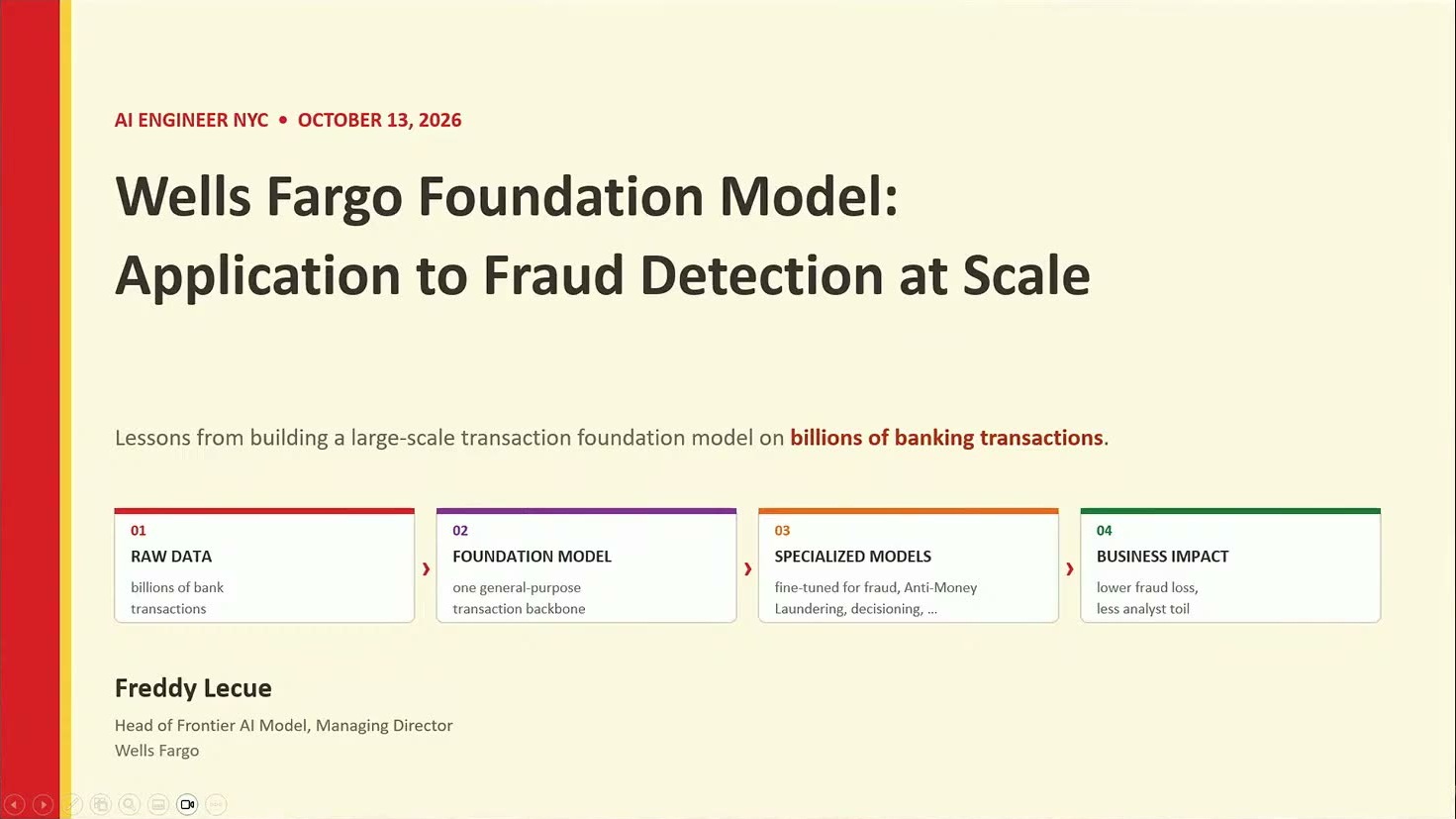
我叫 Freddy Lecue。我在 Wells Fargo 团队工作。我负责这里的前沿 AI 模型部门。我要介绍我们最近在构建首个基础模型——Wells Fargo 基础模型——方面所做的工作。我会解释我们为什么要做、如何做,以及取得了什么成果。
My name is Freddy Lecue. I'm part of the Wells Fargo team. I'm leading the Frontier AI modeling organization here. And I'm going to show you the work we've been doing lastly on building our first foundation model, Wells Fargo Foundation model. So I explain why we did that, how we did it, and what we accomplished.
首先,金融领域的模型不一定要以语言为基础。我们都在使用 Claude、ChatGPT 等,它们都是基于语言的。但在金融服务领域的模型中,我们当然也有语言,以及结构化和非结构化的数据表示,同时还有大量结构化的数据表示。很多数据都是表格数据。我们掌握大量客户信息,也有投资银行业务、零售银行业务等的信息,所有这些数据都保存在 Wells Fargo,所有大型金融机构也都有类似数据。我们希望利用手头这海量数据。但不能只是把数据塞进语言模型,就指望得到最佳效果。当然也能从中获益不少,但这不一定是最佳做法。
in doing so so so first from financial model it doesn't necessarily need to be language based i mean we're all playing with uh claude and chat gpt and others they're all language-based from the show models in financial services uh we also have language of course uh from a structure unstructured representation data but we also have a lot of structure representation a lot of these data is tabular data we have a lot of information from our customers we have information in investment banking, consumer banking, and all of this data is data that we have in Wells Fargo, and all big financial organizations have too. And we want to take benefit of all of this huge amount of data that we have. And it's not like you just take it and put it in a language model and get the best of it. Of course, you can get a lot of benefit out of it, but it's not necessarily the best way to do it.
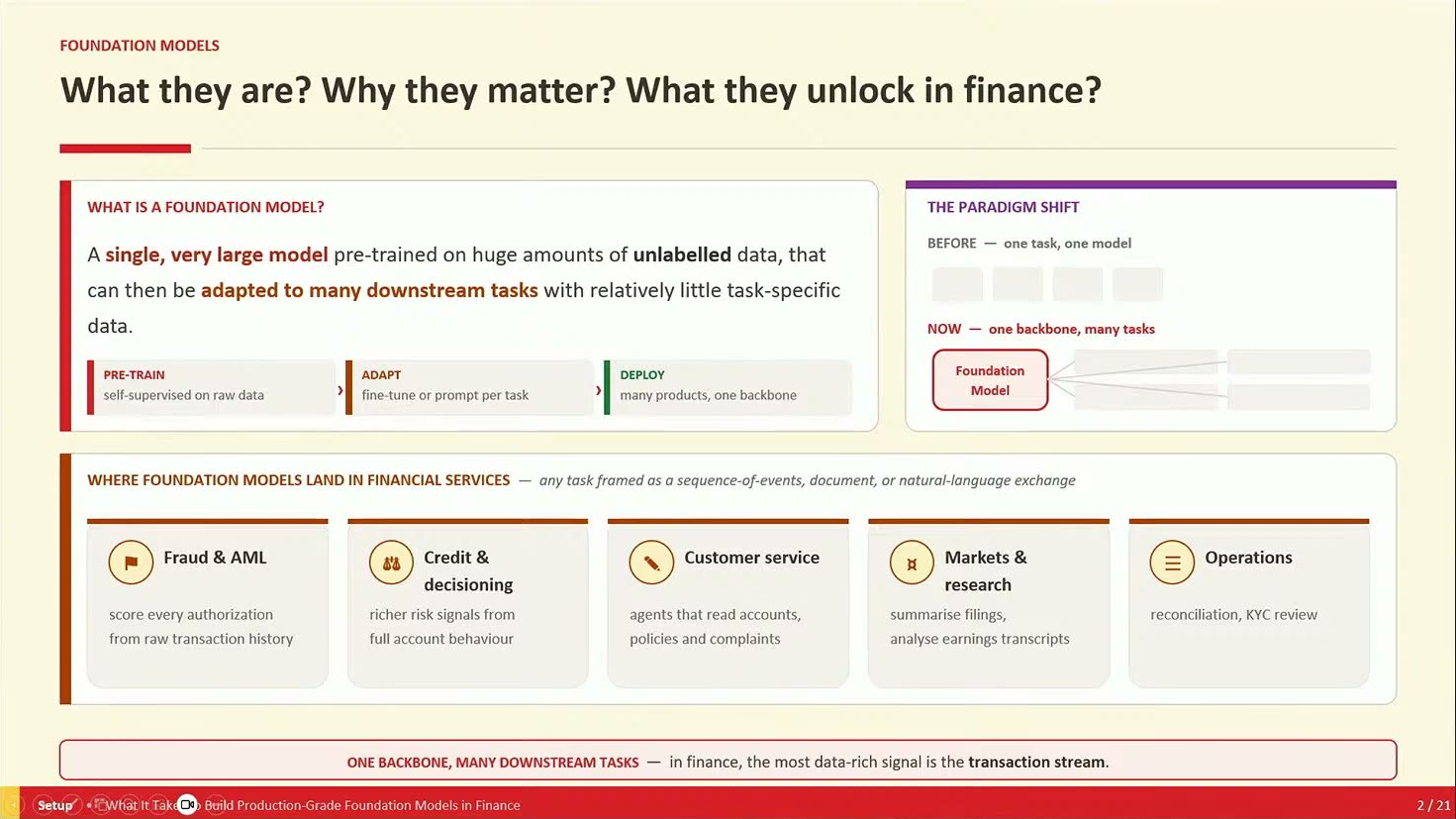
所以我们决定研究现有数据,包括所有交易,以及客户进行的全部交易,例如借记卡、信用卡、数字支付、支票交易,这些交易来自许多不同渠道,看看能否构建一个基础模型,用于下游任务并进行微调,例如信用评分或欺诈检测,反洗钱和营销。我们希望构建一个通用骨干模型,供不同下游任务使用并简化流程。这样就能从不同组织各自使用许多孤立模型,转变为一个通用骨干模型,让各个组织重复使用,因为它能大规模学习客户交易数据的表示。
So what we decided to do is to look at the data we have, all the transactions, all the customer transactions that they're doing with their debit card, credit card, digital, check, all of those coming from many different channels and see if we can build a foundational model that we can use and fine-tune for downstream tasks like credit scoring or that you can use it for fraud detection, anti-money laundering, do marketing. So how we can build one backbone that you can use and streamline across downstream tasks. So now you're moving from many models very siloed across different organizations. In really one backbone that every organization can just reuse because you learn the representations of customers' transactions at scale.
这就是我们的目标。先说明一下,你可能会说:“这不就是表格数据吗?为什么不直接用 XGBoost 以及那些常见方法?”我们试过了。这就是我们之前部署在生产环境中的模型。但我要介绍的模型表现胜过 XGBoost,不仅延迟更低,而且在欺诈检测方面能更大幅度减少误报,并提高检测率。所以这是一个很好的经验:使用基础模型能获得更好的模型,也就是使用基础模型。我说的基础模型是指 Transformer 模块,我们构建的就是这种模型。
So that's the intent. And just spoiler alert, you may say, hey, that's tabular data. why do you just don't use XGBoost and the usual suspect? We did that. This is the model we had in production. But the model I'm going to show you is something that beats XGBoost, even from a latency perspective, but also from a fault detection, we get much better reduction of false positive and better detection rate. So it was a really good lesson learned in terms of having better model using foundation model. And to foundation, I mean transformer blocks, and that's what we build.
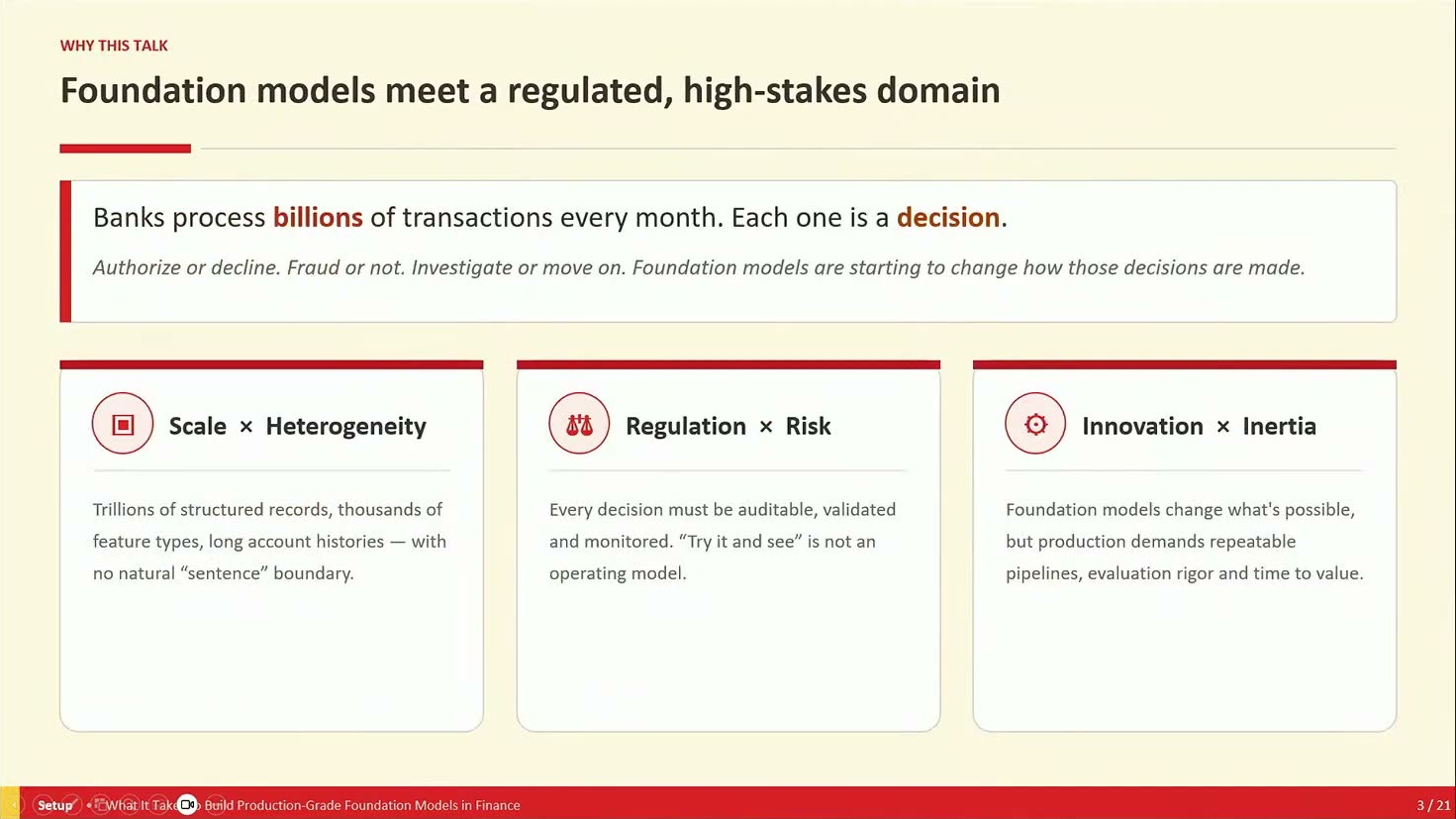
正如我提到的,我们每个月有数十亿笔交易。客户会使用借记卡、信用卡、支票,也会进行各种不同类型的交易。关键问题是,怎样大规模利用这些信息,而不是为每个下游任务单独处理。
So we have, as I mentioned, billions of transactions on a monthly basis. Our customers are interacting with their debit credit card, and they do checks, and they do different sort of transactions. And the question is really how we can use this information at scale, and not for one and every single downstream task.
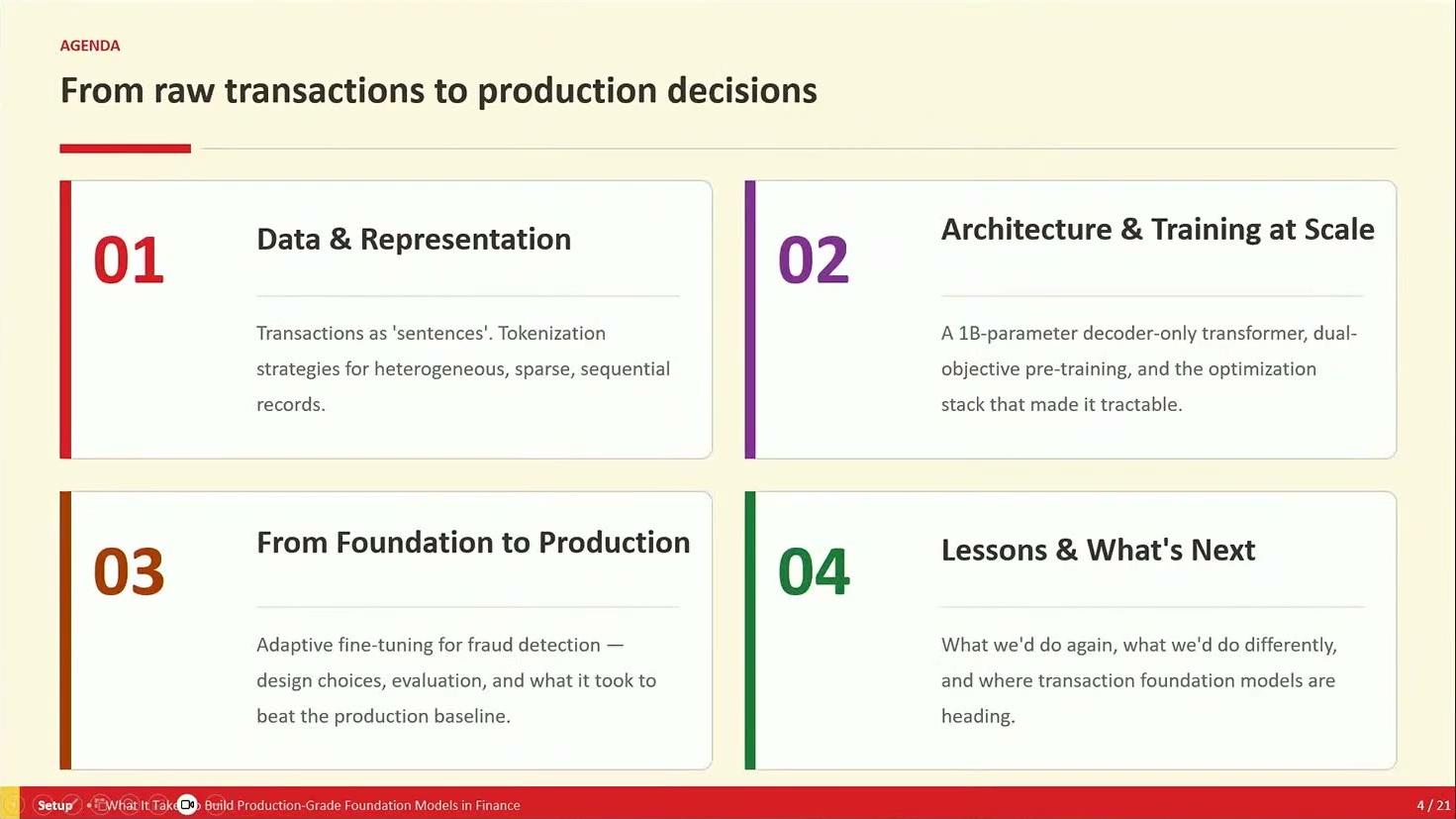
我会介绍数据、数据表示、我们采用的架构,取得的结果,以及构建过程中总结的经验。
So I'm going to cover a bit of the data, the representations, the architecture that we use, what the result we get, and the lesson we learned in building this.
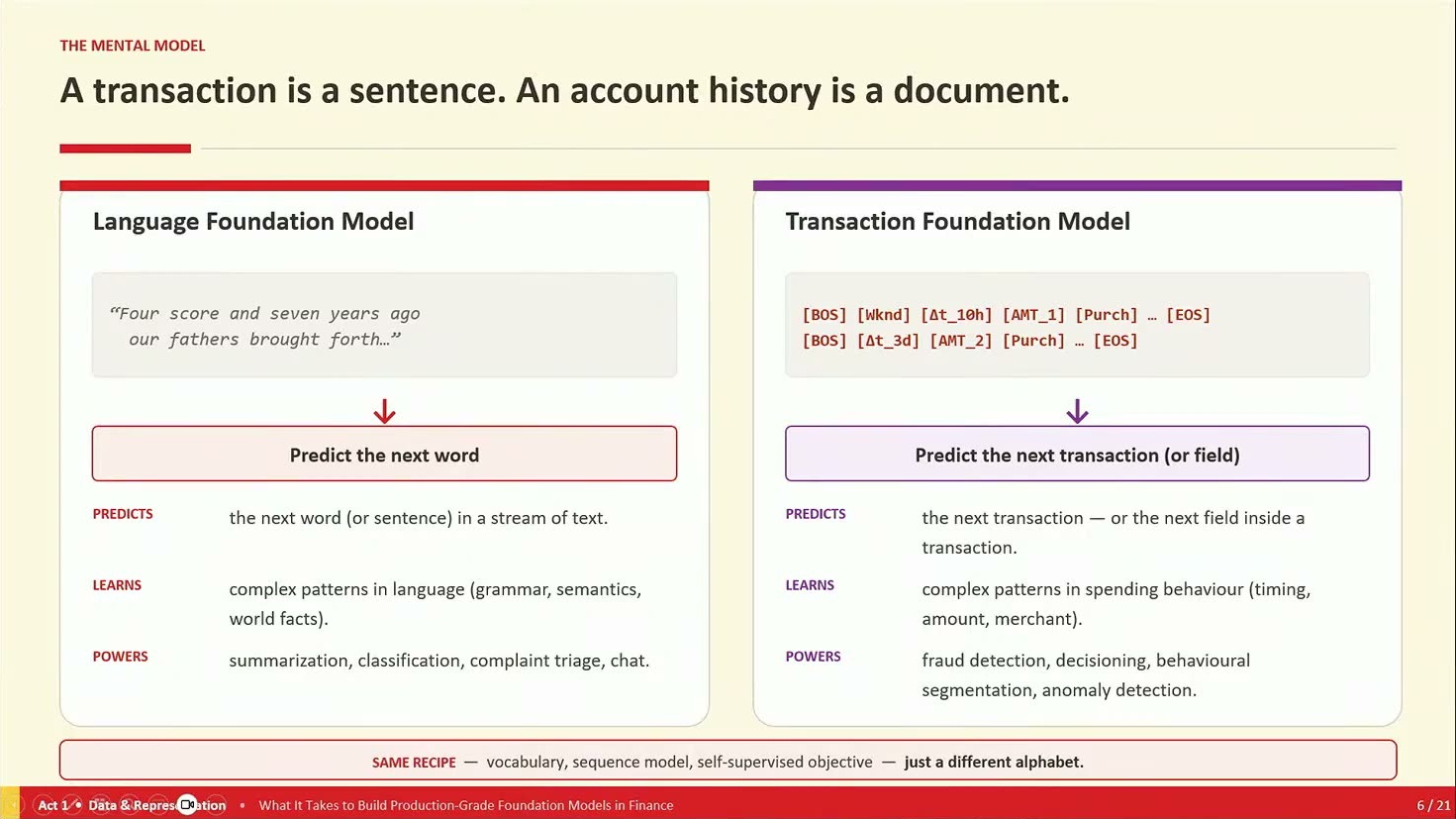
左侧是语言基础模型。它们处理语言 token,目标是学习数据表示,以预测下一个 token。然后进行有监督微调,再做 LHF、LRVR,以及各种优秀的后训练流程,从而提升目标任务的表现,对吧?这对语言任务很有效。但如果你的数据在表示方式上要专门化得多呢?这就是我们构建交易基础模型的原因。它不再以语言作为基础,而是以交易为基础,也就是客户的交易。
So left-hand side, language foundational model. They're processing language tokens, and then the goal is to learn the representations that's going to predict the next token. and then you have supervised fine-tuning and then you do LHF, LRVR and all of the great post-training process to get better at the task that you want to, right? And that's for languages, that's great. But what if your data is very much more specialized in terms of representation? So that's where we build this transaction foundation model. So instead of having languages as the base, the base is now transactions. transaction from our customers.
你仍然会尝试预测下一个内容,这里的下一个内容就是下一笔交易,或者交易中的下一个 token,并利用所有可用渠道的数据。但这并不是最终目标。就像语言模型一样,预测下一个 token并不是故事的终点,对吧?你先学习数据表示,然后使用这种表示,再对它进行微调,并为其他任务进行后训练,对吧?语言模型可以用于分类任务,而在我们的交易基础模型中,它可以用于提高信用额度、检测欺诈并标记不良行为者,用于反洗钱。
And you still try to predict the next thing, and here the next thing is the next transaction, or it's the next token in the transaction, using all of the channels that you have. But that's not the end goal. I mean, similarly to language model, where you try to predict the next token, that's not the end of the story, right? You learn the representation, and then you use that representation, and then you fine-tune it, and you post-tune it for any other task, right? So it could be classification tasks for languages, but in our context for transaction foundation model it could be used for credit line increase could be used for doing fraud detections and flagging bad actors from an anti-money-laundering perspective.
目标是学习交易随时间变化的关系,以及不同客户交易之间的关系。这才是我们的真正意图。第一点,我们从头开始预训练。我再强调一遍,因为有时大家会误解。我们使用自己的交易数据,从头开始大规模预训练 Transformer 模块。我们借鉴公开模型的架构,然后使用自己的 GPU 集群从头预训练,训练几天乃至几周,然后再对下游任务进行后训练。
And the goal is to learn this relationship between transactions over time and transactions across customers. That's really the intent. So the intent number one is you do pre-train from scratch. I'm saying it again because people are sometimes confused. we pre-train transformer blocks at scale from scratch using our transaction data. So the zero rate that we use from open rates, we just use the architecture, and then we pre-train it from scratch using our GPU cluster, and then we train it for a couple of days and weeks, and then you do the downstream task of post-training.
这里的目标是先预训练模型,让它预测下一个token 或下一笔交易,并尝试这样做,尝试预测客户的下一个模式,但这不是最终目的。最终目的是之后执行下游任务。说到规模,
but the goal here and you pre-train it for predicting the next token or the next transactions and you try to do this you try to predict the next pattern of the customer but that's not the intent the intent is to do the downstream task later on and in terms of scale
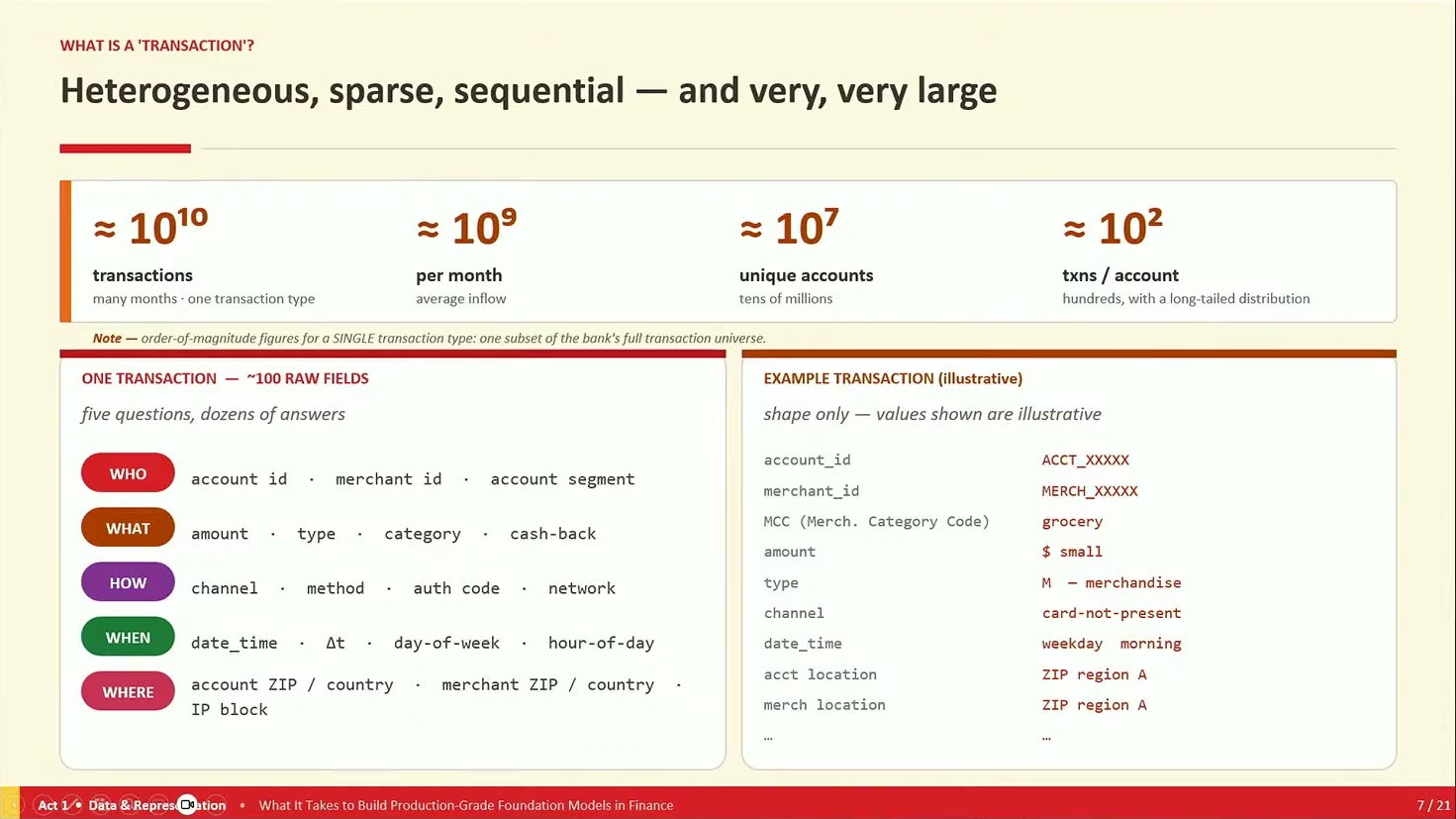
我们的业务规模很大,有数十亿笔交易,数百万个账户,每位客户每月有数百笔交易,他们会使用借记卡、信用卡或支票。我们主要关注五个维度,首先是谁在操作,也就是谁在处理、谁在发起,以及谁在提供服务。那会是客户还是商户?“做什么?”也就是我们买了什么?我们进行了什么交易?以及如何进行?通过哪个渠道?
we operate at a large scale so we have billions of transactions a million of accounts hundreds of transactions per client on a monthly basis interacting with their debit card, credit card, or doing check. And the five main dimensions we look at is really who is doing, I mean, who is processing and who is asking and who is providing a service. So, will it the customer or the merchant? The what? So, I mean, what do we buy? What do we transact? And how? So, which channel?
是信用卡吗?是借记卡吗?是数字交易吗?交易何时发生?又发生在哪里?这五个维度基本会细分成数百个特征。如果你看我们当前部署在生产环境中的模型,类似机构里有很多人构建过这类模型,应该都能理解这一点。他们投入了大量精细手工工程工作,进行了特征工程。这需要投入大量时间。所以我们退一步,研究所需的原始特征,而不是那些已经为下游任务预先加工或后处理过的特征,而是尝试理解哪些才是原始特征。
Is it credit? Is it debit? Is it digital? When is it happening? And where is it happening? And all of those, they're basically breaking down in hundreds of features. And if you look at the existing model we have in production, there's a lot of people that build those models in similar organizations may understand that. They build a lot of very hard-crafted, uncrafted engineering, feature engineering efforts on that. And that's required a lot and a lot of time. So we step back and look at the raw features we need, not the one that's been pre-built and post-built for doing the downstream tasks, but try to understand which raw features.
最后得到的基本上是 Android 特征。即便如此,最终我们还是有数千个特征,但我们努力找出哪些是原始信息单元。然后由架构,也就是 Transformer 模块,来学习这些核心特征之间的关系。你可以看到,我们有许多特征,分布在这五个维度中,这些词汇非常独特,专属于金融服务场景,这就是为什么我们没有采用现有的预训练模型。
And we ended up with basically Android features. Even at the end of the day, we had thousands of them, but we tried to find which ones are the raw information unit. And then we led the architecture, the transformer blocks, to figure out the relationship between those core features. and as you can see we do have a bunch of features on those five dimensions and the vocabulary is very unique to the financial services setup and that's the reason why we didn't really use existing pre-trained model
因为我们使用的词汇非常贴合你想完成的工作。即使把所有数字交易、支票和储蓄账户以及其他类型的交易全部合并,最终的特征和属性数量仍然非常有限。在这样的规模下,问题就是:该如何处理这些数据?
because the vocabulary that we use is very specific to the work that you want to do and even if you merge while all digital and checking and saving and all of those sort of transactions, even if you merge all of those, you still end up with a very limited number of features and characteristics. So at that scale, then the question is, well, how you work with that?
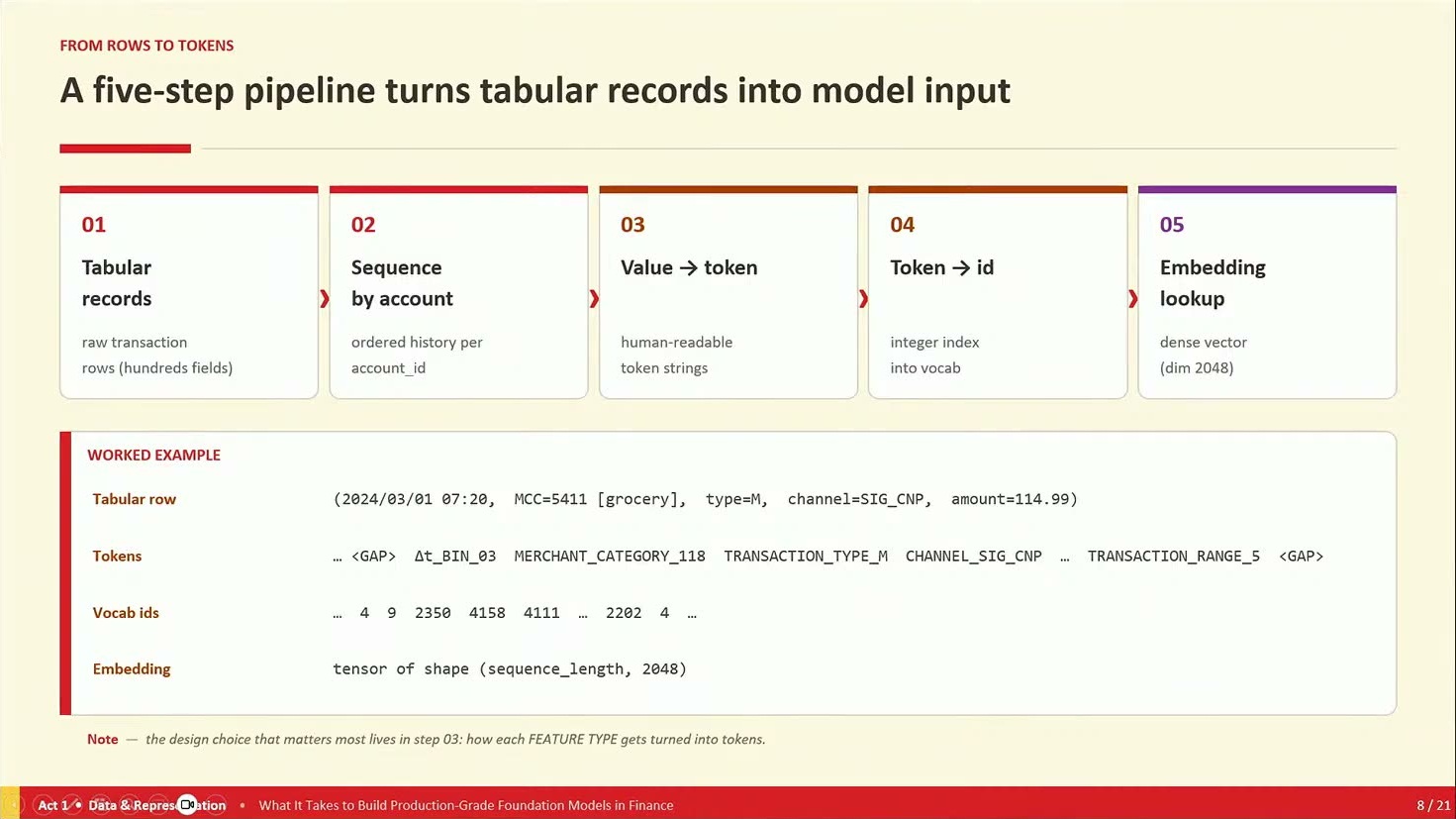
我们的起点是:所有数据都是表格数据。这不是什么秘密,就是表格数据。接下来要理解的是如何表示这些词汇,因为其中既有数值,也有类别值,还有邮政编码等信息。要把每个邮政编码都编码成一个 token 吗?这样有意义吗?因此,我们需要投入大量工作,弄清楚需要哪些词汇,以及怎样让词汇规模可控,因为训练时,如果词汇表太庞大,用如此庞大的词汇表训练模型就会很混乱,规模可能大得过头。
So we started, everything is tabular data. I mean, there's no secret, it's tabular data. And then the goal is to understand how you're going to capture the vocabulary because you do have numerical values, you have categorical values, you have information like zip code, do you encode each and every zip code in a token? Does it make sense? So there's a lot of efforts you need to push in understanding the vocabulary that you need and the vocabulary that you want also to scale because at the training, if you have too huge vocabulary, it would be kind of messy to train such a model with a vocabulary which is far, far too big.
所以我们花了很多精力研究如何把数值映射成 token。哪些信息应该编码成 token?然后还要进行 token 到 ID 的映射,也就是分词,再进行嵌入查找。因此,当一笔交易到来时,我们已经有了词汇表。基本上就是查找并对齐交易及其所有属性,把它们映射到 token、ID,再映射到嵌入。
So there's a lot of effort in understanding this value to tokens. So which information do you encode in a token? And then you have the token to ID, the tokenizations, and then the embedding lookup. So then when we have a transaction coming up, you do have the vocabulary. So basically it's a lookup in aligning a transaction and all the characteristics of that transaction to a token and an ID and then an embedding.
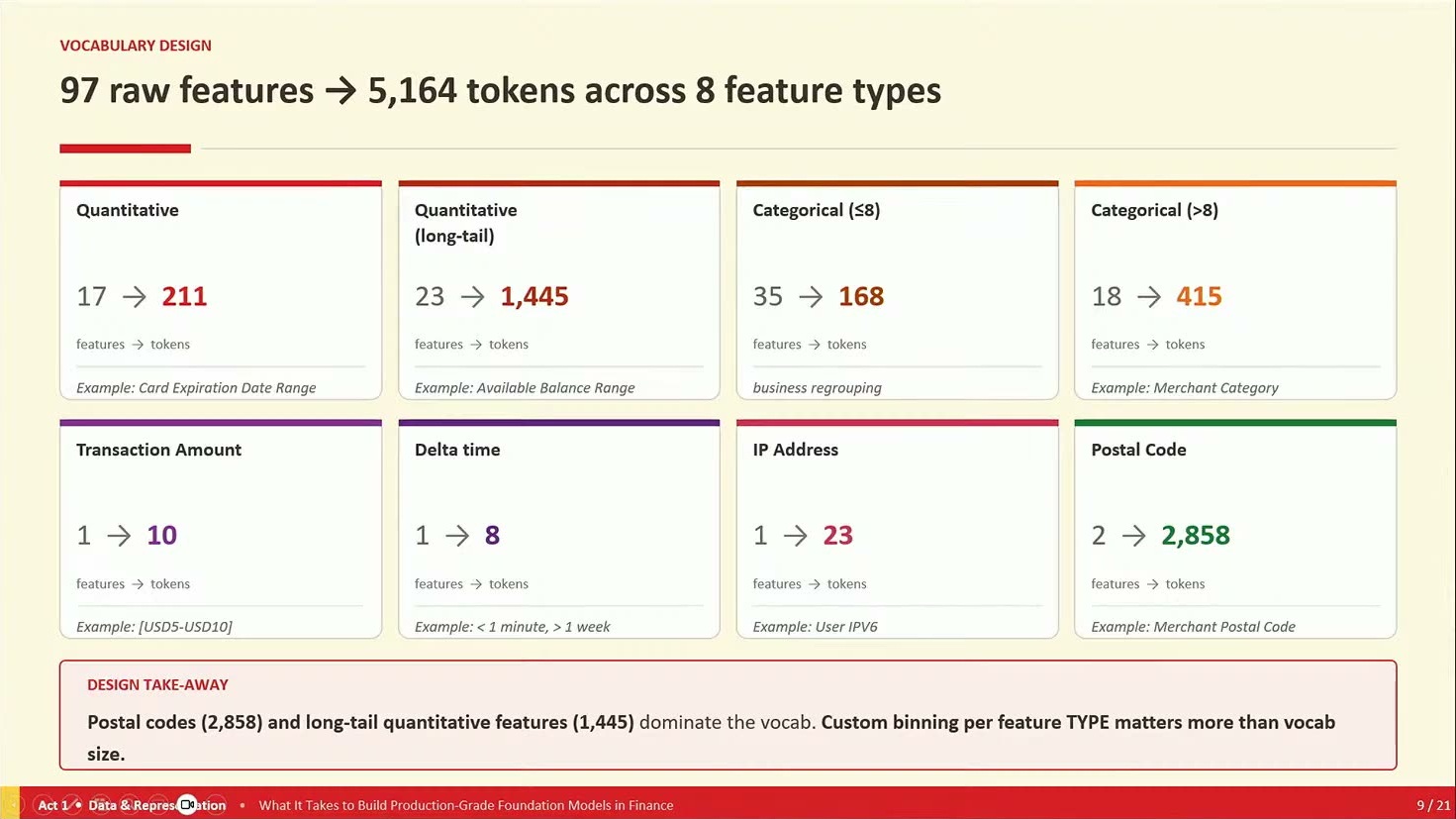
给大家一些具体数字:我们的特征有定量、定性和不同类型的类别变量。有的类别只有 8 种,有的种类多得多;还有交易金额,这是个重要特征;也有交易之间的时间差,以及各种与IP 地址、邮政编码相关的信息。这些例子说明,各种属性的类型和差异都很大,每项属性可能编码成一个二进制 token,也可能编码成数量多得多的 token。即便只看邮政编码,美国的邮政编码数量也远远多于2,800 个,但我们有更好的方式来组织邮政编码的重新分组,例如根据分布情况进行分组。
So just to give you a number, well some numbers so we have quantitative qualitative categorical of different kind right so categories with only eight types some with much bigger types you have transaction amount which is a big deal you have the delta time between transaction so you have anything related to ip address postal code so just to give you example of variety and heterogeneity of each and every characteristic could be encoded in a binary token or could be encoded in a much larger number of tokens. And even if you look at the zip code, I mean, you have a much larger number of zip code in the US than those 2,800, but you have much better way to structure how you're going to regroup zip code based on distributions, for instance.
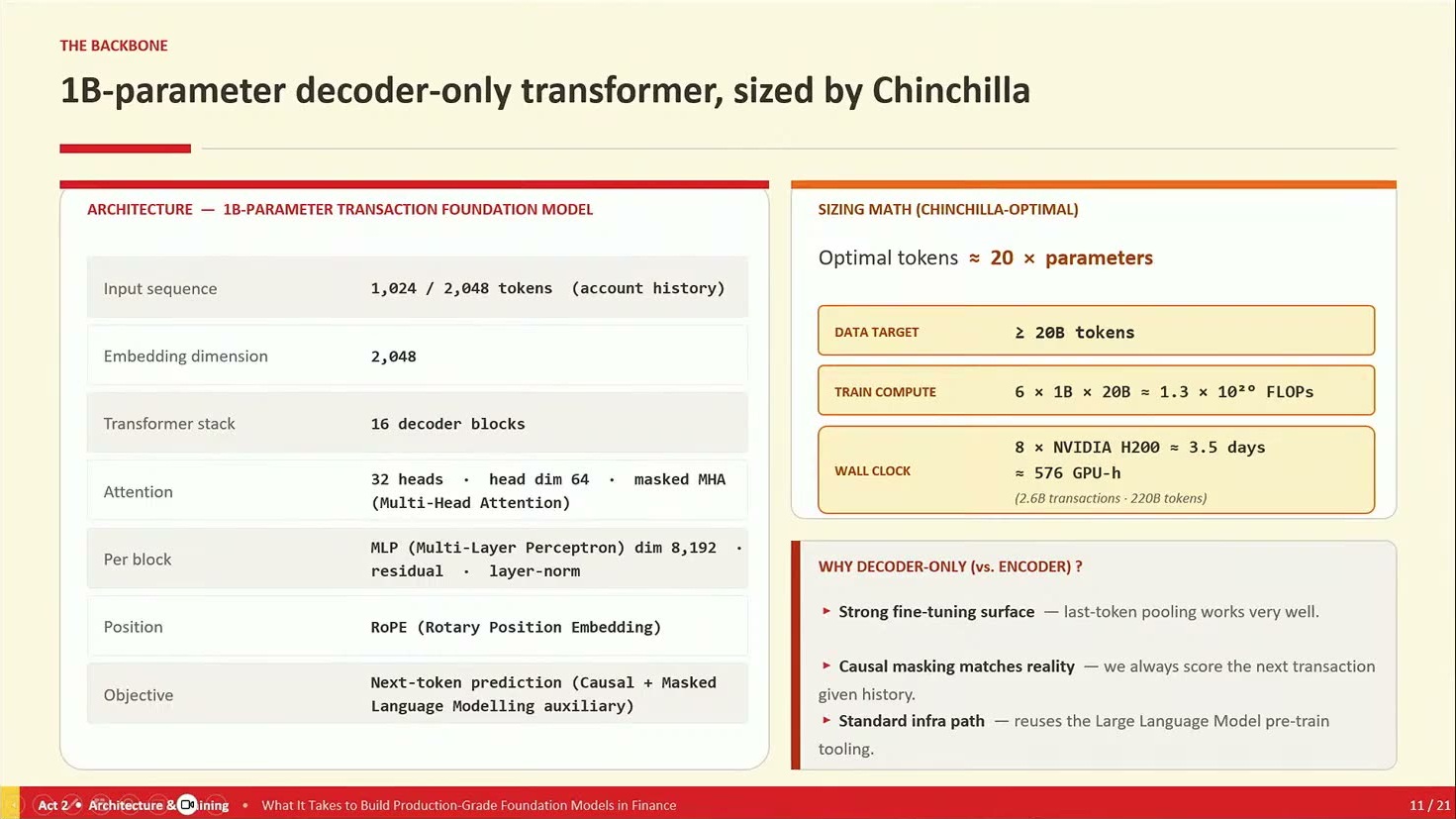
接下来是架构。这里简单说一下,我们使用了Chinchilla背后的数学方法,最初用来确定如何构建模型,因为我们完全不知道它在表格数据领域会如何表现,尽管当时已经有现成的开源方法和解决方案,可以用于表格数据基础模型。所以我们从它们学到的经验出发,再调整到符合我们的需求。下面给大家看一个模型规模、维度和解码器模块数量的示例,以及架构方面的完整配置。如你所见,我们并没有尝试构建万亿参数模型,也不打算与语言模型领域的领军者竞争,因为我们的工作重点是交易,对吧?
so architecture so here just so we use the chinchilla mathematics behind to define how we build it initially because we had no clue how it's going to work in the tabular space even though there are existing open ways and open solutions for doing tabular data foundation models so we started from what they learn and adapt it to what we needed to do and that gives you an example of invading dimensions number of decoder blocks we use and all of the recipe from a from an architecture perspective so we have and as you can see we're not trying to build a trillion parameters model we don't try to compete with any of the the leaders in the language models because we working with and focusing on transactions, right?
我们的交易基础模型规模达到十亿参数级别。我们采用 10 亿参数,是因为这个模型规模相对最小,却带来了最大的提升。现在我们正在开发下一版本,规模为 110 亿参数。但当前模型已经足以为下游任务带来很高的投资回报,例如减少误报,提高欺诈检测的检测率。架构类型方面,我们采用仅解码器架构,基本上用来预测下一个 token或下一笔交易。
Transactions, foundation models at billion level. And one billion is because that's the model that gave us, that was kind of the smallest and gave us the highest boost. And now we're working on the next versions at 11 billion. But that's good enough to give a lot of ROI from a false positive reduction for downstream tasks like for detections and the detection, unit detection rate. So, and the type of architecture, so the decoder-only architecture, that's basically for predicting the next token or the next transactions.
这就是预训练阶段的工作。起初,我们按照参数数量的 20 倍来估算可能需要的 token 数量。最后实际使用的数量比这个估算少了 10 倍。通过几轮实验,我们发现每个参数需要更多 token。这是我们最初做的一些实验。这个部分我就略过了,因为从目标函数来看,都是常见方法,例如因果语言建模和掩码语言建模类型的优化。
And that's really the pre-training. So here we initially used 20 times the number of parameters to define the number of tokens we might need. We ended up actually 10 times fractured than that. So by doing a few experimentations, we needed much more tokens per parameters. I mean, this is kind of the initial experimentation we did. So I'll pass on this because this is the usual suspect from an objective function, so causal language modeling and mass language modeling type of optimization work.
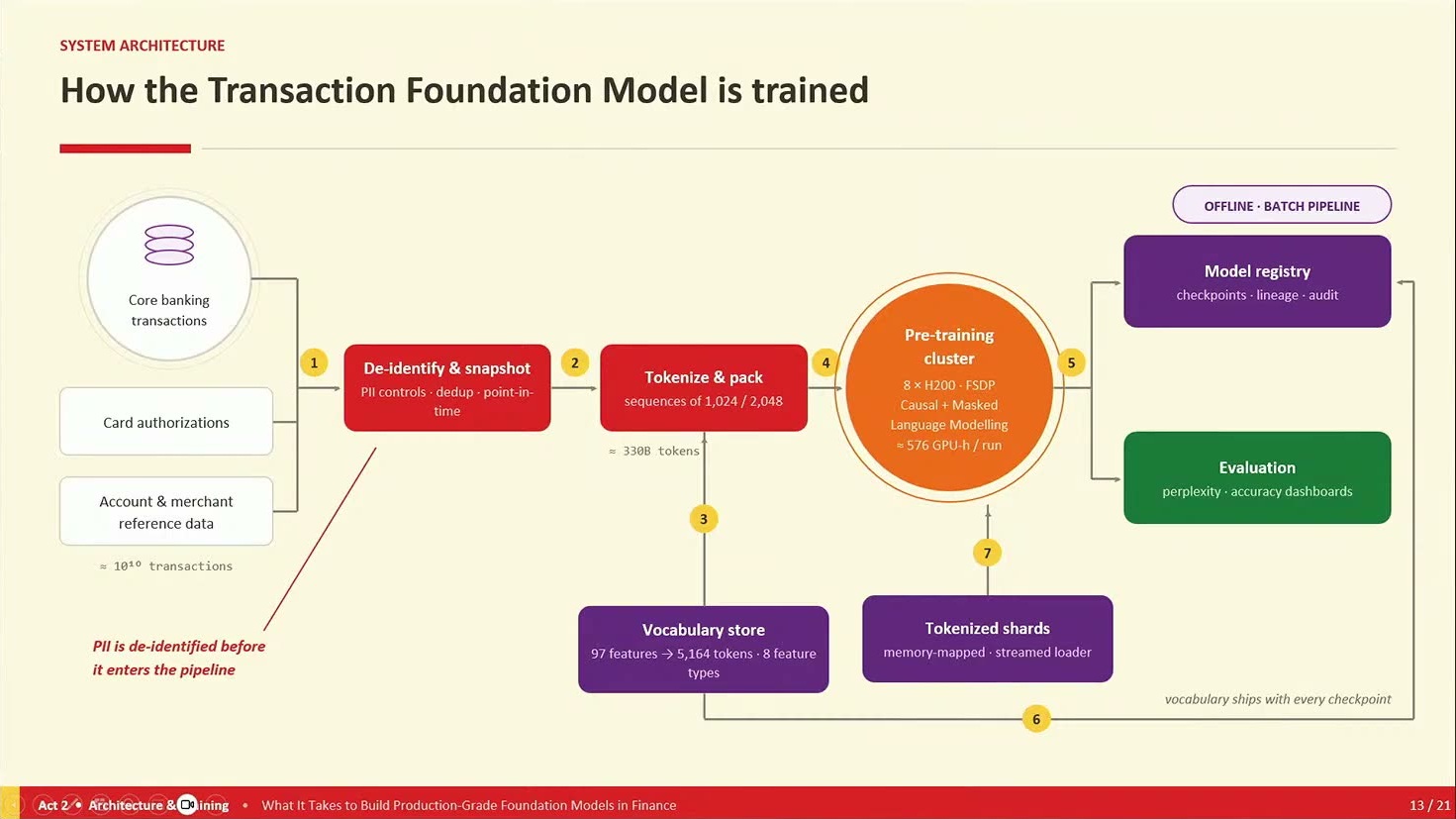
架构方面,没什么特别花哨的。最复杂的部分其实是 token 化,然后进行预训练,以及如何微调。所以我认为,配方或秘诀在于如何进行 token 化,以及如何进行后训练。至于训练方面,问题只是:你要放入多少笔交易作为上下文,或者作为训练历史。然后用困惑度为基础的准确率仪表板评估下游任务。
And from an architecture perspective, nothing really fancy here. the most complex part was really the tokenization and then doing the pre-training and then how you do the fine-tuning. So I would say the recipe or the secret sauce is really how you do the tokenization and how you're going to do the post-training. But anything from a training perspective, the question is just how many transactions you're going to put in your context or in your history for doing the training. and evaluation perplexity-based accuracy dashboard on downstream tasks.
这就是 ULs 方面的情况。
That's the ULs respect.
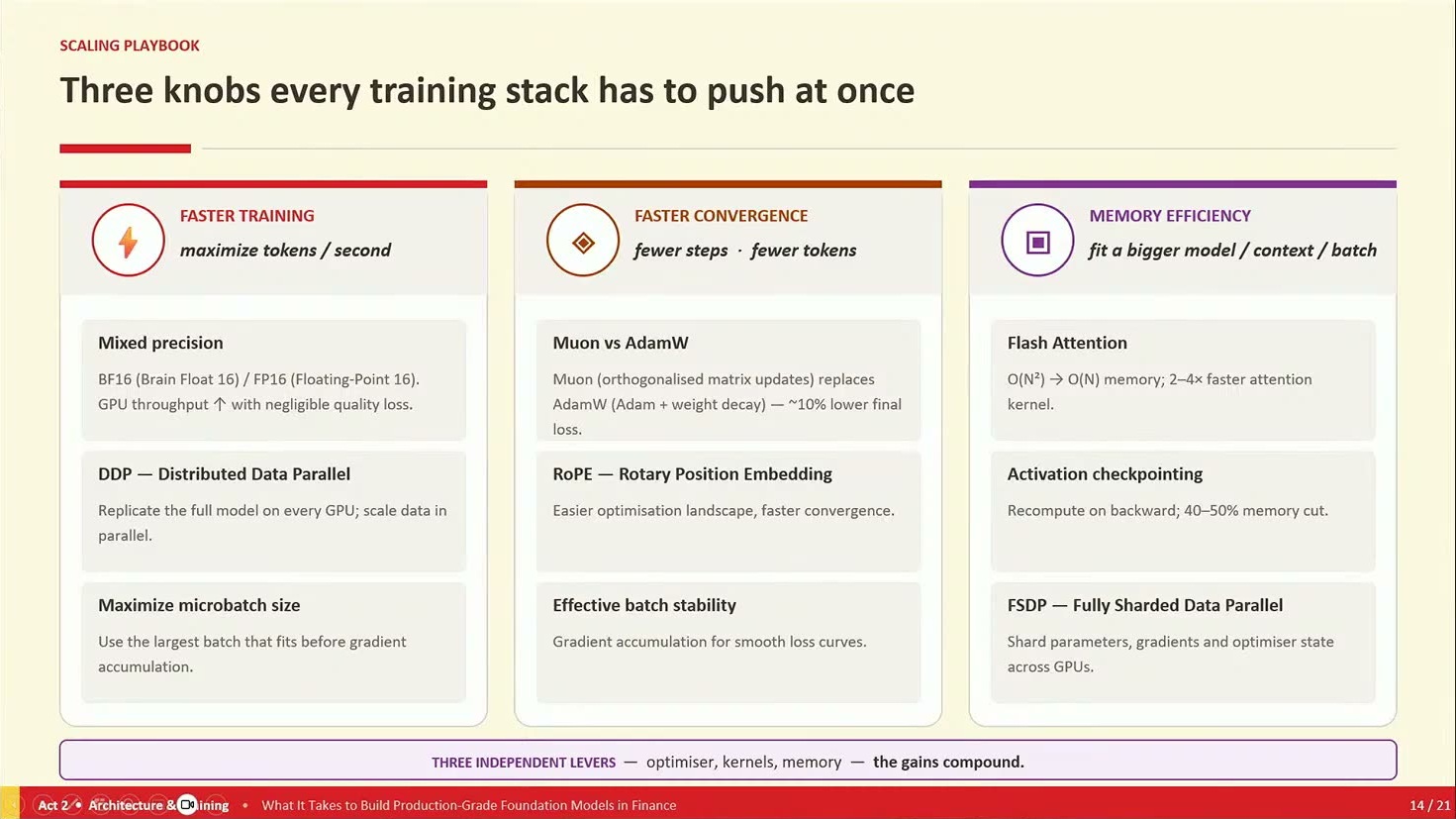
我们采用混合精度,分布式数据并行,尽量扩大宏批次大小,加快收敛,还使用了 Muran,以及常用的 RoPE,通过 FlashAttention 提升内存效率,还有 activation checkpointing。这些都没什么新鲜的。我们只是采纳了最佳实践,也参考了那些构建规模更大模型的团队的经验。这个部分我就略过了。时间有限,但我想花些时间讲讲结果。
And so, yeah, so use mixed precision, distributed data parallel, maximize macro batch size, get faster convergence, yeah, using Muran, Rope, usual, and memory efficiency, flash attention, activation chain pointing. I mean, here there's nothing really new. It's just we use the advices from the best and from the one that built even much bigger models. So I'll pass on this one. Time is short. But I wanted to spend some time on the results.
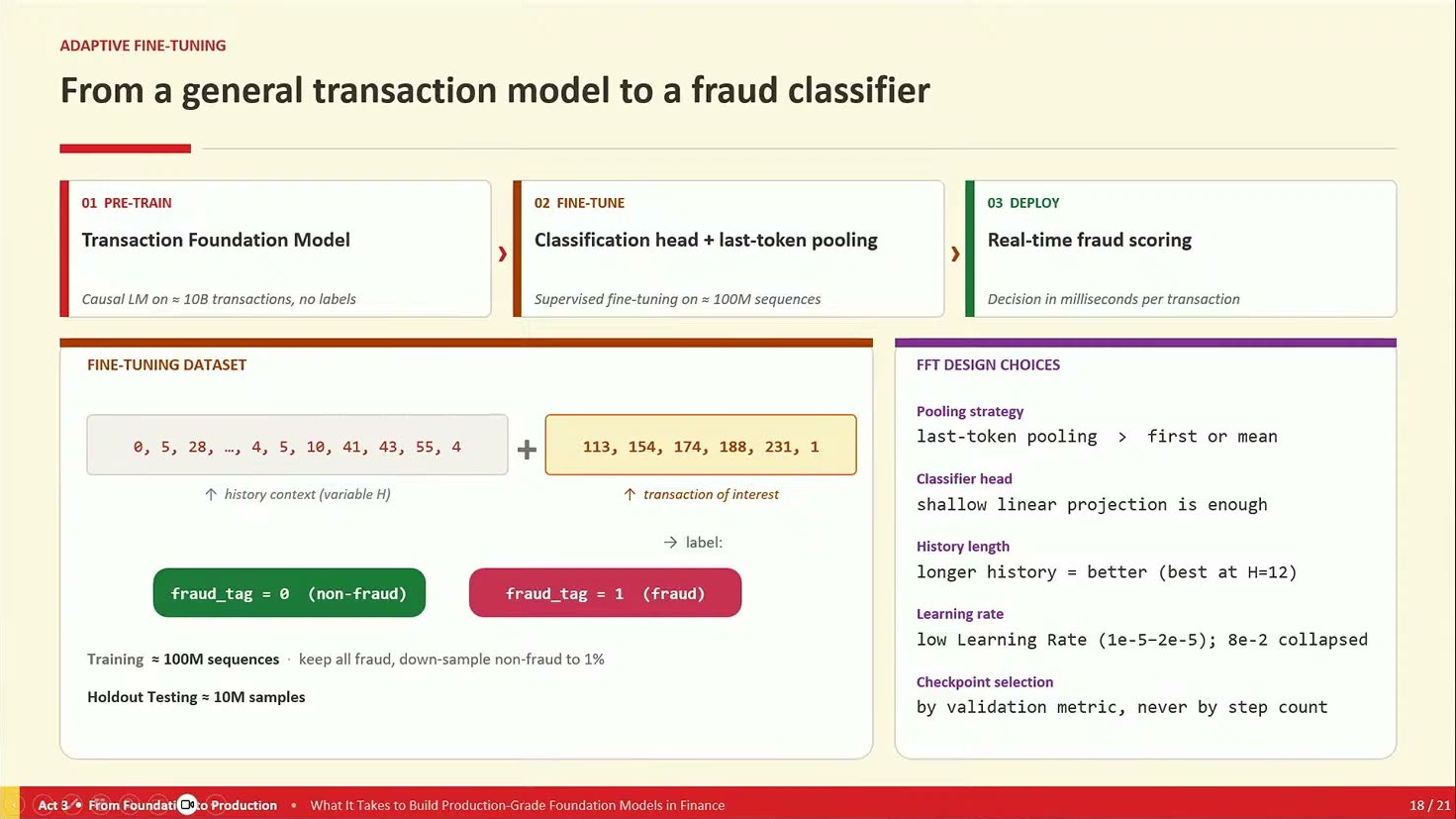
构建这个基础模型之后,它本质上只是一个骨干模型,可用于下游任务。我们的下游任务是欺诈分类。输入一笔交易,然后预测它是否属于欺诈交易。我们部署在生产环境中的模型是 XGBoost,它使用大量欺诈和非欺诈交易进行训练。它缺失的部分是交易之间的关系,也就是我们试图预测、试图分类的那笔交易,与其他交易之间的关系,以及它和所有历史交易之间的关系。
So, yeah, so when you build this foundation, That foundation is really, is only a backbone. It's something you can use for downstream tasks. And the downstream task was to do fraud classification. So you have a transaction, and then you try to predict if that transaction is going to be fraudulent. So in the model we have in production, it's an XGBoost model, and it's trained on large amount of transactions, which is fraudulent or non-fraudulent. and the missing pieces was the relationship between whatever transaction you try to predict, try to classify and the relationship with this transaction with all of the past transactions
而这些信息基本上在使用 XGBoost 模型时会丢失,除非你用一种非常复杂的方式将其编码,但这并不容易;不过如果使用Transformer 架构,就会有很好的注意力机制,能够把当前交易与历史交易联系起来。我们认为,这正是提高欺诈检测率的关键。但归根结底,下游任务就是给模型一组交易序列。假设有人在使用借记卡,那么结合所有历史信息,这笔交易是否属于欺诈?这正是你在推理阶段进行预测时输入模型的内容。
and that information is kind of gone when you use an XGBoost model unless you encode it in a very hard way which is not so easy but if you use transformer architectures you do have these nice attentions from transactions to past transactions And that's basically what helps, and this is what we think, this is what really helps pushing the fraud detection rate much higher. But at the end of the day, the downstream task was to say, here's the sequence of transactions. I have someone just using the debit card. Is that transaction fraudulent with respect of all historical information? And that's exactly what you put in at inference time when you try to do the prediction.
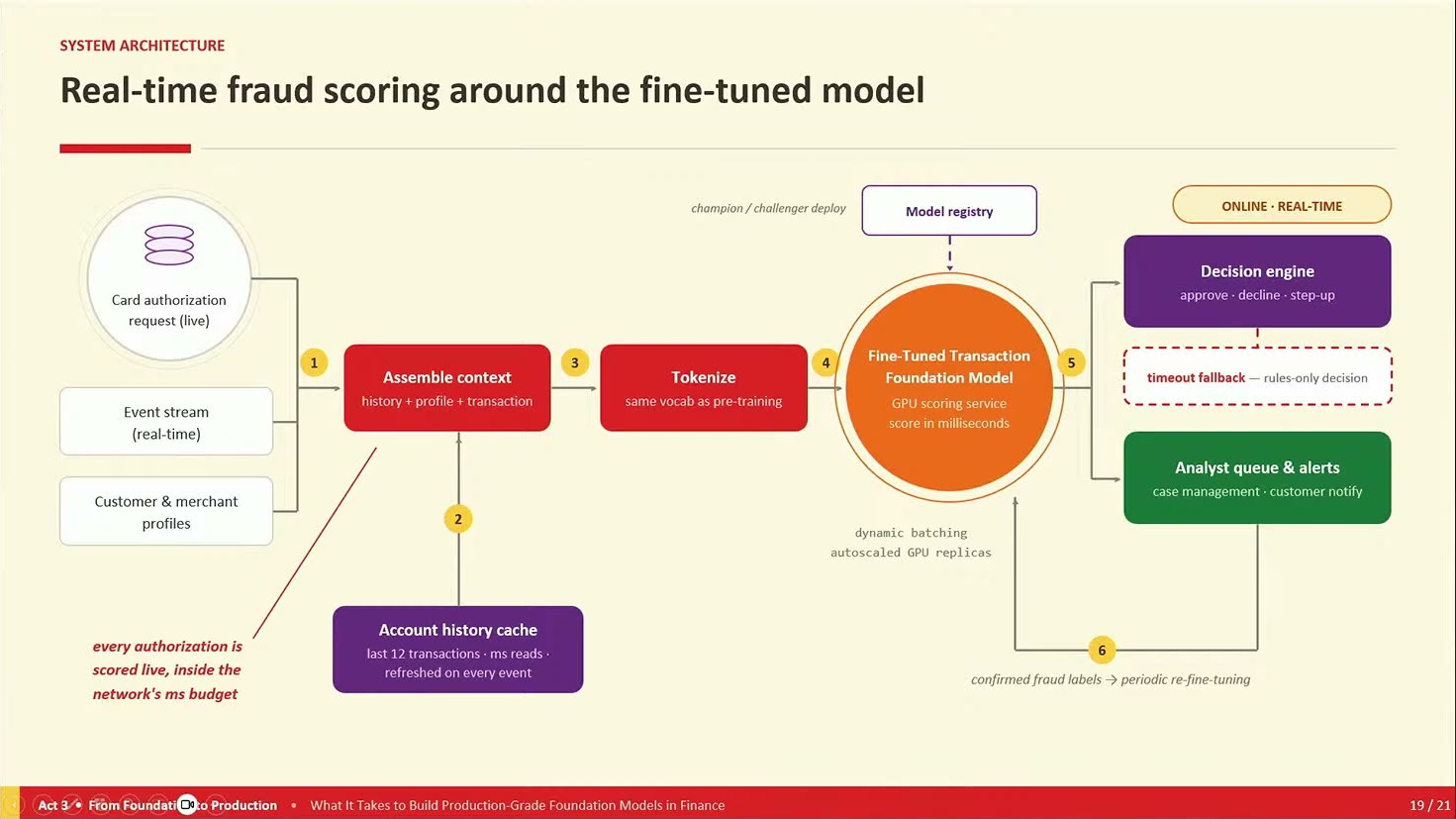
这就是架构,没有什么架构没什么特别花哨的,只要有扎实的工程实现,就能做到低于 250毫秒的处理时间,因为必须在这个时间范围内决定是否拒绝交易。不过,我们之前从延迟角度看慢了 10 倍。所以结果还是不错的。
so that's the architecture so nothing really fancier you just need to have the good engineering in place to do less than 250 milliseconds for doing the processing because the decline needed to happen within that time frame but it's we were 10 times slower than done from a latency perspective so it was all good
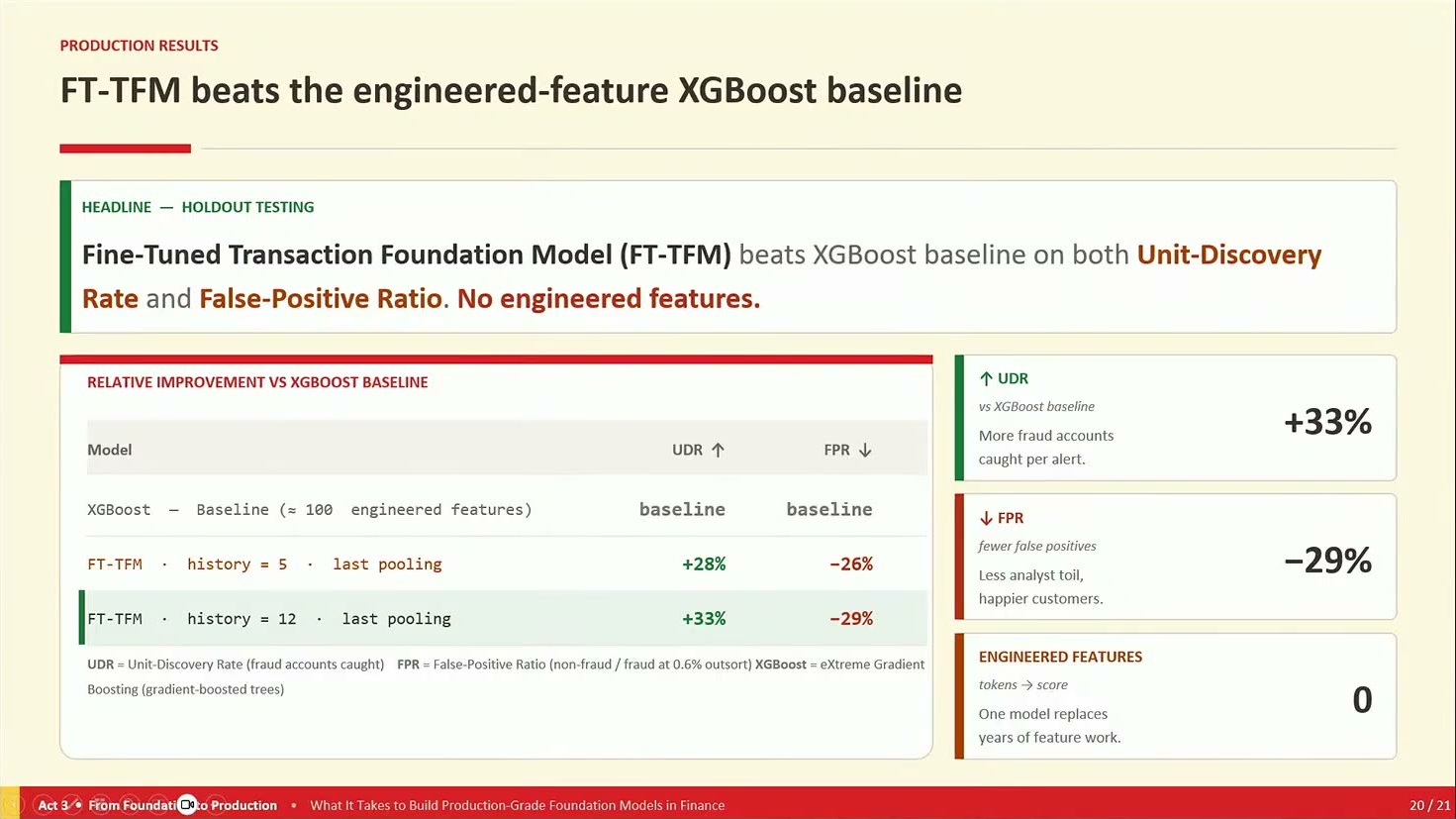
再说一下我们取得的最终结果。主要指标与公司节省的成本直接相关。包括检测率和误报率。当然,你可以提高检测率,但在很多情况下,误报也会更多。而在这个案例中,我们成功检测出更多欺诈行为,同时还降低了误报。这是很大的成功,因为归根结底,如果你拒绝了一笔并非欺诈的交易,客户就会打电话过来,这会产生运营成本,而且你会失去这笔原本正常的交易。
and just in terms of final result we get. So the main metrics and those metrics relate right away to savings for the firm. So it's detection rate and false positive rate. Of course you can detect much higher, but in many cases sometimes you get much more false positive. And in this case, we managed to get more fraudulent activities and we even reduced the false positive. so that was a big win because at the end of the day if you decline a transaction which is not fraudulent then that person is going to call there is an operation cost associated to it you lose the transaction related to that non-fraudulent action
所以这非常嗯,不是我们希望发生的事。再说一次,这是与先进水平的XGBoost 模型在欺诈检测任务上的比较。所以差距非常大。节省了数百万美元。提升幅度很大。
so it's a very well something that you don't really want to happen so again that's compared to the state of the art of the XGBoost model using fraud detection So it's basically huge. It's millions of dollars savings. So it's a very big boost.
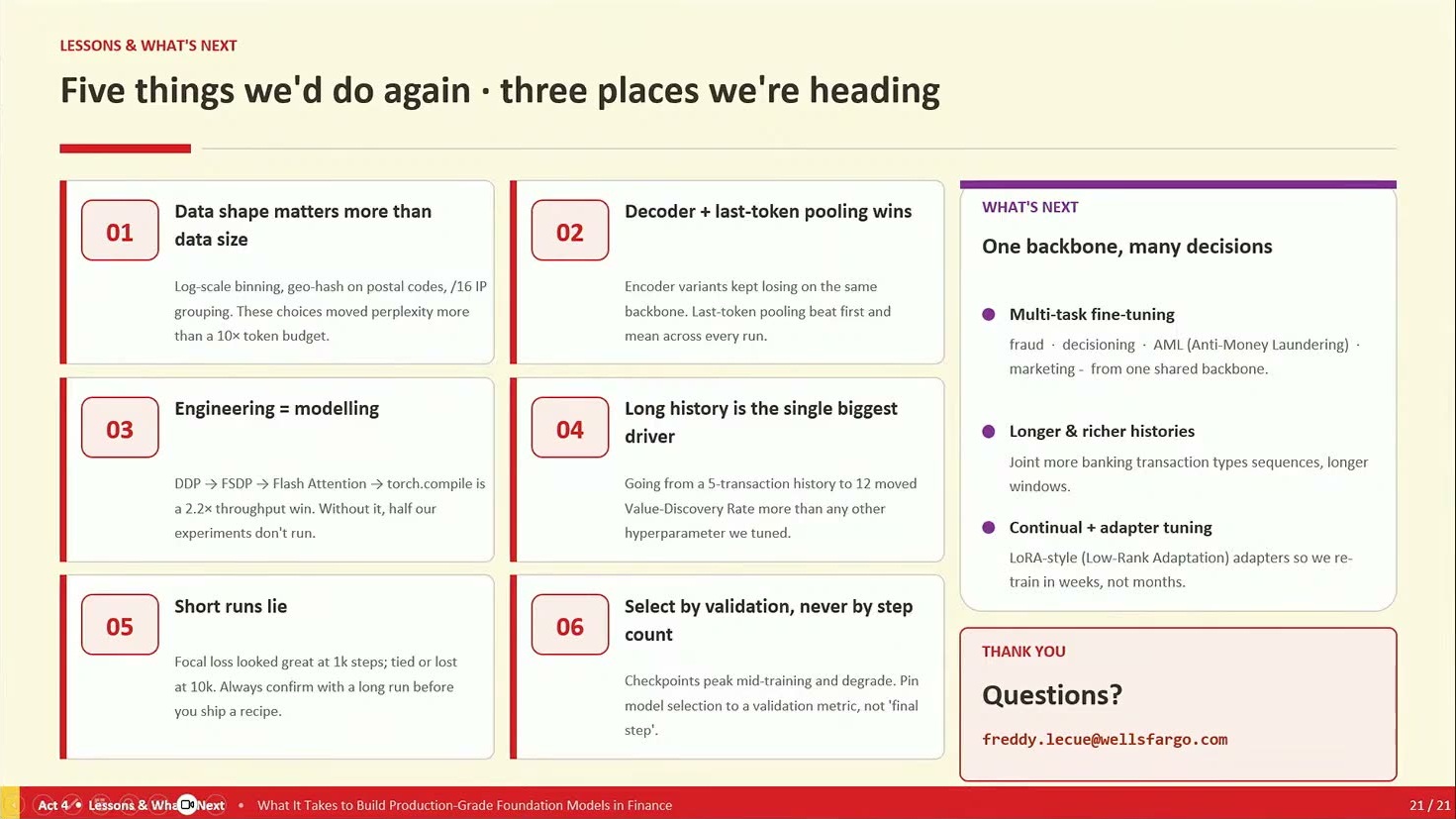
最后总结一下这页内容:这个基础模型使用 Wells Fargo 客户的数十亿笔交易构建。这是第一点。它是从头开始预训练的。我们没有从任何现有公开模型开始继续预训练。我们采用现有架构,但具体的训练方式是从头预训练几天,大约数天。一开始我们训练了几周,然后完成预训练。预训练完成后,它就能很好地预测下一笔交易。完成这一步后,就能将它用于许多下游任务。
So just to finish up on that slide, so that foundation model has been built on billions of transactions from Wells Fargo customers. That's number one. It's pre-trained from scratch. So we don't free train from any open-rate existing model. We use existing architecture, but the way the zero rate, we pre-training on a couple of days. I mean, we did a couple of weeks initially, but then that's pre-trained. And then when it's pre-trained, it's pretty good in predicting the next transaction. And when you're done with that, then you can use it for many downstream tasks.
我们已经将它用于欺诈检测。现在正在研究如何用于提高信用额度、反洗钱,以及营销。所以现在同一个基础模型会在不同组织间使用,包括 Wells Fargo 内部。嗯,感谢大家邀请我,也谢谢大家。
We did it for fraud detection. Now we're investigating for credit line increase, investigating for anti-money laundering, investigating for marketing. so now the same foundation is used across different organizations even Wells Fargo and yeah thank you for having me and thank you