算力的暗池
The Dark Pools of Compute
原文由官网提供,中文由 GPT-6 Luna 翻译。相邻片段合并排版,正文与时间点保持对应。
已插入 18 张经核对的幻灯片或演示截图;点击图片可放大。图注链接为当前视频时间,左侧正文时间保留原转录版本,二者可能不同。
共 36 个阅读段落
好,我想我们可以开始了。大家好。我叫 Affaan,是 Jump Trading 算力交易业务的负责人。Jump Trading 是一家自营交易公司,我旁边这位是我的联合负责人 Alejandro。今天我们要看看算力交易中的市场结构,以及算力交易究竟是什么。还会谈谈我们认为它会发展成什么样。我想先从宏观层面谈起,再看看微观结构,最后稍微聊一聊我们对政策方面的看法。这场演讲的标题是《算力的暗池》,不过在座有些人来自金融行业,可能会疑惑我为什么用这个术语。
All right, I think we can get started here. Hey, everyone. My name is Affaan, and I'm a lead for compute trading at Jump Trading, which is a proprietary trading firm, alongside my co-lead over here, Alejandro. So today we're going to be looking over some of the market structure as it applies to compute trading, what compute trading even is. what we can see it becoming. And I think we'll start with some macro, look at microstructure, and then talk a little bit about where we see things in policy. So the title of the talk is The Dark Pools of Compute, but some of you guys are in finance, so you might be confused as to why I'm using this terminology.
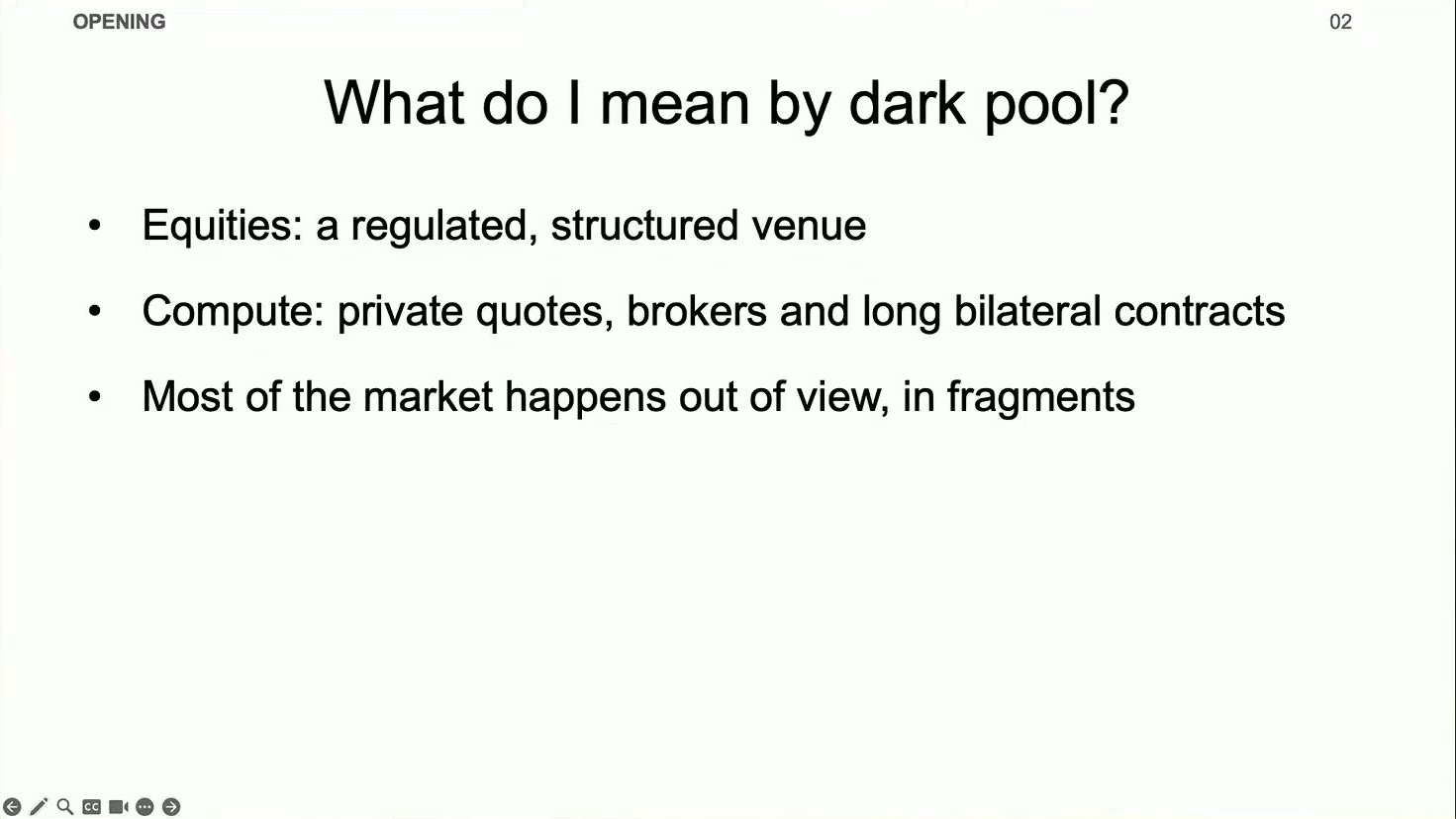
我这里说的暗池是什么意思?基本上,我指的是非公开交易市场。目前,大部分算力以大宗方式交易;这里说的是实体算力。这些都是私下报价,有很多经纪商参与,而且合同期限很长,是双边签订的。归根结底,这些其实都是商业协议。所以我们在这里用“交易”这个词,是想看看各方如何进行交易。这些商业协议通常由主服务协议(MSA)、服务等级协议(SLA)和订单构成,每份订单都针对特定集群,并包含针对具体硬件的条款。但在谈价格和其他一些指标时,大家大多会围绕 SKU 讨论,也就是具体芯片和基板。
What do I mean by dark pool here? Essentially what I'm referring to is an unlit market. Right now, most compute trades in blocks, physical compute here. And these are private quotes, we have a lot of brokers, and these are long bilateral contracts. Now, at the end of the day, these are really commercial agreements. So we're using the term trading here to kind of like look at how it's transacted between parties. These commercial agreements tend to be some mixture of an MSA, an SLA, and an order form, cluster specific with hardware specific language in each order. But when we're looking at pricing and looking at some of these other metrics, a lot of the time most of the talk is around the SKU, so what the chip itself is, the baseboard.
比如 H100、H200、V300 等。所以这里很多谈判都是在公众视野之外进行的。目前还没有一个被广泛采用、供所有人查看并交易实体算力的交易所。这些交易是在聊天中完成的。它们都不公开。有一些公开的市场平台,也有价格参考。还有很多按需供应的场所。但对于这些实际的长期交易,也就是在某个约定期限内购买固定容量并约定一定合同总价的交易,大家会通过 Slack 消息、X 消息、Telegram 群组聊天等各种场外交易渠道来谈。我想把它们叫作Neo chat 之类的地方。熟悉大宗商品的人可能知道,很多沟通都是在 ICE Chat、Bloomberg Chat 等平台上进行的。
So H100, H200, V300, etc. And so a lot of the negotiation here happens kind of outside the public view. There's no exchange for physically traded compute that's widely adopted and used for everyone goes there to take a look and trade compute. These are done in chats. They're out of the public view. There's public marketplaces. There's price references. There's a lot of on-demand places. However, for these actual tenured, so on a given term for a fixed amount of capacity with a certain total contract value, these trade over Slack messages, X messages, Telegram group chats, so a bunch of OTC kind of channels that are all over in these kind of, I want to call them like Neo chat. And some of you might be familiar with commodities and how a lot of, you know, There's chatting happening on Ice Chat, Bloomberg Chat, etc.
现在的算力市场大致就是这样。接下来我想稍微看看宏观市场结构,以及这里的参与者。
This is kind of where the markets here lie. And so I want to look a little bit here on the macro market structure and a little bit on the players here as well.
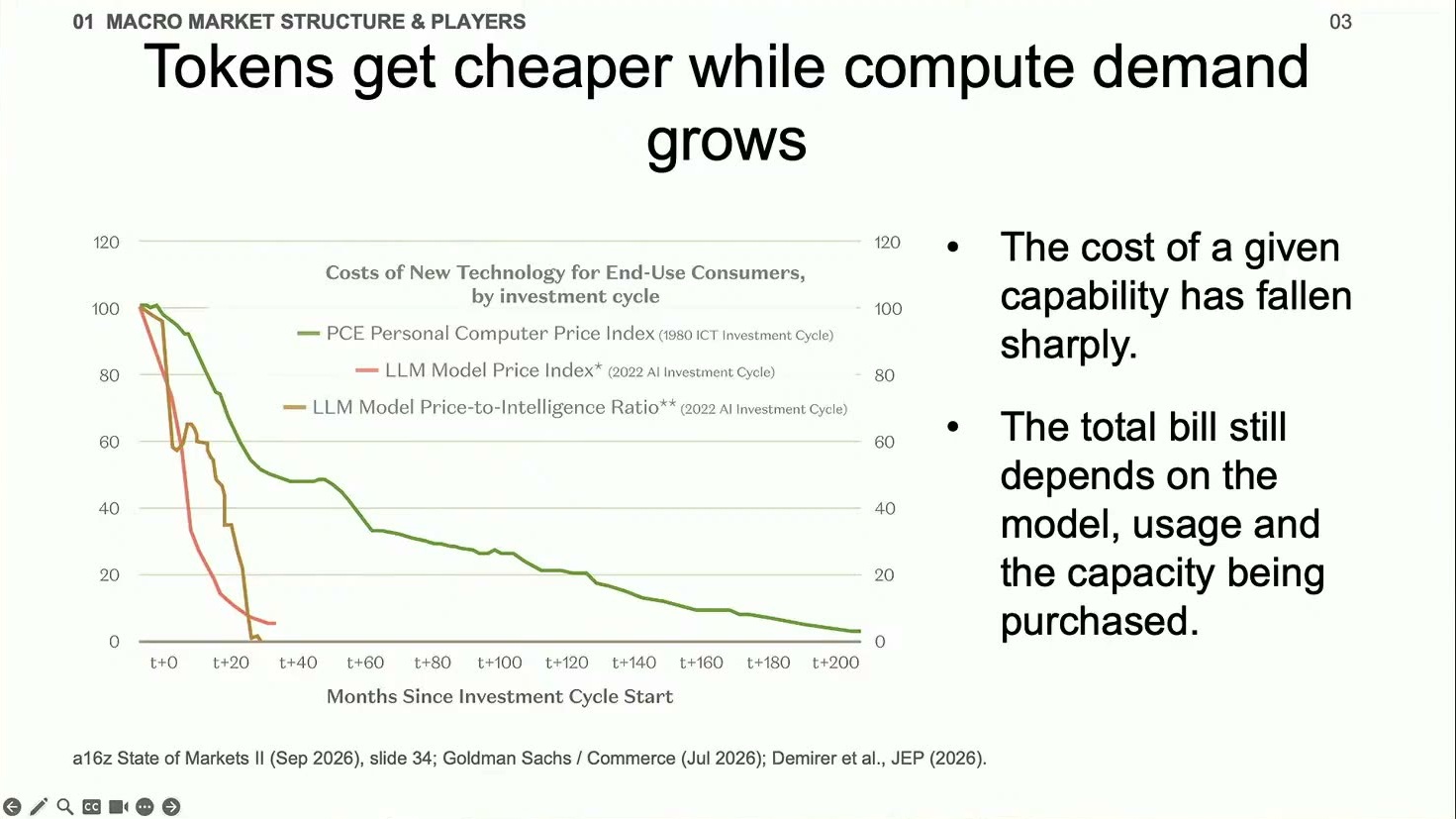
这张图是 A16Z 最近发布的。你们有些人可能看过,我把它放在这里,因为你们可以去 A16Z 的 X 账号查看这张图。图中显示,某种能力的成本已经大幅下降。当然,账单仍取决于模型用量、容量,以及其他因素,比如速度;速度目前是新款 ChatGPT 模型的一大重点。token 更便宜,就能解锁更多用量,同一笔预算能让团队完成更多工作。所以我们看到很多团队只是在大量增加 token 用量。因此还有一大块潜在需求尚未释放,大家会用同样的预算消耗更多资源,也就是以前模型价格较高时所用的预算。
And so this was a recent kind of A16Z. Some of you guys might have seen this, so I'm putting this out there because you can go on A16Z's actual X and take a look at this graph yourself. What we're looking at is that the cost of a given capability has fallen sharply. The bill, of course, still depends on the model usage, capacity, and other factors, such as speed, is a big thing right now with the new ChatGPT models. Cheaper tokens unlock more usage, and a team can do more work for the same budget. So what we're seeing is that a lot of teams are simply just using way more tokens. So we have this latent demand that hasn't really been hit yet, and people are just going to use more with the same budget that they were using before when models cost more.
他们只是消耗了更多 token。所以原先太贵、无法实现的应用现在变得可行。不过,既然我们在谈算力,底层容量仍然需要建设并付费,即使某项任务的成本降低了。因此,关键区别在于智能的价格、人们想运行的任务数量,以及服务这些任务所需的硬件数量。
and they're just spending more tokens. So applications that were too expensive become possible. However, as we're kind of talking about compute here, the capacity underneath still has to be built and paid for, even as the cost of a particular task comes down. And so the important distinction is between the price of the intelligence, the number of tasks people want to run, and the amount of hardware needed to serve them.
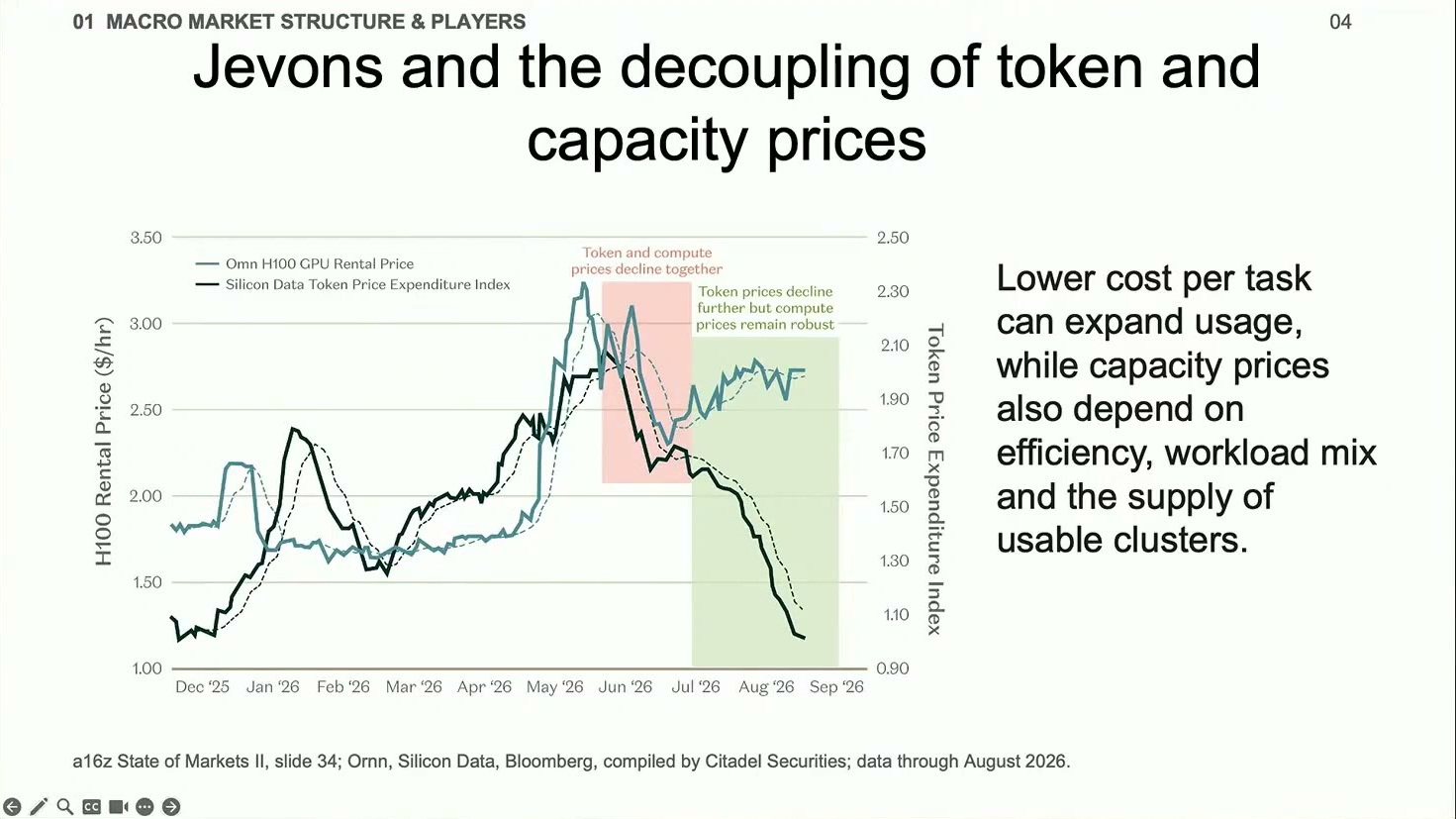
这就引出了杰文斯悖论,以及我们最近关注的一些问题。我们发现一件很有意思的事:直觉上,你可能会认为算力和推理会一起增长,彼此高度相关,从图中也能看到这种趋势。但你会看到两者出现了一些脱钩,token 价格进一步下跌,算力价格却依然坚挺。那么,这可能是什么原因?有很多潜在解释。其中一个就是杰文斯悖论:尽管 token 价格和推理服务在提供服务方面变得极其高效,尤其是在这些新型基板和 GPU 上,人们的消耗量还是增加了很多。
And so this is where we get to kind of the Javon's paradox and a little bit of some of the stuff that we've been looking at lately. where we had a very interesting thing where, you know, intuitively you'd assume that compute and inference kind of like rises together, correlates very, you know, very closely, as you can see. You can see there's a little bit of a decoupling that happened, and token prices declined further, but compute prices remain robust. And so, like, what can be an explanation for this now? There's a lot of, like, potential explanations. One here is the whole Javon's paradox, is that even though token prices and inference is getting extremely efficient to serve on these new baseboards and GPUs, people are just consuming a lot more.
因此算力需求上升,人们消耗的 token 也多得多,即使每百万 token 的输入、缓存和输出成本都变得高效得多。所以,降低任务成本会鼓励更多使用,新增用量最终会超过任务节省下来的资源。对推理云来说,这意味着更多应用,服务更多 token,获得更大的市场份额。对 AppLayer 从业者来说,这意味着你们可以服务更多客户,也就是所有使用 token 基础设施的人。结构。
And so the demand for compute rises and people just consume a lot more tokens, even if the cost per million for input and for caching and for output becomes a lot more efficient. And so making the tasks cheaper, encouraging the additional use to outweigh resource saving for tasks. For inference clouds, that's going to be more applications, serving more tokens, bigger market share. And for AppLayer individuals, that means you guys can serve to a lot more customers, anyone who's utilizing the token infrastructure. structure.
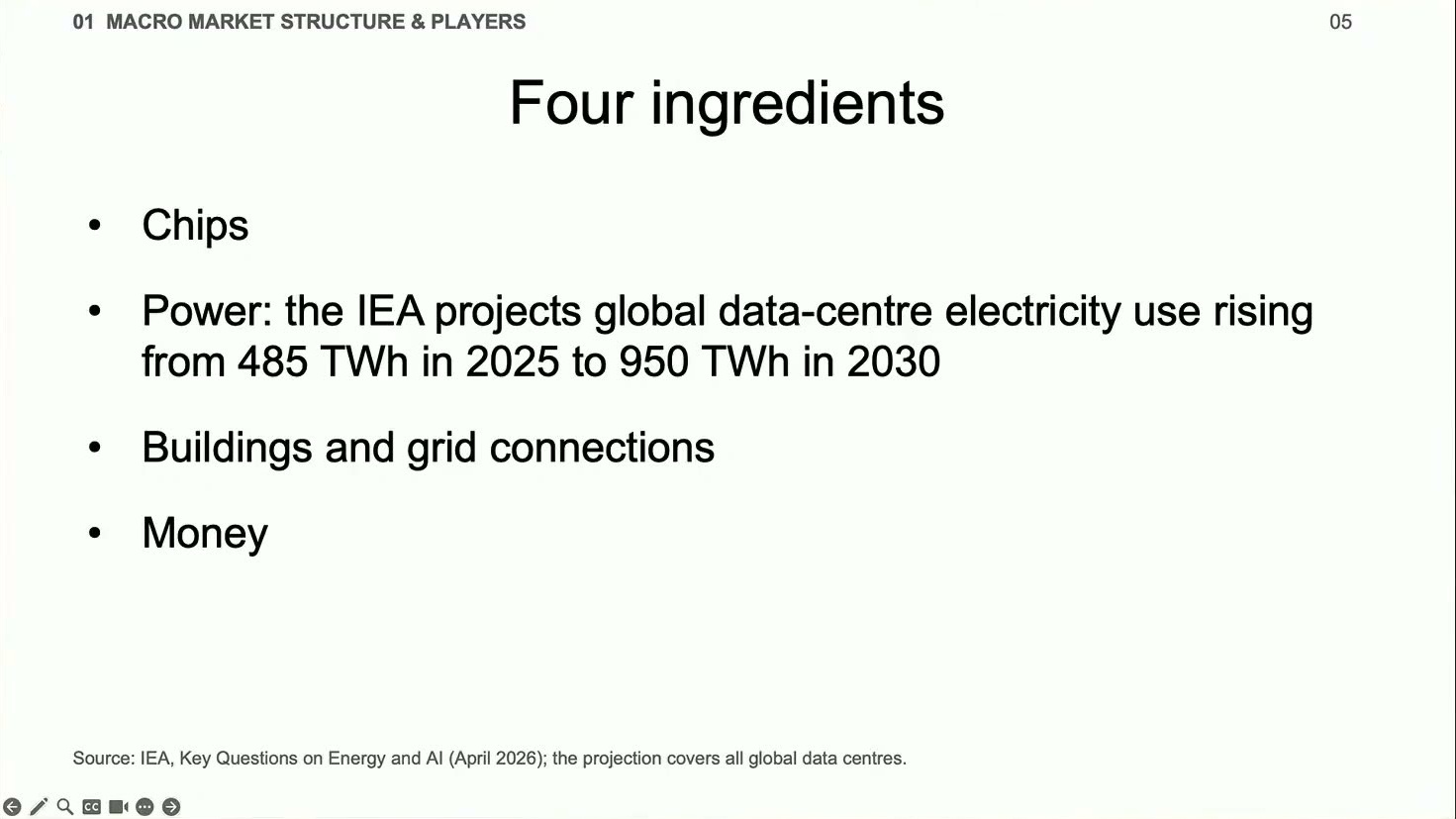
宏观结构具体包括什么?这里讲得很基础,包括我们一直在讨论的芯片、电力、建筑,电网连接,当然还需要大量资本来推进这些建设项目,这也是这里一直在讨论的主题。芯片、电力、建筑和资金都必须到位,之后你才能获得一小时真正可用的 GPU 算力。国际能源署(IEA)4 月份的更新预测,全球数据中心用电量将从2025 年的 485 太瓦时上升到 2030 年的 950 太瓦时。所以现在很多讨论都围绕着如何扩大建设规模、如何把电网搭建起来。
And so what really goes into the macro structure, now like this is very bare bones here, but you've got your chips, which we've been talking about, you have power, you have buildings, grid connections, and then of course you need a lot of capital to get these build outs going and that's kind of been the whole talk here. And so chips, power, buildings, money, they all have to come together before you can even get to an hour of actual usable GPU per hour compute. And so the IEA April update projects that the global data center electricity is going to rise from 485 terawatt hours in 25 to 950 in 2030. And so a lot of the talk right now is around build outs about getting the power grid set up.
这里的电网电力够用吗?我们还能利用其他能源来源吗?我们能在哪里找到土地来建设这些设施?共址场地、数据中心运营商、负责融资和建设的人,以及贷款机构,都在研究这些问题。所有这些算力上游的要素,最终都会影响算力成本和使用量。那么,报价之下的宏观市场结构究竟是什么样的?
Will we have enough power grid here? Is there other energy sources that we can tap into? Where are we able to get the land to actually be able to do this? And so, co-location sites and data center operators and people who are doing the financing, the build-outs, or the lenders themselves, are all kind of looking into this. And that type of everything that's upstream, essentially, of the compute is going to then flow down into the compute costs and also usage. And so, what does this, like, actual macro map look like underneath a quote?
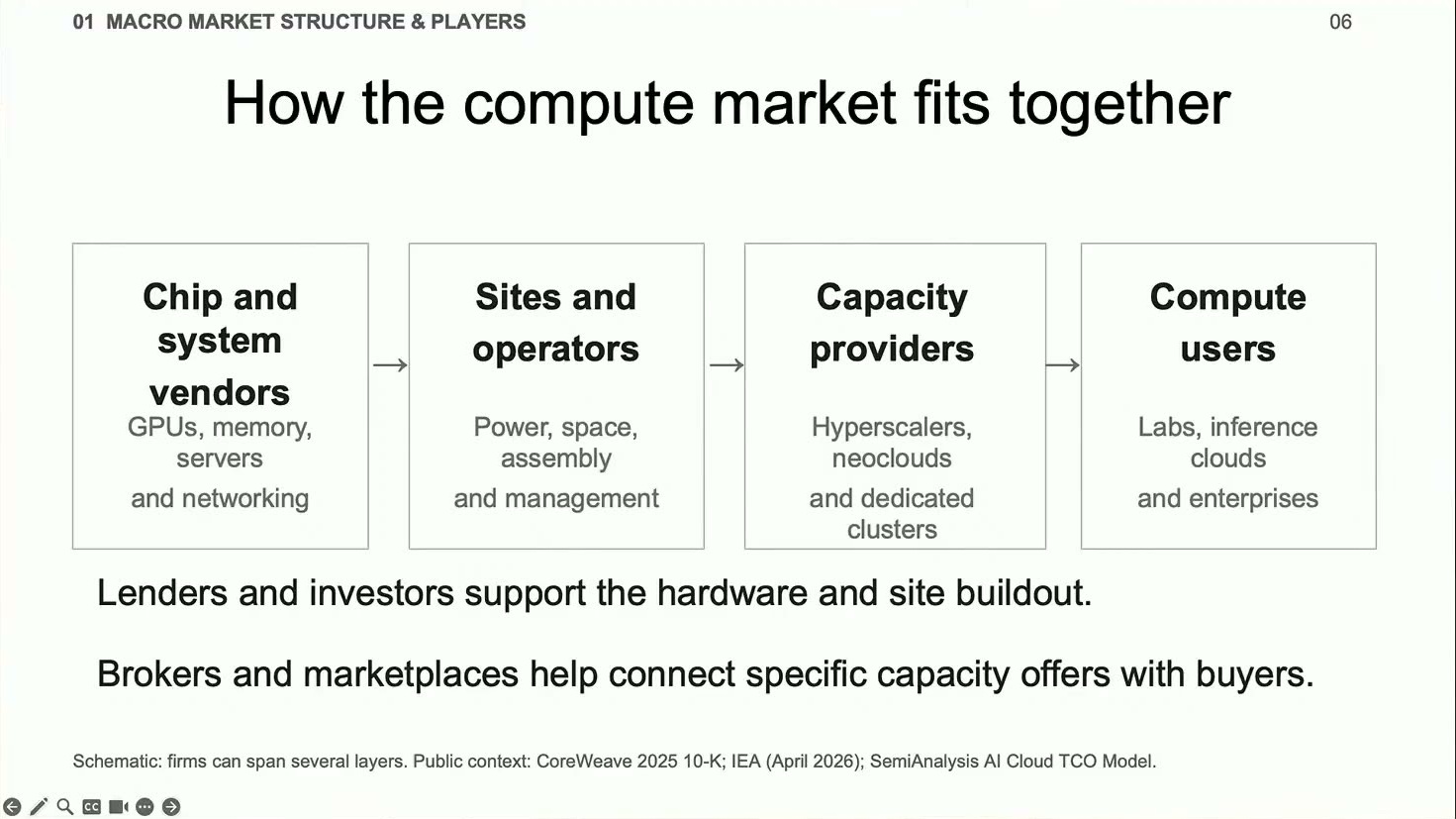
芯片和系统供应商提供 GPU 服务及网络设备。场地和运营商提供电力、空间、组装和管理。这里还包括 GPU、内存服务和网络设备。容量供应商包括超大规模云服务商、新云服务商,以及其他以类似新云服务商的方式运营、转售裸金属容量的运营商。然后是用户。那么最终用户是谁?包括初创公司、推理云,实验室、新型实验室,以及应用层的所有人和企业,还有从事开放权重模型相关工作的用户。我把这些环节画成方框,不过实际上,同一家公司可能同时属于以上所有类别。
Chip and system vendors supply the GPU service and networking. Sites and operators supply the power space assembly and management. right here, GPUs, memory service, networking. Capacity providers, these are hyperscalers, neoclouds, and any other operator that's operating similar to how a neocloud would operate, reselling bare metal capacity, and then the users. So who's the actual end user? The startups, the inference clouds, labs, neolabs, and also anyone on the app layer, and enterprises for anyone doing open-weight stuff as well. And these boxes, I've kind of boxed them out here, but there's people People can be all of the above.
芯片和系统供应商也可能完成端到端建设,同时成为整个系统的最终用户。所以这里会有一些不同情况。正如我刚才提到的推理云,它们可能会租用一个集群,在上面提供 token 服务,再用收入偿还成本。这可能就是推理云自身的一种使用模式。但对于超大规模云服务商、前沿实验室和大型新云服务商来说,它们可以做出大规模承诺,因为它们能够获得大笔股权融资,也有能力承担更多债务,还能够签订期限很长的交易。
A chip and system vendor, someone could do a full end-to-end build out and also be the end user of everything. And so there's a little bit of variation that occurs here. And so as I was kind of mentioning about the inference clouds before, they might rent a cluster and they'll serve tokens off of it and they'll use that revenue to pay off the And so that might be a use case for the actual inference cloud themselves. However, for hyperscalers, frontier labs, and larger NeoClouds, they can make substantial commitments because they have the ability to get into the large equity, they have the ability to take on more debt, and they have the ability to do long horizon kind of deals.
比如 OpenAI 签下 10 年期合同,等等。类似这种交易。但中型市场的参与者实际上做不到这一点。谁会为一家 B 轮初创公司承销融资,让它有足够容量签下超过 $200 million 的算力合同,合同期限还长达三年?他们得融资多少轮,对吧?他们是不是得把整轮股权融资都用来支付集群费用,
So 10-year deal, open AI, contract it out, et cetera. So of that nature. However, anyone in the middle market isn't actually able to do this. Who's underwriting a Series B startup with enough capacity to get in a $200 million plus contract over three years for compute. How many equity rounds will they have to raise, right? Will they have to use their entire equity round to fund just the actual cluster
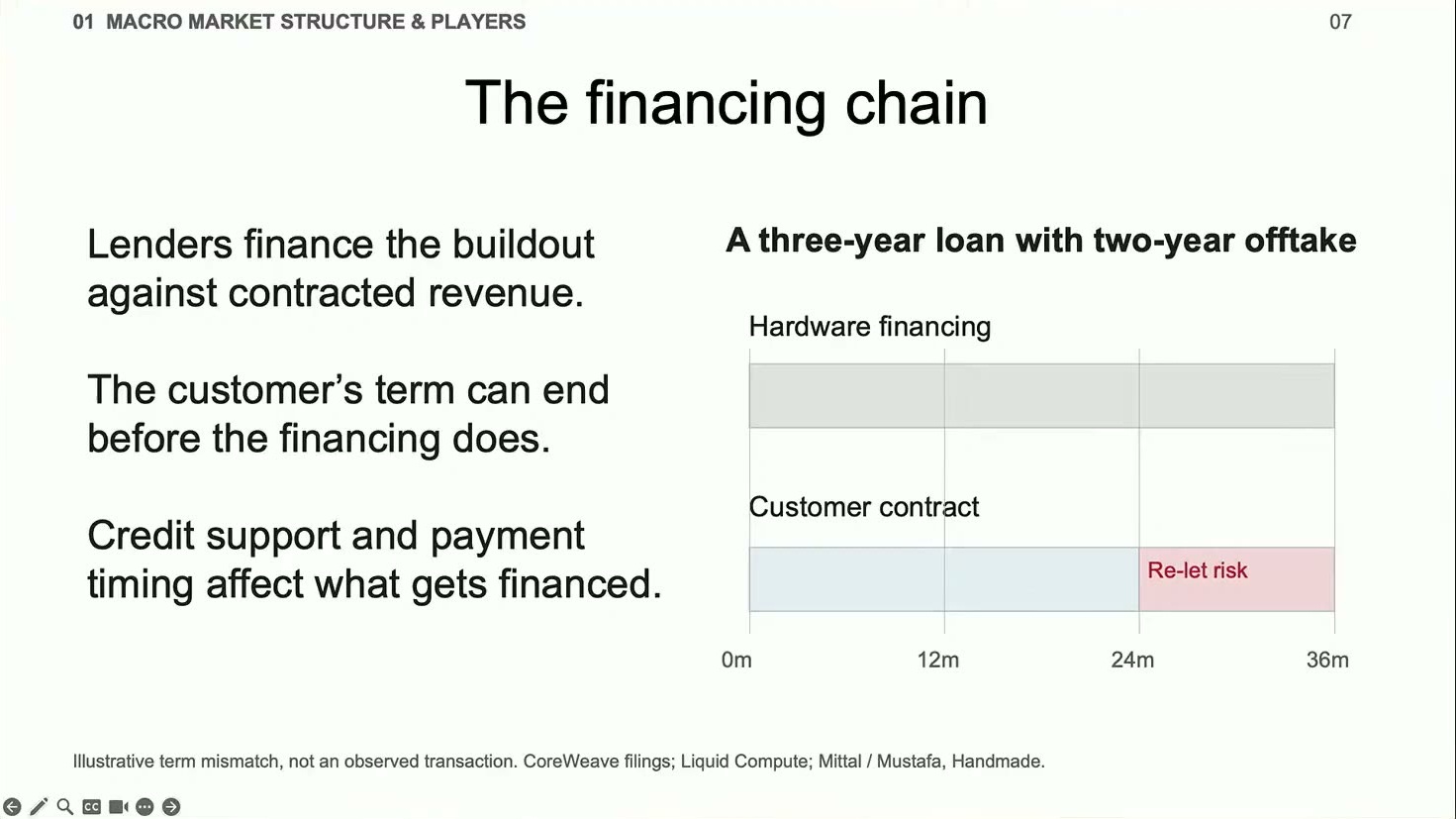
之后就没有剩余资金支付实际运营成本了?所以我们来看看这里的融资链条,以及它如何发挥作用。贷款机构会根据合同收入为建设项目提供融资,许多情况下,推理云也是如此。因此他们愿意为建设项目提供融资,但需要确信贷款最终能收回。我的意思是,你要如何为一家初创公司承销融资?比如一家私营公司,目前手里也没有多少其他优势?它们又没有上市交易。也没有多少现金流、资产负债表或损益表数据。它们甚至可能还没有盈利或收入,等等。所以贷款机构会考察:这家公司能否获得达到一定规模的合同收入?Core Reef 的公开文件提供了一个大规模案例,展示了如何通过照付不议的客户合同支持基础设施融资。
and then they don't have any remaining capital left to use for actual costs? And so we're looking into a little bit of the financing chain here and how that plays in. So lenders are financing the build-out against contracted revenue even in many cases for inference clouds. And so they want to finance the build-out. They want confidence that their loan will get repaid. I mean, like, how are you going to underwrite a startup, like a private company that doesn't have, like, much else going for them right now? Like, what are the, you know, they're not publicly traded. There's no that much cash flows, balance sheet, income statement. They might even be pre-profit, pre-revenue, et cetera. And so what they're looking at is, like, can the person get contracted revenue over a certain scale? And so Core Reef's public filings give large-scale example of infrastructure financing supported by take-or-pay customer contracts.
这张图展示了一个规模较小的例子,这里画出来的例子体现出一种期限错配:硬件融资方希望合同期限很长,但客户只负担得起或者根本不想签超过36 个月的长期融资合同。他们需要先支付 15% 到 25% 的款项,这是 CoreWeave 报告的比例,他们观察到的中位数预付款比例是 15% 到 25%,需要预先支付,对应一份总合同价值(TCV)为 $100 million 的集群合同。这意味着要先付 $15 million 到 $25 million,初创公司必须拿出这笔钱。这可能就是它们整轮融资的全部资金。
And so this diagram kind of shows the smaller, illustrated example here in the mismatch is that hardware financing, they want very long terms, but customers are only able to afford or don't really want to get into a long-term financing over 36 months. They have to put up on after 15% to 25% is what CoreWeave has quoted that they've seen their median prepayments to be, 15% to 25% up front on a 100 million TCV cluster. That's $15 to $25 million that a startup has to put up front. That might be their entire round.
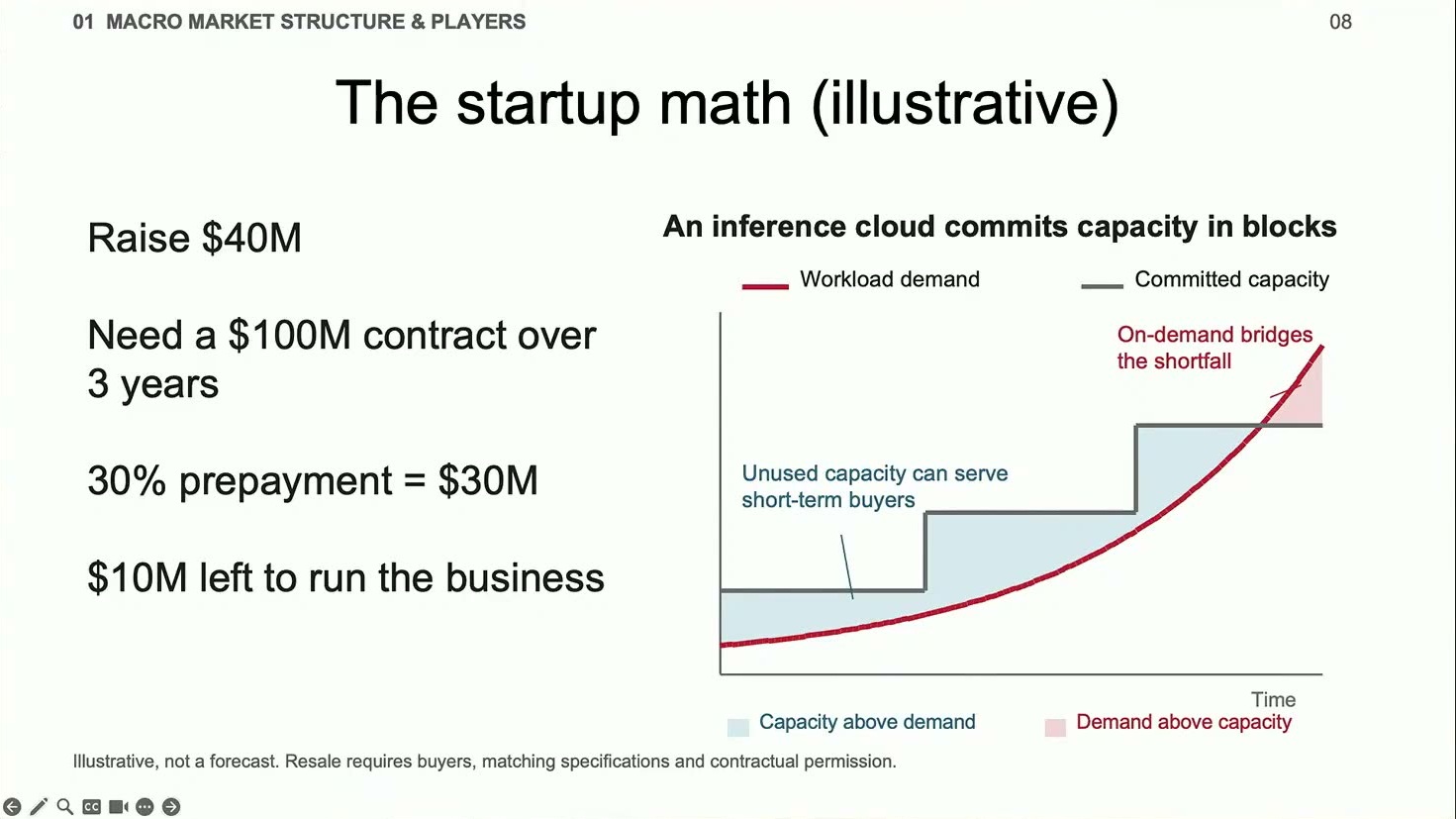
我想用这个例子说明我指的是什么:你融资 $40 million,需要一份 $100 million 的合同,合同为期三年,先付 30% 预付款。这只是一个示例,这样你就只剩 $10 million 来运营公司,可能就会出现这种你会看到阶梯状的曲线,这是合同锁定的容量,而实际需求低于这个水平。所以,每次需要新增集群时,都会和你的股权融资轮次或其他因素挂钩,但你可能会达到上限,不得不拒绝客户。你有哪些选择?要么在下一轮股权融资之前拒绝客户,等有资金支付另一笔 30% 预付款,才能再增加一部分容量;要么使用按需算力,填补缺口,弥补短缺?这就是一种选择。接下来要分析经济账:具体是什么样?和另一种方式有什么区别?
And so this is kind of a look at what I'm referencing here. It's like you're raising $40 million, you need a $100 million contract over three years, you put down 30% prepayments, this is an illustrative example, you've got $10 million left to run the business, and so you might have this kind of step function as you can see here, so that's your contract at capacity and what you can actually, and the demand is below that. And so now every time that you have to get into a new cluster, it's like tied to your equity round or whatever else it may be, but you might have to cap out and turn away customers. So what are your options? You either turn away customers until you can get into your next equity round so you can put down another 30% prepayment so you can get the next little bit of capacity going, or do you use on-demand to close the area under the gap and bridge the shortfall? That's like an option now. Now you have to look into the economics. What does that look like? What's the difference between
也许他们可以找贷款机构,为预付款部分提供融资。但如果预付款融资的收益率低于当时直接按需购买算力的成本,而且他们能买到所需容量,那么这种经济账划算吗?以下是我们看到的一些运营模式。
maybe instead what they do is they go to a lender to finance the prepayment component, But if the yield on the prepayment component that they're getting financed is less than them just buying it out on demand at that time, if they're able to get into that amount of capacity, then does the economics make sense there? And so here's some of the operating models that we've seen.
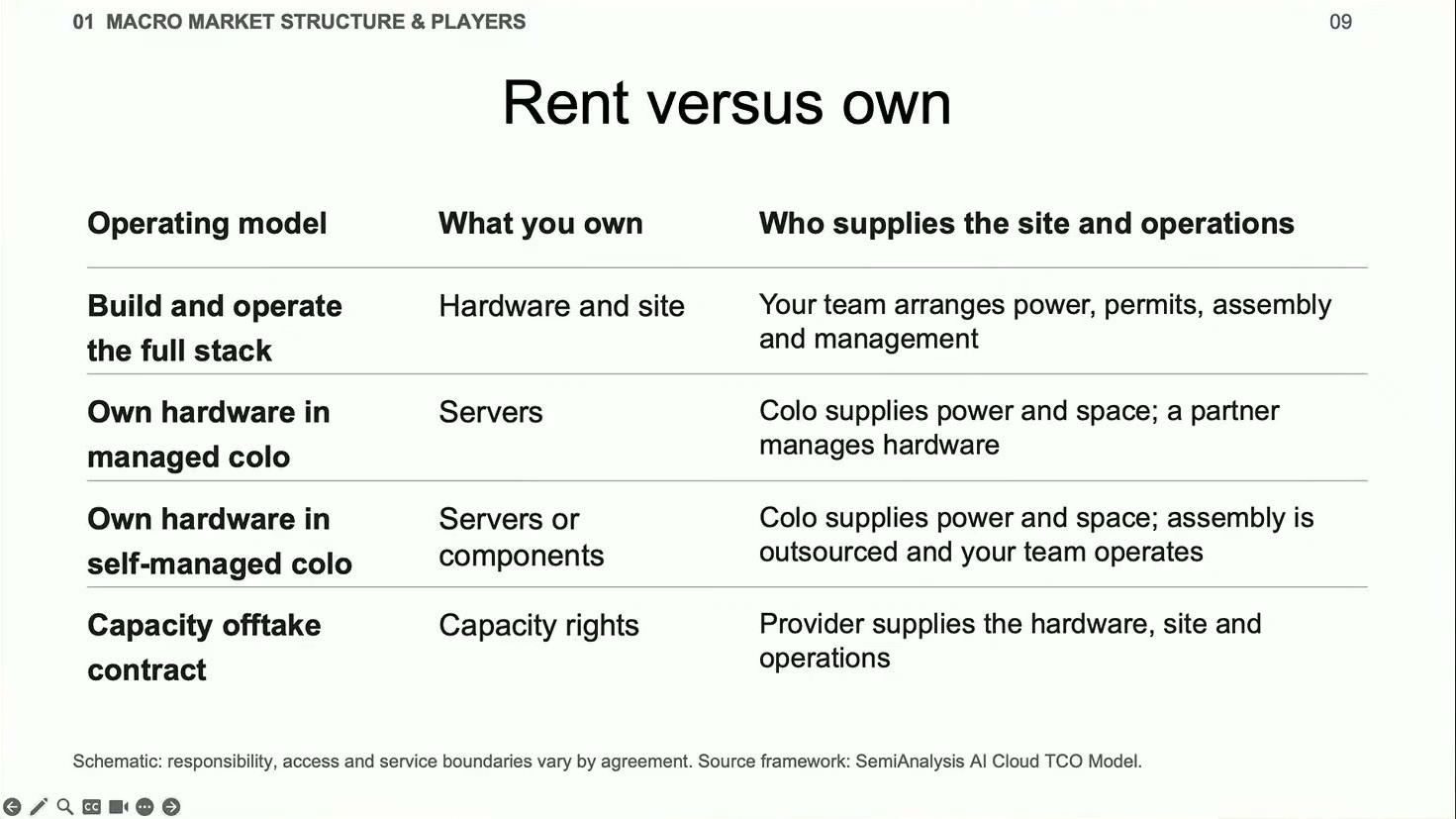
你可以自建并运营完整技术栈,包括硬件和场地,由自己的团队安排电力、许可、组装和管理。你也可以在共址设施中拥有服务器,而组装和运营工作大体上交给合作伙伴处理。另一种方式是签订承购合同,购买明确数量的容量,由供应商拥有并运营资产;对方可能不会给你裸金属服务器的完整 root 权限,也可能根据租户类型和配置决定你能获得多少访问权限,比如单租户或多租户,这些因素也会影响价格。有些企业看重实体访问权限,有些企业看重机密计算,也可能看重特定的拓扑调整,或重新配置系统的能力。
It's like you can build and operate the full stack. Hardware, site, your team is going to arrange power permit, the assembly, the management. You can also own servers in a co-location facility with more or less assembly and operation handled by a partner. On the other hand, an off-take contract buys defined capacity and the provider is going to own and operate the asset and they might not give you complete root access to the bare metal or there might be levels to how much access you get depending on if it's tenant, multi-tenant, et cetera type of configurations that can also affect the pricing. And so some businesses are going to value the physical access. Some businesses are going to value confidential compute. They might value certain topology changes or the ability to reconfigure the system.
如果这些对你的业务很重要,你可能会希望拥有越来越多的控制权,并自己构建和运营整个技术栈。考虑到机会成本,这样的经济账可能划算,也就是如果你只签租用算力的承购合同,你就必须放弃的那些机会。因此,他们可能愿意为此支付更高价格。
And so if that is something for your business, then they might actually want to have more and more control and build and operate the stack. And the economics for them might make sense given the opportunity costs they would have to give up if they were to just take rental off-take contracts. So they might be willing to pay more there.
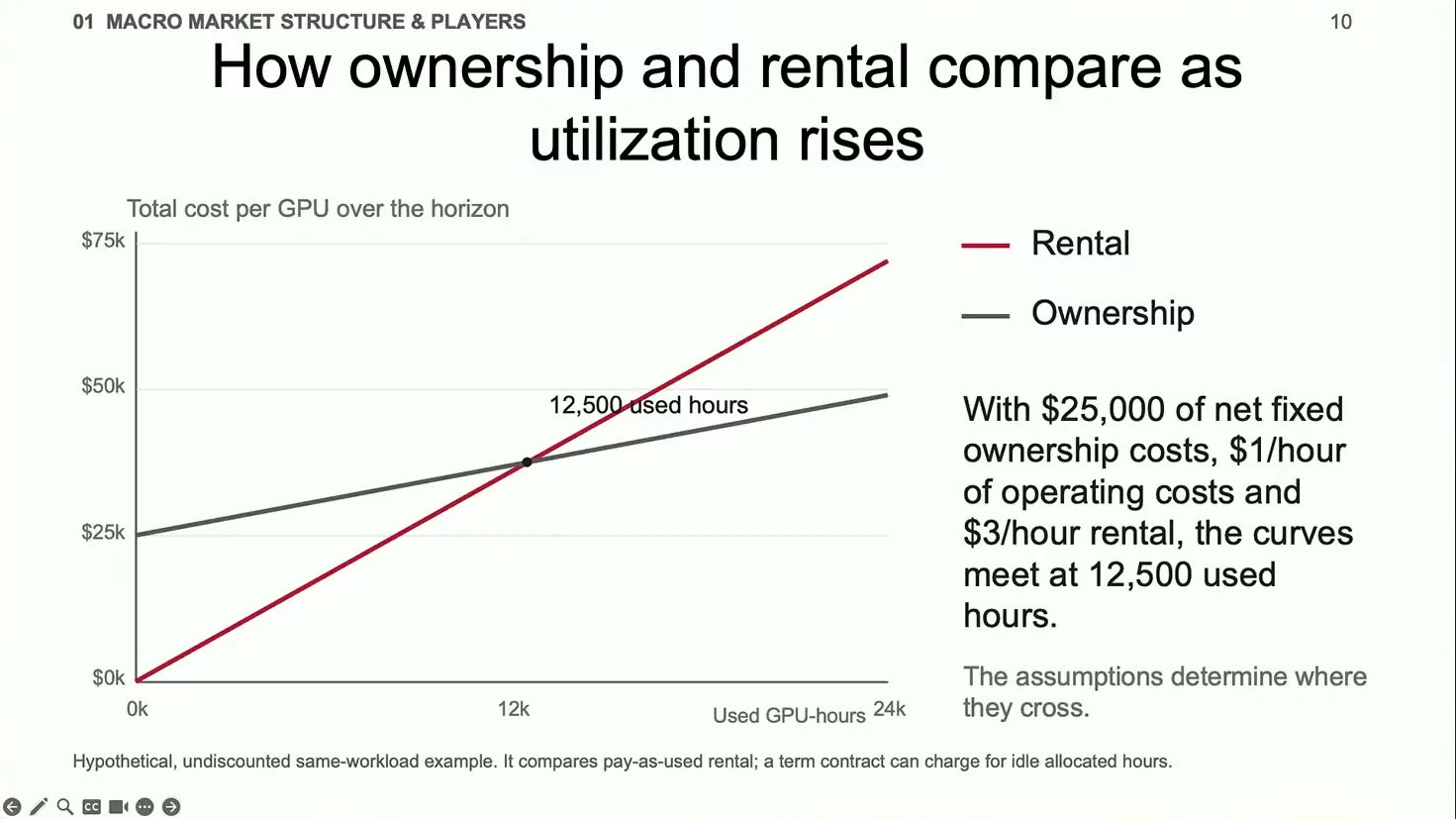
这张图展示了所有权与租用模式如何随利用率变化而比较;图画得很粗略。横轴是利用率。我们看到,承购合同的成本通常已经接近自己建设并融资集群的成本,几乎到了同一水平。因为如果你三年要花 $100 million,而且经济账算得过来,也许直接买下算力运营商会更合理,当然还要考虑时间成本和运营成本。因此存在一个需要满足的均衡:所有权成本应高于租用成本,租用成本则应低于所有权成本。但如果你的利用率这么高,而且需求变化又很大,直接拥有整个技术栈可能更合适。
And so here's how, like, ownership and rental, this is a very, like, crude graph, how ownership and rental can compare as utilization arises. And so what we're looking at is that usually, you know, an off-take contract or these off-take contracts are getting to the cost of actually almost building out and financing your own cluster. And it's not, because, I mean, if you're spending $100 million over a three-year period, then maybe if the economics makes sense, it would have made more sense to simply buy out the compute operator yourself outside of the time cost and then obviously the operational costs that might exist. So there's an equilibrium that exists that has to be followed where the ownership costs outweigh the rental costs, and the rental costs should sit below the ownership costs. But if you're utilizing at such a rate and in such variable kind of increments, it might be best to just own the stack outright.
所以我们看到一种新的动态:算力采购
And so we're seeing this new dynamic that the compute procurement
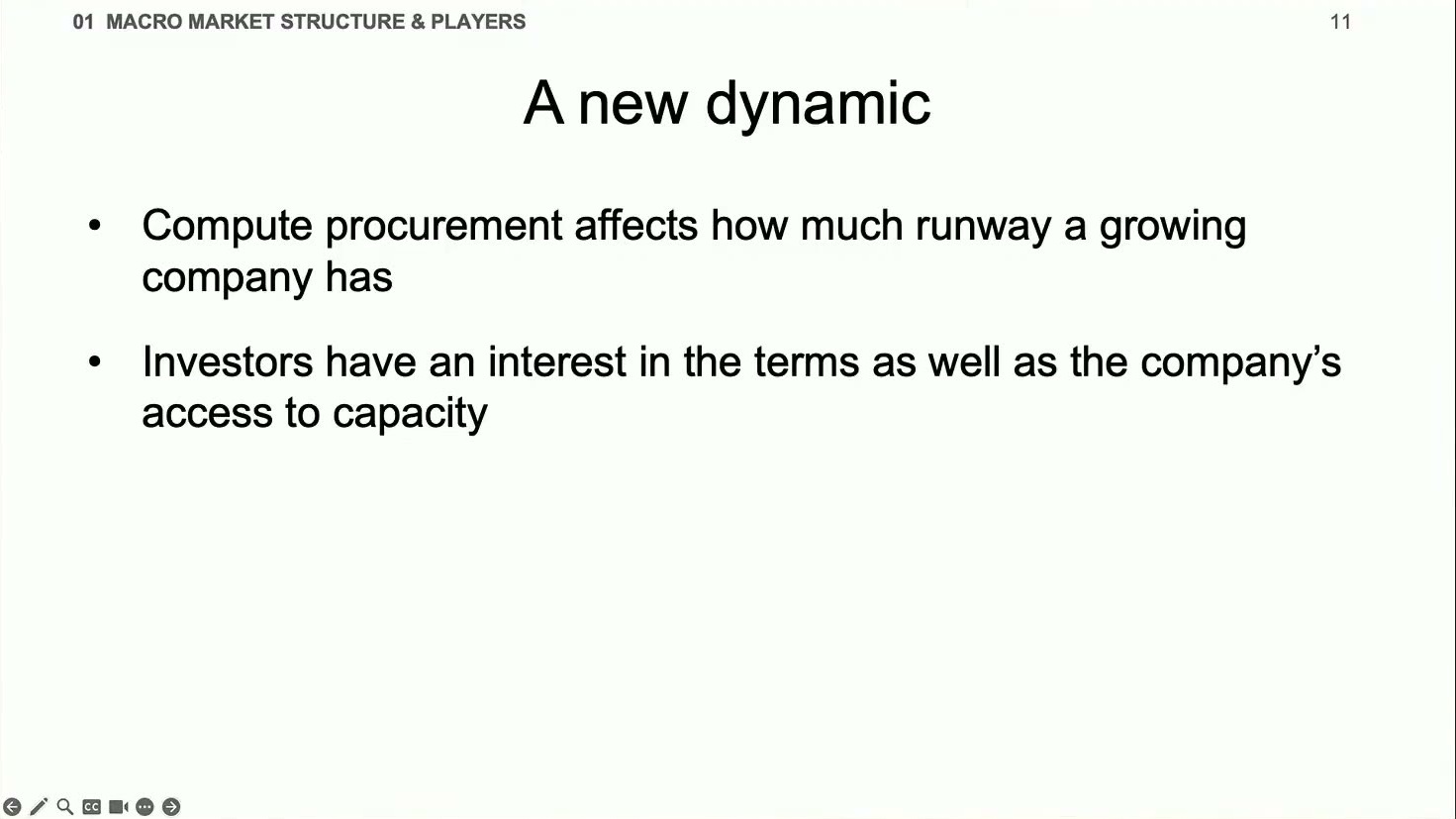
会影响成长型公司的实际运营资金能支撑多久。这也让投资者开始关注算力采购。我们正在看到这种趋势。访问权限和付款条款会影响其被投企业的运营资金能支撑多久,从风险投资的角度看。因此,帮助公司买到合适的容量,可以改善底层投资的表现。这些因素关联非常紧密,对吧?他们可以采购算力,并为其被投企业找到算力容量,然后为这项采购提供资金。这也为宏观结构带来了另一个有意思的方面。微观结构方面的问题是:谁在帮助安排容量,如何比较报价,这些合同可以转移哪些风险?
affects how much runway a growing company actually has. And so this also gives investors an interest in compute procurement. So we're kind of seeing this. Access and payment terms affect how much runway their port codes are going to have from a VC perspective. So helping a company buy a suitable capacity can improve the underlying investment. And they're very connected, right? So they're able to procure and they're able to actually find compute capacity for their port codes and fund that. And so that also brings another interesting aspect to the macro structure. Into the micro structure is that who helps place the capacity and how does this offer get compared and what risks these contracts can transfer.
我们看到有很多不同的参与者,
So we have a lot of different players
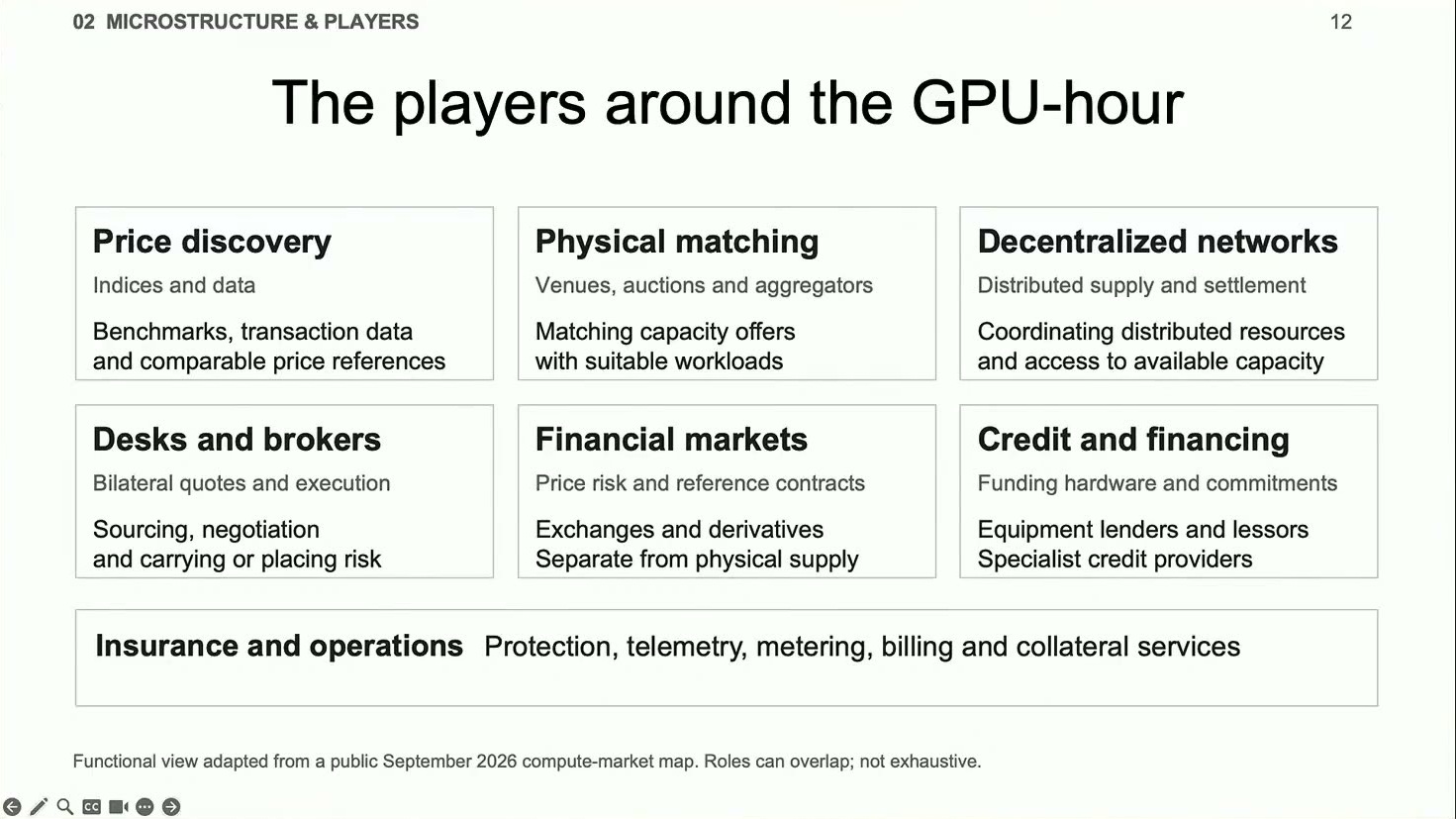
围绕着 GPU 小时算力共同塑造这个市场。首先是帮助发现价格的人。比如提供指数、数据和基准的人,我们都在查看和引用这些基准,未来可以用来推出基于基准的期货合约;相关合同规格正在等待审批。然后还有实体匹配场所、拍卖平台和聚合商,也就是任何能够匹配容量的参与者。我们主要关注去中心化的按需算力市场,也关注提供流动算力池服务的流动算力池,它们还会自行拆分容量并使用标准化合同。还有裸金属服务器转售商,以及销售大规模容量的新云服务商。
around this GPU hour that are helping kind of shape this market here. You've got your price discovery individuals. So people with indexes, data, benchmarks that we're all looking at right now and referencing which would be used to you know in the future launch the futures based on the benchmark it's you know talked about in the associated contracts per spec per pending approval and then there's the physical matching venues auctions aggregators so anyone who can match capacity we're looking at essentially decentralized marketplaces for on-demand compute. You're looking at liquid pools of compute that offer liquid pool services and part it out themselves and have their own standardized contract. You're looking at bare
此外还有个体经纪商和运营商,参与裸金属转售。裸金属转售。你还会看到专门的经纪商,负责查看双边报价并执行交易。他们可能认识很多人,行动很快,也能看到报价,发现不同地方的规格非常相似,并知道有一个买家目前对价格极不敏感,急需算力,而且能够及时收到 RFS,这样他们就能收取不错的价差。接着他们会找到算力来源,进行谈判,然后承担并安排风险。他们还得为客户运营那个集群,但这笔价差必须足以覆盖成本。
metal resellers. You're looking at neoclouds themselves doing larger capacity sales. And then you're looking at individual brokers and individual operators here as well on the bare metal reselling. You have destined brokers. They're looking at the bilateral quotes and execution. They might know a lot of people. They might be able to move fast. They might be able to see quotes have very similar specs in one place and know that there's a buyer that is extremely inelastic to price right now, needs to compute immediately, and they can get the RFS in time so they can charge a decent spread on it. And then what they do is they're going to have the source negotiating, and then they're going to be carrying and placing the risk. They're going to have to operate that cluster for the person, but it has to be worth that spread.
金融市场中也有类似的发展,一些交易所即将推出围绕 GPU小时算力的期货和衍生品。人们会用它们来研究如何对冲风险,并采用更复杂的金融结构。比如对冲风险、资产负债表风险,或签订更有意思的协议。我们也看到预付款和付款融资安排等协议开始出现。我们看到有人在使用期货,也有人有兴趣使用期货以及其他类型的期权来实现风险管理。市场确实有这类需求,可以对冲他们目前账面上承担的风险。买方也在寻找灵活合同,例如:“我能不能签一份灵活合同?”
And you have looks in financial markets, the exchanges that are coming that are based on the GPU hour, the futures and derivatives. People are going to be using it to take a look at how to maybe hedge out and look into more financial structures. So hedge out risk, so hedge out balance sheet risk, maybe get into more interesting agreements. We're seeing kind of agreements such as prepayment, payment facilities are coming online. we're seeing people utilize futures and are interested in utilizing futures and other kind of options to be able to there's demand for this to be able to hedge out the risk that they currently have on the books. We have buy side individuals looking for flex contracts flexible contracts like hey
如果我签下 3 到 5 年的合同,能不能至少升级到新推出的芯片,或者把合同滚动续期,甚至把容量卖回给你?”还有信贷和融资,包括设备贷款方、租赁方,以及专业信贷供应商。我们目前看到的情况是,
is there ability that if I lock myself into a 3-5 year contract that I'll be able to at least upgrade one of the new chips that comes out or maybe I'll be able to roll it over or maybe let me sell it back to you and then there's credit and financing so equipment lenders, leasers specialist credit providers. And so the way we're seeing it right now
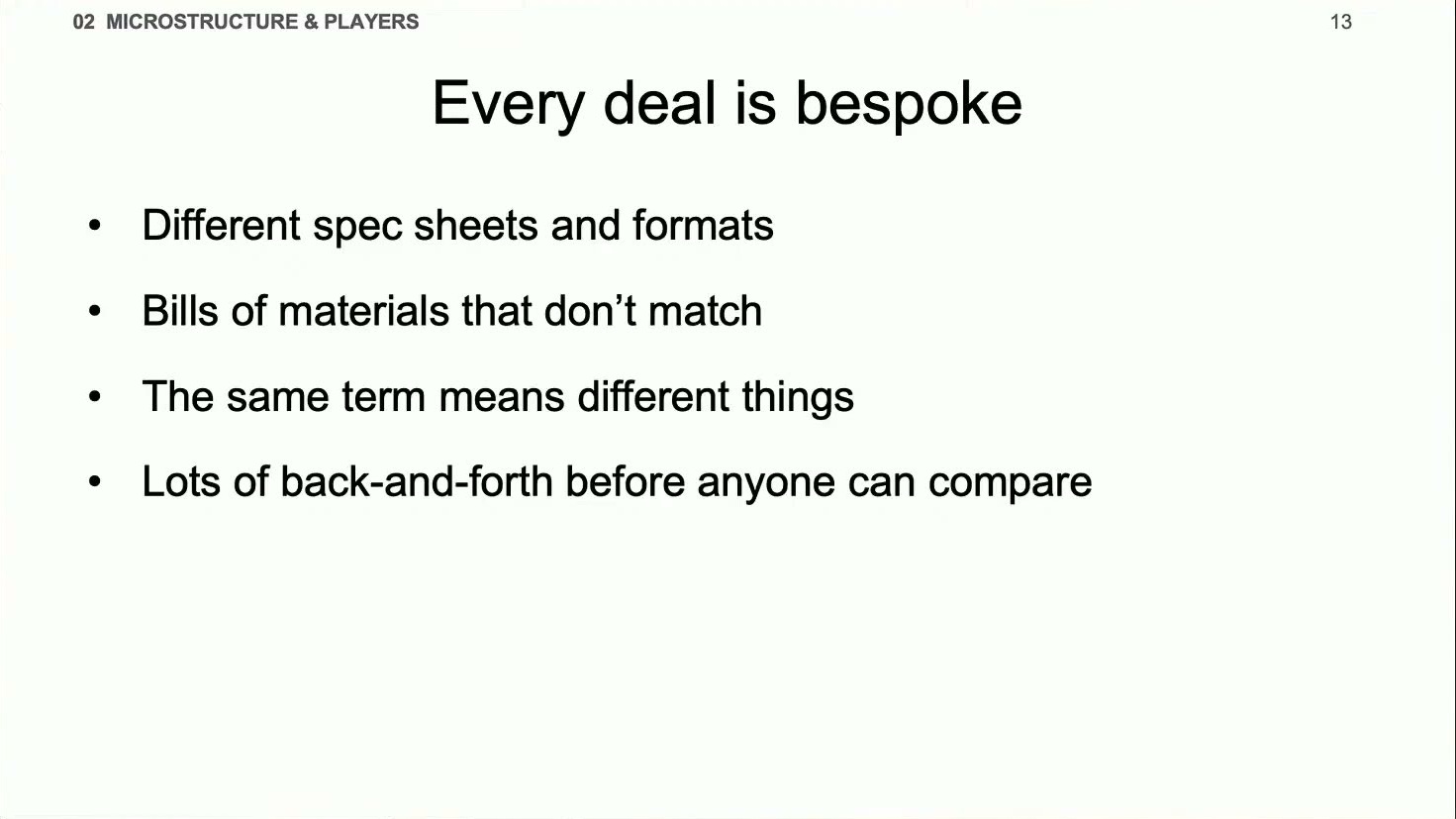
每笔交易都是定制的。规格表各不相同,文件格式也不统一。物料清单可能和实际交付的内容不一致,或者可能会有变更,比如某个部件缺失或缺货。而一些 OEM 和 ODM 供应商的交货周期也非常长。快速谈判时,同一个术语可能代表不同的东西。比如有人说内存,我们说的是显存(VRAM)、CPU 内存,还是额外存储?你具体指的是什么?这会显著影响可以运行哪些负载,也影响最终用户的实际需求,以及价格和交付日期。
is that every deal is bespoke. There's different spec sheets, there's formats. The bill of materials may not match the actual delivery, or there might be a subject to change if a part is missing or a part is out of stock, and there's very long lead times that some of these OEM and ODM kind of providers have. And the same term can mean different things when you're negotiating very quickly. If someone's talking about memory, are we talking about, you know, VRAM, are we talking about the CPU memory, are we talking about additional storage here? Like, what did you exactly mean there? It affects quite a bit what type of loads can be run and, you know, the actual end users' needs, and also with pricing and delivery dates.
所以往往要来回沟通很多次,大家才能真正进行比较。这时就会涉及非同质化的概念,以及如何划分不同部分,哪些部分可以互换,哪些因素影响最大,比如偏差等等,哪些部分仍然会像产品一样交易。比如电商交易,只适用于特定集群的报价。价格每天都可能更新,甚至更新得更频繁。
So there's a lot of back and forth before anyone can really compare, and this is where the concept of, like, non-fungibility kind of comes into place and how to partition that out, what parts can be fungible, what parts hold the most of the weight, such as the skew, et cetera, and what parts are still, like, traded as if it was a product. e-commerce, et cetera, where it's only for that particular cluster that this price applies. And so prices can update daily or faster.
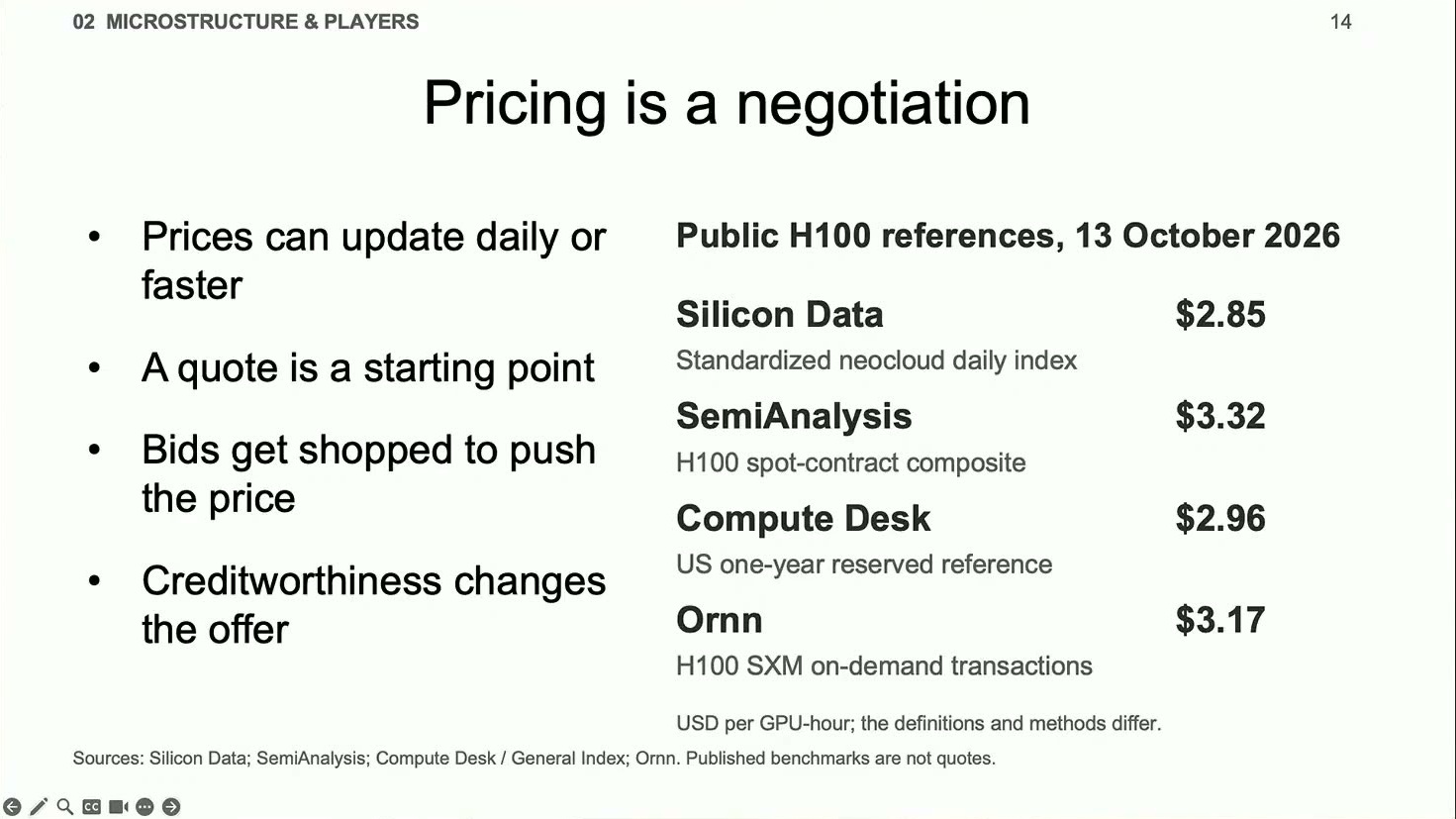
报价仍然是很好的起点。投标也可能被拿去比价。Gradwarding 会改变市场上提供的内容。此外还有各种潜在因素、隐性因素,这就是我们称它为暗市场的原因。这是今天一些公开的 H100 参考价,来自 NAP-chotted。我更新过这些数据。大家可以看看公开市场上的……这些是你可以去相关网站查看的参考价格。这只是一个例子,展示了今天 H100 的公开按需价格或现货价格。这里可以看到不同的价格。人们可能会采用这些价格,也可能依据自己的内部数据,用自己观察到的信息来定价,为具体集群规格确定收费标准,同时考虑其他所有相关因素。
Quotes are still a good starting point. Bids can get shopped. Gradwarding has changes of what's on offer. There's all these kind of latent factors, hidden factors as well, why we're calling it a dark market. These are some public H100 references to NAP-chotted today. I updated them. So take a look at what the public... So those are the references for if you wanted to go on their websites to see. This is just an example here. of what a public on-demand or spot pricing looks like for an H100 today. You can see various prices here. People might use this or they might use their own internal, what they've seen, to actually assume or use it to charge what they want to charge on their actual cluster specification, taking into account every other kind of factor that goes into it.
为什么需要这些新结构?这些微观结构是什么?有意思。主要是为了解决这些错配,对吧?弥补容量缺口、提供更灵活的承诺,允许转售,并防范价格变动。
Why are these new structures needed and what are these microstructures? Interesting. It's mainly to solve for these mismatches, right? Bridging capacity, more flexible commitments, resale rights, and protection against price moves.
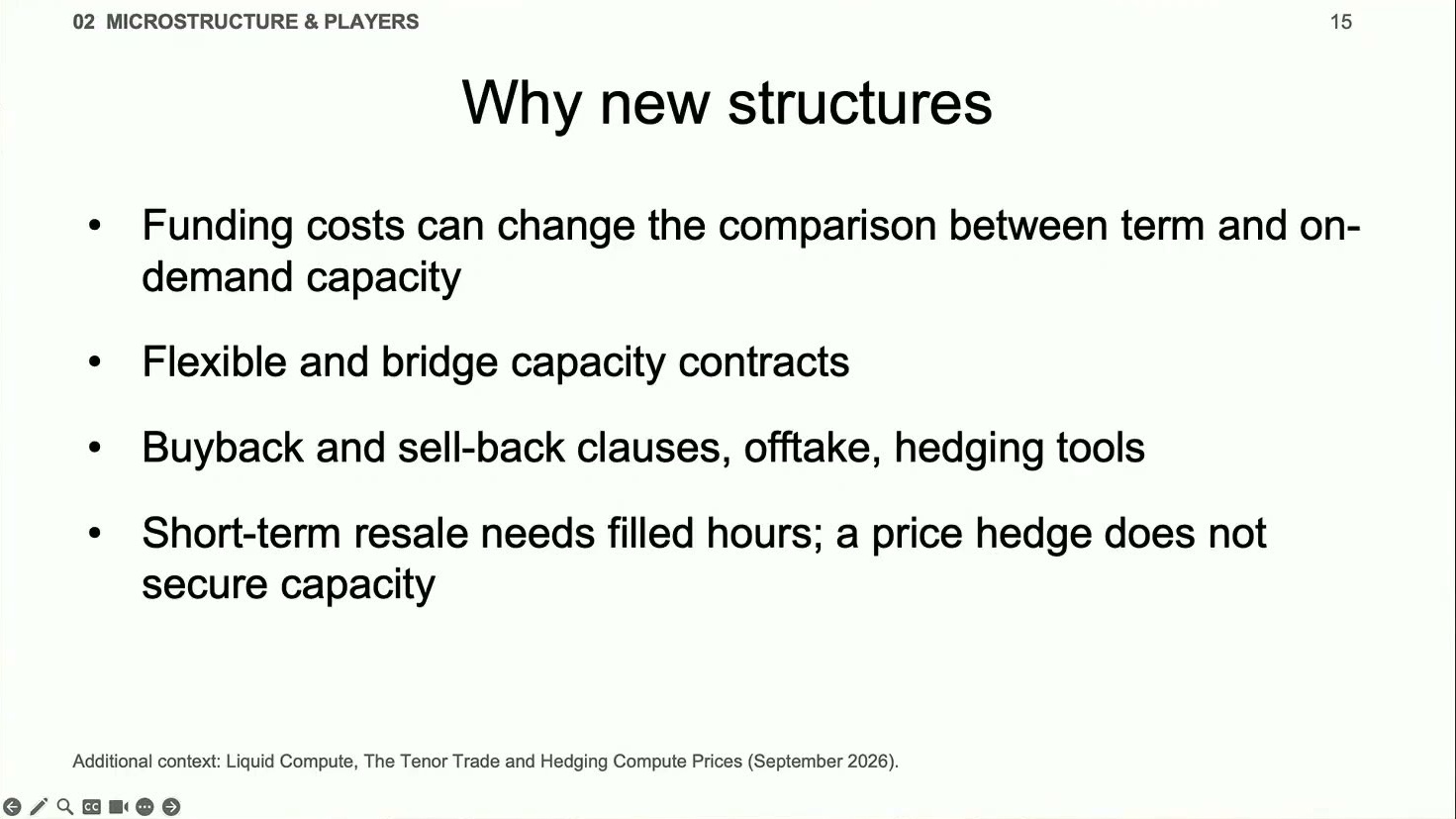
你们销售的是固定价格服务,从推理云的角度来看。你会以固定价格销售服务,但 GPU 账单会浮动,这就带来了价格风险敞口。因此,锁定多年容量可以解决其中一部分问题,但也会造成其他方面的闲置小时风险,除非你一直都在使用这些算力。转售闲置容量只有在确实有人愿意买这些算力小时的情况下才有用。金融对冲可以针对参考价格管理风险,但通过现金结算无法立刻交付集群也不能保证算力利用率。因此,有用的金融结构必须从企业实际面临、需要管理的风险出发。
You know, you're selling a fixed-price service from an inference cloud point of view. You'd be selling a fixed-price service while the GPU bill floats, and that creates price exposure. And so locking capacity for years can solve a part of that, but it'll create idle hour exposure elsewhere as well, unless you're always using it. Reselling spare capacity only helps if someone actually can buy the hours. A financial hedge can address a reference price, but can't deliver the cluster right now in terms of cash settlement or guarantee a utilization. So the useful structure has to start with the particular risk that the business has and needs to manage.
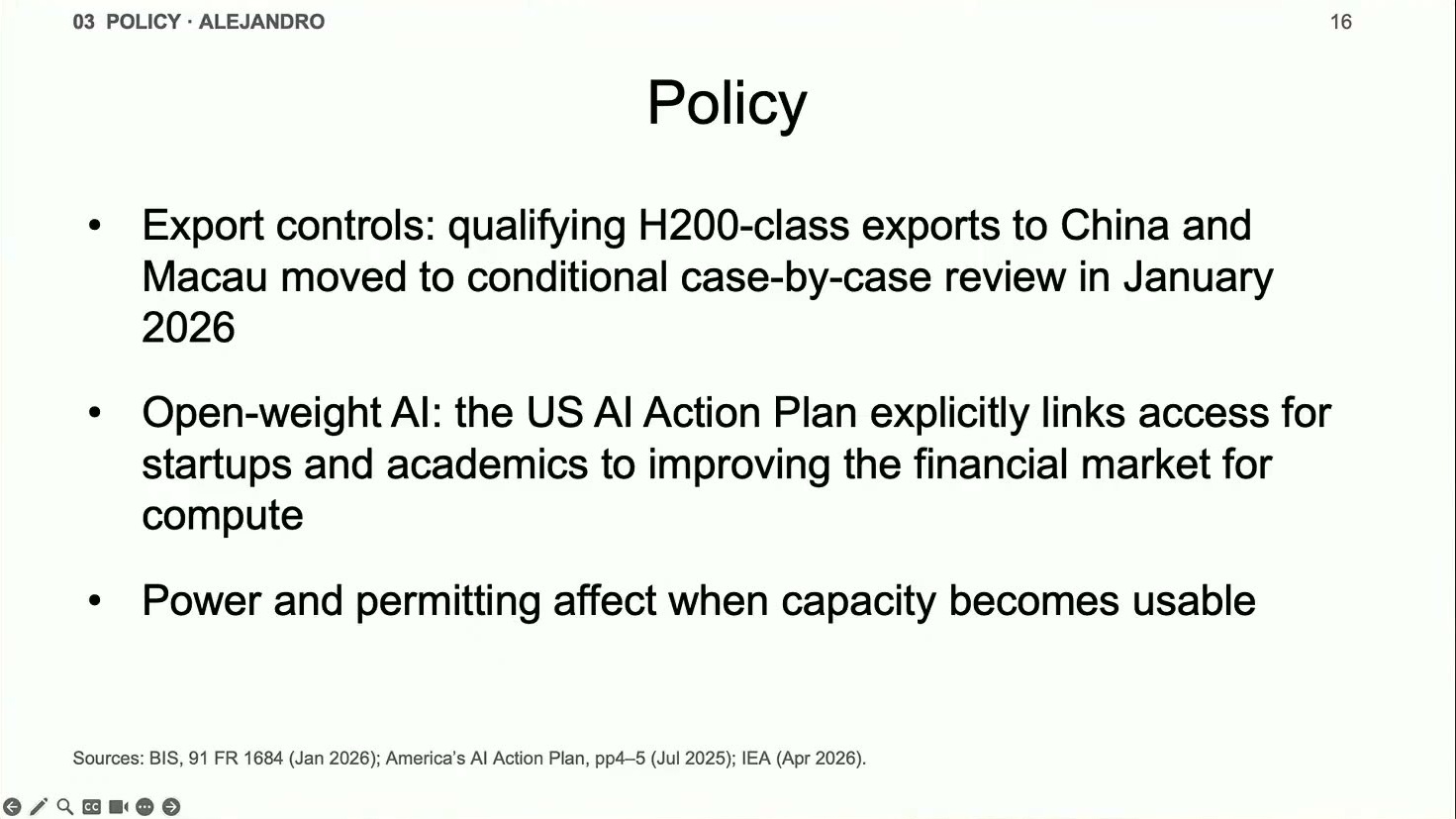
政策部分我会讲快一点,因为时间不多了。Affaan 刚才说的一切都处在一个受监管且受政策影响的体系内。影响方式有很多。一个例子是出口管制。今年 1 月,美国商务部将符合条件的 H200 级芯片对中国和澳门的许可证审查改为逐案审查,并附带条件。此外,开放权重模型也把政策和我们最初谈到的美国经济联系起来。美国《人工智能行动计划》明确鼓励开源和开放权重 AI,并建议改善算力金融市场,让初创公司和学术界能够获得大规模计算能力。我就讲到这里。那机会在哪里?我们看到一个
And I'll go pretty fast on this policy section because we're running out of time. Everything that Affaan has said sits inside of a structure that is regulated and is affected by policy. In various ways. One way is export controls. One of the examples, in January, the U.S. Commerce Department moved qualifying H200 class license reviews for China and Macau to case-by-case review with conditions. furthermore open weight models connect policy back to the u.s economics we started with the u.s ai action plan explicitly encourages open source and open weight ai and recommends improving the financial market for compute so that startups and academics can access large-scale computing power so i'm going to tie this out right here but where's this opportunity like we have this
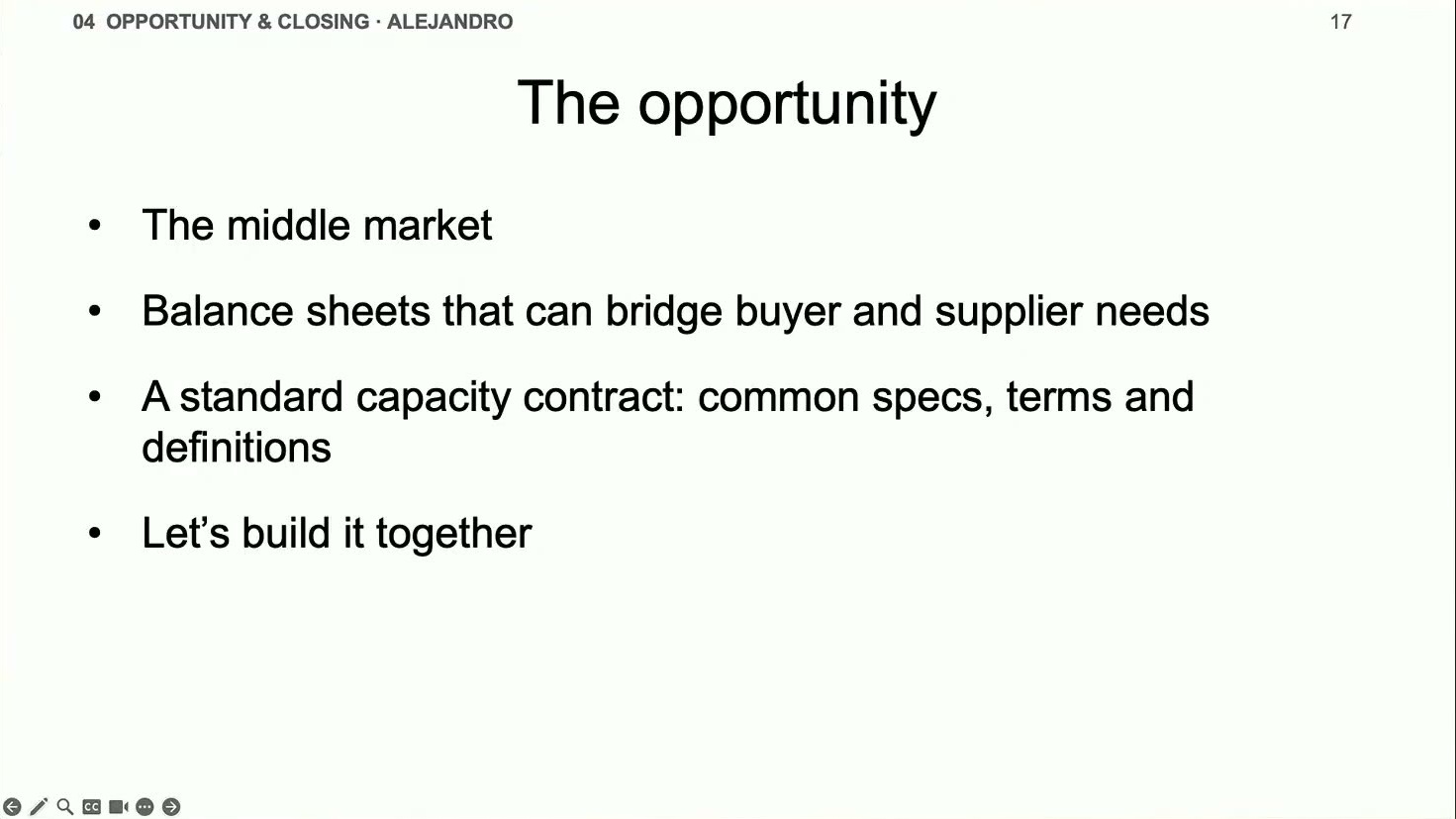
不断壮大的中型市场。我们需要有足够资产负债能力的机构来弥合买方和供应商的需求。还需要一定程度的标准化,包括标准容量合同、通用规格、通用条款和定义。成长型公司的需求和承诺规模可能不符合超大规模云服务商和前沿实验室愿意接受的合同条件,但这些公司确实有实际工作负载,我们希望它们能够成长。它们仍然面临融资、时机和规格方面的问题。供应商可能希望买家为建设项目做出长期承诺,而买家希望随着需求逐渐明朗,以更小的批次扩容,因为需求波动很大、而且变化很快。买家需要一种方式,避免为尚无法使用的容量付费。因此,资产负债表稳健、与市场相关性较低、并且能够评估这些风险的参与者,如果拥有良好的信用状况,就可以帮助弥合买卖双方的需求差距。
growing middle market. We need balance sheets that can bridge buyer and supplier needs. There needs to be some level of standardization, a standard capacity contract, common specs, common terms, and definitions. And so growing companies whose needs and commitment do not fit the contracts, the hyperscalers, and Frontier Labs consign. Those companies have real workloads. We want them to grow. They still face this financing problem, a timing problem, a specification problem. A supplier might want the long-term commitment for the build-out while the buyer wants to expand in smaller blocks as demand becomes clearer, as it's so volatile, front of curve. The buyer needs a way to avoid paying for capacity it can't use yet, and so participants with strong balance sheets that are uncorrelated with the market and the ability to assess those risks with a strong credit profile can help bridge the gap between what buyers need and what suppliers offers.
这需要了解的不只是 GPU 小时的报价,还包括交付、工作负载等所有情况。因此,市场上的参与者很少,而非常合适的参与者可能是一家与市场相关性较低、资产负债表稳健、信用评级良好,并且拥有大量高性能计算硬件专业人才的公司,能够深耕高性能计算领域。
That requires more than quoting the actual GPU hour. It means understanding the delivery, workload, all of that, and so there's very few kind of players in the market, and a very well-suited player, can be a firm that's uncorrelated with market, has a strong balance sheet, strong credit rating, and incredible amounts of hardware talent that sits inside for high-performance computing.
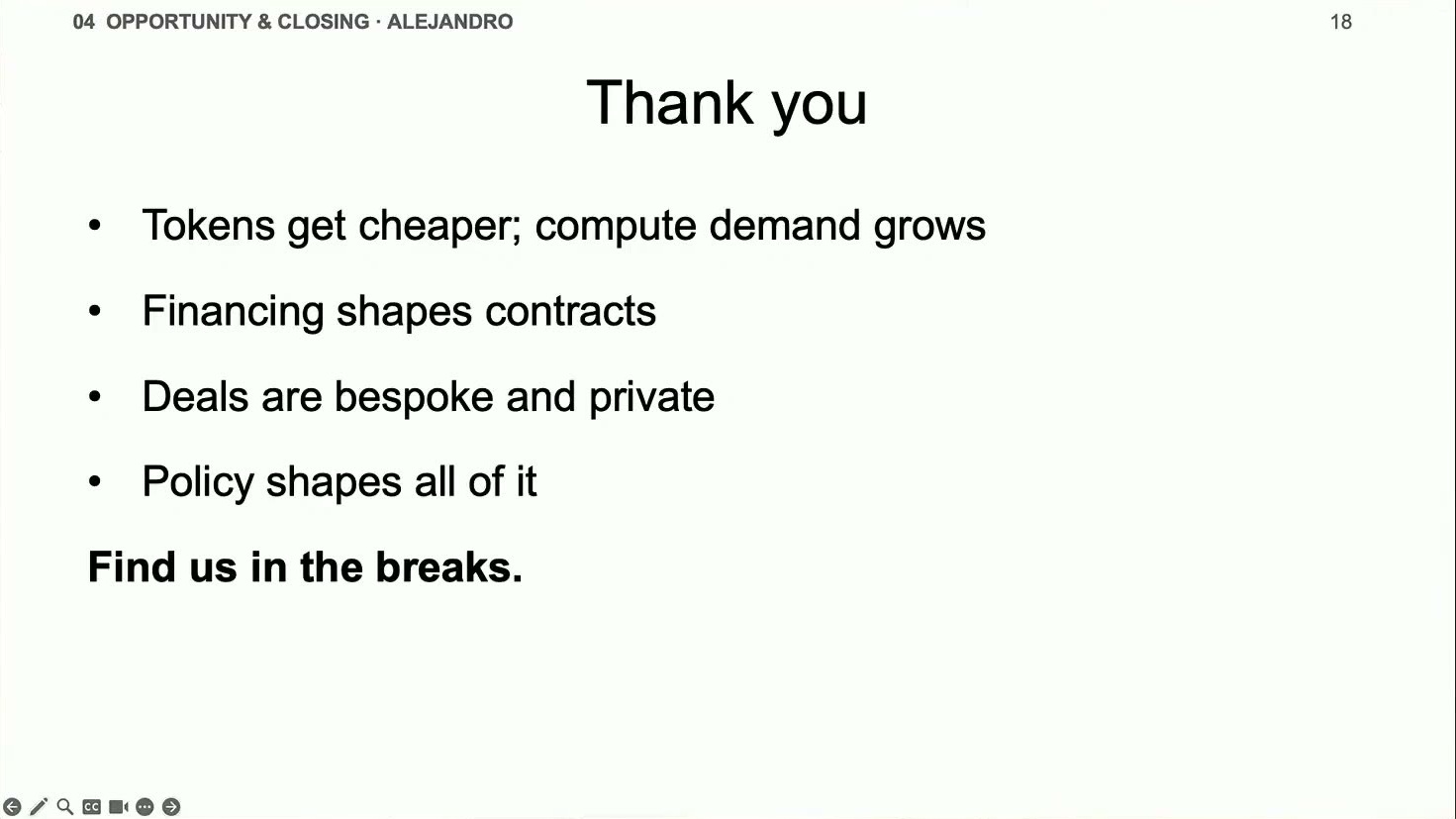
最后,我想发出一个合作邀请:让我们一起构建这个市场。非常感谢大家来听我们的演讲。
And so, just making a CTA here, let's build this together. Thank you guys so much for attending our talk.