算力市场如何运作
How Compute Markets Work
原文由官网提供,中文由 GPT-6 Luna 翻译。相邻片段合并排版,正文与时间点保持对应。
已插入 18 张经核对的幻灯片或演示截图;点击图片可放大。图注链接为当前视频时间,左侧正文时间保留原转录版本,二者可能不同。
共 33 个阅读段落
大家怎么样?这场演讲讲的是算力市场,不过更主要是讲为什么要建立算力市场。如果你们还不认识我,我叫 Evan。
How are we doing? So this is a talk about compute markets, but it's kind of more of a talk about why to make a compute market. If you don't know me, I'm Evan.
我们经营一家名为 San Francisco Compute 的公司。我们运营一个实物交割的订单市场,也就是实物交割远期市场。如果你们听了上一场演讲,内容大致是为什么 GPU 集群运营商的表现往往不太好。我们说实物交割,意思是我们自己就是运营商。我们既运营硬件,就像云服务商运营硬件一样,同时自己也运营市场。这有点像算力领域的电网。
We run a company called San Francisco Compute. We make a physically settled order, physically settled forwards market. So if you were here for the last talk, the last talk was basically why all the operators of GPU clusters don't really work very well. When we say physically settled, we mean we're the operator. We are both the operator of the hardware in the same way that a cloud is the operator of the hardware, and then we are also the market at the same time. It's kind of like a grid for compute.
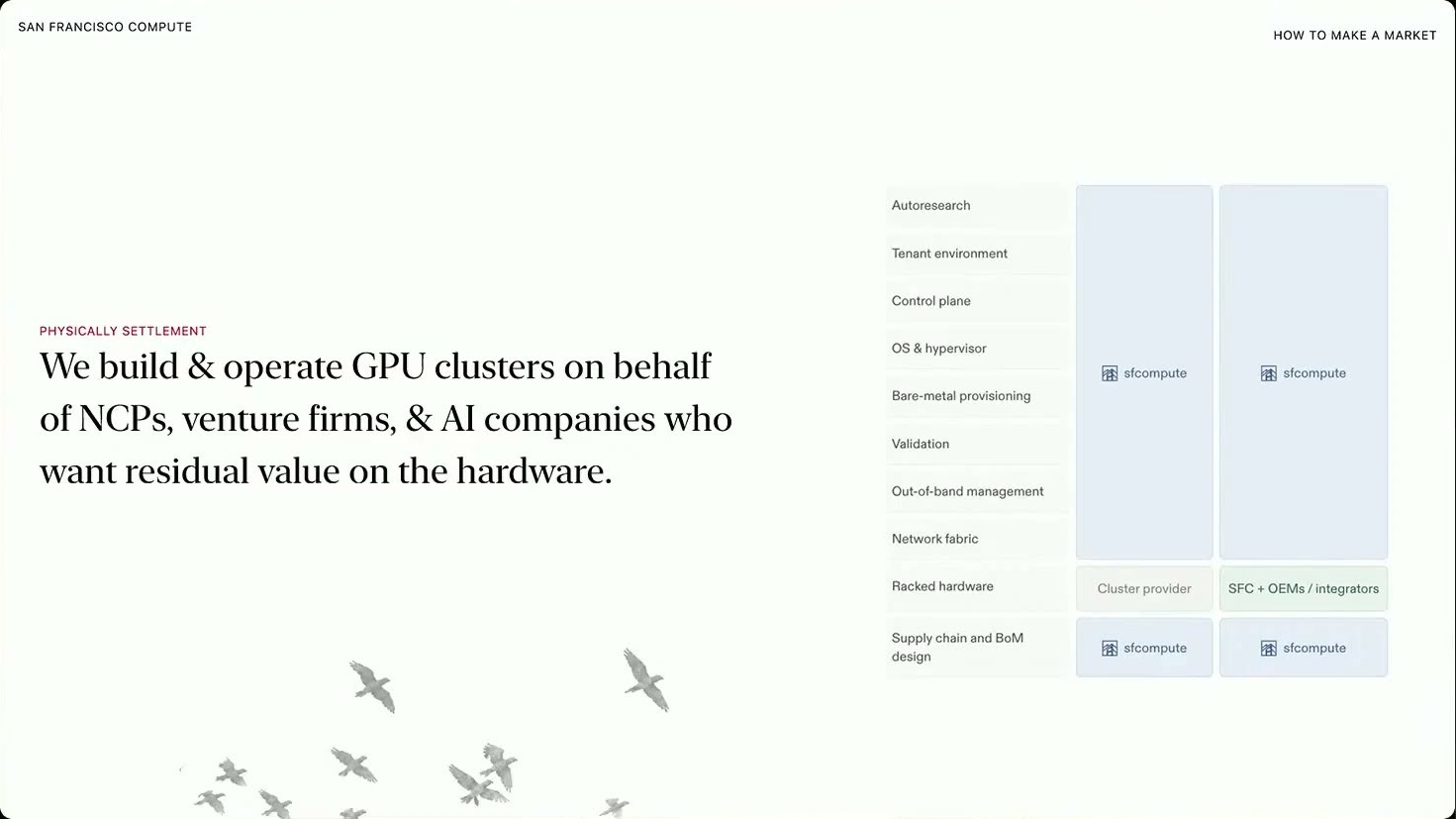
大致来说,我们认为,要运行和运营一台超级计算机,问题从超级计算机的设计阶段就开始了,特别是物料清单的设计。还包括控制背板互连网络。也包括裸金属编排的控制。此外还有上层服务,比如虚拟机等。要把技术栈中许多不同部分都做好。否则,那些拥有数据中心、想通过转型为 GPU 云从数据中心赚更多钱的人,最终会无法满足客户需求。这就是我们做的事。
So the general gist of this is that in order to run and operate a supercomputer, we think problems start right at the design of the supercomputer, right in the design of the bill of materials. It's control of the backplane fabric as well. It's also control of bare metal orchestration. It's also services on top, VMs and so on. There's a lot of different parts of the stack that you have to do effectively. Otherwise, the folks who have a data center and would like to make more money on that data center by becoming the GPU cloud end up failing for the customer. So that's what we do.
我们提供所谓的“超级计算即服务”。我们服务于那些想成为云服务商的人,比如想成为 NVIDIA 所说的 NCP 的企业,或者想为其投资组合中的被投公司配置集群的风险投资公司,并希望能够重新分配这些算力,例如在 Instinct 这样的公司快速发展时,还有希望保留算力残值的 AI 公司,因为它们意识到这对财务状况很重要,但又不想运营超级计算机。这就是实物交割。除此之外,我们还运营一个实时订单簿,供用户购买预留算力,可以立即交付,也可以在未来交付。
We offer what's called supercomputing as a service. We go to folks who want to become a cloud. that's like folks who want to become what NVIDIA would call an NCP, or venture firms that want to have clusters for their portfolio and want to be able to reallocate that capacity when a company like Instinct is taking off, or AI companies who would like the residual value on the compute because they've realized that's really important to their financials but don't want to operate a supercomputer. So that's physical settlement. And then on top of that, we run a live order book for capacity that you can buy reserved, served, either right now or in the future.
但我们最初完全没想到自己会做这些事。我们最初是一家叫 JunLark 的公司,想做类似 Suno 或UDO 的产品,但比 Suno 或 UDO 更早。当时,要真正创办一家实验室,你需要筹集一大笔押金,金额非常大,当时是 1,000 万美元。我们觉得这笔钱太离谱了,于是想:“不行,这太蠢了。”我们要筹集 50 万美元,显然之后就从别人那里租算力。显然,如今要的不是 1,000 万美元,而是 10 亿美元。尽管如此,我们还是筹到了 50 万美元,买了一大批集群,结果每个月集群成本都超出我们的承受能力。如果不把集群转租出去,我们就会破产。
This together is not at all what we thought we were going to be doing. Originally, we were this company called JunLark that was trying to make kind of like Suno or UDO, but prior to Suno or UDO. At the time, what you needed to do to realistically start a lab was you needed to raise a big deposit, a huge one, which was $10 million at the time. We thought that was a crazy amount of money, so we thought, no, that's stupid. We're going to raise 500k and obviously what we're going to do is rent from somebody else. Obviously today it's not $10 million, it's a billion dollars. And nonetheless, we had raised our 500k, we buy a big cluster, and then we're underwater on our cluster every month, and if we didn't sublease our cluster, we would have gone bankrupt.
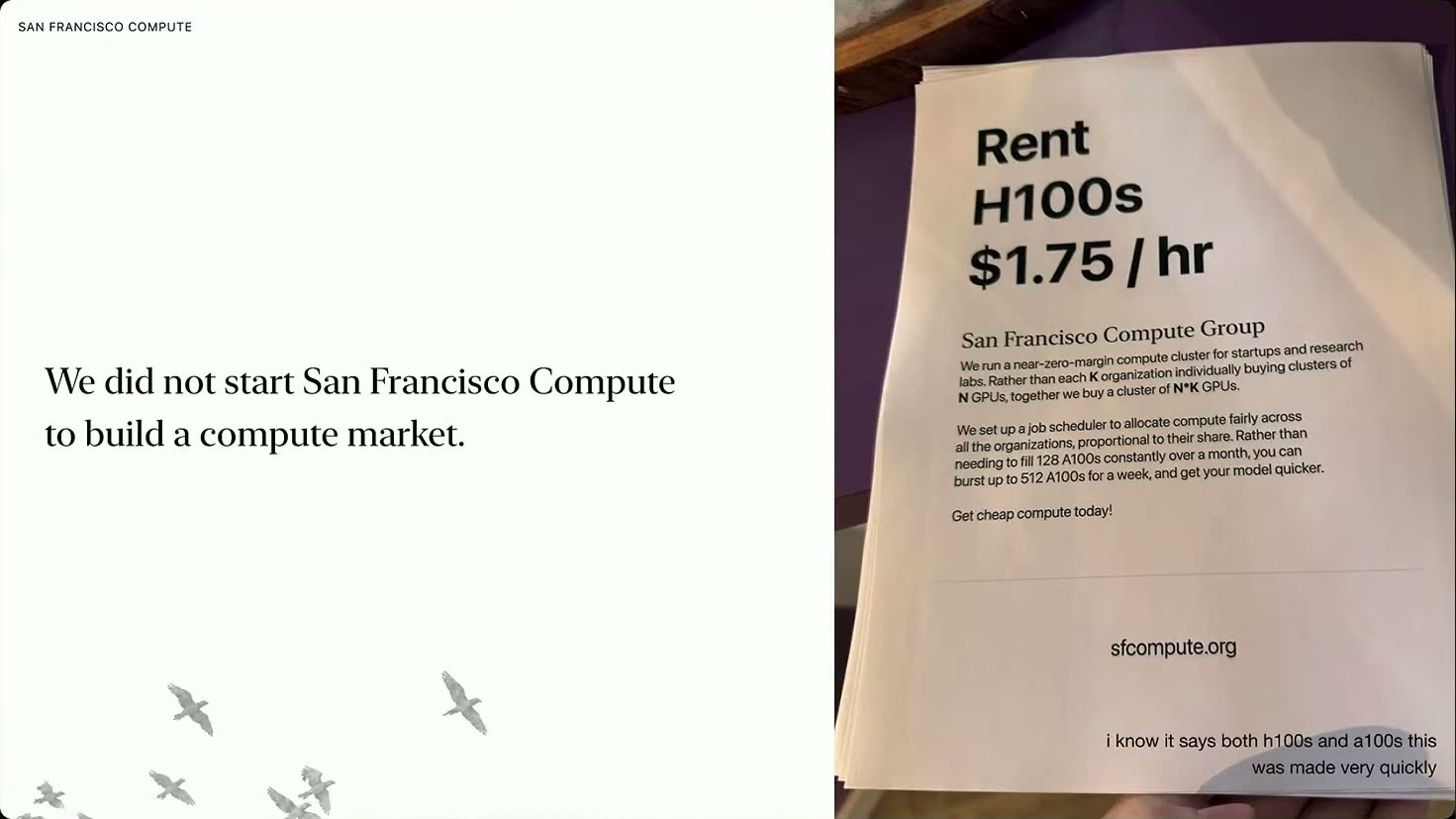
如果你听说过 GPU 经纪商,我们就是第一家;所以公司成立的第一年,我们一直在想办法卖出集群,否则就会破产。所以我会在 NeurIPS 会场上拿着这些纸质海报到处走,两张上面都写着H100 和 A100,因为我当时赶着做海报,就这么快速完成了。所以这场演讲不一定是在讲算力市场如何运作,而是在讲算力市场如何才能建立起来。我们喜欢用一张宣传册来打比方。宣传册的正面写着:“天哪,创办一家 AI 实验室太难了,有各种各样的财务和经济问题。”
If you have heard of GPU brokers, we were the first GPU broker, so the first year the company was us trying to sell our cluster, otherwise we would go bankrupt. So I would wander around with these actual pieces of paper at NeurIps, which both say H100 and A100 at the same time, because that's how I made the posters so quickly. And so this talk is not really about necessarily how a compute market works, it's how a compute market gets to exist. We like to think about it like there's this pamphlet, and on the pamphlet, on the front side, it's like, man, starting a Neolab sucks, there's all these different financial and economic problems.
宣传册背面写着“算力市场”。在你打开宣传册之前,两者之间的联系并不明显;打开之后,你会惊呼:“天哪,这本宣传册里讲的东西也太多了。”而且内容还在不断展开。折页实在太多了。这是个困难又复杂的问题,因为要让它运作起来,得解决两个奇迹般的难题。你既要创建一个市场——这格外困难,因为它有冷启动问题;还得构建一个云服务。同时又不能自己变成云服务商,这又是完全不同的挑战。
On the back of the pamphlet, it says compute markets. It's not super clear how one gets to the other until you open the pamphlet and then And holy shit, there's so much stuff in this pamphlet. And it keeps going. There's so many folds. It's a difficult and challenging problem. Because you need to solve two miracle problems to get working. You have to both make a market, which is a uniquely difficult problem because it has a cold start problem. You also have to build a cloud. And you have to not become a cloud. Which is a whole separate challenge.
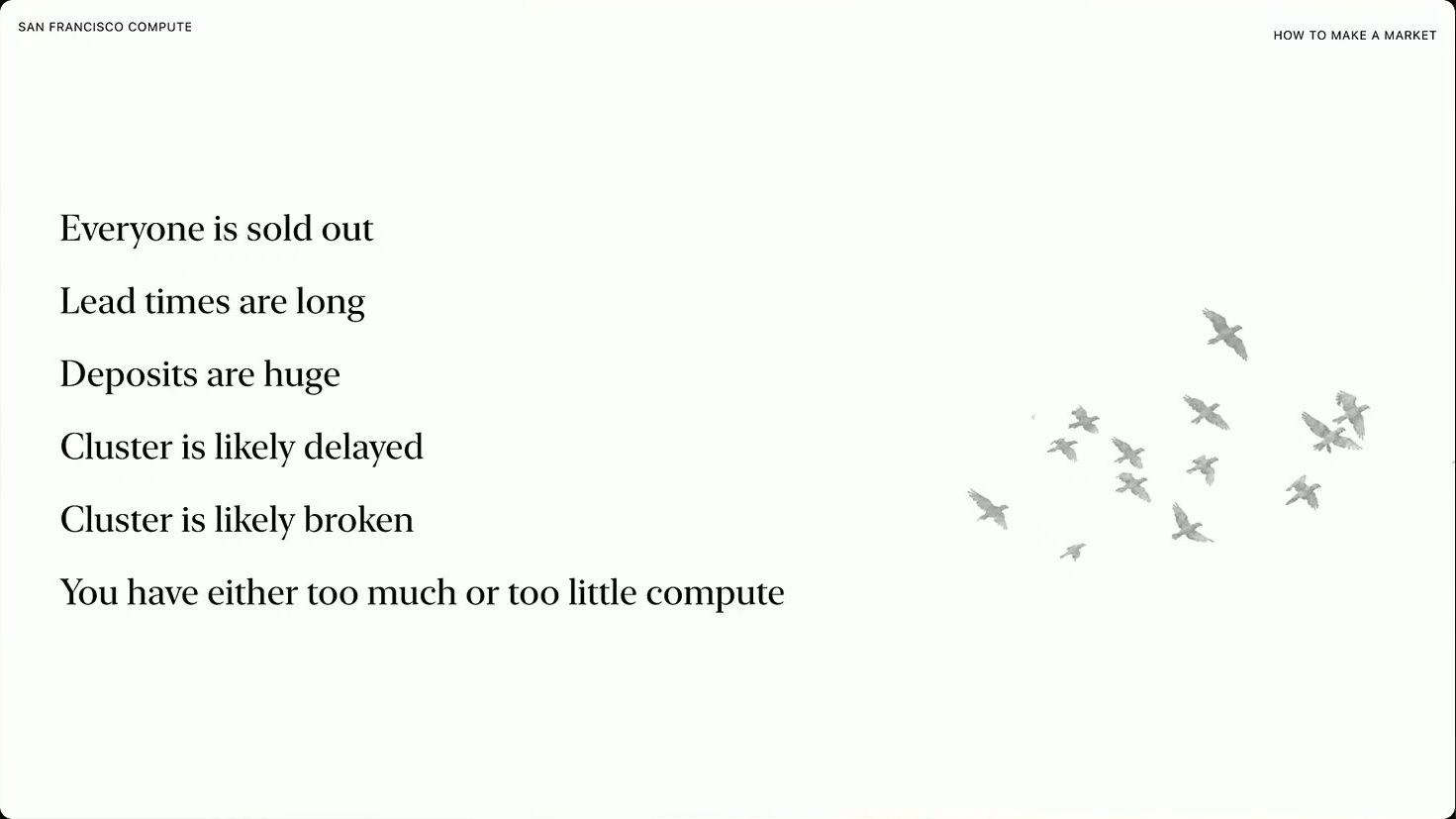
但这些正是 AI 实验室正在面对的问题,而且很快所有人都要面对这些问题。所以如果你在初创公司工作,这些就是你现在要面对的问题。目前,算力已经被大家订购一空。这种情况短期内可能不会改变。所以你得买一套全新的集群,而且还要从零开始采购;这会有交付周期。你现在没有办法为这套集群上线付费。你只能等它以后上线时再付款。市场上没有任何方案能真正让这套集群现在就上线。与此同时,你还得把全部银行存款作为押金付出去。之所以要把全部银行存款作为押金,是因为贷款方完全不知道该如何评估通用人工智能(AGI)的融资风险。
But these are the problems that the labs are facing. And it's about to be the problems that everyone is about to be facing. So if you work at a start-up, these are your problems now. Right now, everybody is sold out of compute. This is probably not going to change for a while. So that means you're going to have to buy a new cluster, a net new one, and there's a lead time. You have no way to pay for that cluster to come online now. You're going to pay for it to come online later. There's nothing in the market that can realistically get that cluster online for you now. Meanwhile, you're going to pay your entire bank balance as a deposit. The reason you're paying your entire bank balance as a deposit is because the lender has no idea how to underwrite AGI.
这到底该怎么评估?旧金山可能有两个人的初创公司,或者纽约也有这样的公司,他们说:“我们要打造超级智能。”没有贷款方知道该如何评估超级智能。所以他们根本不知道这项资产值多少钱。与此同时,你的集群很可能会延期交付。这是因为贷款方需要根据客户的信用风险来评估贷款,所以在部署集群之前,他们得先知道客户是谁,然后才能部署集群。所以客户签约的那一刻,就是整个运营过程中风险最高的时点。你希望的情况是先建好集群,再把它卖出去。这也有助于减少各种问题,例如集群发生故障。
How in the world are you supposed to do that? You've got two-person startups in San Francisco, or maybe New York, who say, I'm going to build superintelligence. No lender knows how to underwrite superintelligence. So they have no idea what the asset is worth. Meanwhile, your cluster is very likely to be delayed. That's because the lender needed to underwrite against the credit risk of the customer, and so they need to know who is the customer first before you deploy the cluster. So right when the customer signs is the riskiest point in the entire operation. You wanted it to be the case that you built the cluster first and then you sell it. This also helps reduce all sorts of different types of problems where clusters break.
与此同时,大多数负责搭建集群的人,其实拥有让成本变得低廉的实物资产,也就是那些让整个业务更便宜的资产。比如他们已经有了数据中心场地。但他们缺少超级计算方面的专业知识。就像上一场演讲中提到的,如果你看过的话。与此同时,你会遇到和 JunLark 一模一样的问题,也就是你会遇到 JunLark 遇到的同一个问题,要么买得过多,要么买得严重不足。这是因为 AI 公司的利润率不像SaaS 公司那么高。所以你几乎没有犯错的余地。因此,你要么买得不够,然后别人因为做对了而赢得竞争,要么买得太多,最后变成 Stability AI,或者资金链断裂,落得 Character AI 那样的境地,这些情况发生的可能性都很高。
Meanwhile, most of the people who are setting up clusters are people who have the actual asset that makes the thing cheap. Like you've got the data center space already. What that doesn't get is supercomputing expertise. as we saw in the last talk, if you've watched that one. Meanwhile, you're going to run into the exact same problem that Junelark did, which is you're going to either way overbuy or you're going to way underbuy. That's because AI doesn't have margins that look like SaaS companies. And so you don't have very much margin for error. And so the chances that you either underbuy and somebody else wins because they did it correctly or you overbuy and then you just become stability AI or you blow up, you end up like character AI, are really high.
所以这些其实都是同一个问题,只是风险类型不同。包括技术风险、财务风险和信用风险。它们是一个捆绑在一起的大风险问题,而这正是我们要解决的问题;我们认为,广义上的算力市场也就是整个行业要解决的问题。我们会逐一梳理这些问题,看看它们如何引出算力市场,因为如果不了解这些问题,就不太明白为什么需要算力市场,算力市场听起来甚至像是有人觉得:“哇,算力市场很酷,我要去创办一个。”我们认为,算力市场应该从人们实际面临的问题中推导出来:
So, these are all the same problem. They're all just different types of risk. They're technical risk, they're financial risk, they're credit risk. They're all one big bundled risk problem, which is the problem that we end up solving, and it's also the problem that we think compute markets broadly, the entire industry solves. So we'll walk through each one of these and walk how that gets to a compute market, because if you don't understand these, it's kind of unclear why you would want a compute market, and they almost seem like this problem that somebody thinks, oh, wow, compute markets are cool, so I'm going to go start one. We think they should be derived from the actual problems that people face,
首先,大家的算力都被订购一空。为什么都被订购一空?因为除非你有长期承购协议,否则贷款方不会为集群融资。CPU 市场就不是这样,因为 CPU 的买家是 SaaS 公司。SaaS 公司的利润率很高,正因为它们的利润率很高,你就可以构建一款使用 CPU 的产品,并从中获得高利润。换个角度想:如果你是一家 SaaS 公司,底层云服务商把价格提高一倍,你不会破产。你会讨厌云服务商,也会很生气,但不会破产。如果你是一家 AI 公司,底层云服务商把价格提高一倍,你就会破产。
which is, first, everyone is sold out. Why are they sold out? Because the lender couldn't finance the cluster unless you had a long-term off-take agreement. In CPUs, this wasn't the case, because CPU buyers are SaaS companies. SaaS companies have high margins, and because they have high margins, you can build a product that rewards you with high margins for your CPUs. Think about it this way. If you're a SaaS company and your underlying cloud doubles their prices, you don't go bankrupt. You hate your cloud, you're mad, but you don't go bankrupt. If you're an AI company and your underlying cloud doubles their prices, you go bankrupt.
这意味着你对价格非常敏感;正因为如此,你没有理由留在某个特定云平台,所以你无法按需销售算力,因为客户会立刻转投更便宜的供应商。因此,要为 GPU 集群融资,你必须签订长期的“照付不议”合同,最好是和信用评级达到投资级的客户签约。
And what that means is that you're actually price sensitive, and because you're actually price sensitive, there's nothing keeping you at any particular cloud, so you can't sell on demand because your customers will immediately leave to whoever is cheaper. And so that means that in order to finance GPU clusters, you have to have long-term take-or-pay contracts, hopefully with someone who has investment-grade credit.
不过,如果这些预留算力缺少流动性,客户又无法退出,那么其他急需当前算力的客户就无法购买;他们可能像 Instinct 一样,产品正快速发展,却买不到算力。他们只能为新集群融资,而这需要交付周期,因为实体世界的建设就是需要时间。有时候你甚至得建造那该死的数据中心。
However, if you don't have liquidity on those, if you're selling reserved and your customer can't get out, then that also means that some other customer who wants the capacity right now because they're like instinct and their product is taking off, can't pay for anything. They have to finance a new cluster which has a lead time because the physical world just exists and it's going to take a while. Sometimes you even have to build the damn data center.
然后,因为要为新集群融资,你就得支付押金。这是因为 AI 行业几乎没有公司具备合理的信用状况。再加上这是一项全新技术,所以这些公司都成立不久。与此同时,即使你开始沿着规模化阶梯向上发展,也会一路遇到信用问题。这是目前 AI 行业最大的瓶颈。不是电力。你会先遇到信用瓶颈,然后才会遇到电力瓶颈。这意味着,每家推理公司、每家新兴 AI 实验室的瓶颈,都是它们银行账户里有多少现金。于是它们去找风险投资人,投资人会说:“我可以投资模型层、应用层或推理层,但我不想投资所有这些资本支出。”
And then, because you're financing a new cluster, you're going to pay a deposit. Because almost nobody in AI has any reasonable credit. And because this is a brand new technology, all these companies are new. Meanwhile, even as you start to scale up that ladder, you're still going to run into credit issues all the way through. It's the number one bottleneck of AI at the moment. It's not power. You hit credit way before you hit power. So, what that means is every inference company, every neo lab, they are bottlenecked by how much cash they have in the bank account. So they go back to the venture capitalist who says, oh, I'm going to fund at the model layer, the application layer, the inference layer, because I don't want to fund all of that capex stuff.
于是风险投资人通过给新兴 AI 实验室或新推理公司开支票,为所有资本支出提供资金。公司再把支票交给云服务商,作为集群押金,贷款方据此评估客户的信用。
And so the venture capitalist then funds all the capex stuff by giving the new neo lab or new inference company, the check that they then send to the cloud, which is the deposit for the cluster, and that's how you underwrite the customer.
因此,集群会延期交付,因为云服务商实际上无法部署集群。直到他们手里有了客户;所以这是风险最高的时点。因此,理想情况下,云服务商应该提前买下集群,等集群运到数据中心后再卖出去。这样一来,延期的可能性就小得多。
So the clusters then are delayed because the cloud couldn't actually deploy the cluster until they had the customer in hand, and so that was the riskiest point. So therefore, what should have happened was the cloud had bought the cluster ahead of time, and then waited until it was landed in the data center, and then sold it. And that means you have way less likelihood of delays.
与此同时,作为客户拿到集群时,集群很可能会发生故障,因为你没有可调配的备用算力。如果故障率高于预期,而你又没有能力调入其他节点,就没有可供替换的节点。也就是说,如果需要新节点替换故障节点,就得把它们送修更换(RMA),再说一次,也就是得拿到新节点。然后问题又回到前面几步,再次遇到交付周期问题。于是大家的系统就会不断出故障。一家新 AI 实验室好不容易熬过这一切之后,你会发现,算力已经被订购一空,大家都买不到了。
Meanwhile, the cluster is very likely to break when you get the cluster as the customer because you don't have liquidity. And so if the failure rate is higher than what you expect, and you don't have the ability to transition a node in, then you don't have anywhere you can pull nodes from. Which means that if you need new nodes to make up for the failed ones, you have to RMA them. which means you have to get a new node. And then that gets us back to several steps before where you have the lead time problem again. And so everything breaks for everybody all the time. Once you have gotten through all of that as a new AI lab, your problems are you, you know, you, nobody was sold, like everyone was sold out.
然后你得等交付周期。你付了一大笔押金。集群延期交付,之后还发生故障。最后,你终于熬过了所有这些。
You then had to wait a lead time. You paid this big deposit. The thing was delayed and then it broke. And finally you got through all of that.
但你准确预测需求的可能性非常低。所以你要么会配置过多或严重不足,而且没有办法退出。你无法把算力卖给别人,也无法在需要时买到更多算力。
And the likelihood that you predict your demand correctly is very low. And so you're either going to be way over-provisioned or way under-provisioned, and you have no way out. There's no way to sell your capacity to somebody else, and there's no way to buy more capacity if you need it.
这就是算力市场。要解决这些问题,就得同时解决一系列不同问题。你需要评估 GPU 集群本身的价值,而不是评估客户的信用风险。这可能是可行的做法。但不保证一定会这样发展。在其他行业,结果往往是市场完全整合。最后会有一家信用可靠的大客户包揽整个行业。AI 行业目前正朝这个方向发展。它不会成为任何人都能参与的流动市场,反而会变成类似 TSMC 的格局。你会看到一个或几个买家,也就是云服务商。
So, compute markets. To solve these problems, you need to solve a bunch of different problems all at once. You need to underwrite the value of the GPU cluster rather than underwriting the credit risk of the customer. This is how it could work. It's not guaranteed to work like this. In other industries, what happened is everything just consolidated. You got one big credit-worthy customer that does the whole damn industry. That's what the path of AI is currently on track to do. It's instead of going to be a liquid market where anybody can participate, it's going to look like TSMC. You're going to get one buyer or a few buyers that are the clouds.
再加上少数几家 AI 实验室,也就是模型实验室。其他初创公司就没了。我们认为这就是将会发生的事。这也是为什么三年前我们经营 AI 实验室时,还有机会作出选择。我们本可以说:“不,我们不打算花好几年时间,只为了勉强维持公司生存。”“我们要去创办一家新的 AI 实验室。”但我们看到了这个问题。我们当时想:“糟了。”如果我们不做点什么,三年后自己也会遇上这个问题。如今三年过去,我们确实遇上了这个问题,而且所有人都将遇到它。如果你看过上一场演讲就会知道,除非同时运营市场和集群,否则很难解决这个问题。
You're going to get a few model labs that are the AI labs. And then you won't get other startups. This is what we think is going to happen. And this is why three years ago, when we were doing our AI lab, we had a chance. We could have said, no, we're not going to stick it out for several years just trying to keep our company alive. We're just going to go do a new AI lab. But we saw this problem. And we said, oh, shit. If we don't do anything about this, then we will just hit this three years from now. And here we are three years from now hitting this problem and where everyone is going to hit this problem. If you watched the last talk, it's very hard to solve this problem unless you are operating both the market and the clusters at the same time.
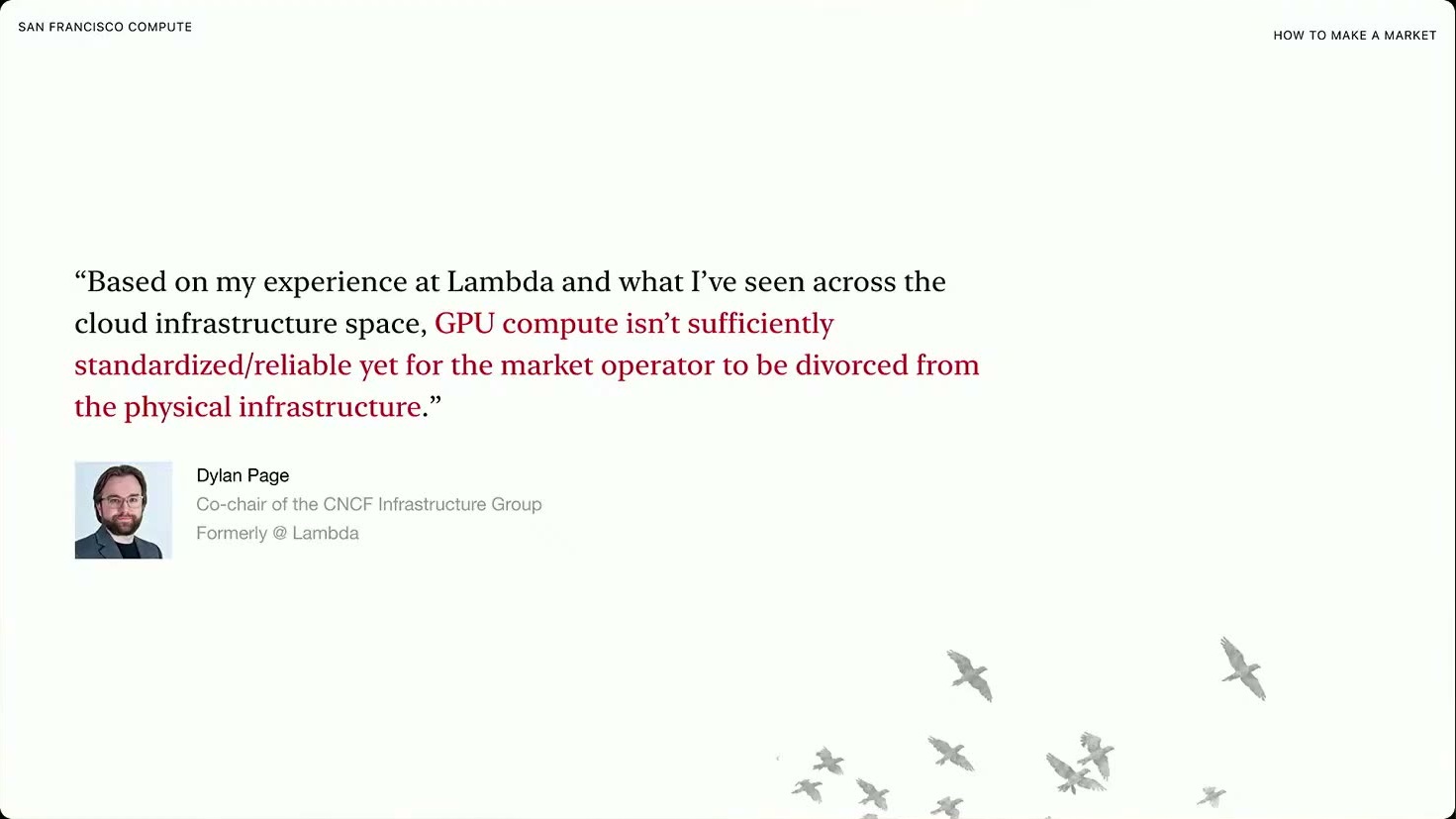
这位是 Dylan Page。Dylan 是 CNCF 基础设施工作组的联合主席。CNCF 就是开发 Kubernetes 的组织。他之前在 Lambda 负责基础设施工作。后来他加入 San Francisco Compute,因为 GPU 算力的可靠性不足以让市场运营方与实体基础设施相互脱离。如果你不是实际购买设备的人,这种模式就行不通。抱歉,我是说,如果卖给你设备的人不负责运营,这种模式就行不通。举个例子说明为什么行不通。你们中肯定有人从海外或外地飞来,也住进了酒店。如果你能把酒店房间转卖给别人,不是很棒吗?假设我来找你买那个房间,然后问:“能送客房服务吗?
This is Dylan Page. Dylan is the co-chair of the CNCF infrastructure group. That's the organization that makes Kubernetes. He formerly worked at Lambda doing infrastructure there. And he joined San Francisco Compute because GPU Compute isn't sufficiently reliable for the market operator to be divorced from the physical infrastructure. It doesn't work if you aren't the one who is buying the thing. Sorry, it doesn't work if the person you are buying from isn't operating it. To give an example of why this doesn't work is I'm sure some of you are flying in from overseas or out of town and you have a hotel room. Wouldn't it be great if you could sell that hotel room to somebody else? I go to you and I want to buy that hotel room and I say, can I get room service?
能帮我打扫房间吗?房间出了问题,我该找谁?”如果你不经营这家酒店,这些问题你一个也解决不了。这就是为什么转售集群行不通。你必须像经营酒店一样运营集群。必须把整个系统都管起来。否则,你根本无法真正建立市场。这种模式行不通。你无法实现实物交割。那么为什么没人做实物交割?问题在于,大家有很强的动机不做实物交割。
Can I get my room cleaned? I've got a problem with my room, who do I call? If you don't operate the hotel, you can't fix any of those problems. That's why brokering clusters doesn't work. You have to operate the cluster like the hotel. You have to run the whole damn thing. Otherwise, you can't actually make a market. It doesn't work. You can't do physical settlement. So why does nobody do physical settlement? The problem is there's a very strong incentive to never do physical settlement.
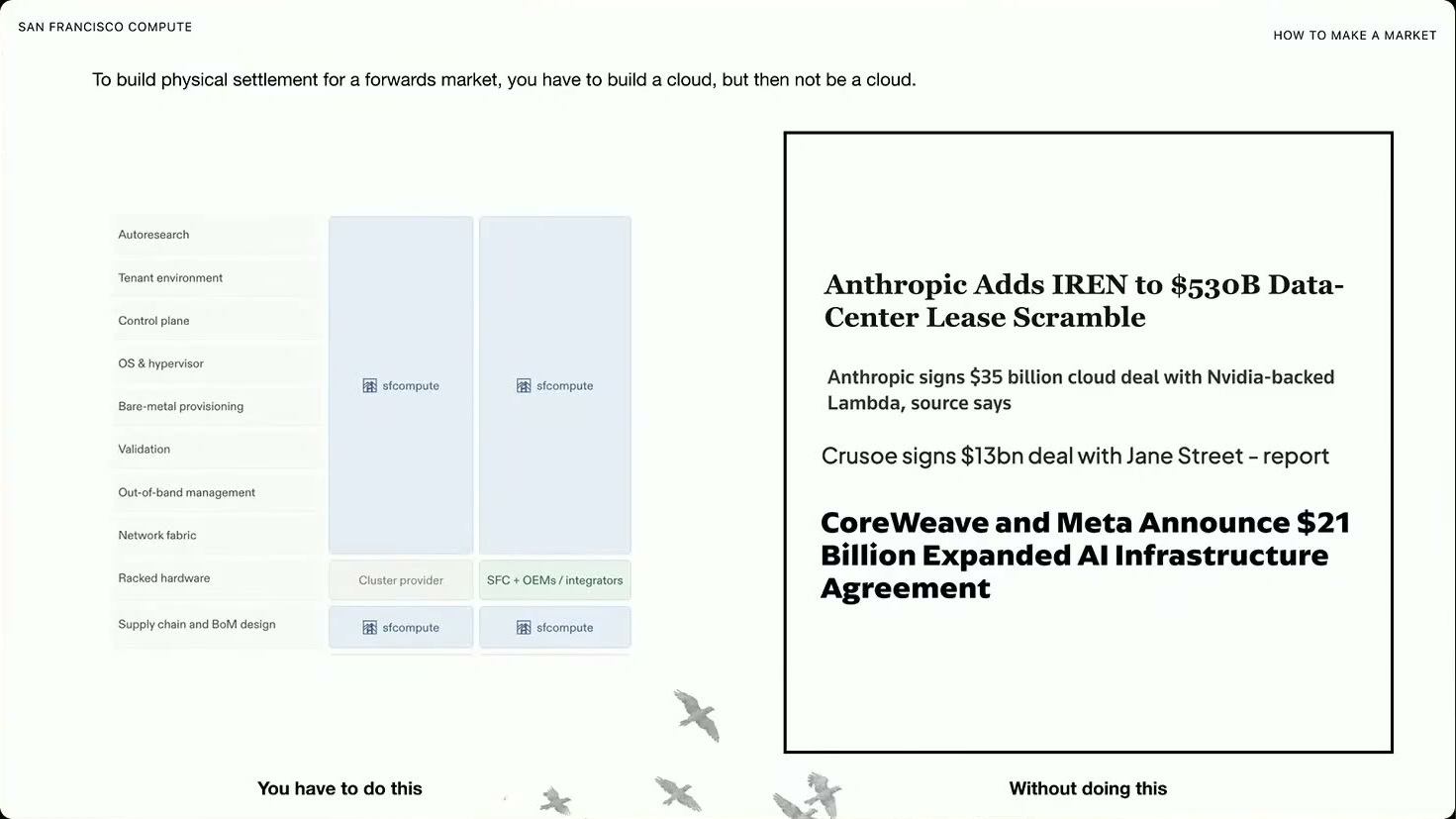
因为如果你为算力建立实物交割体系,实际上就是在建设 GPU 云的全部运营能力。如果你已经在建设 GPU 云的全部运营能力,那干脆直接成为GPU 云服务商好了。因为看起来这样能赚到惊人的钱。你会一笔接一笔地签下十亿美元级别的合同。所以,管它呢。我们不做 GPU 云,也不做算力市场,干脆直接成为 GPU 云服务商好了;基本上大家都会这么做,因为收益数字高得惊人,而且这确实是很合理的选择。我们最终选择构建实物交割模式,是因为我们知道,如果不开始做这件事,我们就没法创办 AI 实验室;而创办实验室才是我们真正最初想做的事。
That is because if you build out physical settlement for compute, what that literally means is you are building out the entire operating capacity of a GPU cloud. And if you are building out the entire operating capacity of a GPU cloud, you should just be a GPU cloud. Because it looks to be the case that you will make an ungodly amount of money. You will sign billion dollar deal after billion dollar deal. And so, fuck it. Let's not make a GPU cloud, or let's not make a compute market. Let's instead just become a GPU cloud, which is what basically everybody does, because the numbers are astronomical and it's a very reasonable thing to do. The reason why we ended up building physical settlement was because we knew that if we didn't start this, we would then not be able to start an AI lab, which was the real damn thing that we wanted to do in the first place.
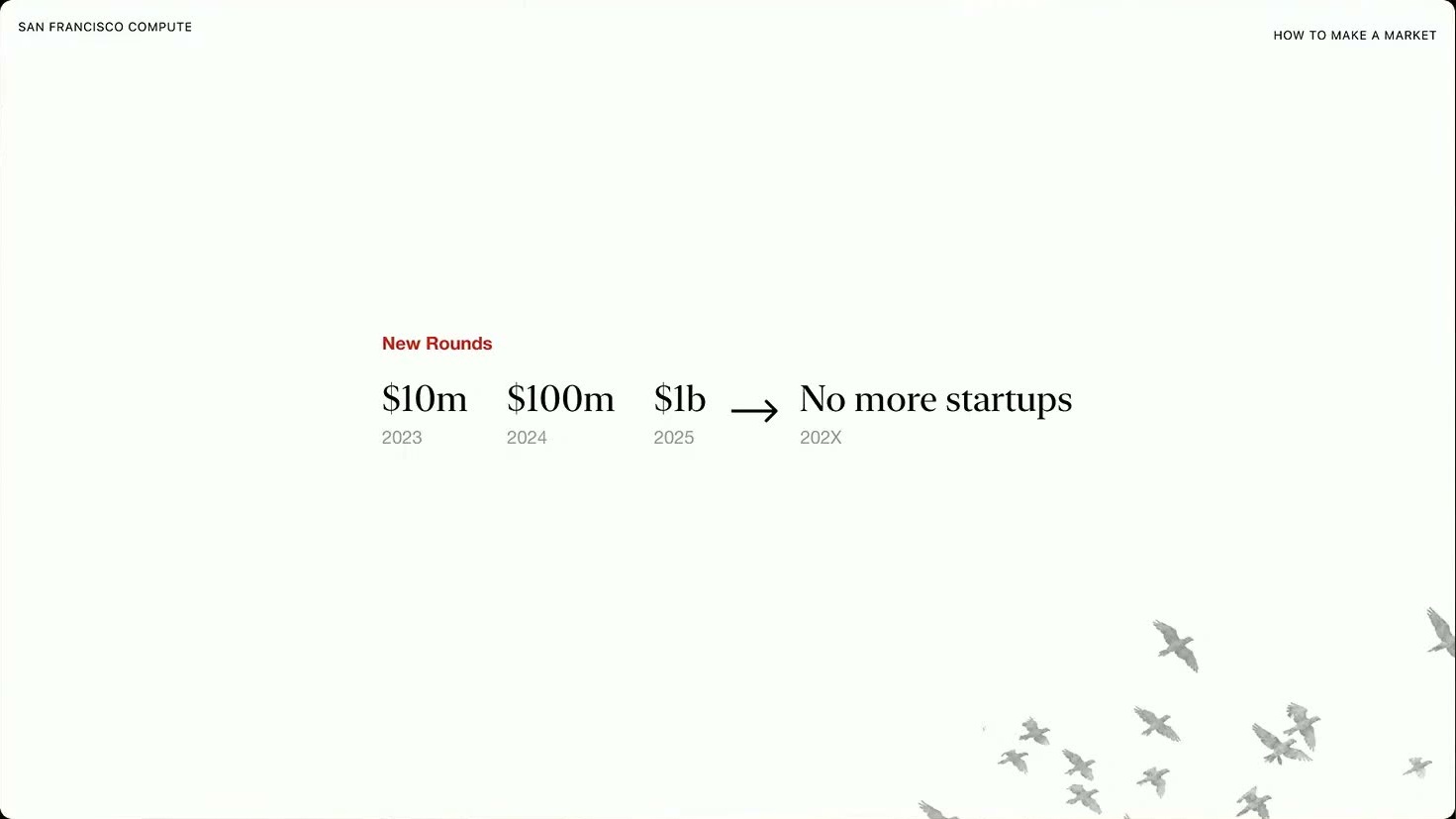
我们想办一家实验室。如果没有这套机制,我们就办不成实验室。我们刚开始时,创办一家新实验室需要先交 1,000 万美元押金。这就是解决信用风险问题的方式。后来集群规模变大了,进入这个领域的最低门槛也提高了,押金先涨到 1 亿美元,现在是 10 亿美元。我们认为这种情况不可能一直持续。我们不认为真有哪种情况能让你一开始就融到 100 亿美元,还没有收入、市场牵引力、产品或任何成果之前。这意味着,如果不解决这个问题,我们目前正走向一个AI 行业里不再有任何初创公司的未来。
We wanted to make a lab. We didn't get to make a lab unless this exists. So when we started, it was 10 million as the deposit that you had to pay to start a new lab. This is how you get over the credit risk problem. Then the cluster sizes got bigger, the sort of minimum ante into the space got bigger, then it was 100 million, now it's a billion. We don't think it can continue. We don't think there is a world in which you can get a $10 billion round right out the bat before you have revenue or traction or your product or anything. And what that means is that if you don't solve this problem, we are currently on track to not have any start-ups in AI.
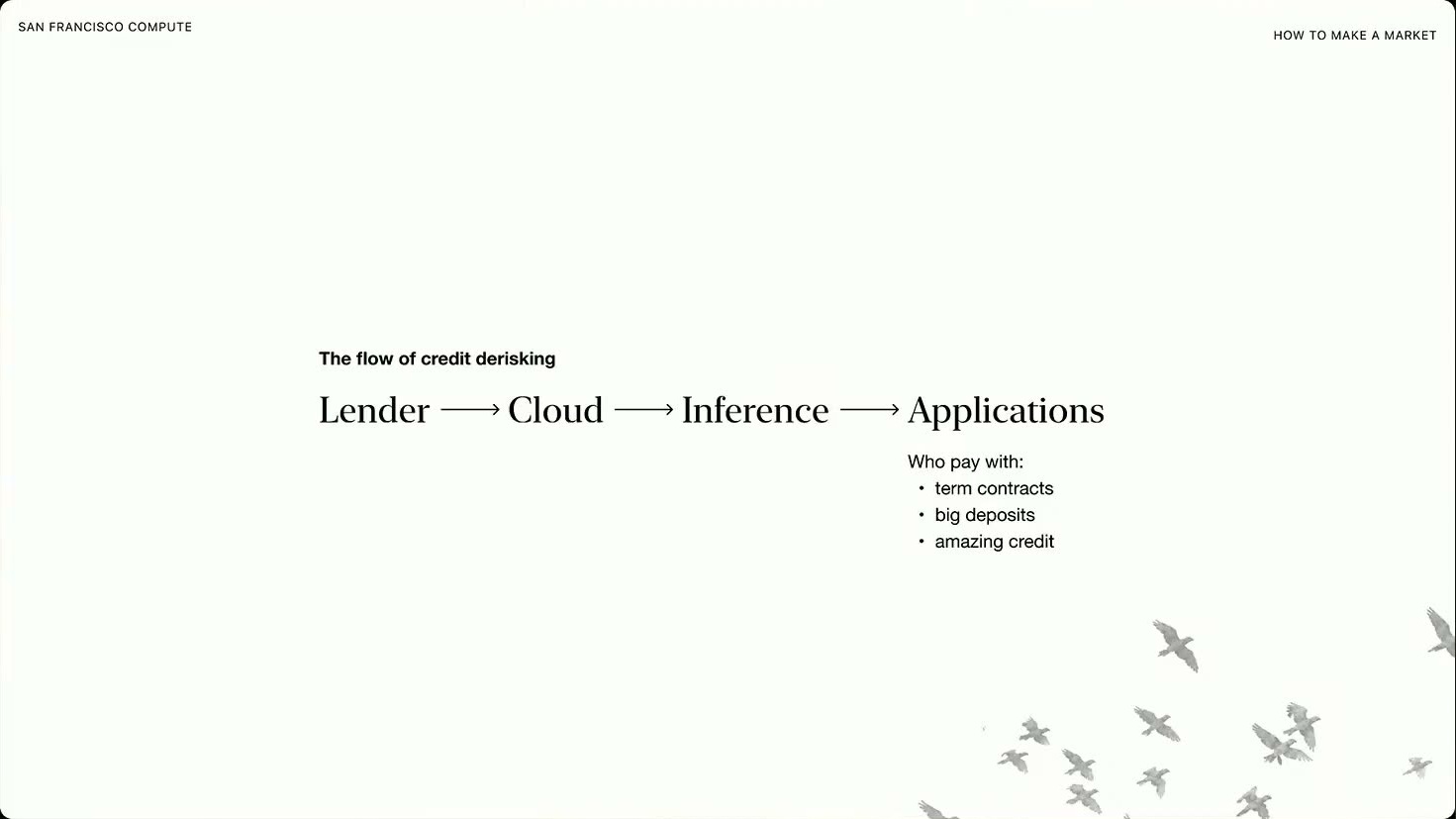
你可能会想,或许还会出现新的推理公司和新的模型实验室。但它们解决信用问题的方式,会是把风险转嫁到应用层。它们会说:“听着,我得解决信用问题,所以我会只和信用评级达到投资级的客户签约,比如《财富》500 强公司,并且只签订为期 5 年的 token 采购合同。我只和愿意预付大额押金的客户签 token 合同。”这样一来,一切都结束了。
Now, one of the things that you could think could happen is maybe there can be new inference companies and new model labs. And the way that they solve the credit problem is that instead they just ship the risk to the application layer. They say, look, I need to get over my credit problem, so what I'm going to do is I'm going to only sign customers who are investment grade credit, you know, Fortune 500, I'm going to only sign customers on five-year contracts for tokens. I'm going to only sign customers for tokens that require a big deposit up front. That is the end of everything.
推理层一旦受信用限制,就会导致你拿不到 token,除非有信用额度或大额押金。问题在于,整个经济都在使用 token。
you have inference layer getting bottlenecked by credit, what happens is you can't get tokens unless you have credit or you have a big deposit. the problem of that is that tokens are used by the whole damn economy.
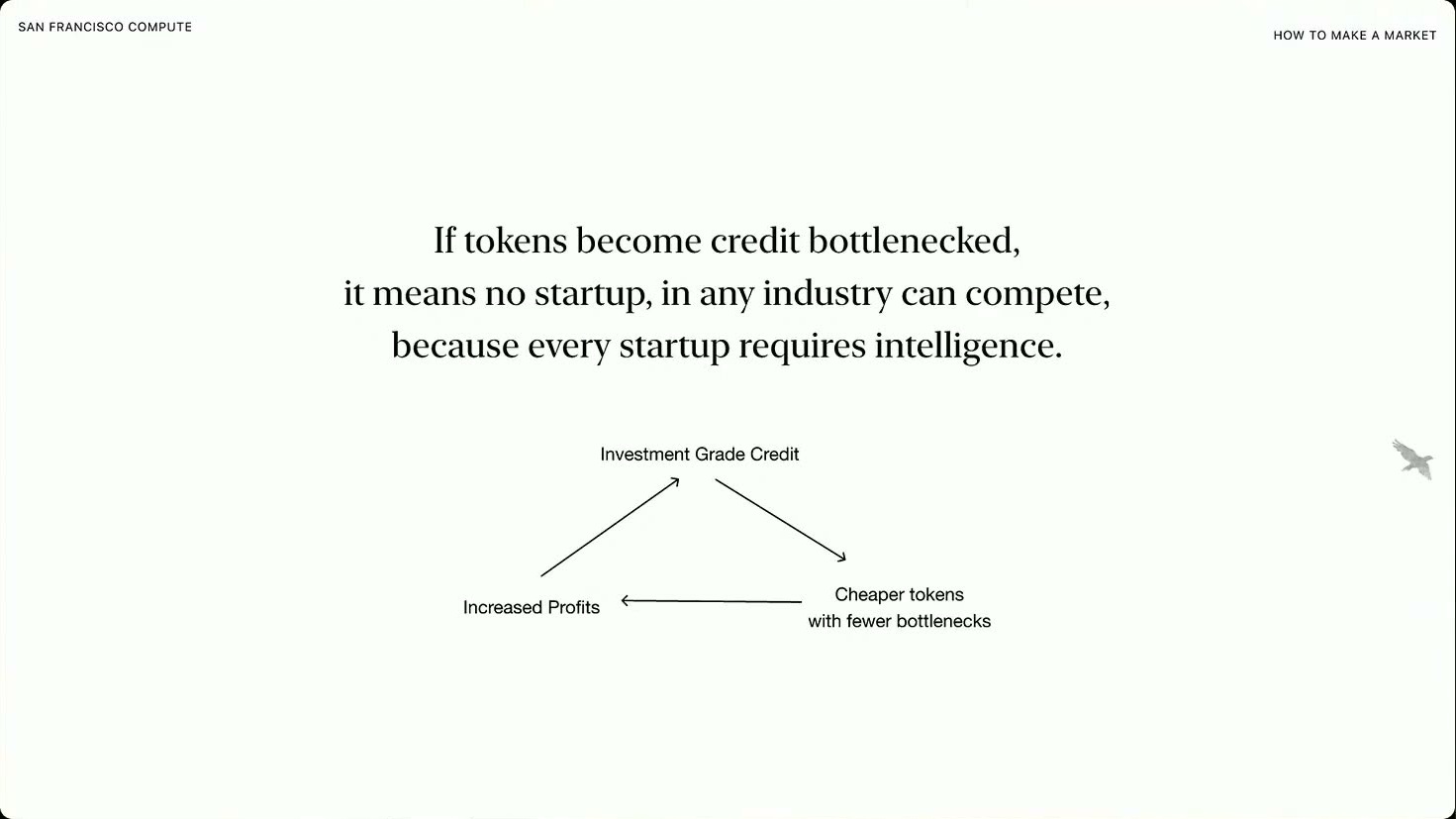
没有哪条规则规定初创公司必须存在。如果所有初创公司为了获取智能都突然受信用限制,现有企业就会把所有业务都包揽下来。它们自己开发产品,因为它们有信用,然后从产品中赚取收入,再用收入改善信用状况。这就形成了一个飞轮,让整个经济不断走向集中。
There is no rule that says that startups have to exist. If every startup is suddenly bottlenecked by credit in order to access intelligence, what happens is existing firms just ship everything. They themselves get to make the product because they've got credit, and then they make the revenue from that product, and then it makes their credit better. And that's a flywheel that makes consolidation happen throughout the entire economy.
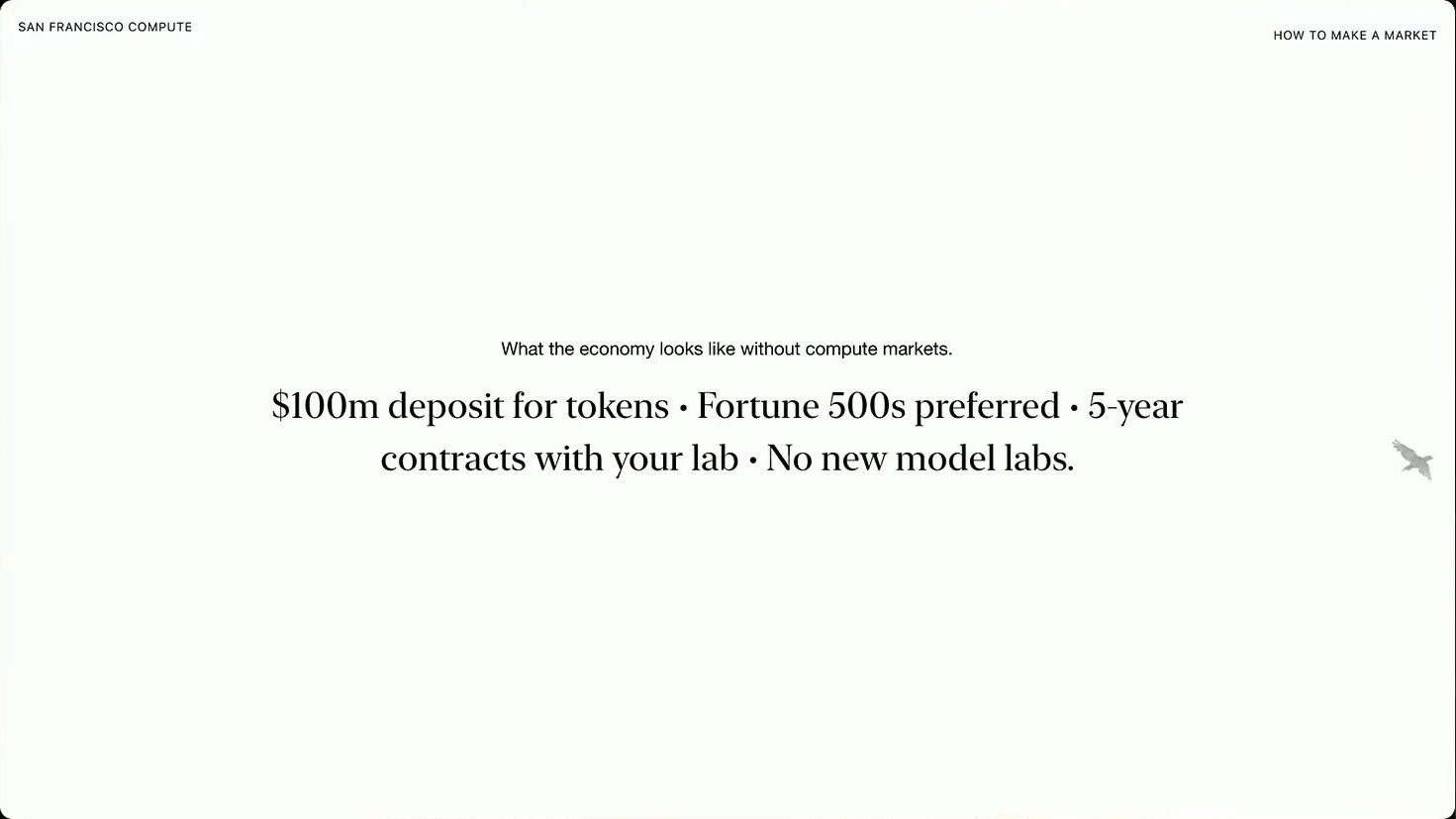
如果不解决这个瓶颈,就不会有初创公司。这就是我们开始做这件事的原因。因为我们认为,几年后你会遇到这样的情况:你放眼望去,想创办一家新公司。但要与现有参与者竞争,你必须买下大量 token。你得买 1 亿美元的 token。我们认为,创办新公司时你将不得不这样做,因为其他人正在花数亿美元购买 token。只要沿着趋势线推演,就会是这样的结果。所以你需要支付一大笔押金,因为你们只是两个不懂行的人,没人信任你们。
If you don't fix this bottleneck, there aren't any startups. This is why we started doing this. Because at one point, what we think is going to happen is you're going to end up in three to five years, you're going to look out and say, I want to start a new startup. To get there, you need to buy so many tokens in order to compete with the existing players. You need to buy $100 million of tokens. We think this is what you're going to have to do in order to start a new company because other people are spending hundreds of millions of dollars of tokens. If you just draw the line out, this is what happens. So you need a big giant deposit because you're two people who have no idea what they're doing and so nobody trusts you.
于是你要从风险投资人那里筹集 1 亿美元。与此同时,没人愿意和你合作,因为你只是一家两人初创公司。然后别人会要求你为这 1 亿美元付钱,或者要求你支付为期 5 年的 1 亿美元合同费用,除非你已经把全部金额作为押金交了。这样一来,新模型实验室和新初创公司就都不会出现。整个行业会走向集中。我们曾经就是这样一家小实验室。我们住在旧金山,也认识其他人,他们也是两个人创办了一家小初创公司,希望能参与我们这个时代最重要的技术。
So you're going to go and raise $100 million from your venture capitalist. Meanwhile, nobody wants to work with you because you're a two-person startup. Then you're going to be asked to pay for that hundred, or you're going to be asked to pay for a five-year contract on that hundred million if you're not paying it all as a deposit. And then you just don't get new model labs, you don't get new start-ups. You get a consolidation in the industry. So we, at one point, were this little lab. And what we did is we lived in San Francisco and we knew all the other people who were also just two little folks who had started a start-up and wanted to be able to participate in the most important technology of our time.
我希望这些人能继续存在。我希望这个人存在,也希望那个人存在。我希望这家初创公司存在,那家也存在,还有另一家也存在。还有这一家、那一家、这家、那家,以及其他许多家。如果这些公司发展起来,也许它们会成为大型企业,研发治疗癌症的方法,或创造出没人想到过的东西,而不只是用 AI 随手生成些平庸内容。这就是算力市场要解决的问题。如果不解决这个问题,我们认为就不会有初创公司。好。就这样。就这样。
So I want these people to exist. I want this person to exist and I want this person to exist. I want this startup to exist and this startup to exist and this startup to exist. This one and this one and this one and this one and this one and this one and this one and this one. If you get these companies going, maybe they'll become big folks that build your cancer cures or they build something that nobody thought of or something that wasn't just sort of AI slopped out. This is kind of the problem that compute markets solve. And if you don't solve it, we don't think there's going to be any startups. Cool. That's it. That's it.
对。
Yeah.