并非所有 GPU 的部署效果都一样
Not All GPU's Are Deployed The Same
原文由官网提供,中文由 GPT-6 Luna 翻译。相邻片段合并排版,正文与时间点保持对应。
已插入 16 张经核对的幻灯片或演示截图;点击图片可放大。图注链接为当前视频时间,左侧正文时间保留原转录版本,二者可能不同。
共 33 个阅读段落
并非所有 GPU 的部署效果都一样。感谢大家今天抽出时间来到这里。我叫 Oliver Kennon。我是 SemiAnalysis 的研究分析师。时间和注意力是我们每个人最宝贵的东西,当然,除非你是OpenAI 或 Anthropic 的早期投资者。那我们开始吧。并非所有 GPU 的部署效果都一样。GPU 的表现取决于运营者的能力。硬件给你提供潜力。运营能力决定你实际能够交付多少有用的工作成果。这就引出了今天我想和大家一起回答的问题:谁能以最低成本产出你需要的智能?
Not all GPUs are deployed the same. Thank you everyone for taking the time to be here today. My name is Oliver Kennon. I'm a research analyst at SemiAnalysis. Time and attention are the most valuable things any of us have, unless of course you're an early stage investor in open AI or Anthropic. With that, let's get into it. Not all GPUs are deployed the same. A GPU falls to the level of the operator. hardware gives you potential. capability is what determines how much useful work you actually are able to deliver. That leads us to the question I will attempt to answer with all of you today. Who can produce the intelligence you need at the lowest cost?
成本很重要。今天的演讲中,我想向大家说明,运营能力如何改变成本,以及它为何对算力这个大宗商品市场很重要。为什么这在大宗商品市场很重要?
Cost matters. today's presentation, I want to show you guys why and how operating capability changes that cost and why it matters in the commodity market that is compute. matters in a commodity market?
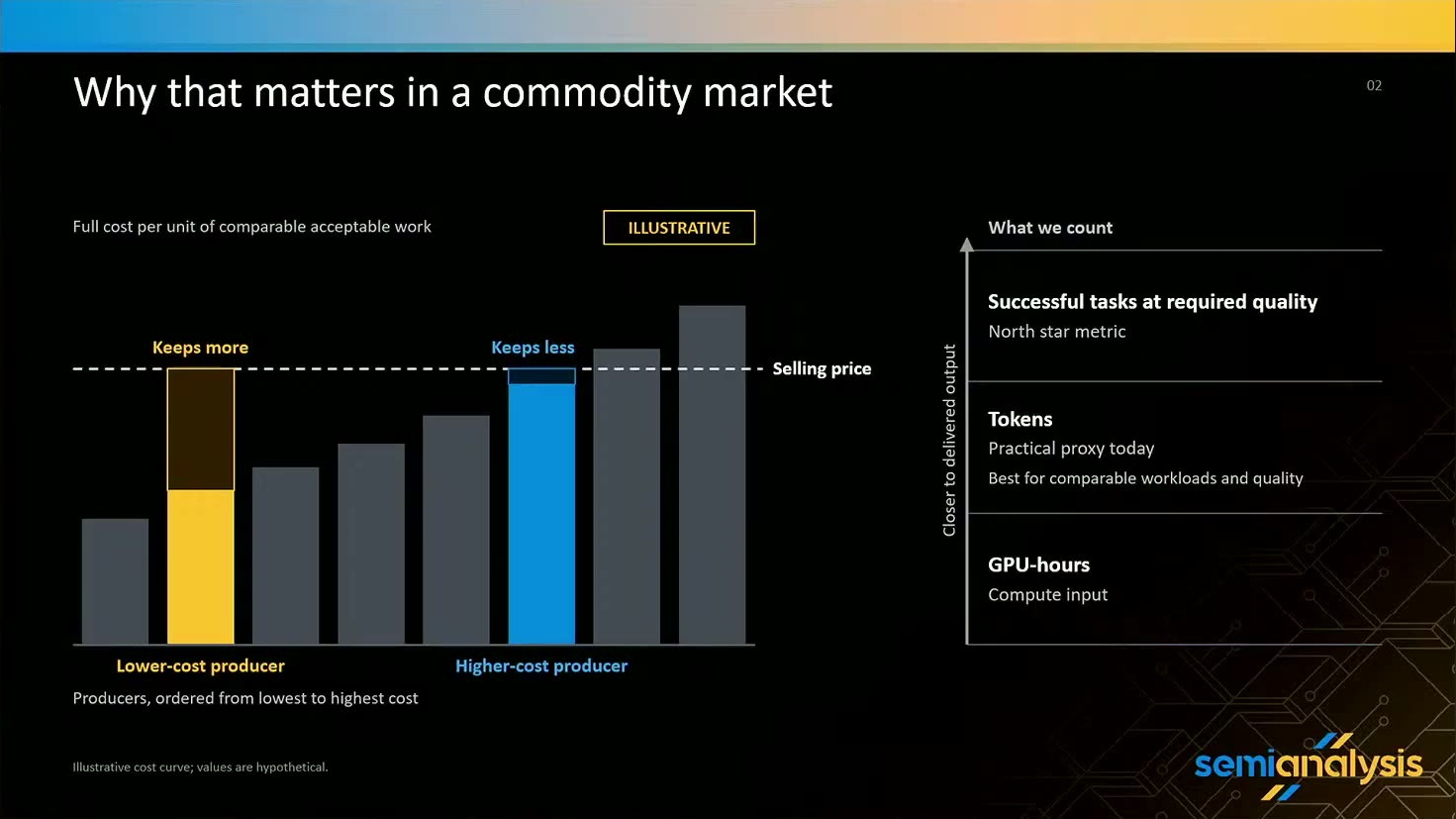
很多科技投资者或技术人员可能不熟悉这个框架,所以我们快速介绍一下。在大宗商品市场,生产者通过提供可比的产出来竞争。生产成本更低,在价格下跌时就有更大的竞争空间。这就是成本曲线所展示的内容:按照提供同等可用工作成果所需的支出排列生产者。如果两家生产者获得相同价格,成本更低的一方就能留下更多利润。很简单,对吧?对我们来说,智能就是我们关注的经济产出。最终,我们的北极星指标会是每项成功完成的任务的价格,并且任务要达到所需质量。
A lot of tech investors or technologists may not be familiar with this framework, so a little crash course. In a commodity market, producers compete to deliver comparable output. A lower production cost gives more room to compete when prices fall. what a cost curve shows. producers lined up by what they spend to deliver the same usable work. If two producers earn the same price, the one spending less to deliver the work gets to keep more of it. Pretty simple, right? For us, intelligence is the economic output we care about. Eventually, our North Star metric will be price per successfully completed task at the required quality.
遗憾的是,我们还没做到这一步。这很难标准化。如今,每个 token 的价格是一个有用的实用近似指标,尤其适用于可比工作负载和质量要求;它比大家常提到的指标更接近实际交付的产出,在座各位金融从业者可能听说过 GPU 每小时美元价格;我们把它看作成本。我们把 GPU 小时视为投入,而非产出,这就是成本与价格的区别。价格与生产者完成工作的成本并不相同。
Unfortunately, we're not quite there yet. That's a pretty hard thing to standardize. today price per token is a useful practical proxy especially for comparable workloads and quality requirements and gets us closer to delivered output much closer than the often quoted all you finance bros out here will have heard this a gpu dollar per hour price or as we view it a cost We view GPU hours as a measure of input, not output, the cost versus price distinction. prices are different from the producer's cost of doing the work.
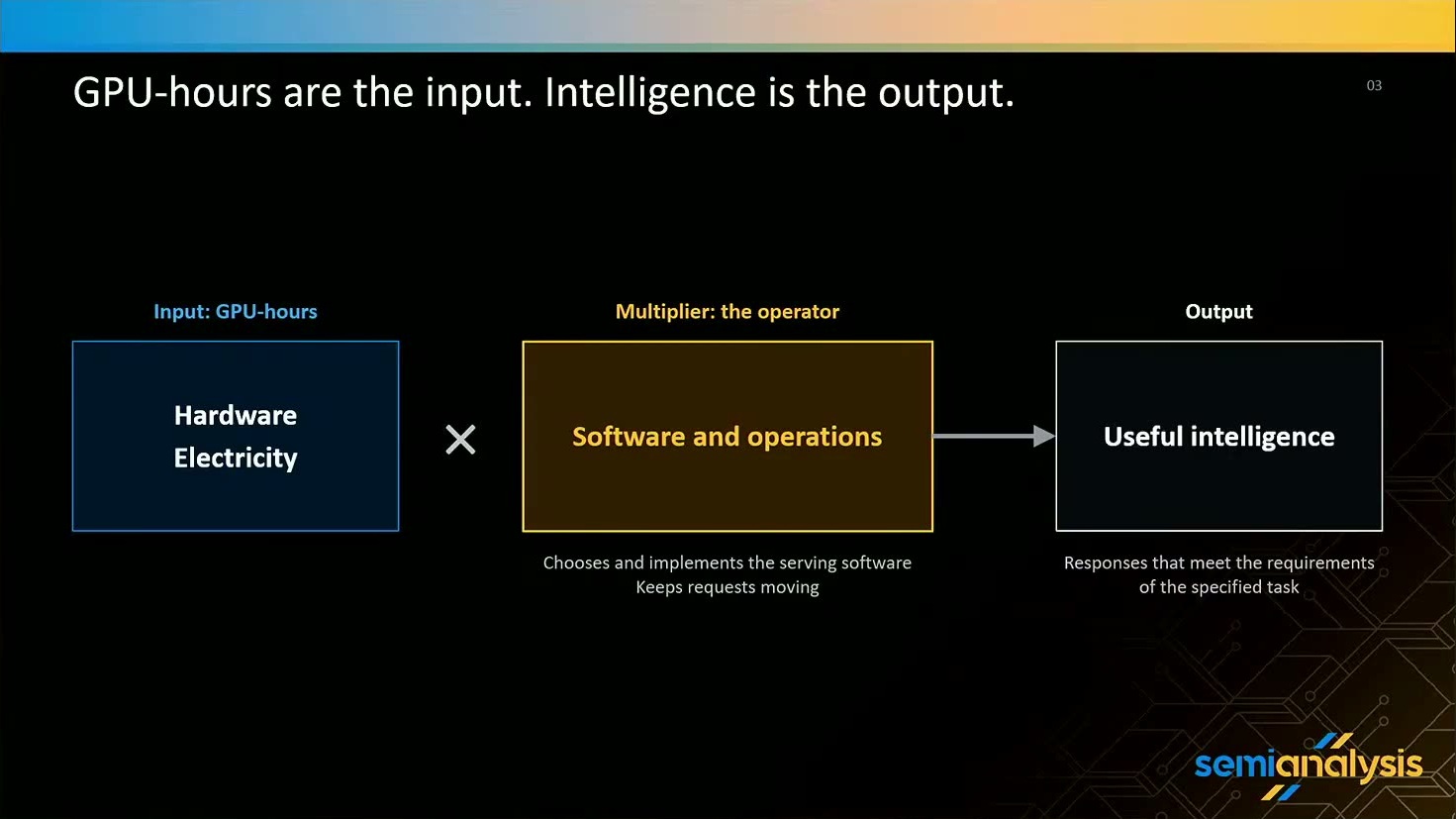
GPU 小时是投入,智能才是产出。这张幻灯片展示了创造有用智能所需的投入。对于今天的演讲,我们从硬件和电力,也就是 GPU 开始。软件和运营可以看作前两项投入的乘数,最终产出就是有用的智能。运营者负责选择并实现为模型提供服务的软件,并确保请求能够在系统中顺畅处理。机器就算已经准备好,仍然需要有人让它们产出响应,让客户真正能够使用。
GPU hours are the input, intelligence is the output. On this slide we can visualize the inputs needed to create useful intelligence. We start with hardware and electricity, GPUs, for this presentation. Software and operations can be thought of as a multiplier on those first two inputs, with the end product being useful intelligence. The operator is who chooses and implements the software that serves the model and keeps requests moving through the system. The machines might be available, but you still need someone to make them deliver responses customers can actually use.
重要的是,你能获得多少有用的工作成果,以及它是否符合指定任务的要求。即使使用同一种芯片,投入转化为产出的效率也可能不同。我们来看一个实测案例。
What matters is how much useful work you get and whether it meets your requirements for the specified task. The conversion can differ with the same kind of chip. Let's look at that in the measured example.
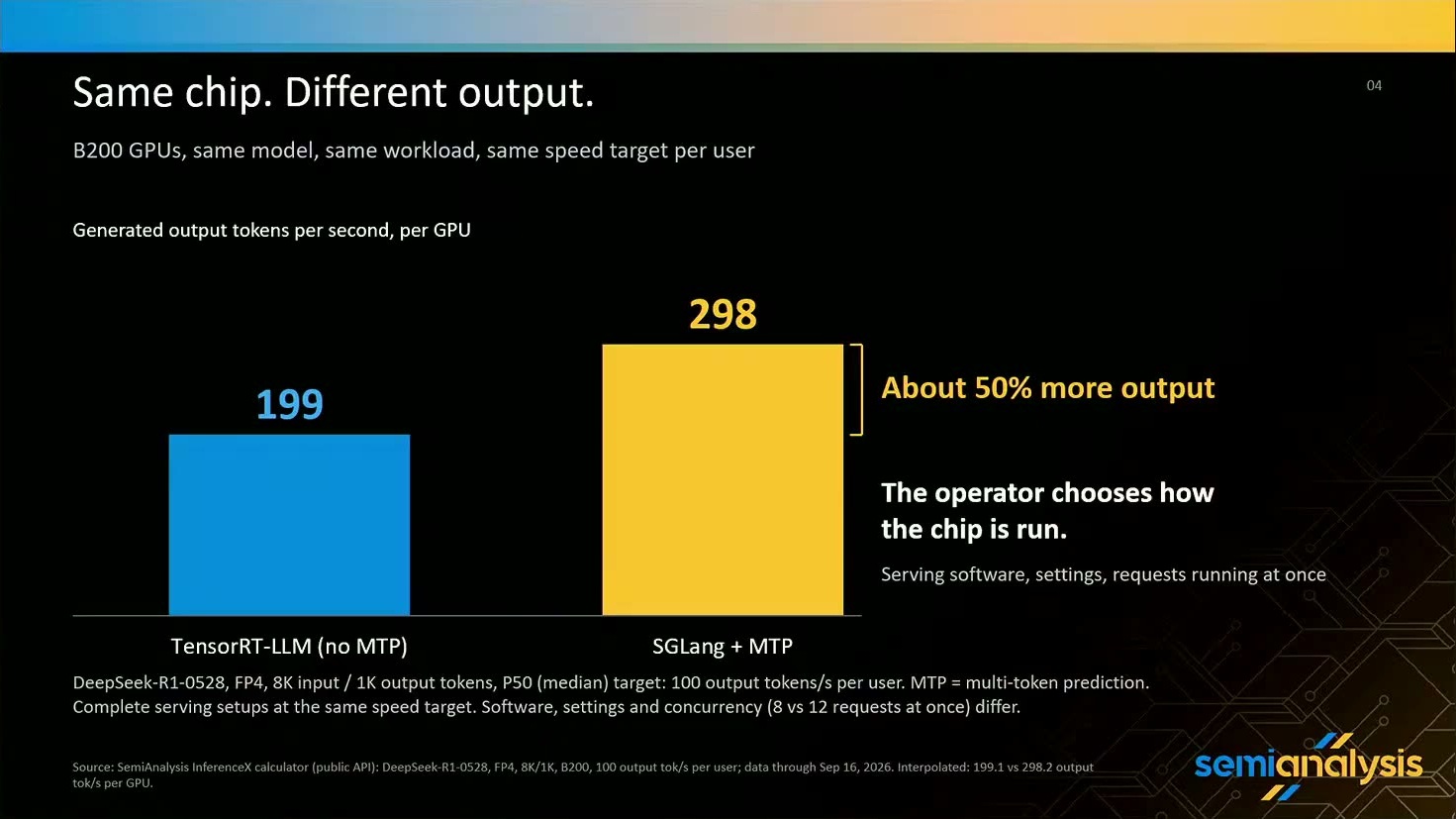
这是我们公开推理 X 计算器中的一个具体示例。大家都可以去 semianalysis.com 查看。两种估算都使用 B200 GPU,为同一个模型提供服务,输入 token 大约为 8,000 个,输出 token 为 1,000 个,这是很常见的比例。P50 目标是每位用户每秒输出 100 个 token。服务栈是处理模型响应的软件。在 P90 场景中,其中一种服务栈每秒大约生成 200 个输出 token,另一种则大约生成 300 个。差别很大,原因在于软件、设置和同时运行的请求数量。
Here's a concrete example from our public inference X calculator. You guys can all check it out, semianalysis.com. Both estimates use B200 GPUs serving the same model with roughly 8,000 input tokens and 1,000 output tokens, a pretty standard ratio. P50 target is 100 output tokens per second for each user. The serving stack is the software handling the model's responses. In the P90 scenario, one of these stacks gives about 200 generated output tokens per second while the other one gives about 300. That's a big difference and comes down to software, settings, and number of requests running.
这些都是运营者做出的选择。同一款芯片、相同的交互目标,输出量却高出约 50%。差别很大。那么,这对买家的账单意味着什么?
All choices made by the operator. Same chip, same target interactivity, about 50% more output. That's a lot. So what does that mean for the buyer's bill?
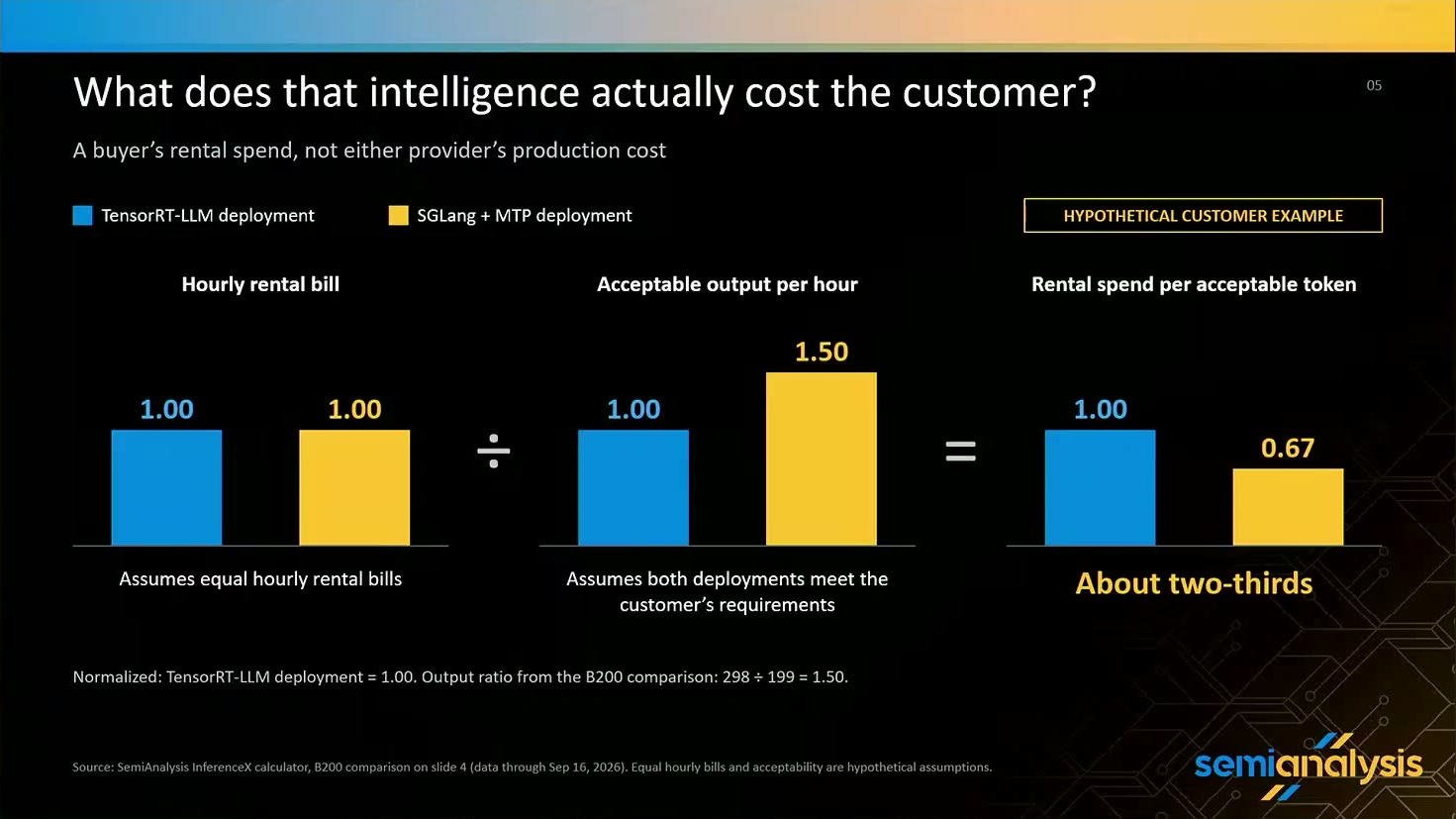
这种智能对客户来说实际成本是多少?在这个例子里,假设两种部署的每小时账单相同,而且都满足你的要求。输出量大约高出 1.5 倍时,每个合格 token 的租用支出就会按比例降低。也就是说,每小时的算力能买到更多可用且有价值的输出。
What does that intelligence actually cost the customer? For this example, let's assume the hourly bill is the same for both deployments and both meet your requirements. At roughly one and a half times the output, your rental spend per acceptable token is proportionally lower. That is to say, the hour buys you more usable and useful output.
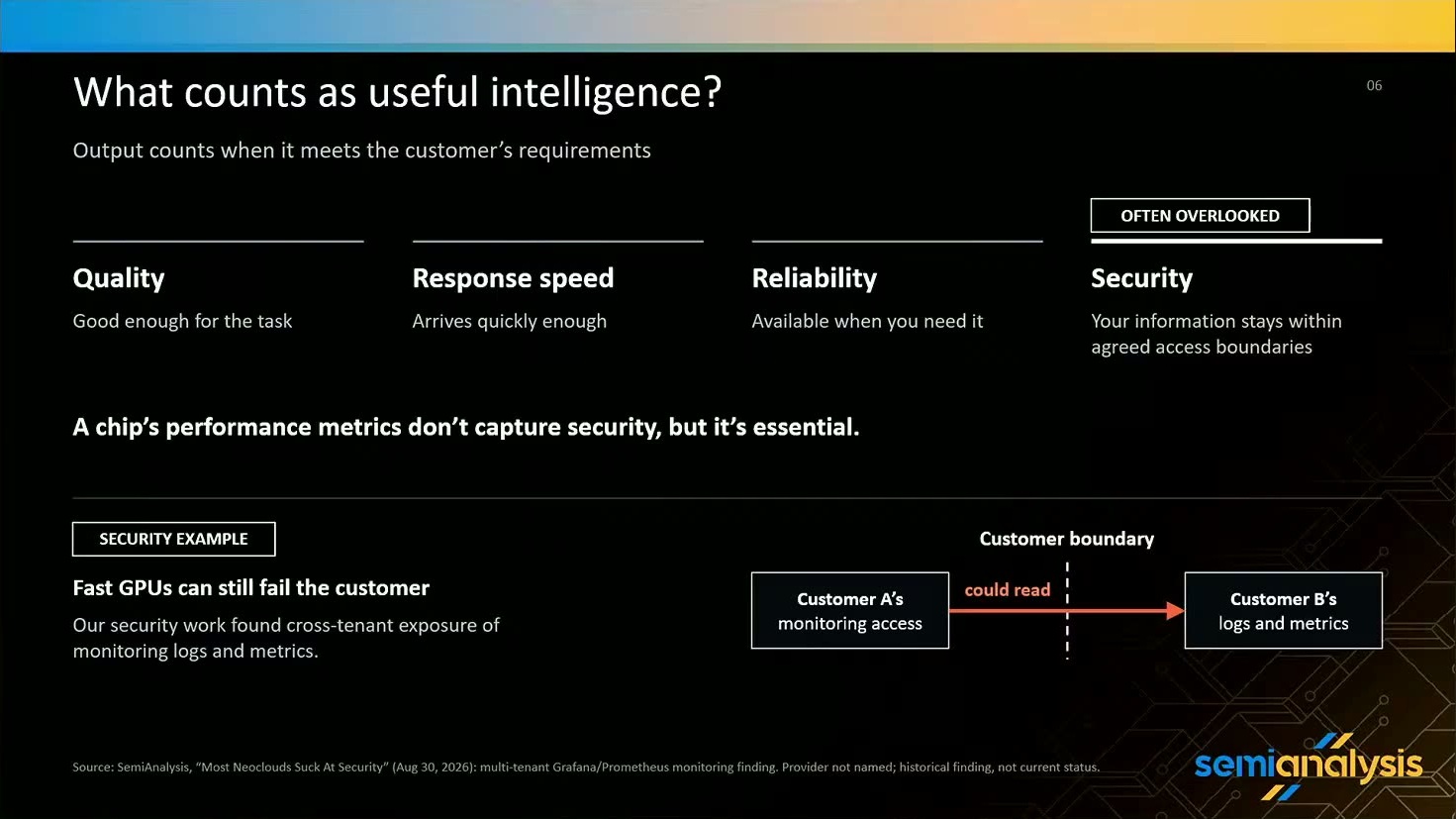
什么才算有用的智能?智能必须能完成你雇用它去做的工作。很简单,对吧?答案必须足以满足任务要求、及时给出,而且在你需要时能够使用。你的信息还必须留在你同意的访问边界内,也就是说,必须安全。这是一项常被忽略的要求,芯片性能指标不会体现它,但它对芯片能否真正实用至关重要。我们在已发表的安全研究中发现,监控访问可能泄露其他客户的日志和指标。这种情况并不罕见:相关案例中的 GPU 速度很快,事实上快得惊人,因此整个问题更令人遗憾,但服务仍然彻底失败了。确保集群安全需要持续投入工作,就像保证达到承诺的性能一样。
counts as useful intelligence? intelligence has to do the job you hired it to do. Pretty simple, right? it, the answer needs to be good enough for the task, arrive quickly enough, and be available when you need it. Your information also needs to stay within the access boundaries you've agreed upon, aka it needs to be secure. This is an overlooked requirement that is not captured in a chip's performance metrics, but it is essential for a chip to be usable and useful. In our published security work, we found monitoring access that exposed another customer's logs and metrics. This is a case, and an unfortunately common one at that, where the GPs were fast, in the case I'm referencing really, really fast, which makes the whole thing sadder, and the service still failed horrific. Basically, ensuring cluster security takes ongoing work just as delivering the promised performance does.
多数情况下,这项责任由运营者承担。
most cases, it is the operator that owns that responsibility.
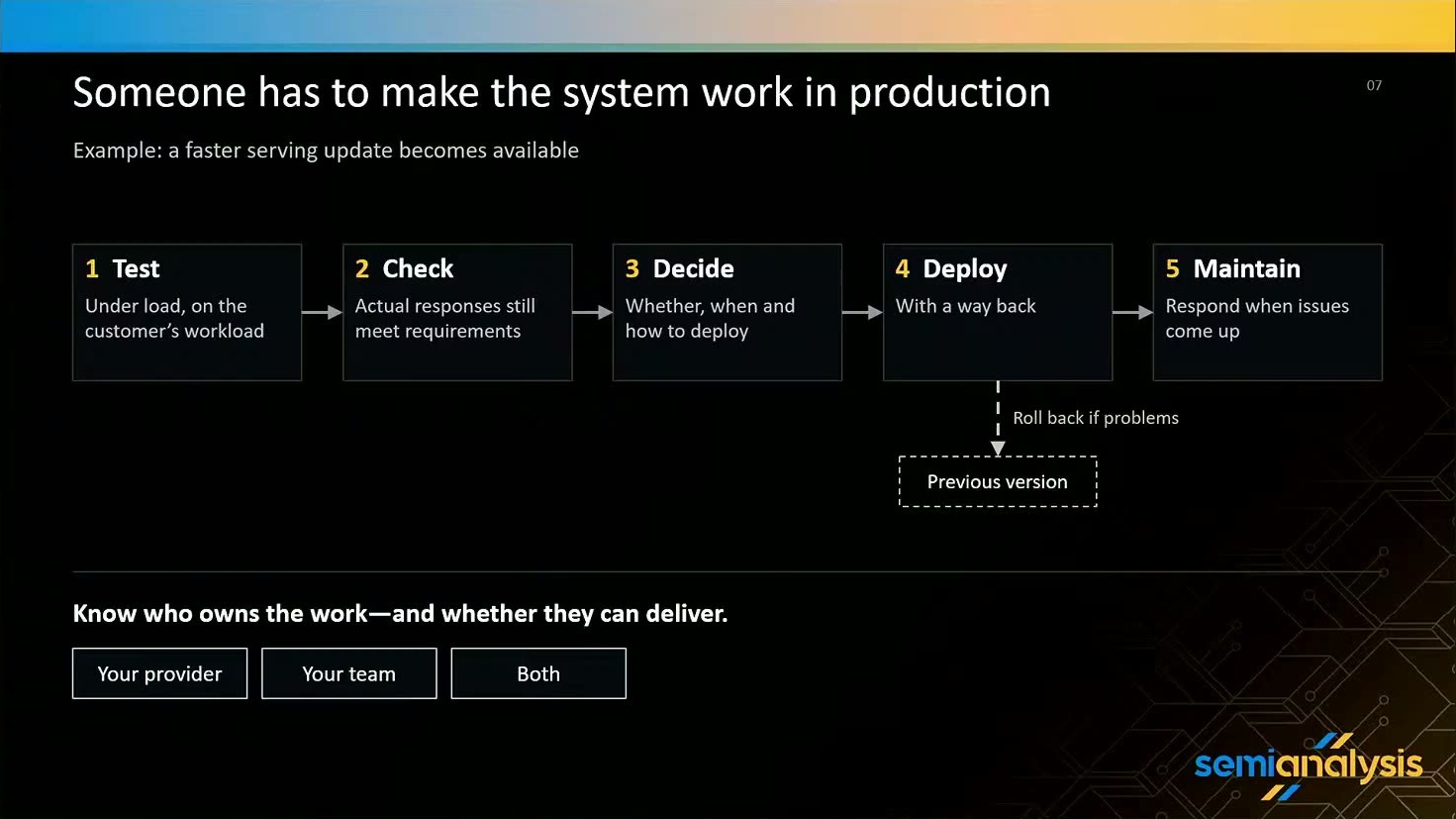
必须有人让系统在生产环境中正常运行。假设有一个更快的服务更新可用了,就得有人在客户的工作负载上测试它,检查输出是否仍符合要求,然后决定何时、何地以及如何部署。这意味着要检查实际响应,进行负载测试,并确保出现问题时可以回退到先前版本,以防更新部署后引发问题。部署完成后,还得有人维护它,并在问题出现时做出响应。这项工作可能由供应商负责,也可能由你自己的团队负责,或者双方共同负责。
Someone has to make the system work in production. Suppose a faster serving update becomes available. Someone has to test it on the customer's workload, check whether the output still meets the requirements, and then decide when, where, and how to deploy it. That means checking the actual responses, testing it under load, and keeping a way to return to previous version if the update causes problems once it's deployed. Once it is deployed, someone has to maintain it and respond when issues come up. That work may sit with your provider, your own team, or both.
无论如何,你需要知道谁负责,以及他们是否有能力履行责任。
Irregardless, you need to know who's responsible and whether they can actually do it.
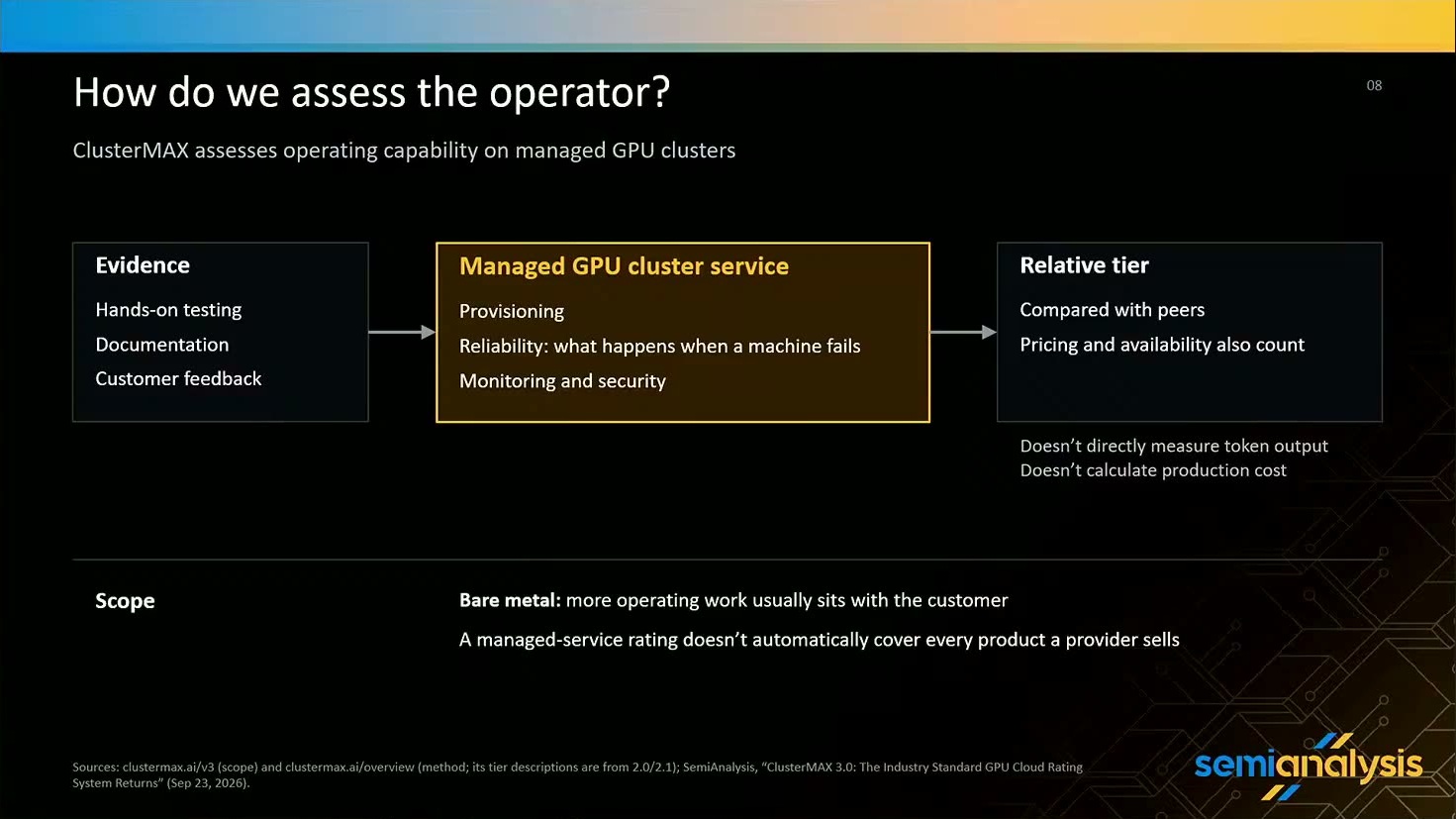
那么,如何评估运营者?SemiAnalysis 的 ClusterMAX,目前已经到 3.0 版,用来评估托管 GPU 集群的运营能力,目前评估了几百个,而且还在增加。如果你想加入 ClusterMAX 4.0,欢迎联系我们。我们考察资源配置、可靠性、监控和安全。实地测试、文档和客户反馈能帮助我们了解服务的实际运行情况,不只是顺利的时候,也包括机器发生故障时。我想借此机会重申,ClusterMAX 评级针对的是托管集群,和裸金属服务不同,差别很大。
So how do we assess the operator? Semi-analysis cluster max, we're on version 3.0 at this point, assesses operating capability on managed GPU clusters, a couple hundred growing. Please reach out if you want to be on cluster max 4.0. We look at provisioning, reliability, monitoring, and security. hands-on testing, documentation, and customer feedback help us understand how the service runs, not just on a good day, but also when a machine fails. I want to take the chance to reiterate that cluster max ratings apply to managed clusters, different from bare metal, very different.
使用裸金属时,更多运营工作通常由客户承担。托管服务评级并不会自动涵盖供应商销售的每一种产品,各等级是相对于同行比较的。这句话有点绕口,不过我说对了。价格和可用性也是评估中的重要因素。这些指标不会直接衡量 token 产出,但非常重要。评估可以帮助我们了解谁能够交付。现在可以转向下一个问题:生产有用智能的实际成本是多少?
With bare metal, more operating work usually sits with the customer. Applying a managed service rating there does not automatically cover every product a provider cells. The tiers are relative to peers. A little bit of a tongue twister. I nailed it. And pricing and availability are also important factors in this assessment. These are metrics that do not directly measure token output but are incredibly important. Assessment helps us understand who can deliver. Now we can move on to the next question. What does It's not actually cost to produce useful intelligence.
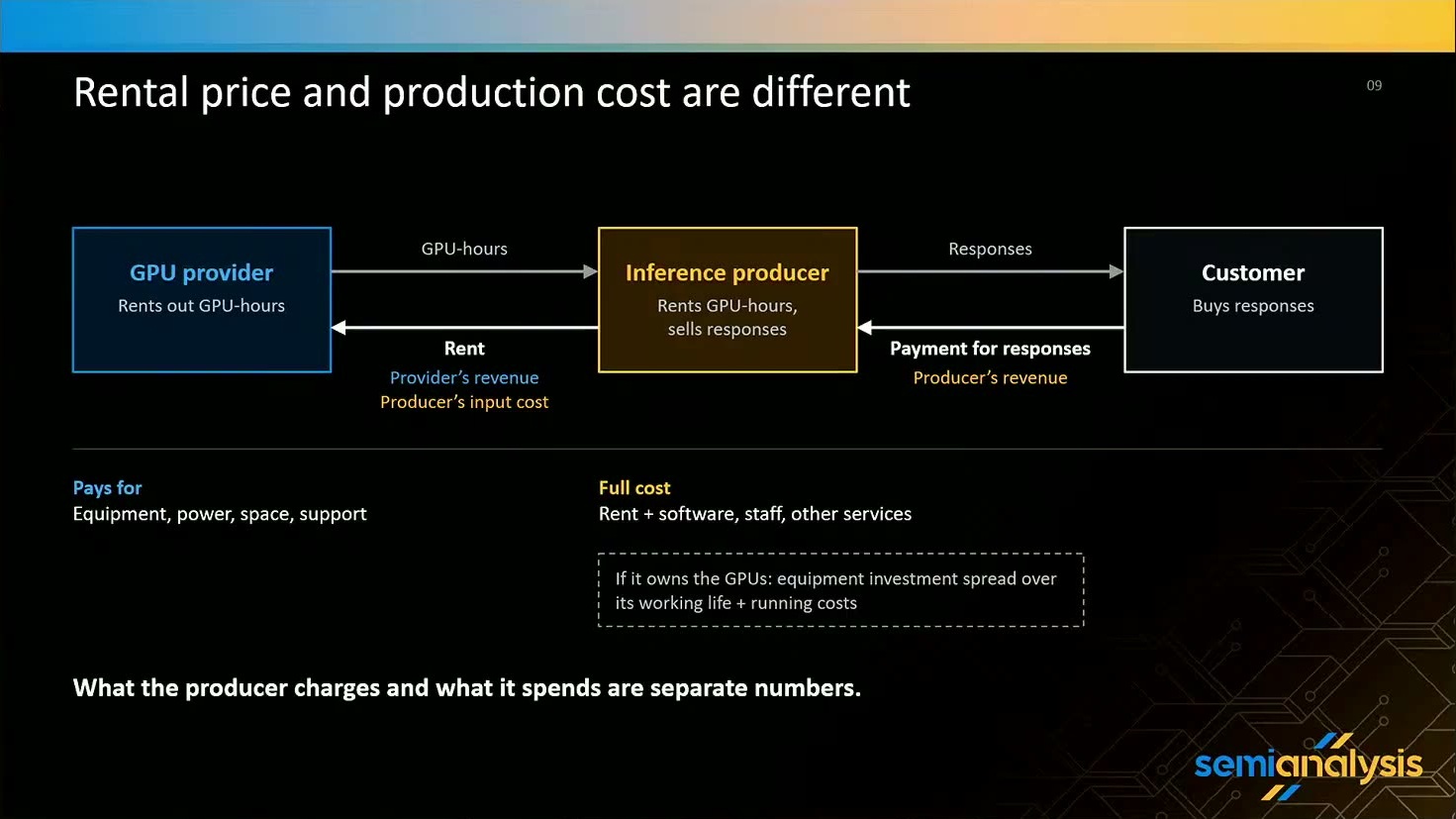
先从算力账单和生产者仍需承担的其他成本说起。价格和生产成本并不相同。在我们的例子中,GPU 供应商出租算力小时,推理服务商购买这些小时,再销售模型响应。租用账单是供应商的收入,也是推理服务商的投入成本。GPU 所有者要支付设备、电力、空间和支持服务费用。推理服务商的全部成本包括租金,以及租金之外支付的软件、人员和其他服务费用。如果推理服务商自己拥有设备,我们就把设备投资按使用寿命分摊,再加上运行成本。
Let's start with a compute bill and other costs that producers still have to cover. price and production costs are different. In our example, the GPU provider rents out hours, the inference producer buys those hours and sells responses. rental bill is revenue to the provider and an input cost to the inference producer. The GPU owner pays for the equipment, power, space and support. inference producer's full cost includes rent, plus whatever software, staff, and other services it pays for beyond that rental. If the inference producer owns its equipment instead, we spread the equipment investment over its working life and add running costs.
生产者收取的费用和实际支出是两个不同的数字。要理解生产有用智能的成本,我们需要知道这些支出实际能产出多少有用工作。更好的运营可以降低有用智能的成本。B200 对比展示了输出量为何重要。
What the producer charges and what it spends are separate numbers. To understand the cost of useful intelligence, we need to know how much useful work the spending actually produces. Better operations lowers that cost of useful intelligence. The B200 comparison showed why the amount of output matters.
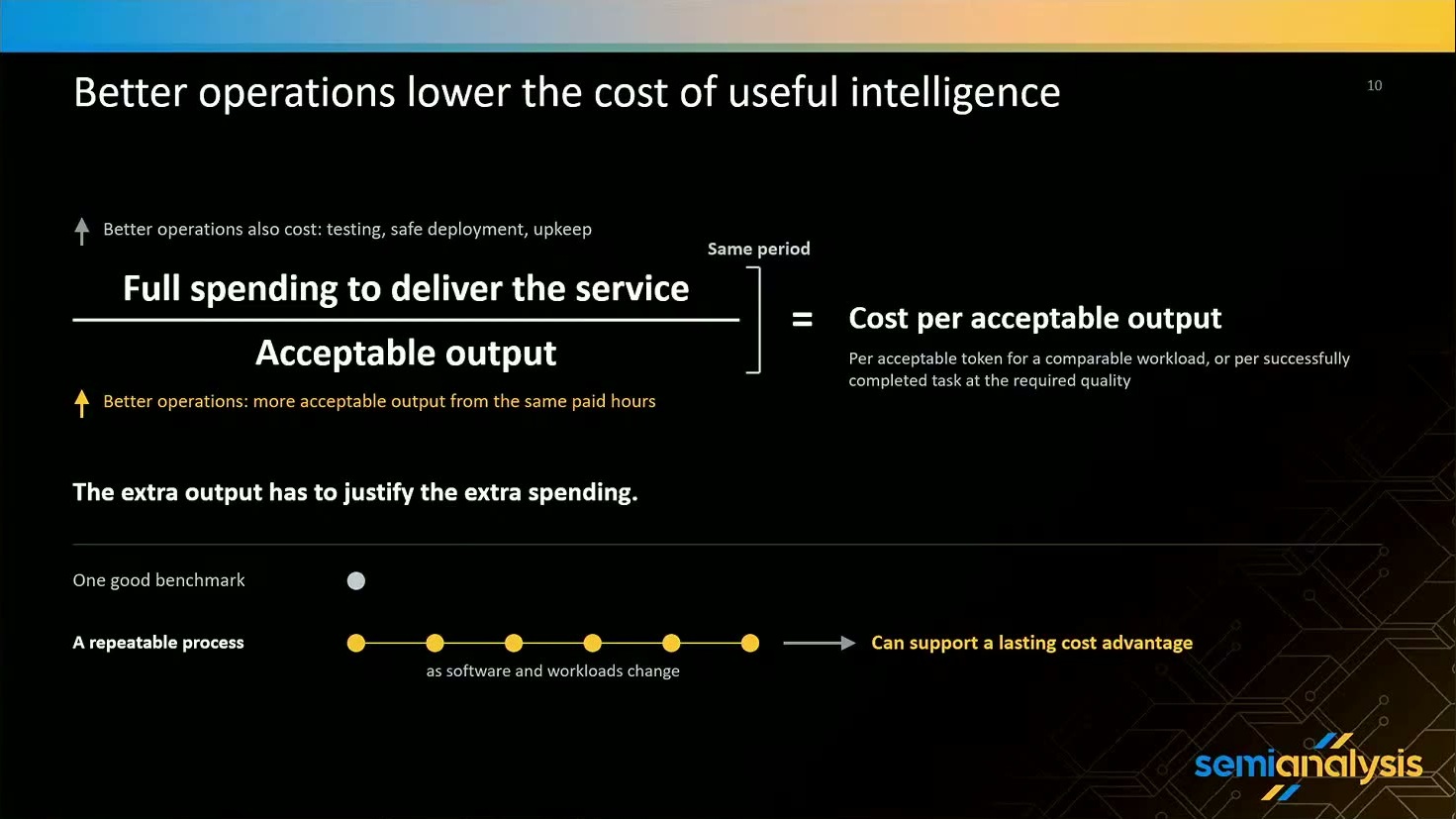
相同的付费时长能得到更多合格响应,就能把推理服务商的租用费用分摊到更多有用工作上。如果生产者自己拥有 GPU,同样的道理也适用:设备投资和运行成本可以分摊到更多产出上。在同一时期内,统计交付服务所需的全部支出,再除以客户实际能够使用的产出。这样就得到了可比工作负载下,每个合格 token 的成本。运营本身也需要投资。更新、确保安全部署并维持正常运行,都需要人员和资金。额外产出必须证明额外支出是值得的。
More acceptable responses from the same paid hours can spread the inference producer's rental expense over more useful work. For a producer that owns its GPUs, the same logic spreads the equipment investment and running costs over more output. Count all the spending needed to deliver the service over the same period, then divide by the output customers can actually use. That gives us cost for acceptable token for a comparable workload. operations also require investment. and update, deploying it safely, and keeping it working take people and money. extra output has to justify the extra spending.
随着软件和工作负载变化,如果团队不断重复这项工作,优势就能持续。但一次好的基准测试并不能证明这一点。你必须每天都持续做到。每种新工作负载仍然需要检查。不过,根据我们的观察,可重复的运营流程有助于建立持久的成本优势,也能形成价格优势。但即使你不断进步,竞争对手也不会停下脚步。你在成本曲线上的位置是相对的。这一页最能说明大宗商品框架在整个讨论中的重要性。
advantage can persist when a team repeats that work as software and workloads change. But one good benchmark doesn't establish it. You have to earn it every single day. Each new workload still needs checking, but a repeatable operating process, from what we've observed, can support a lasting cost advantage and a price advantage, too. Even if you do keep improving, though, your competitors are not sitting still. position on the cost curve is relative. This slide, out of all the slides, should make clear the importance of the commodity framework in all of this.
你在成本曲线上的位置取决于竞争对手能交付什么,而不只是
Your position on the cost curve depends on what your competitors can deliver, not just
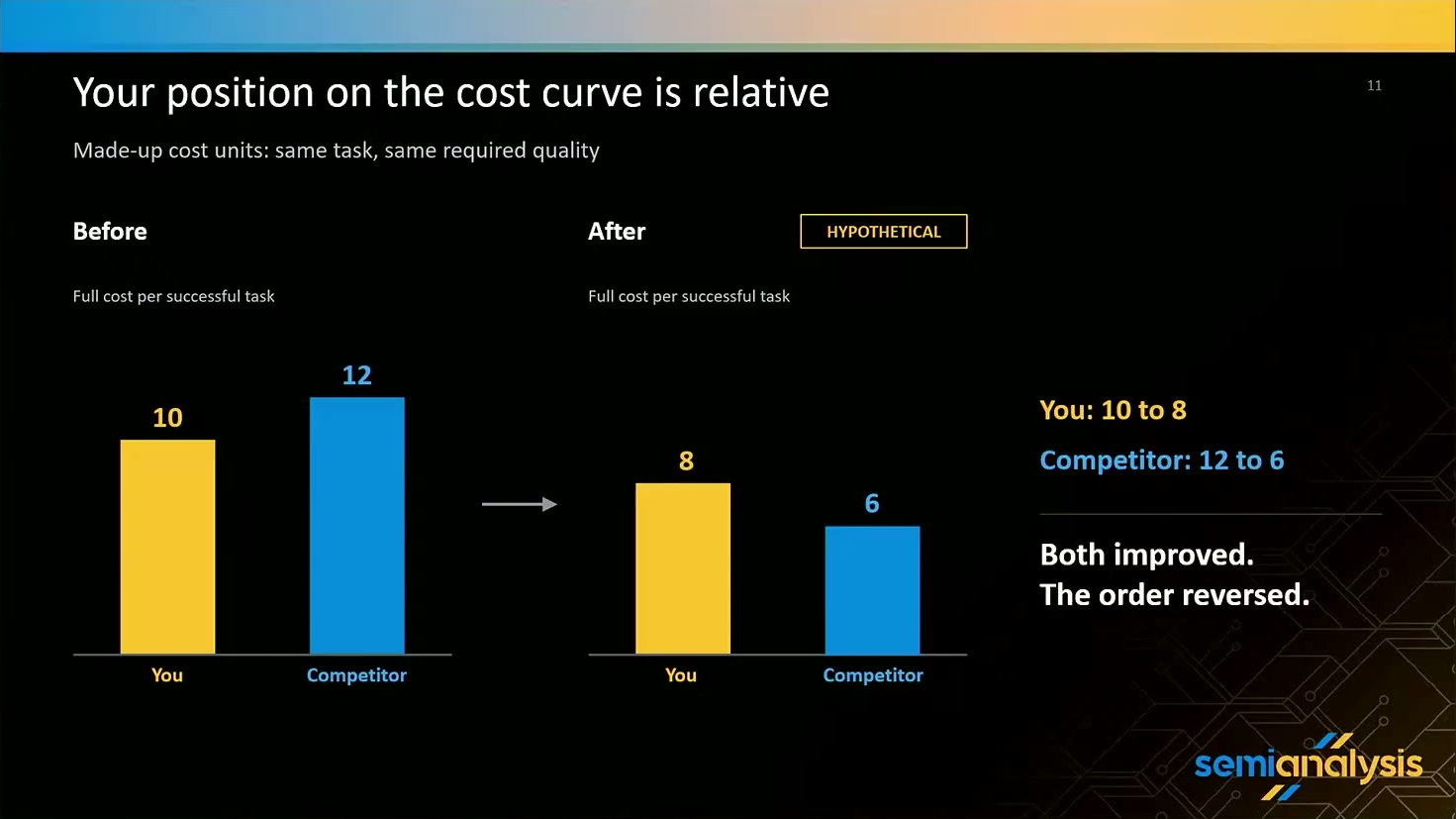
你自己能交付什么。这是一个相对指标。来看一个简单的假设例子。我们比较相同的任务和质量要求,成本单位是虚构的。我喜欢把它想象成金条。你每项成功任务的全部成本从 10 降到 8。同一时期,你的竞争对手成本却从 6 升到 12。你进步了。太棒了。但你们双方都进步了。在这个例子里,你起初是成本更低的生产者,最后却变成成本更高的一方。只要客户认为两项服务同样合格,竞争对手就有更大的降价空间,并且能保持同等可接受的服务质量。
yourself. It's a relative measure. Here's a simple hypothetical. We're comparing the same task, the same required quality, using made-up cost units. I like to imagine bars of gold. Your full cost per successful task falls from 10 to 8. In the same period, your competitors fall from 6 to 12. improved. That's awesome. But both of you did. And in this example, you started as the cheaper producer and ended as the more expensive one. That gives the competitor more room to lower its selling price, provided customers find the two services equally acceptable.
变得更好并不会自动让你领先。因此,应用大宗商品框架后你就会意识到,必须比较自己每单位有用工作的相对成本,并把自己的产品与竞争对手能够交付的内容进行比较。在当下这种需求远超供应,而且可预见的未来仍会如此的时期,这种比较很容易被忽略。未来两到三年也是如此。可见性很好。这会掩盖成本差异。
Getting better does not automatically move you ahead. Instead, applying the commodity framework makes you realize that you have to compare your cost per useful work on a relative basis, comparing your own product with what your competitors can deliver. That comparison can be easy to overlook in moments like today where demand far outstrips supply and will for the foreseeable future. to three years. Visibility, good. can obscure those differences.
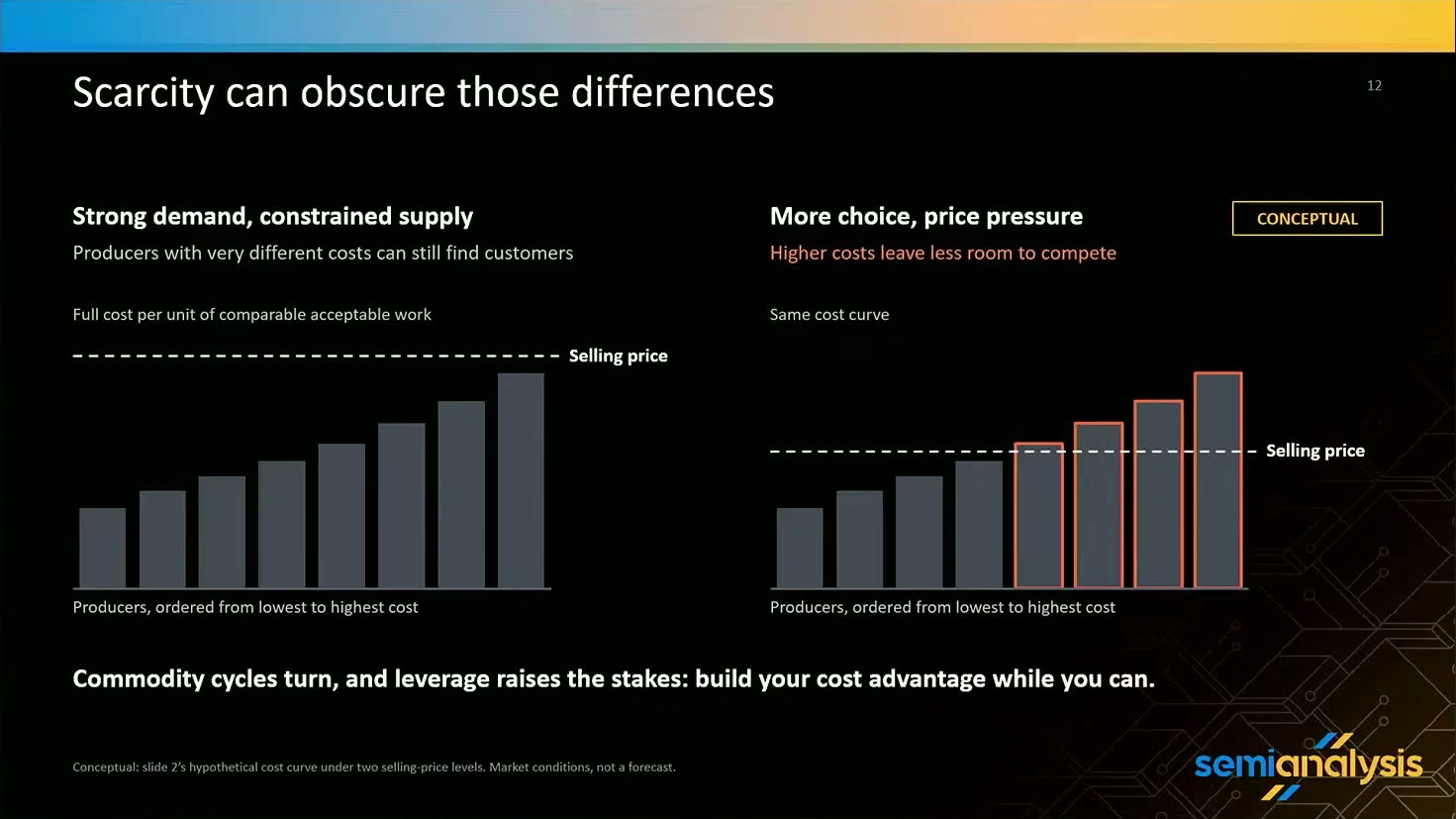
需求旺盛、供应受限时,成本差异很大的生产者都能找到客户。收入强劲会让这些差异显得没那么紧迫。如果你是 CEO,为什么要把宝贵的时间、精力和资金花在巩固自己在成本曲线上的位置,而不是去建一座大型新数据中心?在这样的时期,重要的是退后一步,保持一些视角,从历史角度看待问题。人类历史上的每一种大宗商品都经历过供需波动。我们现在还看不出波动何时到来,并不意味着这一轮会有什么不同。除非你是个彻底的 AI 极端乐观派;我们有些人确实如此,所以我完全接受自己可能看错。
When demand is strong and supply is constrained, producers with very different costs can find customers. Strong revenue can make those differences feel less urgent. If you're a CEO, why would you focus on your precious time and energy and money, shoring up your spot on the cost curve when you can be building a massive new data center? In moments like this, it's important to step back and have a little perspective, take a little historical perspective. Every commodity in the history of humanity has had swings in supply and demand. Just because we don't see when that will be yet does not mean that this cycle will be any different. Unless you're a total AI maxi, which some of us are, so I'm very open to being wrong.
我每天都可能犯错。但如果你的企业有杠杆,尤其需要认真看待这个问题。主动建立成本优势,可能没有扩大营收那么吸引人,但如果你想在商业周期中生存下来,这一点至关重要。所以你应该趁有机会时建立运营能力和成本优势,趁市场环境良好、还能融资的时候。等客户有更多选择、价格承压时,这些能力就更重要了。那么,如何清楚说明买家实际买到了什么?可比算力需要明确的等级标准。
I'm wrong every day. But I would say if you're a business with leverage, you need to be especially conscientious of this. Being proactive with building your cost advantage might not be as sexy as making your top line bigger, but it matters deeply if you want to survive through a business cycle. That's why you want to build your operating capability and cost advantage while you have the opportunity, when the sun is shining, when you can raise capital. They matter even more when customers have more choices to make and prices come under pressure. So how do we make clear what the buyer actually gets? Comparable compute needs clear grades.
现在来看看智能生产者购买的算力。
Now let's look at the compute that an intelligence producer is buying.
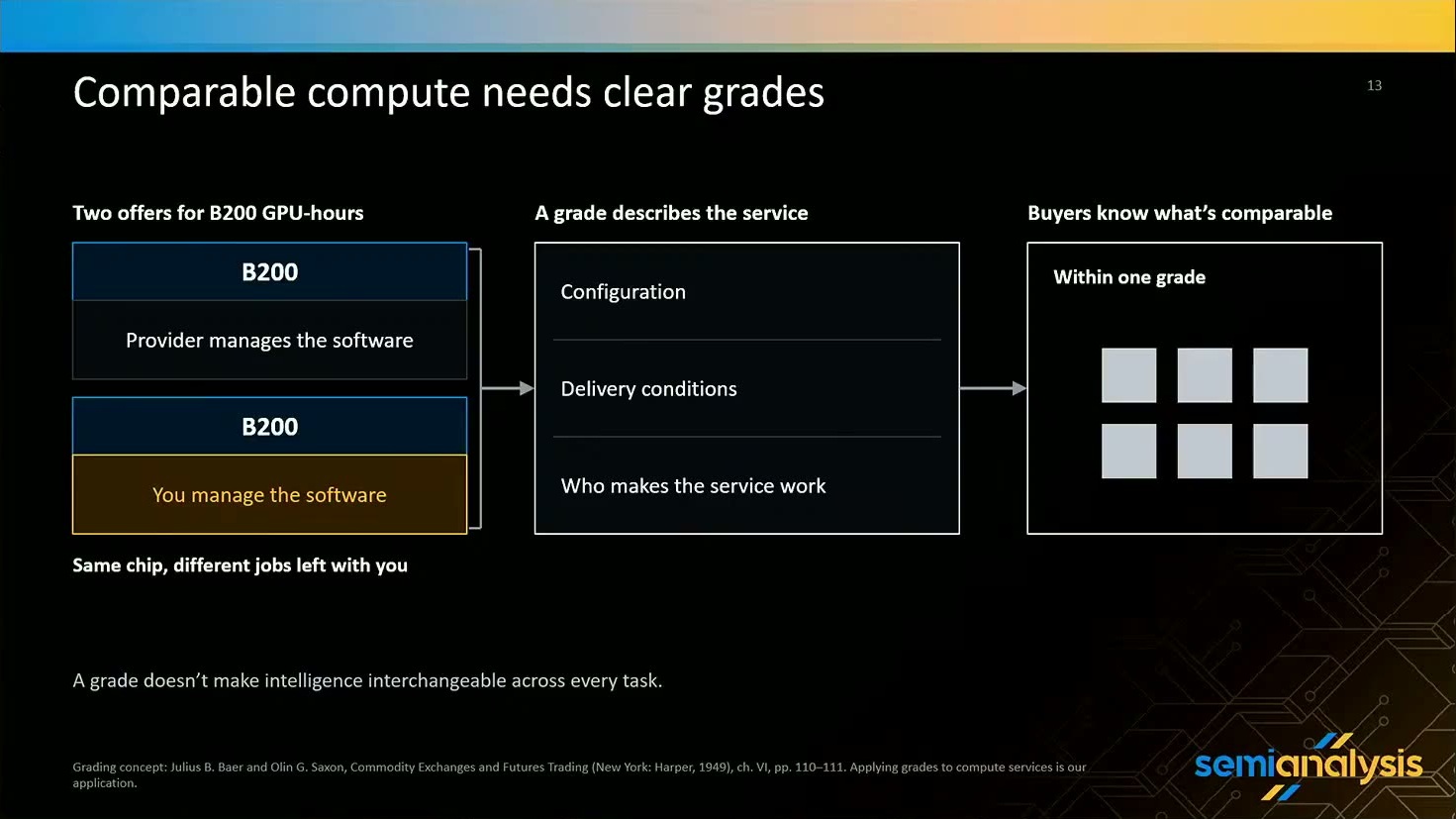
我们已经看到,相同的芯片会因运营方式不同而产生不同结果。两份 B200 GPU 小时的报价可能包含不同服务,也可能把不同的运营工作留给客户。大宗商品框架需要一种方式来描述这些差异,让买家知道哪些服务可以视为可比。这就是等级标准的作用。等级描述某项特定的算力服务,以及买家可以期待什么。这并不意味着所有任务中的智能都可以互换。定义好这项服务后,我们就可以问它的租赁价格告诉了我们什么。
We've already seen that the same chip can deliver different results depending on how it's operated. And two offers for B200 GPU hours can include different services and leave different operating jobs with the customer. A commodity framework needs a way to describe these differences so buyers know which services they can treat as comparable. That's the job of a grade. grade describes a particular compute service and what its buyers can expect. It doesn't make intelligence interchangeable across every task. Once we've defined that service, we can ask what its rental price tells us.
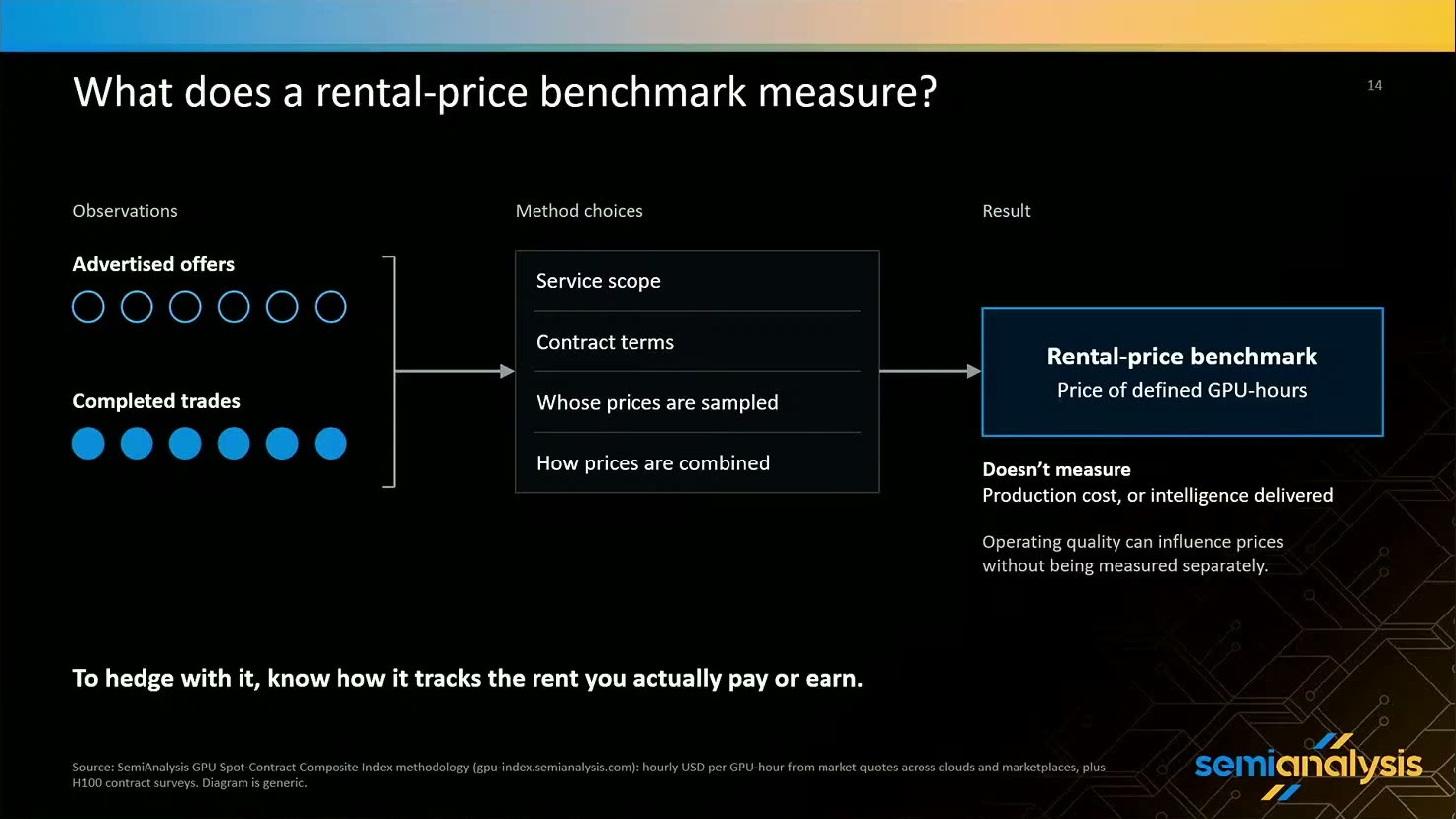
租赁价格基准衡量什么?租赁价格基准汇总了其定义市场内 GPU 小时的价格。它既不是生产者的生产成本,也不是已交付智能的衡量指标。我们需要了解这些价格的来源。广告报价和已完成交易并不是一回事。服务范围、合同条款、采样了谁的价格,以及如何汇总,都会影响这个参考价格。运营质量可能影响价格,但指数不会单独衡量它。有租赁价格参考,并不能告诉你部署实际能产出多少有用工作。如果要用它对冲风险,就需要了解它和你实际支付或收取的租金之间如何变动。
What does a rental price benchmark measure? A rental price benchmark summarizes the price of GPU hours within its defined market. It isn't the producer's production cost or a measure of intelligence delivered. We need to know where those prices come from. An advertised offer and a completed trade are not the same thing. Service scope, contract terms, whose prices are sampled, and how they're combined all shape that reference point. Operating quality can influence those prices without the index measuring it separately. Running a rental reference doesn't tell you how much useful work your deployment will produce. To use it as a hedge, you need to understand how it tracks the rent you actually pay or earn.
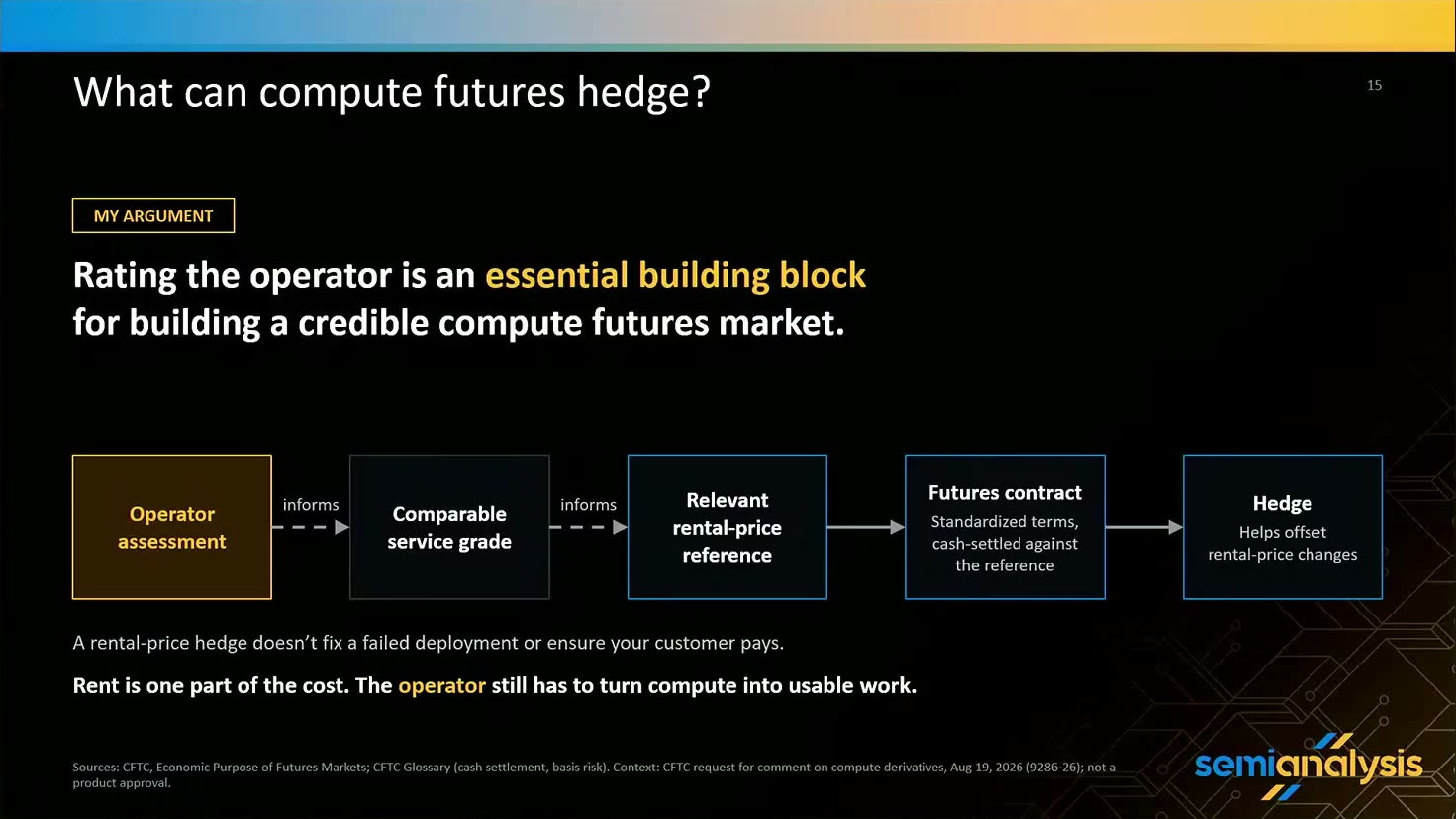
算力期货能对冲什么?最近人们对算力期货非常兴奋。如果你不了解期货合约,它会为未来的交付或现金结算设定标准化条款,也可以约定现金结算。现金结算取决于一个价格参考。买方和卖方都面临租赁价格的不确定性。回想一下服务栈和监控故障的例子。评估系统由谁运营,可以帮助描述买家实际获得的服务。这有助于建立等级标准,让买家了解哪些算力服务可以比较。基准还必须追踪他们实际支付或收取的租金。这就是我提出这个论点的原因。
What can compute futures hedge? There has been a lot of excitement lately about compute futures. For all of you that don't know, a futures contract sets a standardised term for future delivery or cash settlement. Cash settlement depends on a price reference. Buyers and sellers both face uncertainty about rental prices. Think back to the serving stacks and the monitoring failure. Assessing who runs the system helps describe the service buyers get. That helps us to find grades so buyers know which compute services are comparable. The benchmark then needs to track the rent they actually pay or earn. That's why I make this argument.
评估运营者是建立可信算力期货市场的一项关键基础。评级能够为这项工作提供信息。但评级本身不能定义期货等级、建立可靠的基准,也不能创造足够的交易量,让买卖变得容易。它也不一定能让对冲有效。租赁价格对冲可以帮助抵消租金变化,但无法修复部署故障,也无法保证客户付款。收费高于指数本身并不意味着对冲失败。关键是参考价格的变化是否能跟上你租金的变化。如果两者关系意外变化,你仍会面临真实的价格风险。这些工具可以帮助你了解自己购买的服务,并管理租赁价格风险。
Rating the operator is an essential building block for building a credible compute futures market. A rating informs that work. It doesn't by itself define a futures grade, establish a sound benchmark, or create enough trading to buy and sell easily. It also doesn't necessarily make a hedge effective. A rental price hedge can help offset rental price changes. It does not fix a failed deployment or ensure that your customer pays. Charging more than the index does not by itself make it a bad hedge. What matters is whether changes in the reference track changes in your rent. Unexpected changes in that relationship leave real price risk. risk, those tools can help you understand what you're buying and manage the rental price risk.
对智能生产者来说,租金只是成本的一部分。运营者仍须把算力转化为客户真正能够使用的工作成果。
For an intelligence producer, rent is one part of the cost. The operator still has to turn that compute into work that the customer can actually use.
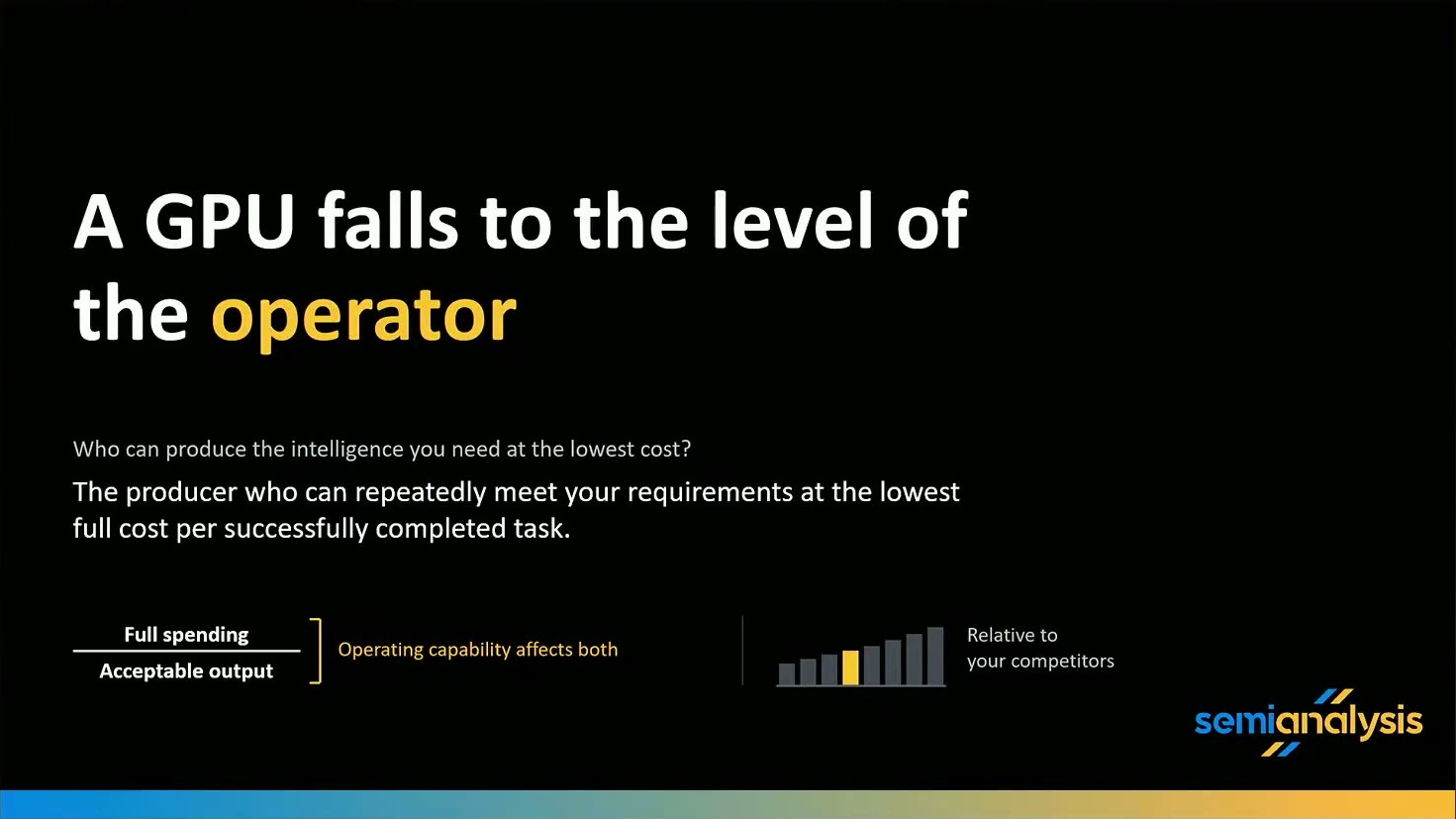
这就让我们回到了最初的问题。GPU 的表现取决于运营者。那么,谁能以最低成本产出你需要的智能?能持续满足你的要求,并以最低的每项成功任务总成本交付的生产者。统计交付服务的全部支出,再除以客户实际能够使用的产出。运营能力会影响这个等式的两边:你花了多少,以及能多交付多少有用工作。另外,你的相对位置取决于竞争对手。
This brings us full circle. a GPU falls to the level of the operator. So who can produce the intelligence you need at the lowest cost? The producer who can repeatedly meet your requirements at the lowest full cost per successfully completed task. Count everything spent to deliver the service, then divide by the output that the customer can actually use. Operating capability affects both sides of that equation, what you spend, and how much more useful work you can deliver. Also, your position depends on that of your competitors.
即使你进步了,如果竞争对手进步得更快,你仍可能落后。这就是为什么要在整个周期中了解运营者,而不只看某个时点。尤其是在客户选择更多、价格压力更大的时候。最后,如果你刚进场,只想听一个简要结论,那就是:GPU 的表现取决于运营者。让我们共同建设一个信息更充分的算力市场。女士们、先生们,感谢大家今天抽出时间。在 SemiAnalysis,我们知道市场不会自行变得信息充分且高效。我们希望积极投入并参与这项工作。不过,这需要双方共同努力。理想情况下,还不止双方。如果你想与我们合作、作出贡献或加入团队,我们很乐意听到你的消息。我们一直在招聘优秀人才,欢迎联系。
You can improve and still fall behind if your competitors improve faster than you. That's why understanding the operator matters through the cycle, not just at one point in time. Especially when customers have more choices and prices come under more pressure. In conclusion, if you just walked in and want the TLDR, this is it. A GPU falls to the level of the operator. Help build a better informed compute market. Ladies and gentlemen, thank you so much for your time today. at SemiAnalysis, we know that markets do not become informed and efficient on their own. We seek to be an active, engaged partner in that work. It takes two to tango, though. Ideally, more than two, actually. If you'd like to partner with us, contribute, or join the team, we would love to hear from you. We are always hiring great people. Please reach out.
如果这些内容引起了你的共鸣,请发送邮件至 sales@semianalysis.com,洽谈合作机会。如果你有兴趣加入团队,我的邮箱是 kenin@semianalysis.com,拼写为 K-E-N-N-O-N。感谢大家收听,祝大家今天接下来的时间过得愉快。谢谢。
If this resonated, please go ahead and email sales at semianalysis.com for partnership opportunities. And if you're interested in potentially joining the team, my email is kenin at semianalysis.com, K-E-N-N-O-N. Thank you all for listening, and have a fantastic rest of your day. Thank you.