构建金融领域 AI 的新篇章
Building the Next Chapter of AI in Finance
原文由官网提供,中文由 GPT-6 Luna 翻译。相邻片段合并排版,正文与时间点保持对应。
已插入 15 张经核对的幻灯片或演示截图;点击图片可放大。图注链接为当前视频时间,左侧正文时间保留原转录版本,二者可能不同。
共 33 个阅读段落
大家好,我叫 Joseph Kim,负责 ChatGPT 金融服务版。这是我们一个月前刚推出的新产品。你们当中许多人已经亲身体验过 Codex 这类工具如何改变软件工程的开发方式。AI 已经成为你们日常工作中重要得多的一部分。模型智能仍在以惊人的速度提升。但在金融等行业工作的人,日常工作还没有经历同样的变化。我预计未来几个月这种情况会迅速改变。在座各位这样的开发者,在推动这一变化快速发生方面发挥着重要作用。把这些模型的智能转化为人们日常工作中可以使用的产品。
Hi, everyone. I'm Joseph Kim, and I lead ChatGPT for Financial Services, a new product we launched just one month ago. Many of you have already experienced how tools like Codex have changed the way you build in software engineering. AI has become a much bigger part of the work you do every day. Model intelligence is continuing to improve at an incredible pace. But many people working industries like finance haven't yet experienced that same change in their day-to-day work. I expect that to start changing rapidly over the next few months. And builders like all of you in this room have a big role in making that happen quickly. Taking the intelligence in these models and turning it into products that people can use in their daily work.
今天,我会分享一些我们构建 ChatGPT 金融服务版时学到的经验,以及我们对下一步发展的思考。
Today, I will share a little bit about what we learned building ChatGPT for financial services and how we're thinking about what comes next.
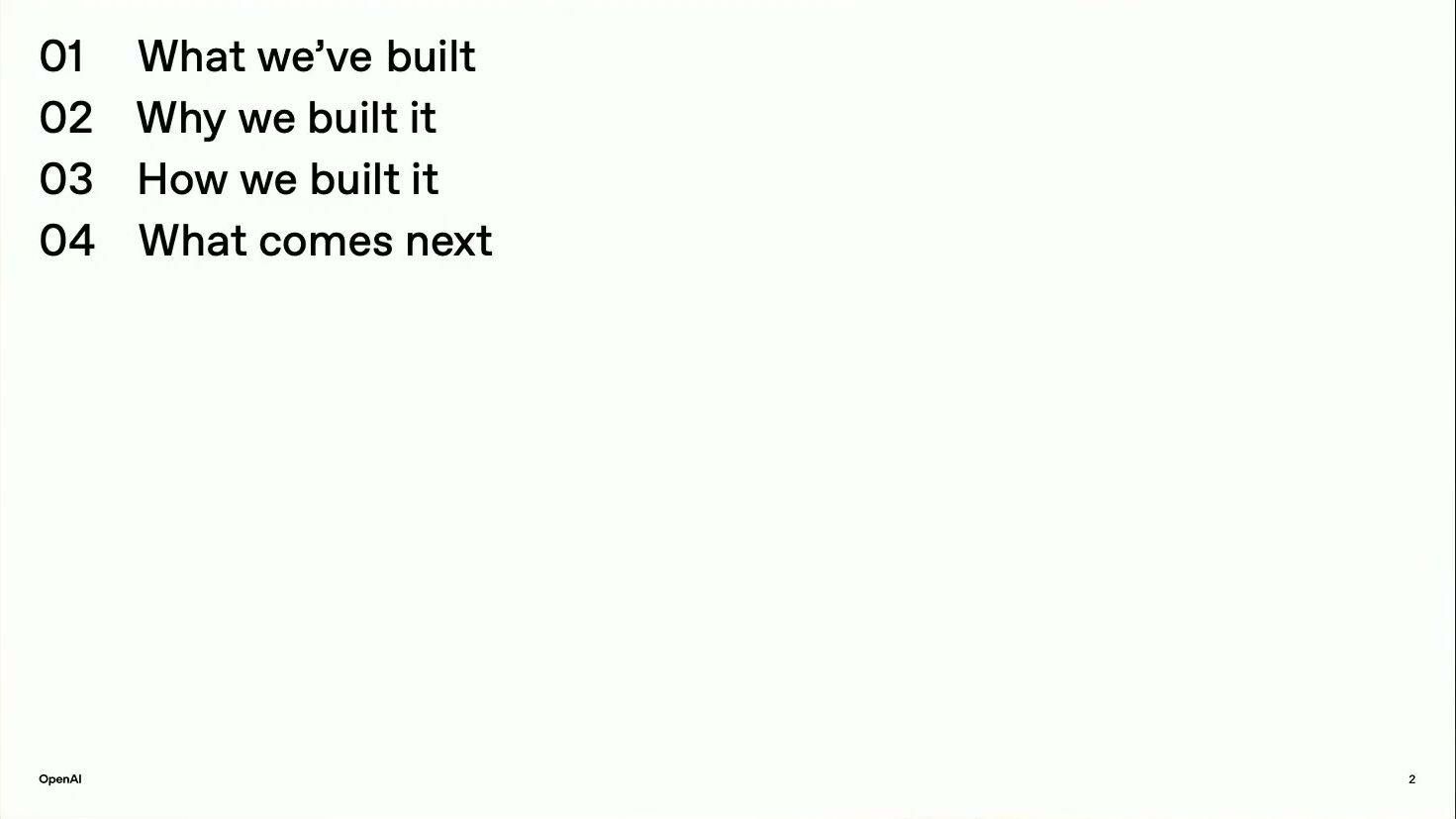
我会先展示我们构建的产品,包括一个简短演示。然后解释我们为什么构建它,以及为什么认为现在是构建它的合适时机。接着,我会介绍我们是如何构建它的,并分享一些技术经验,希望你们能应用到自己的产品中。最后,我们会看看模型的发展方向和产品的走向,以及这对未来一年金融工作可能意味着什么。先从我们构建的产品开始。
I'll start by showing you what we've built, including a quick demo. Then I'll explain why we built it and why we think now is the right time to build. From there, I'll walk you through how we built it with some technical lessons that I hope you can apply to your own products. Finally, we'll take a look at where models are headed and products are going and what that can mean for financial work over the next year. Let's start with what we've built.
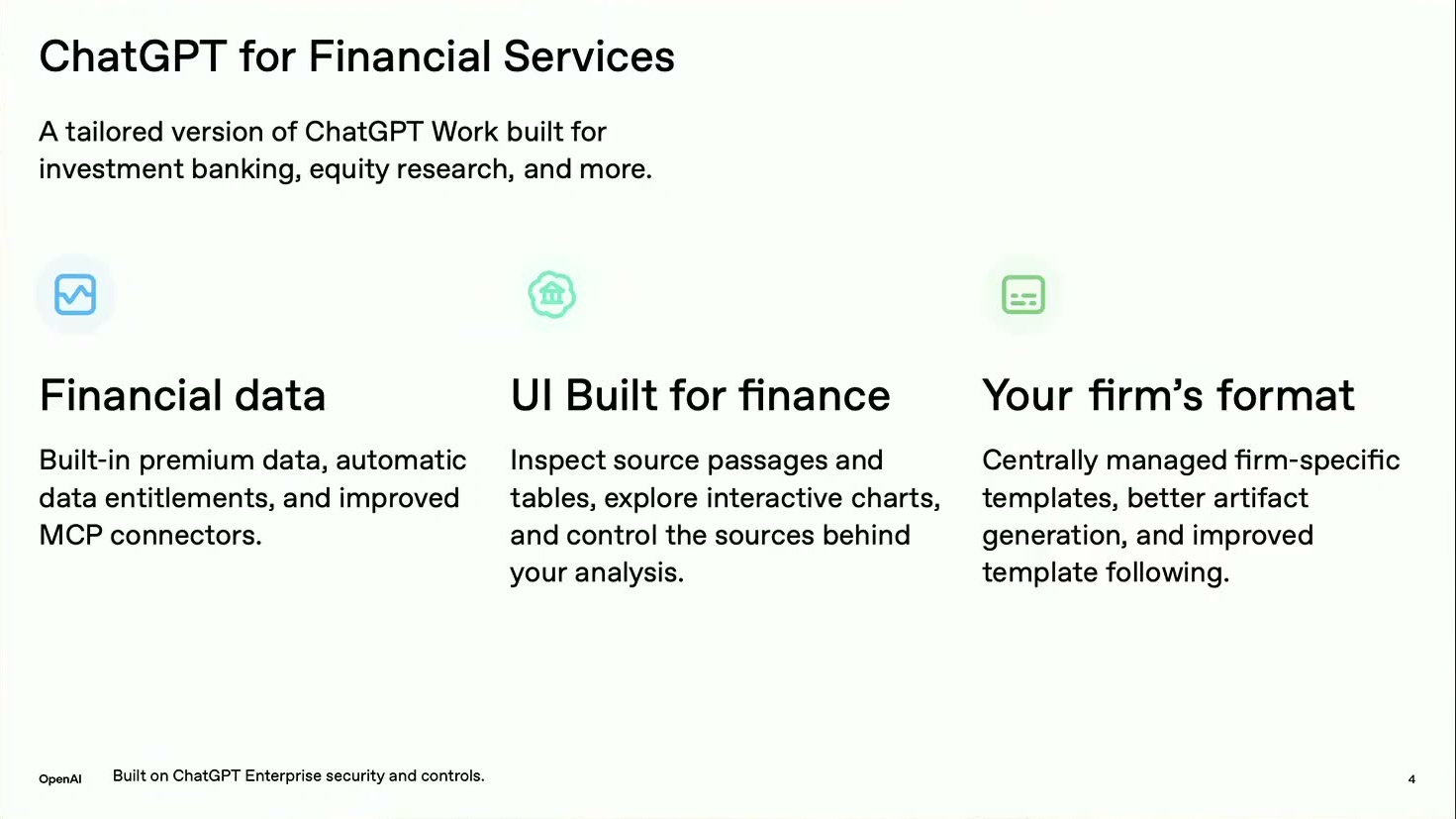
ChatGPT 金融服务版是 ChatGPT Work 的定制版本,专门面向金融专业人士,首批服务于投资银行和股票研究领域。它旨在帮助大型金融机构的员工更高效地完成日常工作,就像 Codex 加快软件开发一样。我们与 Morgan Stanley 和 Evercore 等设计合作伙伴共同构建产品时,重点关注了三个核心领域。第一,金融数据。金融数据是金融工作的基础,而你能完成的工作,受限于数据源的质量。我们希望人们能直接在 ChatGPT 中访问所需数据。第二,为金融领域打造的界面。
ChatGPT for Financial Services is a tailored version of ChatGPT work built specifically for financial professionals, starting with investment banking and equity research. It's designed to help people at the large financial institutions get more out of their day-to-day work, similar to how Codex speeds you up in software development. As we built the product with our design partners, Morgan Stanley and Evercore, we focused on three core areas. First, financial data. Financial data is the foundation of financial work, and the work you can do is limited by the quality of your sources. We wanted people to have access to the data they need directly within ChatGPT. Second, an interface built for finance.
我们希望产品让金融专业人士感到熟悉,能够查看源材料、探索金融图表,并控制分析所依据的数据源。第三,符合你所在公司的格式。金融工作是在组织环境中开展的,人们制作的模型和演示文稿需要符合所在公司的格式和标准。我们利用公司专属模板,让创建这些成果更简单。
We wanted the product to feel familiar to financial professionals with ways to inspect source material, explore financial charts, and control the sources behind an analysis. Third, your firm's format. Financial work happens within the context of an organization, and the models and presentations people produce need to follow their forms format and standards. We made it easier to create those artifacts using firm-specific templates.
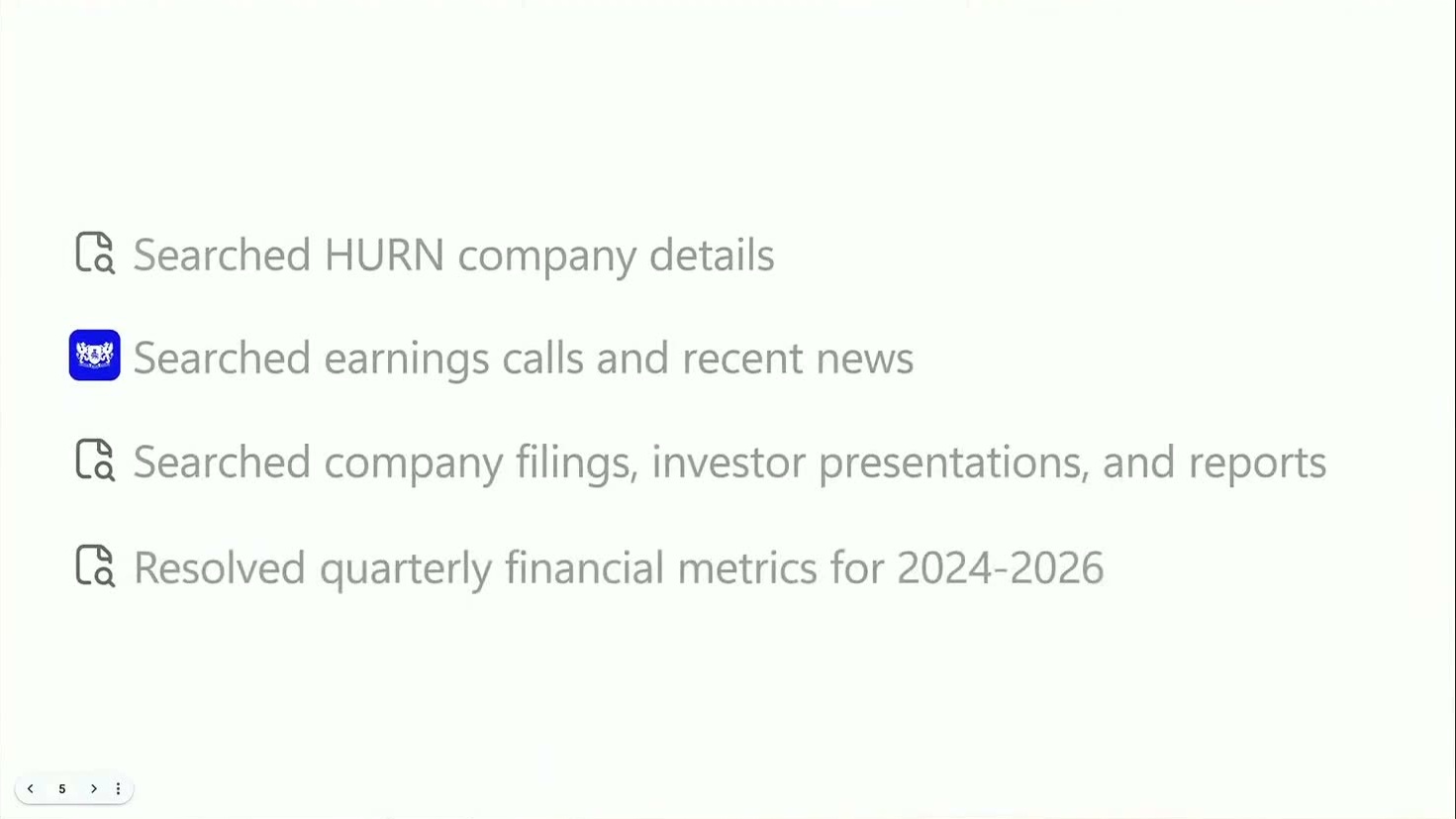
不过常言道,一图胜千言,
But they say a picture is worth a thousand words,
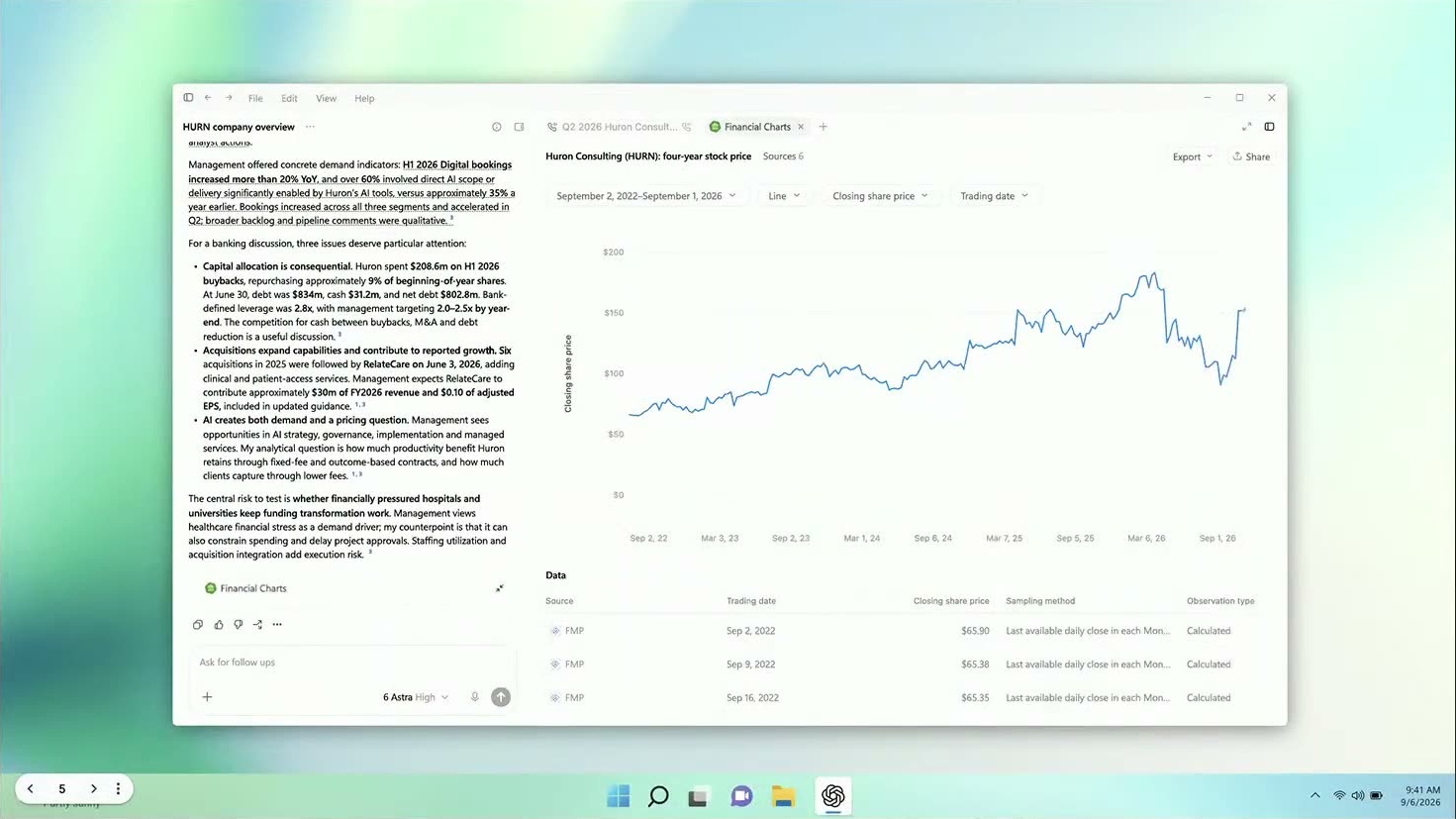
所以我先不多说,给大家展示一下产品。太棒了。
so I'll stop talking for a bit and show you the product. Wonderful.
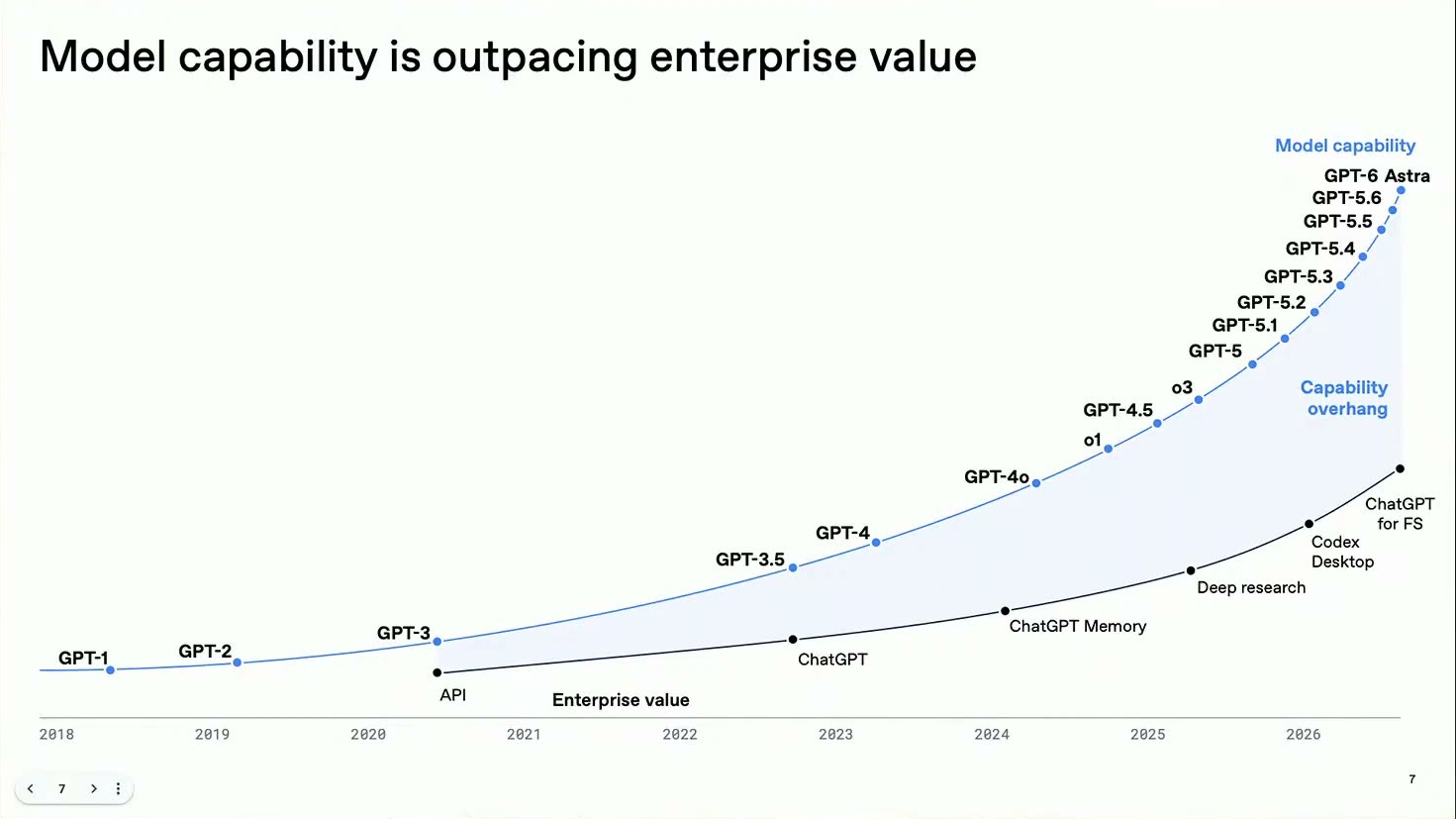
现在我想花些时间谈谈我们为什么要构建它。我们构建 ChatGPT 金融服务版,是为了弥合我们所说的“能力落差”。如你所见,过去几年模型能力以惊人的速度提升。短短几年间,模型已经从解决高中数学题,发展到能够解决数学领域的千禧年大奖难题。但人们在日常工作中从这些模型获得的价值,并没有跟上这一进步。你会在新闻中读到各种突破,但对许多金融专业人士来说,工作方式的变化远没有那么快。我们把这种差距称为“能力落差”,也就是模型能够做到什么与人们实际上能够从中获得的价值之间的距离。
Now I'd like to take some time to talk about why we built it. We built ChatGPT for financial services to help close what we call the capability overhang. As you can see here, model capabilities have improved at a tremendous rate over the last few years. In just a few years, we've gone from models solving high school math problems to systems capable of solving millennial-prized math problems. But the value people get from these models in their day-to-day work hasn't kept pace. You read about the breakthroughs in the news, yet for many financial professionals, the way they work hasn't changed nearly as quickly. We call that gap the capability overhang, the distance between what the model is capable of and the value people can actually get from it.
弥合这一差距,需要的不只是构建能力强大的模型。人们还需要合适的数据和工具,以及符合他们工作方式的使用体验。这正是各位开发者可以发挥作用的地方。我想举个例子,说明合适的产品体验能带来多大的不同。
Closing that gap takes more than building a capable model. People need the right data and tools and they need an experience that fits the way they work. That's where builders like you come in. I want to show you an example of how much of a difference the right product experience can make.
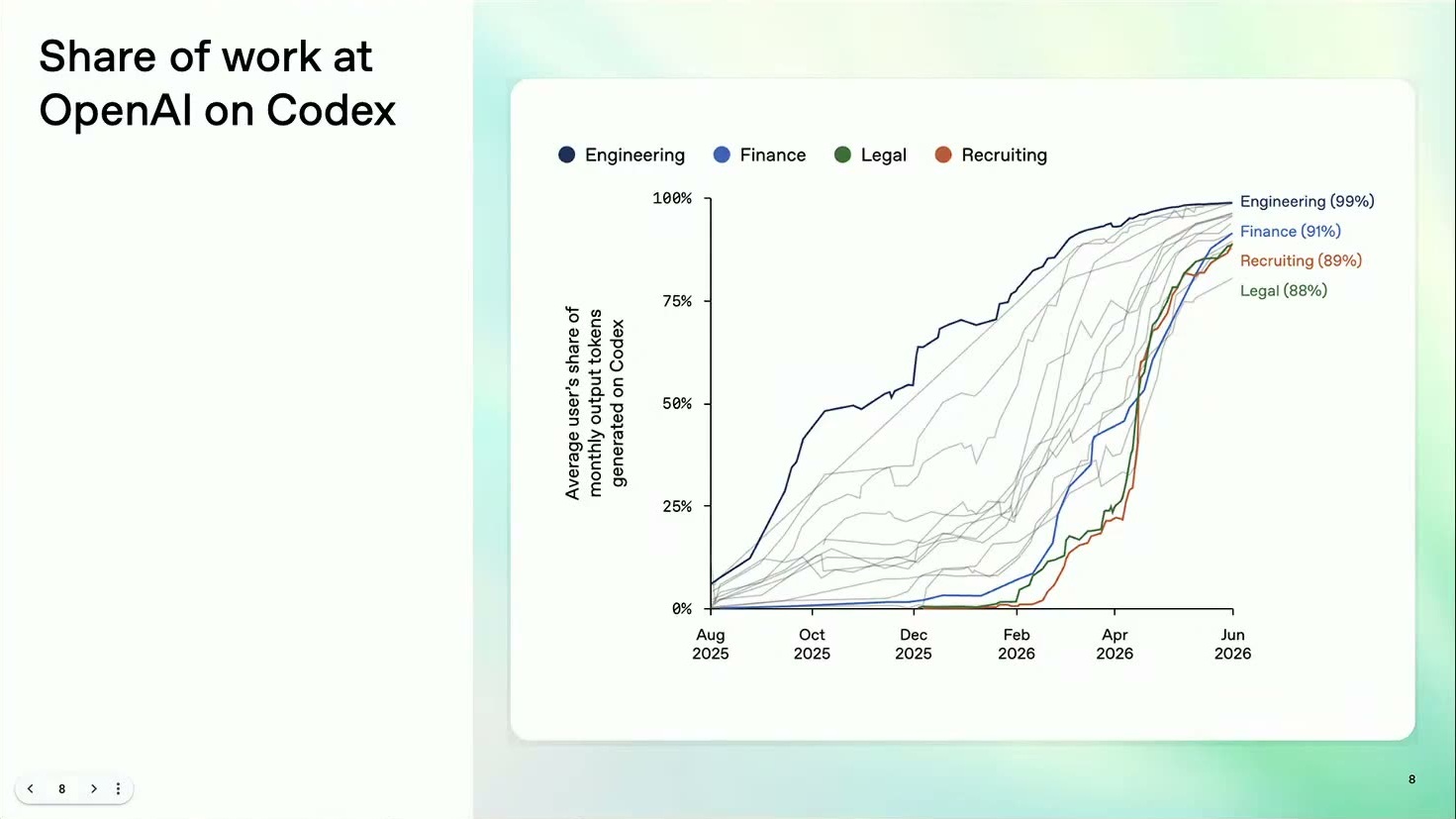
这张图展示了 OpenAI 不同职能团队中 Codex 使用量的增长。如你所见,工程师很早就开始使用 Codex,其占比持续稳步增长。但再看看财务、法务和招聘团队。2026 年初,他们几乎没有任何 AI 输出是在 Codex 中生成的。到了 6 月,这一比例已达到约 90%。仔细观察就会发现,今年 2 月到 3 月左右出现了一个巨大的转折点。我回头查了那段时间发生了什么,本以为我们一定发布了新模型,但结果发现,我们是在 2 月推出了 Codex 桌面应用。我的体会是,产品让工程领域以外的人更容易运用这些能力。
This is a chart that shows how codex usage grew within OpenAI across different job functions. As you can see, engineers started using codex early and that share grew steadily. But look at finance, legal, and recruiting. At the beginning of 2026, almost none of their AI output was generated in Codex. By June, that share was around 90%. If you look carefully, you'll notice a huge inflection point that happened around February, March of this year. I went back to see what happened around this time, assuming that we must have released a new model, but instead I found that we had released the Codex desktop app in February. My takeaway is that the product made it easier for people outside of engineering to put these capabilities to work.
这正是我们在金融领域追求的机会:构建一种体验,帮助金融专业人士更充分地利用已经可用的智能。现在我来谈谈我们如何构建它。
That's the opportunity we're pursuing in finance, building an experience that helps financial professionals get much more value from the intelligence already available to them. Now let me talk about how we built it.
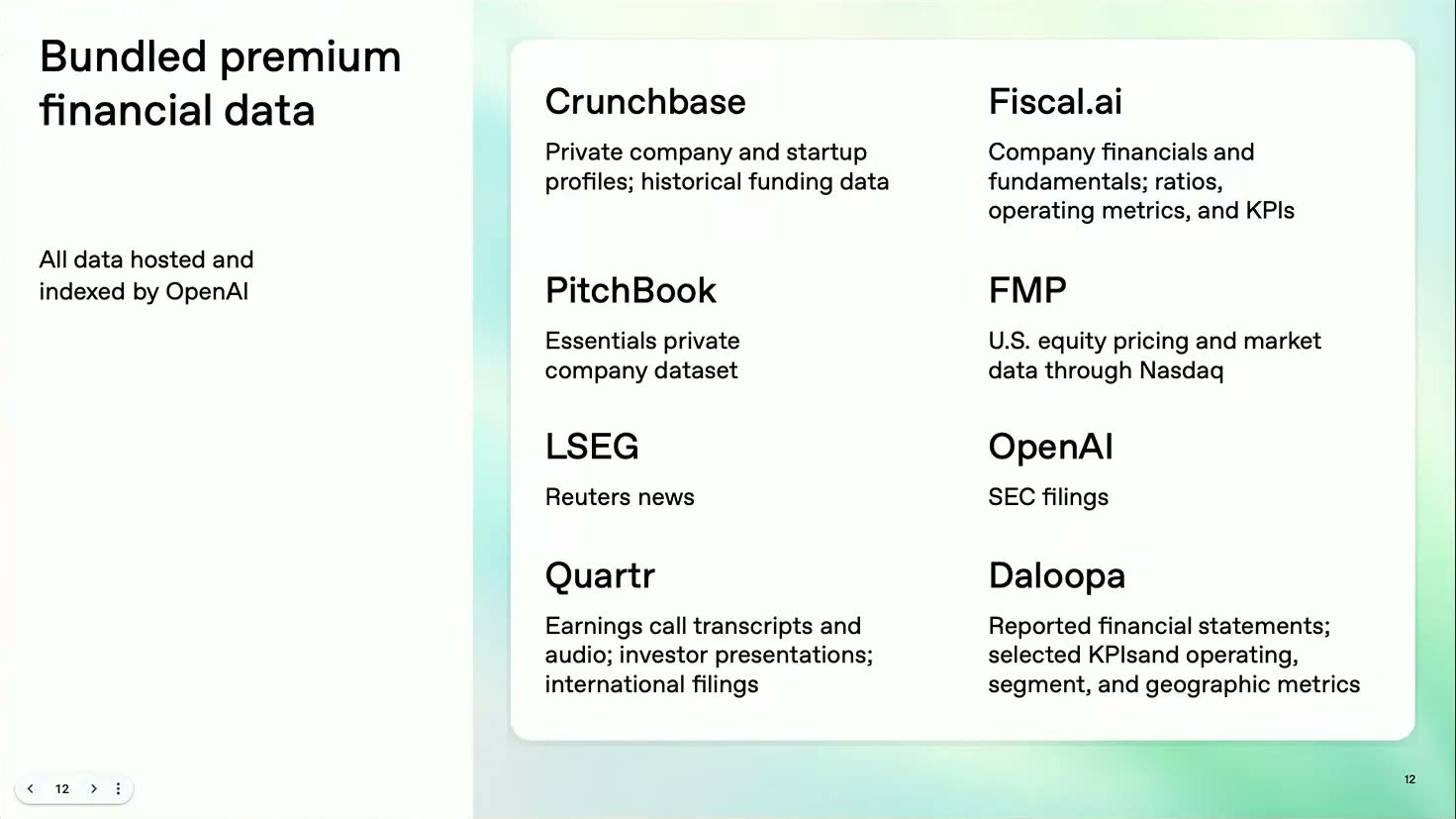
先从数据开始。在金融领域,你能完成的工作受限于你所能访问的信息质量。所以我们希望产品内置专业人士依赖的数据源,从财务报表、财报电话会文字稿,到市场数据和私营公司数据。我们研究了现有的金融数据 MCP 连接器,发现许多连接器在延迟、错误率或搜索质量方面存在问题。因此,我们直接授权使用了大量此类数据,并构建自己的托管和搜索索引,使用的基础设施与我们的网页索引相同。我们仍然使用 MCP 协议让模型访问数据,但自行托管和建立索引,让我们能够更好地控制体验质量和可靠性。
Let's start with data. In finance, the work you can do is limited by the quality of the information you have access to. So we wanted the product to come with the sources professionals rely on, from financial statements and earning transcripts to market and private company data. We looked at existing MCP connectors for financial data and found that many had issues with latency, errors, or search quality. So we went and licensed a lot of this data directly and built our own hosting and search indices using the same infrastructure as our web index. We still use the MCP protocol to give the model access to the data, but hosting and indexing it ourselves gives us more control over the quality and the reliability of the experience.
这也让我们能够灵活地对模型进行后训练,让它们更好地处理这些数据集。我喜欢这样类比:MCP 和技能就像给初级分析师一本操作手册,而后训练则像让模型成为一位资深分析师,这位分析师已经处理这些数据二十多年,对其中的特殊之处了如指掌。MCP 和技能为模型提供了指令。后训练则能帮助模型更熟悉数据本身。
It also gives us the flexibility to post-train our models to work with these data sets. The analogy I like to use is MCP and skills are like handing an instruction manual to a junior analyst versus post-training where the model is like having a senior analyst who's been working with the data for over two decades and knows all of its quirks like the back of their hand. MCP and skills give the model access to instructions. Post-training can help it develop more familiarity with the data itself.
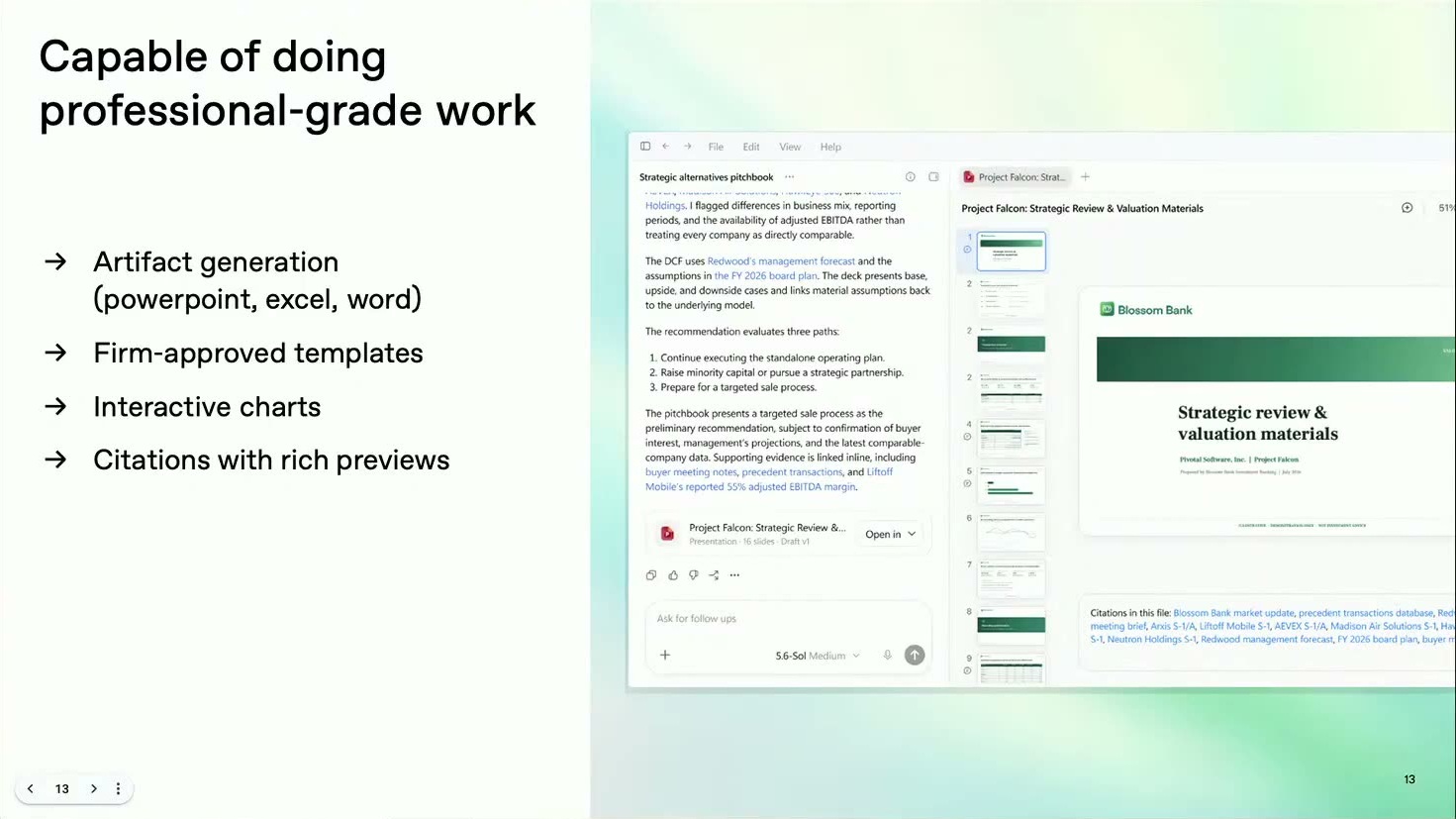
数据基础就绪后,下一步是让人们轻松地把这些信息转化为专业水准的成果。金融专业人士的工作成果通常是 Excel 模型或 PowerPoint演示文稿,也可能是需要审核并与他人分享的书面分析。所以我们着重帮助模型以符合公司现有工作流程的方式生成这些成果。我们构建了模板系统,让用户在生成电子表格和演示文稿时可以使用公司批准的模板。我们的目标是减少人们为团队或客户准备好输出内容所需的工作。我们还增加了交互式金融图表等功能,让用户可以查看股价,并在分析过程中直接在 ChatGPT 中探索金融指标。
Once we had that data foundation in place, the next step was making it easy to turn that information to professional-grade work. For financial professionals, that work often takes the form of an Excel model, a PowerPoint presentation, or a written analysis that needs to be reviewed and shared with other people. So we focused on helping the model produce those outputs in a way that fits the firm's existing workflows. We built a template system that gives users access to the firm's approved templates when generating spreadsheets and presentations. The goal is to reduce the work someone has to do to get an output ready for their team or clients. We also added things like interactive financial charts so users can explore stock prices and financial metrics directly within ChatGPT as they work through an analysis.
我们还构建了引用查看器,让人们能够检查答案背后的来源段落和表格,了解答案的依据。在金融领域,你需要能够核实某个数字的来源,并理解它的背景信息。我们希望审核能自然地融入使用体验。这些产品细节有助于把模型能力转化为人们可以实际使用的成果。
And we built citation viewers that let people inspect the source passages and tables behind an answer. In finance, you need to be able to check where a number came from and understand the context around it. We wanted that review to be a natural part of the experience. These are the kind of product details that help turn a model's capabilities into work that someone can use.
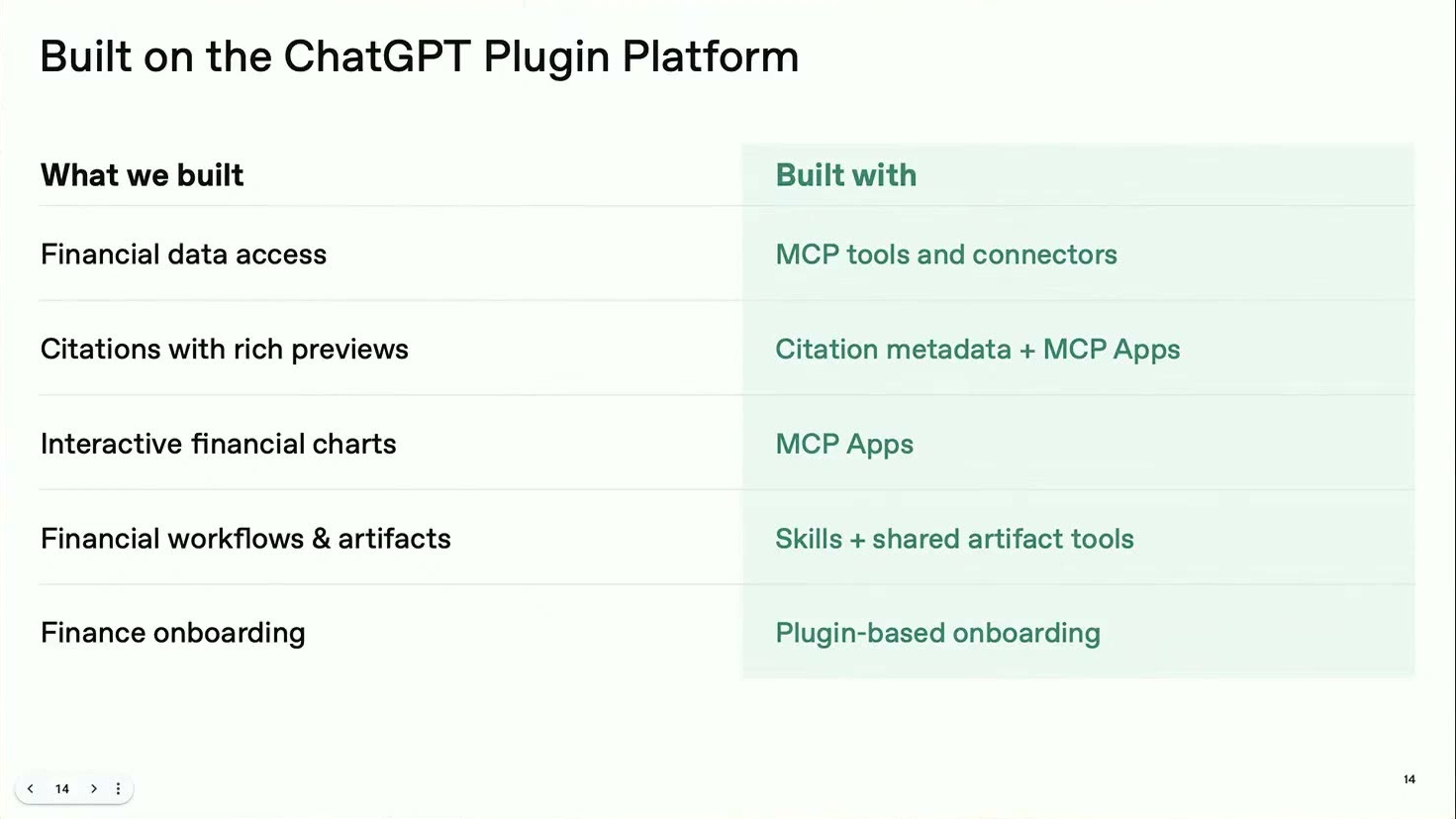
我认为,和在座各位最相关的部分是我们如何构建它。你们刚才看到的大部分功能,都是使用开发者也能使用的同一 ChatGPT 插件平台构建的。这个平台也向你们开发者开放。对于金融数据,我们使用 MCP 工具和连接器,让模型能够访问所需信息。我们在 MCP 应用中使用引用元数据,让用户查看来源;MCP 应用也为交互式金融图表提供支持。我们把技能与共享成果工具结合起来,引导金融工作流程,并生成 Excel 模型和 PowerPoint 演示文稿。在金融服务的入门引导方面,我们使用原生插件入门体验。对开发者来说,这意味着你们可以专注于让产品有价值的专业能力。
The part I think that is most relevant for people in the room is how we built it. Much of the functionality you just saw was built using the same ChatGPT plugin platform that's available to you as developers. For financial data, we used MCP tools and connectors to give the model access to the information it needs. We use citation metadata in MCP apps to let users inspect their sources, and MCP apps also power interactive financial charts. We use skills together with shared artifact tools to guide financial workflows and produce Excel models and PowerPoint presentations. And for financial onboarding, we leverage the native plugin onboarding experience. What that means for builders is that you can focus on the expertise that makes your product valuable.
如果你有独特数据、现成工具,或对某个工作流程有深入理解,就可以利用这些构建模块把它接入 ChatGPT,并围绕它打造体验。金融服务只是一个例子,但我认为这个机会远不止于金融。我个人相信,仅靠 ChatGPT 插件就会诞生多家价值 10 亿美元的企业。随着模型能力增强,这个机会也会继续演变。最后,我想用剩下的时间谈谈接下来会发生什么,以及这对我们今天应该构建的产品意味着什么。我想先谈谈模型能力和对未来的预期。
If you have unique data, an existing tool, or a deep understanding of a particular workflow, you can use these building blocks to bring that into ChatGPT and create an experience around it. Financial services is just one example, but I do think this opportunity expands far beyond finance. I personally believe that we're going to see multiple $1 billion businesses built simply as ChatGPT plugins. And that opportunity will keep evolving as the models become more capable. Last but not least, I'd like to spend the rest of the talk on what comes next and what that means for the products we should be building today. I'd like to start by talking about model capabilities and expectations for the future.
模型进步如此之快,我们很难凭直觉判断接下来会发生什么。建立这种直觉的一个好方法,是回顾过去。过去几年里有件很了不起的事:进步的某些部分竟然相当可预测。模型进步主要来自三个大方向,有时彼此重叠:扩大计算规模、改进算法,以及我们所说的“解除束缚”,也就是设法让模型完成更多有用的工作。稍后我会再讲解除束缚。在 2002 年和 2003 年,最明显的驱动力是预训练,也就是扩大计算规模,通过增大模型并增加数据量来实现。
Models are improving so quickly that it can be difficult to get an intuitive sense of what comes next. One useful way to build that intuition is to look backwards. Something remarkable about the last couple of years is how predictable parts of that progress have been. Model improvements have come from three broad, sometimes overlapping drivers. Scaling compute, improving algorithms, and something we call unhobbling, which is about finding ways to get more useful work out of the models. We'll come back to unhobbling on a later slide. In 2002 and 2003, the most visible driver was pre-training, which meant scaling compute by making the models bigger and adding more data.
借助缩放定律,研究人员能够高精度地预测模型表现。例如,在 GPT-4 完成训练之前,OpenAI 的研究人员就能预测它最终的损失值,以及它在代码评测中的表现。算法方面的改进也出乎意料地稳定。一项研究发现,从头训练语言模型达到某一性能水平所需的计算量,大约每8 个月就会减半。虽然无法预测每项突破何时发生,但总体的累积改进速度呈现出相当稳定的趋势。2024 年和 2025 年,推理成为另一个主要进步驱动力。我们使用强化学习和后训练,教模型更有效地解决问题,也让它们在回答时使用更多计算资源来思考。这为提升性能开辟了另一条途径,与预训练相辅相成。
By leveraging scaling laws, researchers were able to predict model performance with high accuracy. For example, before GPT-4 finished training, OpenAI researchers were able to predict its final loss as well as its performance on a coding eval. Improvements on the algorithm side have also been surprisingly steady. One study found that the compute needed to reach a given level of language model performance from scratch fell by roughly half every eight months. Although you can't predict the timing of each individual breakthrough, the cumulative rate of improvement follows a surprisingly steady trend. In 2024 and 2025, reasoning became another major driver of progress. We used reinforcement learning and post-training to teach models to work through problems more effectively, and we gave them more compute to think when answering. That opened up another way to improve performance alongside pre-training.
不过,可能有些人不知道,OpenAI 在预训练方面遇到过一些问题,因此很难扩大模型规模。到了 2026 年,我们已经解决了许多此类问题,并成功训练出更大、能力更强的模型,正如你们从 GPD-56 Sol 和 GPD-6 Astro 中看到的那样。这些年来,研究人员一直担心进一步扩展模型可能会遇到障碍。例如,2024 年许多研究人员担心会遇到数据瓶颈,也就是可供训练使用的人工生成文本会耗尽。但合成数据生成等技术,从可验证奖励中学习,以及算法改进,让模型从每个 token 中学到更多,基本上已经解决了这个问题。
However, for folks that don't know, at OpenAI, we ran into problems with pre-training and and therefore had difficulty scaling the model. In 2026, we've been able to solve many of these issues, and we've successfully trained larger and more capable models, as you've seen through GPD-56 Sol and GPD-6 Astro. Throughout these years, researchers have raised concerns about potential barriers to further scaling. For example, in 2024, many researchers were concerned about a potential data wall where we would run out of human-generated text to train on. But techniques like synthetic data generation, learning from verifiable rewards, as well as algorithmic improvements to learn more from each individual token have essentially solved this problem.
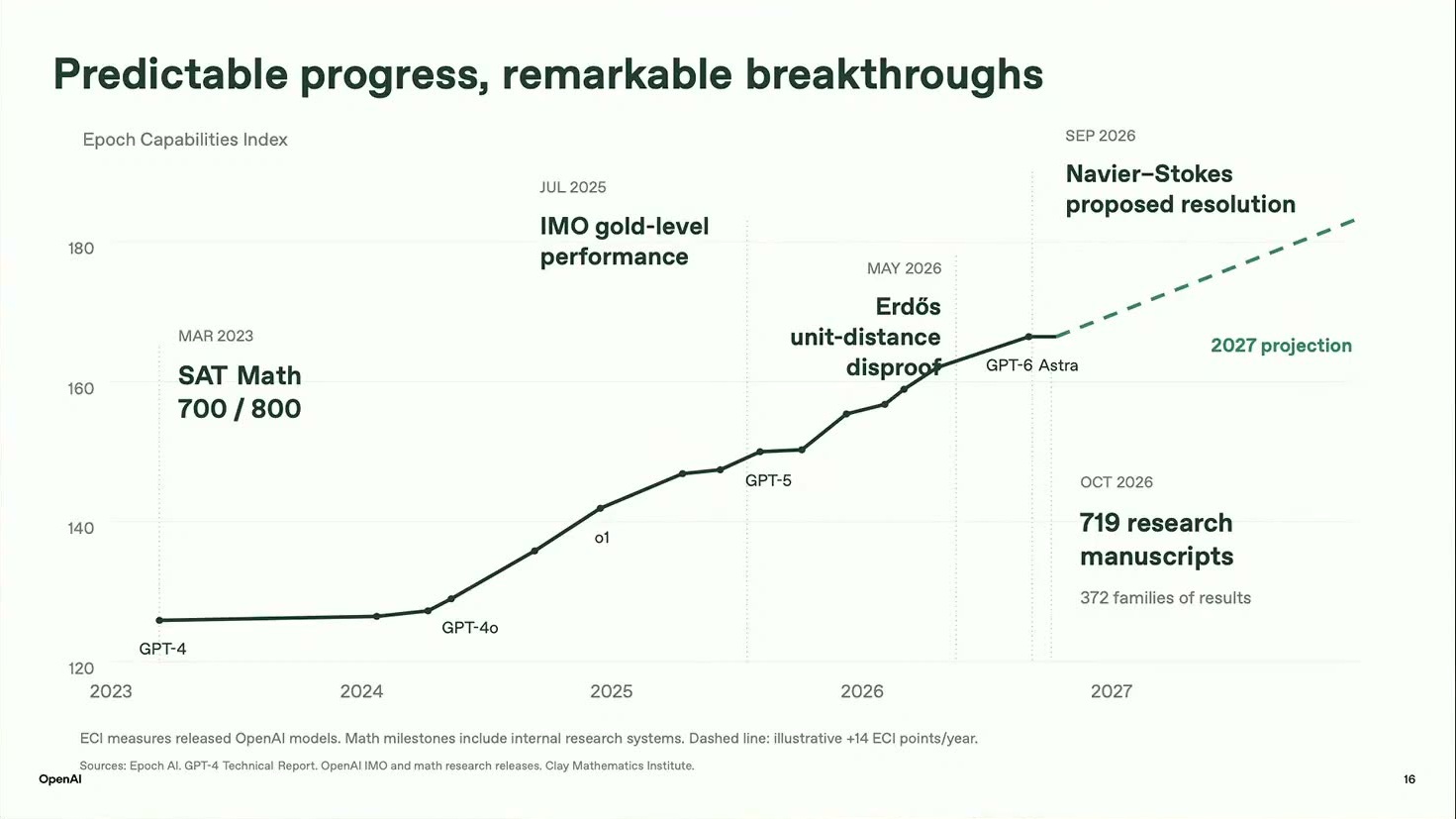
我们也解决了其他方面的担忧,例如上下文窗口长度,通过稀疏注意力和压缩等技术来处理。展望 2027 年,我非常相信,过去的趋势线会延续下去,我们会训练出更大、更高效、能力也更强的模型。显然,我们仍有非常困难的问题需要解决,特别是在对齐和安全方面,但我相信,就像过去一样,人类的创造力,在能力强大的模型日益增多的辅助下,也将帮助我们在这些问题上取得进展。那么,到 2027 年底模型会有多强?我们以数学为例。2023 年,GPT-4 在 SAT 高中数学考试中得了 800 分中的 700 分。到了 2005 年,一个 OpenAI 模型获得了金牌水平,通过了国际数学奥林匹克竞赛。
We've also solved concerns around things like context window length using things like sparse detention and compaction. Looking ahead to 2027, I strongly believe that the trend lines of the past will continue and that we'll train larger, more efficient, and more capable models. We clearly still have very difficult problems to solve, especially around things like alignment and safety, but like we have in the past, I believe that human ingenuity, increasingly assisted by capable models, will help us make progress on those problems too. So how good will models be at the end of 2027? Let's use math as an example. In 2023, GPT-4 scored 700 out of 800 on SAT high school math. By 2005, an opening eye model reached gold medal status on the International Mathematical Olympiad.
2026 年初,一个内部模型推翻了一个由来已久的猜想;该问题自 1946 年以来一直有数学家在研究。最近,一个内部模型提出了纳维-斯托克斯千禧年大奖难题的解法,我们还分享了 719 篇数学研究手稿,涵盖 372 组结果。短短几年间,我们从高中数学考试取得优异成绩,发展到 AI 系统在数学前沿领域产出原创研究。如果未来一年进展大致延续过去几年所呈现的速度,我预计到 2027 年底,模型将在越来越多的困难任务上超过顶尖人类专家,涵盖不同领域和专业方向。
And in early 2026, an internal model disproved a long-standing conjecture related to a problem that mathematicians have been working on since 1946. More recently, an internal model proposed a solution to the Navier-Stokes Millennium Prize puzzle problem, and we also shared 719 mathematical research manuscripts across 372 families of results. In just a few years, we've gone from a strong score on a high school math exam to AI systems producing original research at the frontier of mathematics. If we see another year of progress roughly in line with what we've been seeing over the past couple years, I expect that by end of 2027, models will outperform even leading human experts on a growing range of difficult tasks across different fields and specialties.
数学让我们得以提前一窥这种能力可能是什么样。
Mathematics gives us an early glimpse of what that could look like.
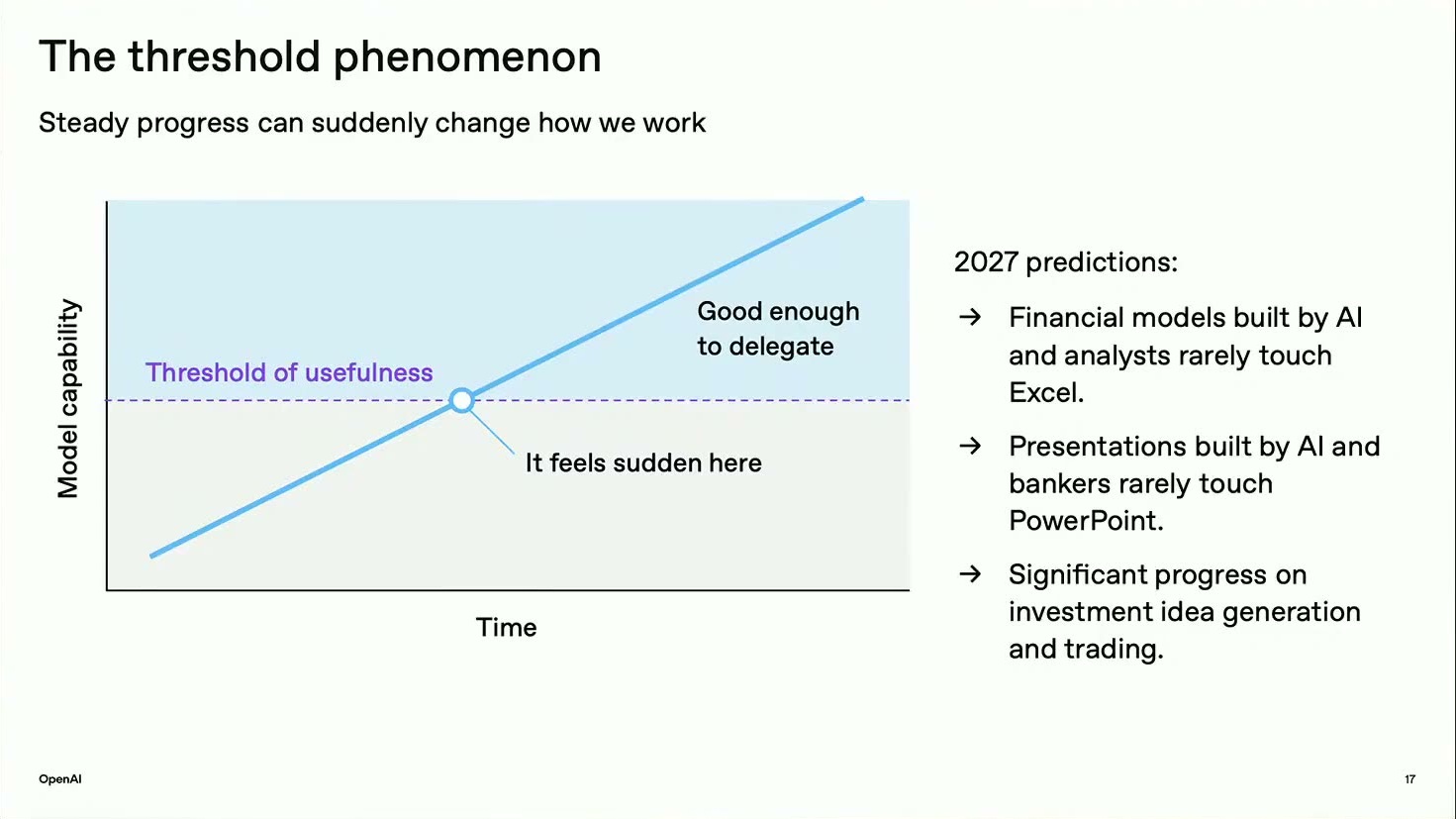
能力曲线看起来或许是渐进的,但工作方式的变化可能会让人觉得突然。我把这称为“阈值现象”。对于任何一项任务,都存在一个有用性阈值,也就是模型变得足够有能力、足够可靠,能够为你节省时间的那个点。这个阈值取决于你从事的工作,以及需要多少检查或人工审核。才能完成任务。低于这个阈值时,进步可能不容易察觉。模型可能会给出更好的答案、犯更少的错误,或者能把任务推进得更远。但如果检查和修正它的工作仍然和你自己做一样花时间,你对它的实际评价就没有改变。它依然没有实用价值。能力有了实质提升,体感上却像没怎么进步。然后模型跨过了那个阈值。
And while the capability curve may look gradual, the change in how we work can feel sudden. I call this the threshold phenomenon. For any given task, there's a threshold of usefulness, the point where a model becomes capable and reliable enough to save you time. That threshold depends on the work you're doing and how much checking or human review it requires. Below that threshold, improvements can be hard to appreciate. The model might produce better answers, make fewer mistakes, or get further through a task. But if checking and fixing its work still takes as long as doing it yourself, your practical assessment hasn't changed. It's still not useful. Meaningful improvements in capability can feel like little progress. Then the model crosses that threshold.
它突然就能产出你可以使用的东西。你审核它所花的时间远少于它替你节省的时间。你开始定期使用它,最终也会放心把那项任务委托给它。这种转变会让人觉得是一次巨大飞跃,即使底层的能力提升幅度和前几次差不多。进展真正改变的是它开始对你有用。这有助于解释为什么模型的进步有时让人觉得很突然,即使底层趋势的某些部分一直稳定且可预测。而且困难任务各自有不同的阈值,所以我们应当预期,不同工作领域的阈值会在不同时间到来。因此,在思考你正在构建的产品时,我鼓励你问问自己:今天有哪些模型能力被我低估了,只因为它们还不够实用?
Suddenly it produces something you can use. The time you spend reviewing it becomes much smaller than the time it saves you. You start using it regularly, and eventually you become comfortable delegating that task. That transition can feel like an enormous leap, even if the underlying improvement was similar to the previous few improvements. What changes of progress became useful to you. This helps explain why model progress sometimes feels sudden, even when parts of the underlying trend have been steady and predictable. And because difficult tasks have different thresholds, we should expect those moments to arrive at different times across the work that we do. So as you think about the products you're building, I'd encourage you to ask yourself, what model capabilities am I underappreciating today because they aren't quite useful yet?
这些能力一年后可能发展到什么程度?然后想想,如果这些能力跨过有用性阈值,变得足够可靠、可以委托,你会构建什么?界面会如何变化?用户还需要控制、检查或批准哪些事情?这些都是我们现在就可以着手研究的产品和设计问题。我们希望提前准备好合适的体验,这样一旦模型跨过阈值,人们就能立即利用这些能力,你们也能领先竞争对手一步。
Where might those capabilities be a year from now? Then think about what you would build if those capabilities crossed the threshold of usefulness and became reliable enough to delegate? How would the interface change? What would the users still need to control, review, or approve? Those are product and design questions we can start working on now. We want to have the right experiences ready so that when the models cross that threshold, people can take advantage of the capabilities right away, and so you can stay one step ahead of your competitors.
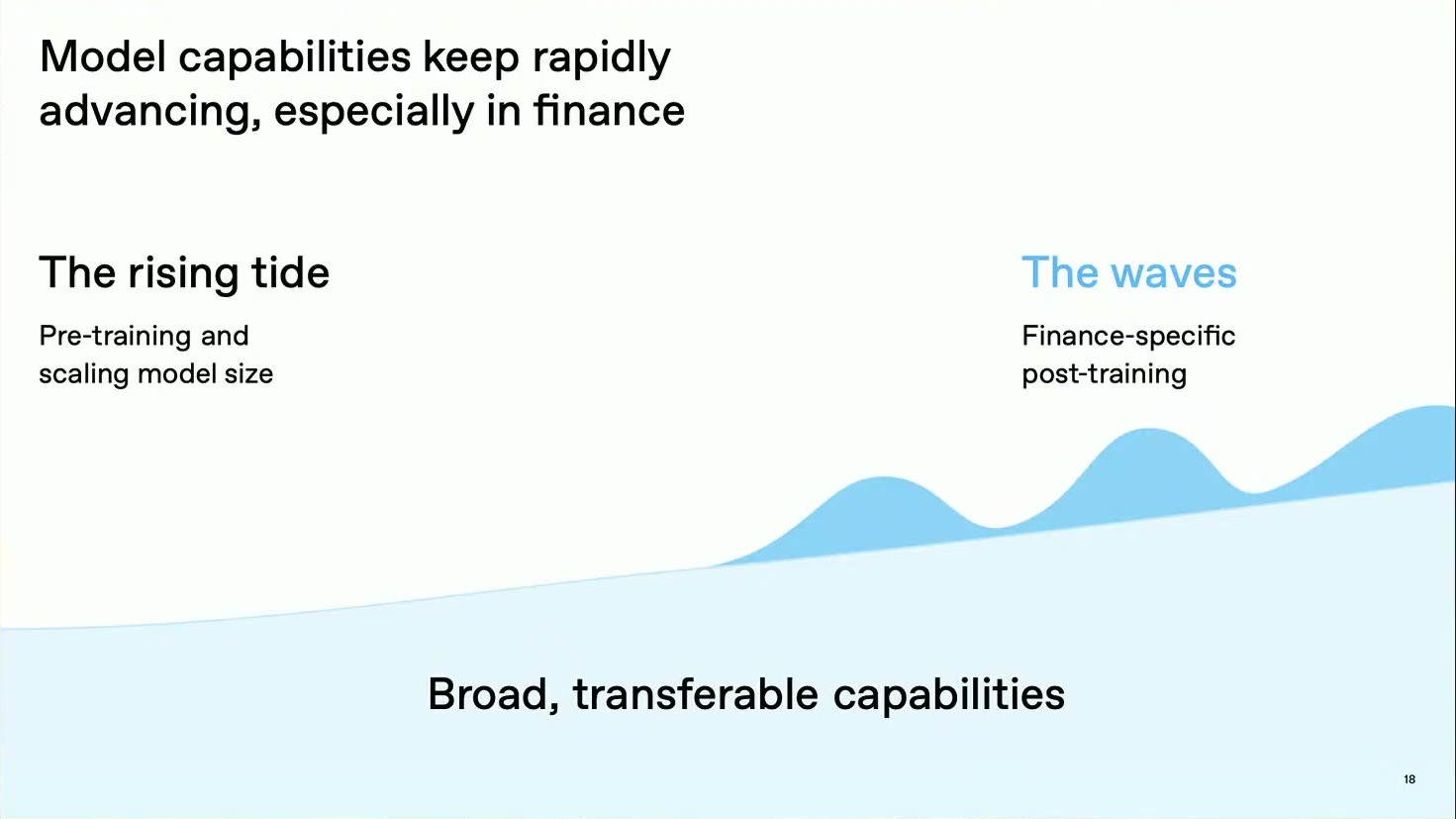
那么这对金融领域意味着什么?我认为有两股力量会推动更多金融工作跨过这个有用性阈值。我把它们称为不断上涨的潮水和其上的浪潮。不断上涨的潮水,指底层模型本身的持续改进。过去,我们并没有专门为金融领域投入大量训练时间或计算资源。如今看到的许多金融能力,来自构建更大、能力更强的模型,以及从数学、编程和推理等领域迁移而来的技能。随着这些通用能力提升,各类金融工作的表现也随之提高。而浪潮,指的是我们直接专注于金融领域后发生的变化。
So what does this mean for finance? I think there are two forces that will push more financial work across that threshold of usefulness. I think of them as the rising tide and the waves on top. The rising tide is the underlying improvements to the underlying model. Historically, we haven't dedicated a significant amount of training time or compute specifically to finance. Much of the financial capabilities you see today have come from building larger, more capable models and from transferable skills developed in areas like mathematics, coding, and reasoning. As these general capabilities improved, they lifted performance across many kinds of financial work. The Ways are what happens when we focus directly on finance.
我的团队正在牵头一项工作,大幅增加金融领域专项后训练的投入。这里的思路是在这些通用能力之上,更直接地针对人们在金融领域从事的工作训练模型。这能在持续上涨的潮水之上,让模型在特定任务上取得突出表现。未来三个月,我们会重点提升通用金融推理能力,以及模型生成成果的质量,例如分析金融信息、构建 Excel 模型,以及制作 PowerPoint 演示文稿。这些任务构成了初级分析师日常工作中的很大一部分,我们希望输出准确、结构良好,并且在实际工作流程中越来越有用。除此之外,我们还计划投入更多资源,让模型具备资深银行家、分析师和投资者面对难题时所展现的判断力。
My team is leading an effort to invest significantly more in finance-specific post-training. The idea here is to build on those broad capabilities and train the model more directly on the work people do in finance. That can create peaks in performance on particular tasks on top of the rising tide. Over the next three months, we're focused on improving general financial reasoning and the quality of the work these models produce, analyzing financial information, building Excel models, and creating PowerPoint presentations. These are the kinds of tasks that make up a significant percentage of the daily work of a junior analyst, and we want the output to be accurate, well-structured, and increasingly useful in real workflows. Beyond that, we plan to invest more in the kinds of judgment that senior bankers, analysts, and investors bring to more difficult questions.
这包括吸收大量信息、判断哪些内容重要,并尝试预测未来,例如预测公司的盈利、评估大宗商品价格走势,或判断哪些企业值得投资。我们的目标是让模型在这类金融任务上的表现达到顶尖人类专家的水平,预计会在 2027 年的某个时候实现。我们预计进展将来自两股力量共同作用:底层模型持续改进,以及我们的团队更有针对性地训练模型,适应人们在金融领域的工作。我们谈过模型能力不断增强,也谈过如何训练模型,让它们在特定任务上表现更好,
This includes taking in large amounts of information, deciding what matters, and essentially trying to predict the future, forecasting a company's earnings, assessing where commodity prices might go, or evaluating which businesses are attractive investments. Our goal is for models to match the performance of the best human experts on these types of financial tasks sometime in 2027. We expect that progress to come from both forces working together, the underlying model continuing to improve, and our team training it more directly for the work people do in finance. We've talked about how models are becoming more capable and how we can train them to perform better on specific tasks,
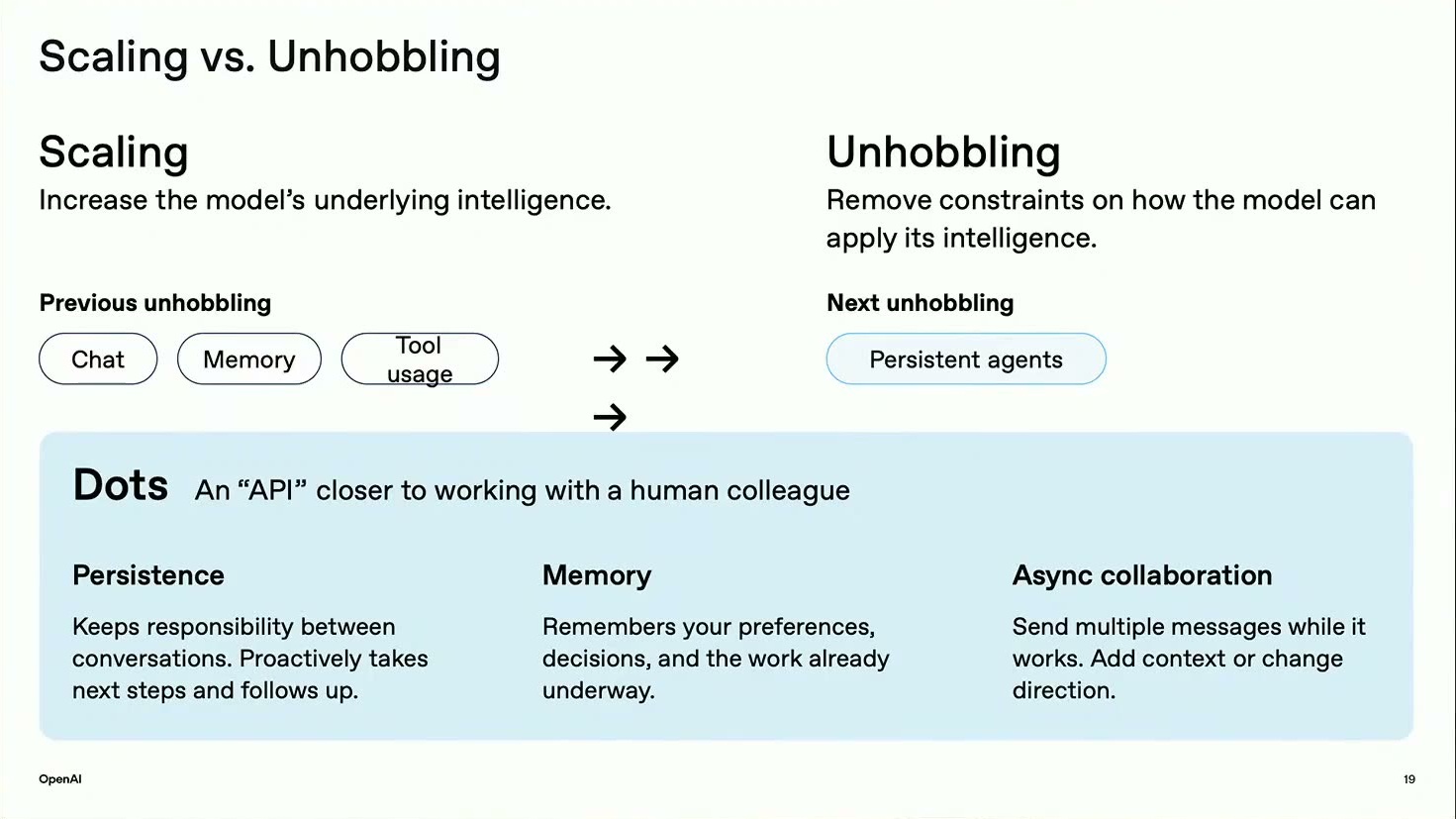
但我想回到之前提到的第三个驱动力——解除束缚。我们已经看到了一些例子。ChatGPT 使用 RLHF 教模型遵循指令并与我们对话。工具能让它们搜索信息、编写并运行代码,以及与我们使用的软件交互。这些功能都让模型在现实世界中更有用。我认为,下一种解除束缚的形式会是主动且持久运行的智能体。如今,我们与 AI 的许多互动仍然是打开对话,然后告诉它下一步做什么。持久运行的智能体可以持续追踪一个目标、记住相关上下文,并在后台继续工作。你给它指明方向后,即使没有持续提示,它也能继续取得进展。持久运行之所以重要,另一个原因是它会改变 API,也就是人们与智能体协作的方式。
but I want to come back to one third driver I mentioned earlier unhobbling. We've already seen a few examples. ChatGPT use RLHF to teach models to follow instructions and have conversations with us. Tools allow them to search for information, write and run code, and interact with the software we use. Each of these makes the model more useful in the real world. I think the next form of unhobbling will be proactive and persistent agents. Today, a lot of our interactions with AI still happen when we open a conversation and tell it what to do next. A persistent agent can hold on to a goal, remember the relevant context, and continue working in the background. Once you've given it a direction, it can make progress even when you aren't actively prompting it. The other reason persistence matters is it changes the API or the way people work with the agent.
如今,要充分利用 AI 智能体,需要学习新的工作流程、学习如何提示它,以及如何使用工具。持久运行的智能体可以用更熟悉的方式工作。你可以给它一个项目、分享上下文,并向它询问进展。这更像是人与人合作的方式,因此也让 AI 更容易被那些还没有掌握这些初始技能的人使用。
Today, getting the most out of AI agents requires learning a new workflow, learning how to prompt it, and learning how to use the tools. A persistent agent can work in a way that's more familiar. You can give it a project, share context, and ask for an update. It's much more similar to how humans work with other humans, and therefore makes the AI more accessible to people that don't develop those initial skills.
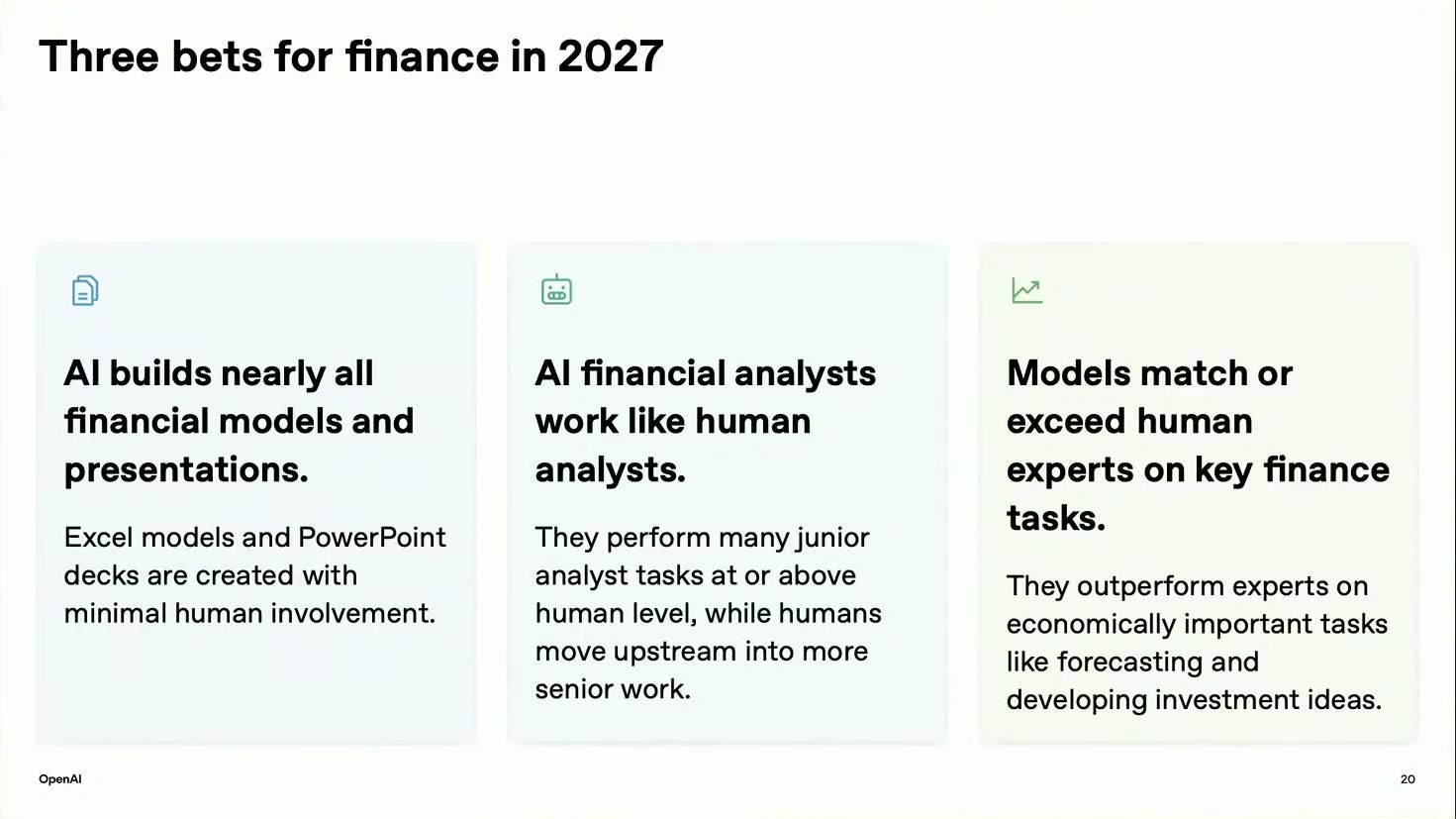
最后,我想分享对 2027 年金融领域的三个预测。这只是我对模型进步后可能出现情况的一些预期。第一,人们将很少再依赖,甚至完全不再依赖Excel 和 PowerPoint来制作金融模型或融资推介材料。第二,AI 金融分析师会开始让人感觉像真人同事。它们会记住你的偏好和上下文,包括前几天的信息,会主动承担任务,有效跟进,并在你专注于其他事情时继续工作。第三,模型会开始在重要的金融任务上超过顶尖人类专家。这包括预测盈利和提出投资思路等工作。我预计,在做出这些对经济有重要影响、面向未来的判断时,模型会比最优秀的人更出色。这就是我对 2027 年的三个预测。
Let me close with three bets for finance in 2027. These are just a couple of my expectations for what comes as the models improve. First, people will rely rarely, if ever, on Excel and PowerPoint to make financial models or pitch decks. Second, AI financial analysts will start to feel like human coworkers. They'll remember your preferences and context from the previous days, take ownership of assignments, productively follow up, and keep working when you're focused on something else. Third, models will start to outperform the best human experts on critical financial tasks. That includes things like forecasting earnings and developing investment ideas. I expect models to become better than the best people at making these economically important, forward-looking judgments. Those are my three bets for 2027.
如果我们预计 2027 年会达到这样的水平,最后留给大家一个问题:为了迎接模型明天必将跨越的阈值,你今天应该开始构建什么?谢谢。
And if this is where we expect to be in 2027, I'll leave you with one last question. What should you start building today to be ready for inevitable thresholds that the models will cross tomorrow? Thank you.