用于在时空中行动的前沿模型
Frontier Models for Acting in Space and Time
原文由官网提供,中文由 GPT-6 Luna 翻译。相邻片段合并排版,正文与时间点保持对应。
已插入 7 张经核对的幻灯片或演示截图;点击图片可放大。图注链接为当前视频时间,左侧正文时间保留原转录版本,二者可能不同。
共 30 个阅读段落
大家好。我想请大家暂时退后一步,想一想:如果今天有人告诉你,我们会获取互联网上的所有信息,用这些信息训练一个模型,然后用它解决互联网上没有答案的科学问题,我觉得很多人会说这太疯狂了。我们正在做的事情与这个故事有很多相似之处。想想智能是如何运作的。假设你现在身处电影《冰雪奇缘》,你是雪人 Olaf。
Hello. I want you to zoom out for a second and think about if somebody were to tell you today that we would take all the information on the internet and then we would train a model on it and we would use that in order to solve scientific problems that were not on the internet. I think a lot of people would tell you that that's crazy. And what we're doing has a lot of parallels to that story. So if you think about how intelligence works, imagine for a second that you're in the movie Frozen and you're Olaf, the snowman.
如果 Olaf 是一个 LLM,那么电影里有个我最喜欢的场景:他滚下山,一块小石头突然出现,Olaf 的身体散开,暂时变成一个散架的雪人,然后又重新组装起来。Olaf 知道怎么做,是因为他在行动时可以观察周围。Olaf 可以做到这一点,而LLM 会自回归地预测 token;两者不同的是,Olaf 的行为始终包含一部分实时观察。这就是 LLM 尝试解决机器人问题时,与我们正在研究的原生架构之间的重大区别。看 Twitter 上的演示时,很容易觉得 LLM 会解决一切,但它们有根本性的局限,而专门设计的模型会更适合这些任务。
If Olaf was an LLM, and there's a scene which is one of my favorites, which is where he rolls down a mountain and there's a little stone that pops up and Olaf spreads out, temporarily becomes a disassembled snowman and then becomes an assembled snowman. Olaf knows how to do that because Olaf can observe as he is acting. Olaf can, unlike LLMs, which autoregressively predict tokens, constantly part of that behavior is that it's constantly observing as it is acting. And so this is the big difference between, you know, when you see LLMs try to solve robotics problems or when you look at native architectures like we're working on, it's very, very easy to think of LLMs in the demos to see on Twitter as the thing that will Solve everything, there are fundamental limitations where purpose-built models are a much better fit.
今天我想谈谈硬币的另一面是什么样的。对我们来说,一切始于 Medal。我们打造了全球最大的视频游戏录制平台,并把它看作互联网。人们用 Medal 录制自己玩数万种不同电子游戏的过程。想一想,作为人类,我们可以用同一个大脑远程操控机器人,也可以用这个大脑玩电子游戏;事实上,很多时候我们还能使用同一个控制器。
Today I'm going to talk a little bit about what the other side of that coin looks like. For us, it all started with Medal. We built the largest video game recorder in the world, and we think of that as the internet. People use Medal to record themselves playing tens of thousands of different video games, And if you think about it, as a human, we can teleoperate a robot with the exact same brain that we played at video game, and in fact, in many cases, we also can use the same controller.
这意味着,由于游戏控制器的存在,电子游戏的动作空间和远程操作或现实世界的动作空间,在很多情况下是相同的。
So what this means is that the action space of video games, often because of game controllers, and the action space of teleoperations or the real world, in many cases is the same.
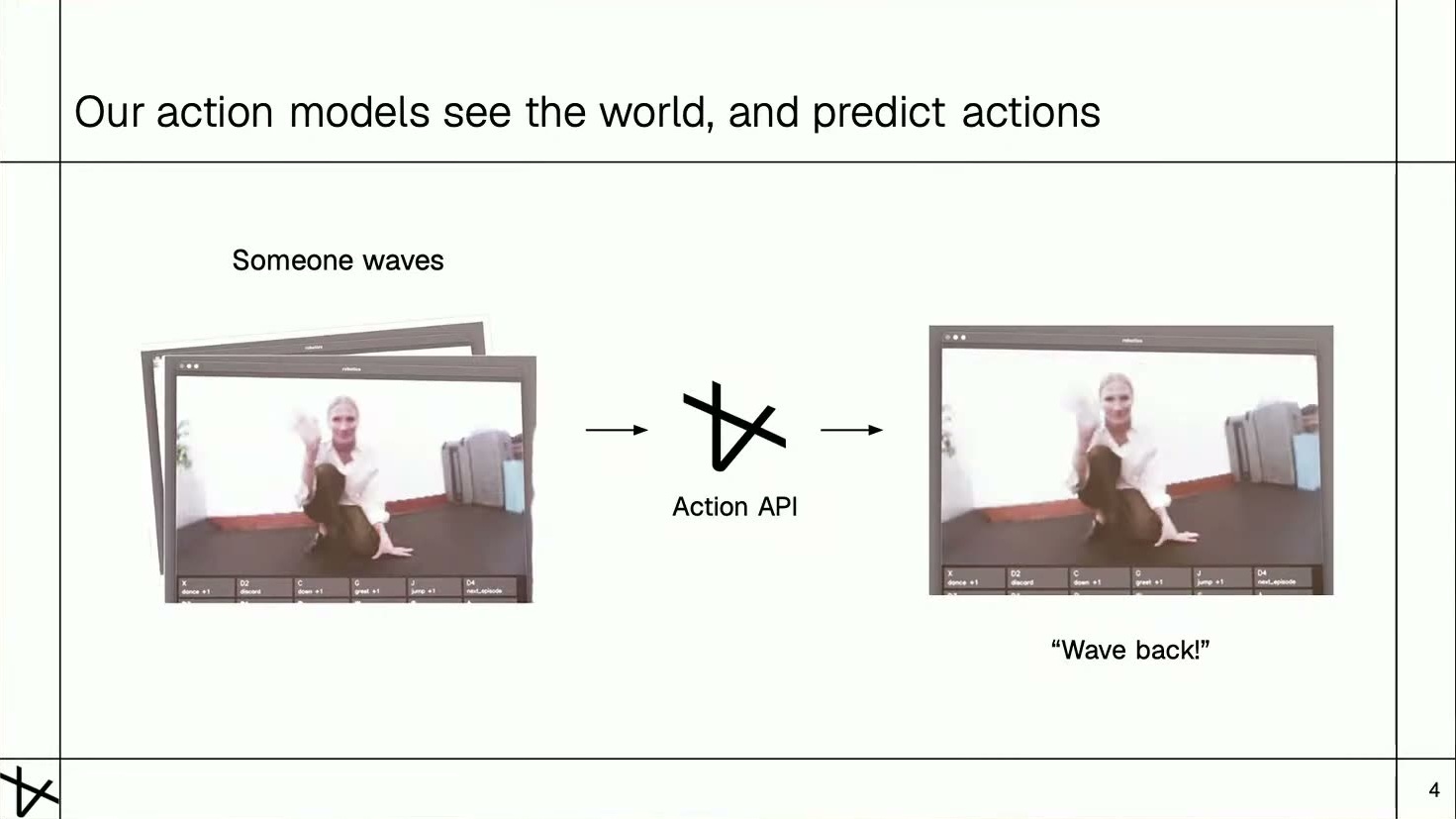
所以,低于一定自由度的机器人,出厂时都会配一个游戏控制器。大多数供应链已经是这样运作的。于是我们想,如果把视频录制器收集到的所有动作数据都拿来,录制器会把输入和动作与实际画面关联起来;我们再给动作标注,让我们理解每个动作背后的语义,并把数据提供给视觉模型。左边展示的是模型工作方式的一种直观示意。你给模型一组可供选择的按键,本质上就是一种计算机使用模型。它以画面帧作为输入,你也可以给它文本提示。
And so every single robot, below certain degrees of freedom, ships with the game controller. The majority of the supply chains already work this way. And so we thought, what if you just take all of the action data that we get through the video recorder, which associates the inputs and the actions with the actual frames, we label the actions so we understand semantic meaning behind every action, and we use it to give it to a vision-based model. What you see here on the left is just an intuitive way of how the model works. You give the model a set of keys to choose from, essentially a computer use model. It gives frames as the input, so you can give it a text prompt as well.
然后通过 API 发送请求,比如说“有人向你挥手,你也挥手回应”。在输入空间里,模型知道自己可以执行网格动作,于是会输出与之对应的动作。
And you send it through API, and you say somebody waves at you, wave back. In the input space, the model understands that you have a grid action available, it will output the action associated with that.
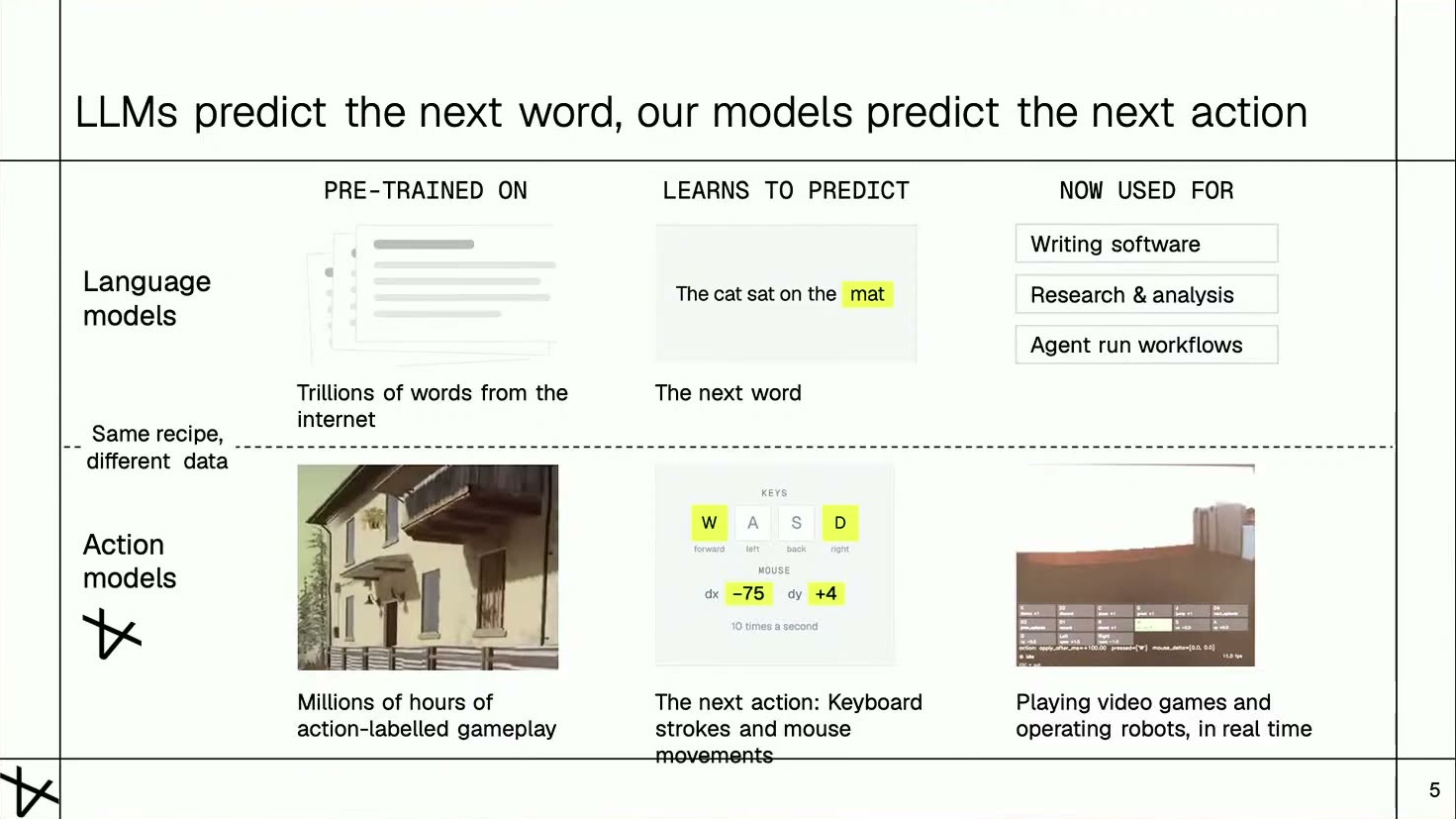
理解其工作方式的一种直观办法是——我这里显然作了简化,因为它预测的是下一个 token,而不是下一个词,不过请先听我说。LLM 使用大规模互联网数据进行训练,预测下一个文本 token,如今我们用它来编写软件。这类工作都非常适合那些不会在你预测时同时展开的未来场景。代码是轮流进行的。你说一句,模型做点什么;你再说一句,模型再做点什么。它能用于很多有价值的工作,但归根结底,因为这种交互是轮流进行的,它很难泛化到其他环境,尤其是涉及空间和时间的环境。
One way of intuitive understanding how this works, I've obviously simplified here because it's predicting the next token, not the next word, but bear with me here. LLMs took large-scale internet data, then trained it to predict the next text token, and now use it for writing software. These are all workloads that are really, really well fit for futures that are not simultaneously unfolding as you are predicting. Code is turn-based. You can say something, the model will do something, you can say something again, the model will do something again. And you can use it for lots of valuable work, but at the end of the day, because it's turn-based, it's very, very difficult for it to generalize to environments, especially that include space and time.
我们的模型会持续接收画面帧,或者接收来自机器人摄像头的信息批次,也可以接收屏幕画面。它会把一切都当成电子游戏来预测。可以想想 Anthropic 如何专注于把编程做到极致。他们从来没有把重点放在前沿的基础文本生成上,而是始终专注于成为最擅长生成代码的模型。他们的押注是,更多人会开始把更多问题带入编程领域。如果你了解 General Intuition,我们的押注是:人类通常会把像素转换成动作;此外还有感官输入,很多情况下也能转成像素。
So our models, the way that they work is they're continuously receiving frames or receiving batches of information from the camera of the robot, or it could be a screen. And it predicts everything as if it were just a video game. So you can think of the way that Anthropic focused on just nailing coding. So they were never frontier and just base text generation. They always focused on being the best at generating code. And then the bet that they made is that more people would start bringing more problems into coding space. If you think of general intuition, our bet is that you can, as humans, we are generally pixel-to-action converters, plus senses, which in many cases you can convert into pixels as well.
而且你可以同时输出动作。
And you can output actions at the same time.
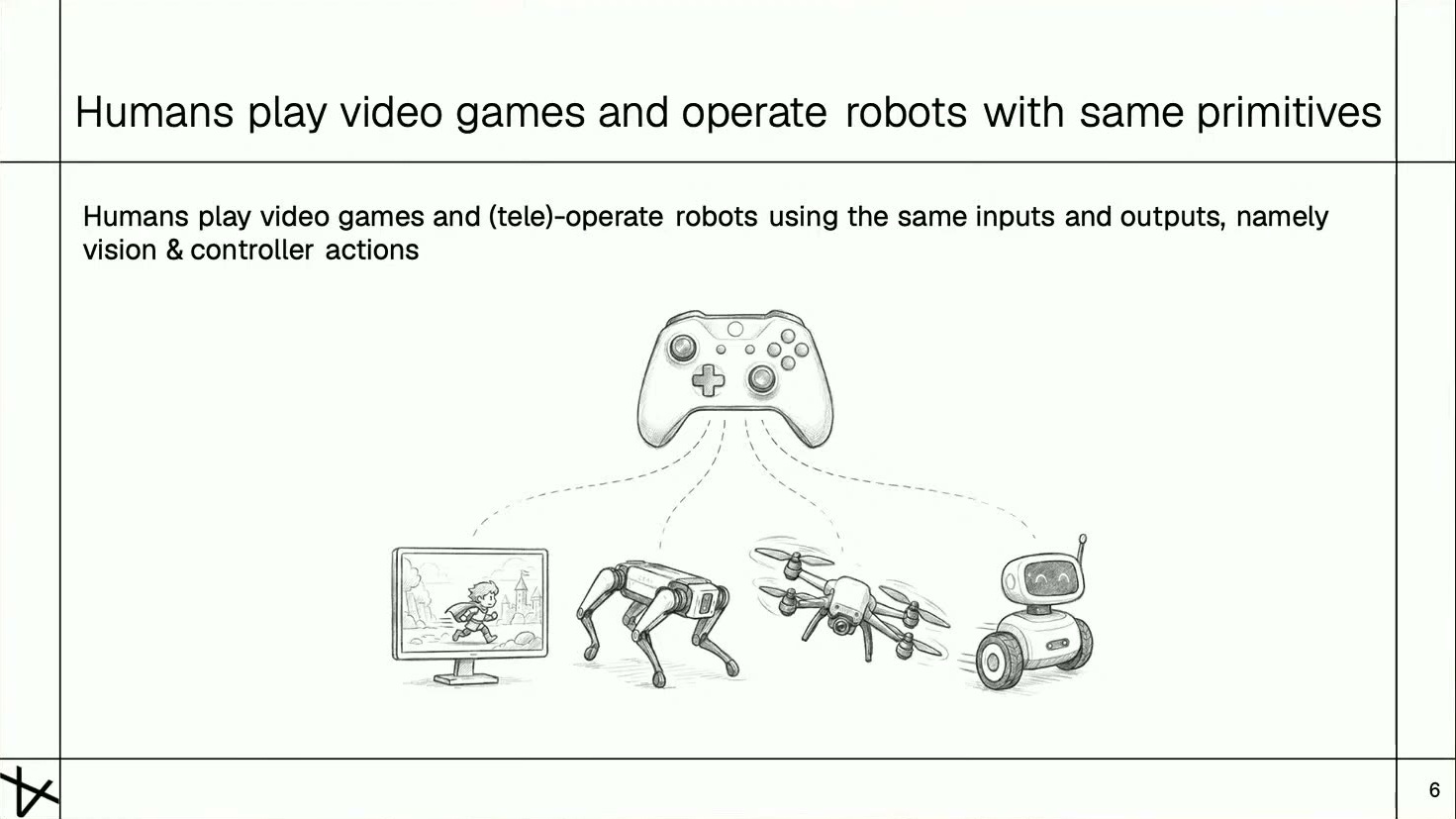
在这里,这些动作就是键盘和鼠标,或者游戏控制器。所以,模型输出的 token 本质上相当于增强版计算机使用模型的输出,只是增加了更多动作,让模型能将它们内化。因此,你发送画面帧,就会得到动作。这套方法可行,再说一次,是因为你看到的每一件事都能控制这些不同的实体。作为人类,我们不知道如何预测电机扭矩。我们不知道该向机器发送什么数值。多年来,人们打造了一种很棒的设备,能替我们完成这些工作,让我们得以操控机器。
Those actions are, in this case, either keyboard and mouse or game controller. So the output tokens of the model are essentially equivalent to that of enhanced computer use model with more actions on the output space to internalize it. So you send frames, and you get actions. This works, again, because every single thing that you see here can control all of these different embodiments. So, as humans, we do not know how to predict motor torque. We do not know what value to send to a machine. There's this beautiful device that has been made for many years, which actually does that work for us so we can control them.
如今大多数机器人公司都试图从端到端层面解决问题,试图预测精确姿态或电机的精确数值,而不是直接利用每家机器人公司都已构建的设备,让我们的能力得以泛化——毕竟我们理解物理的能力十分有限,也很难预测精确数值,然后再解决这个问题。
Most robotics companies today are trying to solve the problem at the end-to-end level, trying to predict exact poses or exact values in the motor, instead of just looking and picking up the thing that every robotics company has built to generalize our very limited abilities to have physics understanding and predict exact values, and solve for it.
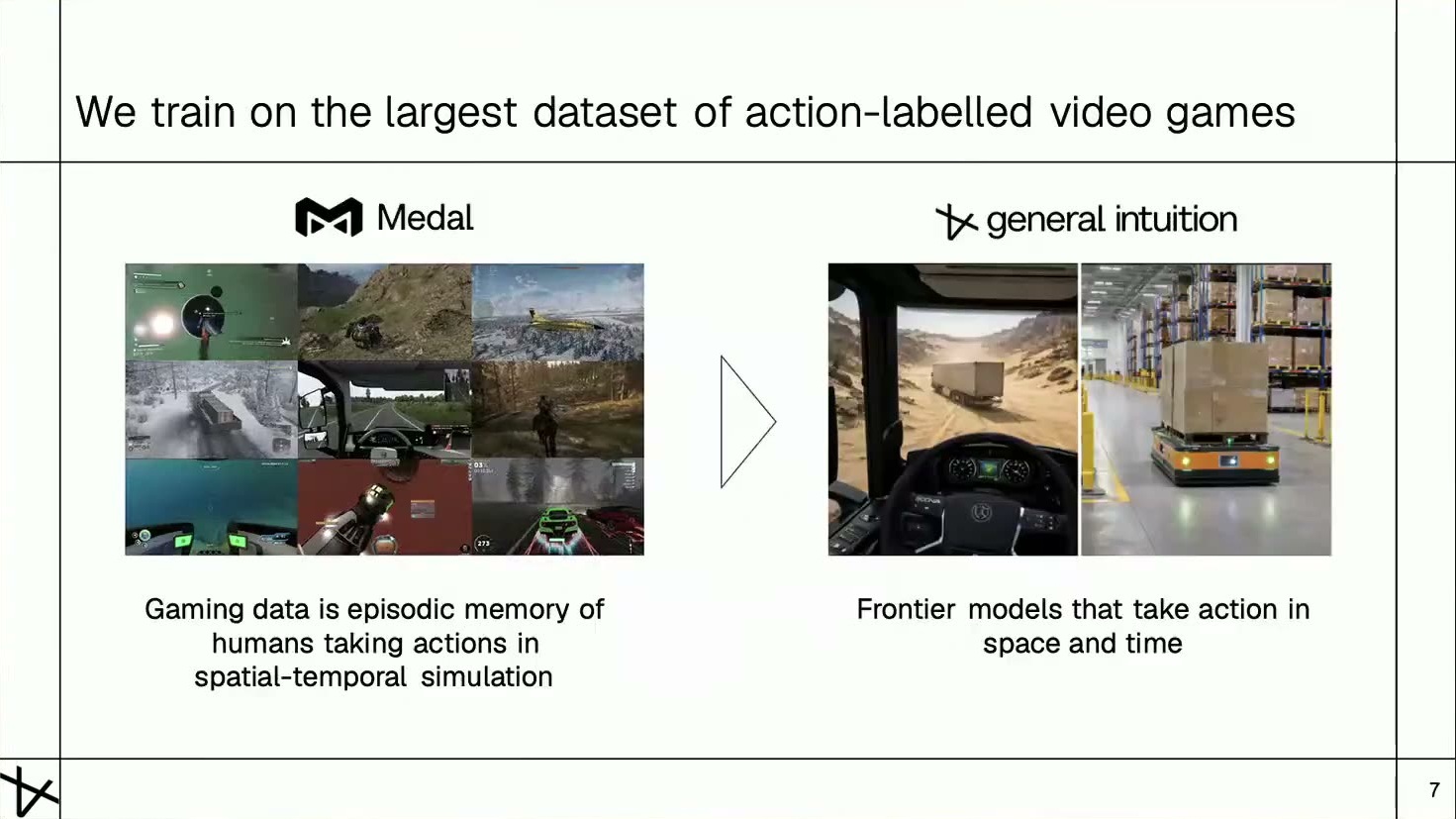
所以我们的方法是:直接用现成的设备。目前 Medal 每年会看到大约 10 亿个视频上传。今年预计会达到 30 亿,
And so our approach is, let's just use that. And so Medal, at the moment, sees about a billion videos uploaded per year. This year we're on track for three billion,
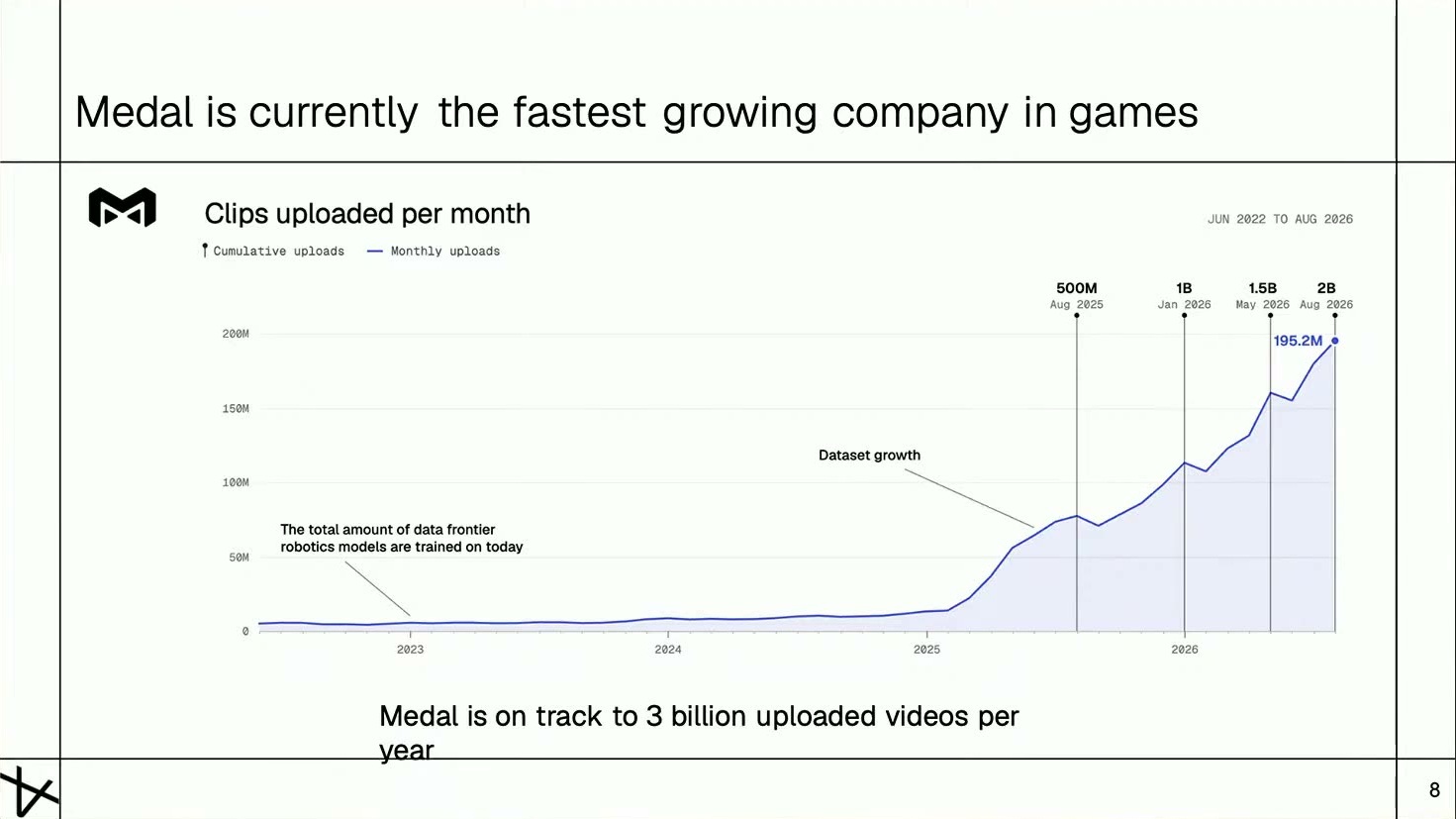
每月因此产生超过 1.5 万亿个动作 token。为了作个比较,理解这项押注,前沿实验室目前训练机器人模型所使用的数据总量,我们现在只要半天就能收集到。这就是我们的押注类型。再想想,人类能用同一套控制器和眼睛玩电子游戏,也能用它们帮助改进机器人。
which lead to over a trillion and a half action tokens per month. So just for comparison, to think about the bet, the total amount of data that Frontier Labs use today to train robotics models, we collect in, at the moment, half a day. And so the type of bet, and again, think of the fact that humans can use the exact same controllers and their eyes to play video games that they can't help upgrade robots.
本质上是一回事。我们押注扩展像素空间,就像 Anthropic 在编程领域取得突破那样;我们还押注,随着我们把数据和计算规模扩展到像素空间,人们会把更多问题带到像素空间中来解决。接下来会发生什么?突然间,你会得到一个极其通用的智能体,能够在现实世界中通过计算机解决问题。此外,就像 Anthropic 专注于构建编程环境一样,我们专注于世界模型;你们大多数人应该知道 Mirai 发布的世界模型,用来生成额外环境,供这些模型学习。
It is the same thing. We just bet on scaling pixel space the same way that anthropics killed coding space, and betting that people will just, as we scale data compute into pixel space, that people will bring more problems into pixel space. And so what happens? of a sudden you get an incredibly general agent that can go and solve problems on computers in the real world. in addition, similarly to how Anthropic focuses on doing coding environments, we focus on world models, which most of you know is for, the Mirai release world models, to then generate additional environments for these models to learn in.
要理解这种方法相对于 LLM 的一大优势,可以想想:如果你是一家LLM 公司,你得押注为模型生成学习环境的能力,那你会遇到两个问题。第一,你确实要花算力模拟环境;你试图模拟得越逼真,成本就越高。假设你想学会一项新技能,你想在与人类完全相同的输入空间里学习。如果我们从像素中学习,我们就是通过观察周围来学习。如果我想表达一件事,我希望机器人搭档观察到完全相同的内容。
One way of internalizing a big advantage of this approach against LLMs is if you're an LLM company and you have to bet on the ability to generate environments for your models to learn, you have two problems. One, you actually need to spend the compute to simulate environments, and the more realistic you try to simulate, the more expensive that gets. and so imagine you want to learn a new thing you want to learn that new thing in the exact input space of the human so if we are learning from pixels we're learning by looking around if I'm trying to communicate something I want my robot partner to observe that exact same thing
所以我不希望这件事还得经过一个语言模型,还得创建数字孪生,还得部署模型,还得做一堆验证检查,去判断两者是否等效,然后机器人过很久才学会。所以可以这样理解:如果你能在人类的原生模态中学习,突然间就能解决更多问题,而且速度快得多。这些模型发布后,它们明显比任何 LLM 都更快在做这些事情时。因为游戏的动作密度非常高。
and so what I don't want is for that to have to go through an LM for a digital twin to have to be created for the model to have to get deployed for it to be a bunch of verifier checks whether or not things are equivalent and then for the robot to learn much later. And so one way of thinking about it is when you can learn in the native modality of the human, you can all of a sudden start solving a lot more problems a lot faster. What you'll see when these models come out is they're significantly faster than any LLM at doing these things. Because games are so action-dense,
你看到的一个有趣之处是,模型能同时预测多个动作。我们能把玩家的这种动作密度转化成非常复杂的机器人工作负载。例如,如果你在操控无人机,需要作出很多细微调整,那你真的应该从游戏开始。你不想从远程操作开始,因为人类采取的动作会少得多。其中包含的信息也少得多。你需要能预测极高 APM 的模型。所以数据集中的 APM 让很多问题突然变得触手可及,让模型能够同时执行很多动作。
So what you see, right, is one thing that's interesting is you saw, for instance, the model predicting multiple actions at the same time. We're able to take that action density from gamers and convert them into really complex robotics workloads. So, for example, if you are operating a drone and you need to make lots of little adjustments, you really, really, really want to start with games. You don't want to start with teleoperations because the human will just take a lot less actions. It has a lot less information. You want a model that can predict really high APM. And so the APM of the data set puts a lot of these problems all of a sudden in reach so that it can do a lot of these actions simultaneously.
正如我提过的,模型理解的不只是它要预测哪个按键。它还理解这个按键相关的语义含义,这对可解释性等方面非常重要。我们会在今年发布这些模型。我们非常高兴。我想更准确地说,我们感到震惊,因为这些模型居然能做到这么多事情。这真的……这真是……这是直播,所以很遗憾我没法分享模型发布演示视频,否则就会破坏惊喜。不过,如果你在纽约,我们也在纽约,已经开始做一些模型演示。
And as I mentioned, the model doesn't just understand the key it's predicting. It also understands the semantic meaning associated with that key it's predicting, which is really important for things like interpretability. So we will be releasing the models this year. we are very happy I think the correct word would be that we're stunned by the fact of what these models can do it is this is a live stream so I unfortunately couldn't share the release videos without breaking the surprise but if you're in New York we are also in New York we have started doing a few demos
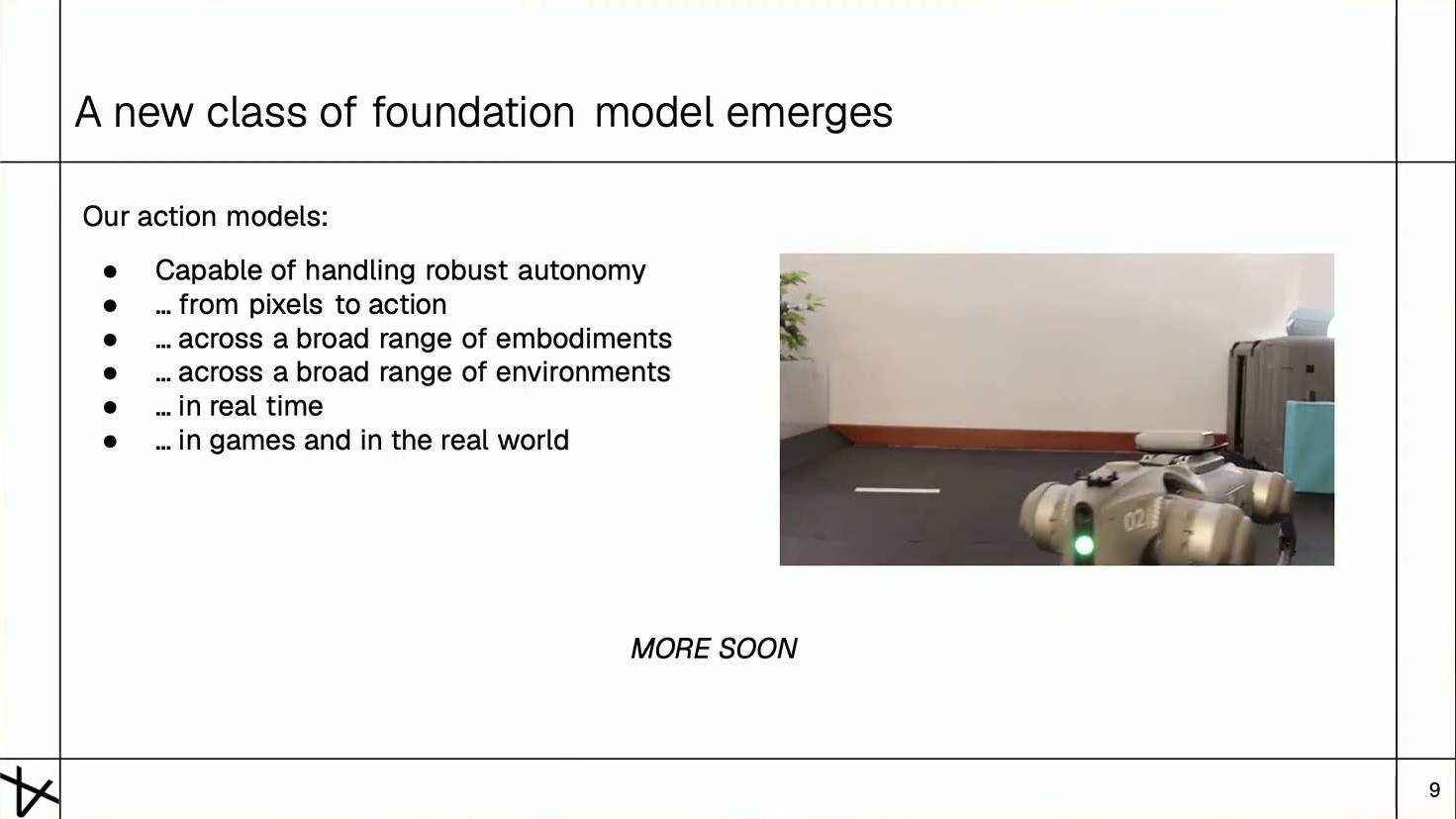
如果你能联系到团队里的人,可以找我们,我们可以开始现场向你展示一些能力。不过,基本上我们有一个模型,能以最高水平玩电子游戏,还能用完全相同的原语控制 10 多种机器人。所以就是像素输入、动作输出,完全实时。接下来几个月,我们会推出这些模型的早期访问版本。已经有一些客户在使用,但目前仍是私下测试,所以你们还没怎么听说。扫描这个二维码就能申请使用模型,我们会根据等候名单上的报名时间来安排顺序。
of the model so if you can know somebody on the team reach out and we can start It's showing you some of the capabilities live. But we have essentially one model which can play video games at the highest level and control over 10 types of robots using the exact same primitives. So pixels in, actions out, completely real time. And we'll be rolling out early access to these models over the next few months. We already have some customers that are on them, but it's still private, so you're not hearing too much about it. But if you scan this QR code, you'll be able to get the models because we go by who signs up on the wait list at which times.
所以现在是联系加入的好时机。正如我提到的,我们在纽约。你们会发现,这和 Jev 以及许多决策模型类似,它们展示了拥有一种新的架构原语后能做什么,让大家大开眼界。人们已经准备好摆脱 LLM 的不确定性,换用更可靠、更快、行为也更可预测的东西,而不用处处迁就它。如果你觉得这很有共鸣,那么这些模型正是你需要的。突然之间,你就可以开始探索用 LLM 生成的环境。我特别特别兴奋的一个用例是,这些模型可以像人类操作界面一样采取行动。
So this is a great moment to get in touch. As I mentioned, we are in New York. What you'll find is similar to how Jev and a lot of these decision-making models have kind of opened people's eyes on what you can do when you have a new architectural primitive. People are ready to do away with the unpredictability of an LLM and put something in that is more reliable and faster and you understand how it is going to react as opposed to having to work around it. If that resonates, these models are exactly what you're looking for. And all of a sudden you can start exploring the environments that you generate with LLMs. All of a sudden, one of the use cases that I'm really, really excited about is, well, these models, they can take actions as if a human was on the interface.
所以如果你在做 UX 工作,想了解这个界面是否直观,是否容易理解,这就是一种非常有意思的解决方法。对于 LLM 无法解决的那些问题,因为它们无法像人类一样实际探索,你可以用这些模型来处理。这些模型的发布方式是,我们仍然预计你会使用一个编排模型。比如,你可以用 Gemini 或 Astra 来做长期规划等等。然后可以把这些模型接入你的工作负载。而且,这些模型的通用性非常强。我觉得它真的会让你想起早期 LLM 的日子:你拿到一个新玩具,就想弄清楚它能做什么、能用来做哪些事。
And so if you're doing UX work and you're trying to understand, is this an intuitive interface? Well, this is a very interesting way of solving the problem. So all these problems that LLMs can't solve because they can't actually explore like a human, you can use these problems and start using these models for. So the way that they're going to be released is we still expect you to use an orchestrator model. So you may use something like Gemini or Astra in order to do long-term planning and everything. And you'll be able to plug these into your workloads. And we're actually, the models are so general. It is genuinely going to, I think, feel like the early LLM days when you have a new toy and you just want to figure out what it does and all the things you can use it for.
我第一次使用这些检查点时,也有这种反应,我想你们也会有同样的反应,很多人都会,就像刚接触 LLM 时一样。如果你能早一点入场并理解这些原语,我认为你就会明白,你甚至可以在它的基础上打造许多企业。举例来说,想想科学实验室。如果你突然能够可靠地在时空中编排机器人,让它们接收文本指令并执行任务,事情就会形成递归循环,对吧?机器人领域很有意思,因为解决机器人问题的一大难题就是制造更多机器人。
my reaction was like that when I first started using the checkpoints and I think you'll have the same reaction and I think a lot of you will just like with LLMs if you're a bit early and you start understanding these primitives I think you'll understand that you can even build lots of businesses on top of this think about for instance a science lab all of a sudden if you can reliably orchestrate robots in space and time, and they can take text instructions and do things. All of a sudden, it's a recursive problem, right? Robotics is interesting because one of the big problems of solving robotics is making more robots.
很多企业会因此涌现,因为整个领域都受智能瓶颈限制,只要解决一个简单问题,也就是从像素到动作,就能催生这些企业。我觉得,如果你能早点上手这些模型,效果会类似于早点接触 LLM。我也最为兴奋的一点是我们正在做的一个有趣项目:如果你有朋友或家人因为某些原因需要无障碍辅助来使用电脑,这些模型可以像人一样操作电脑;比如,如果你只能用一只手,模型就能让你玩电子游戏,因为你只需要控制鼠标,模型会预测键盘操作。
And so there are all these businesses that, because it's so bottlenecked by intelligence, are going to emerge just from solving this one simple problem, which is pixels to actions. And I think if you're early on getting your hands on these, it will have a similar effect on getting your hands on early LLMs. I am most excited also, one of the things that we're working on which is interesting is if you have any friends or family who are in some way need accessibility help for using their computer, because these models can use computers like a human, all of a sudden, for For instance, if you only can use one arm, all of a sudden the model can allow you to play video games because you can just control the mouse and the model is predicting the actions for your keyboard.
由于模型还理解你正在预测哪些动作,因为输入本身就是这些动作,它会一边观察一边行动,所以不会预测你正在执行的动作,只会预测按键操作。这会带来许多后续影响,你可以在此基础上构建很多东西。我是一名工程师。如果你有兴趣在这个领域构建东西,这会是今年出现的最有意思的玩具,今年发布的这些模型。我相当确定。我也认为,最初很多用途会在仿真环境中。如果你们很多人都在用 Astra 或 Gemini 生成环境,那就再合适不过了。现在,你突然就有了能探索这些环境的东西,而你不必亲自去做。
Because the model also understands which actions you're predicting, because that's the input, it's observing as it's acting, it will actually just not predict the things that you're doing and it will just predict the keys. It has all these downstream effects of things that you can build on top. I'm an engineer. If you're interested in building in this space, this is going to be the most interesting toy that comes out this year. I'm fairly certain. I also think a lot of the initial usage will sit in simulation. If a lot of you are into generating environments with Astra or Gemini, it's perfect. Now all of a sudden you can have something that can explore it and you don't have to do it yourself.
而且时机恰到好处,因为各种环境生成能力都开始集成进这些模型中。结束前,我想很快介绍一下团队。我们总部在纽约市。Medal 团队和 General Intuition 团队都在纽约市,如果你在这里,可以联系我们,我们可以给你演示模型,尤其如果你想加入团队,我们会优先考虑。我们确实在找这样的人:第一,和我们一样想深入理解这些模型。
itself, and it's perfect timing because of all the environment generation capabilities going into these models. So really quickly before I wrap up, I want to talk about the team. We are based in New York City. The Medal team and the general intuition team is here in New York City, so if you're here you should reach out to us and we can both show you the models, especially if you want to join the team, I think we'll prioritize even higher. But we really are looking for people who, A, want to understand these models as much as we do.
所以,如果你特别擅长创造新颖的环境,通常也许有一些研究背景;不过我没有研究背景,所以这也没关系。如果你是工程背景,而且很乐于学习,那也完全可以。理想情况下,我们希望找一位有端到端 AI 产品交付经验的人,但不一定要有研究方面的经验。我们就是想招能够理解整个流程的人。我看看。我们有 3 个团队。一个做角色建模,另一个做策略,也就是智能体,还有一个主要负责数据生成和环境生成。
So if you're really, really good at generating novel environments, typically if you have some sort of research background, but I don't have a research background, so that's OK. If you come from an engineering background and you're very happy to learn, this is fine too. And ideally what we want is somebody who has experienced shipping end-to-end AI products, but it doesn't have to be on the research side. So we just want to hire people that understand the entire thing. Let's see. We have three teams. So one is role modeling, the other is the policy, so the agent, and the other one is working on essentially the data generation and the environment generation.
如果你是工程师,最适合加入的是环境生成团队。之后你就能逐渐接触所有人。我非常非常期待 11 月。真希望大家能留意相关消息。正如我提到的,目前计划是 11 月底或 12 月初。还有一件事。我们准备组织 3 场黑客松。第一场在纽约市,时间是 11 月中旬。如果你报名加入合作伙伴等候名单,我们会发一些邮件,让大家都能获得访问权限。
If you are an engineer, the best one to join is the environment generation team. And then you grow into getting access to everyone. I'm very, very excited for November. I really hope that you'll be on the lookout. As I mentioned, it will be either late November or early December is the current planning. One more thing. We are going to organize three hackathons. The first is in New York City, it will be mid-November. If you sign up for the partner wait list, we will send out some emails so everybody can get access.
希望在黑客松上见到大家。我想那会是大家第一次亲自体验这些模型,就像我们现在在内部使用它们那样。纽约市和伦敦各会举办一场。如果你在这两座城市之一,或者愿意前往其中一座,那会是和团队见面的好机会。好,我看看。我还有时间回答一两个问题,然后我想我们就可以结束了。我看看。它和 JEPA 有什么不同?对,它和 JEPA 有什么不同?
We hope to see everybody at the hackathons. I think it will be the first time to get your hands on them the way we are playing with them internally now. And there will be one in New York City and one in London. So if you are in either of those cities or want to travel to either of those cities, those would be good times to meet the team. Yeah, let's see. I have time for one or two questions, and then I think we can wrap. Let's see. How is it different from JEPA? Yeah, how is it different from JEPA?
JEPA 不会和动作标签一起训练,所以它们大多押注于推断出的动作标签。我觉得可以这样理解:从极限情况来看,JEPA 可能是更正确的方法,但短期内实用性低得多,因为你得押注于另一个独立的动作推断扩展定律,而且……我们确实很喜欢JEPA 这个概念,认为它是……你知道,我们也用了其中一些模型技术。而且……但归根结底,它是一种方法,不是产品;我认为我们会……你知道,借鉴彼此双方的概念。可以这样理解:因为我们有大量动作数据,假设你在开飞机,并且正在移动后面的方向舵,你没法从视频画面中看出这一点。
So JEPA doesn't train alongside the action labels, so they bet on inferred action labels for the most part, which I think, one of the ways of thinking about it is JEPA I think in the limit is the more correct approach but it's just a lot less practical in the short term because you need to bet on a separate scaling law on the action inference itself and we really like JEPA as a concept, we think it's a you know, we use some of the things in the models and but at the end of the day it's an approach not a product and I think we'll you know, borrow concepts both ways one way of thinking about it is because we have so much action data let's say you're flying a plane and you're moving the rudder in the back there's no way of being able to tell that from the video frames
这非常非常困难。所以我们的模式依赖动作数据,它更适合迁移到动作序列,而不是世界模型和生成像素。因此我们全力投入训练通用的动作预测基础模型,同时用各种技术来做世界模型。你知道,我们是……我们也很欢迎其他公司来构建世界模型。好,太好了。再问一个问题,然后我想我就得走了。好。行。谢谢大家。祝大家一切顺利。
it's very very difficult so our mode on having the action data really transfers better to action sequences than it does to world models and to generating the pixels and that's why we just went all in on training these general foundation models for action predictions and we use all sorts of techniques to do world models. You know, we are own. We really like other companies building them as well. So, great. One more and then I've got to run, I think. Great. All right. Thank you, everyone. Have a good one.