把对冲基金视为一个函数
A Hedge Fund as a Function
原文由官网提供,中文由 GPT-6 Luna 翻译。相邻片段合并排版,正文与时间点保持对应。
已插入 8 张经核对的幻灯片或演示截图;点击图片可放大。图注链接为当前视频时间,左侧正文时间保留原转录版本,二者可能不同。
共 23 个阅读段落
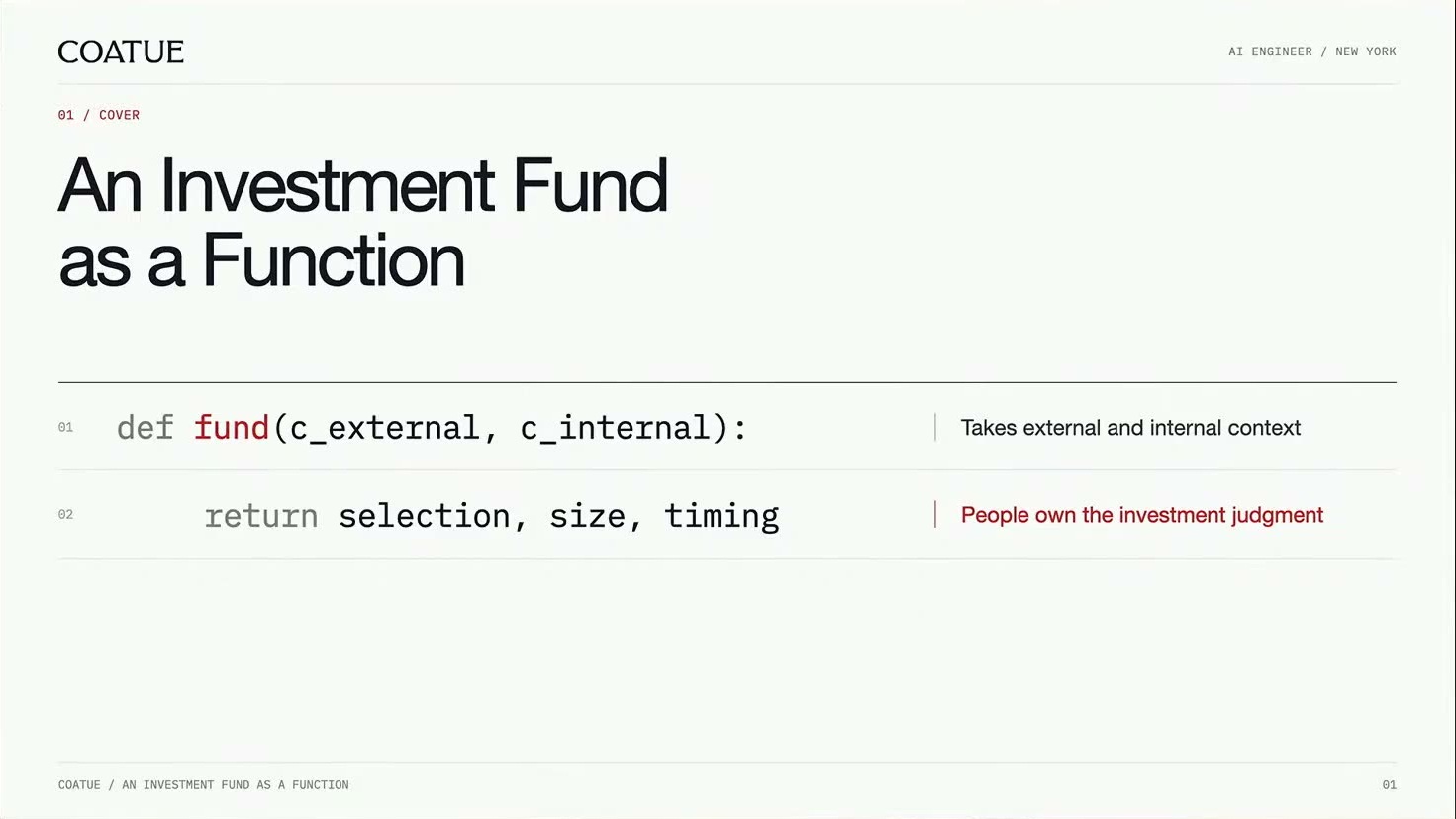
大家好。很高兴来到这里。我叫 Frank,在 Coatue 工作。Coatue 是一家横跨公开市场和私募市场的科技投资公司。在我们的业务中,真正需要做到的是,对重大主题下高确信度的判断进行投资,并观察这些判断如何兑现。老实说,我认为职业生涯也是如此。去年加入 Coatue 时,我想押注的是,我认为智能体对投资的影响会比它们对编程的影响更大。我知道这是个很大胆的说法。我们今天都来到这里,是因为 AI 对编程产生了变革性影响。但我确实非常相信这一点。今天我想稍微谈谈我们用来真正实现这种影响的框架。
Hello Exciting to be here. My name is Frank. I work at Coatue which is a technology investment firm across public and private markets So, in our business, what you really need to do is be able to take high conviction bets on big themes and watch those play out. I think, honestly, a career is the same way. And last year when I joined Coatue, the bet that I wanted to make was I think that agents will have an even bigger impact in investing than they did at coding. I know that's a big statement. We're all here because of the transformative impact that AI has had in coding. But I really believe it strongly. And today I want to talk a little bit about the framework that we use to actually realize that impact.
从高层次来看,可以把对冲基金想成一个函数,它接收两个参数:外部情境和内部情境,然后输出一个三元组:选什么、配多大、何时做。哪只股票、投多少、什么时候投。我认为这是一个很好的框架,能帮助我们把工作落到实处:我们试图解决这样一个压缩问题:如何把世界上的所有信息变成这个简单的三元组;我们提供的产品,本质上是一条由这个三元组组成的时间序列,它构成一个投资组合。
So, at a high level, you can think about a hedge fund as a function that takes in two parameters, context external and context internal, and spits out one tuple. Selection, size, timing. stock, how much, when. And I think this is a good framework to actually ground our work, which is we are trying to solve this compression problem of how do you take all the information in the world and spit out this one simple tuple and the product that we provide is essentially a time series of this tuple that constructs a portfolio.
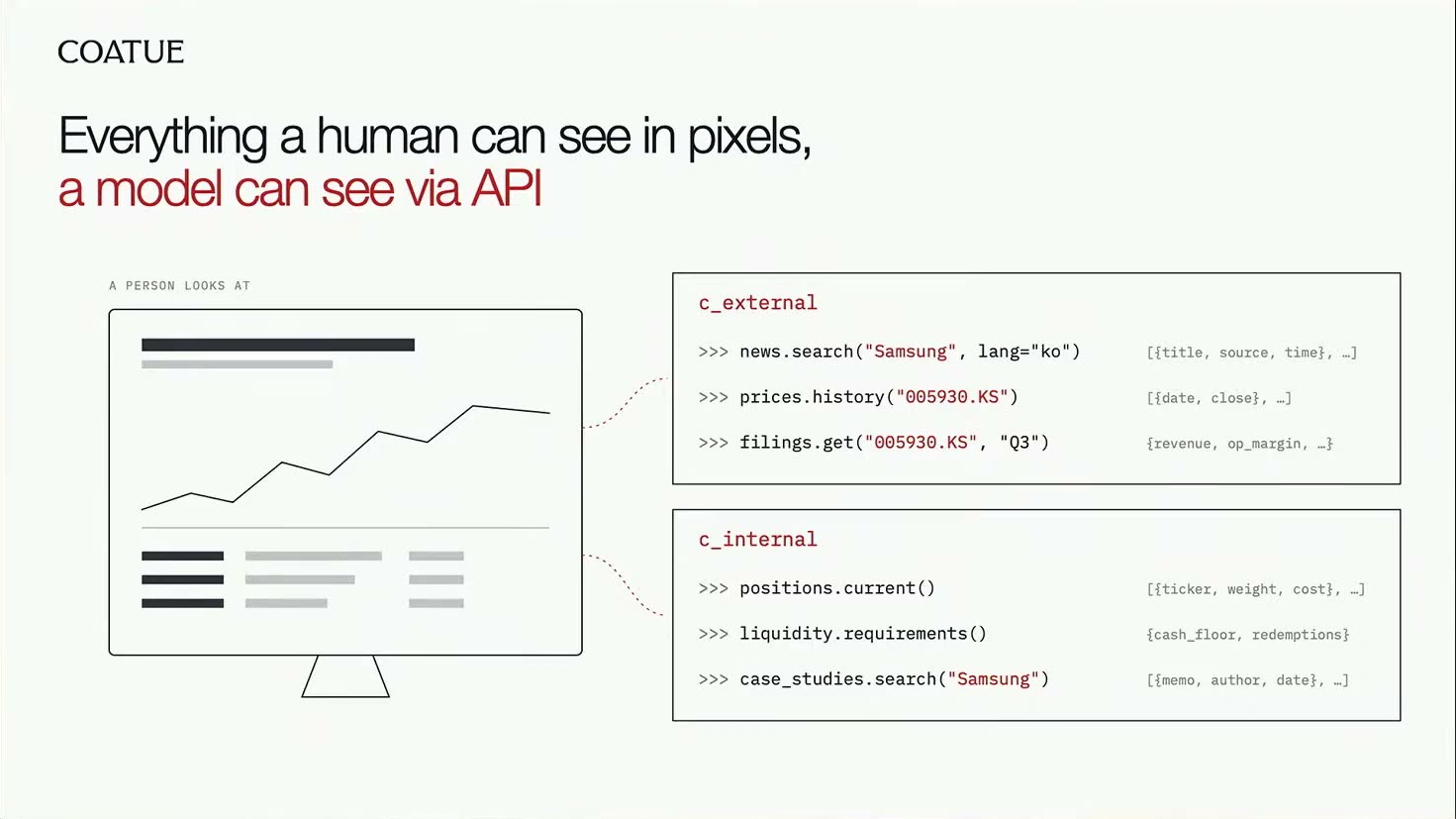
我们从最上面开始,也就是输入。这是一个简单的理念。我们使用屏幕查看内容、研究信息、开展工作。人类能在屏幕像素上看到的每一件事,智能体在你的组织里都应该能通过 API 看到。我常用的比喻是:想象你把史上最聪明的人、最伟大的在世投资者都请进公司,却给了他们一台电脑,而且不给他们登录75% 的服务。如果系统没有实际采取行动的工具,那么它有多聪明几乎无关紧要。外部情境包括两部分,这里没有什么意外:新闻、价格、申报文件,所有这些都应该很容易获取,而不是靠拖放、复制粘贴,而是直接通过 API 获取。
let's start from the top, which is the inputs. simple philosophy. We use our screens, we look at stuff, we do work. Every single thing that a human can see in pixels on the screen, an agent in your building should be able to see via API. The analogy I use is imagine you brought the smartest people ever, the greatest investors alive and you brought them into your company but you gave them a computer without logins to 75% of your services. It's almost immaterial how smart this system is if it doesn't have the tools to actually action that. So the two parts, external context, no surprises here, think the news, prices, filings, all of that should be easily accessible and not via dragging and dropping, copy and pasting, like directly via API.
内部情境同样重要,对吧?这就是你们自己公司的情况。可能包括我们当前的持仓、潜在流动性,以及围绕某些名称的风险要求,还有关于某个行业、股票或管理团队的过往案例研究或历史记录。这些都极其重要。这就是基础工作。而且我觉得,这功劳不该算在我头上,Coatue 在这方面一直是出色的领军者,而且已经持续了十多年。这既是技术层面的,也是文化层面的。我们有出色的数据科学团队、出色的流程和出色的系统,把所有这些信息汇集起来;同样重要的是,我们有一种极其严谨的文化,从一开始就致力于捕捉所有这些洞见。
Internal context is just as important, right? So this is your own firm situation. So that might be our current positions, potential liquidity and risk requirements we have around certain names, and past case studies or history with a certain sector or stock or management team. That is all super important. So this is the foundation, and I think, no credit to me, Coatue has been an amazing leader on this for over a decade. It is both technological and cultural. We have an amazing data science team, amazing processes, amazing systems that bring all this in, and just as importantly, we have a culture that is super, super rigorous and built from the ground up to capture all this insight.
几十年来,我们记录了每一条关于每笔交易的笔记,以及每一个我们做出的或没有做出的决定、哪些进展顺利、哪些不顺利;这些记录让我们具备了向 AI 开放这些信息的条件。想想看,我大概不能把所有这些东西直接塞进一个上下文窗口,然后就拿到神奇的三个数字,回家了。
For decades, we filed every single note about every single trade, about every single decision we made or didn't make about what went well and what didn't go well, and that has poised us to expose us to AI. If you think about it, I probably can't just take all of those things, jam them into a context window and get my magic three numbers and go home.
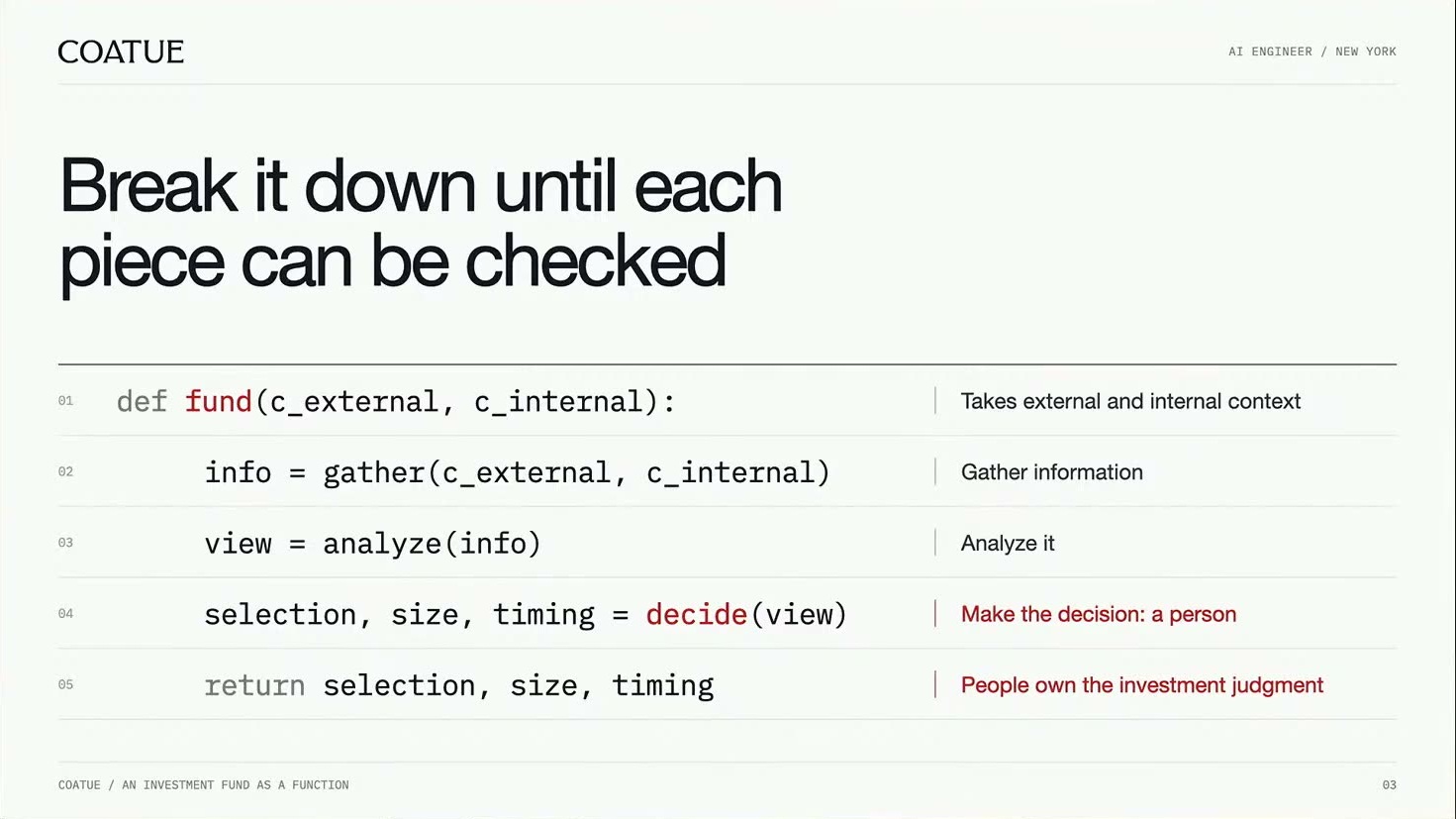
事情不可能这么简单。我们大概得把这个函数进一步拆解。第一步也许是接收外部和内部情境并加以收集,汇总起来。我想收集信息,也想筛掉相关和不相关的内容。比如,我找来了一些关于 MBA 的新闻文章,它们对股票可能并不重要;但这些关于当地审批许可的内容可能会影响数据中心。收集这一步里有很多细微之处。你们大概会看到,下一步是分析这些信息并形成观点。
It can't be that easy. You probably have to break down this function a bit further. So maybe the first step is I take in that external and internal context and I gather it. I want to gather it, I want to filter out what is relevant and not relevant. Okay, well, I pulled some news articles about the MBA that probably isn't material to stocks, but this is related to local permitting that might impact data centers. There is a lot of nuance in this gather step. you will see probably the next step is I need to analyze that information and form a view.
我需要思考这对公开市场和私募市场意味着什么,然后把这个观点转化为一个决策。一个决策对象包含这三个参数,也就是这三个子部分。你们可以看到,每一步都有输入和输出;后续步骤的输入就是前一个函数生成的输出。作为一名工程师,我觉得这种方式能让我用一种很容易理解的方式来构想这个问题。但即便如此,它也不可能只是写三个函数那么简单。
I need to think about what that means for the markets, public and private, and then I need to take that view and turn it into a decision. A decision object has these three parameters, these three sub pieces. You can see every single step has an input and an output, and the input for the subsequent step is the output that the previous function generated. I think as an engineer, this is a way for me to conceptualize the problem in a way that makes a lot of sense. But even this, it really can't be as simple as writing three functions.
为了真正体会问题的规模并理解它的全部复杂性,
So let's just, to really appreciate the scope and understand the full complexity of the
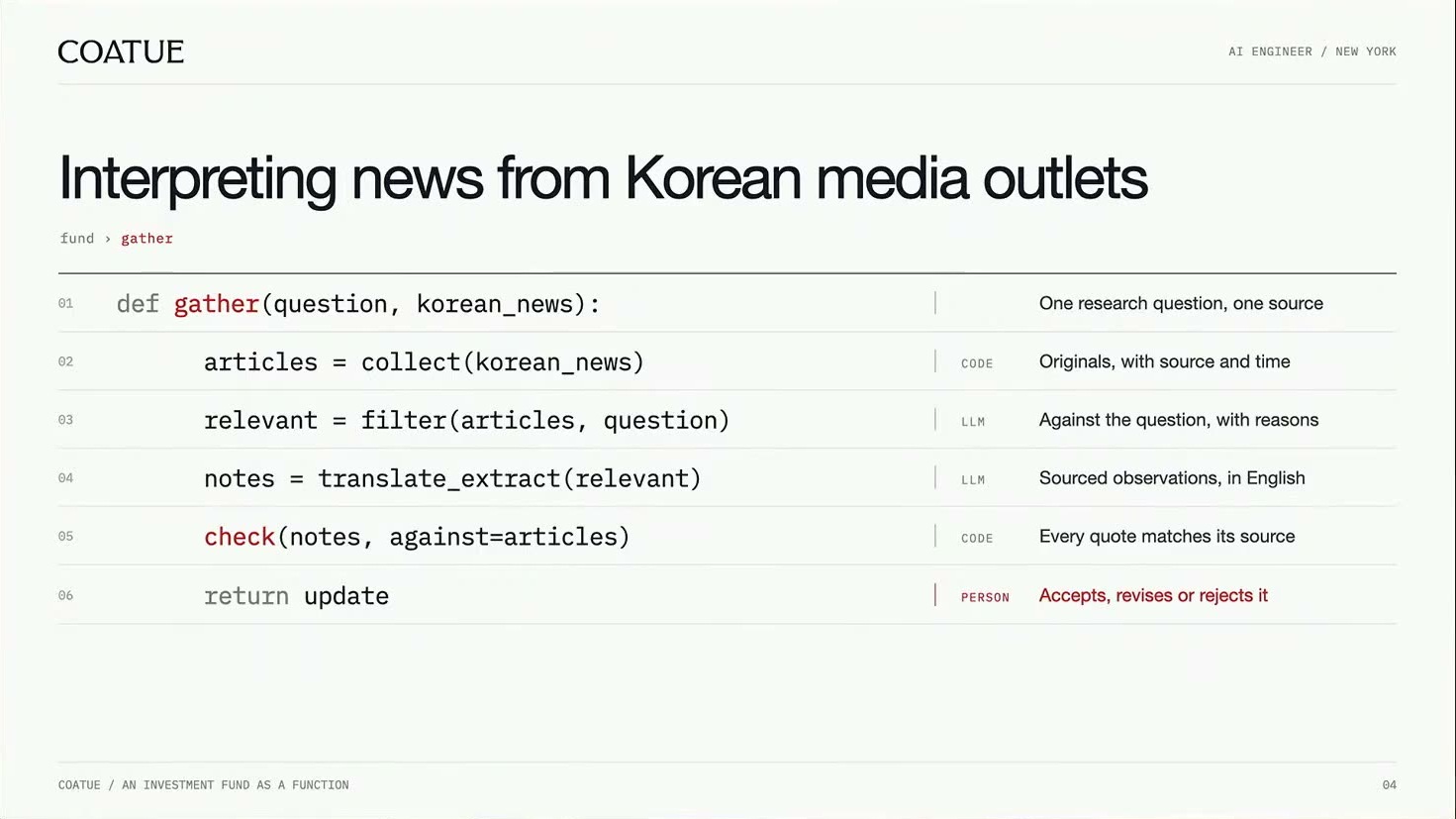
我们来看第一步里一个很小很小的子部分:仅仅是收集信息;我们用解读新闻做个案例研究。你们大概都知道,今年亚洲新闻和韩国媒体的报道非常重要,因为半导体和 AI 是市场上极其、极其重要的主题。非常重要的主题。我认为这是 AI 即将产生巨大影响的一个领域。比我们完全不会韩语的员工更好地阅读韩语新闻。我认为这是个不错的应用场景。
problem, let's look into the first step, a tiny sub piece of a tiny sub piece of just gathering information and let's do a case study on interpreting the news. So it's probably no secret to you guys that news from Asia and Korean media outlets has been super important this year because semis, AI, have been a huge, huge theme in the market. Huge theme. And I think this is an area where AI is poised to have a lot of impact. Reading Korean language news better than our completely non-Korean speaking staff. I think I have a good thesis that this might be a good use case.
第一步,可以想象我拿到了一些文章。我需要收集这些文章。这可以通过 MCP、CLI、订阅和清理数据源等方式实现。方法有很多,仅仅是编写这部分流程就有很大的自由度。把内容交给 LLM 时该如何分块?要不要把图片作为图片提取?要不要提取图片后再转成文本?这里有很多可调参数。我几乎会把这些参数看作传统机器学习系统中的超参数。我把每个参数都看作需要调优和优化的对象。
So you can imagine the first step is I have articles. I need to collect the articles. This could be an MCP, this could be a CLI, license the data feeds, clean the data feeds. There are a lot of ways to do this and a lot of dimensions of freedom for how you can even just write this simple piece. How do I chunk it when I pass it to the LLM? Do I want to pull the images as images? Do I want to pull the images and then turn the images into text? There are actually a lot of knobs here. I almost think about those knobs as hyperparameters in a traditional machine learning system. I think about each of these knobs as something for me to tune and optimize against.
显然还要筛选,我们刚才谈过了。肯定有韩国 NBA 球迷,对吧?肯定有很多内容不一定与我们的投资组合中真正重要的公司名称、主题和股票有关。所以我想确保把那些内容过滤掉。这里涉及翻译、提取,以及要不要总结、要不要把内容提取成某种结构化形式。再说一次,做法和实验方式都很多,如何把信息呈现给模型也有很多办法;这件事难就难在它一直在变化。显然还要核查。
Obviously, filtration, we talked about it. There are probably Korean NBA fans, right? There is probably a bunch of stuff that is not necessarily material to the names and themes and stocks in our portfolio that really, really matter. So I want to make sure that I filter those out. There is this translate slash extract slash should I summarize, should I extract this into some sort of structured form. Again, so, so many ways to do this, so many ways to experiment, how to expose information to the model, and one of the reasons this is hard is it keeps changing. And obviously checking.
要把这些内容与我们自己的内部笔记、内部观点、可能进行过的谈话、会议录音进行核对。我们确实需要交叉引用这些内容。实际上,从不同来源提取信息并交叉核对,威力非常大。你们会看到右边有代码、LLM、LLM、代码、人工。执行这些函数有很多很多种方式。我刚才想到,最后一步是更新。我们会更新自己的观点。
Checking our own internal notes, our own internal views, potential conversations we have had, meeting recordings against these things. We actually need to cross-reference those things. Actually the idea of pulling information from disparate sources and cross-referencing them, that's super powerful. So you will see on the right here I have code, LLM, LLM, code, person. There's many, many ways to run these functions. I think about, oh, yeah, and finally, update. We update our views.
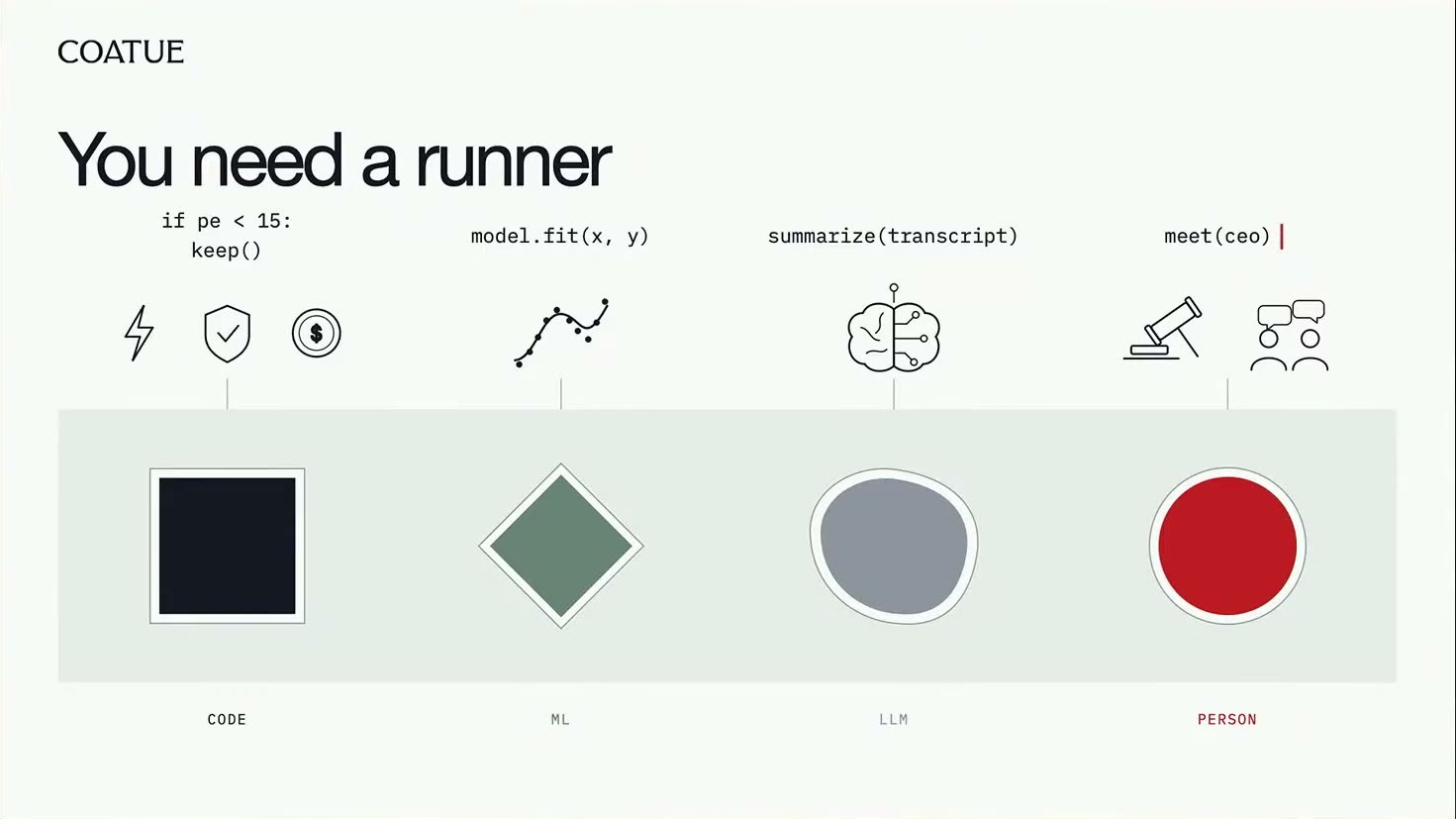
执行这些函数有很多方式。我把每一行都看作有一个执行者,最明显的就是代码。代码非常好用。它速度快、成本低、可靠;比如,如果市盈率低于 15,这种情况我就应该用确定性代码处理。第二类执行者是统计方法和传统机器学习。你可以想象针对特定模式拟合一条回归线;它很强大,因为可以建模比纯确定性代码复杂得多的关系。而对于更复杂的关系,也就是我们今天聚在这里讨论的内容,LLM 和 AI 智能体是另一类执行者。
There are many ways to run these functions. I think of each line as having a runner, and the most obvious one is code. Code is very good. It is fast, it is cheap, it is reliable, so for something like if the prices to earnings ratio is less than 15, I should just use deterministic code for that. Runner number two is statistics, classical machine learning, and you can imagine fitting the line to a regression for a specific pattern, this is very powerful because you can model much more complex relationships than just pure deterministic code. And for even more complex relationships, the reason we are all here, LLMs, AI agents, that's another type of runner.
比如做摘要,这就是最先进的技术。大概完全不可能仅靠一堆 if 语句,做出比现代 LLM更好的摘要。当然还有人。人在系统里也是重要的执行者。想象一下这个函数的任务是与一家公司的管理团队会面。我大概不会派 LLM 或 AI 智能体去做这件事。我大概也不会派一条 if 语句去参加这场会议。我认为很多时候,因为这需要判断力,也需要灵活应对现实世界里的种种情况,某个函数环节最好由人来执行。
So for something like summarization, that's the state of the art. It's probably totally impossible to build a bunch of if statements that can summarize better than a modern LLM. Of course, people. People are important runners in the system. Imagine a function meeting the management team of a company. I probably don't want to send an LLM or an AI agent in to do that. I probably don't want to send an if statement into that meeting. I think there are many cases where because of judgment and the ability to navigate the real world and all of these things, a person is the best runner for a given piece of the function.
我认为这一点极其、极其重要。我们自动化不是为了自动化而自动化。我们的目标不是尽可能多地把事情交给 LLM 来做。对于这个函数的任何一个环节,目标都是:我该怎么做才能把绝对质量提高到最高?
I think this is a super, super important point. There is no glory in automating things for the sake of automating things. The goal is not to take as many things and make them LLM as possible for us. The goal is for any given piece of this function, what can I do to maximize absolute quality?
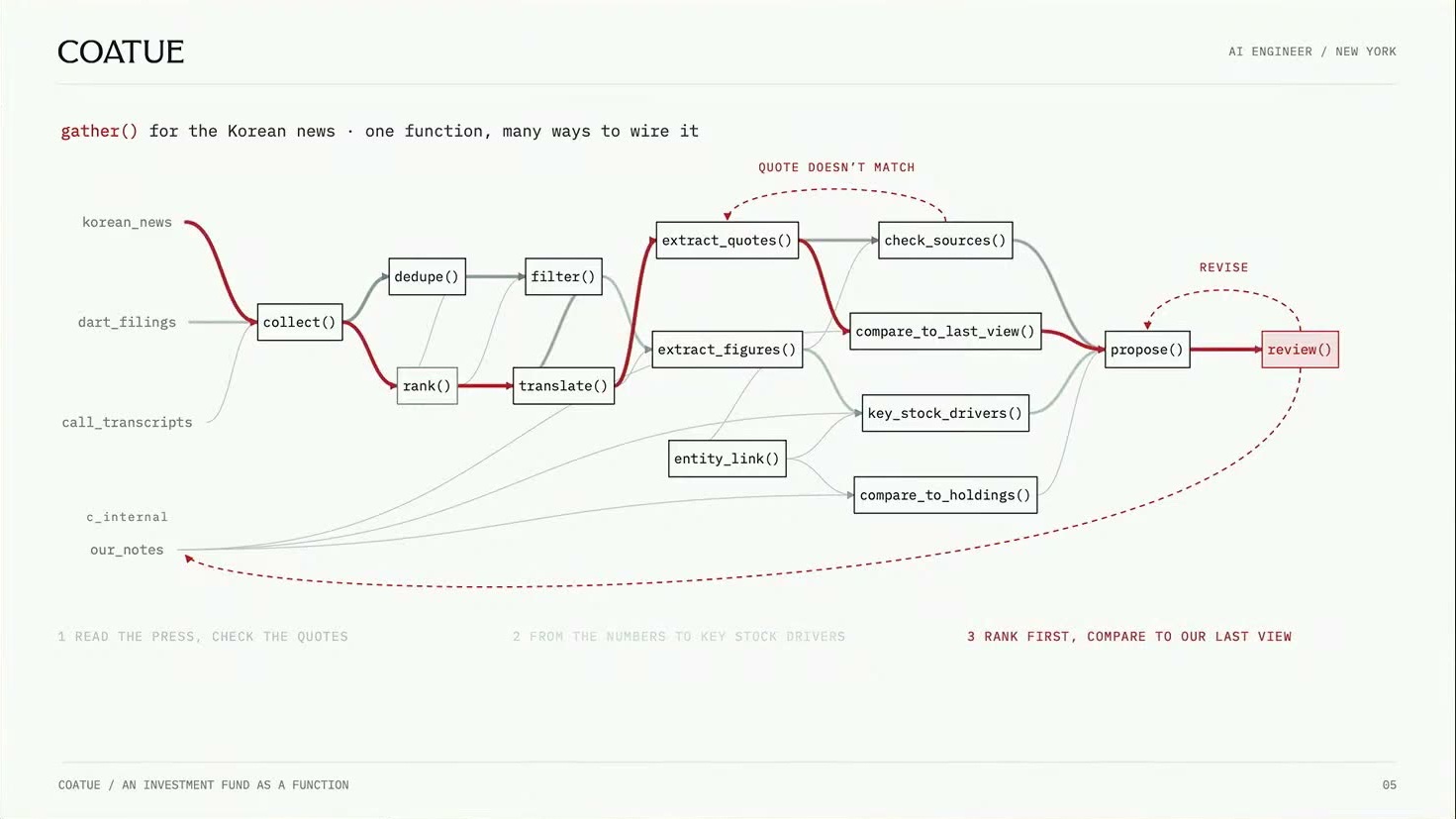
如果你真的想一想这个函数,它大概会是这个样子。它大概不是一条由许多不同事情组成的线性流程。它可能有各种分支逻辑,也有各种分叉方式。也许我想先收集信息,再把它翻译出来;我的主要目标是提取引文,并对照来源进行核查,确保这些确实是人们说过的话;这就是我的做法。但这可能完全错了。也许我想先去重,再筛选,然后提取外部数据;或者我想做完全不同的事。我也可能先传入一条笔记,然后寻找其他能够佐证的数据点;又或者我是在尝试进行红队测试。
And if you actually think about the function, it probably looks something like this. It's probably not just a linear statement of a bunch of different things. There's probably all kinds of branching logic and all kinds of ways to actually fork this. So maybe I want to collect the information and then translate it, and my main goal is to extract quotes and check those against sources to make sure that these are actually the things that people said, and that's my approach. But that might be totally wrong. Maybe what I want to do is I want to de-dupe and then I want to filter and then I want to pull external figures or maybe I want to do something totally different. I actually want to, I'm passing in a note first and I want to find other confirmatory data points or maybe I'm trying to red team.
配置方式多得数不清。所以,控制流程里又出现了更多超参数,对吧?仅仅是对 LLM 新闻提取、筛选、总结和汇总这个看似简单的问题,就有这么多思考方式。
There's a million different ways to configure this. So yet again, more hyperparameters within the control flow, right? So many ways to think about just this very simple problem of pulling, filtering, summarizing aggregating the news for LLMs.
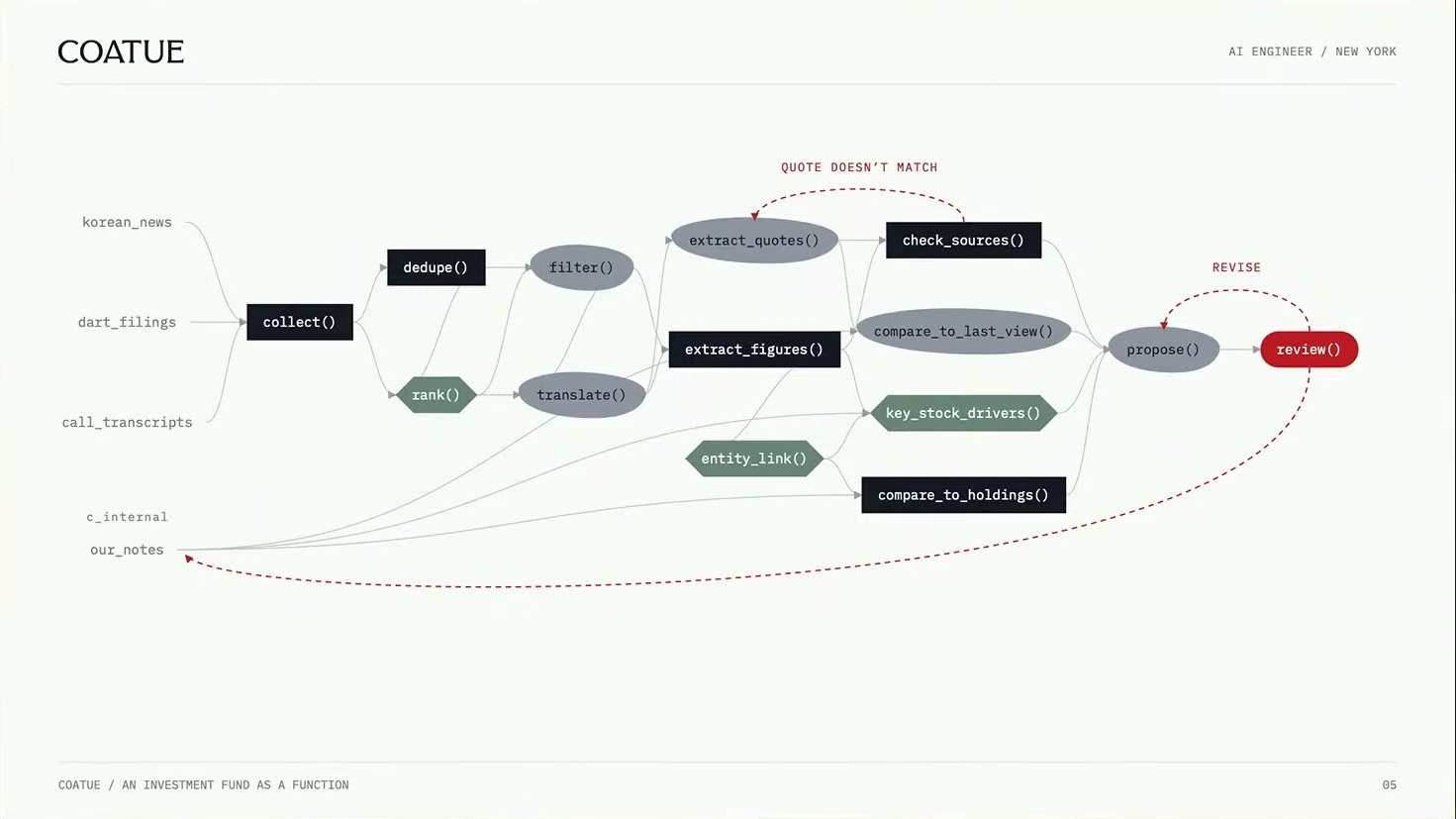
而这些方框里的每一步,可能都有一个最优执行者,对吧?例如,收集信息时最优的执行者可能是确定性代码,对吧?比如,我要获取某个来源过去 24 小时的内容。这就适合用确定性代码。筛选呢?可能适合用模型。LLM 呢?统计方法,或者把几种方式组合起来,对吧?所以这可能还是低估了问题的复杂性。现实中,大多数事情都由多个执行者共同完成。大多数事情都是确定性代码加 LLM,再加统计方法,或者由人和 LLM协同完成。
And each of these boxes probably has an optimal runner, right? So the optimal runner might be deterministic code for collection, right? I'm pulling last 24 hours for a given source. That's deterministic code. Filtration? models maybe. LLMs? statistical methods, a combination, right? So this probably understates the complexity. The reality is most things are multi-runner. Most things have deterministic code plus LLM plus statistical method or human with LLM in conjunction.
现实中,很可能是我这四类执行者之间各种组合;而且类别还远不止这四种。因为在 LLM 这一类中,我还可以调节模型。我可以选大模型、小模型、中等规模的模型。我可以调整思考力度:X high、high、medium,还可以调整 harness,选择使用哪种 harness;我可以选择加载哪些 skills,以及这些 skills 要加载哪些 hooks。所以我的搜索空间里又多了更多超参数。我搜索空间中的超参数数量大得惊人。而这还只是这个小问题——仅仅是筛选新闻。拆解这类问题的思路是:我到底能否把它分成一些我们能够理解和评估的部分。
reality is it's probably combinatorics between my four buckets and there's even more buckets than that. Because within the LLM category I can tune the model. I can choose big model, small model, medium model. I can tune thinking effort. X high, high, medium, I can tune harness. I can choose the harness. I can choose which skills load with the harness. I can choose which hooks load with the skills. So yet again, more hyperparameters within my search space. I have an absolutely enormous amount of hyperparameters within my search space. And this is just for this one tiny problem, right, of just filtering the news. So the way to think about breaking down these problems is what can I actually compartmentalize in a way that we can understand and evaluate.
这就是我不断爬山优化的目标。否则我只是在不断调这些东西。我会想:好,这一步实际上应该由机器学习系统来做,而不是 LLM。这一步应该是我们训练的一个小模型。哦,不,这一步根本不该用模型。应该用一条 if 语句。或者,天哪,LLM 在把这些内容转化为对投资组合的影响方面真的非常不擅长。这一步确实应该由人来做,但他们可以使用确定性系统帮助自己搜索并提取信息。可能会有各种不同的做法。如果没有一个明确的北极星目标作为爬山优化的方向,你就只会,嗯,只是在那里瞎折腾。我想再怎么强调也不为过:这只是我们做的一件小事。想象一下我们纳入的每个数据源:要把它们转化为中间产出,可能远不止三次转换。
That's what I'm hill climbing against. Otherwise I'm just tuning these things. I'm okay, that should actually be a machine learning system instead of an LLM. That should be a little model that we train. Oh, no, that shouldn't be a model at all. That should be an if statement. Or, oh, man, LLMs are really, really bad at translating that to portfolio impact. It should really be a human on that step, but they're using a deterministic system to help them search and pull the information. It could be all different things. And if you don't have a north star to hill climb against, you're just kind of, you're just fidgeting around. And I think I cannot convey enough that this is just one tiny thing we do. Imagine every single data source that we pull in, there's probably more than just three transformations to get them to the intermediate output.
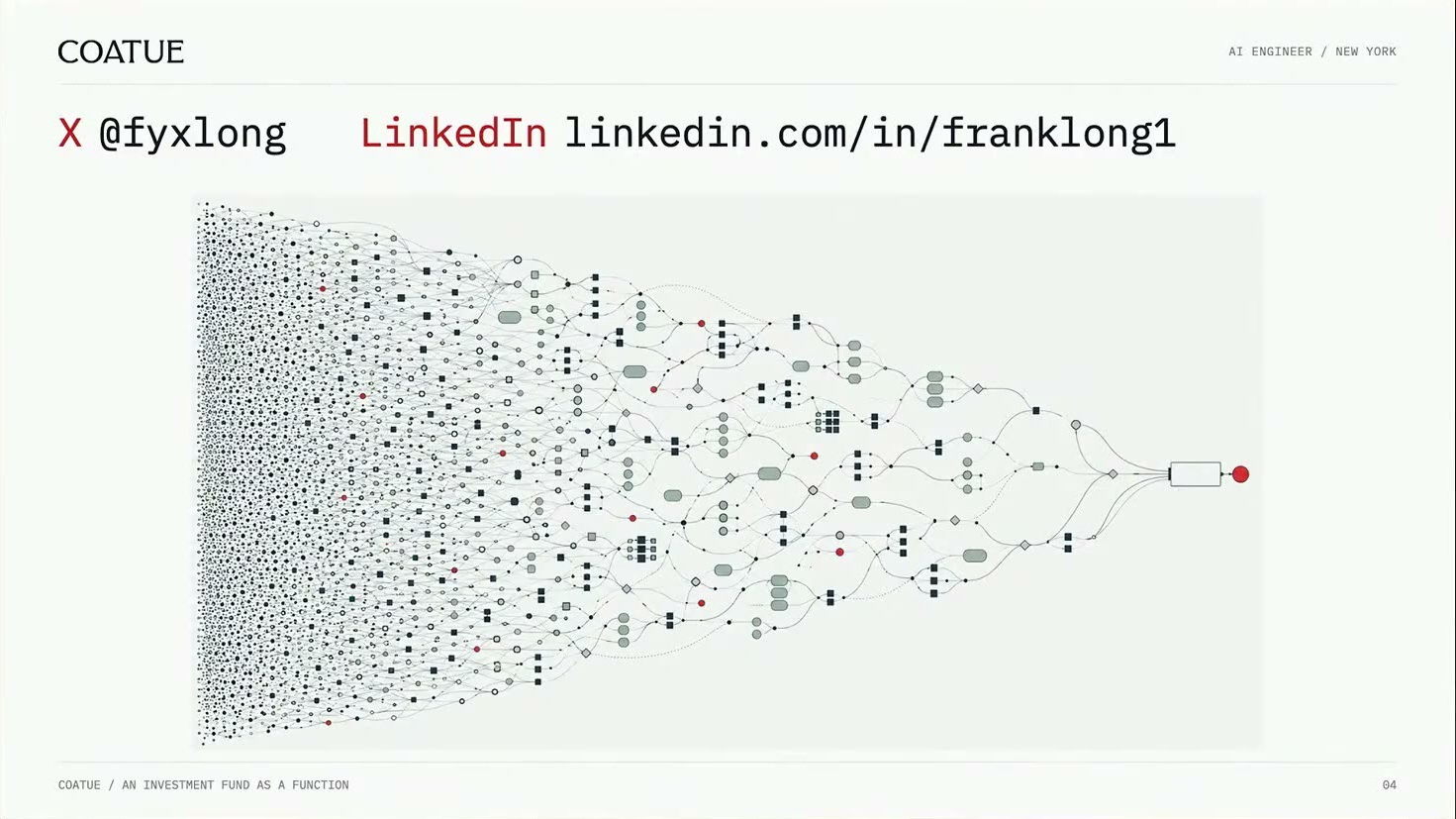
所以,Coatue 及类似基金的实际流程图,大概会是——哦,不,不是这个样子。这是我的屏幕保护程序。实际的流程图大概会像这样。它很可能复杂得多。我们刚才提到,那些节点中的每一个至少有 10 个超参数,每个参数至少有 20 种不同取值。所以搜索空间基本上是无限的。真正的挑战是如何把这一切安排出来,让人既能从技术角度理解,也能在文化和组织层面消化吸收。这就是在投资领域应用 AI 的最大挑战。
So the actual graph of Coatue and funds like Coatue, it actually probably looks, oh, not like this. is my screen saver. The actual graph probably looks something like this. It is probably massively complex. In each of those nodes, we just talked about at least ten hyperparameters with at least 20 different values for them. So the search space is basically infinite. And figuring out how to actually lay this out in a way that you can comprehend both from technical perspective, but also absorb culturally, organizationally. That is the great challenge of applying AI in investing.
除了投资之外,我们真正讨论的是创建一个状态机,它能够从世界获取信息,并充分理解这些信息,从而做出连贯的决策。这类应用远不止投资公司,还包括政策制定,非营利组织、药物研发和企业战略。对我来说,参加这样的论坛最令人兴奋的事情之一,就是和其他领域的人交流,听他们谈论不同领域中的不同问题,这些问题最终会汇聚到同一个问题空间里。我很愿意继续聊这个话题。之后我会在走廊里待一会儿。
And beyond investing, what we're really talking about is creating a state machine that can take information from the world and understand it well enough to make coherent decisions. There's use cases for this far and above, wider than just investment firms, in policy, in non-profits, in drug discovery, in corporate strategy. I think one of the most exciting things for me about being in forums like this is talking to other people in different spaces with different problems that kind of congeal on the same problem space. I'd love to keep talking about this. I'll hang out in the hallway afterwards.
这是我的社交媒体账号。谢谢大家抽出时间。谢谢。
Here are my socials. And thank you, everyone, for your time. Thank you.