人人都有 AI,谁能占据优势?
Everyone Has AI. Who Has the Advantage?
原文由官网提供,中文由 GPT-6 Luna 翻译。相邻片段合并排版,正文与时间点保持对应。
已插入 27 张经核对的幻灯片或演示截图;点击图片可放大。图注链接为当前视频时间,左侧正文时间保留原转录版本,二者可能不同。
共 35 个阅读段落
大家下午好。今天过得很愉快,能来到这里我感到非常荣幸。我今天演讲的主题是:“人人都有 AI,谁能占据优势?”我会谈谈那些在 AI 落地和采用方面走在前列的机构,他们做得有什么不同?
Good afternoon, everyone present here. It's been a great day and an absolute pleasure to be here. The topic of my talk today is everyone has AI, who has the advantage? I'll be talking about what the orgs that are doing, that are leading in AI with their implementation and adoption, what are they doing differently?
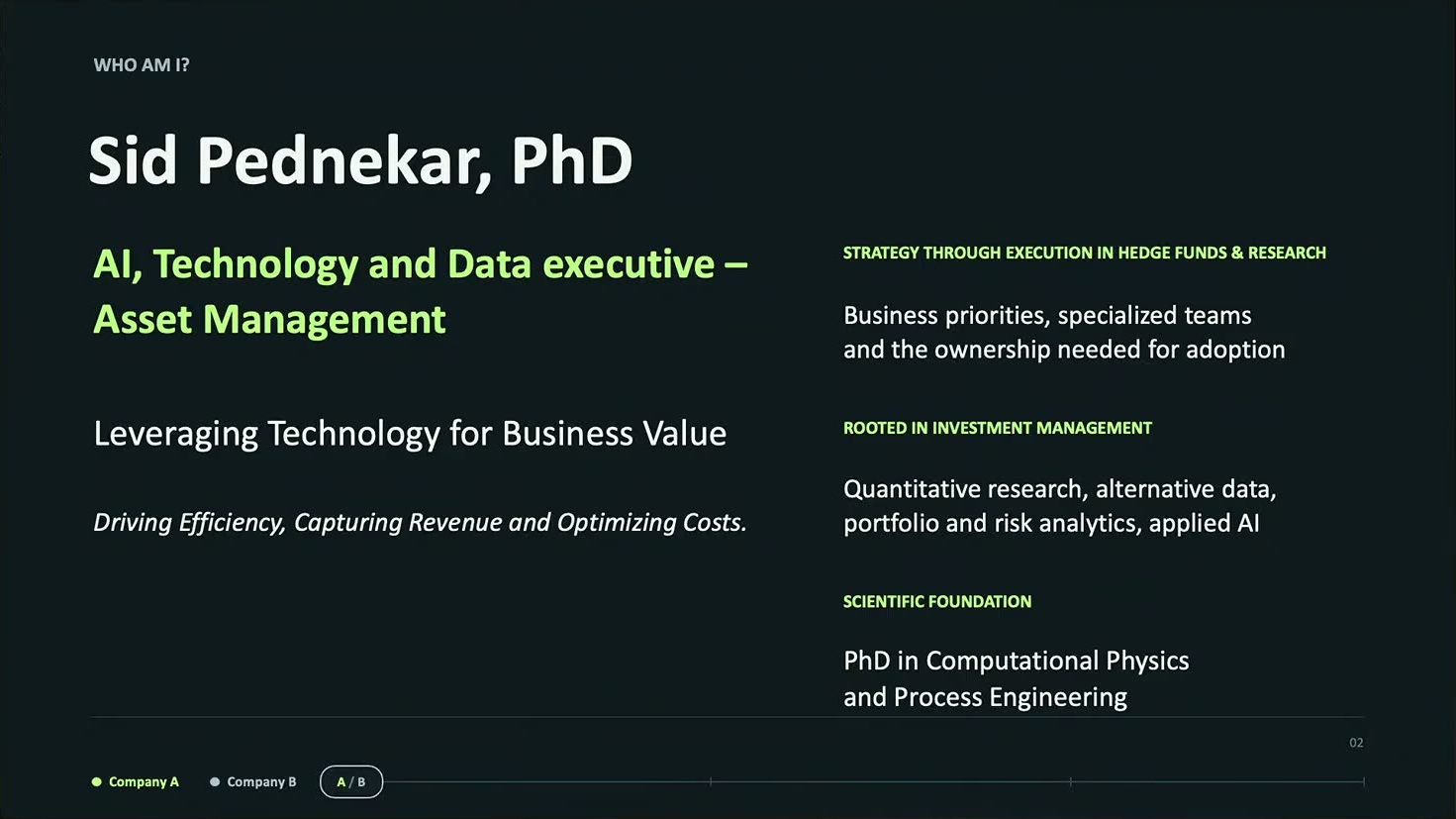
在此之前,先介绍一下我是谁,以及我的观点是什么。我是 Sid Pednekar 博士,是资产管理领域的 AI 技术和数据高管。我的大部分职业生涯都在对冲基金、投资和学术研究领域度过。我的工作重点是领导战略制定,并组建专业团队,围绕三个主要方向开展工作:提升效率、推动损益增长,以及降低成本。接下来我会结合两家假想公司来展开讨论,也就是下面滑块中的 A 公司和 B 公司。
so before that, who am I and what's my POV? So I'm Dr. Sid Pednekar. I am an AI technology and data exec in asset management. I've spent most of my tenure in hedge funds and investment in academic research. What I've done and focused on is lead strategy and build specialized teams towards three main verticals, optimizing efficiency, driving PNL, and reducing costs. So I'll be following the discussion along with two hypothetical companies, Company A and Company B, right at the slider below.
它们是虚构的,工作流程也都是编出来的,但在本次演讲剩余部分里,我们会一路跟进它们的发展。
These are hypothetical, you know, with made-up workflows, but we'll be following their journey along the rest of this presentation.
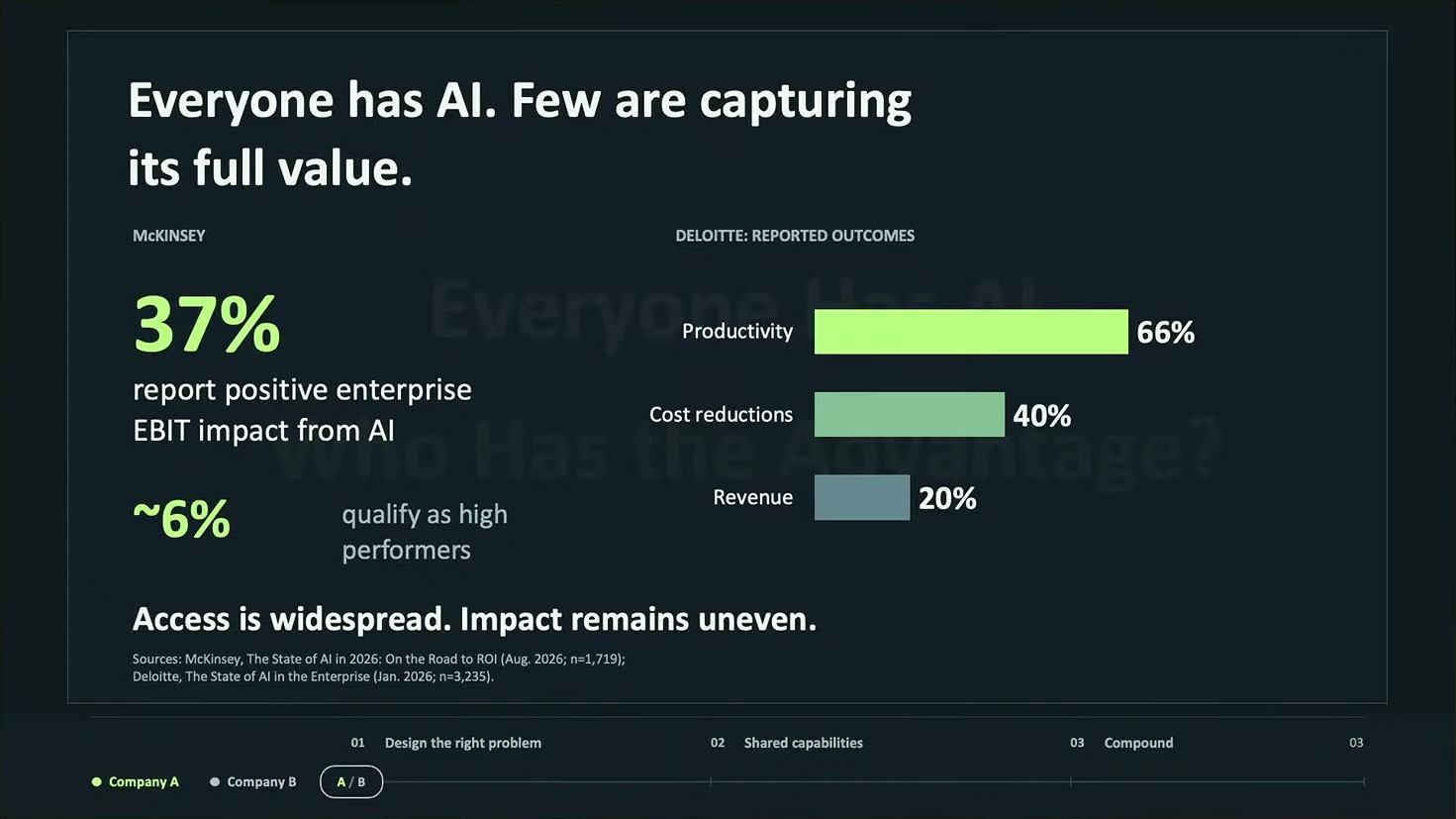
那么,人人都有 AI,谁能占据优势?在开始之前,我们先看看目前的整体情况。近期研究显示,在接受调查的企业中,只有约 37%实现了 EBIT 的正向贡献。其中只有约 6% 可以被归类为高绩效企业。这意味着它们对 EBIT 的贡献约为 5%。今年早些时候的其他研究显示,约 66% 的受访者表示生产力有所提升,但实际上只有约 40% 和 20% 的受访者分别看到了成本下降和收入增长。
So, everyone has AI. Who has the advantage? Before we get started there, first let's see what the lay of the land is. And recent studies have shown that only about 37% of enterprises that were surveyed are showing a positive contribution to their EBIT. And only about 6% of those would be qualified as high performers. So that's about 5% contribution to their EBIT. Other studies earlier in the year have shown that about 66% are saying they're having a productivity increase, but only about 40% and 20% are actually seeing cost reductions and revenue growth.
所以,正如我们所知,AI 的使用已十分普遍,但影响仍然参差不齐。我会从三个方向来思考这个问题,也会问一个问题:我认为这三个方向既适用于组织,也适用于个人,同样适用于组织中的各项职能,不论你身处组织的哪个位置。
So as we know, access of AI is widespread, yet the impact remains uneven. So, the question I would ask, or how I think about this, is really in terms of three verticals. And the way I think about these three verticals should apply to organizations and individuals alike, and it should apply to functions, regardless of where you are in that organization.
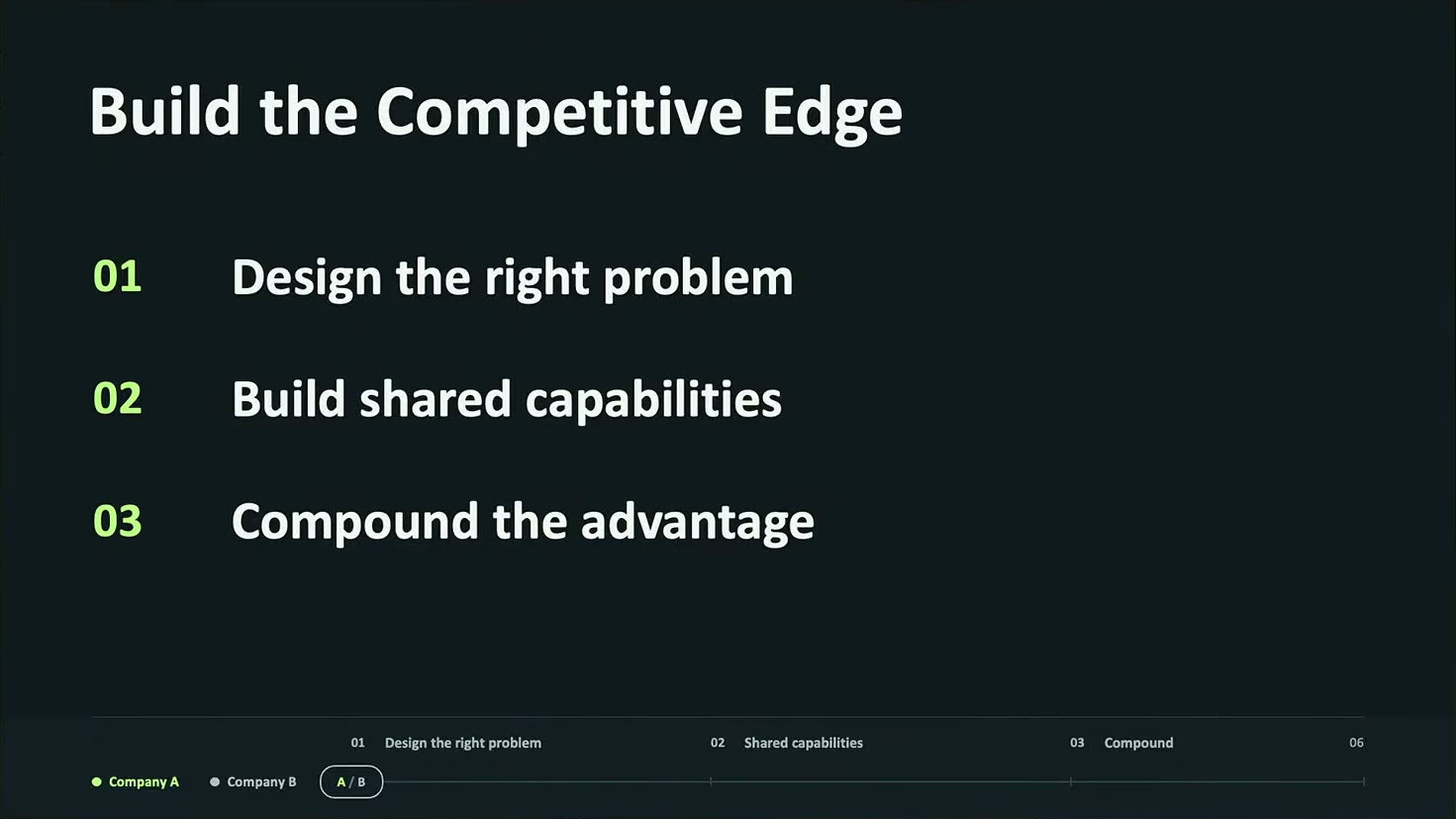
我认为主要有三大支柱:第一,设计正确的问题。第二,构建共享能力。第三,让优势不断复利增长。在深入探讨每个支柱之前,有一个贯穿所有这些方向的理念。我认为,最领先的公司正在利用这一点,并从中获益。众所周知,纵观历史,这个世界唯一不变的就是变化。
So the three main vertical pillars that I think of are, number one, design the right problem. Number two, build shared capabilities. And number three, compound the advantage. Now before we dive into each of these pillars, there is an idea that I think goes through all these verticals. And I think the best leading firms are taking advantage of that and capitalizing on it. As we know, throughout time, the only constant in this world has been change.
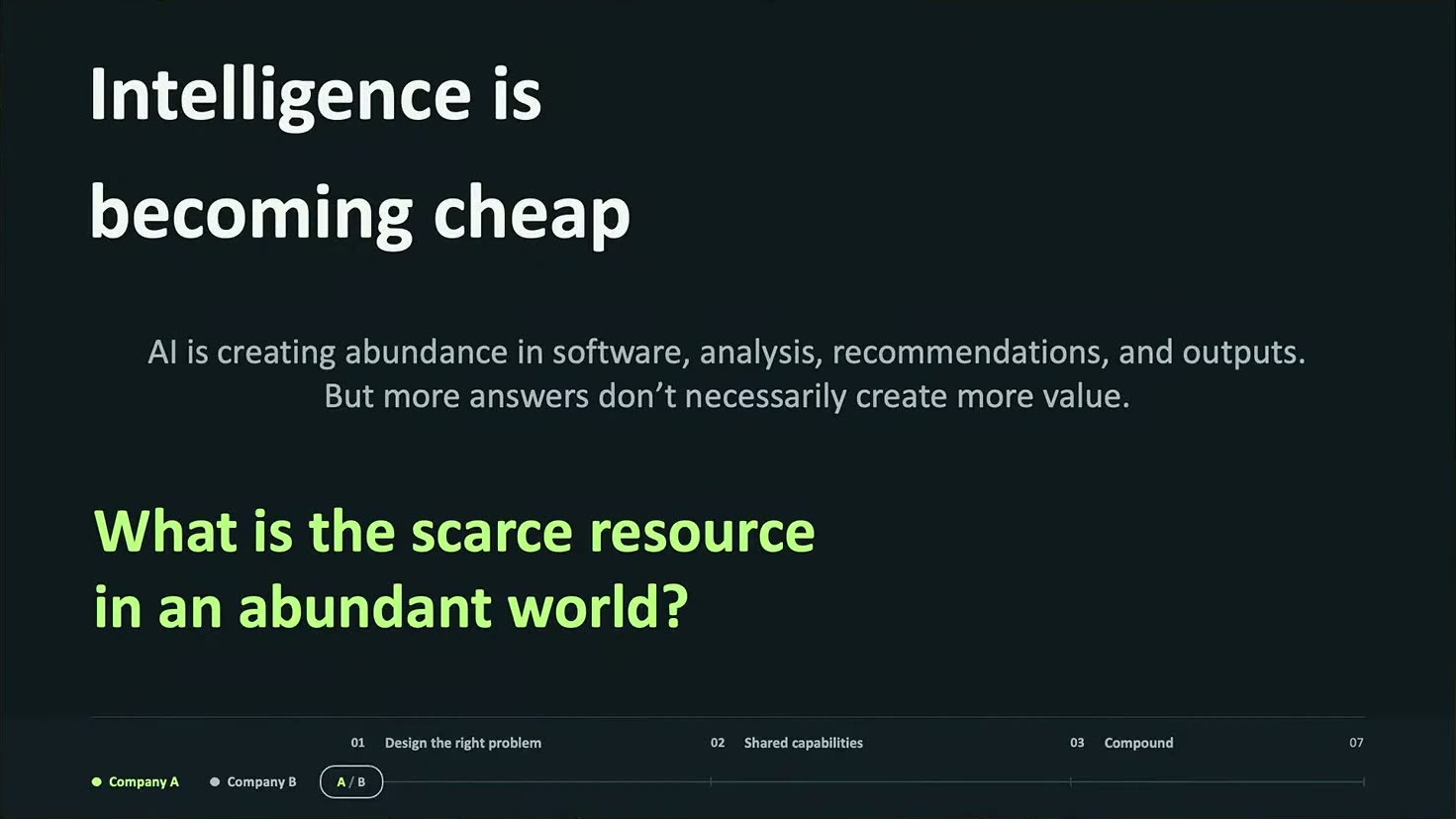
AI 和超级智能时代的不同之处在于,智能已经变得廉价。无论你衡量智能的单位是什么,无论是软件、分析、推荐还是报告,AI 都让所有这些东西变得充裕。而且我们知道,更多答案未必能创造更多价值。那么什么东西是稀缺的?在一个资源充裕的世界里,什么资源是稀缺的?至少那些领军企业正在利用什么?
What's different in the AI and superintelligence era is that intelligence has become cheap. Regardless of what your unit of intelligence is, whether it be software, analytics, recommendations, reports, AI is creating an abundance in all of it. And as we know, more answers don't necessarily create more value. So what is scarce? What is the scarce resource in an abundant world? What are companies taking advantage of, the leaders at least?
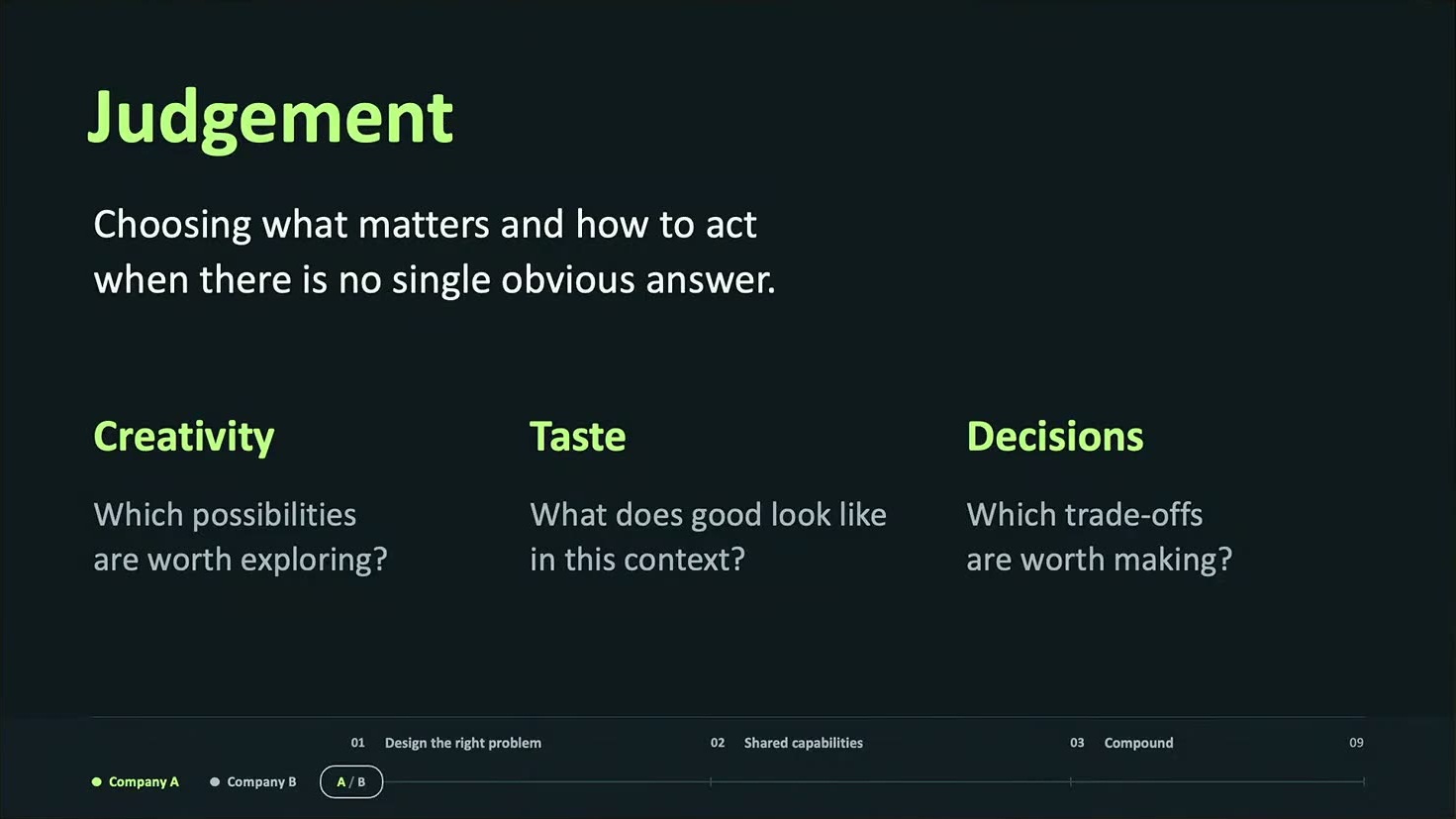
那就是判断力。什么是判断力?判断力就是在没有唯一明显答案时,选择什么最重要以及如何采取行动,尤其是在没有唯一明显答案时。它还包括一种创造力,让你探索哪些可能性值得探索。它也包括一种品味,让你在给定情境下判断什么才算好。它还体现在决策中,让你权衡哪些取舍值得做。
It's judgment. What is judgment? Judgment is choosing what matters and how to act when there's no single obvious answer. It's the creativity that lets you explore what possibilities are worth exploring. It's the taste that tells you what good looks like in your given context. It's the decisions where you can weigh what trade-offs are worth making.
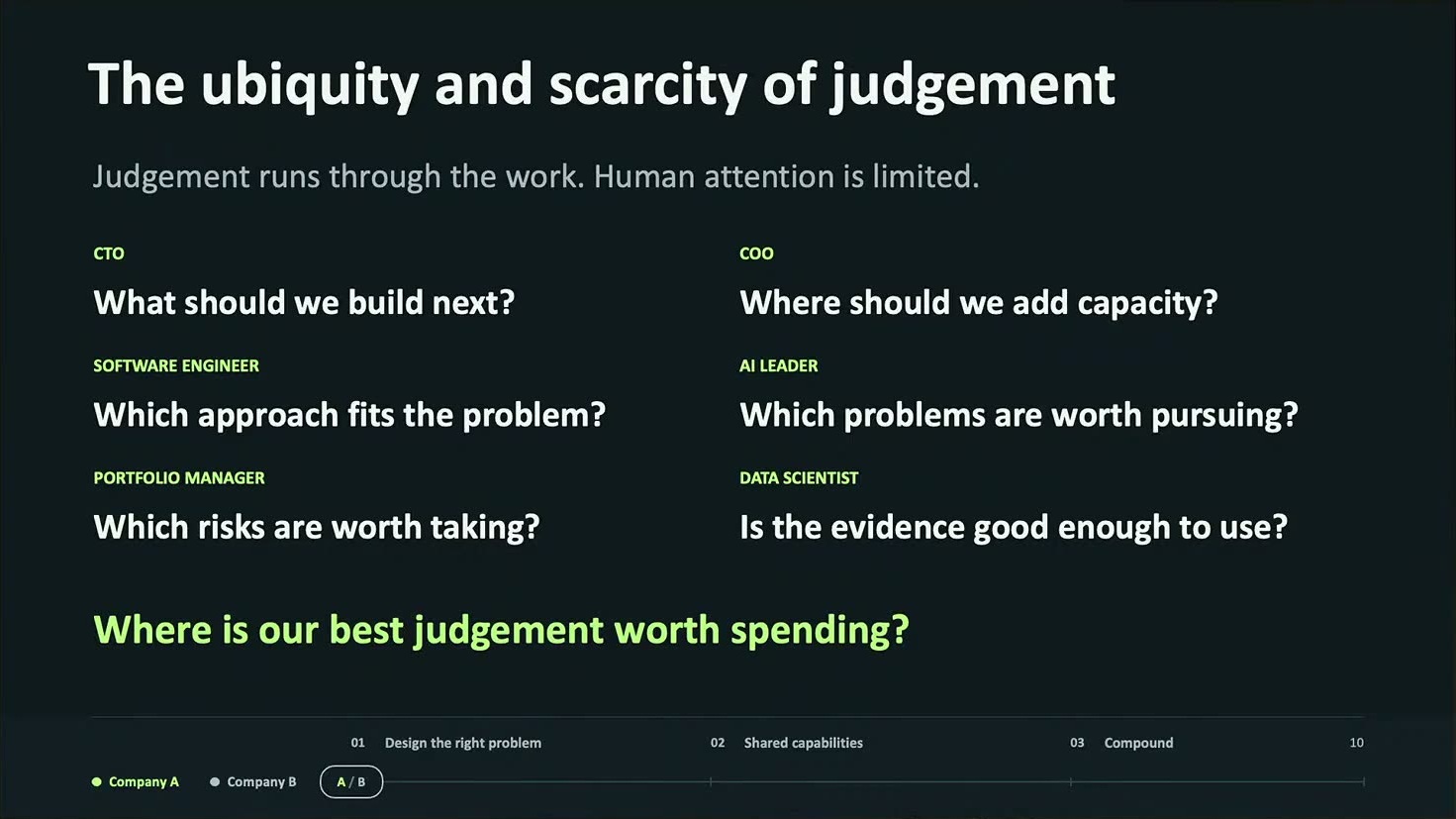
它无处不在。它每天都存在于你的整个组织之中。你们的高管层一直在提出问题,并运用判断力。软件工程师、AI 负责人、投资组合经理和数据科学家也是如此。因此,他们关注的问题是:既然判断力是一种有限的资产、有限的能力,那么最重要的问题就是,我们最宝贵的判断力应该用在哪里?请大家记住这个想法。接下来,我们进入第一个支柱。
is ubiquitous. It exists throughout your organization on a daily basis. Your C-suite, the C-suite is asking questions, taking advantage of judgment all the time. So are the software engineers, the AI leaders, the portfolio managers, and the data scientists. So the question that they're focused on is, given judgment is a finite asset, a limited capacity, the main question becomes, where is our best judgment worth spending? I'd like for you to hold on to that thought. With that, we'll dive into our first pillar.
设计正确的问题。领先机构一直在问这样的问题:我们应该解决的正确问题究竟是什么?他们对此非常专注。从工具开始很有诱惑力。如今,周围有更好的模型和智能体运行框架。周围有各种各样的 AI 工具。周围还有各种副驾驶工具。但这并不是正确的思路,对吧?至少,行业领军者并不是这样着手的。现在,让我们回到那两家假想公司。假设它们都属于资产管理行业。
Design the right problem. So questions, a question that the leading organizations are asking all the time is they're obsessed over what is the right problem to solve, right? It's tempting to start with a tool. Today we're surrounded with better models, harnesses. We're surrounded with all these AI tools. We're surrounded with co-pilots. But that isn't the way about, is it? At least that's not the way the leaders are approaching it. Now, let's go back to our hypothetical two companies. Let's say they're from asset management.
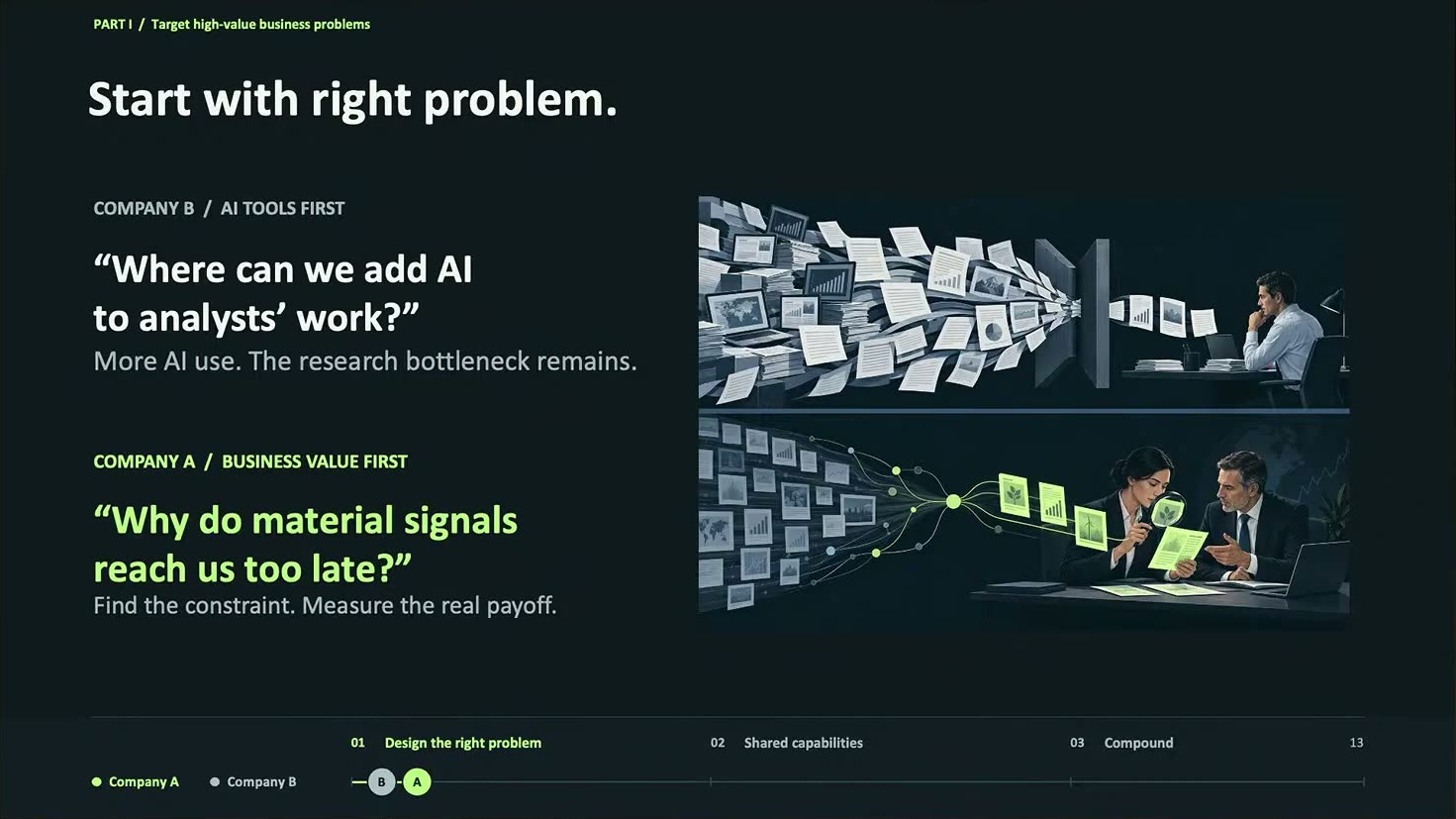
假设我们跟踪这两家假想机构中的两位研究分析师的工作流程。假设 B 机构从工具,也就是副驾驶工具入手。他们在问:“我们可以在哪些分析师工作环节加入 AI?”他们会查看当前已有流程,并想:财报电话会记录传来了,我发现可以做一个摘要工作流,不如把所有内容都通过我的“消防水带”灌进去,让分析师更快收到财报摘要,双赢,对吧?其实也不尽然,至少和那些领先者相比并非如此。
Let's say we're tracking the workflow of two research analysts in these hypothetical organizations. Well, let's say organization B starts with the tool, the co-pilot. They're asking, where can we add AI to the analyst's work? They're looking at the current existing process to say, earning transcript comes in, I discovered a summarization workflow, let me pass all of this in through my fire hose, analysts get earning summaries faster, win-win, right? Well, not so much, at least not compared to the guys who are leading.
而这种把工作流程变成“更快的马”的做法,带来了一个关键细节。也就是说,在信息被摘要、被精简的过程中,你可能会丢失上下文。那么,假想中的 A 机构在做什么呢?他们非常专注于提出正确的问题。他们可能会问:“为什么重要信号总是太晚才传到我们这里?”我们应该把注意力、AI、带宽和能力集中到哪里?我们的瓶颈在哪里?于是,这就变成了对工作流程进行重新设计,或者至少重新评估应该把重点放在哪里。
And such a workflow of being a faster horse introduces one key nuance. That is, you are losing context as you have information, I guess, reduction as part of your summarization. So what is a hypothetical organization A doing in this? Well, they're obsessed on the right problem to ask. They could be asking, why are our material signals reaching us too late? Where do we focus the attention, the AI, the bandwidth, the capability on? Where is our bottleneck, right? And so it becomes this redesigning of the workflow, or at least a re-evaluation on what to focus on.
这就是他们做法不同的地方。
That's what they're doing different.
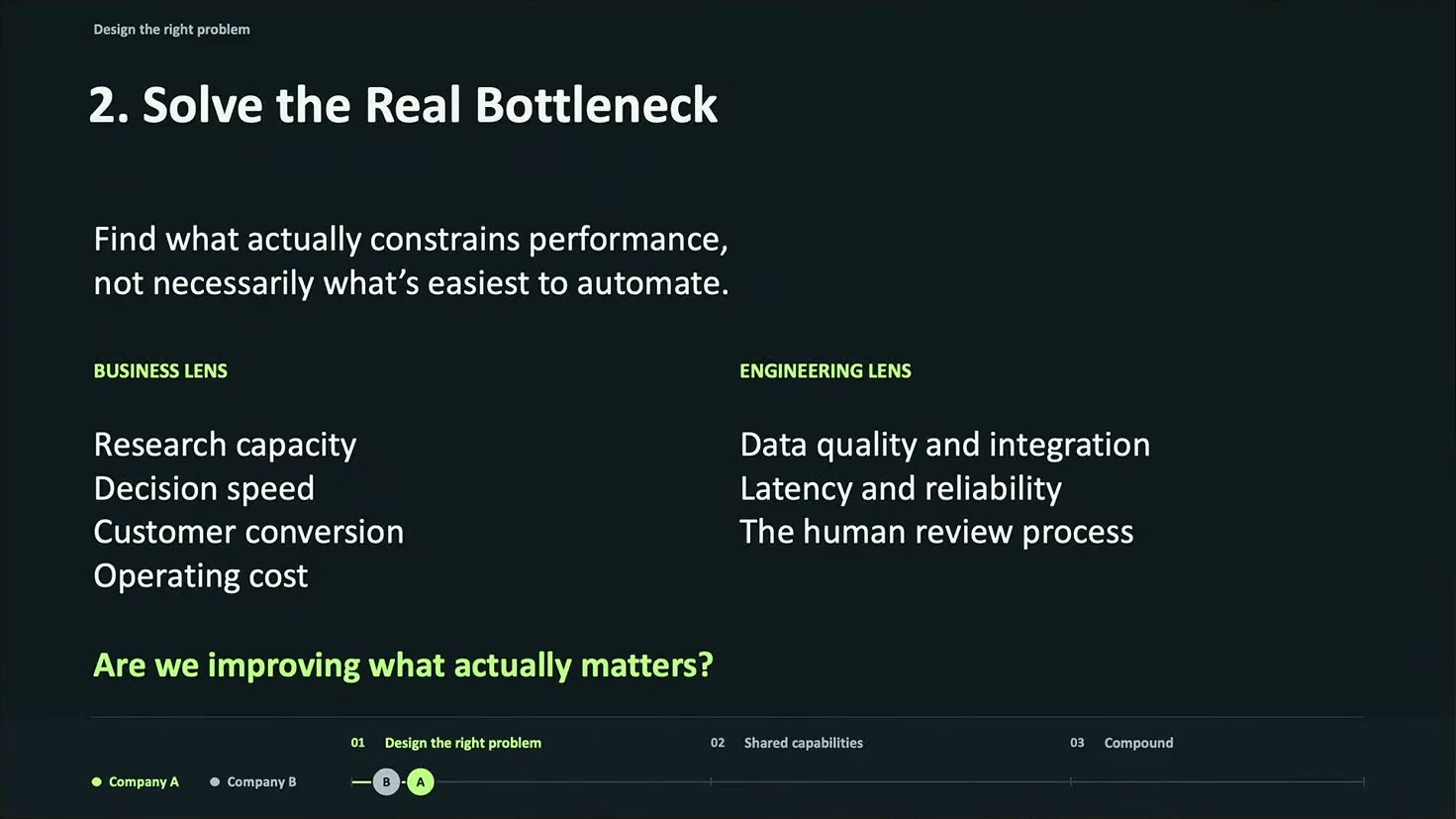
这种考量并非金融领域独有。它适用于各个领域和职能。你会问同样的问题:应该把重点放在哪里,无论是研究能力、决策速度,数据质量、延迟还是可靠性。所有这些方面都涵盖在内。
Now, this consideration isn't particular to finance. It's across the realm and function. You're asking the same question on what to focus on, whether it be research capacity, decision speed, quality of your data, latency, reliability. It traverses all of that.
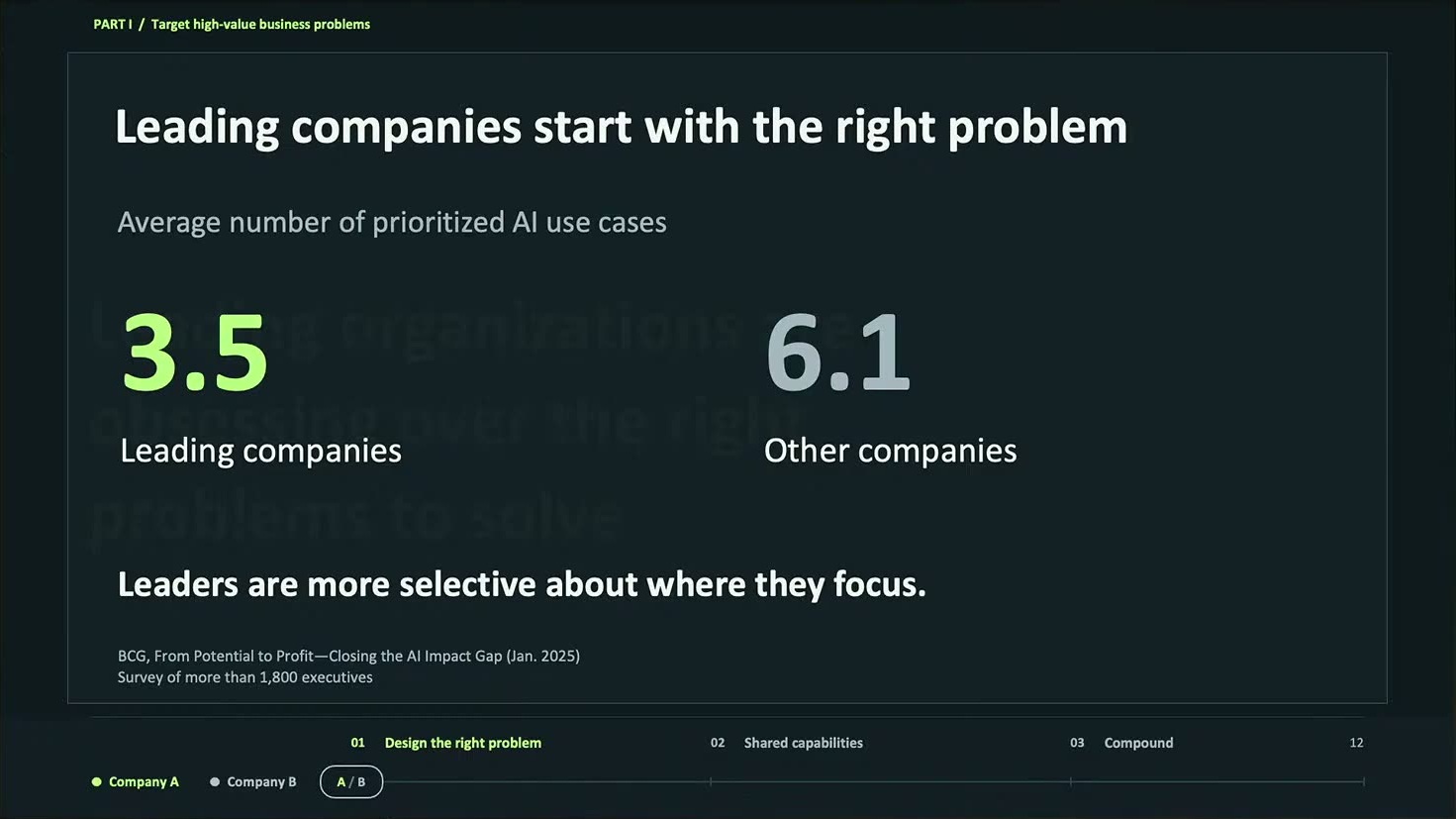
研究显示了这一点。相关研究显示,领先者平均而言,把注意力放在更少但质量更高的决策上,而另一组则不是这样。因此,领先者会更有选择性,会审慎选择把注意力放在哪里,以及把注意力放在什么事情上。很好。领先的公司已经知道哪些才是正确的问题。接下来他们会怎么做?他们还会把投资集中到价值最高的工作流程上。我明白这一点,我自己也犯过类似的错,那就是 AI 几乎会带来过多的机会。
studies show this. They show leading studies, on average, spend their attention on fewer higher quality decisions than the other cohort. So leaders are being more selective in where they focus their attention and what they focus their attention. So it's great. The leading companies have an idea of what the right problems are. Where do they go from there? Well, they also concentrate their investments in the highest value workflows. I get it, and I've been culpable of something similar, where AI is almost creating too many opportunities.
实验本身可以是件好事。但我们需要把实验和由此产生的创新表演区分开来,更糟的是,还要区分生产力表演与真正创造价值。
And experimentation can be a good thing. But one needs to separate experimentation and the resulting innovation theater, or worse, the productivity theater, which actual value generation.
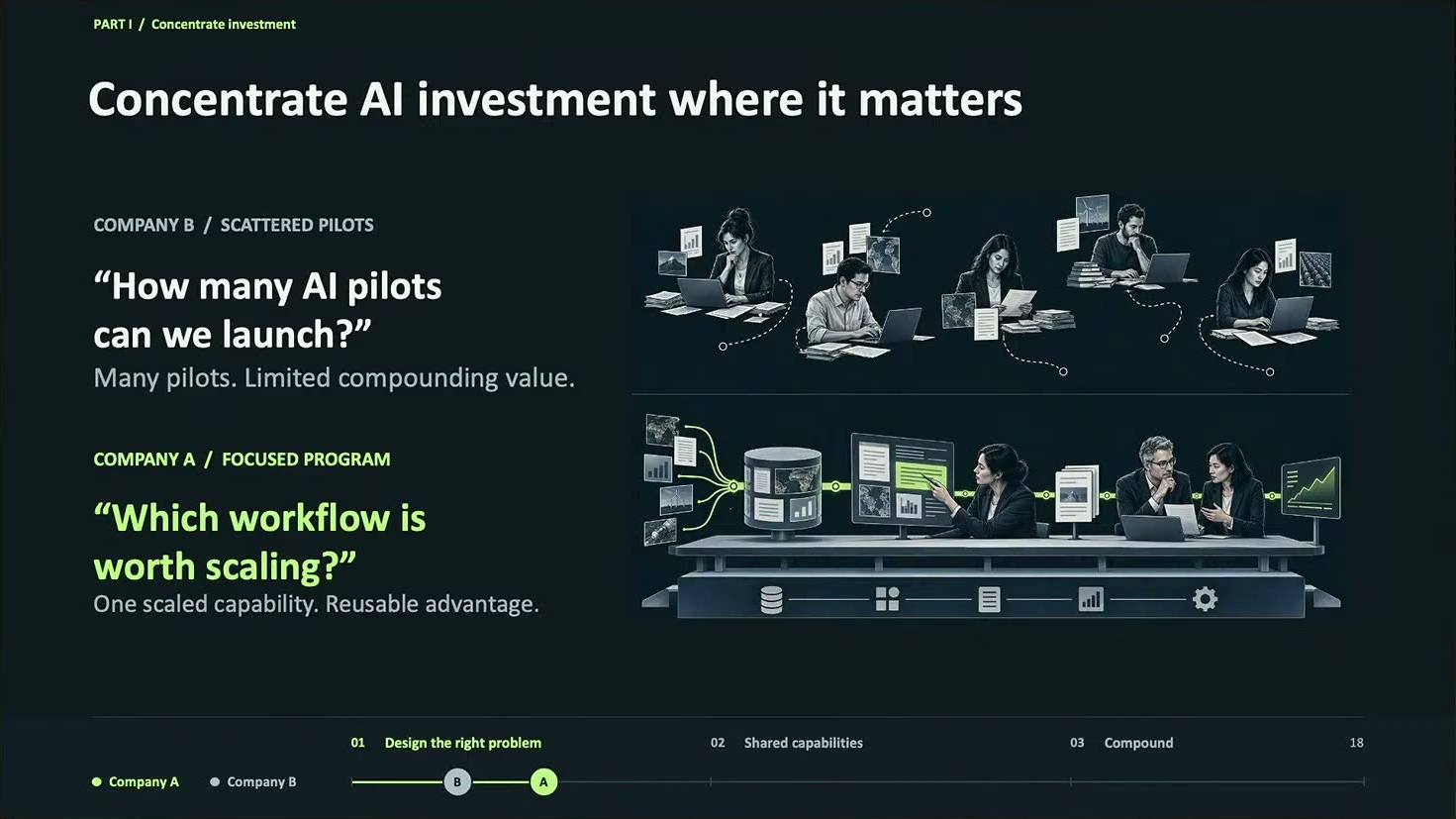
回到那两家假设中的公司,这意味着什么?公司 B 考虑的是:我们如何尽可能多地推出 AI 试点项目?最后呈现出来的可能是:这里有一个文档摘要机器人,那里有一个副驾驶工具,这里又有一个数据检索机器人。这些项目散落在各处。而公司 A 的投资重点则可能是端到端工作流程这样的用例,覆盖整个研究流程。他们专注于协调工程、分析、AI、能力建设和判断力,使之服务于同一个目标。
Going back to our two hypothetical companies, what does this mean? Company B is looking at how do we launch the most number of AI pilots? And what that ends up looking like is a document summarization bot here, a co-pilot there, a data retrieval bot here. It's scattered all over the place. whereas what company A is focused on in their investments is potentially use cases like end-to-end workflows on the research pipeline. They're focused on aligning engineering, analytics, AI, capacity, and judgment towards a singular focus.
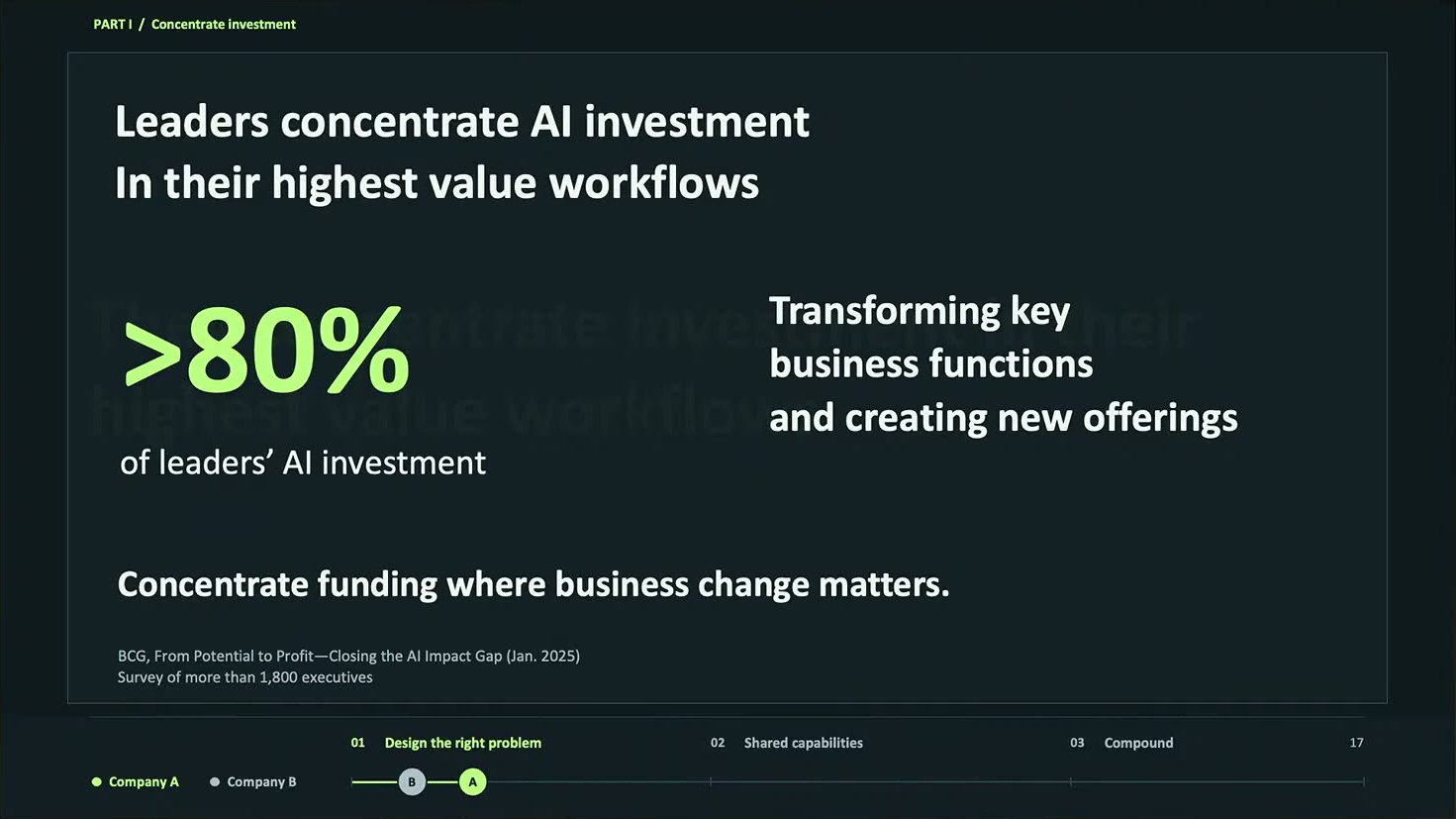
研究表明,领先者会把超过 80%的投资用于这些高价值用例,改造关键业务职能,并创造新的产品或服务。很好。我们知道,他们专注于找到正确的问题,也会投入大量资源到精选的工作流程中。此外,他们还有另一种不同的做法。他们重新构想工作的完成方式。我认为这一点很关键。这又回到了我们之前讨论的判断力。
And research has shown that the leaders spend more than 80% of their investments on these high-value use cases, transforming key business functions and creating new offerings. Perfect. We know they're focusing on finding the right problem, and they're also spending deep investment in select workflows. Well, they're also doing something different. They're reimagining how work is done. I think this is key. And it goes back to what we discussed previously, which is judgment.
他们正在重新定义并重组职能、角色和能力配置,围绕判断力这一关键要素。
They're redefining and reorganizing functions, roles, capacities around this key element of judgment.
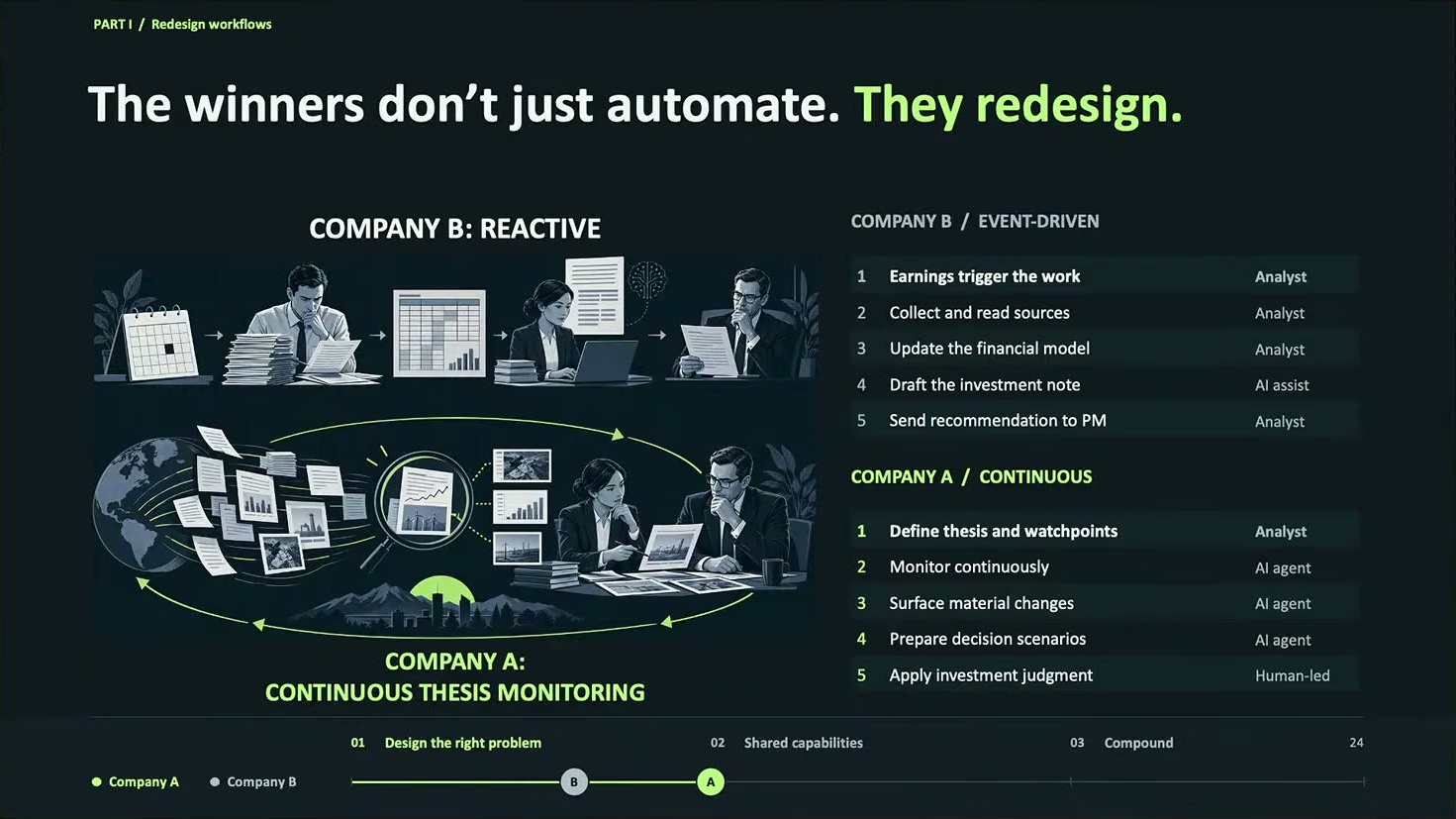
这对我们假设中的公司意味着什么?正如我们讨论过的,公司 B 可能关注的是:我拿到业绩电话会文字稿,也拿到研究报告。我该如何总结它们?也许可以让这件事更快一些。也许我可以更快地更新财务模型。也许我可以更快地把投资建议发给我的投资组合经理。公司 A 关注的则完全是另一回事。假设他们会让分析师明确提出投资论点,然后持续观察并收集可能反驳或支持该论点的证据。他们会持续监控、调查异常情况,并深入研究精选案例,从而有可能真正创造价值。
What does that mean for our hypothetical company? Well, company B might be focused on, as we discussed, I'm getting my earnings transcript, I'm getting my research reports. How do I summarize it? Maybe I make that faster. Maybe I update my financial models faster. Maybe I send my recommendation to my PM faster. Company A is focused on an entirely different ballgame. Hypothetically, they could be asking the analyst to define the investment thesis, and they're watching and gathering evidence that could refute that thesis or support it. They'd be monitoring continuously, they'd be investigating exceptions, and they could be deep diving on select examples that could lead to actual generation of value.
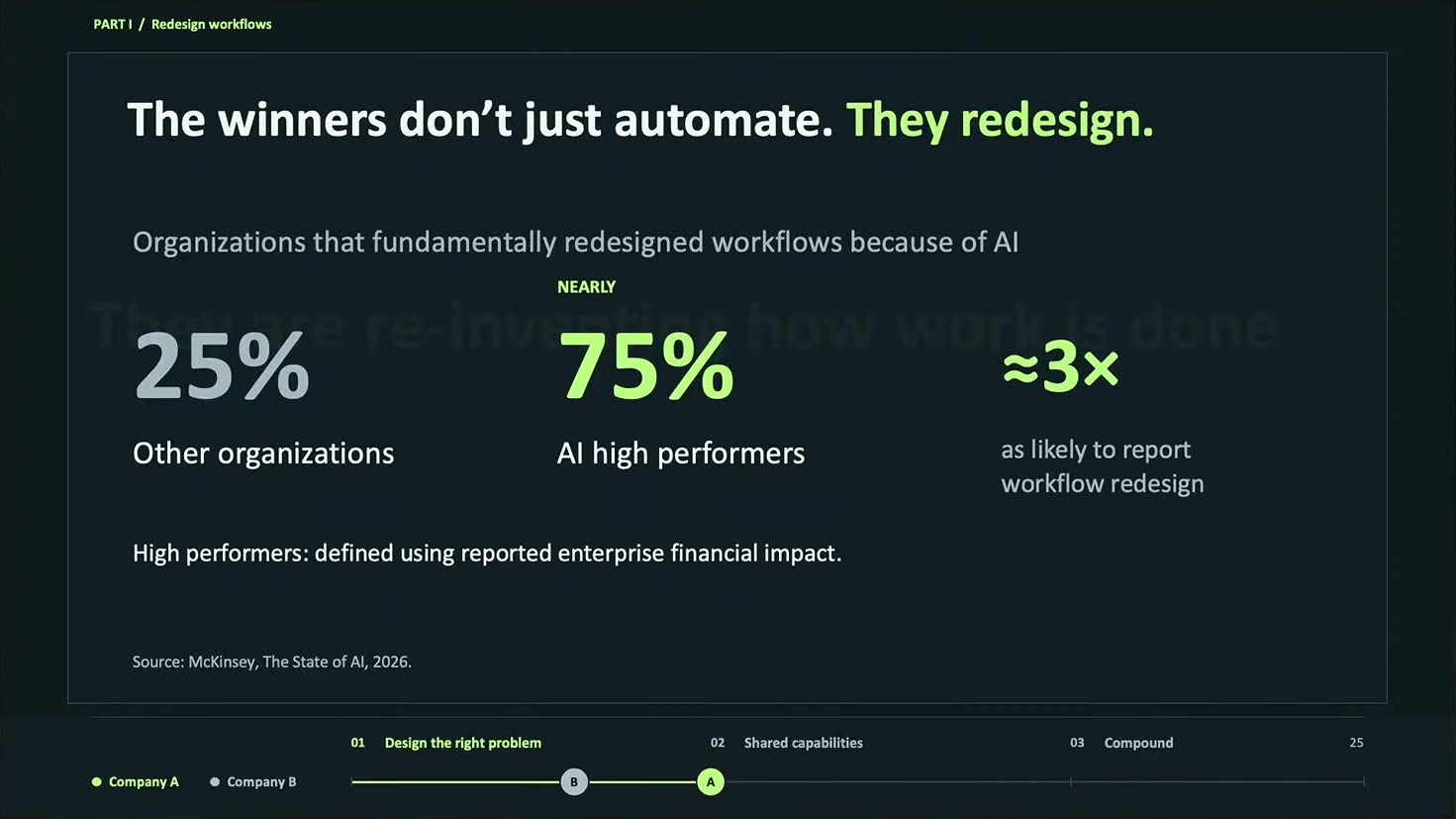
所以,赢家不只是自动化,而是重新设计工作。研究显示,高绩效者这一组高绩效者重新设计工作流程的可能性高出 75%;或者说,实际上,他们确实会重新设计自己的工作流程,而另一组中这样做的比例是 25%。
So the winners don't just automate, they redesign. studies show that the cohort of high performers are 75% more likely, or in practice, they actually do redesign their workflow versus 25% of the cohort that doesn't.
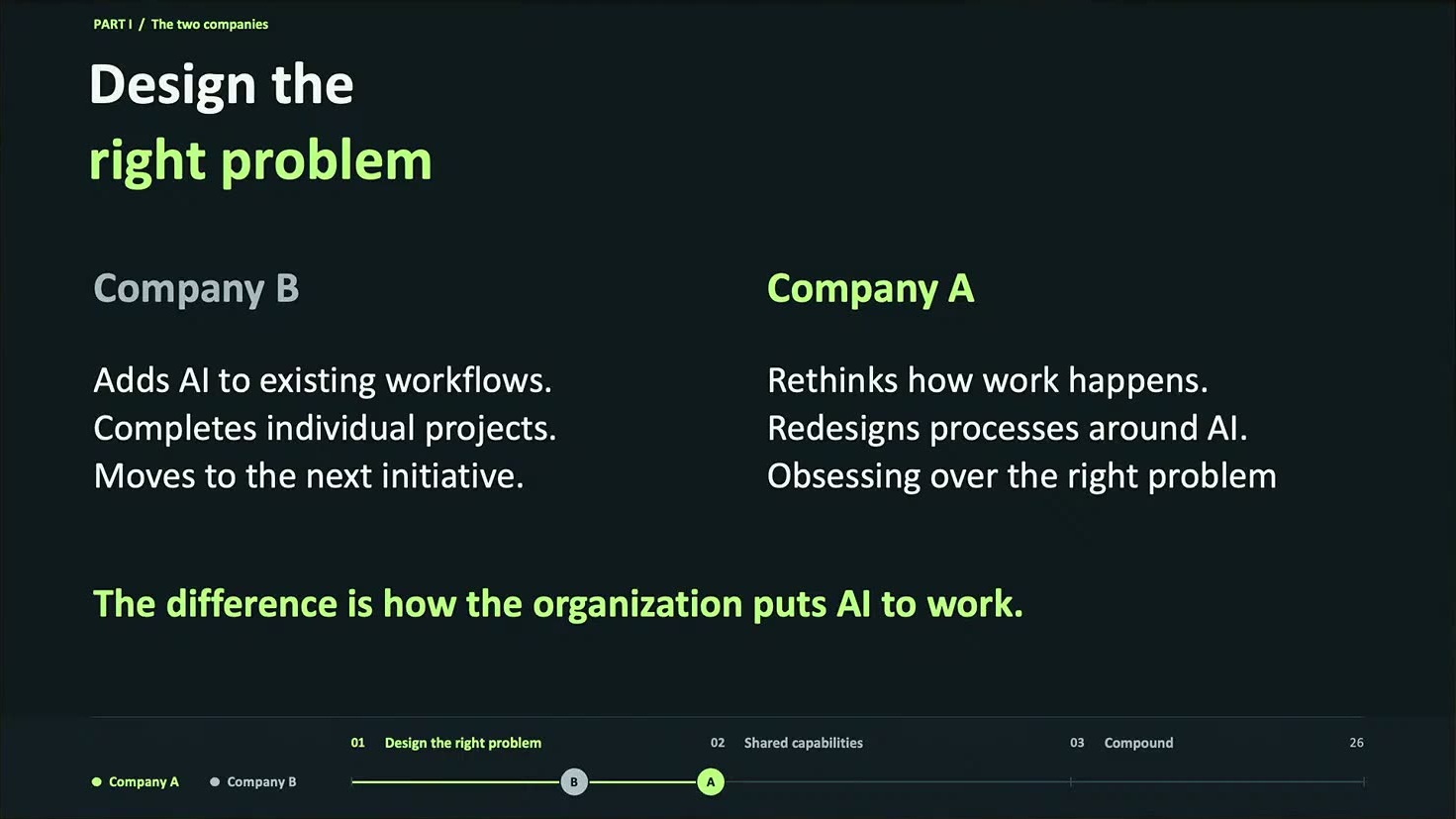
那么,在设计正确问题这件事上,我们假设的两家公司各自处于什么状态?公司 B 把 AI 加到现有工作流程中,完成一个个独立项目,然后转向下一个计划;而公司 A 则重新思考工作的完成方式,围绕 AI 重新设计流程,并执着于找到正确的问题。这就是各个组织运用 AI 的方式为何不同。很好,他们已经选定了正确的问题。接下来会发生什么?我们都知道,要真正释放这种能力,
So where does this leave us with our two hypothetical companies and designing the right problem? Company B adds AI to existing workflows, they're completing individual projects and they're moving to the next initiative, whereas Company A is rethinking how work is done. They're redesigning processes around AI and they're obsessing over the right problem. That's the difference in how organizations put AI to work. Great, so they've picked the right problem. What happens next? Well, we all know in order to actually enable that capacity,
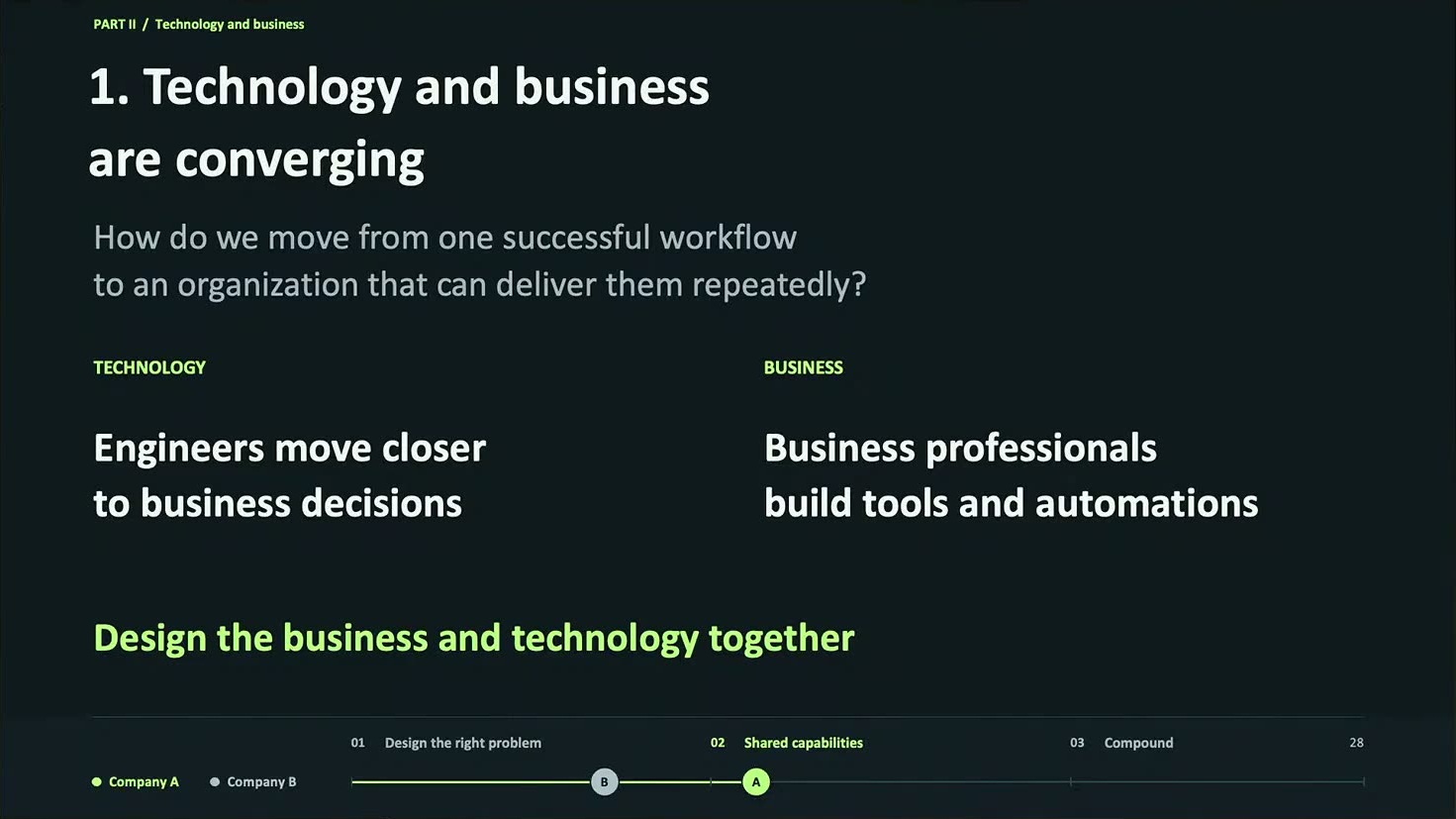
就需要在整个组织中构建共享能力。而近来似乎逐渐显现的一种趋势是,技术与业务之间的界线正在融合。我们到处都能看到这种现象。我们看到工程师的工作越来越贴近业务成果。我们也看到业务人员在构建工具和自动化流程。正如你所看到和设想的,可以有驻场工程师,也可以有驻场产品经理,还可以反过来设立驻场投资组合经理。而领导者真正倚重的,正是通过打破组织孤岛,把合适的人聚到一起。
you need to build share capabilities across the org. And what's a trend that's seemingly emerging for some time now is that the lines between technology and business are converging. And we're seeing this everywhere. We're seeing engineers that are moving closer to business outcomes. We're seeing business professionals that are building tools and automations. And as you can see and imagine, you can have forward deployed engineers, you can have forward deployed product managers, but you could also have the inverse, which is forward deployed portfolio managers. And it's really this combination of getting the right people in the room by breaking down organization silos that the leaders are really leaning on.
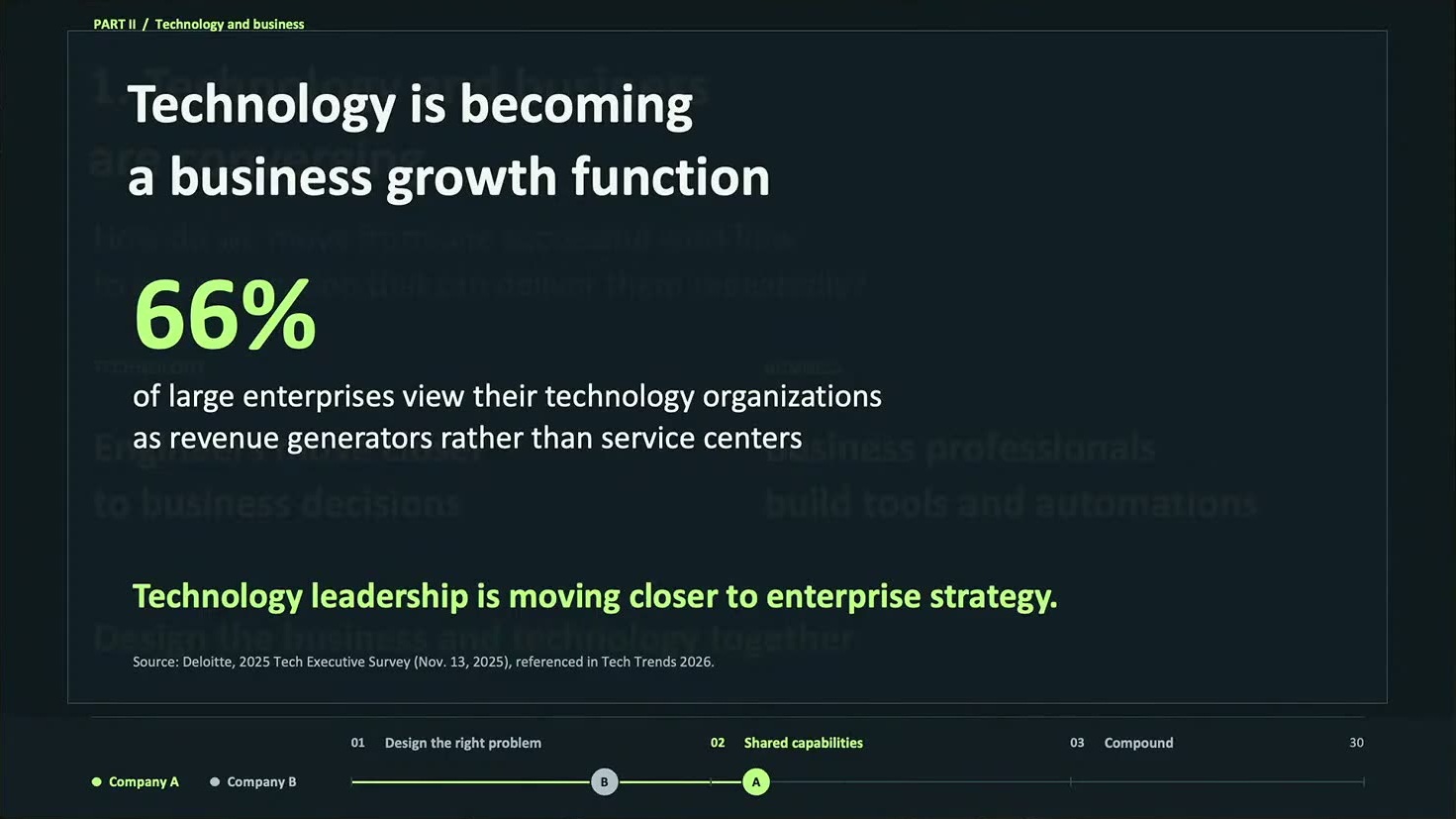
研究显示,越来越多的大型企业把自己的技术部门视为业务增长职能,这也为这些公司创造了优势。
studies have shown that more and more of the large enterprises are viewing their technology arm as a business growth function and that's creating an edge for these companies
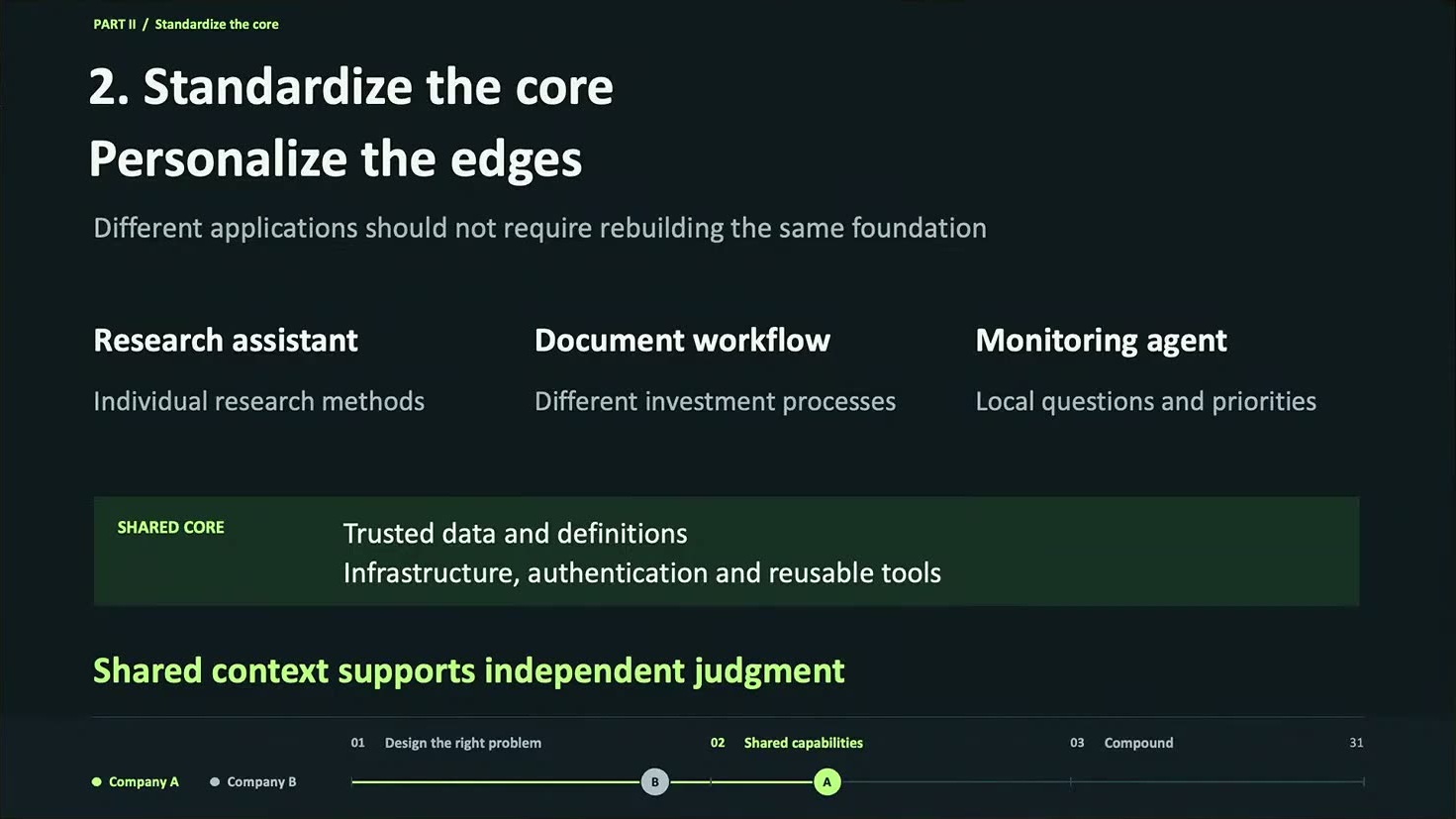
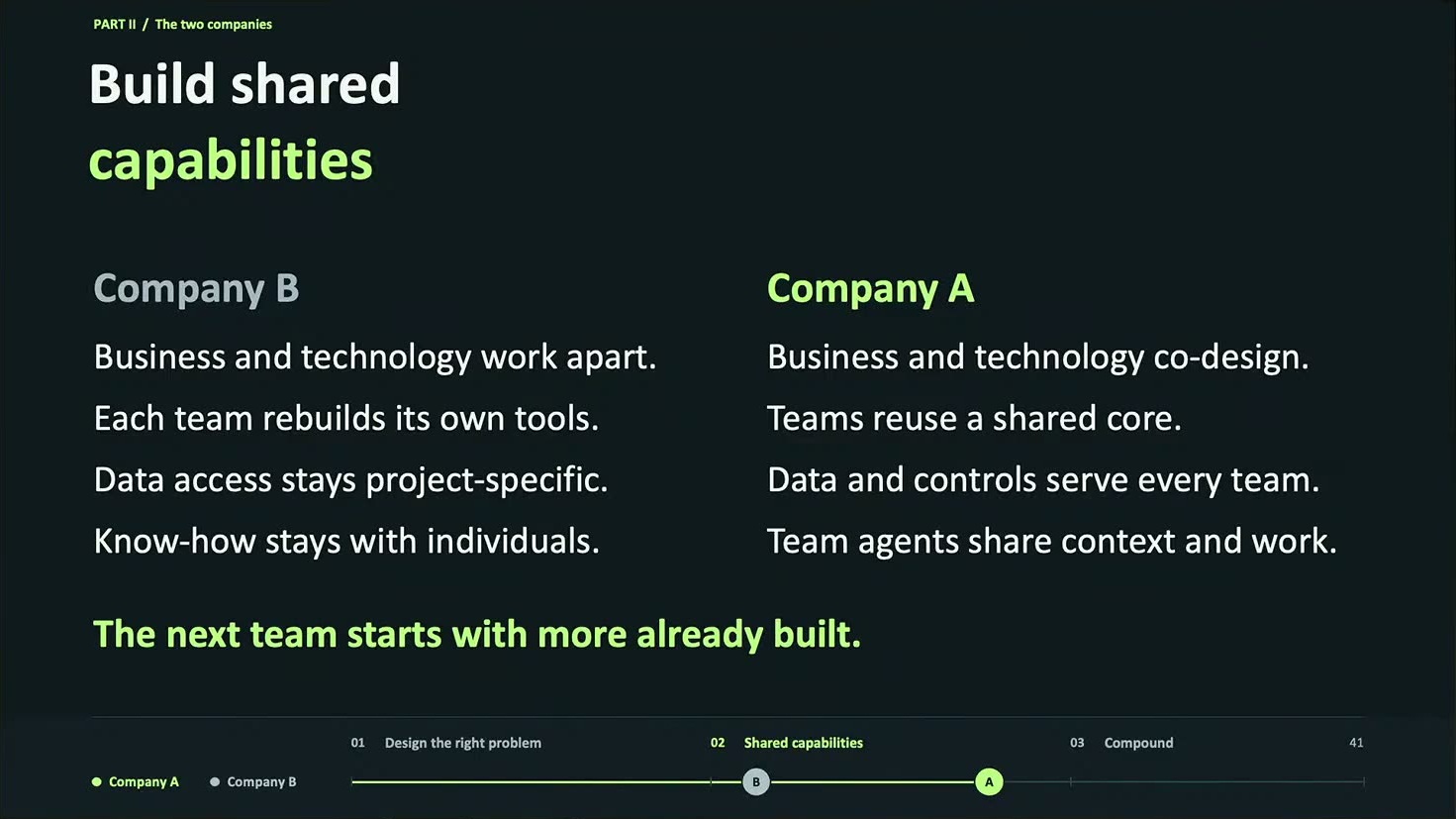
而我个人很喜欢的、构建共享能力的另一条路径是,标准化核心,并让边缘部分个性化。这在技术领域并不是什么新概念。我们已经构建了基础设施。我们也构建了共享模块和系统设计。但如今有趣的是,随着现有能力的发展,做法呈现出非常不同的形态,组织结构也在变化,孤岛也在被打破。
so the other sort of vertical inside building shared capabilities that is probably a personal favorite of mine it's standardizing the core and personalizing the edges And this is something that isn't new to the technology world. We've built infrastructure. We've built shared modules and system design. But what's interesting here today is that's taking a very different shape with the capabilities out there and with the org and the breaking down of silos.
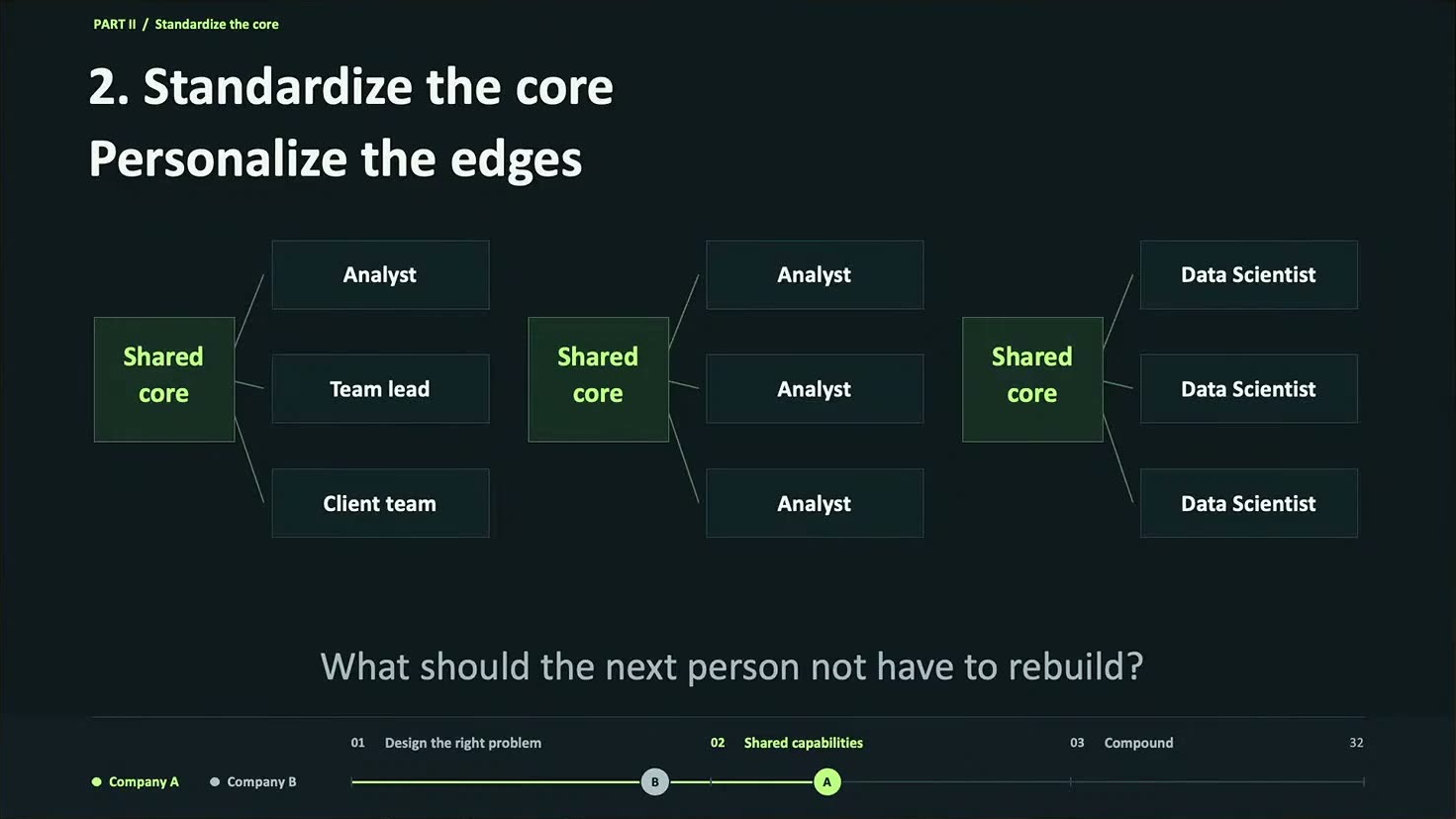
根据你所在的位置,这可能会有很不一样的呈现方式。你可以为一个团队构建共享核心,而这个团队的构成可能截然不同。包括分析师和客户。你可以和一群分析师一起这样做,也可以为软件工程师这样做,或者为数据科学家这样做。尤其是以数据科学家为例,这可能会很有意思:与其采用一次性的工作流程,而这在业内确实很常见,你可以构建一个共享核心,其中包括数据集及其语义层,包括哪些做法有效、哪些无效,以及其中的权衡,包括某些数据集擅长什么,还包括存在哪些缺口,等等,这样一来,每位新加入的员工就几乎成了系统中一个即插即用的模块,可以在系统里站在前人的肩膀上继续前进。
And this could look very different depending on where you sit. You could be building shared cores for a team that looks very different with analysts and clients. You could be doing that with a bunch of analysts, or you could be doing that for software engineers or data scientists. With the data scientist example in particular, that could look very interesting where instead of having one-off workflows that is really common in the industry, you could build a shared core of the data sets, their semantic layers, the trade-offs of what worked, what didn't, what some data sets do good of, where are the gaps, and so on and so forth, such that each new personnel becomes almost a plug-and-play module in the system where they can then stand on the shoulder of their predecessors.
那么,下一位加入的人就不必再从头构建什么?
So what should the next person not have to rebuild?
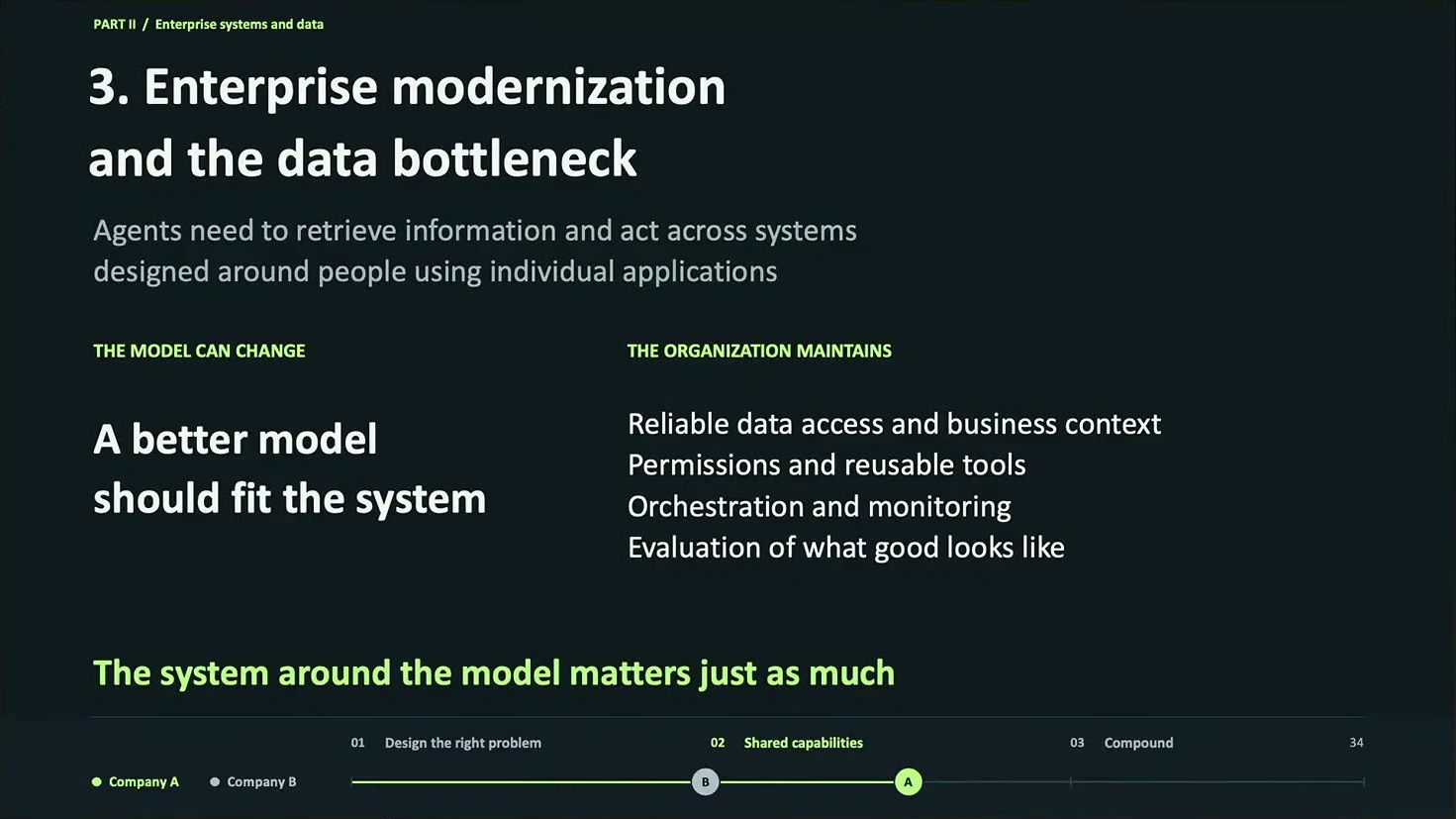
还有一点有意思的是,企业原本并不是为智能体而构建的。智能体会跨工作流程和应用运行,会获取上下文、进行思考,并采取行动;而企业过去主要围绕单个员工或一群员工与单个应用交互来构建。因此,领先者意识到有些事情必须改变,他们需要让基础设施实现现代化。他们也很清楚自己目前处于转型旅程的哪个阶段。
now what's also interesting is um you know the enterprise wasn't really built for agents um agents they they work across workflows and applications they they take context they uh deliberate they take actions whereas really the enterprises are focused um previously on a single human or a collection of them interacting with a single application. So the leaders are cognizant that something needs to change and that they need to modernize their infrastructure. And they're very self-aware of where they are in their journey.
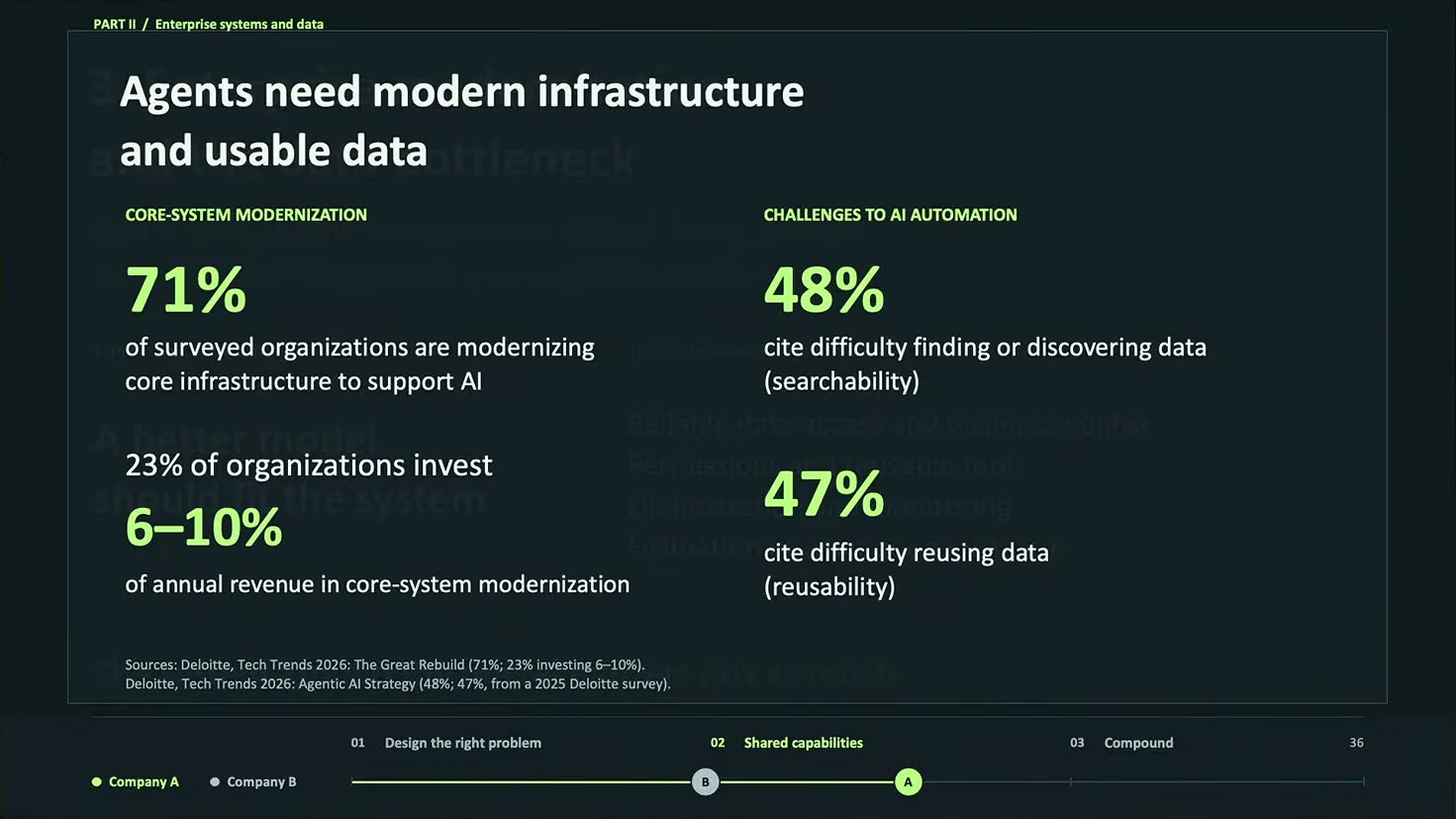
研究显示,71% 的组织正在对核心基础设施进行现代化改造,以支持 AI。其中 6% 到 10%,或者说 23% 的组织,正在投入其年度收入的 6% 到 10%用于核心系统现代化,以把握这一机遇。人们在这里经常抱怨、或者说经常遇到的一项挑战,是数据质量,以及重复利用数据的能力。很好,合适的人已经聚在一起了。需要的知识也已经具备。接下来该做什么?
And so studies show that 71% of the orgs are modernizing their core infrastructure to support AI. and 6% to 10% or 23% of them are investing 6% to 10% of their annual revenue in core system modernization to take advantage of this. And a common complaint here or a common challenge here is data quality and the ability to reuse data. So, great. We have the right people in the room. We have the right knowledge there. What do we do next?
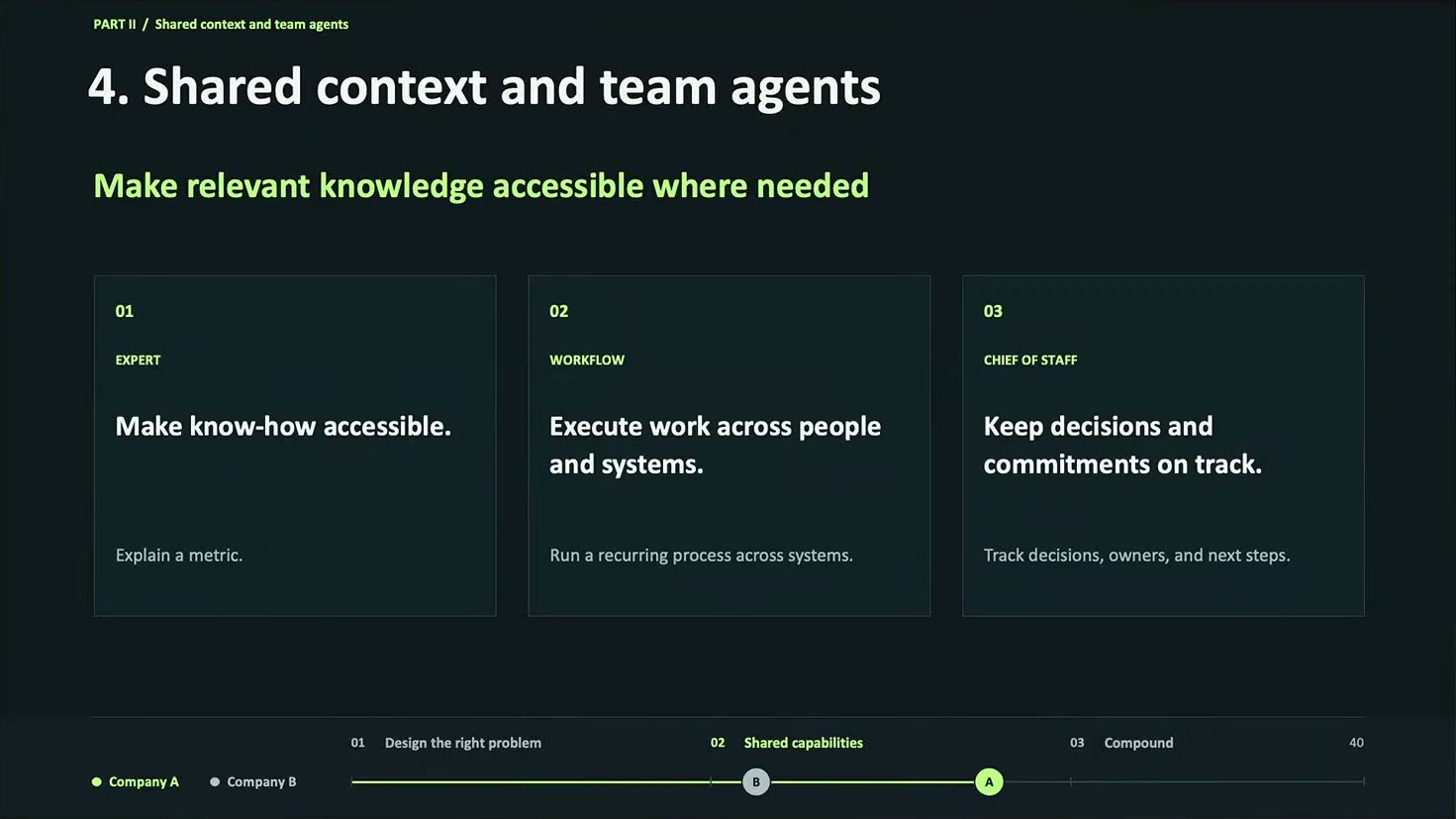
接下来就要考虑:如何让这些知识能够重复利用并且容易获取?根据采用程度和所处阶段,可以使用不同类型的团队智能体,例如作为主题专家的专家智能体。也可以有跨工作流运行的工作流智能体,比如创建并打开工单的 Slack 机器人,它们还会关闭工单,等等。此外,还可以有类似幕僚长的智能体,
And then comes the concept of, hey, how do we make this knowledge reusable and accessible? And that's where we have, depending on the adoption and where they are, you can have different types of team agents, where you can have expert agents being subject matter experts. You can have workflow agents that work across streams like Slack bots that are creating and opening tickets. they're closing them, and what have you. And then you can have really chief of staff kind of agents
持续掌握组织当前的状态,以及接下来需要完成什么。回到我们的工作流程,公司 A 再一次采取了完全不同的看法,这次是在共享能力方面。
that keep a tab on what the state of the organization is and what needs to be done. So, you know, going back to our workflows, A, again, is looking at this very differently in terms of shared capabilities.
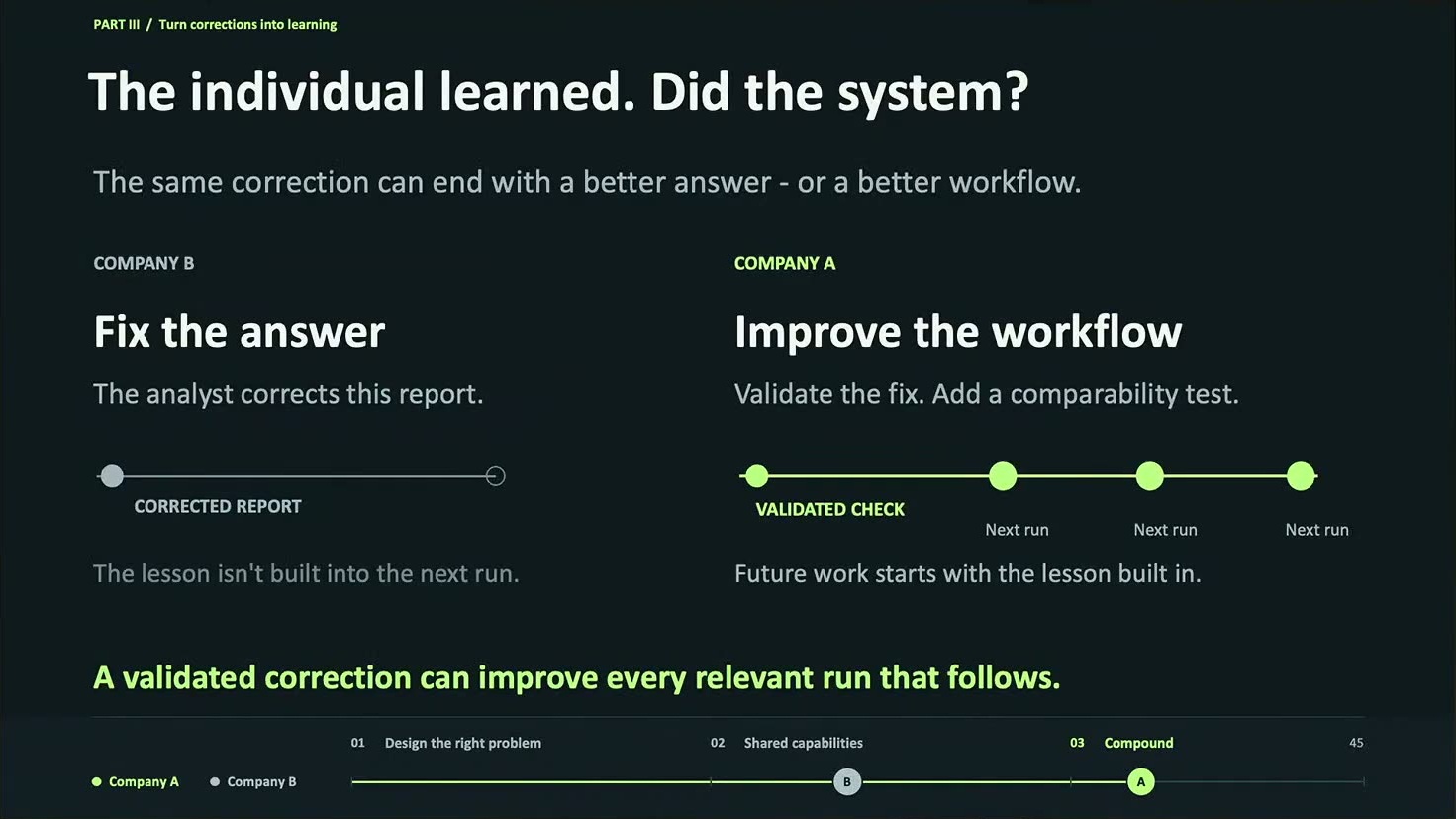
现在,我想请你关注最后一项支柱:这个系统要到什么时候才能真正产生复利?部署之后会发生什么?领先的公司实际上会以稍有不同的方式思考这个问题。哪些失败能让我们获得优势,从中学习?如果取得了成功,我们该如何把它纳入系统?他们思考的是:个人学到了东西,但系统学到了吗?当他们遇到需要纠正的情况时,是否有办法把这些知识反馈到组织中,例如通过新工具、新上下文,或其他方式?
Now, the last pillar here that I want to draw your attention to is, well, when does this system really compound? What happens when it's deployed? Well, the leading companies, what they're doing is they're actually thinking about it slightly differently. What are failures that can give us an edge that we can learn from? If there's a success, how do we make it part of the system? And the way they think about this is, you know, the individual learned but did the system. Is there a way, perhaps, when they've encountered something where they need to make a correction, that that knowledge is fed back into the org, either through a new tool or context or what have you.
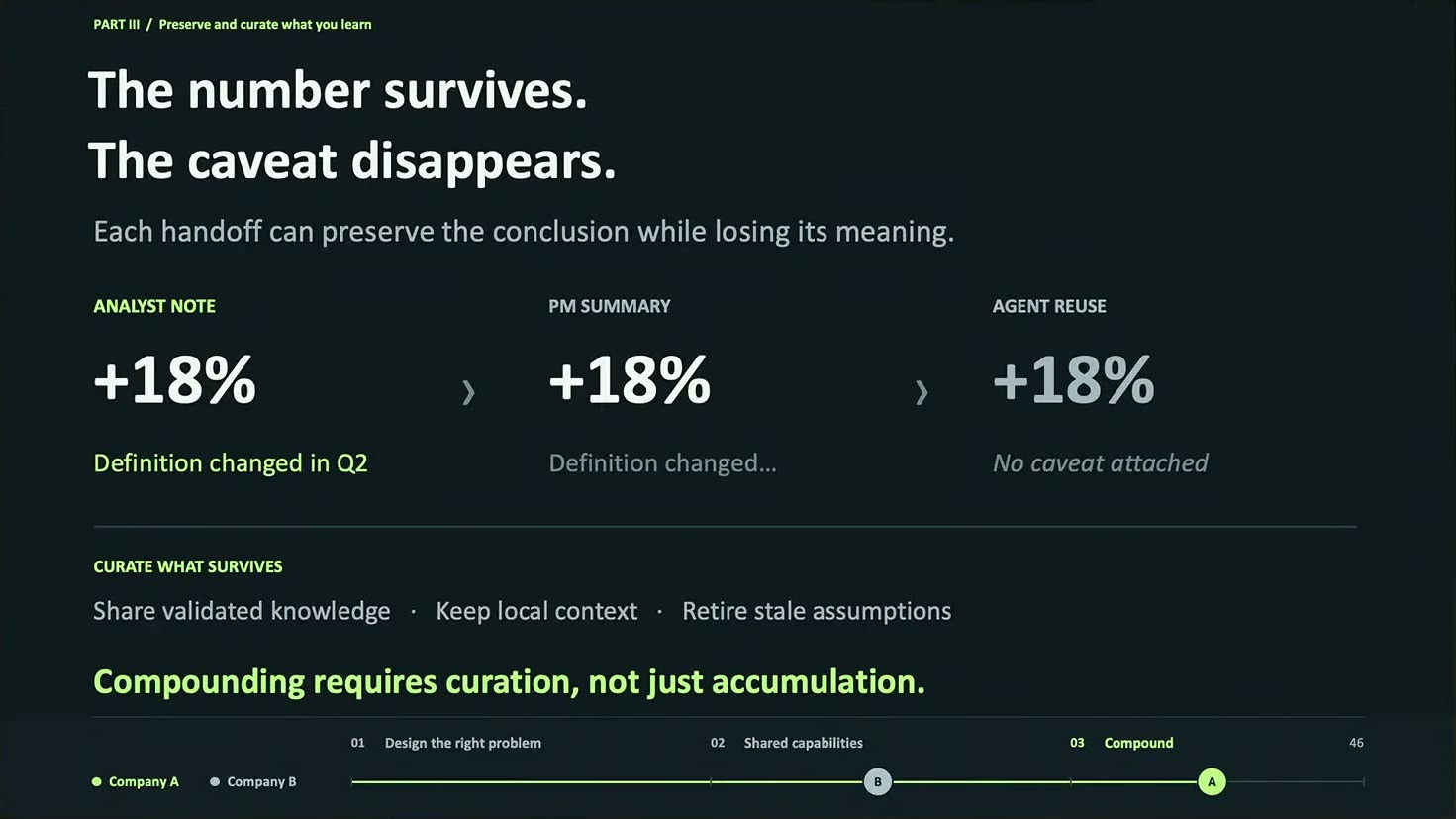
关键在于,要连同这些经验教训一起保留证据。所以,最后一项支柱实际上是释放 AI 带来的能力。这些能力会流向哪里?要意识到,你需要重新设计系统,并真正围绕你正在评估的关键指标来聚焦,持续监控这些指标,并以此形成增长飞轮。
And what's key here is preserving the evidence along with those learnings. So really the last vertical here is AI freeze capacity. Where does it go? Being cognizant that you need to redesign your system and really focus it on key metrics that you're evaluating, you're monitoring, and you're creating a flywheel off.
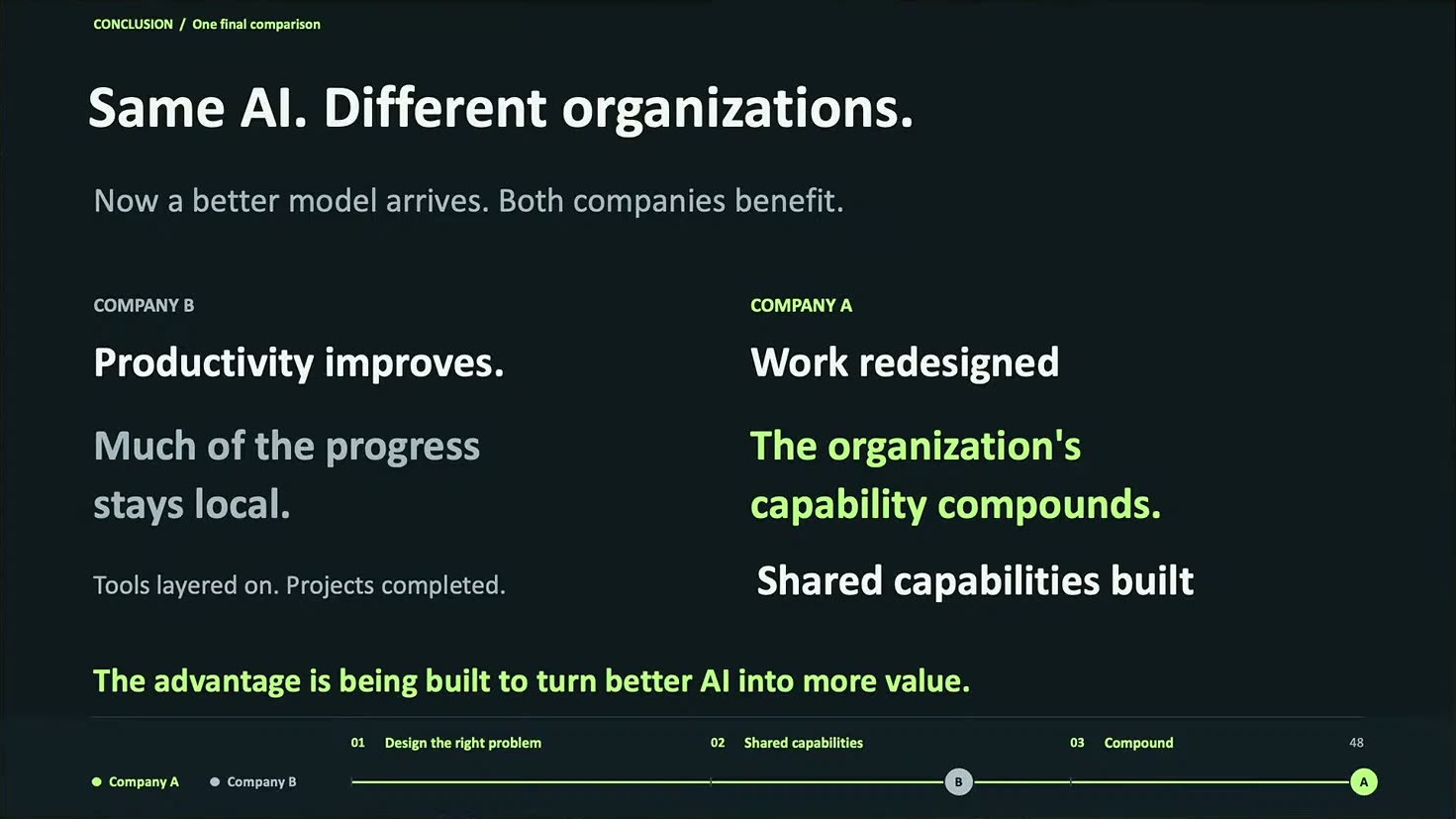
那么,对于公司 A 和公司 B,结论是什么?公司 A 已经重新设计了整套工作。他们在构建能够产生复利的能力,也已经建立了共享能力。
So where does this leave us for companies A and B? You know, company A has their entire work redesigned. They're building capabilities at Compound, and they have shared capabilities built.
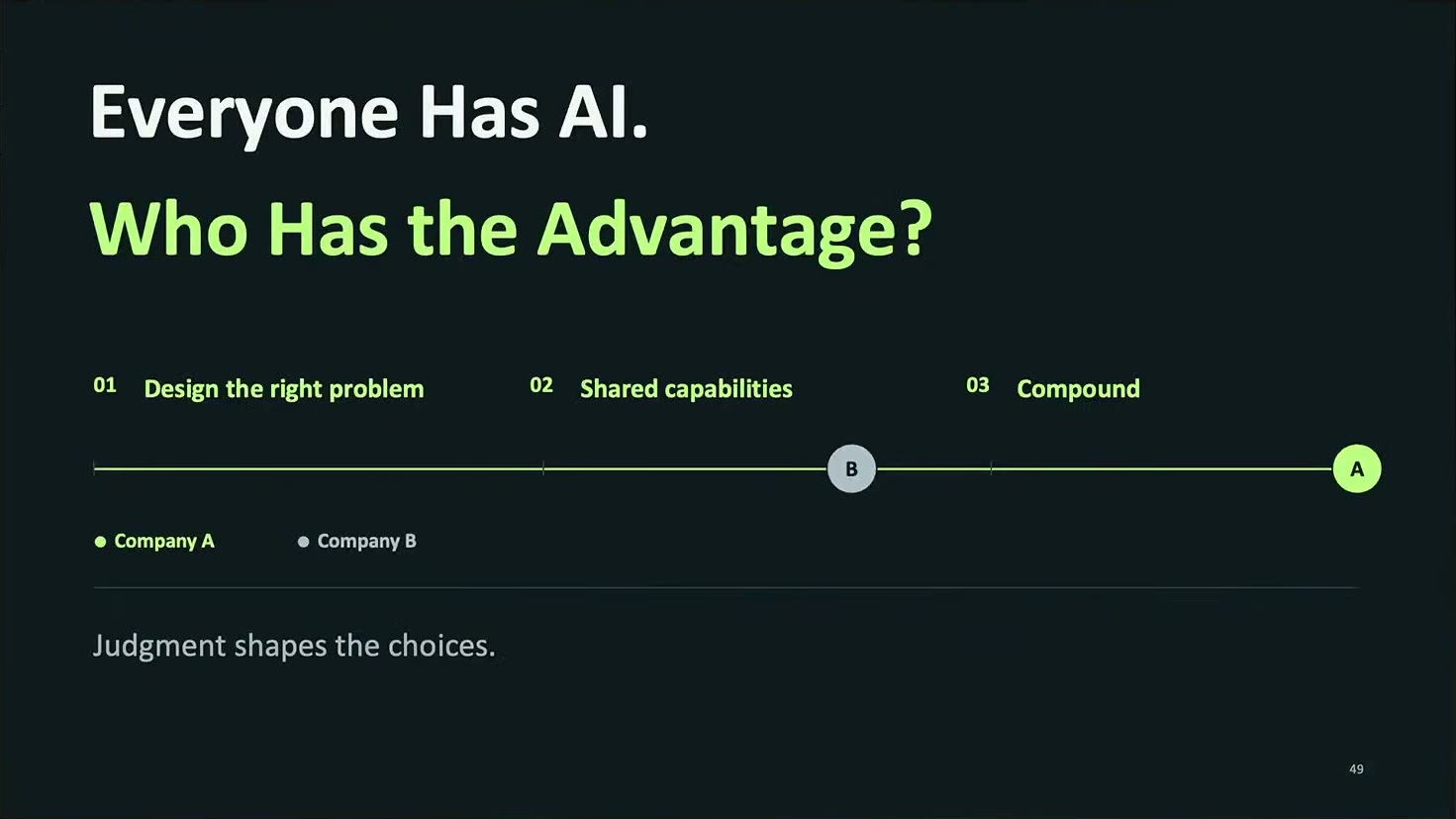
最后,我想留给大家一个问题。人人都有 AI,谁能占据优势?谢谢。
So I want to leave you off with one final question. Everyone has AI. Who has the advantage? Thank you.