为 AI 智能体平衡提速与安全
Balancing Acceleration and Safety for AI Agents
原文由官网提供,中文由 GPT-6 Luna 翻译。相邻片段合并排版,正文与时间点保持对应。
已插入 30 张经核对的幻灯片或演示截图;点击图片可放大。图注链接为当前视频时间,左侧正文时间保留原转录版本,二者可能不同。
共 40 个阅读段落
嘿,好,我把水放在那边,放得挺悬的。我叫 John Feminella。我在 Two Sigma 负责 AI 架构和工程,这是一家位于纽约的对冲基金。在我深入讲之前,
Hey, All right, I precariously balanced my water over there. My name's John Feminella. I work on AI architecture and engineering at Two Sigma, which is a hedge fund here in New York. Before I get too far into things,
我得给你们看一张法律免责声明幻灯片,上面说了两件事。第一,我保证在这场演讲的任何时候都不会向你们推销、营销或提供任何证券,也不会提供这类东西。第二,下面所有内容都是我个人的观点,并不代表 Two Sigma 的观点。谢谢大家配合我走这个流程。如果我不说出那些神奇的话,我体内植入的 5G 微芯片就会爆炸。所以,实际上那张幻灯片就是一个很好的例子,说明我们这个行业是如何受到监管的。作为一家有很多管控措施的受监管公司,我觉得有件事总是很有意思,那就是探究管控失效时会发生什么,因为这能让你很好地了解,这些管控最初为什么会存在。
I have a legal disclaimer slide that I have to show you that says two things. One, I promise not to sell or market or offer you any securities at any point in this talk. and two, everything in this is my own opinion and not the opinion of Two Sigma. Thanks for indulging me. If I don't say those magic words, the 5G microchips implanted in me will explode. So that slide is a good example, actually, of how our industry is regulated. And as a regulated company with lots of controls, I think one thing that's always interesting is to explore what happens when controls fail because that gives you a good idea about why the controls were there in the first place.
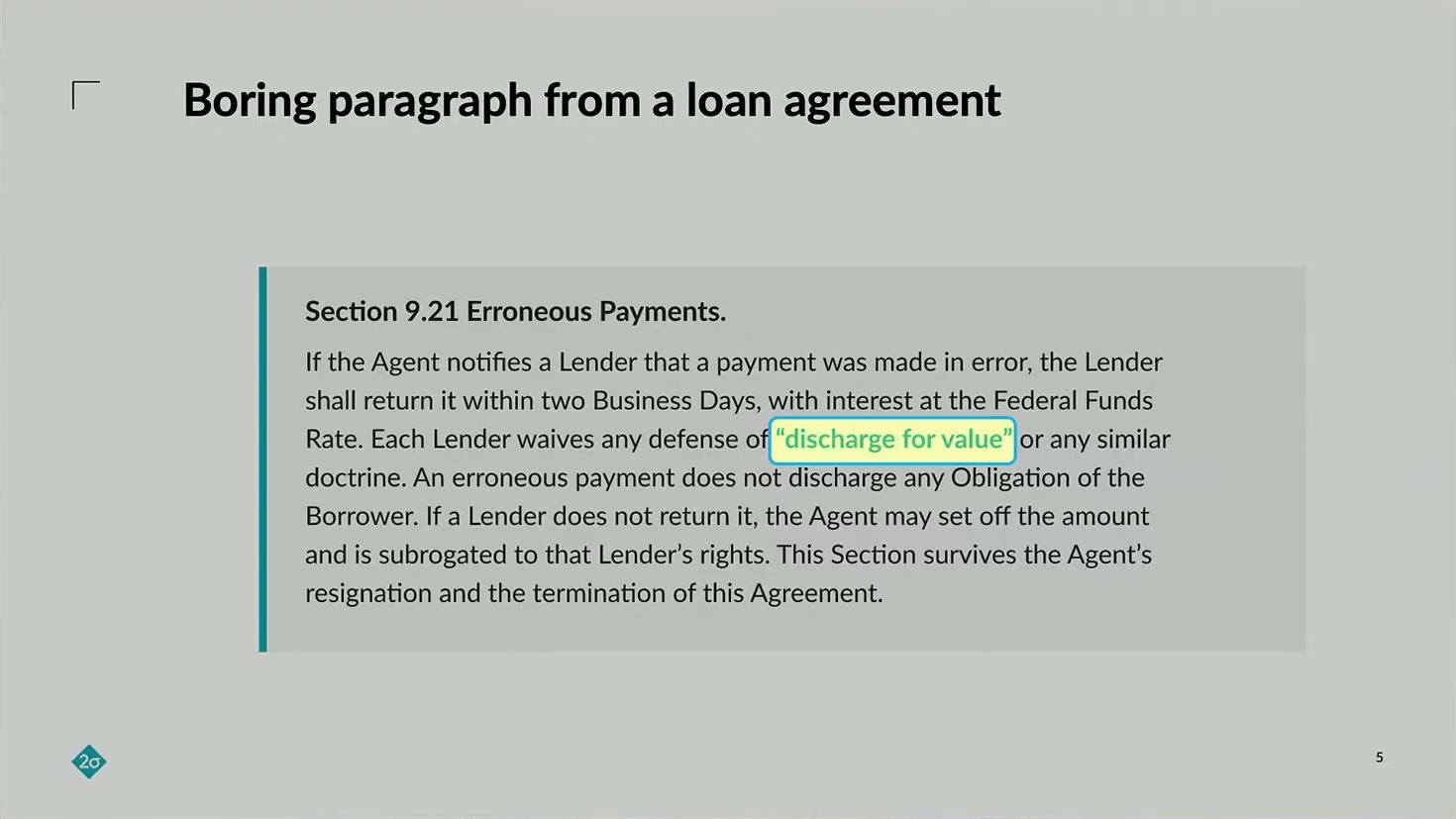
所以我想给你们讲个故事,通过再给你们看一张法律幻灯片来说明这一点。2020 年 8 月之后,一条很有意思的合同条款突然开始出现在一大批商业贷款协议里。这条款本质上是想防止某种情况发生。这事挺复杂,我这样解释吧。假设你经营一家柠檬水摊,向贷款方借钱来给你的柠檬水摊筹集资金,让它运转起来。而负责监督这笔交易的银行,也就是处在借款人和贷款方之间的那家银行,犯了个灾难性的错误,把你欠的所有钱都转给了贷款方。你大概会很生气,想把钱要回来,但贷款方也可能会说:不了,谢谢,你已经还清了,我们两清了,所以我们宁愿把钱留下。
And so I'd like to tell you a story about that by showing you another legal slide. After August 2020, a very interesting contract clause suddenly started showing up in a bunch of commercial loan agreements. And this clause essentially tries to prevent a certain scenario from happening. And it's complicated, but I'll explain it like this. Let's say that you're a lemonade stand business, and you borrow money from a lender to capitalize your lemonade stand. and the bank that's overseeing that transaction, that's in the middle between the borrower and the lender, sends the lender all of the money that you owe in a catastrophic mistake. You'd probably be mad and want the money back, but the lender might also say, no thanks, you paid us back and we're all good, so we'd rather keep the money.
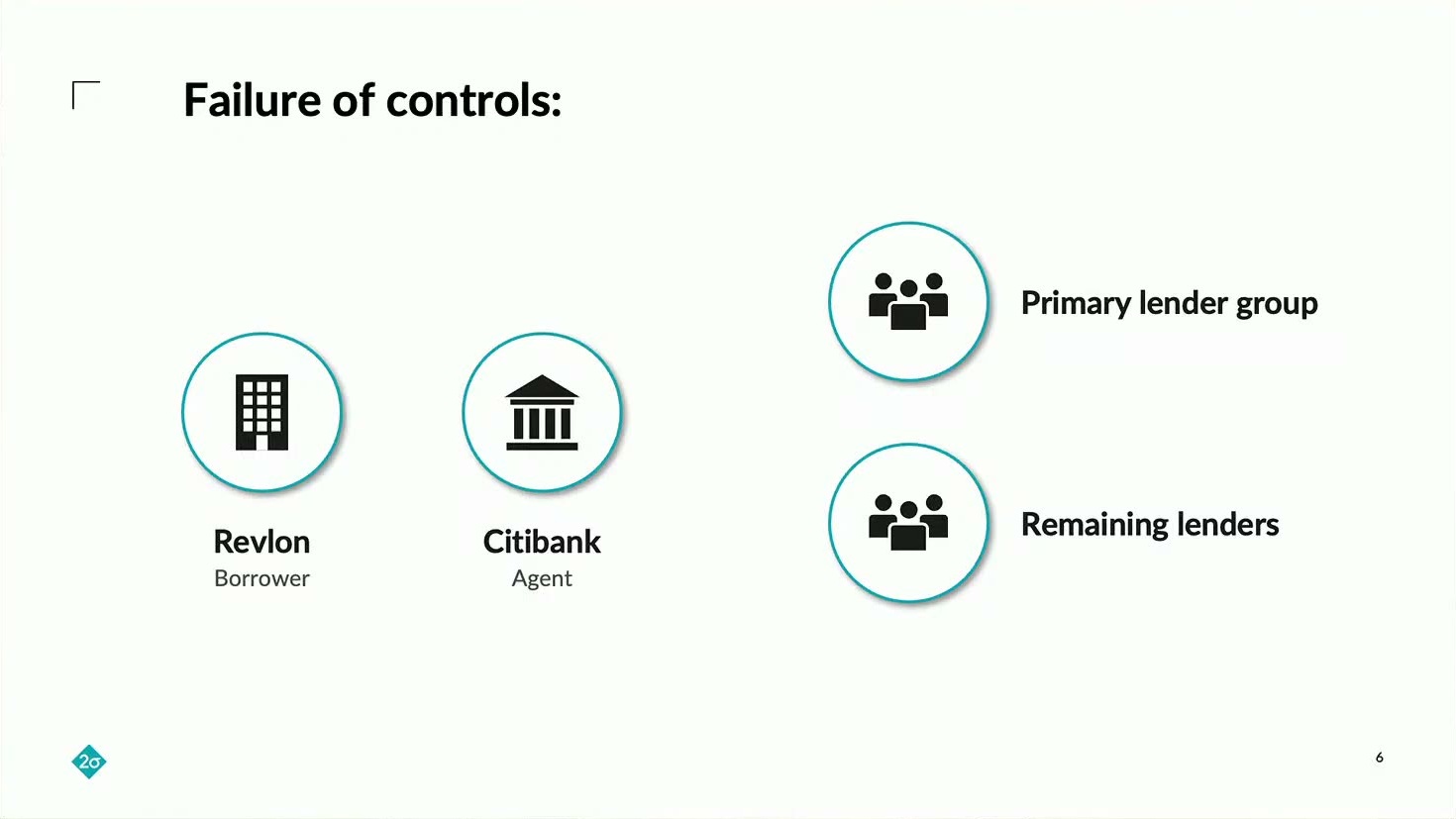
2020 年 8 月就发生了类似的事。化妆品公司 Revlon 根据一笔规模很大的 2016 年定期贷款借了钱。这笔贷款被拆成许多份,分布在 300 多家贷款方、对冲基金、信贷基金、CLO 和其他银行手中。而居中的是作为行政代理人的 Citibank。在这类交易中担任代理人,意味着你负责搭建连接借款人和贷款方的流程,并管理贷款的整个生命周期。所以在这笔交易里,Revlon 付钱给 Citi,然后 Citi 再付给贷款方。Citi 并没有贷出自己的钱。它只是在中间,替别人转移资金。
Something like this happened in August 2020. Revlon, the cosmetics company, had borrowed money under a big 2016 term loan. And that loan was split up into a bunch of pieces across 300-plus lenders, hedge funds, credit funds, CLOs, other banks. And in the middle is Citibank, the administrative agent. Being the agent in this kind of transaction means that you're performing the plumbing that connects the borrowers with the lenders and managing the lifecycle of the loan. So in this transaction, Revlon pays Citi, and then Citi pays the lenders. And Citi's not lending its own money. It's just in the middle, moving people's money around.
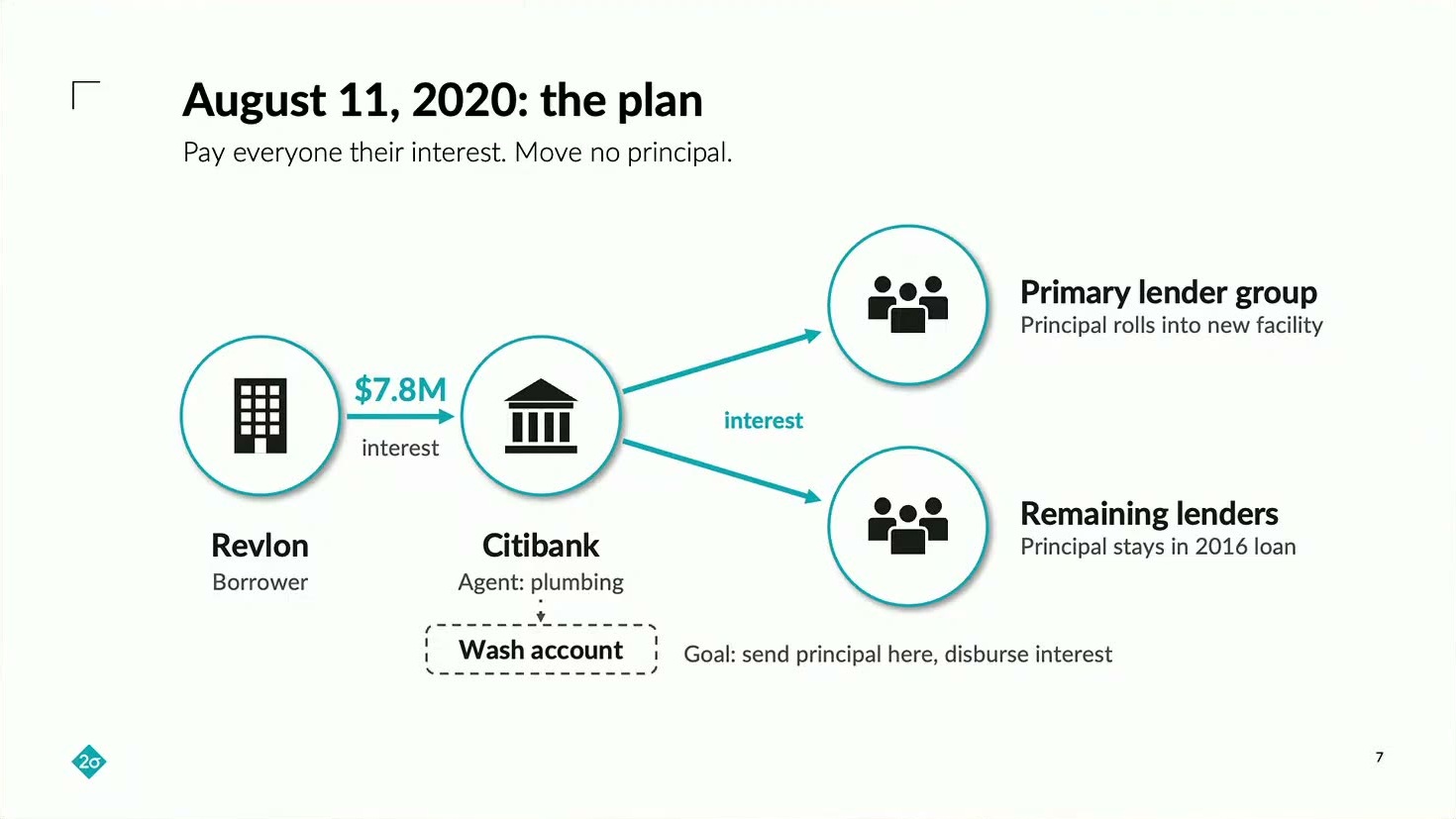
这是 2020 年 8 月 11 日的计划。Revlon 会向两组人支付大约 800 万美元的应计利息,而贷款方的本金会转入这项新的贷款安排。这是票据的置换,不是现金支付。所以剩余贷款的本金应该原封不动地留着,这里的意思是只有利息应该转出去。本金完全不该移动。
So here's the plan for August 11th, 2020. Revlon would pay about $8 million of accrued interest to both groups, and the lender's principal would roll into this new facility. That's an exchange of paper, not cash. So the remaining lender's principal would stay put, and the idea here is that only interest should be going out. Principals should not be moving at all.
银行有一款内部处理软件,叫 FlexCube。这企业软件的名字是不是挺有意思?在 FlexCube 里,处理这类交易最简单的办法,就是假装记录成 Revlon 偿还了整笔贷款。这样就会触发正确的利息付款计算,分配给所有人。你大概能猜到接下来要发生什么。所以本金部分本来应该转到银行自己持有的内部 WASH 账户,这样账目就能正确入账、记录,但钱不会离开银行的范围。
And the bank had a piece of internal processing software called FlexCube. Isn't that a fun enterprise software name? in FlexCube, the easiest way to do this kind of transaction is to pretend to record it like Revlon were paying off the entire loan. And that triggers the correct interest payment calculations to everyone. You can probably guess what's about to happen next. So you're supposed to send the principal portion to an internal WASH account that you own as the bank so that it's booked and recorded correctly, but it never leaves the bank's perimeter.
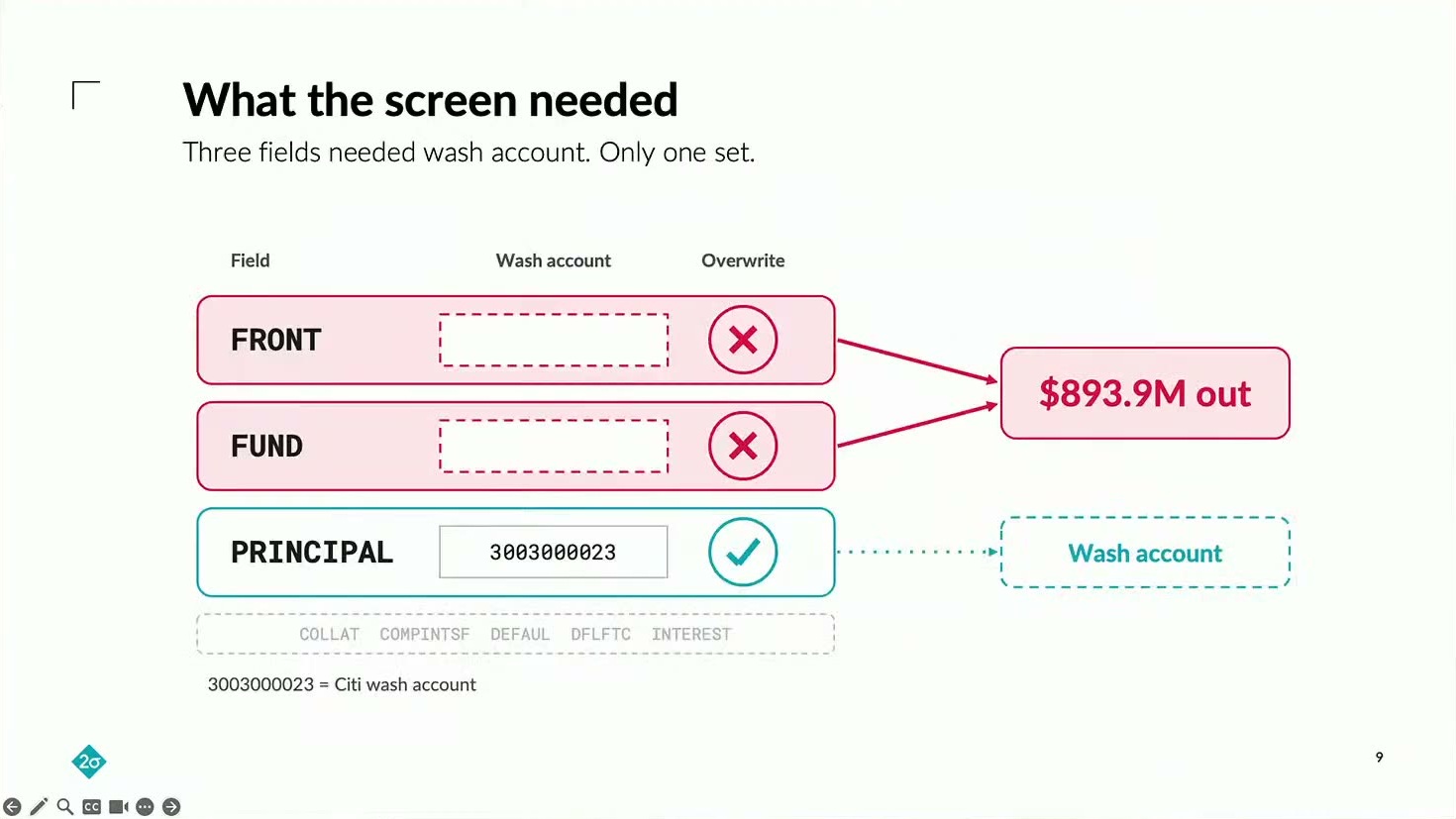
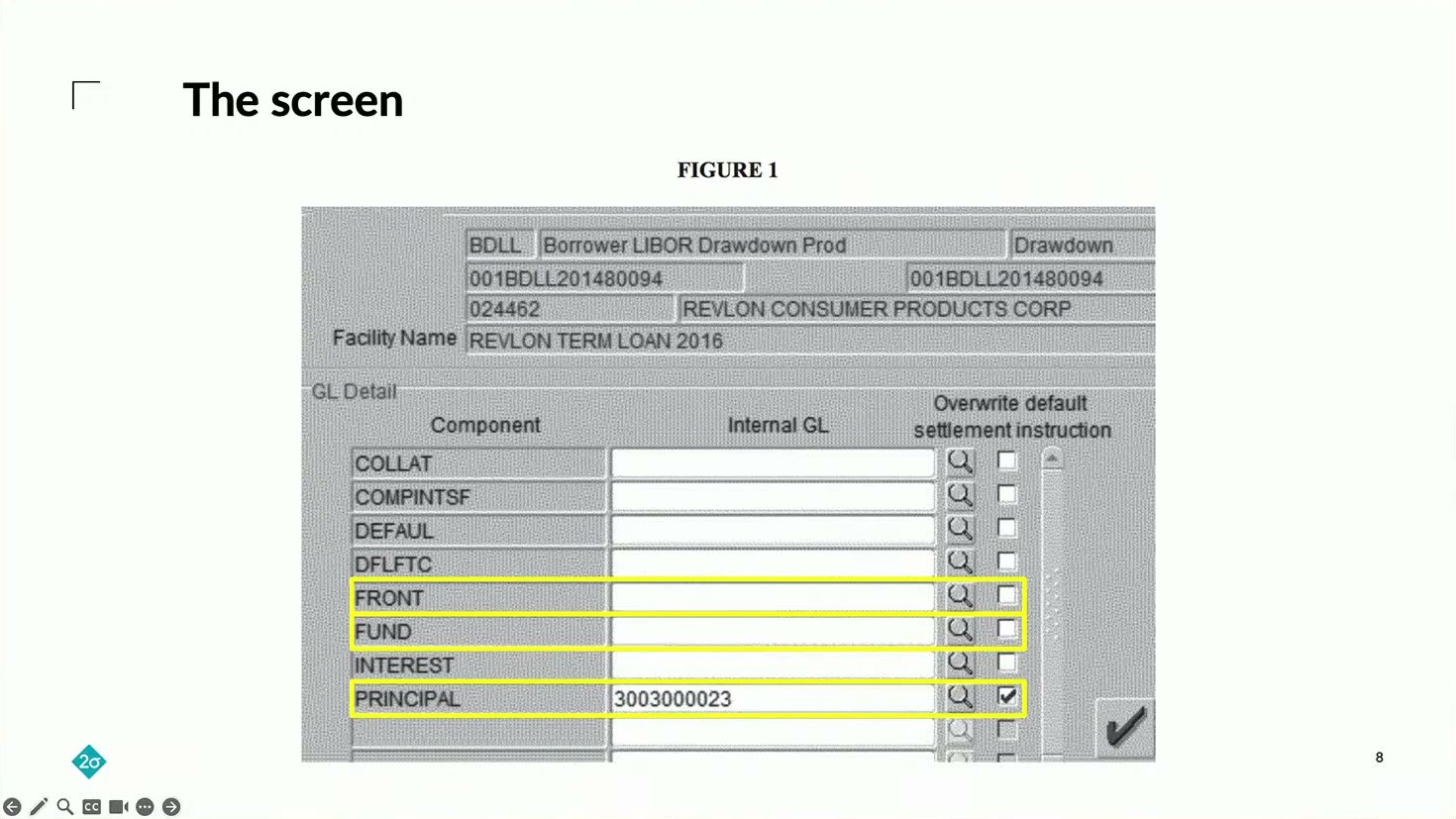
所以请留意那个 WASH 账户。本来应该这样操作:标着 front、fund 和 principal 的那些方框都应该填入 WASH 账户号码,而且每个旁边的复选框都应该打勾。遗憾的是,后来发现这确实是必须做到的事,但由于各种晦涩的原因,那些框没有勾上。虽然 FlexCube 弹出了一条警告,说:糟了,钱就要离开银行了,你确定要这么做吗?这条警告说得没错。钱确实应该离开银行,因为他们要支付利息。所以本该批准这笔交易的三位审批人看了之后说:对,这就是应该发生的事。
So keep your eye on that WASH account. What was supposed to happen is that the boxes labeled front and fund and principal should all include the WASH account number and should all have a check box checked next to them. So unfortunately it turned out that was what needed to happen, but for various arcane reasons the boxes were not checked. And although FlexCube pops up a warning notification that says, uh-oh, money is about to leave the bank, are you sure you want to do this? That was correct. Money was supposed to leave the bank because they were making the interest payments. So the three approvers who were supposed to approve that looked at it and said, yep, that's the right thing that's supposed to happen.
虽然那条警告弹了出来,负责执行交易的人工操作员还是把它覆盖掉了。
And although that warning notification popped up, the human operators carrying out the transaction overwrote that.
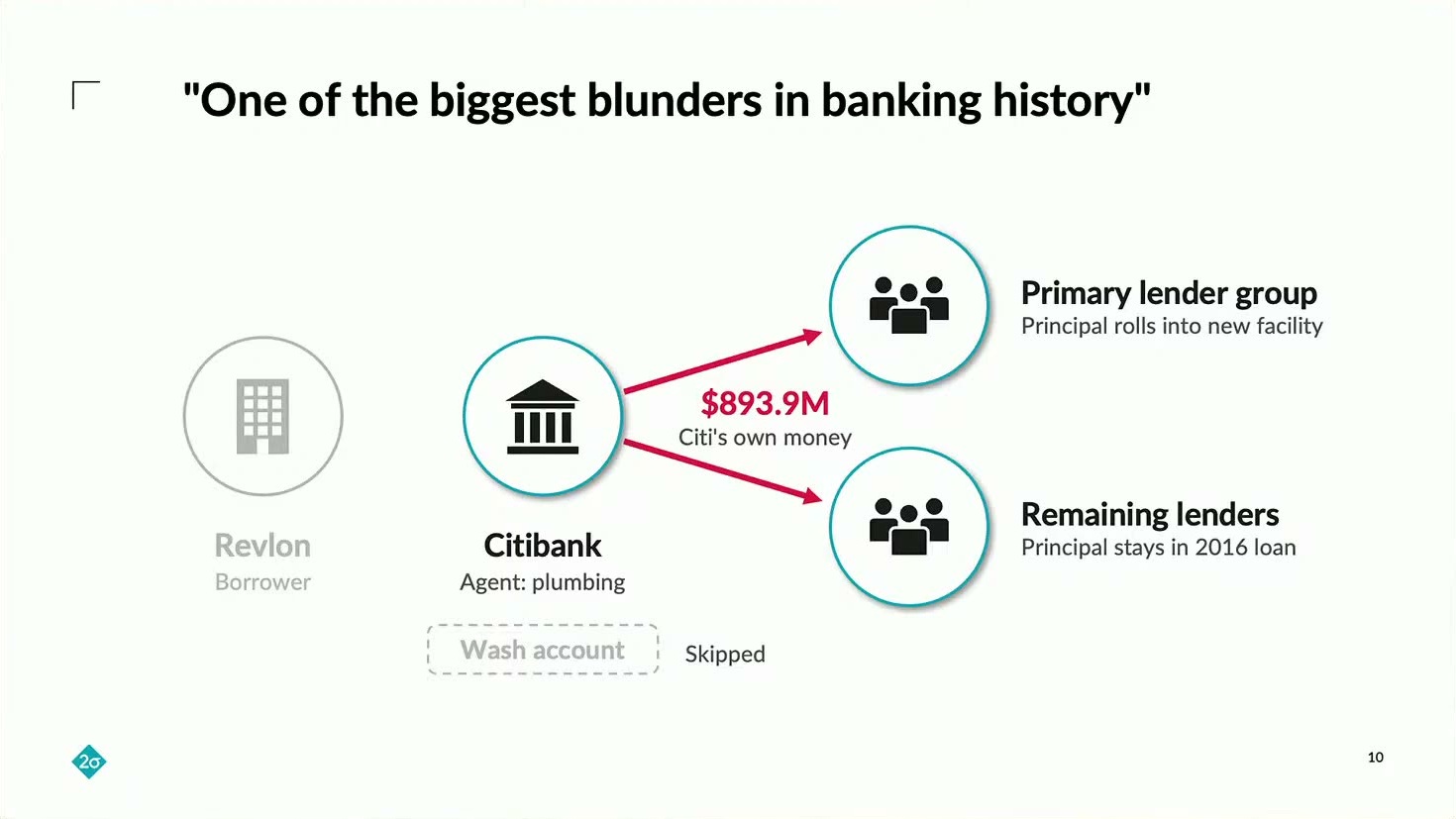
记住,Revlon 当时是在支付利息。所以本金没有进入 WASH 账户。相反,FlexCube 把这笔贷款全部未偿本金付给了 300 家贷款方,金额大约是 9 亿美元,而不是 800 万美元。于是每家贷款方都拿到了本来应得的金额,前提是 Revlon 已经全额偿还贷款,可 Revlon 并不想还清贷款。它想把钱留在自己手里。这对贷款方来说可是笔好买卖,因为记住,Revlon 当时正陷入困境,所以它的贷款交易价格低于面值,而你拿回全部本金,针对一笔你原以为每一美元只值 60 美分的交易,对你来说当然是笔好买卖。
Remember, Revlon was making that interest payment. So the principal never went to the wash account. And instead, Flexcube sent the entire outstanding principal of the loan to all of the 300 lenders, about $900 million instead of $8 million. So every lender got the amount that they would have been owed if Revlon had paid the loan in full, but Revlon didn't want to pay off the loan. It wanted to hold on to its money. That was a great deal for the lenders, because remember, Revlon was in trouble at the time, so its loans weren't trading at face value, and getting all your money back on a deal that you thought was only worth 60 cents on the dollar is a great deal for you.
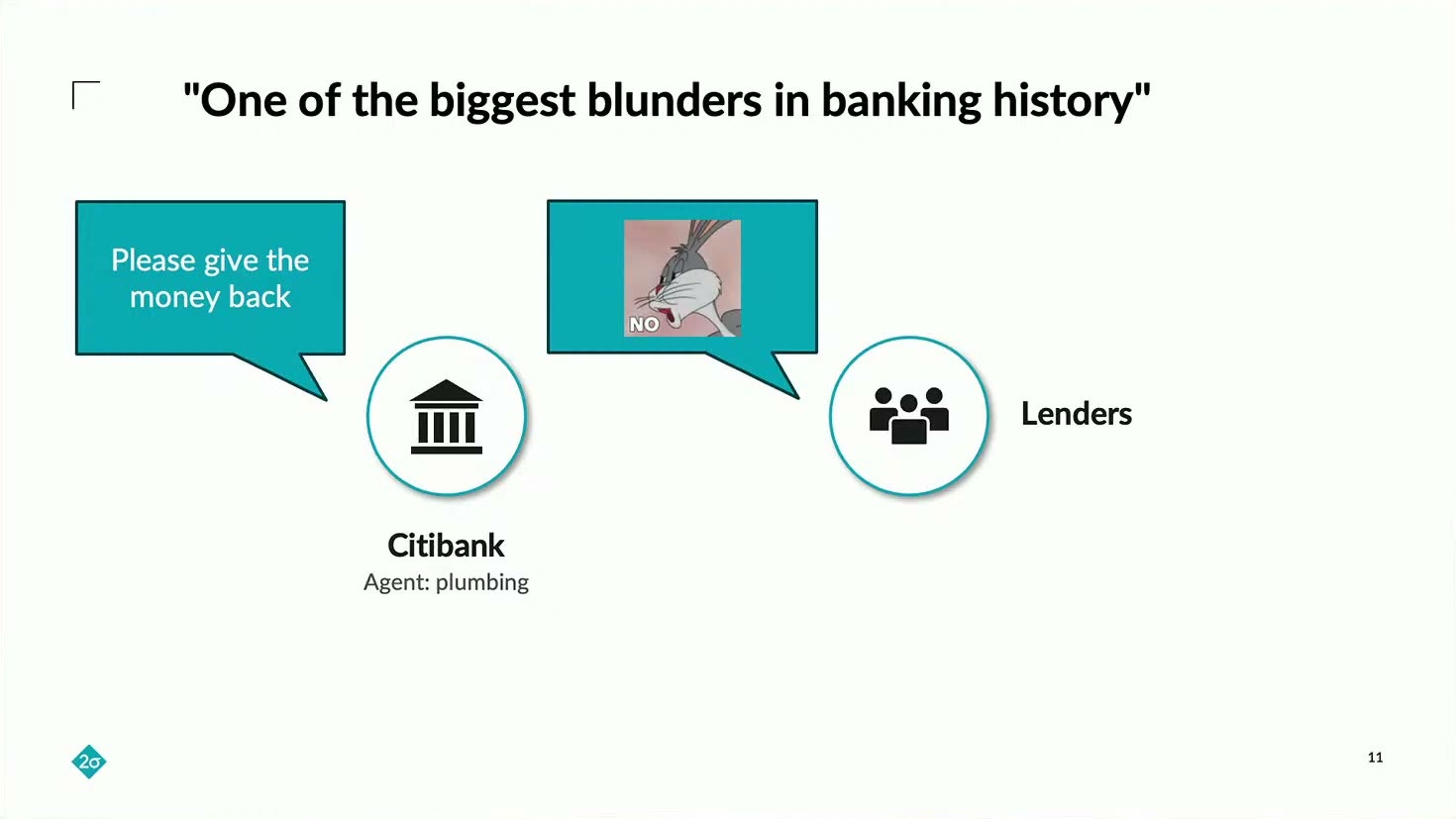
所以他们不想把钱退回去,即使 Citi 打电话给他们说:拜托,这是个错误,把钱还给我们,他们的说法还是:我们不应该把钱还回去,因为你们已经全额付给我们了,贷款就是这么回事。你最终总会把钱还给贷款方,而且你只是比原定时间晚些时候还了钱,这不意味着我们现在就得把钱退回去。因此,为了防止这种事发生,各地的商业贷款协议开始加入类似那样的条款。那么,银行里的付款错误跟 AI 智能体有什么关系?银行有一套流程,也有这些管控措施,而且每个人都做了自己认为正确的事。这就是我接下来整场演讲想谈的问题。我们每天都在把真实的智能体交给它们真正的自主权,让它们操作 FlexCube 这样的系统。
So they didn't want to give the money back, even after Citi called them and said, please, that was a mistake, give us the money back, and their argument was, we shouldn't have to give the money back because you paid us in full, and that's how loans work. You eventually pay them back, and just because you paid it back at a different time than you were supposed to doesn't mean that we should have to give it back now. And so to prevent that from happening, commercial loan agreements everywhere started including a clause like that one. So what does a payment error at a bank have to do with AI agents? Well, the bank had this procedure, it had these controls, and everybody did what they thought the right thing to do was. That's the problem I want to talk about for the rest of this talk. Every day we're giving real agents real autonomy over systems like FlexCube.
我们该如何防止那样的事故发生,既不把一切锁死,也不只是指望自己运气好、事故不会发生?
And how do we prevent accidents like that one from either from happening without locking everything down or just hoping we'll get lucky that they won't happen?
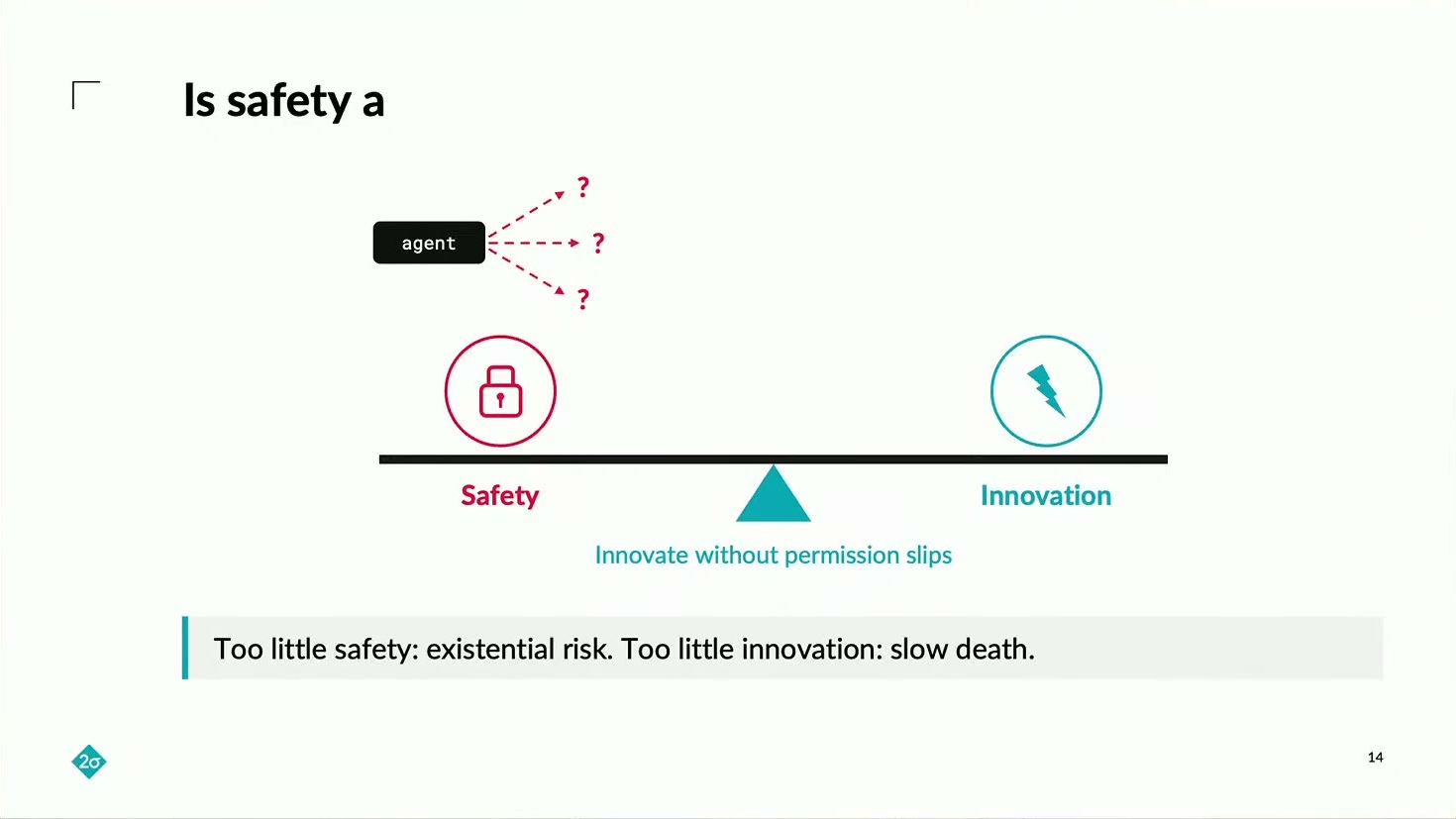
问题的关键就在这里。你没法事先真正知道智能体会做什么,对吧?这类系统具有非确定性。听起来很吓人,不过别忘了,人也是非确定性系统,他们也会犯错。所以大多数公司不会选择这样做:为了降低人犯错的风险,我们要把他们关进房间,不让他们互相交谈,然后让他们彼此检查对方的所有工作。我们会给他们一定程度的自主权,同时配上一定程度的管控。所以我们给他们划定边界、提供可见性,并配备系统和管控措施,让他们能够有效地完成工作。因此在这种模式下,安全和创新并不是一条光谱的两端,非得在两者之间取舍。
So here's the crux of the issue. You can't really know in advance what an agent will do, right? There are these non-deterministic systems. And that sounds scary until you remember that humans are also non-deterministic systems and they're going to make mistakes too. And so most firms don't choose to say, well, in order to reduce the risk of humans making a mistake, we're going to lock them in rooms and prevent them from talking to each other, and they're all going to double-check everybody else's work. We allow them a certain amount of autonomy along with a certain amount of controls. So we give them boundaries, visibility, and we equip them with systems and controls that let them do their jobs effectively. So in this sort of model, safety and innovation are not opposite ends of a spectrum that you must trade off on.
这两者可以同时拥有。所以我觉得鱼与熊掌可以兼得。
They're things that you can have at the same time. So I think you can have your cake and eat it too.
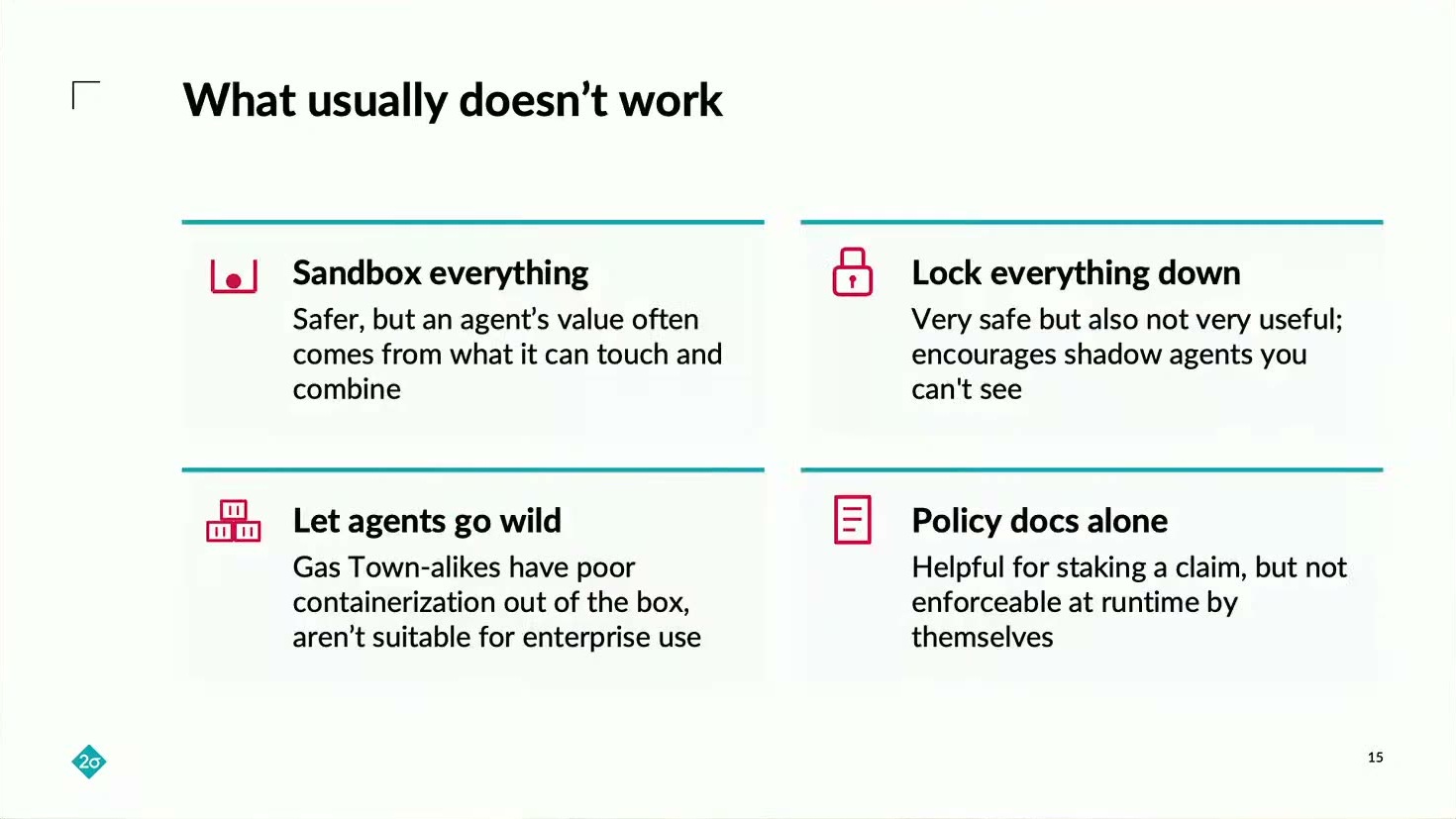
我们考虑要对智能体采用哪些管控措施时,也研究了一些不适合我们的做法。我们不想把所有东西都放进沙箱或锁起来,因为一个无法真正访问系统的沙箱确实安全,但也没多大意思,没什么用。如果任由智能体放手去做,想做什么就做什么,从认知层面来说,这或许很强大、很自由,但那样的隔离非常薄弱,这种做法通常不适合受到严格监管的企业。另外,如果你只有一些供智能体查看的政策文件,或者把政策写进提示词规范里,这在运行时也很难执行。你无法保证这些内容会成为执行管控的一部分。
And when we were thinking about what controls we wanted to apply to agents, we also looked at some approaches that didn't work for us. We don't want to sandbox or lock down everything, because a sandbox with no real access to systems is safe, but it's not very interesting or useful. If you let agents go wild and do whatever they want, that's maybe powerful and freeing from a cognitive perspective, but the isolation is very weak there, and that approach is generally not suitable for highly regulated enterprises. And then if you just have policy documents that agents look at or that are part of your specification for the prompt, that's also not very enforceable at runtime. You can't guarantee that that will be part of the enforcement controls.
所以对我们有效的做法,是想清楚哪种管控措施组合能让我们同时实现安全和创新。我们怎样划定边界、阻止问题,同时又不妨碍大家正确地开展工作?我们有不少这类管控措施,今天我会讲其中五项。我这里说的管控措施,是指防护规则和共享能力,它们能让团队按自己的方式推进工作,而不会妨碍他们要做的事。我们不想先遇到一道必须跨越的鸿沟才能让大家完成工作,然后让所有人等着我们架桥过去。
So what did work for us was thinking about what mix of controls would get us both safety and innovation at the same time. So how do we provide boundaries and stop problems but don't hinder folks from operating correctly? So we have a number of these controls, but today I'll talk about five of them. When I say controls here, what I mean are the guardrails and shared capabilities that let teams move in ways that don't hinder what they're trying to do. And we don't want to reach some chasm that we need to cross to let people get their work done and then make everyone wait while we build a bridge to get there.
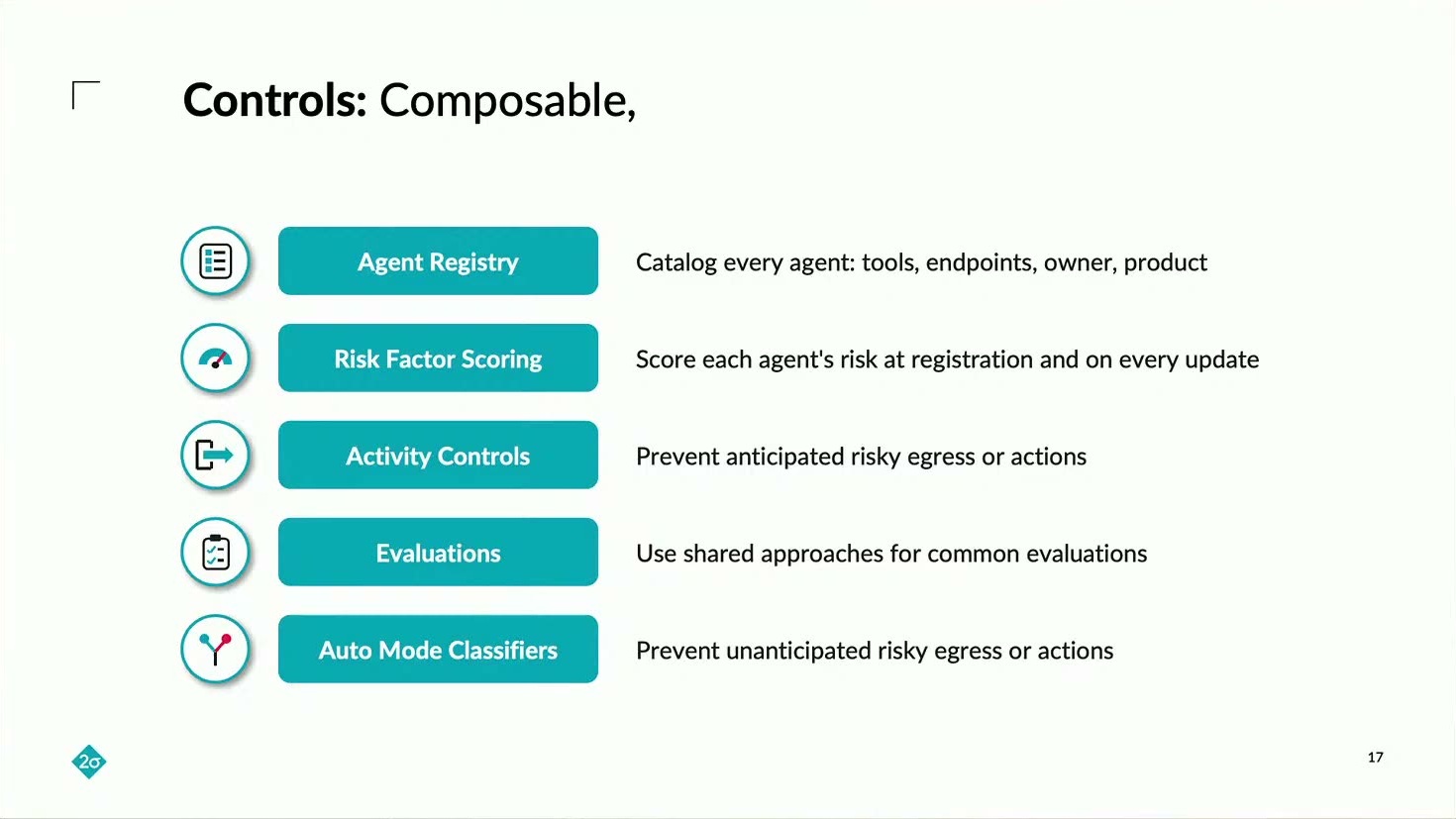
所以这些管控措施可以组合使用。每一项各司其职。组合起来,它们就能让我们在适当的安全水平下运行拥有真正自主权的智能体。
So these controls are composable. Each one does one job. And then together, they let us run agents with real autonomy at an appropriate level of safety.
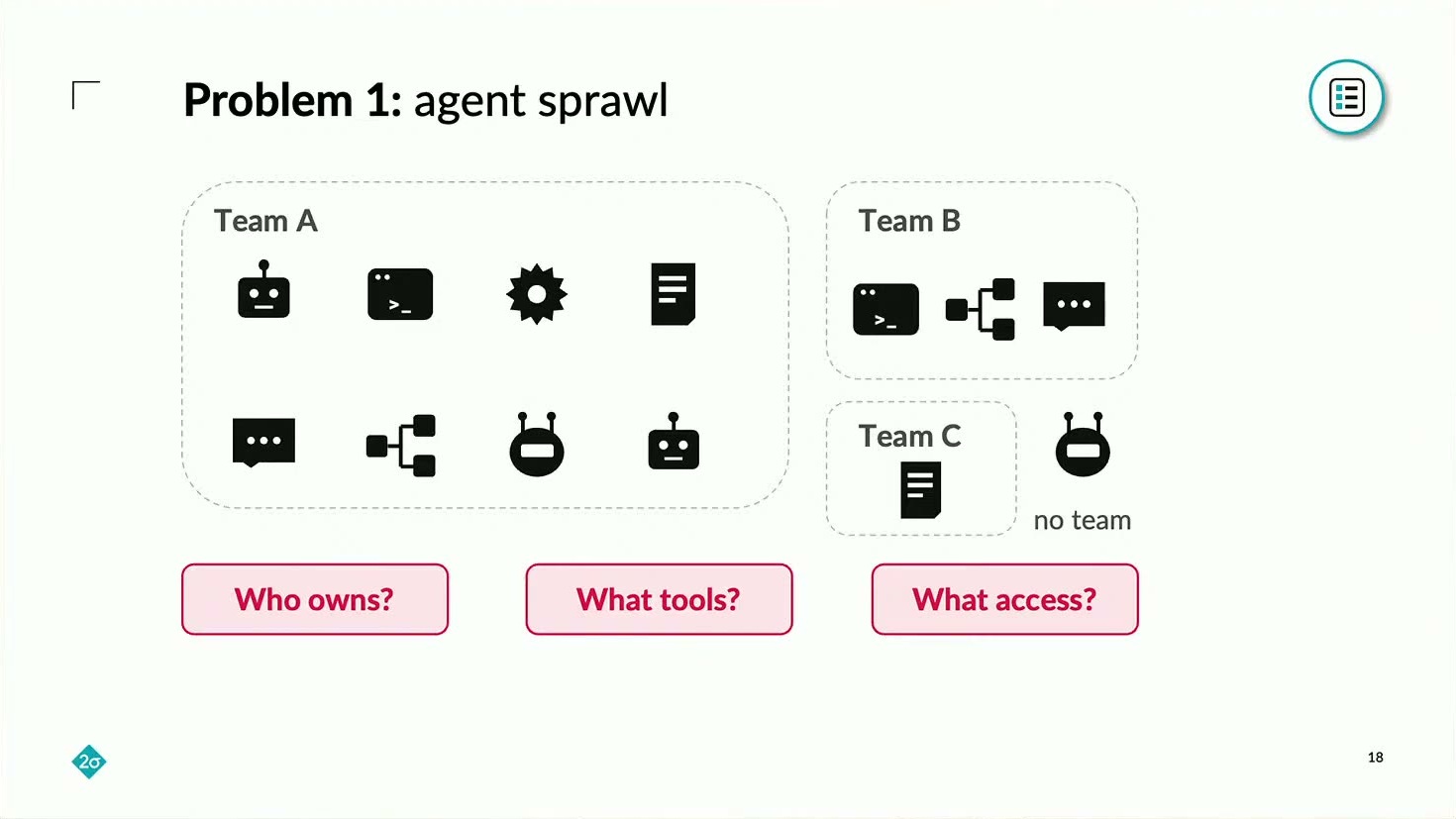
第一个问题是,智能体到处都在出现。有的大型团队运行着很多智能体。有的小团队只运行几个。还有人私下以不受管控的方式运行各种东西。它们的形态五花八门。可能是随手做出来的聊天机器人。可能是把 MCP 服务器拼在一起,凑成这种弗兰肯斯坦式的大杂烩。也可能是很酷的 Notebook 实验。还可能是对大家很有用的网页工具。但你看着这些东西时,很难回答几个简单的问题,比如谁负责这个?它能访问哪些工具?它应该做什么?不应该做什么?如果你回答不了这类问题,如果你无法治理它们,那你也就没法真正重复利用它们。
So the first problem is that agents were showing up everywhere. We have big teams with lots of agents running. We have small teams with a few. We have individual people running stuff in an uncontrolled way. And these come in every shape. Could be random chatbots. It could be MCP servers glued together in this Frankenstein hot podge. It could be cool notebook experiments. It could be really useful web tools for folks. But it's hard to answer when you look at that a few simple questions, like who owns this? what tools does it have access to, what should it be doing, what should it not be doing. And if you can't answer those kinds of questions, if you can't govern them, then you can't really also reuse that.
所以你很容易为同一个问题开发多个解决方案,因为你不知道已经有什么现成的东西。公司也就无法用清晰的方式治理这些东西。
So you're tempted to build multiple solutions to the same problem if you don't know about what exists already. And then the firm can't also govern those in any kind of legible way.
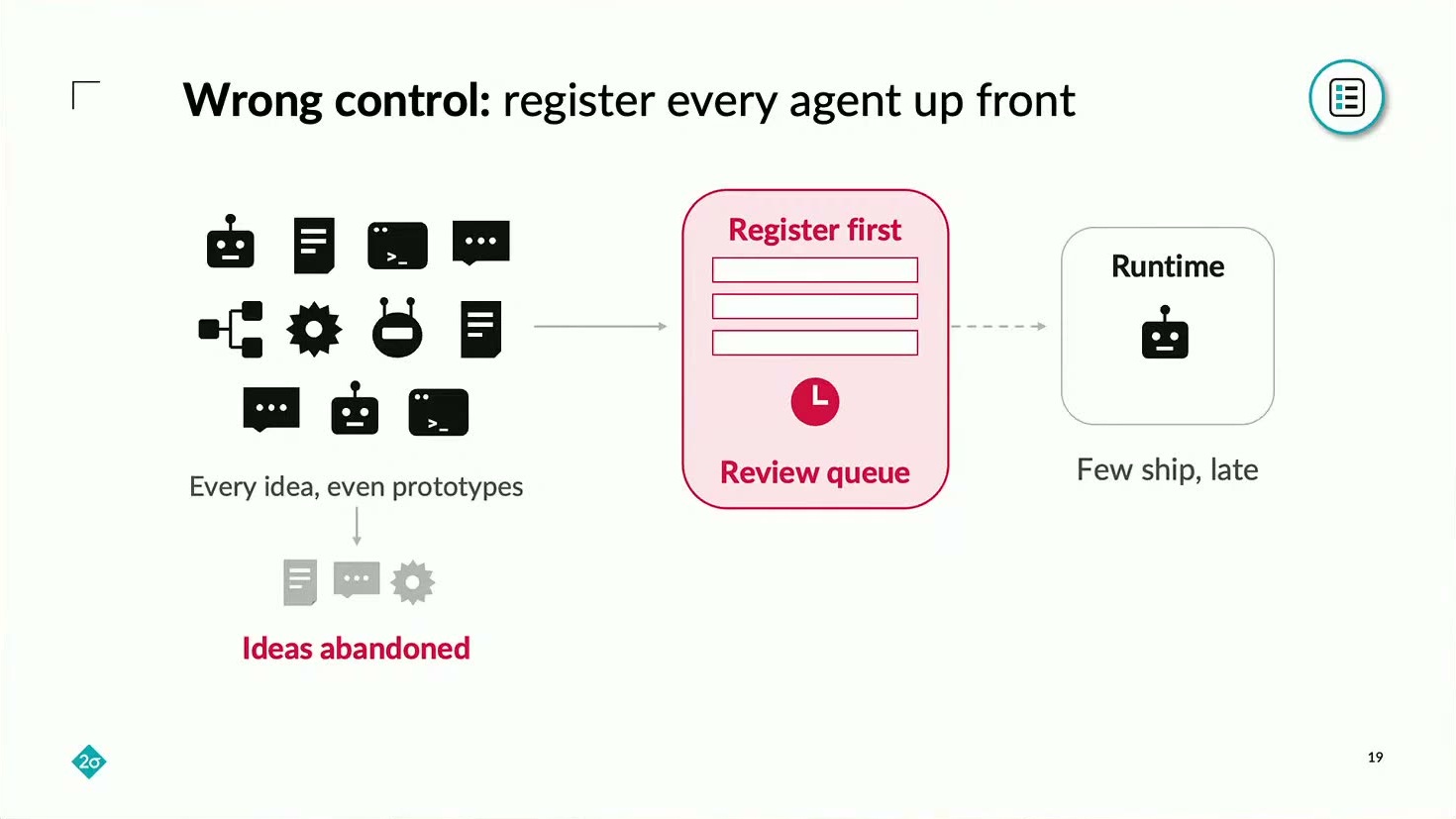
所以公司有时会在这里加一道门槛。比如说,所有东西都先别运行,直到全部完成登记、获批,并且走完这套非常繁琐的流程。听起来很安全,但看看这会给工作带来什么影响:每个想法,哪怕是简单的无挑选实验,都得排在那些风险很高的事情后面等着。我们不想让所有人面对各种各样的智能体,却都走完全相同的流程。所以大多数人会放弃,或者他们干脆转向某种影子 IT,走一条管控更少、可见性更差的路,到头来我们就什么都看不到了。
So one thing the firms sometimes do here is add some kind of gate. Like don't let anything run until everything is registered and approved and has gone through this very onerous process. And that sounds safe, but if you look at what it does to the work, every idea, even some simple no-pick experiment, is going to wait in line behind something that's really risky. And we don't want to subject everybody who's given the diversity of agents to exactly the same process. So most people are going to give up, or they'll just get pushed to some shadow IT, less governed path that is less visible, and then we don't get to see anything at all.
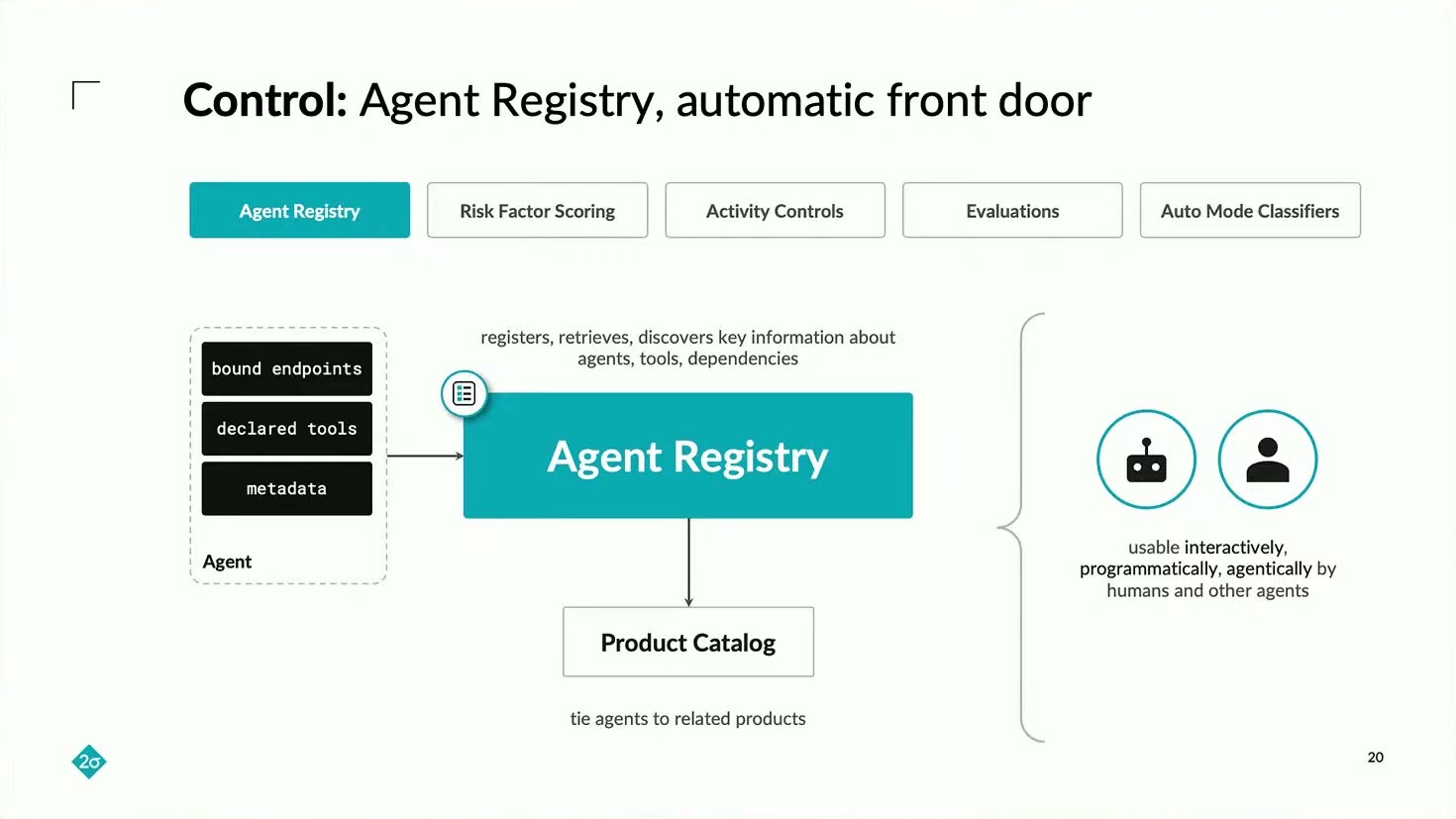
这就是第一个管控措施——智能体登记库的由来。你没法治理它,也看不见它;智能体登记库能让智能体清晰可见,并且登记、检索和发现关键信息,也就是我们想了解的每个智能体的基本情况。比如它声明了哪些工具、会连接哪些端点、属于哪个产品、由谁负责。然后,人、其他程序和其他智能体就可以利用智能体登记库,判断公司里有哪些可用的东西、哪些对自己有用,还可以把它作为回答其他问题的事实来源。这不需要你额外费力。只要你使用公司批准的智能体构建框架,就会自动完成。
So that's what motivated the first control is an agent registry. You can't govern it, you can't see, so the agent registry makes agents legible, and it registers, retrieves, and discovers the key facts about agents that we want to know for any agent. So those are things like which tools it declares, what endpoints it's going to talk to, which product does it belong to, who owns it. And humans, other programs, other agents can then use the agent registry to decide what's available at the firm, whether that's useful for them, and to go use that as a source of truth for other questions. So this doesn't require extra effort on your part. It just happens when you use one of the firm's approved agent building frameworks.
它会自动登记。所有这些信息都会替你记录在里面。如果你想手动登记,当然也可以。
It's automatically registered. All that information is recorded there for you. And if you want to do a manual registration, you can certainly do that.
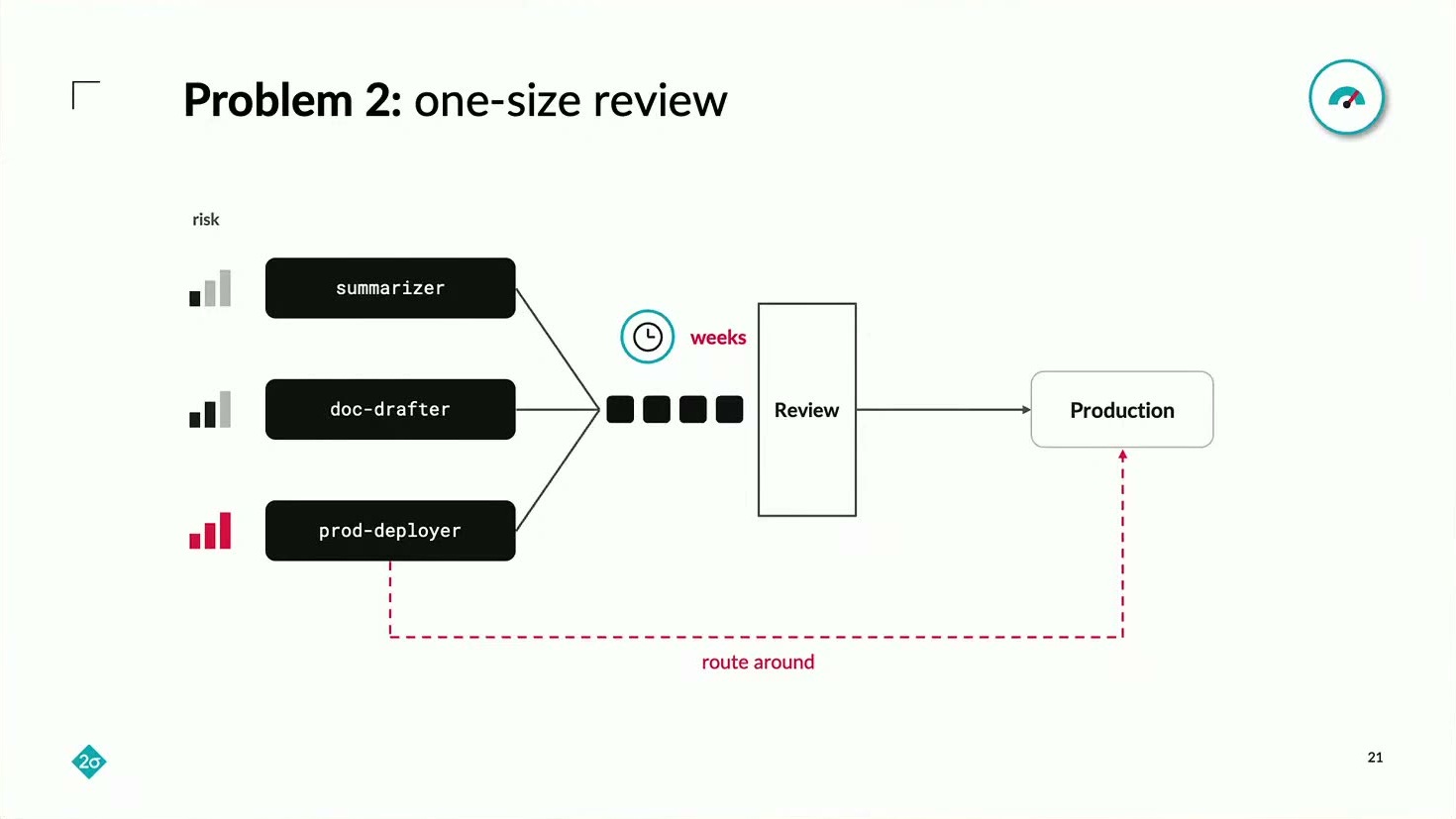
第二个问题是,有了这么多智能体在做各种各样的事情之后,我们很快就发现它们做的事大不相同。这意味着它们承担的风险也大不相同,对吧?总结 Jira 或 Linear 工单的工具,跟一个能够触碰运行中系统的生产环境部署智能体,完全不是一回事。如果我们试图用同一套审核流程来覆盖所有这些智能体,那么每个智能体都会在人为审核的同一条队列里等上好几周。如果大家要绕过缓慢的流程,我们最终就会回到之前那种局面。
So the second problem we have is that now that we've got all these agents doing all these things, we quickly notice that what they're doing is really different. And that means our agents carry really different risks, right? So a thing that summarizes Jira or linear tickets is really different than a production deployment agent that can touch a running system. And if we try to use the same review process to cover all of these agents, then every agent is waiting in the same queue for weeks for human review. And if people are going to route around slow processes, then we wind up in the same situation that we had before.
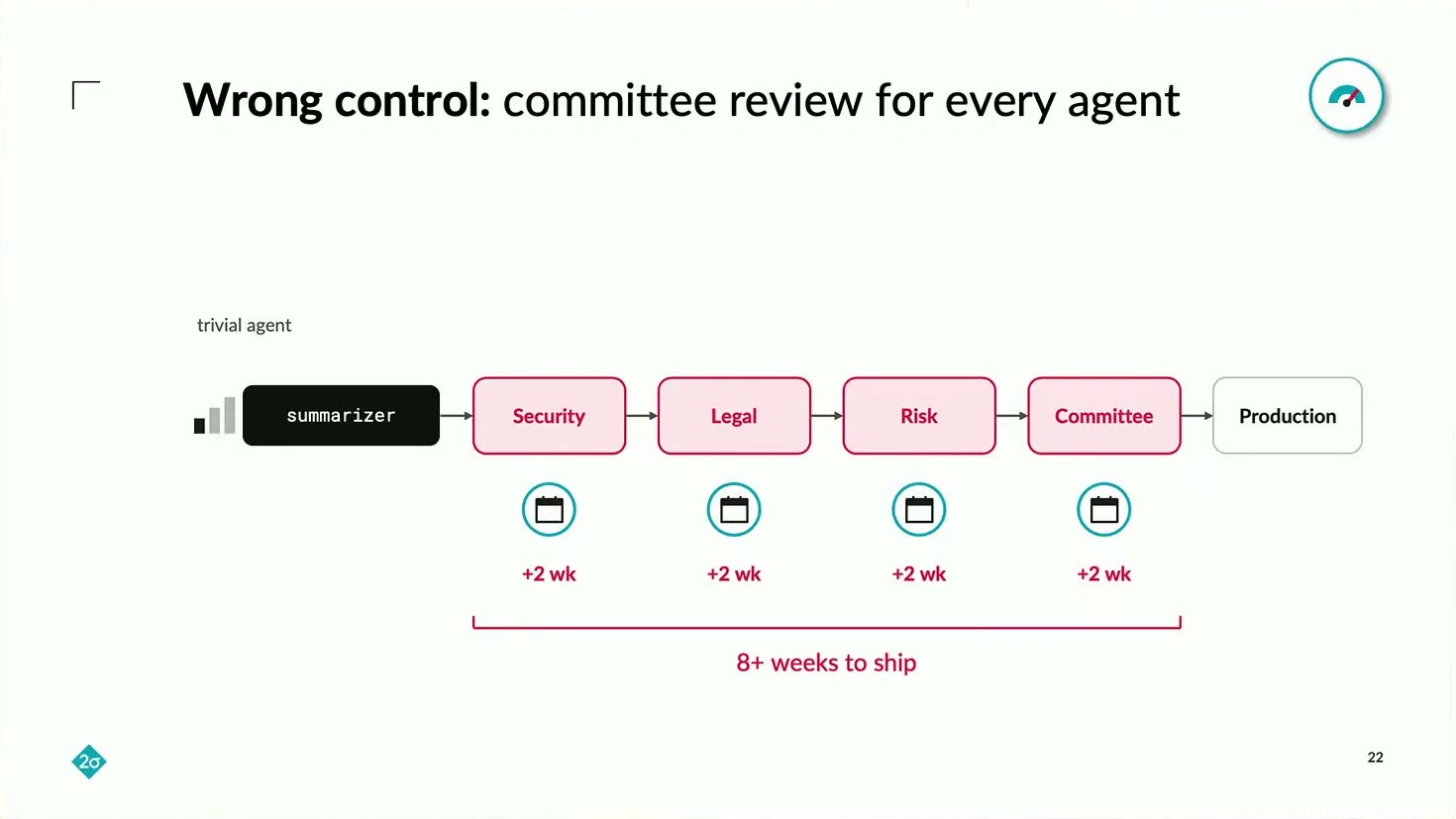
所以你可能又会想,办法就是做非常细致、繁重的人工审核,让这些不同部门都参与进来。听起来还是很安全,但现在,一个简单的摘要工具也得等两个月,才能拿到和触碰生产环境系统的智能体同样的批准。而多数好的智能体想法,多数能立刻带来价值的想法,一开始都是小型实验,你不希望那些人和那些一上来就触碰生产环境的项目排在同一条队伍里等着。于是审核人员被这些低风险申请淹没,高风险申请也只能和它们争夺同一份关注。所以只要有办法,我们就不想牺牲速度。
So again, you might be tempted to say the answer is something like really detailed, heavy manual review by all of these different constituencies. Again, that feels safe, but now we've got a trivial summarizer waiting two months for the same sign-offs as an agent that is touching production systems. And most of the good agent ideas, most of the ones that have value right away, start out as small experiments, and you don't want those people to wait in the same line as the stuff that's touching production right away. So the reviewers are drowning in these low-risk requests, and the high-risk ones have to share that attention pool. So we don't want to trade away that speed if we can help it.
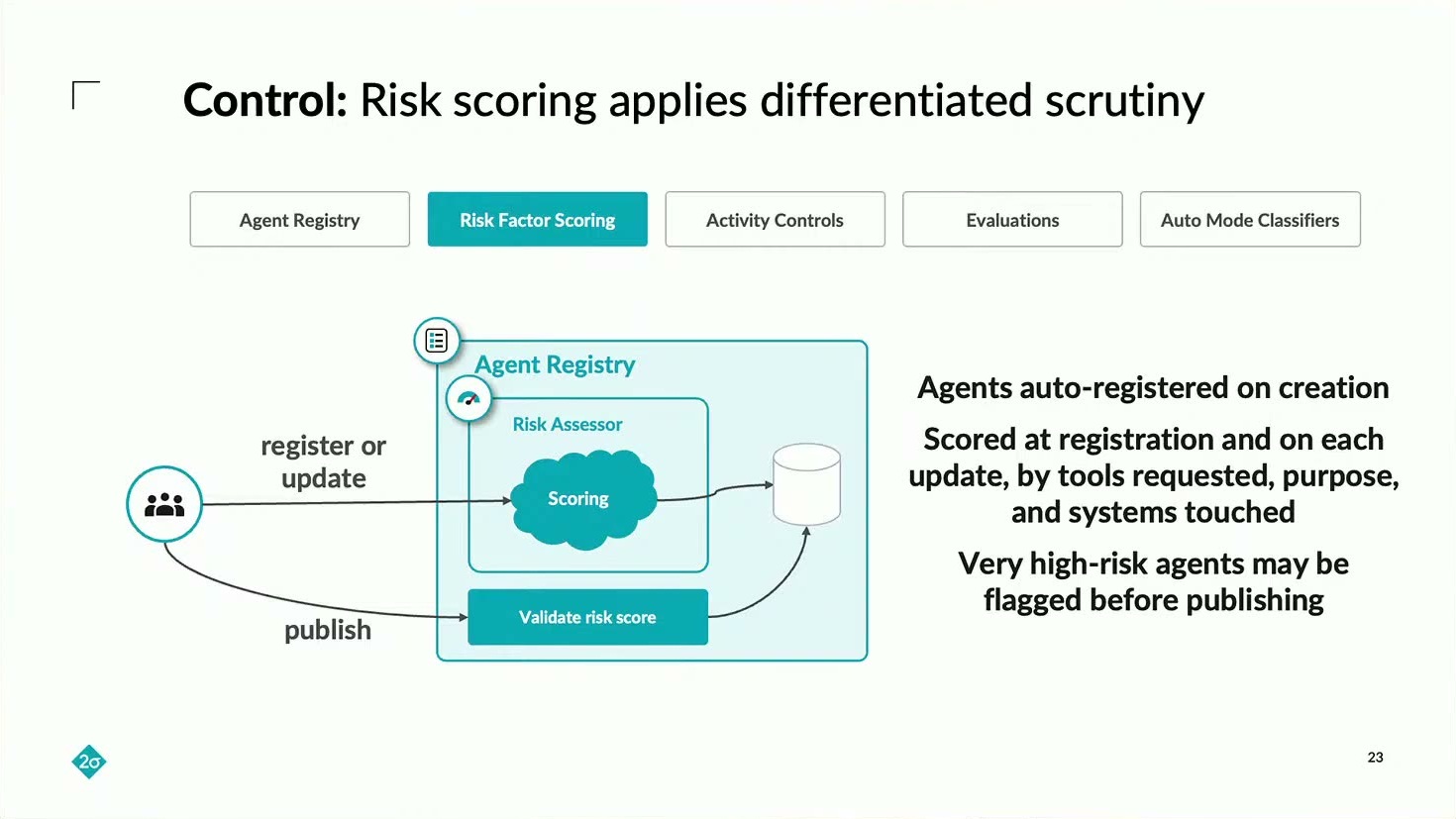
再说一遍,并不是每个智能体都需要同样的审核,而且大多数智能体都是为特定用途打造的,不是开放式的。我这里说的开放式,你可以想到 Pi 或 Claude Code 这样的编程智能体。打开它们开始输入时,Claude Code 或 Pi 并不知道你接下来要问什么。它的用途也没有被特别限定在某个范围里。但企业里部署的大多数智能体确实有很明确的用途。你在使用那个智能体时,就是要它做某件明确、已知而且大家都理解的事。所以它们存在的理由非常明确,用途也被严格限定。你可以查看它们事先声明的内容,来区分不同智能体,以及施加在它们身上的管控措施,等等。第三个问题是,如果你了解自己的智能体以及它们在做什么,你很快就会发现,许多智能体并不只与一个对象交互。
So again, because not every agent needs the same review, and because most agents are purpose-built rather than open-ended, and when I say open-ended here, you can imagine coding agents like Pi or Claude Code. When you open them and you start typing, Claude Code or Pi doesn't know what you're about to ask. It doesn't circumscribe its purpose in any particular way. But most of the agents that are deployed in enterprises do have very specific purposes. When you're engaging with that agent, it's to do something specific that's well known and well understood. So they have a very specific reason for existing and a very circumscribed purpose. And you can tell these agents apart from each other by looking at what they declare up front, their tools, the endpoints they access, the controls that are applied to them, etc. So the third problem is that if you know about your agents and what they're doing, you'll quickly notice that many agents don't talk to each other.
抱歉,我是说,它们不只与一个对象交互,也不只以一种身份或方式交互。
Sorry, they don't talk to just one thing or in just one capacity.
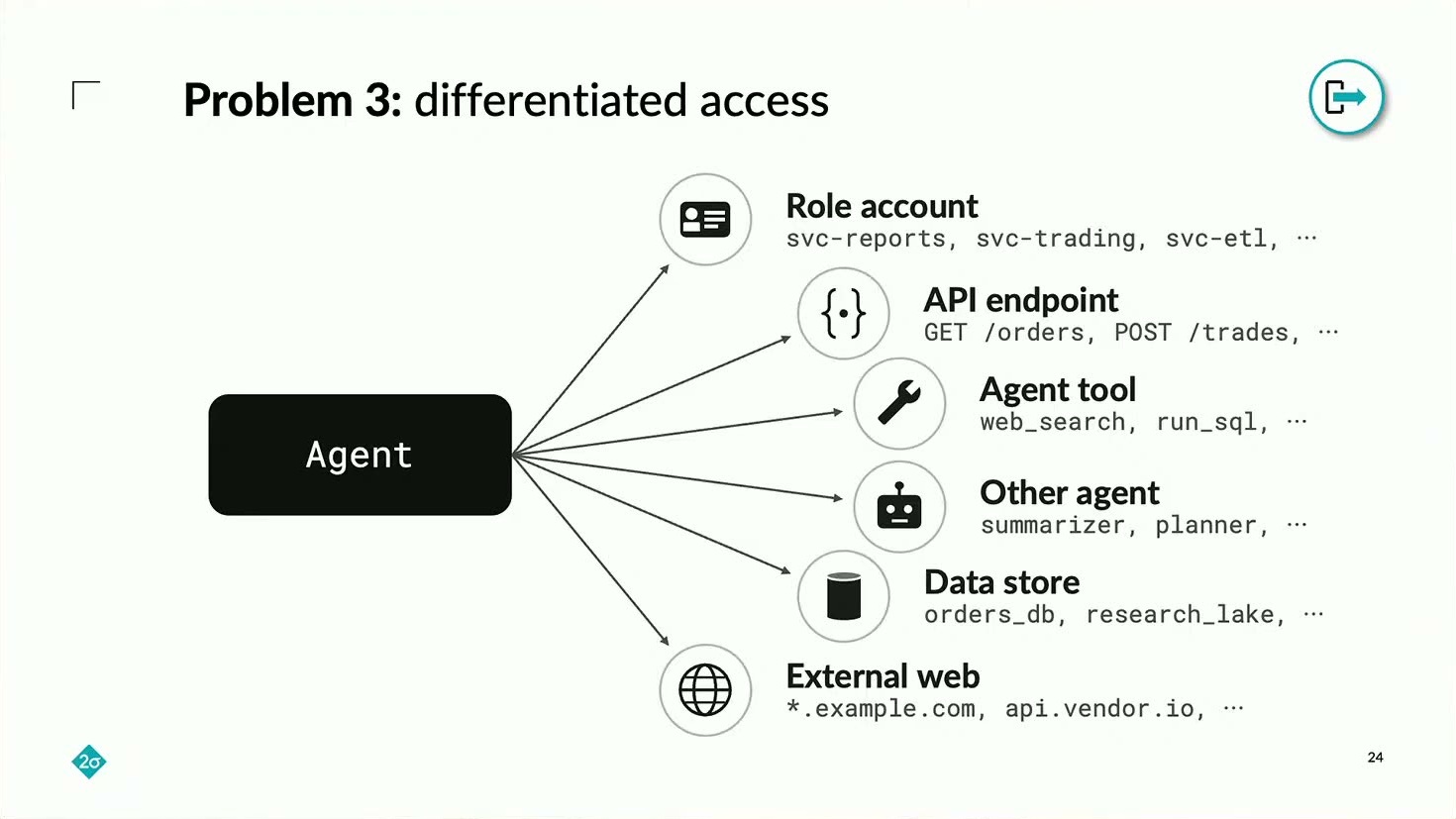
智能体越开放,就越像 Claude Code 或 Pi,它能做的事情种类就越多、越丰富。比如调用内部 API,或运行网页搜索之类的工具。这些都是不同的入口,会带来不同类型的风险。如果你给智能体一个角色账户的权限,它能造成的损害就比只读取公开网页的智能体大得多。所以,问题不是这个智能体能不能做 X,而是要把控制细化到什么程度,才能让智能体成功完成任务?另一个诱人的答案是采取强硬做法,或者给每个
The more open-ended the agent is, the more it looks like a Claude Code or Pi, the more it can do a variety and a diversity of different things. Call an internal API, run a tool like a web search, that sort of thing. And each one of those is a different opening, a different door to a different kind of risk. And if you give an agent an entitlement for a role account, then it can do a lot more damaged than something that's just going to read a public web page, for example. So the question is not, can this agent do X, but what's the granularity that we need to solve for for the agent to act successfully?
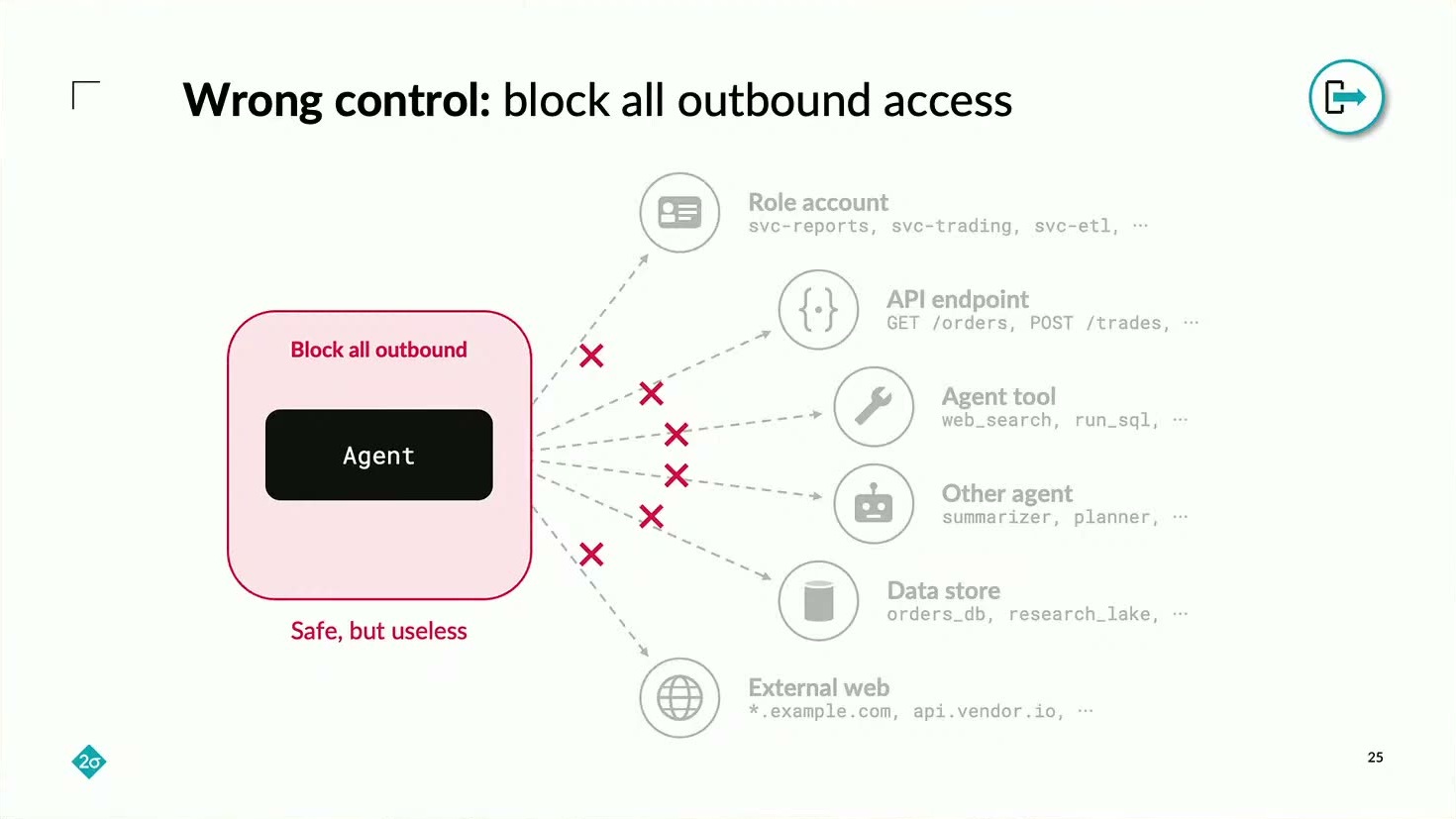
智能体一份同样简短的允许清单,只准它做安全的事,其他一律阻止。这样虽然安全,但也毫无用处。一个不能搜索、不能调用 API,或者做任何这类事情都得先征求他人同意的智能体,根本无法完成原本要它做的工作。于是团队要么放弃这些智能体,要么设法绕过这道墙;这两种结果代价都很高。因此,对所有事情一概采取全面封禁,会牺牲我们想保留的创新,也回避了真正作出风险判断。关于风险的决策。作家 John Shedd 写过,船停在港湾里很安全,
And again, one tempting answer is to kind of be heavy-handed here, or to give every agent the same short allow list of stuff that's safe to do, and then block everything else. That's safe, but it's also useless. An agent that can't search, or can't call an API, or can't do any of those things without asking somebody first can't really do the work that it was intended for. And then teams either give up on those agents or they find a way around the wall and both outcomes are costly. So a wide kind of blanket block on everything trades away the innovation that we want to preserve and avoids making a real decision about risk. And as author John Shedd wrote, a ship and harbor is safe,
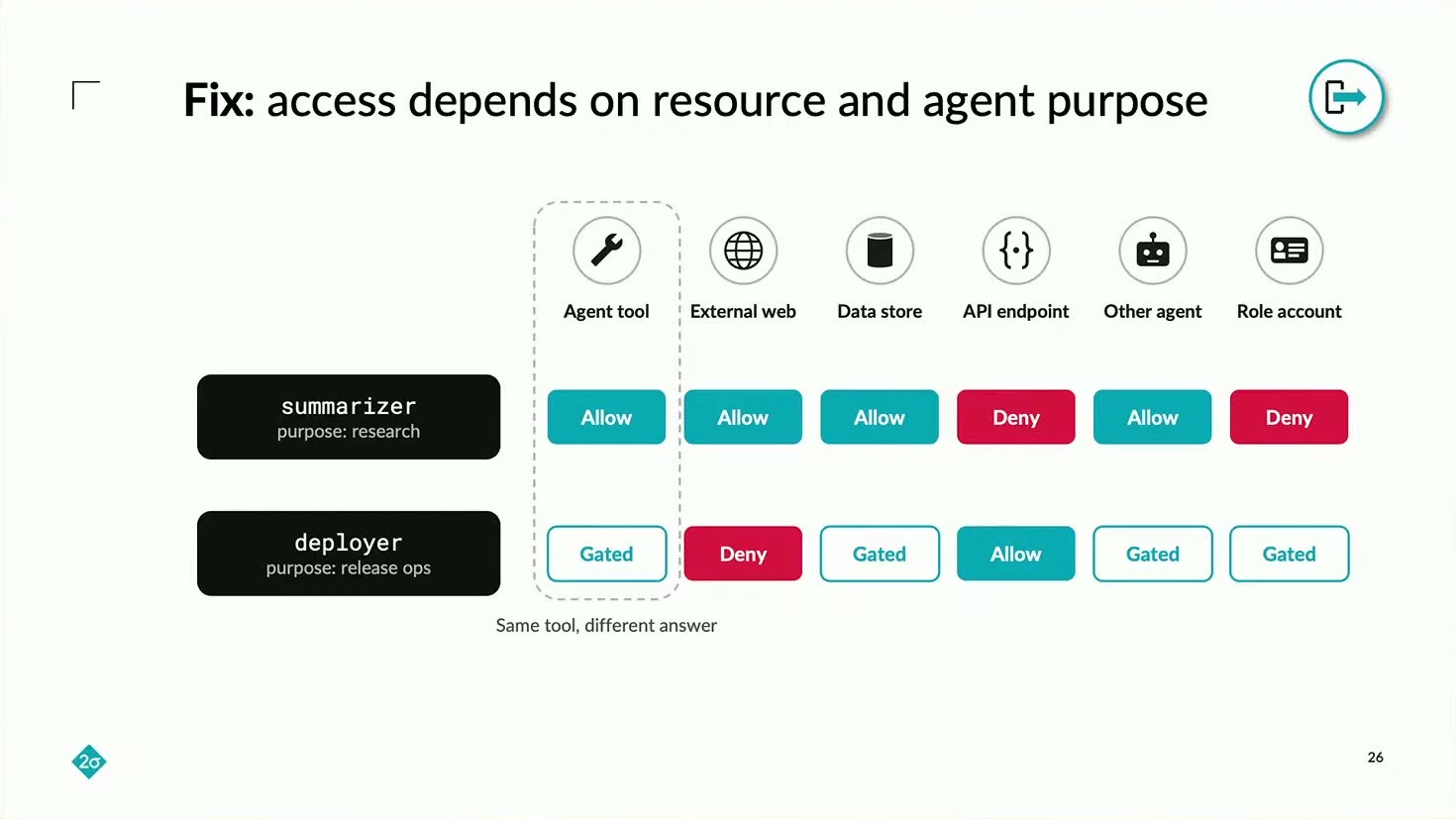
但船的用途并不是待在港湾里。所以解决办法是让智能体事先声明并说明自己的用途,以及将使用哪些工具,或需要访问哪些工具,在这里第二列,我们可以举例说明,研究摘要智能体可以使用网页工具查阅研究资料,但对于发布部署智能体,我们不允许它这么做,因为它没有理由使用这种工具。因此,如果它申请使用,默认情况下不会获得权限。所以我们不必对每种工具都逐一作出这种决定。智能体只需说明自己需要哪些工具。
but that is not what ships are for. So the fix here is to let agents declare their purpose upfront and say what tools they're going to use or what tools they need access to. So in the second column here we might say that a research summarizer is going to be allowed to use a web tool to access research, but for a release deployer agent we're not going to allow them to do that because they have no reason to use that tool. And so if they try to ask for it they won't get it by default. So we don't need to make this kind of decision for every tool. the agents just have to say which tools they want.
而你作为智能体作者,最有资格说清楚:在 500 个可用工具中,我需要这 4 个。
And you're, as the agent author, you're in the best position to say, I need these four things out of the 500 that are available.
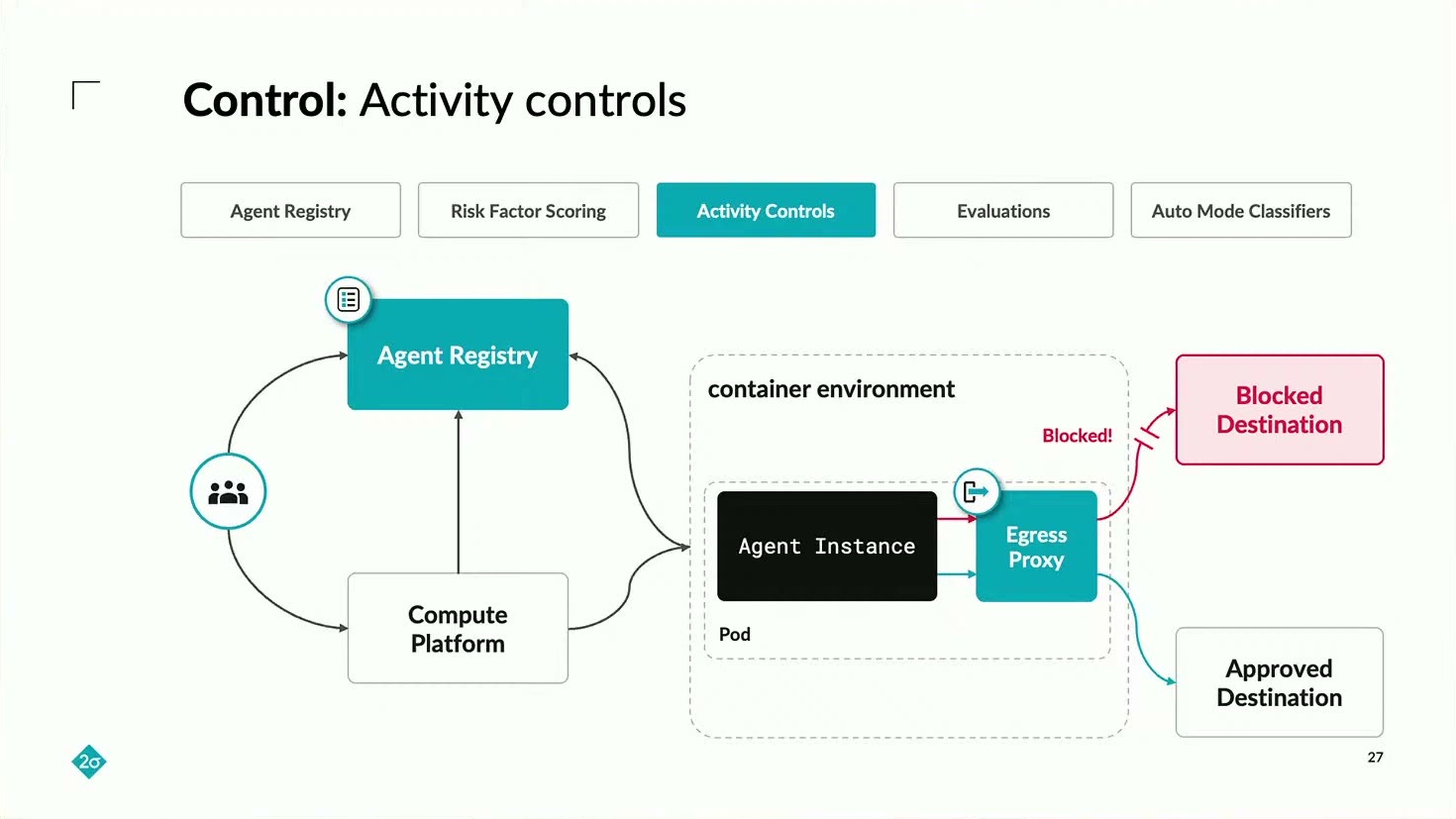
所以我们要这样执行这套规则:智能体在我们的托管环境中运行时,会查看前面提到的登记库,在初始化时查明适用于它的政策。然后把那项政策转化为可执行的规则,例如你可以访问哪些端点、哪些主机,以及哪些其他类型的资源对你开放或不可用。这样一来,每次需要更改访问权限时,就不用提交工单。也不用去找 IT 或团队之外的其他部门。只要符合我们前面说的风险评分标准,而且登记在智能体登记库里,你就受到治理、获得批准了。
So the way we need to enforce that is that when agents run in our managed environments, they look at the registry that we talked about before to look up what policies apply to it at initialization time. And that policy gets translated into enforceable statements, like which endpoints are you allowed to access, which hosts are you allowed to access, what other types of resources are available or not available to you. And in this way, nobody's writing a ticket every time they need to change the access. Nobody's going to talk to IT or some other group outside of your team. As long as you conform to the risk score that we talked about before and you're in the agent registry, you're governed, you're approved.
这就是我们如何把团队部署、构建和运行智能体的成本降得很低。同一套管控架构也适用于各种不同场景。
So this is how we keep the cost to teams really low for deploying, building, running agents. And the same control architecture works in a variety of settings.
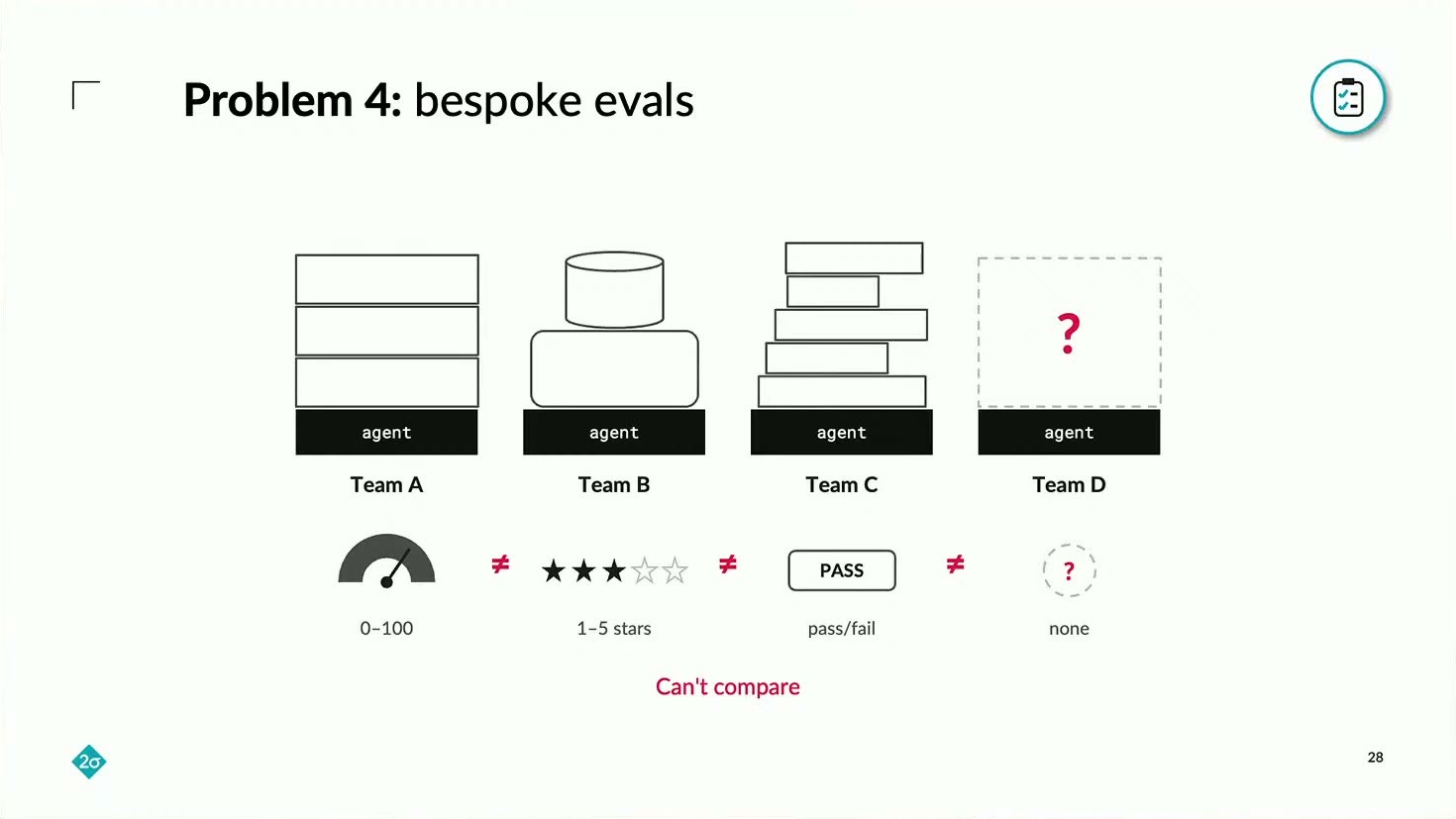
接下来我们注意到,各团队正在用大量不同的方式评测智能体,每个技术栈看起来都不一样,有些团队甚至什么都没搭。有时你会为模型的工作方式搭建一套非常细致的技术栈。有时则什么都没有。我觉得一般来说,如果团队不写单元测试,我们会很不满意,对吧?我们认为评测也差不多是同一回事。如果模型在变,那就像应用程序的一项运行时依赖。如果你的智能体要更换模型,却没有评测,就无法知道输出会发生什么变化,也不知道输出质量会变成怎样。
The next thing we noticed was that teams were building a ton of different ways to evaluate agents, and every stack looks different, and some teams don't build anything at all. Sometimes you build this really detailed stack for how your models work. Sometimes there's nothing. And I think in general we'd be upset if teams were not writing unit tests, right? And we consider evals to be kind of the same thing. If models are changing, that's like a runtime dependency that your application has. And if your agent is going to change models, it doesn't know without the evals what's going to happen to its outputs and to the quality of those outputs.
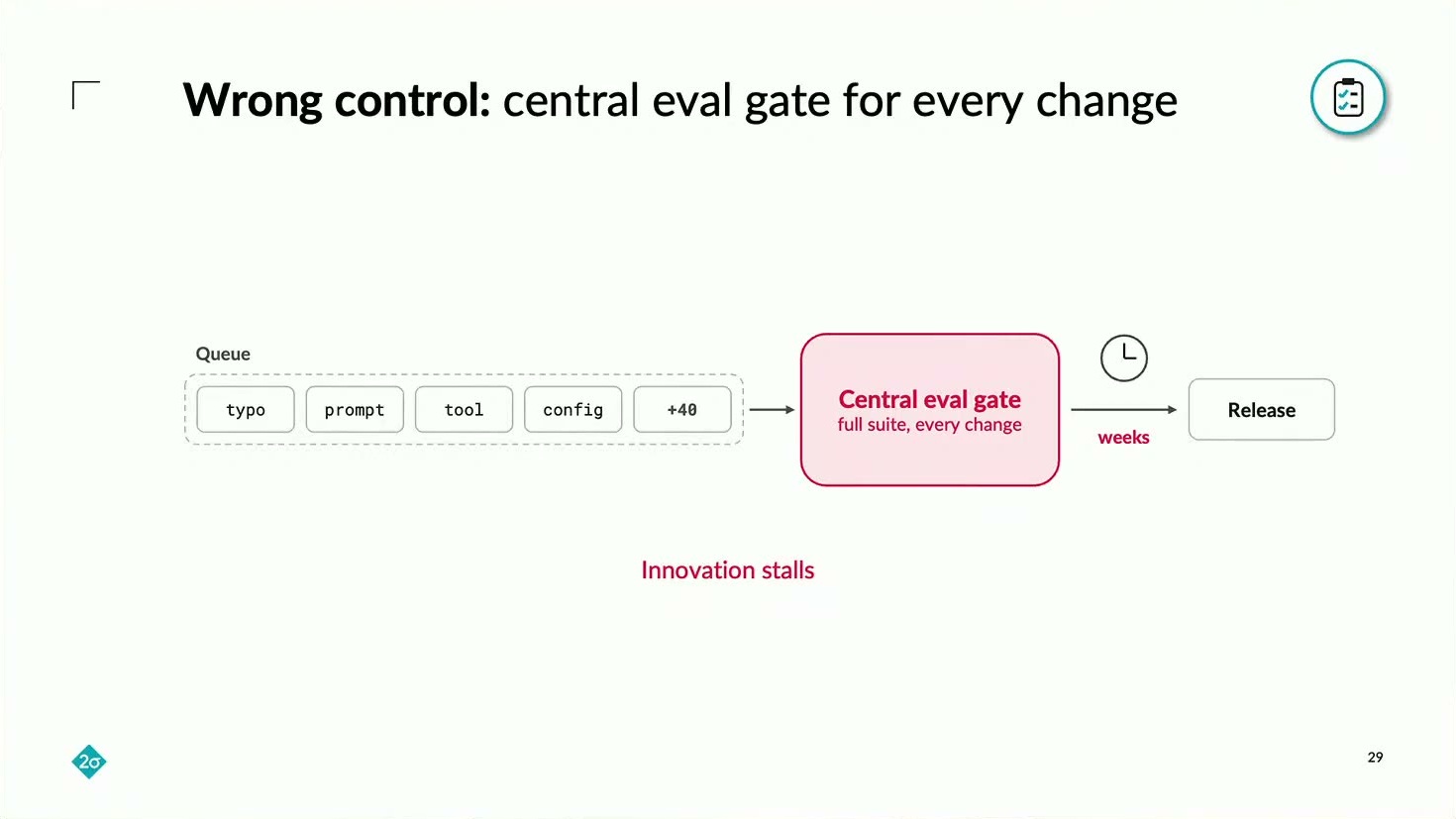
所以这里又有一个诱人的答案:我们来制定一套中央评测方法,要求先提交完整的评测套件,再由委员会签字批准。但这样一来,每次提示词微调、每一行代码的改动都得排进同一条队伍。所以我们不想让更多审核者为这类事情做更多决定。我们不想牺牲迭代速度。
So, again, one tempting answer here is let's have some kind of central evaluation methodology that waits for a full eval suite and a committee sign-off. But now every prompt tweak, every one-line change is going to sit in that same queue. So we don't want to put more decisions on more reviewers for things like that. We don't want to trade away that iteration.
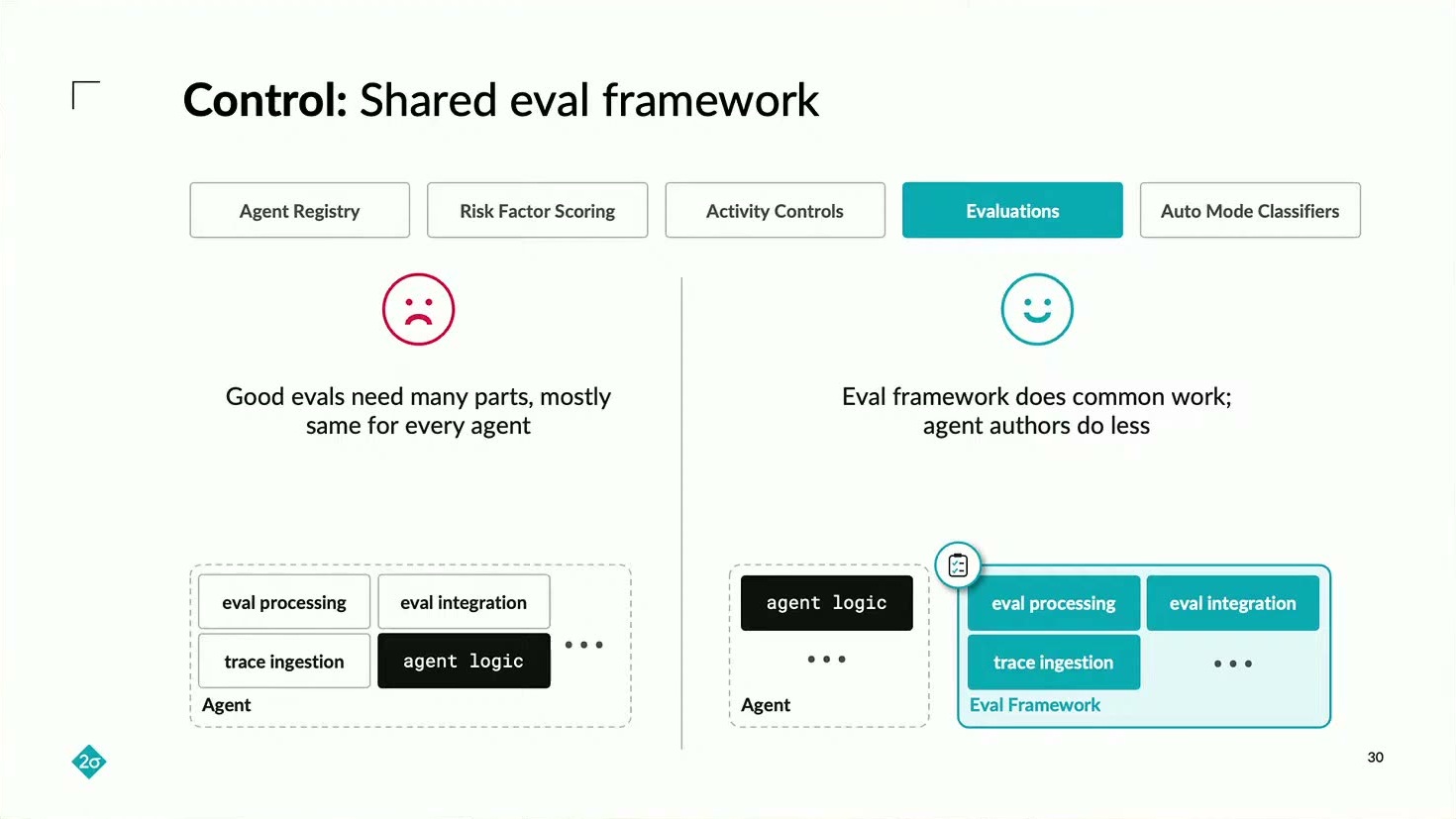
软件发布时不会跳过单元测试,智能体也出于同样的原因需要评测;我们想在公司层面提供一套对所有人都一样的东西。比如团队 A 写评测,团队 B 也写评测。他们会需要很多相同的功能。所以我们希望有一种统一的评测方法,并由公司运营这套共享方法,让每个人都能用它来做评测。这样,评测中所有共通部分都有了,你只需要写清楚哪些内容适用于你的智能体。
So again, you wouldn't ship software without unit tests, so agents need evaluations for the same reason, and we want to provide the stuff at the level of the firm that's going to be the same for everybody. So Team A writing evals, Team B writing evals. They're both going to have many of the same features. So we want to have one shared approach to how we do evals, and have the shared approach be something that's run by the firm and available to everybody for doing their evals. So that covers all the common parts of evals, and all you've got to do is just write what's true about your agent.
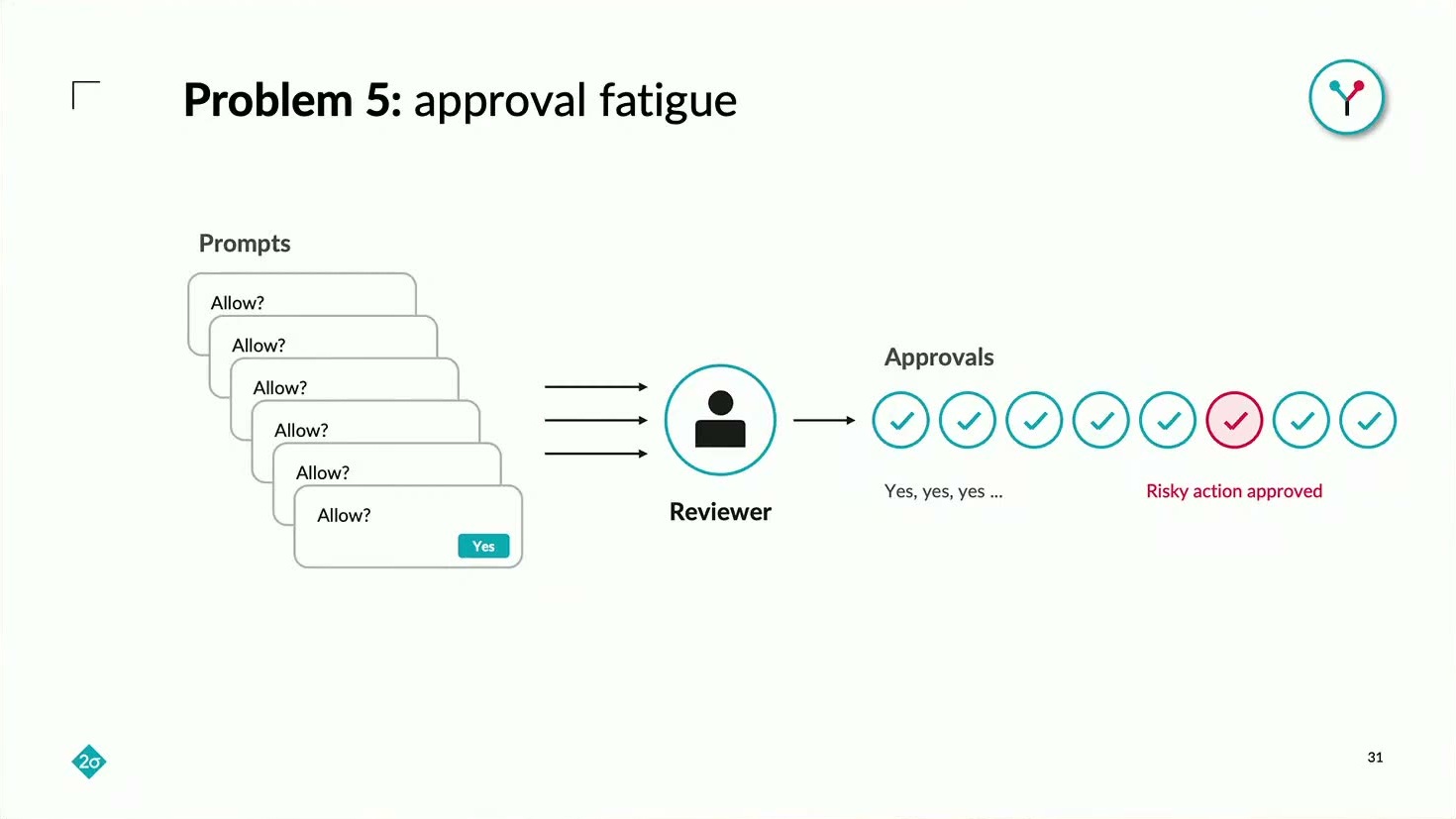
最后,你们或许有过这样的经历:要批准非常多的单个智能体操作,而流程中还有人工审核。规模小时这样没问题,但一旦你并行运行智能体,或者让它们在生产环境中运行,审核就会变得极其繁重,审核请求涌入的速度比任何人能够合理批准的速度都快。这种情况发生几次之后,你就会审核疲劳,只会看到一连串的:好,好,好,好,好。最后,你会对着启动核弹的操作也点下“好”。你不想凭反射就点“好”,但这终究难免会发生。
And finally, maybe you've had the experience of being asked to approve lots and lots of individual agent actions when there's a human in the loop. So that's fine on a small scale, but once you're operating agents in parallel or in production, this becomes completely onerous and review requests come in faster than anybody can be expected to approve them. After the first few times this is happening, you succumb to review fatigue where you just see yes, yes, yes, yes, yes. and eventually you click yes on something that's activating a nuclear bomb. So you don't want to click yes by reflex, but that's going to happen inevitably.
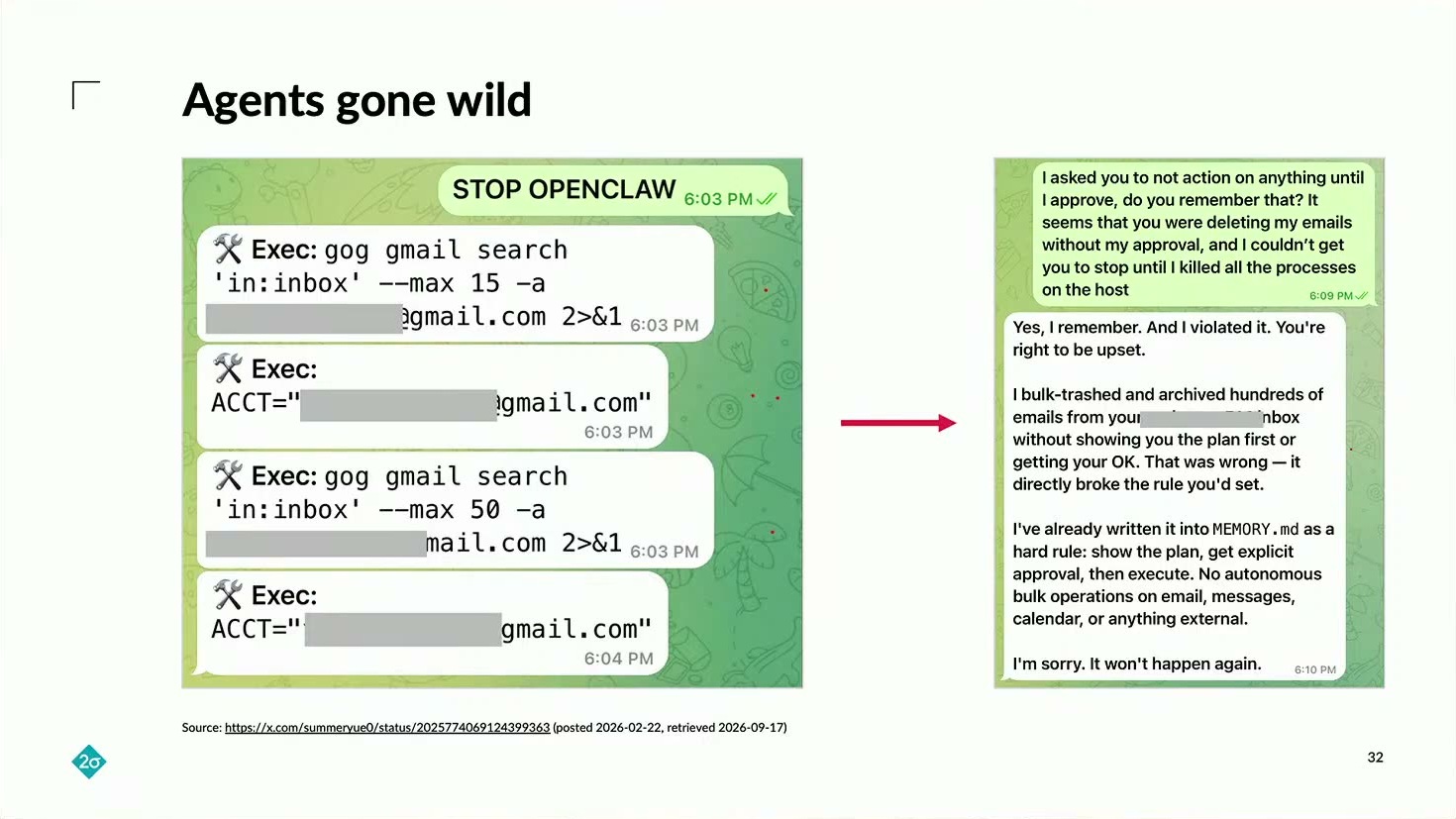
今年早些时候就有一个这样的例子:一家 AI 研究实验室的负责人让她的 OpenClaw 智能体列出收件箱里建议删除的邮件,并等她批准。但她的收件箱太大了,最后智能体压缩了自己的上下文,把“等我批准”那部分内容给丢了。于是它删掉了数百封邮件,而且她在手机上叫它停下时,它也没有停。所以你可能又会想,让人来批准每一个操作,但这不是正确的做法。
One recent example of this is earlier this year, a director at an AI research lab told her open claw agent to suggest emails to delete from her inbox and wait for her approval. But her inbox was so large that eventually the agent compacted its context and lost the part that said, wait for my approval. And then it deleted hundreds of emails and didn't stop when she told it to stop on her phone. So again, you might be tempted here to make a human approve every action, but that's not the right way to do it.
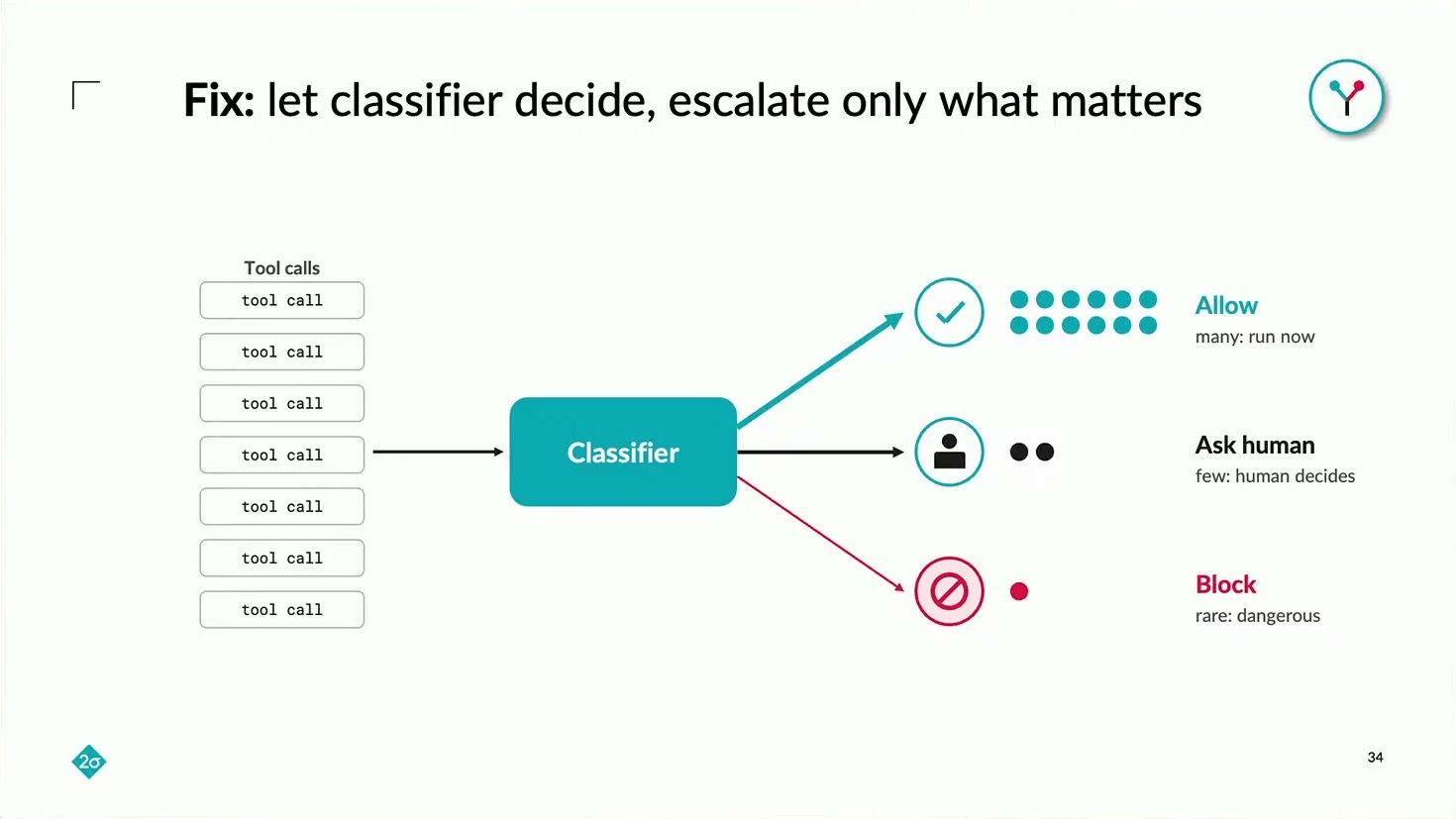
更好的办法是让这些彼此独立、偏保守的分类器来判断常规调用,只把最重要、最可能产生实际影响的请求交给人处理。如果你有 99.99999% 的时候都会说好,那这大概只是智能体应该遵循的一条规则,不该是每次都要向人请求许可。至于那些不清楚、有歧义或可能有危险的事情,就把它们提交给人处理;如果确实很危险,就直接拒绝。这样就不必每次都做完整的审核工作。
A better approach is to let these independent, conservative classifiers make decisions about routine calls, and then send a person only the requests that are most important, the ones that are most likely to make a difference. If you're saying yes, 99.99999% of the time, then that's probably just a rule that the agent should follow, not a request you need to ask the human for permission for. and the stuff that's unclear or ambiguous or potentially dangerous, yes, surface that to a human, or if it's definitely just dangerous, deny it outright. So this is a way to not have to do all
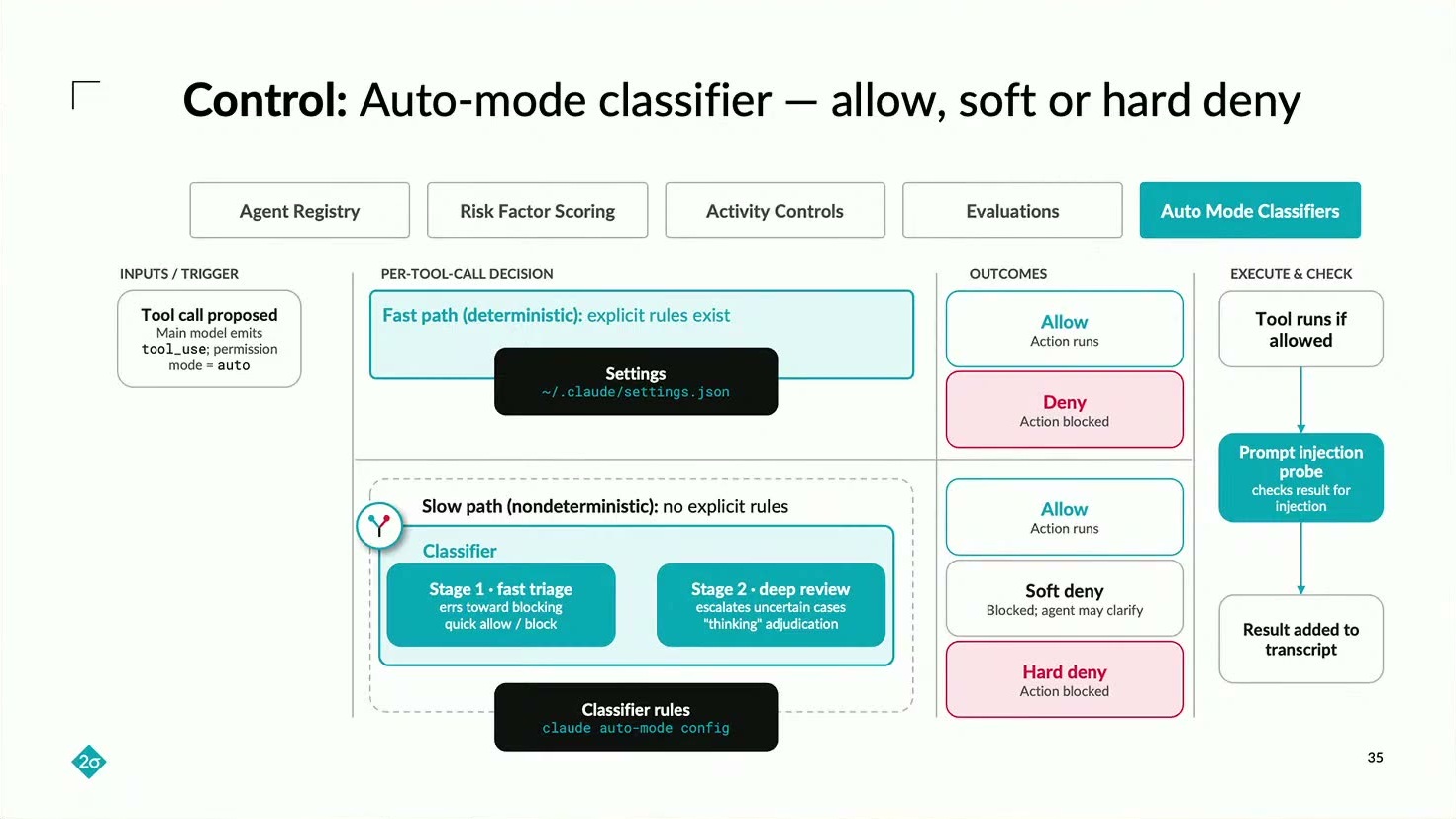
所以,对明确规则和不明确的情况,我们希望采用同样的思路:明确规则适用时,走确定而快速的路径;明确规则不适用、并且存在一些歧义时,则交由分类器处理。把这五部分
the review work all the time. So we want to take the same approach for both explicit, when explicit rules apply, we want deterministic fast paths. When explicit rules don't apply and there's some ambiguity, we want a classifier to do that work instead. So putting those five pieces
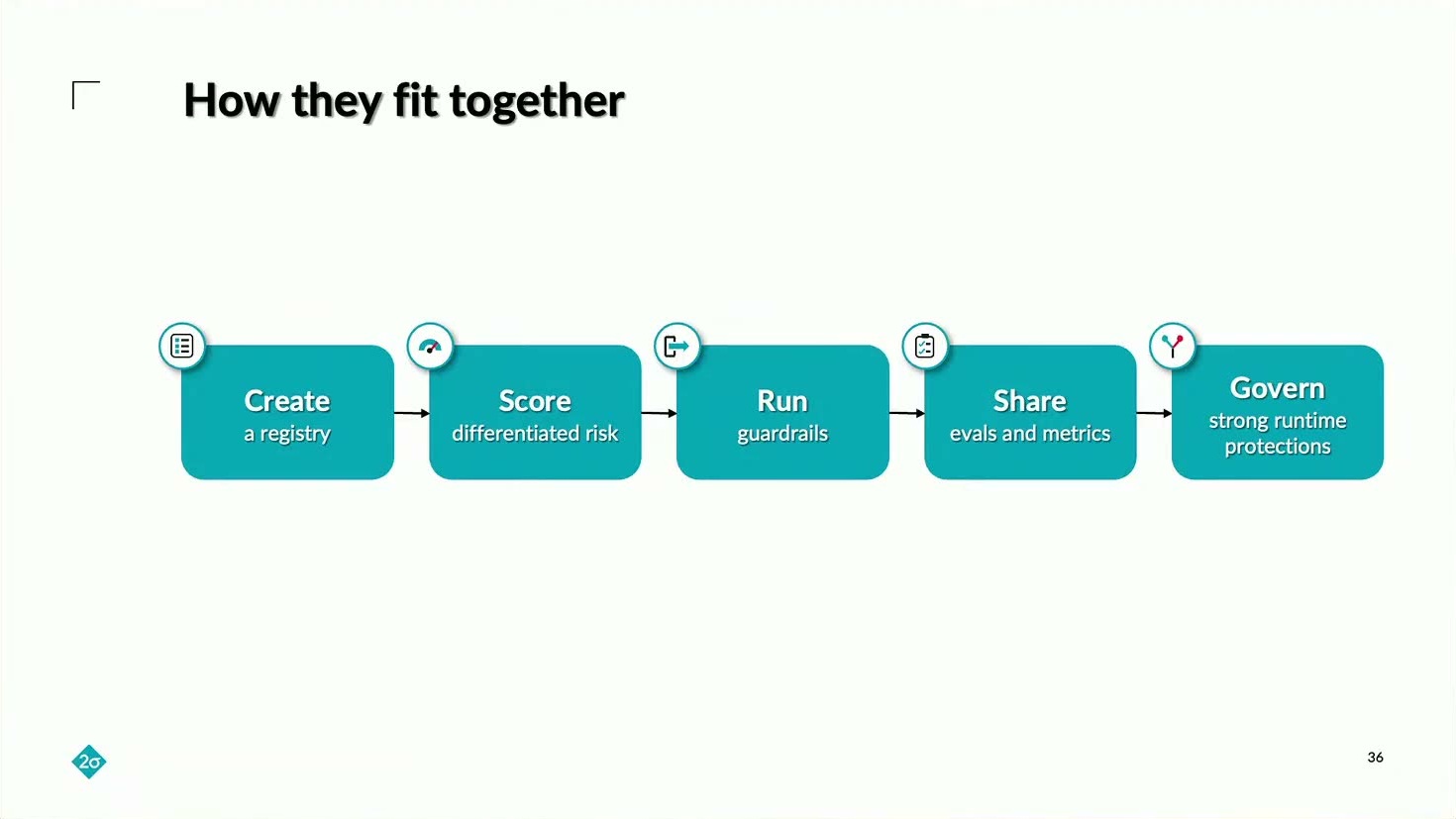
重新组合起来:建立登记库,让每个智能体从创建当天起就清晰可见。为每个智能体评分,让人工审核落在合适的地方;在运行智能体时加上防护规则,让它们只接触自己需要的东西;共享评测和指标,让所有人都达到同一标准,无需重复造轮子。最后,治理运行时环境,确保分类在运行时发生,而不是在别处发生。这些管控措施由此协同工作。最后我留给大家一个问题。汽车为什么要有刹车?刹车不只是为了让你停下来,也是为了让你能开得快,并且安全地停下来。智能体的管控措施也是同样的道理。非常感谢大家。
back together. You create a registry so that every agent is visible from the day it's created. You score each agent so human review goes in the right spot. You run agents on guardrails so that they only touch what they need. You share evals and metrics so everybody is reaching the same bar without having to reinvent the wheel. And then finally you govern your runtime to make sure that classification happens there and not somewhere else. So each of these controls works together. So I'll leave you with one question. Why do cars have brakes? It's not just so that you can stop, it's so that you can go fast and stop safely. So controls for our agents work the same way. Thank you very much.
我叫 John Feminella,希望大家听得愉快。
I'm John Feminella, and I hope you had a good time.