Vault:让非结构化数据服务于投资
Vault: Making Unstructured Data Work for Investing
原文由官网提供,中文由 GPT-6 Luna 翻译。相邻片段合并排版,正文与时间点保持对应。
已插入 21 张经核对的幻灯片或演示截图;点击图片可放大。图注链接为当前视频时间,左侧正文时间保留原转录版本,二者可能不同。
共 33 个阅读段落
稍等一下,我们的幻灯片马上就好。好了,出来了。大家早上好。我是 Sam Green,Bridgewater Associates 应用 AI 团队的负责人,这是我的同事,Aaron Linsky。
Just waiting for our slides. There we go. Good morning, everyone. I'm Sam Green, team lead for Applied AI at Bridgewater Associates, and this is my colleague, Aaron Linsky.
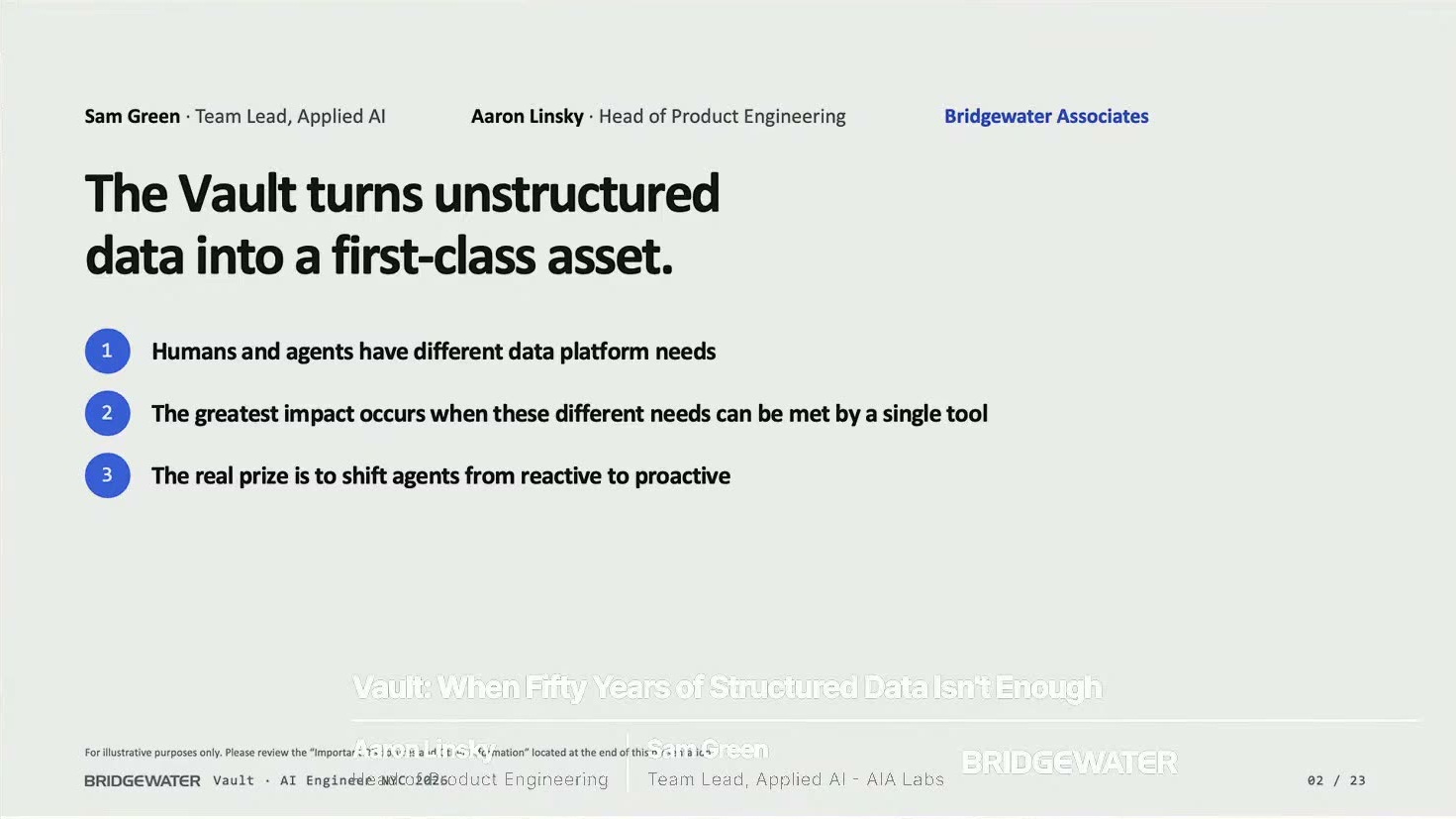
今天我们想和大家聊聊 Vault,也就是我们在 Bridgewater 构建的数据平台,用来把非结构化数据变成我们投资流程中的一项一等资产。今天上午的演讲中,我们想分享构建 Vault 学到的三点经验。第一,人和智能体对数据平台的需求很不一样,所以你必须分别针对这些不同需求来构建。第二,最大的影响出现在单一工具能够同时满足这两类需求的时候。第三,真正的收获,是你能否打好所需的基础,让智能体成为投资流程中的主动参与者,或者成为你使用工具做任何事情时的主动参与者,而不是供人使用的被动工具。
and today we're here to talk to you about the vault, the data platform that we've built at Bridgewater to turn unstructured data into a first-class asset in our investment process. And as part of the talk this morning, we'd like to share three lessons that we've learned building the vault. The first is that humans and agents have very different needs from a data platform, and so you have to build for those different needs separately. The second is that the greatest impact occurs when a single tool can meet both of these sets of needs at the same time. And the third is that the real prize is when you can build the foundations needed to make agents a proactive participant in your investment process or whatever you're doing with your tools instead of a reactive tool for your humans to use.
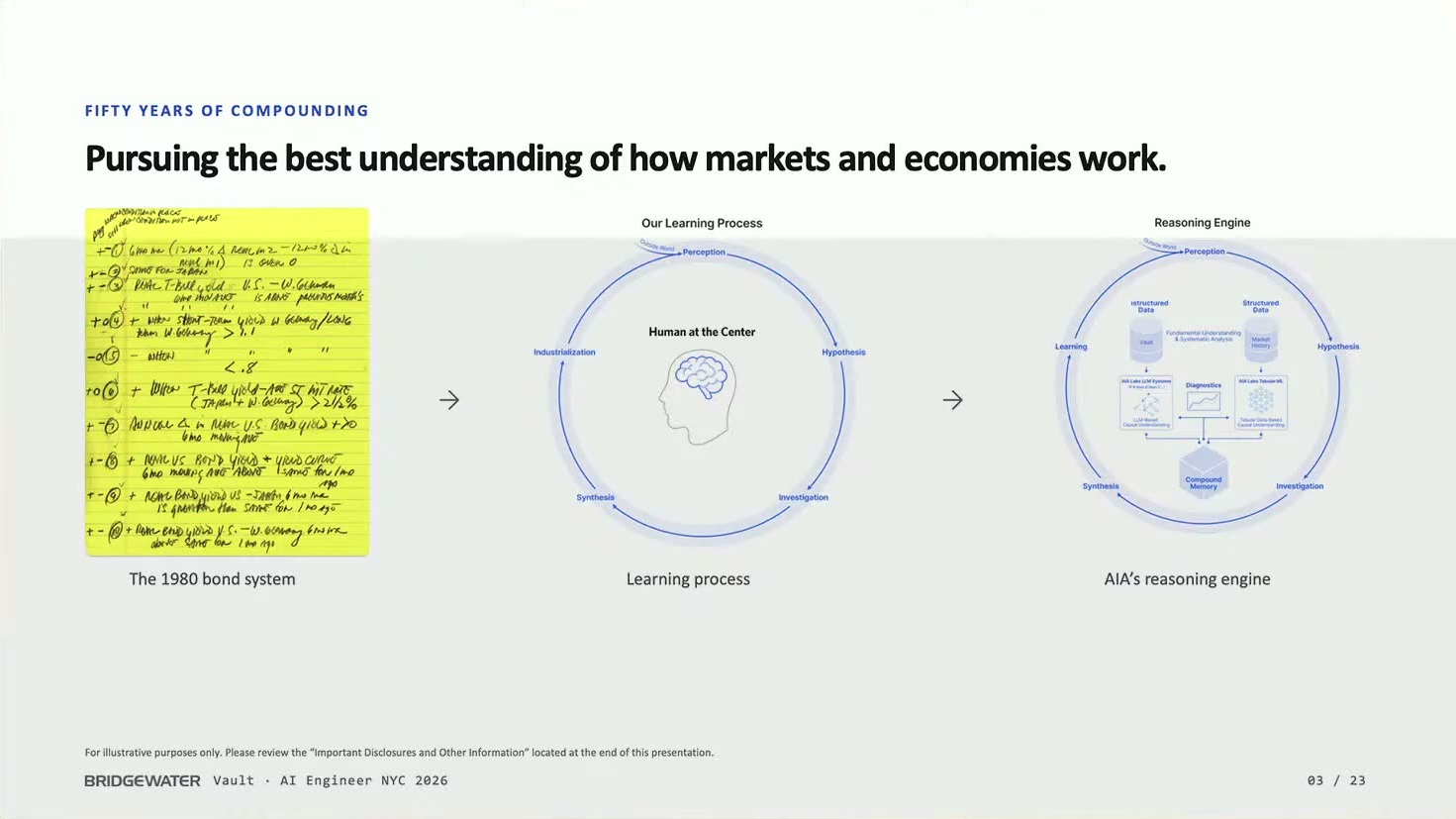
在深入介绍 Vault 之前,我想先从一些背景开始,介绍一下 Bridgewater。过去 50 年里,Bridgewater 一直在努力追求对市场和经济如何运行的世界最佳理解,并把这种理解转化为系统化的编码,让我们能随着时间推移检验自己的逻辑。最初,这只是黄色法律便笺纸上的一组“如果—那么”规则,后来逐渐演变为一个持续复利增长的流程,由人处于核心位置,不断寻找市场中下一个正在发生变化的事物。近来,我们一直在打造 AYA,也就是人工投资助理,让机器处于这个持续流程的核心。
Before I dive deeper into talking about the vault, I wanted to start with some background about Bridgewater. Over the last 50 years, Bridgewater has been in the constant pursuit of the world's best understanding of how markets and economies work, and turning that into a systematic encoding that we can use to stress test our logic over time. And what originally began as a set of if-then rules on a yellow legal pad evolved into a continuous compounding process with humans at the center constantly looking for the next thing that's changing in markets. And more recently, we've been working on building AYA, the artificial investment associate, which puts a machine at the center of this continuous process.
在所有这些演进阶段中,我们始终秉持一个理念,那就是,我们希望持续观察世界如何变化、世界上正在发生什么,注意到哪些动态尚未被编码进我们的理解中,并利用这些学习成果不断改进,为未来积累复利。
Across all these phases of evolution, we've had a constant philosophy in mind, which is that we want to be constantly looking at how the world is changing and what's going on in the world, noticing what dynamics are not yet encoded in our understanding, and use that learning to improve and compound for the future.
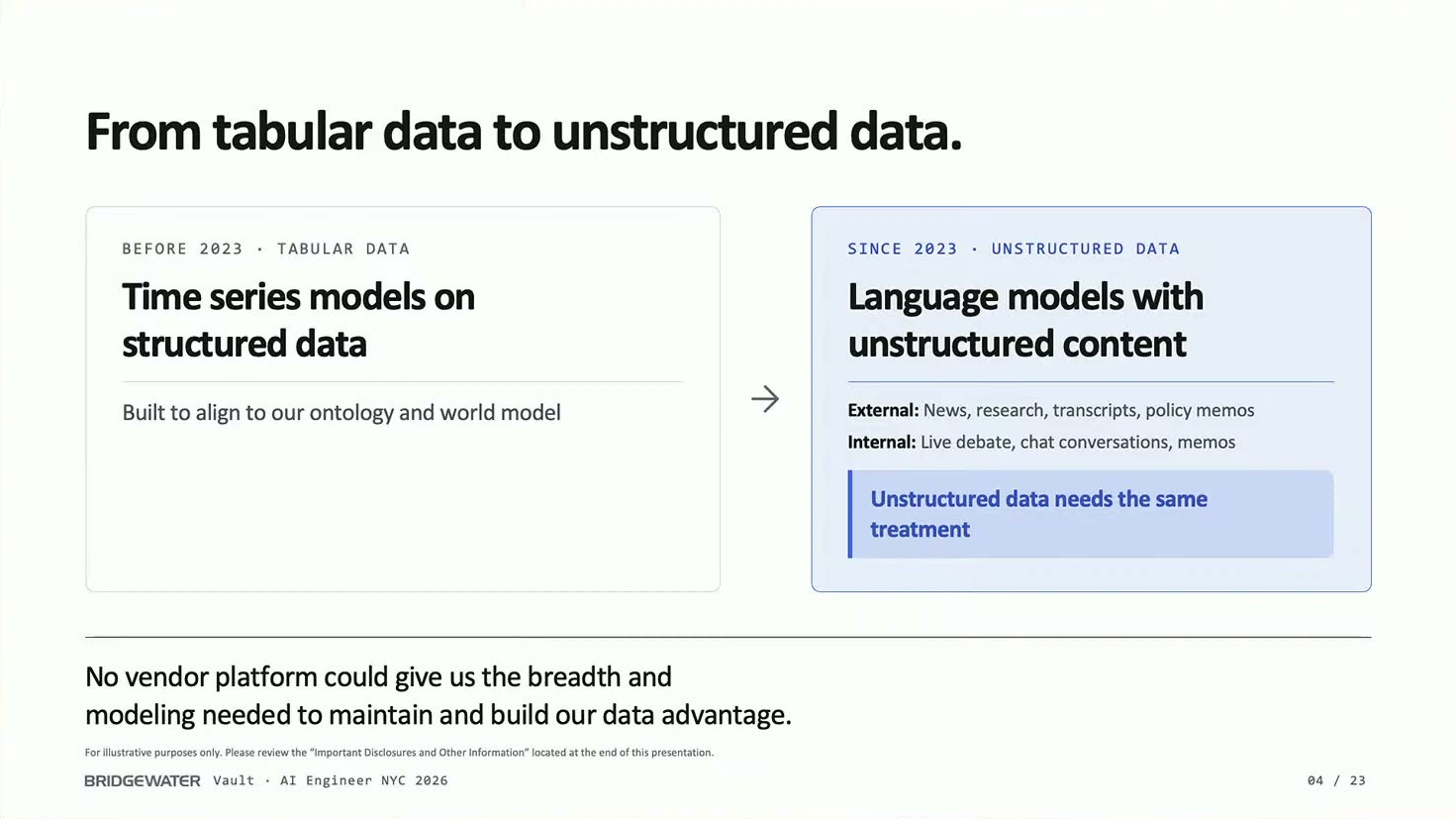
在 Bridgewater 的大部分历史时期,这意味着要构建并监督基于结构化数据的时间序列模型。这些结构化数据需要经过细致构建,这样才能安全地用于我们的研究流程,并且与我们的内部本体和世界模型保持一致,从而让我们能够充分发挥我们所构建数据的价值。随着语言模型的出现,我们迎来了一个巨大的新机遇,可以接触范围广得多的数据世界,包括新闻和研究、文字记录、政策文件,以及所有内部对话,这些内容过去都只是散落在空气中。也就是内部备忘录、会议记录,以及公司内部发生的辩论。
For most of Bridgewater's history, that meant building and overseeing time series models on structured data. And that structured data needed to be carefully built so that it could be safe for use in our research process and aligned to our internal ontology and world model so that we could get great leverage out of using the data that we had built. With the emergence of language models, we had a huge new opportunity to engage with a much wider world of data, news and research, transcripts, policy documents, and all of the internal conversation that was previously just in the ether. So the internal memos and meeting transcripts and debate happening inside the firm.
我们很快意识到,所有这些数据都需要经过完全相同的处理,才能适合实际用途。需要仔细清理、治理,并准备好用于时点研究问题,也用于今天的研究,以及我们长期开展的系统性研究。当我们审视数据供应商和数据平台提供商的市场时,发现没有任何一家能提供我们所需的全部控制能力,
We quickly realized that all of that data needed the exact same treatment to be fit for purpose. It needed to be carefully cleaned, governed, and made ready for use in both point-in-time research questions today and also our systematic study over time. And when we looked out at the landscape of data vendors and data platform providers, there was nothing that provided us with all of the control
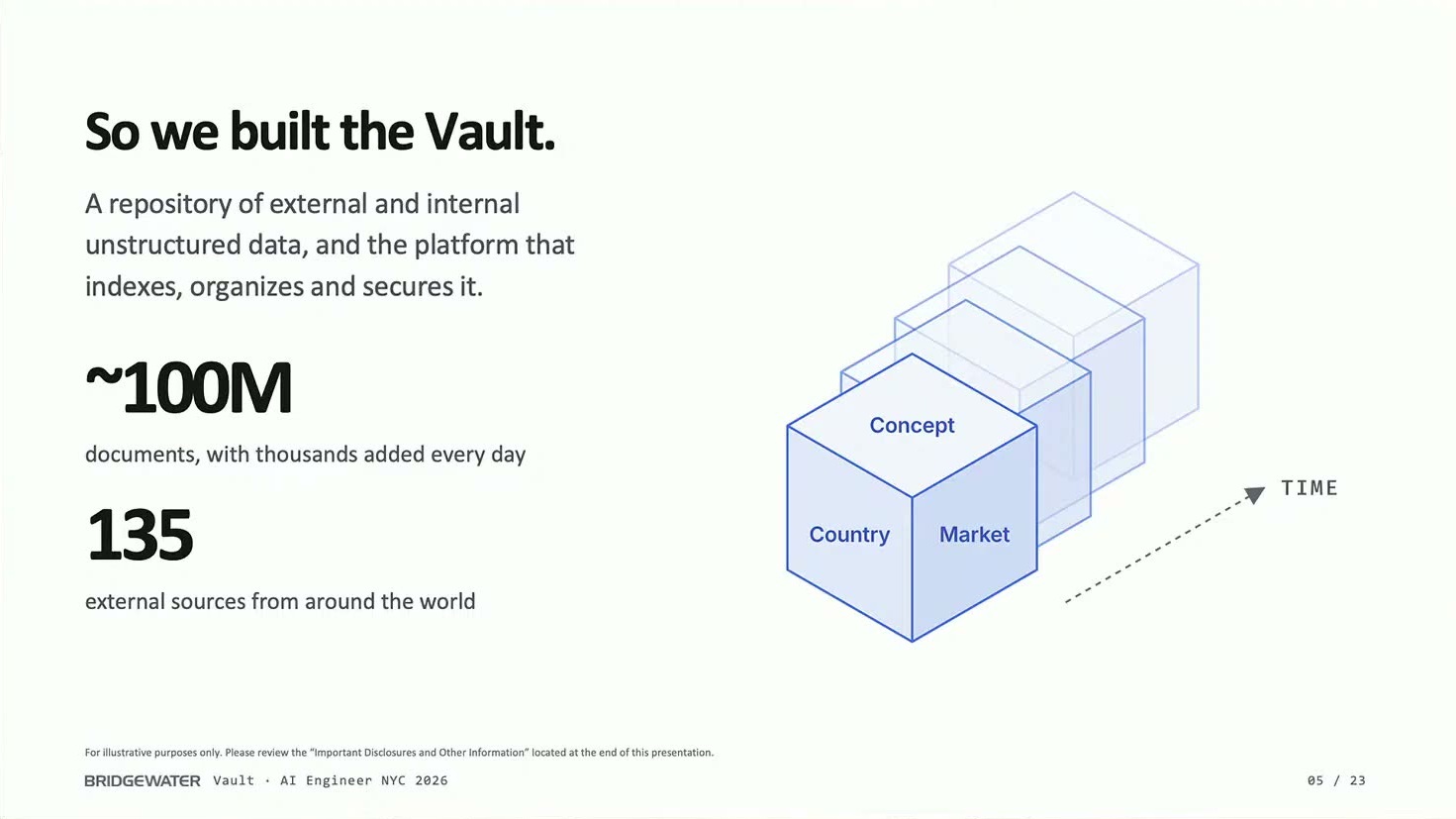
以便建立并维持我们的数据优势。因此我们构建了 Vault,它是我们的外部和内部非结构化数据存储库,也是一个为所有这些数据编制索引、加以组织,并使之准备好供我们的投资人员和智能体使用的平台。如今,Vault 中有超过 1 亿份文档,每天还会不断新增数千份,时时刻刻都在增加,数据来自 135 个外部来源,而且来源数量还在持续增长,同时也包括 Bridgewater 内部的全部数据。关键是,这些数据并不是直接一股脑地丢到投资人员的桌面上。它们经过细致处理,与我们的内部本体对齐,并补充了国家、概念、市场等信息,最重要的是,补充了文档所讨论的时间段。
that we needed to build and maintain our data advantage. And so we built the vault, which is our repository of external and internal unstructured data, and the platform that indexes, organizes, and makes all of it ready for use by our human investors and agents. Today, the vault has more than 100 million documents in it, with thousands more added every day, minute by minute, from 135 external sources, and again, growing all the time, as well as all of the data from inside of Bridgewater. And crucially, all that data is not just dumped on our investors' desks. It is carefully aligned to our internal ontology with enrichments like the countries, concepts, markets, and most importantly, time period discussed in the document.
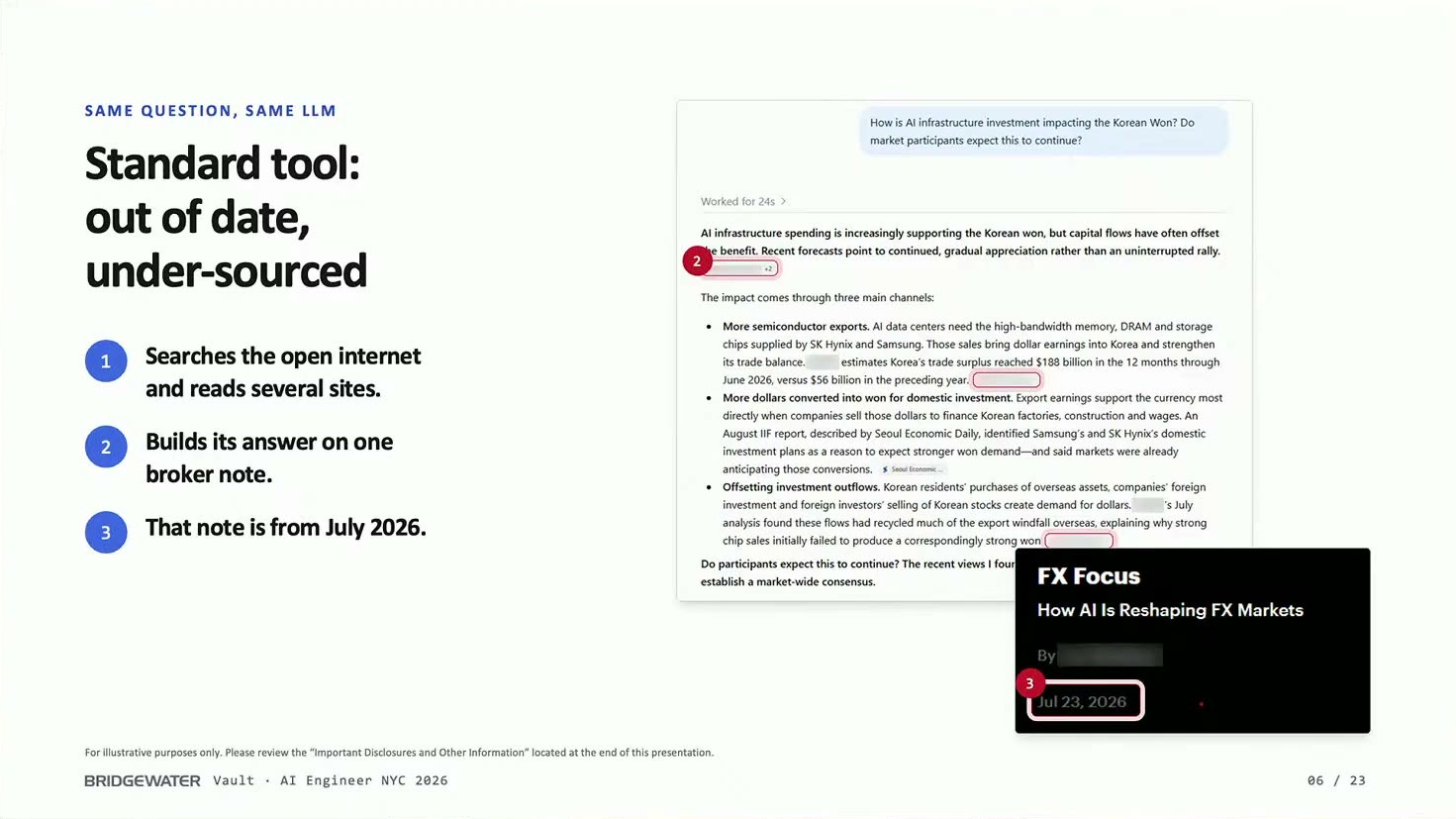
为了让大家直观感受,我想先举一个简短的例子。我向一个企业级聊天客户端提出了一个相当基础、具有代表性的投资问题:“AI 基础设施投资如何影响韩元,我问:AI 基础设施投资如何影响韩元,市场参与者是否预期这种影响会持续?正如大家都很熟悉的那样,智能体会去网上查找它可以参考的资料,因为我明确要求它去找其他人对这个问题的看法,你们可以看到,它深入查找,找到了 15 份看起来相关的资料,供它参考,然后才把答案给我。我放大查看它给出的答案时,有两件事让我印象很深。
To bring this to life, I want to start with a quick motivating example. So what I did here is I asked a fairly basic representative investment question to an enterprise chat client. I asked, how is AI infrastructure investment impacting the Korean won, and do market participants expect this to continue? you. As you are all familiar with, the agent goes to the web and looks for resources it can draw on because I have explicitly asked it to go find other people's perspectives on the question. You can see it zooms in and finds 15 relevant looking resources to draw on before it gives me back its answer. When I zoomed in on the answer it gave back, a A couple of things stood out to me.
第一,尽管它找到了 15 个看起来相关的来源,最终却只选了一两个来回答我的问题。第二,在回复末尾,智能体自己承认它并没有回答我的问题。它没能在开放网络上找到足够的文档来确立市场共识,也没能满足我提出的要求。我进一步仔细查看后,问题变得更严重了。它回答我的问题时主要参考的一份说明,早在 2026 年 7 月就发布了;可我是在上周末,也就是 10 月初,提出问题并截取这个答案的。在 AI 时代,尤其是在投资领域,3 个月是非常长的一段时间。
The first is that even though it found 15 relevant-looking sources, it only picked one or two to answer my question. And the second is down at the end of this response, where the agent itself acknowledges that it hasn't answered my question. It didn't find enough documents on the open web to establish a market consensus and meet the parameters that I laid out. When I double-clicked even further, the problem got even worse. One of the notes that it primarily drew on to answer my question was published way back in July of 2026, even though I asked this question and captured this answer just at the end of last week in early October. In the age of AI and in investing, three months is a massive amount of time.
参考这份资料来回答我的问题,远远不够好。
It's not even close to good enough to draw on this resource to answer my question.
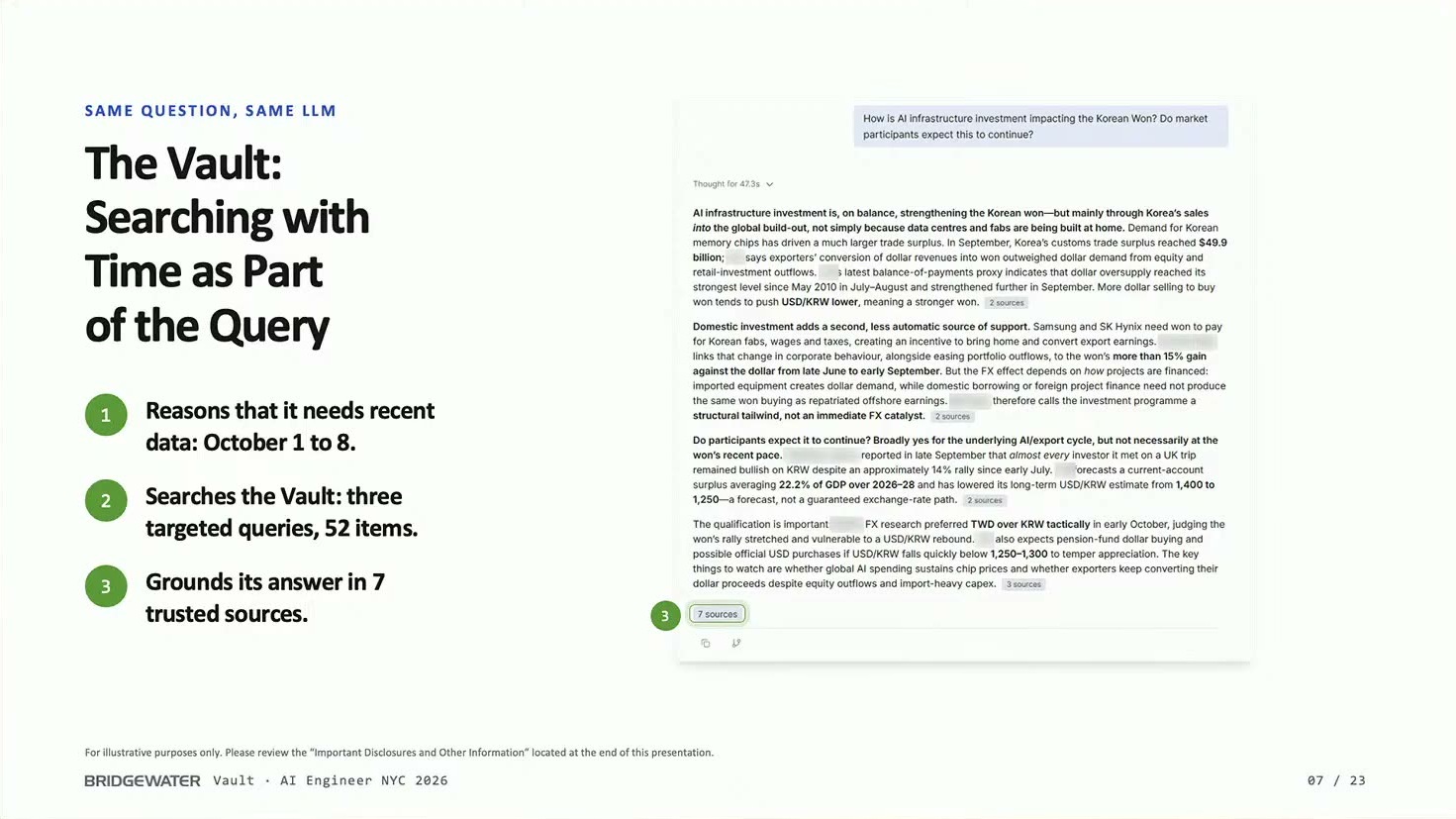
当我把完全相同的问题交给接入 Vault 的智能体时,情况就完全不同了。首先,连接到 Vault 会提示智能体,回答我的问题时应该查找某个特定时间段内的资料。于是它把范围聚焦在 10 月 1 日到 10 月 8 日。它找到的资料种类丰富得多,在这段特定时期内,有 52 份候选文档与问题相关,这是因为 Vault 拥有规模大得多的内容库,其中有更多与投资问题相关的内容,可供检索。最终回答我的问题时,它参考了 7 份资料,而不是只有一两份,给我提供了内容丰富的答案,智能体也更有把握能切中我的问题。
When I ask this exact same query attached to the vault, something totally different happens. The first is that the connection to the vault helps to prompt the agent that it should look for a specific period of time when answering my question. So it zooms in on October 1st to October 8th. It finds a much wider array of resources, 52 candidate documents that are relevant to the query over this specific period of time because of the vault's much more significant corpus of content that's relevant to investing questions. when it ultimately answers my question, it draws on seven instead of only one or two, gives me back a rich answer that the agent is more confident is going to address my question.
所以,对我们来说,构建 Vault 得出的重要经验,也是今天这场演讲的出发点,就是要让智能体发挥影响力,需要优质数据和合适的连接器。现在我把时间交给 Aaron,请他谈谈构建 Vault 的一些产品工程经验。
And so for us, this is the big lesson from building the vault to motivate the talk today, which is that it takes great data and the right connectors to make agents impactful. And I'm going to hand it over to Aaron now to talk about some of the product engineering takeaways from building the vault.
谢谢你,Sam。大家好,我是 Aaron。我负责 Bridgewater 的产品工程。接下来我会介绍一些我们过去几年构建 Vault 时总结出来的经验。
Thanks, Sam. So hi, I'm Aaron. I run product engineering at Bridgewater. I'm going to take us through a few of our learnings from building the vault over the past few years.
我先讲一条可能听起来显而易见、但我仍觉得值得说出来的经验,那就是搜索很难。如果我们要为两种不同的使用者设计,事情就更难了。在这里,我们面向人和智能体进行设计。
I'm going to start with one that might seem obvious, but I still think it's worth saying, which is search is hard. But it gets even harder if we're designing for two different consumers. In this case, we're designing for humans and agents.
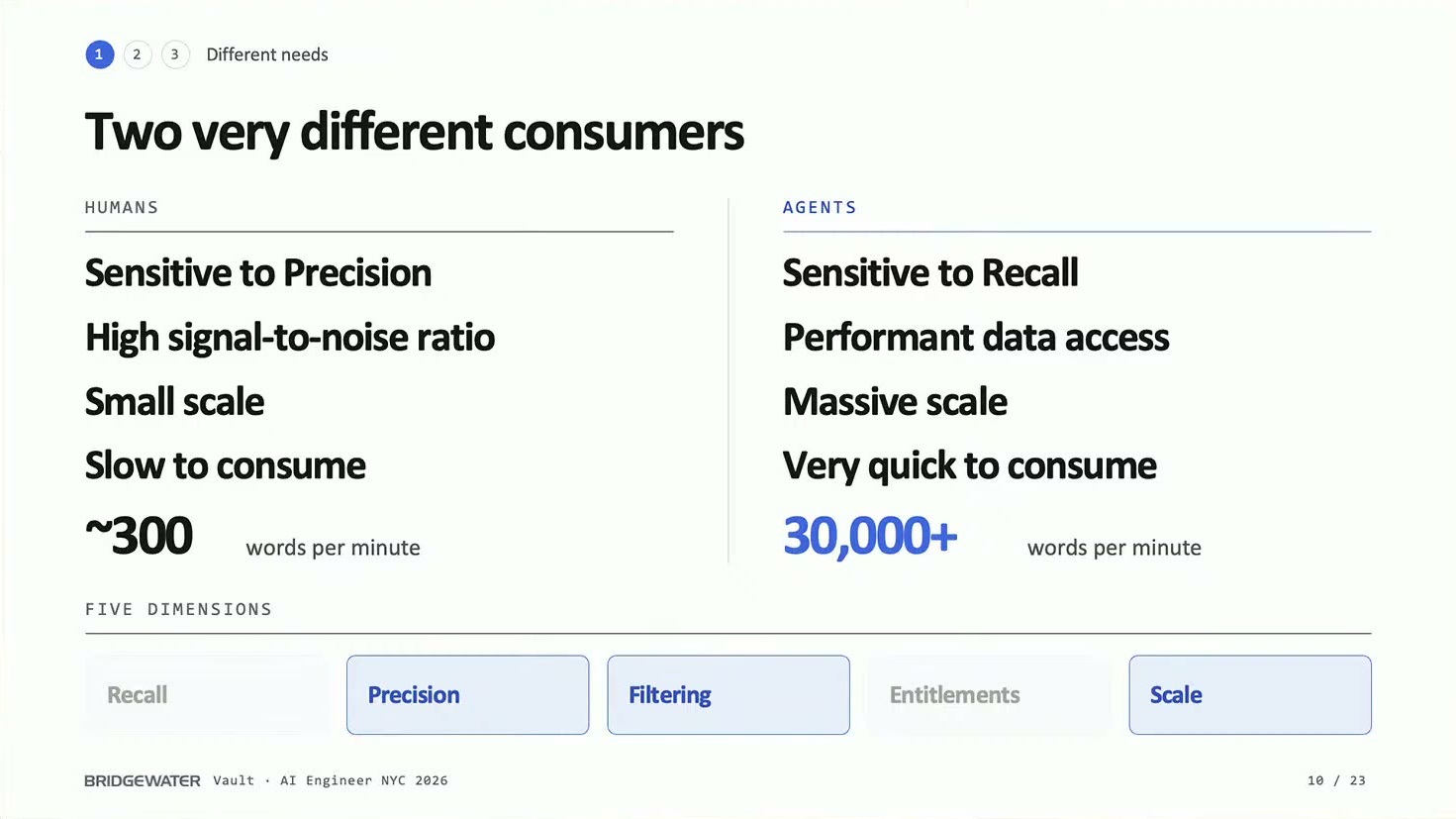
我先从人开始,谈谈两者的差别。人需要高精确率和高信噪比,因为我们能读的内容有限。即使是阅读速度很快的人,每分钟也只能读大约 300 个词;而我个人要慢得多。智能体是另一种读者。它们对精确率的敏感度低得多。只要数据在那里,它们就能找到。基本上,你交给它们的任何内容,它们都会处理。它们扩展得非常快,处理速度大约快 100 倍,每分钟能读 30,000 个词。因此,我们需要构建 Vault,同时满足这两类使用者的需求。
I'm going to go over the difference here, starting with us. So humans need precision and a high signal-to-noise ratio because we can only read so much. Even a fast reader manages about 300 words a minute, and personally, I'm much slower. Agents are a different kind of reader. They're far less sensitive to precision. If the data is there, they'll find it. And basically anything you hand to them will get attended to. They scale super quickly and they consume about 100 times faster, 30,000 words per minute. And so we need to build Vault for both of these.
我们考虑哪些维度最重要时,板上列出了这五项:召回率、精确率、过滤、权限控制和规模。其中一些对人很重要,一些对智能体更重要,很多则对两者都重要。接下来我会深入讲其中三项:面向人的精确率、面向智能体的规模,以及两者都需要的过滤。先讲精确率。
And when we're thinking about the dimensions that matter, there are these five on the board. recall, precision, filtering, entitlements, and scale. Some of them matter to people, some matter more to agents, many to both. I'm going to go deep on three of these, precision for people, scale for agents, and then filtering for both. So, precision.
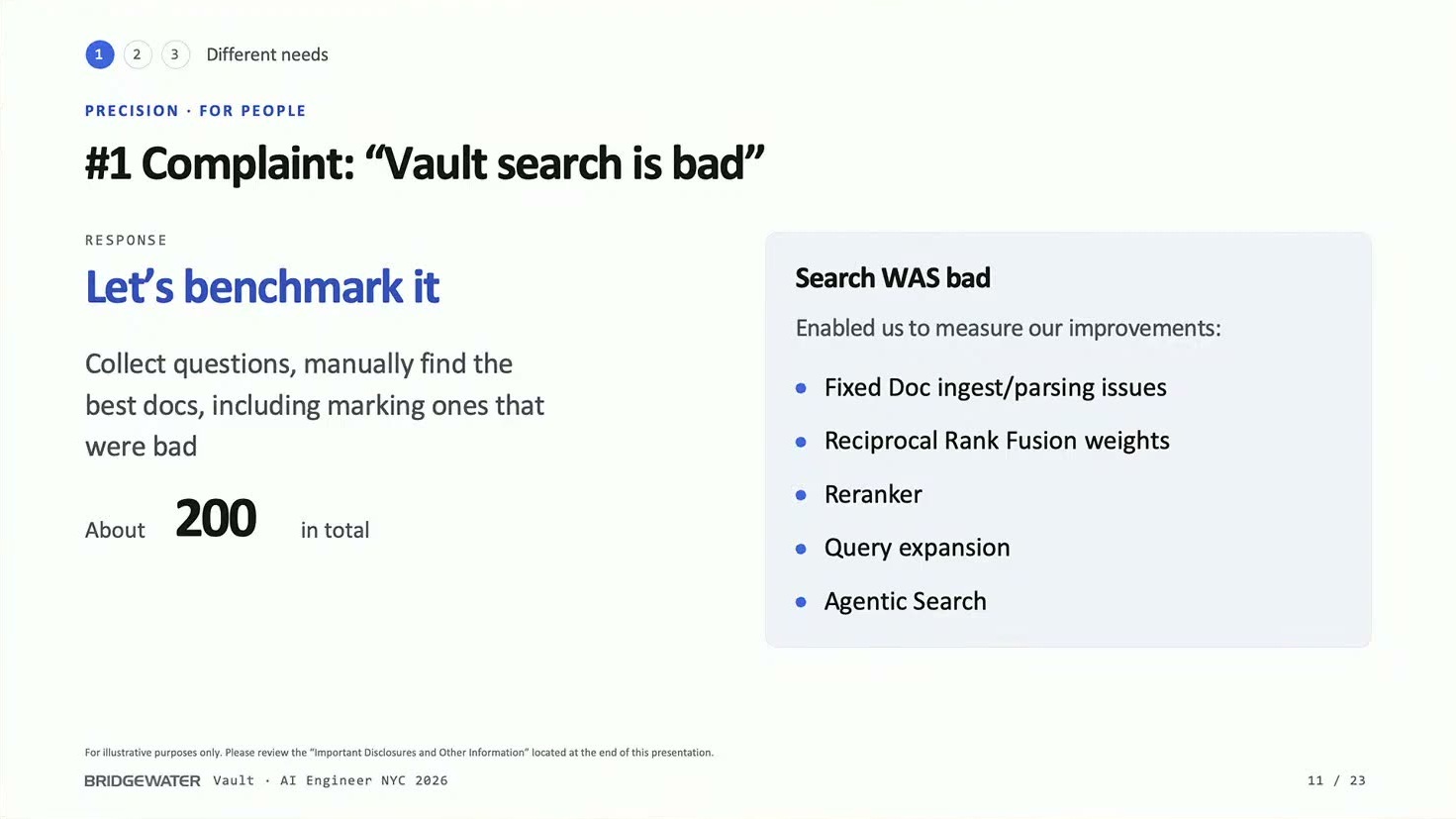
填满 Vault 是数据团队和法务团队付出巨大努力的成果;填满之后,召回率就不再是紧迫问题了。然而,最常见的抱怨就是 Vault 搜索很差。作为产品负责人,听到这种话很难受,但我的回应是:那我们来做基准测试吧。于是我们就这么做了。我们收集了一些问题,手动找出最好的文档,也包括那些看似有帮助、实际却没有帮助的文档。总共大约有 200 个例子,我们花了不到一周时间。这活儿既不好玩,也谈不上光鲜,但非常有帮助。跑完测试后,结果一目了然。
Once we've filled the vault, which was a heroic effort by our data and legal teams, Recall was no longer a pressing issue. However, the number one complaint was vault search is bad. As a product owner, it's painful to hear that, but my response was, let's benchmark it. And that's what we did. We collected questions and found the best documents by hand, including ones that looked helpful but weren't. In total, it was about 200 examples, and it took us less than a week. It was not fun or very glamorous, but it was very helpful. And after we ran it, it was very clear.
搜索效果很差。我们关注的关键指标是前 10 条结果的精确率,也就是前 10 条结果中,有多少份是正确的文档。我们的水平大约是 60%。所以大家说得没错。效果确实很差。但现在我们有办法衡量所有改进了。板上列出了其中五项。等我们完成智能体驱动的搜索后,前 10 条的召回率达到了 90% 到 95%,或者说是前 10 条的精确率。好,精确率就讲到这里。
Search was bad. The key metric we were looking at is precision at 10, which is of the top 10 results, how many are the right documents. And we were hitting about 60%. So the people were right. It was bad. But now we had a way to measure all of the improvements. And here on the board are five of them. And by the time we got done with agentic search, we were up in the 90-95% recall at 10, or precision at 10. All right, so that was precision.
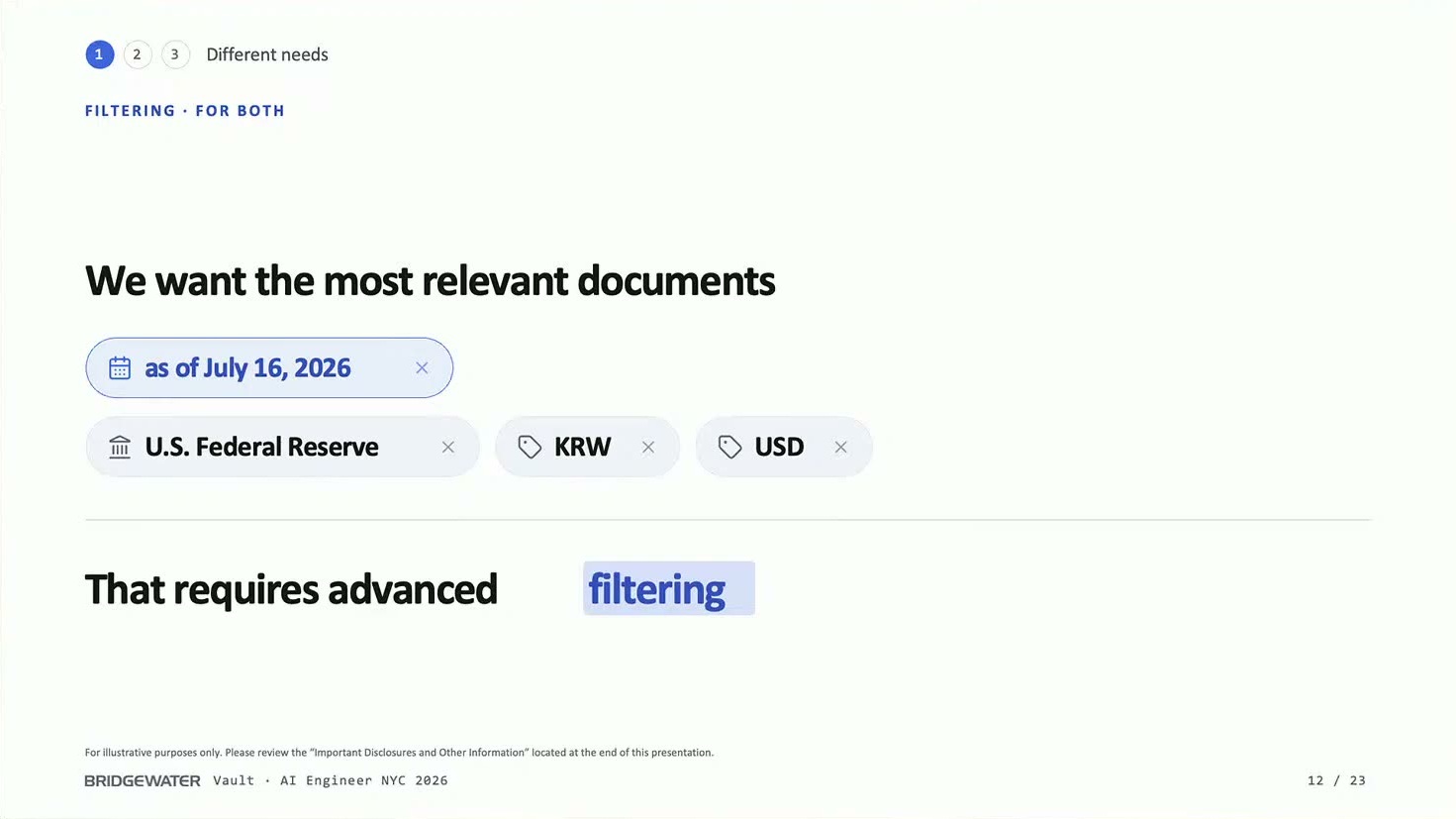
接下来讲过滤。和所有人一样,我们希望找到最相关的文档。但我们查看生产环境的跟踪记录时,发现几乎总会有某个条件,比如截至某个日期、来自某个来源,或者涉及某项特定资产。而这些都需要高级过滤功能。这正是我们遇到的第一个重大性能问题。
Now on to filtering. Like anyone, we want the most relevant documents. But when we looked at the production traces, what we were seeing is that almost always there was some condition, either as of a certain date or from a certain source or about a specific asset. And all of that requires advanced filtering. And that's where we ran into our first major performance issue.
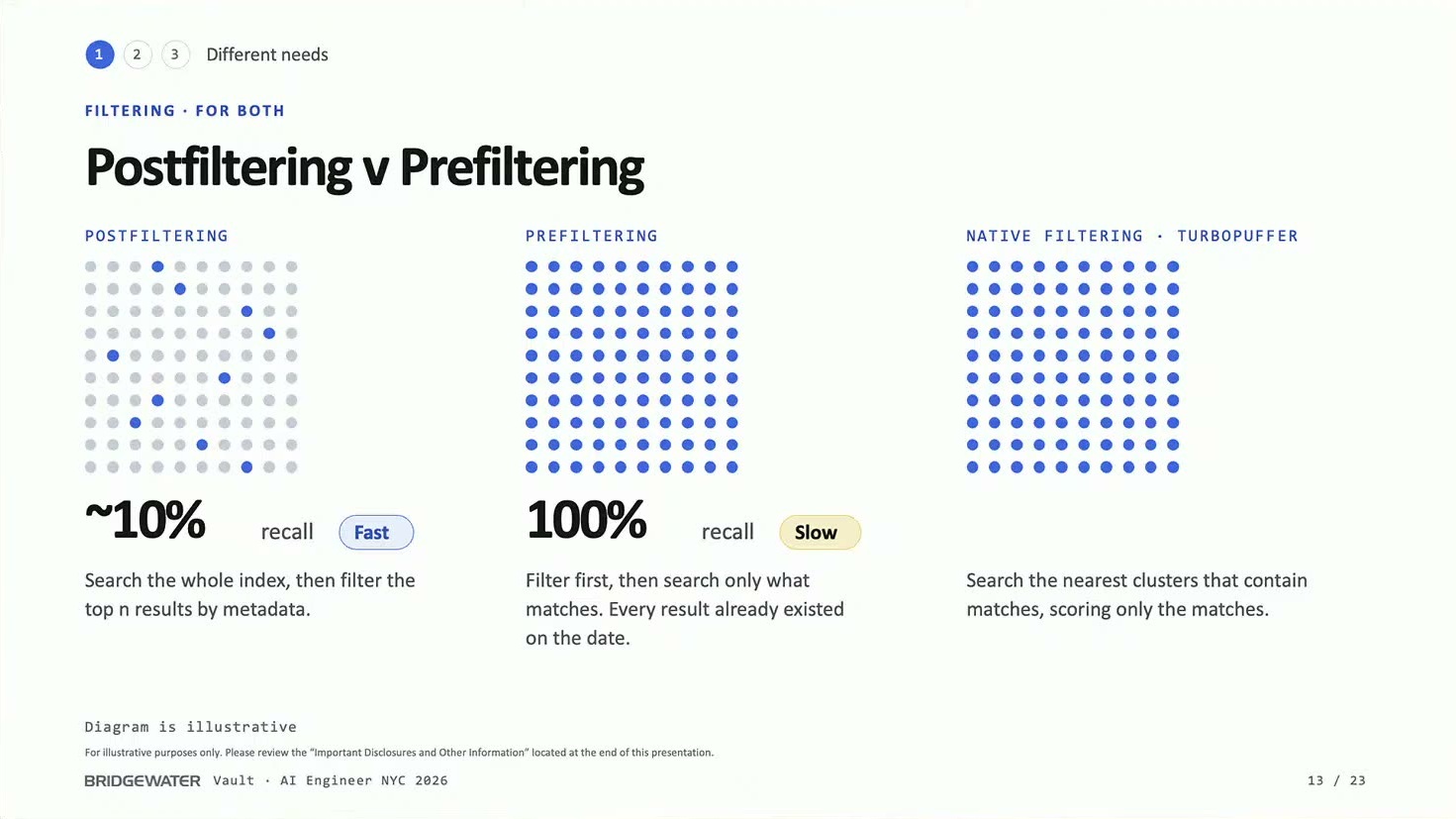
我快速讲一下,这部分会稍微偏技术一些。传统上,过滤向量数据库有两种方法。后置过滤是先使用向量索引,再根据元数据对排名靠前的结果进行过滤。这种方法速度快,但召回率可能相当低,因为在全局范围内相关的结果,可能不符合你的筛选条件。另一种是前置过滤,先进行过滤,然后为每一条匹配结果计算距离。这种方法的优点是召回率很高,但可能会非常慢,而我们需要一种介于两者之间的方法。所以我们开始试用 turbopuffer,最终也因此切换到了它。
So I'm going to quickly go through this, a little bit technical here. There's classically two ways to filter a vector database. Post-filtering, we'll use that vector index first, and then filter the top results by metadata. It's fast, but recall could be pretty low, because the globally relevant results might not match your filters. On the other side, we have pre-filtering, where we'll filter first and then calculate distances for every one of those matches. The advantage there is that the recall is very good, but it can be very slow, and we needed something in between. So that's what led us to try and then ultimately switch to turbopuffer.
他们把自己的方法称为原生过滤,只查看包含匹配项的最近邻簇,然后只对这些簇评分。最终得到的是一种速度很快的方法,和后置过滤一样快,但召回率接近前置过滤。
Their approach, which they call native filtering, looks only in the nearest clusters that contain matches and then scores just those. What you end up getting is something that's fast, like post-filtering, but with close to the same recall as pre-filtering.
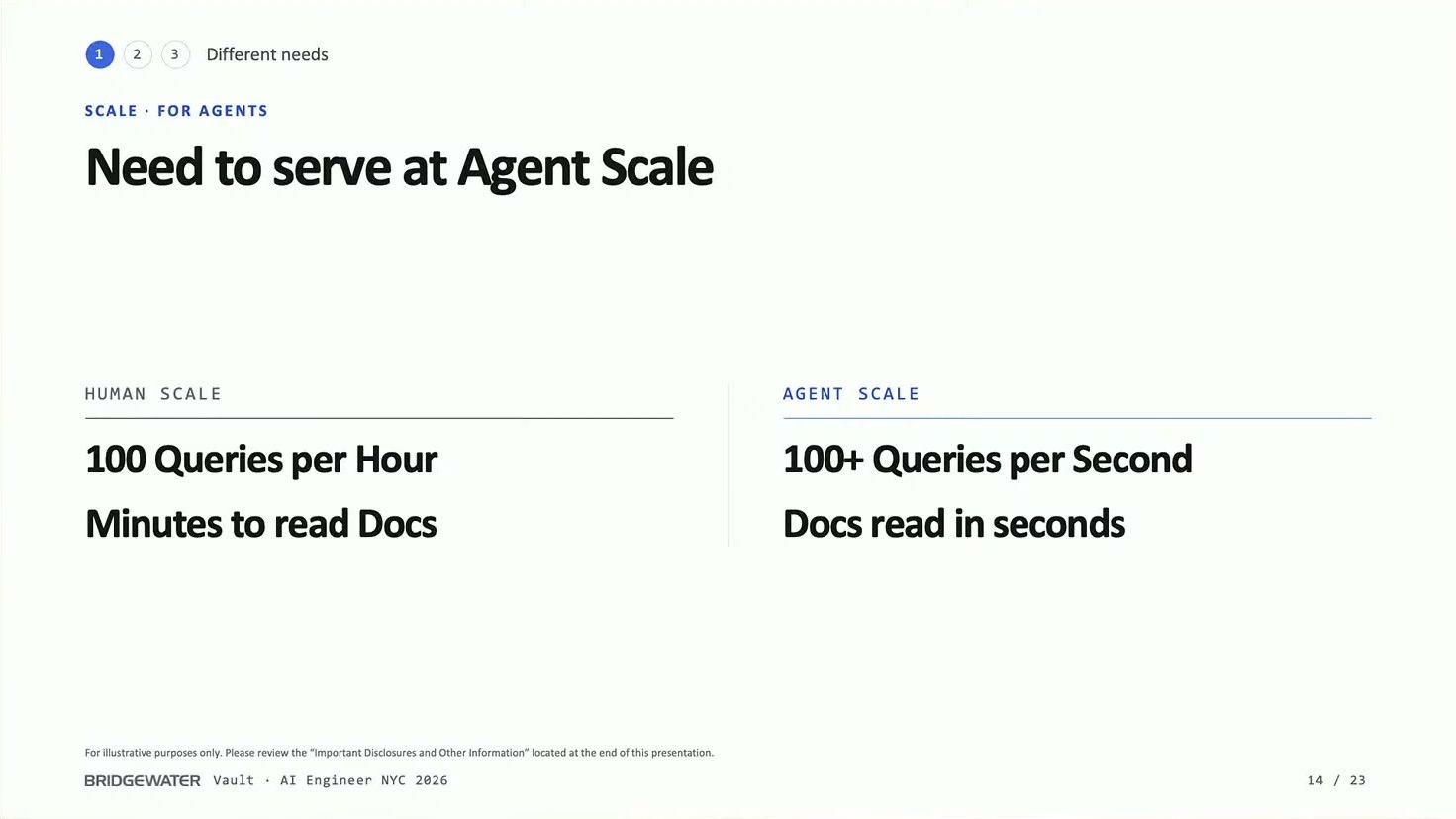
最后,我要讲讲规模。对我们来说,规模需求相当普通。每小时 100 次查询,我们有 300 名用户,他们偶尔会搜索一下。用户需要几分钟才能读完收到的文档。而智能体的需求要高出几个数量级。每秒轻轻松松就有 100 多次查询,智能体群组很容易就能达到数千次。而且显然,正如我之前说的,它们只需几秒钟就能读完文档。所以我们还需要一个能够扩展的平台。同样,turbopuffer 也轻松应对了这一点。
Lastly, I'm going to talk about scale. scale for us is pretty pedestrian. 100 queries an hour, we have 300 users, they're going to search every so often. It takes our users minutes to read the docs that they're receiving. Agents on the other hand are a few orders of magnitude beyond that. Easily 100 plus queries a second and agent swarms can hit thousands easily. And they obviously will read, as I said earlier, will read docs in seconds. So we needed something that could scale as well. And again, turbopuffer handled that easily too.
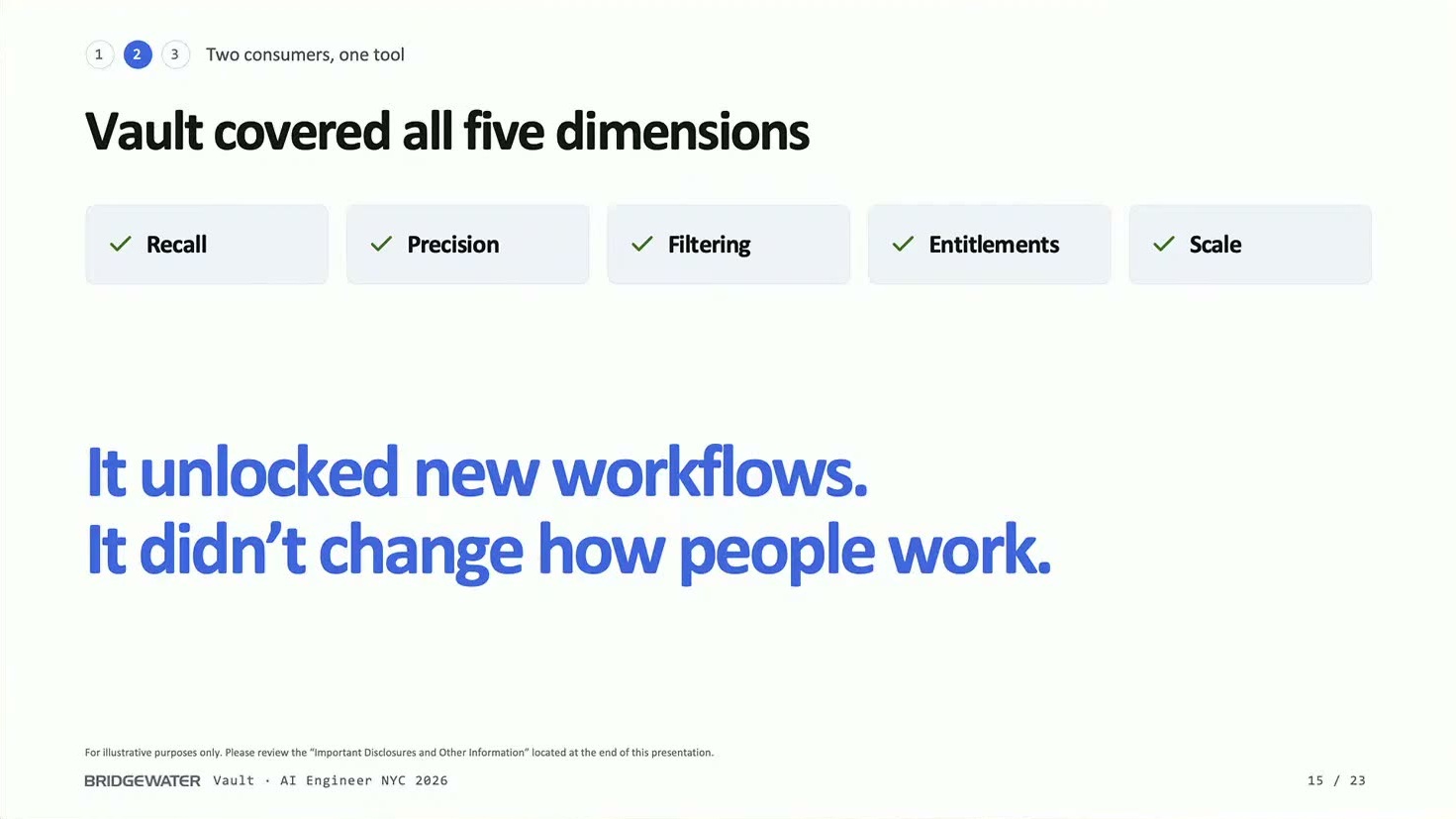
这样一来,五个维度我们都覆盖到了。我还没讲权限控制,不过今天晚些时候会谈到。但这五项我们全都覆盖了。它解锁了新的工作流程。但它没有改变研究人员的工作方式。他们还是不会每天早上都打开 Vault。
So we were covering all five dimensions. I didn't talk about entitlements, but I'll be talking about that later today. But we covered it all. It unlocked new workflows. But it didn't change how our researchers worked. They still weren't coming to Vault every morning.
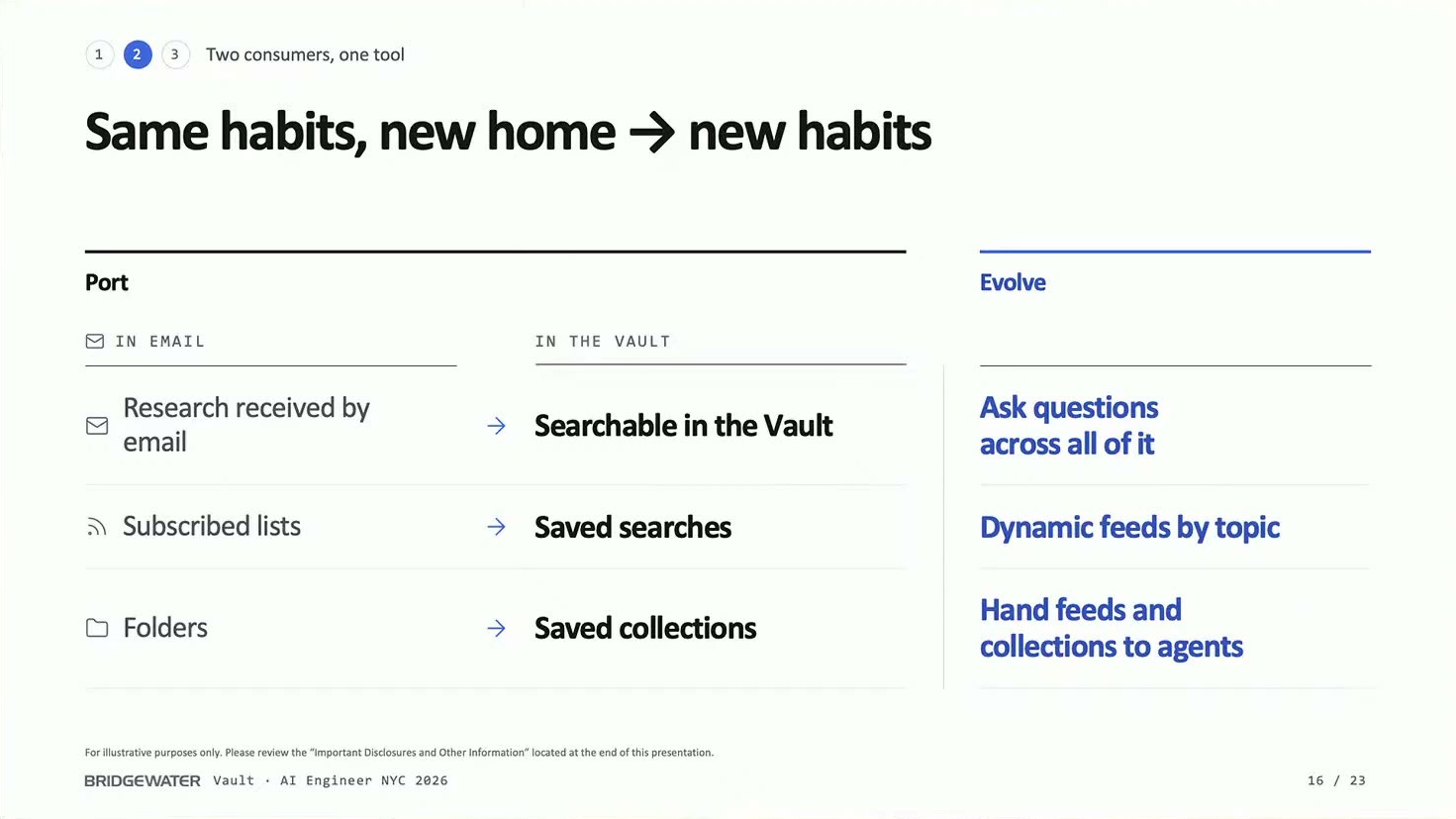
这是我想分享的第二条经验:无论工具有多么出色,我们不能只是把工具放到投资人员的桌面上,然后指望他们会用。我们需要把他们旧有的习惯迁移到新的形式中。于是我们观察他们原本在做什么。很多人整天都在用电子邮件。研究资料直接来自经纪商。他们订阅了邮件列表,还设置规则把所有内容筛选到不同文件夹里。这套方式行得通,也很熟悉,而且他们知道自己不会漏掉任何东西。所以我们必须把所有这些功能都做进 Vault。我们确实就是这么做的。
And that's my second lesson that I want to share here, is that no matter how amazing the tools are, we can't just drop them on our investors' desks. and expect them to be used. We need to migrate their old habits into a new form. And so we looked at what they were already doing. Many of them were living in email. The research came straight from the brokers. They had subscribed lists. They had rules that filtered everything into folders. It worked. It was familiar. And they knew that they weren't missing anything. So we had to build all of these features into the vault. That's exactly what we did.
所有内容都可以搜索,订阅列表变成了保存的搜索,文件夹则变成了保存的合集。习惯还是那些习惯,只是换了个新地方。等他们习惯在那里使用后,我们就可以开启新的习惯。比如像 Sam 展示的那样,针对所有数据提问。他们可以按主题关注动态信息流,还可以把这些合集交给智能体,让它们继续采取行动。就在那时,我们明确实现了产品市场契合。
Everything searchable, the subscribed lists became saved searches, and folders became saved collections. It's the same habits, just a new home. And once we had them there, we can open up new habits. So they can ask questions across all the data, as Sam showed. They can follow dynamic feeds by topic, and they can hand those collections over to their agents to take further action. And that's when we clearly had product market fit.
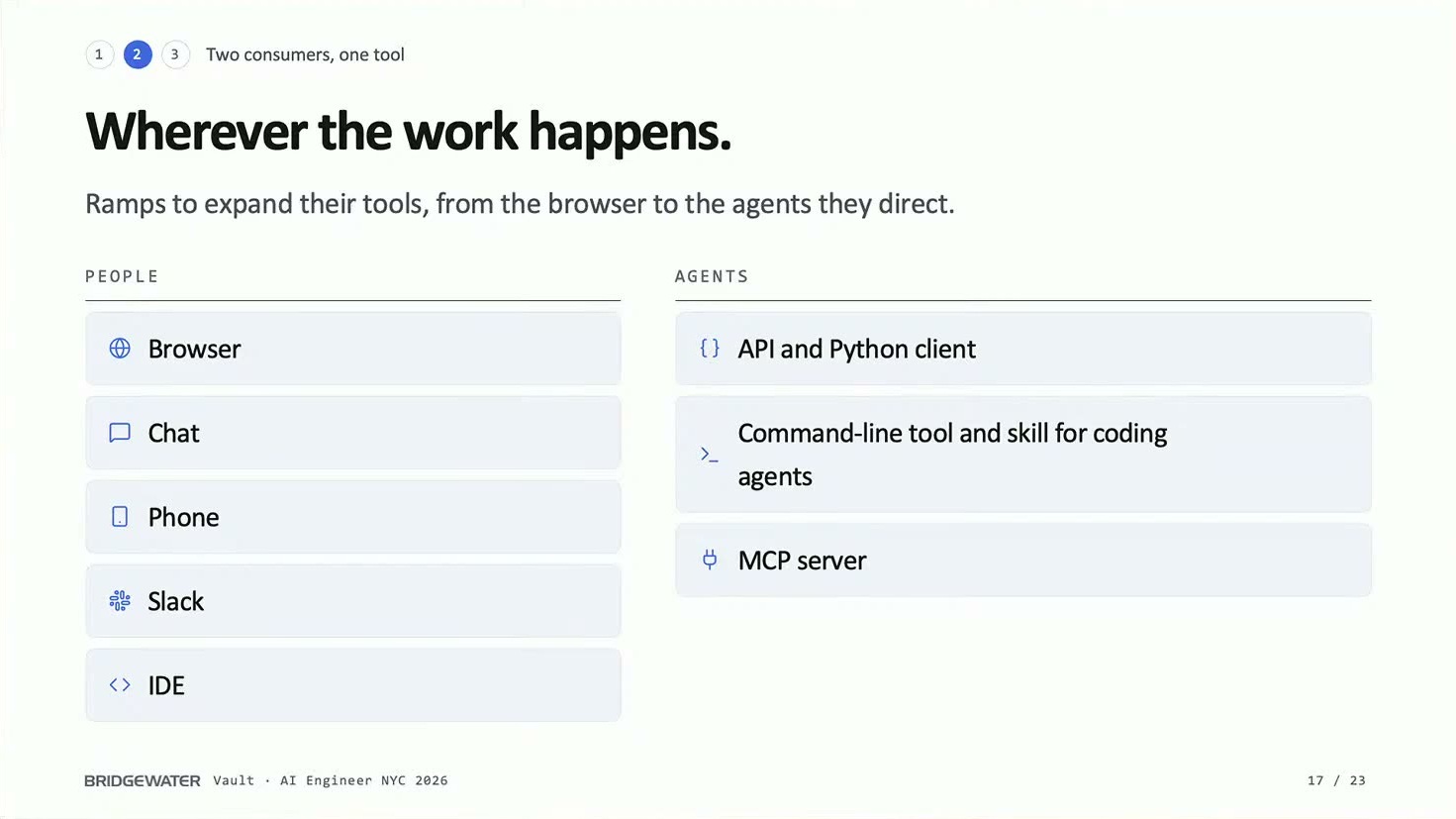
实现契合后,用户希望到处都能使用它,所以我们把它放进聊天工具,做了手机应用,也接入了 Slack 和他们的 IDE;当然,我们也把这些功能都提供给智能体,包括命令行界面,因为智能体很喜欢命令行界面。
And once we had that fit, the users wanted it everywhere, so we put it in chat, we made a phone app, it's in Slack in their IDE, and of course we availed all of that to the agents as well, including a CLI, because agents love CLIs.
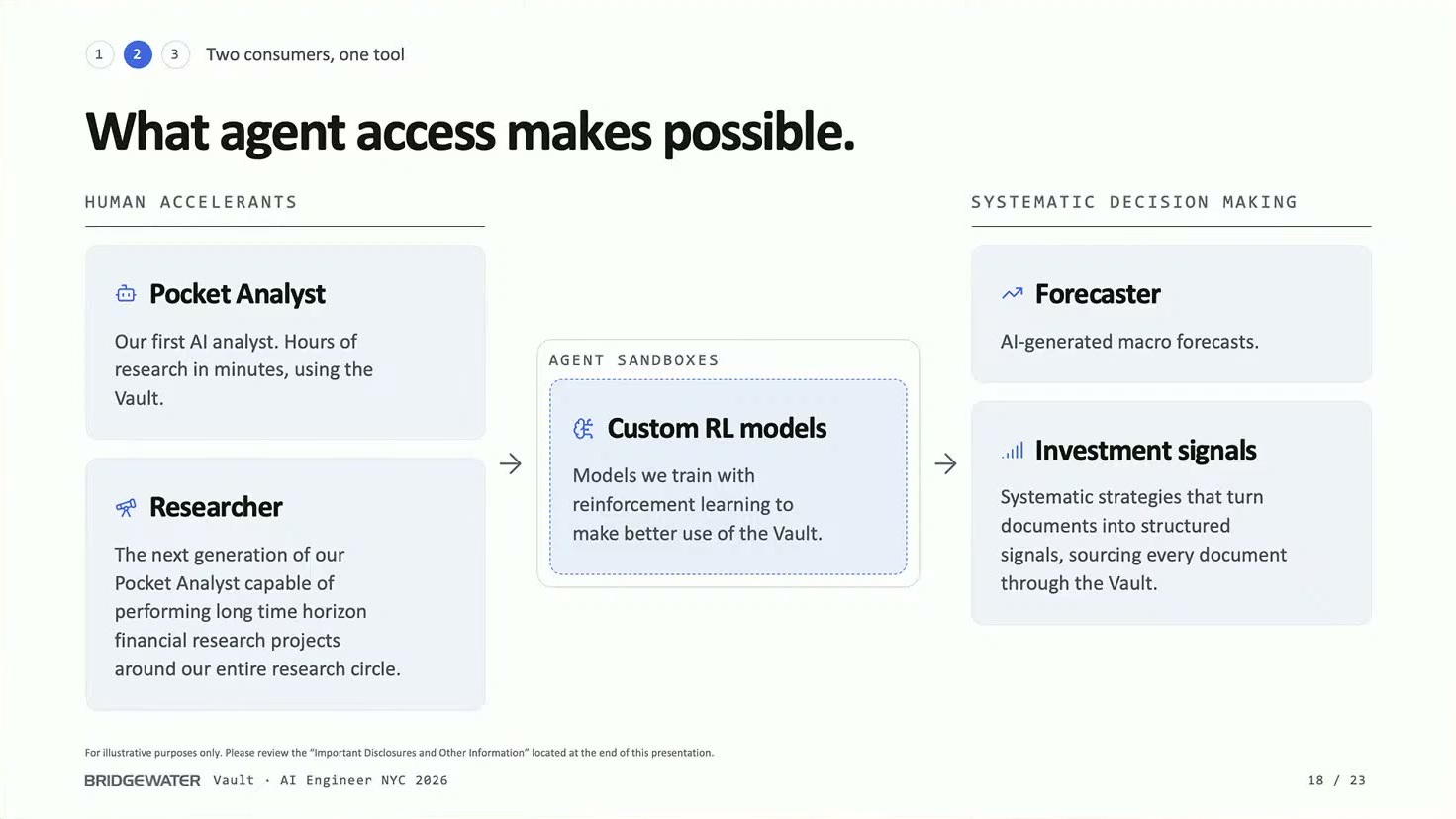
所以这里的主要问题是:好吧,这能带来什么?Sam 会谈谈我们现在正在构建的东西,不过首先,它在帮助我们更快地沿着研究循环前进。我们的随身分析师是第一个 AI 分析师;它依托 Vault,只需几分钟、花几美元,就能完成数小时的研究。现在我们又在此基础上扩展,打造下一代工具——研究员。理念相同,只是把时间跨度延长到几天或几周。我们还能够训练定制模型,让它们更智能地对 Vault 中的数据进行推理,并将这些模型与其他基础模型结合起来,为系统化决策流程提供支持。
And so the main question here is, okay, so what does this enable? Sam's going to talk about what we're building right now, but first and foremost, it's helping us to move around that research circle faster. With our pocket analyst, which is our first AI analyst, it can do hours of research in just a few minutes for a few dollars, and that's relying on the Vault. And then we're expanding that now with the researcher, which is the next generation. It's the same idea stretched across days or weeks. We're also able to train custom models to more intelligently reason over the Vault's data, and use those together with other foundation models to feed systematic decision-making processes.
Forecaster 是我们的第一个此类工具,它会生成由 AI 产出的、与宏观经济相关的预测。我们还基于 Vault 构建了投资信号,把非结构化数据转化为结构化、可交易的策略。现在我把时间交给 Sam,请他带大家了解 Vault 的最新能力。
The Forecaster is our first one, which produces AI-generated macro-relevant predictions. then we also have built investment signals from the Vault, turning unstructured data into structured, tradable strategies. Now I will hand it to Sam to take us through Vault's latest capability.
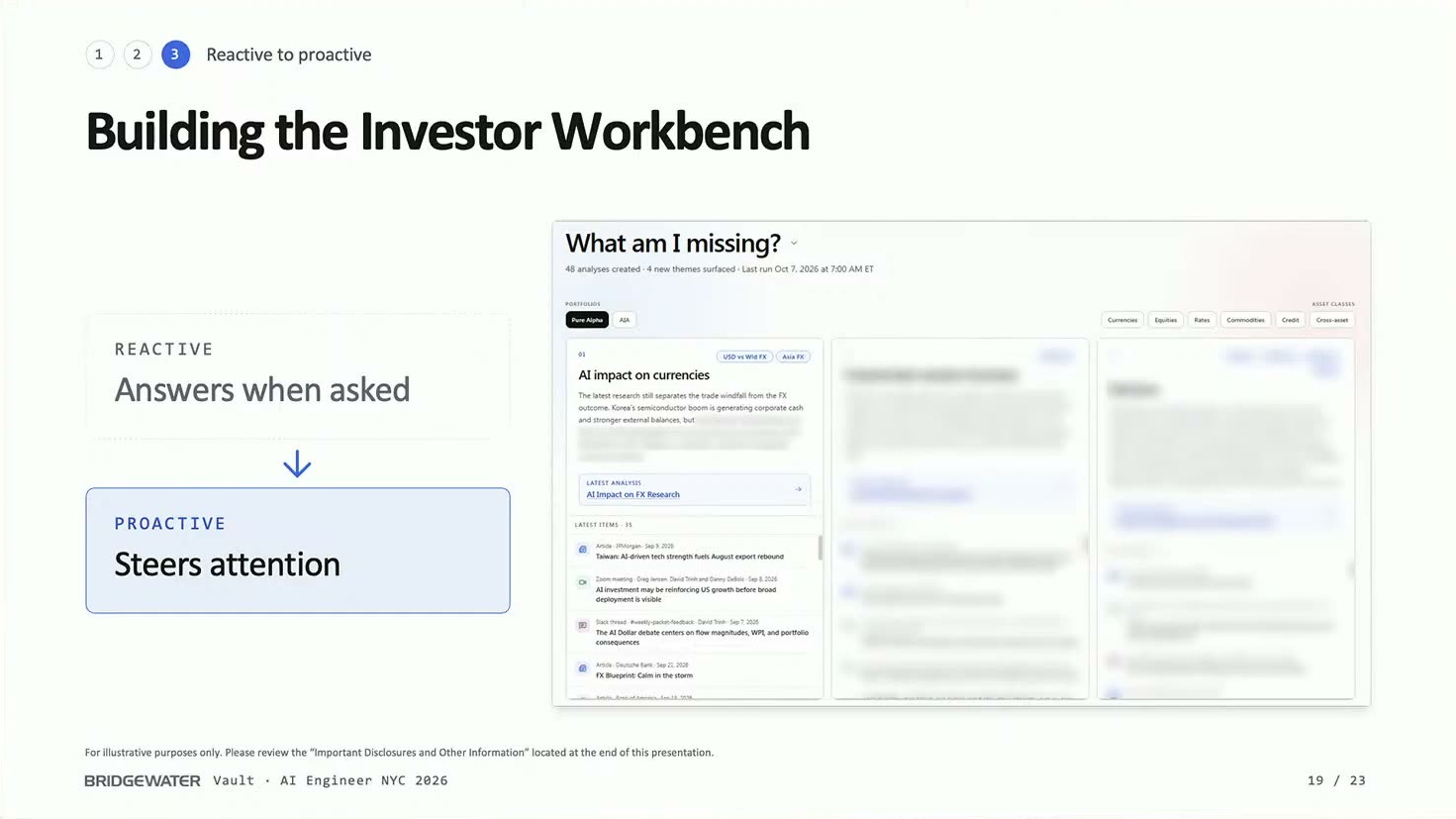
就像我在演讲开头提到的,真正的收获,是能够把智能体从一种被动资源——随时准备回答人的问题——转变为主动参与者,帮助引导高价值专业人士,把注意力放到最重要的领域。我们通过一种名为 Investor Workbench 的体验来解决这个问题,在其中,智能体始终在线,持续追踪对投资者重要的事情,并向他们呈现最需要他们关注的领域。这大概就是一种依托 Vault 的体验:系统提出一个主题,并向投资者展示若干条信息,让他们决定是否应该深入挖掘,还是完全忽略这个主题。
like I alluded to at the beginning of the talk, the real prize is when you can take agents from a reactive resource that can be ready to answer a human's question and instead make them proactive participants helping to steer your high value professionals towards the most important areas for their attention. The way we're solving that problem is in an experience we're calling the investor workbench, where the agent is always on, tracking what's important to that investor and presenting them with the areas that are most in need of their attention. looks like an experience like this that relies on the vault, where a topic is proposed and several pieces of information are presented to the investor to decide whether they should dig deeper or ignore that topic entirely.
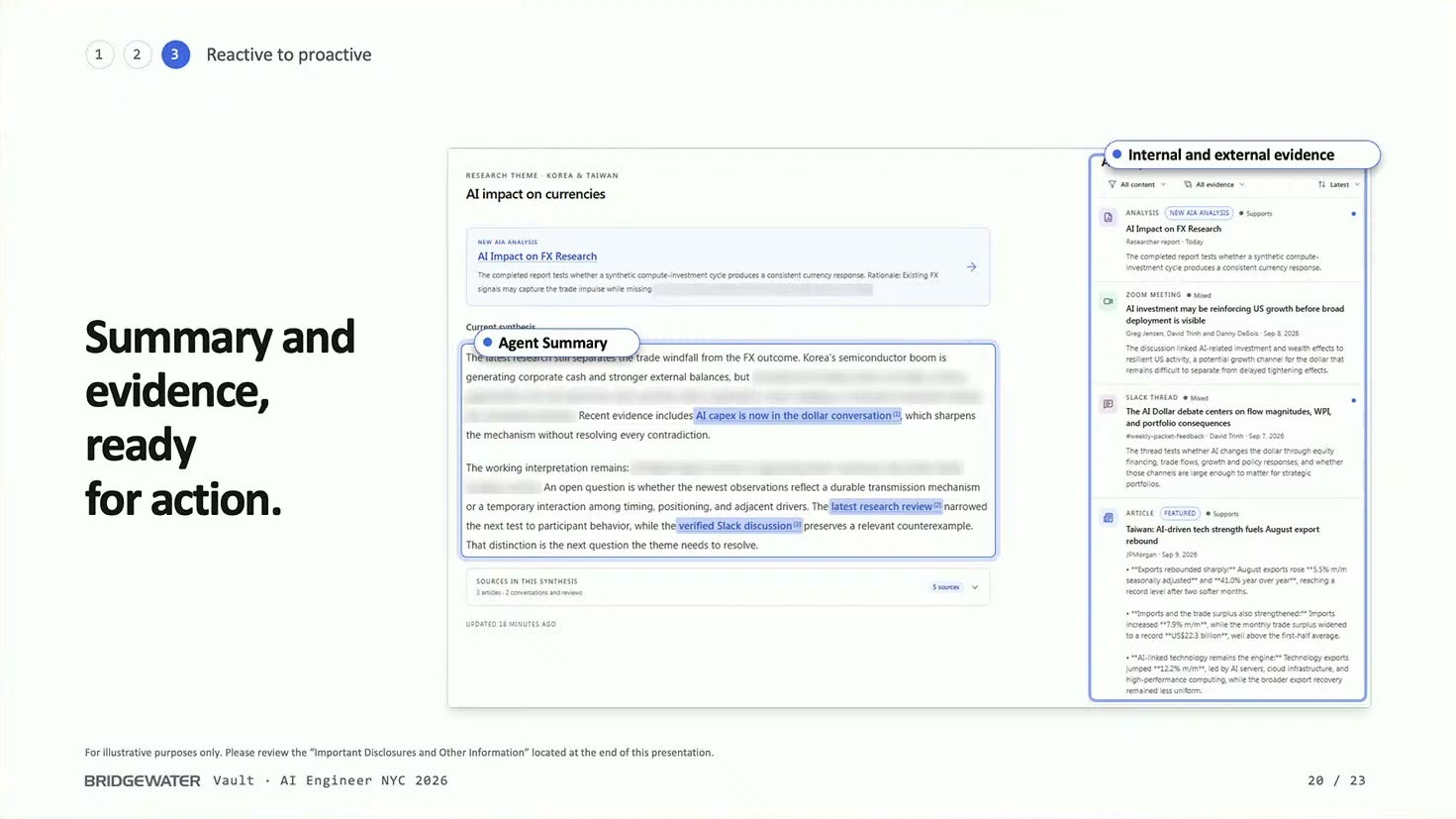
你们可以看到投资者看到的这张卡片,它帮助投资者决定是否进一步深入研究我们在演讲前面提过的同一个问题:AI 对货币的影响。投资者会收到所需的一切内容。他们可以查看智能体生成的摘要,快速浏览智能体的发现;他们也能看到智能体所依据的确切证据,亲自判断是什么促成了这条建议。
You can see here the card that an investor sees in order to decide whether to dig in deeper into the same AI impact on currencies question that we looked at earlier in the talk. And the investor receives everything they need. An agentic summary, if they want a quick scan across the agent's findings, they also get the exact evidence that the agent was drawing on, so they can assess for themselves what was leading to this recommendation.
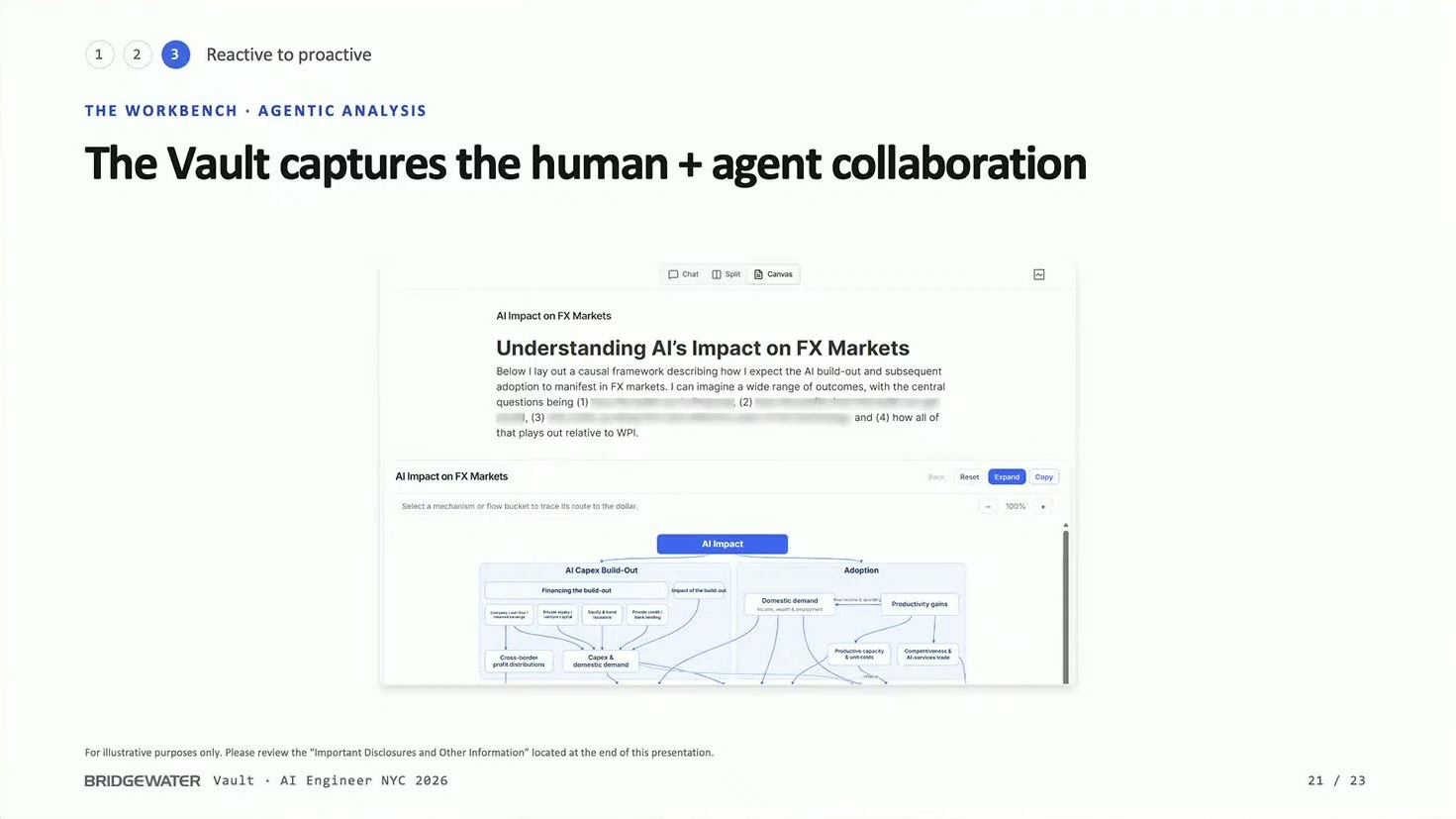
如果他们选择深入研究,就可以直接连接到研究输出,这些输出来自那些分析工具,正是 Aaron 刚才介绍的那些工具。当他们与智能体一起深入研究推动这个问题的各种动态时,新的认识会自动记录下来,他们合作的结果也会自动回存到 Vault。
And if they choose to dig deeper, they have a direct connection to the research output from the analytical tools that Aaron was just describing. And when they dig deeper alongside the agent to look at the dynamics driving this question, the learnings are automatically captured, the results of their collaboration are automatically captured back in the vault.
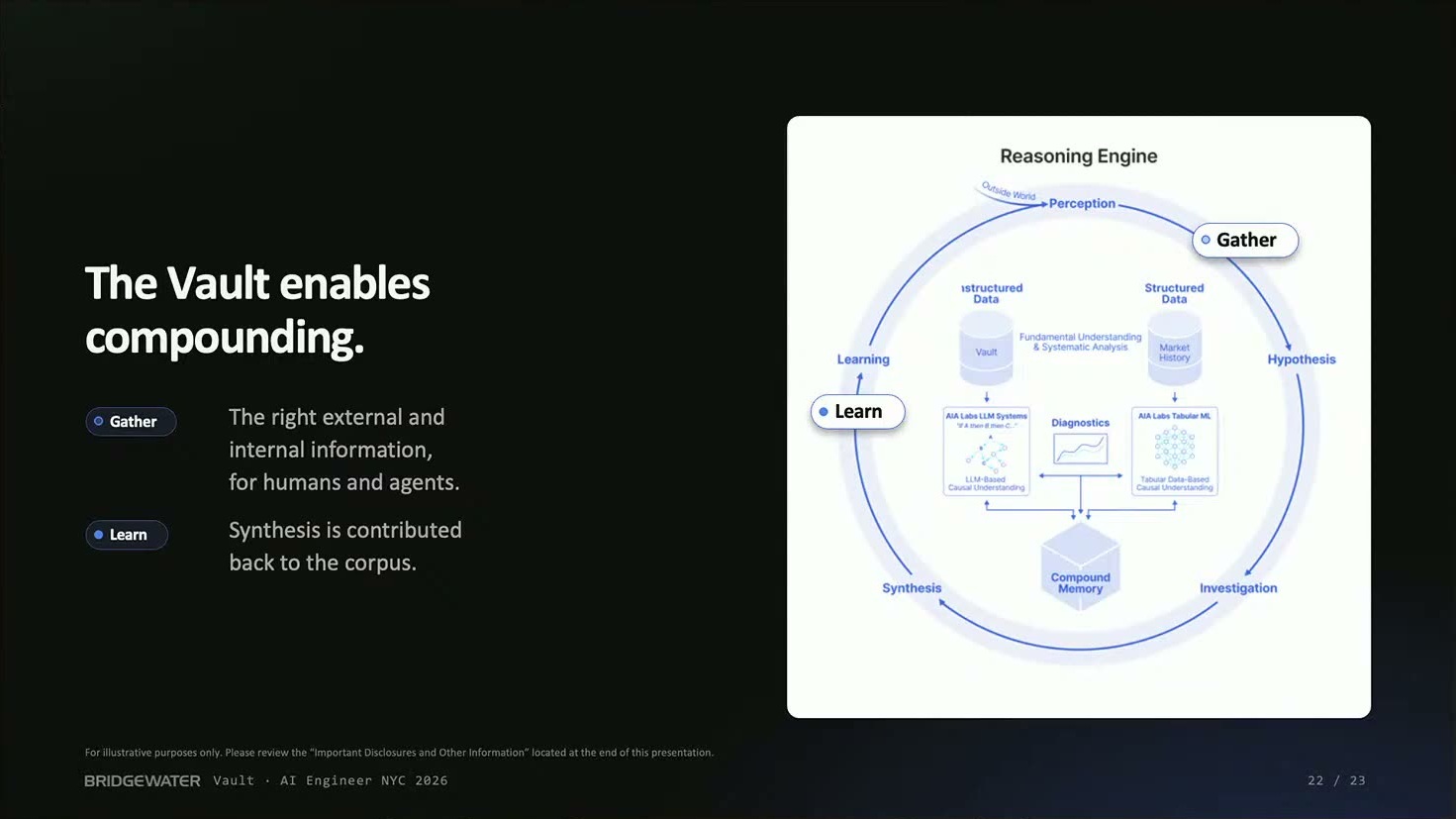
所以,对我们来说,这就是关键经验。Vault 让知识不断积累,因为它把恰当的证据、恰当的内部和外部信息送到投资人员和智能体手边,并且会自动收集他们形成的综合研判,再放回内容库,供下一轮使用。这样我们就能更快、更好地沿着这个循环前进。回想我们一开始提出的问题,要让智能体发挥作用,需要具备什么?答案是:要有恰当的上下文,并且了解你的世界里正在发生什么。我们想问大家:你们的 AI 知道这个世界正在发生什么吗?它记得你们公司从中学到了什么吗?
And so this for us is the key lesson. The vault enables compounding because it provides the right evidence, the right internal and external information at the fingertips of our investors and agents, and it automatically captures the synthesis that they generate and puts it back in the corpus for the next turn. And that makes us go around the circle faster and better. And so when we think back to the question we began with, what it takes to make an agent work is the right context and understanding of what's going on in your world. Our question for you is, does your AI know what's going on in the world and does it remember what your firm has learned about it?
因为我们也在教我们的 AI。如果你们觉得这是一项令人兴奋的挑战,我们很乐意交流。谢谢大家。
Because we are teaching ours too. And if these sound like an exciting challenge, we'd love to talk. Thank you.